Robert Eisner, 1997/05/23 Prosperity and Economic Policy (&1991)
https://love-and-theft-2014.blogspot.com/2023/01/httpseconomics.html
| ||||||||||||||||||||||||



https://twitter.com/stephaniekelton/status/1616447108579749888?s=61&t=s-XdyLnx6sFCTvgHIWBDxQ

| ||||||||||||||||||||||||
https://twitter.com/stephaniekelton/status/1616447117178073092?s=61&t=s-XdyLnx6sFCTvgHIWBDxQ

| ||||||||||||||||||||||||
https://twitter.com/stephaniekelton/status/1616447125797179392?s=61&t=s-XdyLnx6sFCTvgHIWBDxQ

| ||||||||||||||||||||||||
https://twitter.com/stephaniekelton/status/1616447130184335362?s=61&t=s-XdyLnx6sFCTvgHIWBDxQ

https://vdocuments.net/robert-eisners-save-social-security-from-its-saviors.html
| ||||||||||||||||||||||||
https://twitter.com/stephaniekelton/status/1616447132948660225?s=61&t=s-XdyLnx6sFCTvgHIWBDxQ
Save Social Security From its 'Saviors'
https://stephaniekelton.substack.com/p/save-social-security-from-its-saviors
ステファニー・ケルトン
ステファニー・ケルトン(StephanieKelton
ロバート・アイズナーが "Save Social Security from Its 'Saviors'"という名文を書いた理由がよくわかる例だ。1/x pic.twitter.com/t2kqjUCPwb
2023/01/20 23:46
https://twitter.com/stephaniekelton/status/1616447108579749888?s=61&t=s-XdyLnx6sFCTvgHIWBDxQ
ステファニー・ケルトン
ステファニー・ケルトン @StephanieKelton
アイズナー:"資金残高の非交渉型財務省債券にクレジットされる金利を決めたのは、神ではなく議会と財務省だった。" IOW、もっと「競争力のあるリターン」が欲しいなら、そうすればいい。政府系ファンドを🙄にするのである。2/ pic.twitter.com/EkVCV4pF1r
2023/01/20 23:46
https://twitter.com/stephaniekelton/status/1616447117178073092?s=61&t=s-XdyLnx6sFCTvgHIWBDxQ
ステファニー・ケルトン
ステファニー・ケルトン @StephanieKelton
しかし、アイズナーも書いているように、これは痛みのない会計上の修正の一つに過ぎない。もっと大きなポイントは、そもそも支払能力の問題がないということです 3/ pic.twitter.com/Kob1U4TgbJ
2023/01/20 23:46
https://twitter.com/stephaniekelton/status/1616447125797179392?s=61&t=s-XdyLnx6sFCTvgHIWBDxQ
ステファニー・ケルトン
ステファニー・ケルトン(StephanieKelton
自分のために、アイズナーの記事を読んでみてください。4/
vdocuments.net/robert-eisners...
2023/01/20 23:46
https://twitter.com/stephaniekelton/status/1616447130184335362?s=61&t=s-XdyLnx6sFCTvgHIWBDxQ
https://vdocuments.net/robert-eisners-save-social-security-from-its-saviors.html
ステファニー・ケルトン
ステファニー・ケルトン(StephanieKelton
そして、その重要性が再び高まることを見越して、昨年の夏に書いたいくつかの作品へのリンクはこちらです。5/5
stephaniekelton.substack.com/p/save-social-...
2023/01/20 23:46
~~~
Wikimedia Commons/Hudson Institute, Flickr/Gage SkidmoreHudson Institute
Sens. Bill Cassidy, R-La., and Angus King, I-Maine, are drafting
legislation to ensure the solvency of Social Security that might involve
the creation of a sovereign wealth fund, Semafor has learned from three
people familiar with the efforts.
It reflects the growing momentum to address the future of entitlement
programs, particularly as a showdown over the debt ceiling looms in the
summer. The bill would be kept separate from that battle. Both King and
Cassidy were part of a bipartisan Senate gang that eventually passed an
infrastructure law in the Senate in summer 2021.
One option under discussion would see the federal government create a
new fund with borrowed money, which it would invest in stocks to cover
future retirement benefits. That maneuver is designed to cash in on the
higher returns that equities usually earn compared to the Treasury bonds
that Social Security's current trust fund invests in. The people briefed on
the proposal's details cautioned that it may or may not end up in the final
bill.
ーーーーー
If we want Social Security to share in whatever earnings investors
are receiving, why not award balances in the Trust funds, instead of
the current 5.9 percent interest rate on long-term government bonds,
the higher returns that might be earned in equity investment? Barry
Anderson, as indicated above of the Office of Management and
Budget, has calculated that crediting the balances with a 10.4 percent
interest rate, which is close to the long-run return on stocks, would
keep the funds in balance indefinitely, on the basis even of those
pessimistic "intermediate" projections. This would again be merely
a matter of accounting, with no real effect on the measured budget
deficit, the federal debt held by the public, or the economy. But it
would solve that presumed problem of a future shortage in the Trust
funds. Then, if we really cared about the welfare of Social Security
contributors, we would increase their benefits to match these higher
earnings.
ーーーーー
The notion that Social Security faces bankruptcy begins with a funda-
mental misconception, that payment of benefits somehow depends upon
the OASDI (Old Age and Survivors and Disability Insurance) trust
funds. The trust funds are merely accounting entities. Our payroll taxes
6
6 Barry Anderson, the top civil servant in the White House's Office of Management
Budget, who has just retired after twenty-seven years of service, writes me, "You are
absolutely correct on this point," and adds, "very few if any of the academics or ana-
lysts who comment on Social Security have the guts (or perhaps knowledge) to recog-
nize this fundamental fact."
SAVE SOCIAL SECURITY FROM ITS SAVIORS 81
or "contributions" go directly to the United States Treasury. Our benefit
checks come from the Treasury and those receiving them can verify
on those checks that the payer is the Treasury of the United States, and
not any trust fund.
Social Security payments are an obligation under law of the U.S.
government. Our government and its Treasury will not, indeed cannot,
go bankrupt. As Federal Reserve Chairman Alan Greenspan has re-
cently put it, "[A] government cannot become insolvent with respect to
obligations in its own currency."
997
ーーーー
Expenditures alleged to be related to trust funds are often less than their
income witness the highway and airport funds as well Social Security.
There is no particular reason they cannot be more. The accountants can
just as well declare the bottom line of the funds' accounts negative as
positive and the Treasury can go on making whatever outlays are pre-
scribed by law. The Treasury can pay out all that Social Security provides
while the accountants declare the funds more and more in the red.
For those concerned, nevertheless, about the "solvency" of the trust
funds, there are simple, painless remedies for this accounting problem.
Wikimedia Commons/Hudson Institute, Flickr/Gage SkidmoreHudson Institute Bill Cassidy
上院議員(共和党)とAngus King上院議員(共和党)が、社会保障制度の支払能力を確保するための法案を起草中で、政府系ファンドの設立を伴う可能性があると、この取り組みに詳しい3人からSemaforが聞き出した。これは、特に夏に債務上限をめぐる対決が迫っていることから、社会保障制度の将来に対処しようという機運が高まっていることを反映したものである。この法案は、その戦いとは切り離されることになる。キングとキャシディの両氏は、最終的に2021年夏に上院でインフラ法を可決した超党派の一団に加わっていた。議論されている選択肢の1つは、連邦政府が借り入れ金で新しい基金を創設し、それを株式に投資して将来の退職金を賄うというものだ。これは、現在の社会保障基金が投資している国債に比べ、株式は通常高いリターンを得られるため、これを利用しようというものだ。この提案の詳細について説明を受けた人々は、この案が最終的な法案に含まれるかどうかは分からないと注意を促した。
ーーーー
投資家が受け取る利益を社会保障で共有したいならば、長期国債に対する現在の金利5.行政管理予算局のバリー・アンダーソン氏は、悲観的な「中間」予測にもとづいて、株式の長期リターンに近い10.4%の金利を残高に付与すれば、基金の残高を無期限に維持できると算出している。これもまた会計上の問題に過ぎず、財政赤字の測定値や国民が抱える連邦債務、あるいは経済には何の影響も与えない。しかし、信託基金が将来不足するという想定される問題は解決される。そして、もし我々が社会保障の加入者の福祉を本当に心配しているのであれば、この高い収入に見合うように彼らの給付を増やすだろう。
ーーーー
社会保障が破綻に直面しているという考え方は、給付金の支払いがOASDI(老齢・遺族・障害保険)信託基金に依存しているという基本的な誤解から始まっている。信託基金は単なる会計上の存在に過ぎない。ホワイトハウスの行政予算局のトップであったバリー・アンダーソン氏は、27年間勤めた後退職したばかりだが、「この点に関しては全く正しい」と私に書き、さらに「社会保障についてコメントする学者やアナリストの中には、この基本的事実を認識する度胸(あるいは知識)がある者は、いたとしてもごくわずかだ」とも付け加えている。SAVE SOCIAL SECURITY FROM ITS SAVIORS 81または "貢献 "は、直接米国財務省に行く。私たちの給付金の小切手は財務省から送られてくるので、受け取った人はその小切手から、支払人が信託基金ではなく、米国財務省であることを確認することができます。社会保障の支払いは、米国政府の法律上の義務である。米国政府とその財務省が破産することはない、いや、ありえない。グリーンスパン連邦準備制度理事会会長が最近述べたように、「政府は自国通貨建ての債務に関して支払不能になることはない」のである。997
ーーーー
信託基金に関連するとされる支出は、社会保障だけでなく高速道路や空港の基金も含めて、その収入より少ないことが多い。それ以上であってはならない特別な理由はない。会計士は基金の収支をマイナスにすることも、プラスにすることもできるし、財務省は法律で定められた支出を続けることができる。会計士が赤字だと宣言している間にも、財務省は社会保障費をすべて支払うことができる。それでも信託基金の「支払い能力」を心配する人たちには、この会計上の問題に対する簡単で痛くない解決法がある。
★
https://stephaniekelton.substack.com/p/save-social-security-from-its-saviors
Save Social Security From its 'Saviors'
Stephanie Kelton Jul 3, 2022 43 26
Lately, I’ve been writing about Social Security (here and here). With everything else that’s’ commanding our attention at the moment, it’s not a topic that feels particularly urgent. It soon will.
The debates have already started, and I expect them to heat up after the midterms. Just think back to what happened after the midterm shellacking in 2010, when a newly-emboldened group of republicans lawmakers joined forces with a group of so-called “moderate democrats” to push for cuts to Social Security as part of a “Grand Bargain.”
Of course, no one ever comes right out and says they want to CUT Social Security. That would be political suicide. Instead, lawmakers—democrats and republicans—describe their positions as well-intentioned and grounded in the harsh reality of budgetary math. They want to SAVE Social Security.
Robert Eisner, who spent most of his career as a professor of economics at Northwestern University, was onto this charade.
In 1998, Eisner published an article called “Save Social Security from its ‘Saviors’.” I strongly encourage you to read the entire thing.
In addition to that article, Eisner wrote a number of books and op-edsabout Social Security. He was frustrated by the policy debates, which he saw as entirely misguided. Here’s the closing sentence from an op-ed he published in The Wall Street Journal in 1997.
Politicians and pundits should stop playing games with a confused public, and focus on total spending and total taxes, how they affect the economy, who gains and who loses.
If you go on to read the article I recommended, you’ll see that Eisner echos this little-known fact made by MMTers like Warren Mosler.
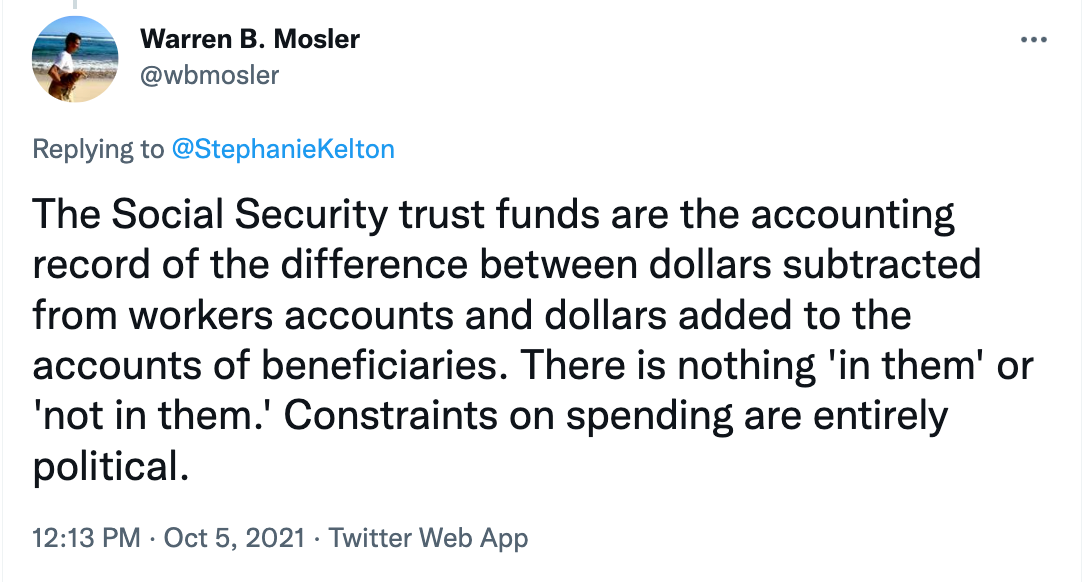
Eisner’s main message was that the obsession with Social Security’s Trust Funds (OASI and DI) is a distraction. To borrow a phrase from Gertrude Stein, “There is no there there.” The trust funds exist merely as accounting entities. We don’t need them to carry a positive balance—or any balance whatsoever—in order to preserve Social Security for future generations. Here’s Eisner:
Expenditures alleged to be related to trust funds are often less than their income—witness the highway and airport funds as well [as] Social Security. There is no particular reason they cannot be more. The accountants can just as well declare the bottom line of the funds’ accounts negative as positive—and the Treasury can go on making whatever outlays are prescribed by law. The Treasury can pay out all that Social Security provides while the accountants declare the funds more and more in the red.
The only conceivable problem, as I explained last week, is with the way the enacting legislation was written.
Congress could “fix” Social Security simply by amending that legislation to grant the Old-Age and Survivor’s Insurance (OASI) and Disability Insurance (DI) programs the same federal backstopping that already guarantees program solvency for the Supplemental Medical Insurance (SMI) Trust Fund.If for some reason we choose to perpetuate the myth that the trust fund balances are vital to the program’s “solvency,” Eisner had this to say:
For those concerned, nevertheless, about the ‘solvency’ of the trust funds, there are simple, painless remedies for this accounting problem.
What he strongly opposed were the kinds of “remedies” that are often proposed in the name of “saving” Social Security—means-testing, raising the retirement age, reducing cost-of-living adjustments, diverting payroll contributions into privatized accounts, etc.
The proposed nibbling away of Social Security, including that by some of its presumed friends, is disingenuous and misleading. Even some of its defenders seem all too ready to accept ‘minor’ cuts in benefits to achieve prospective fund balance.
Eisner might have tweaked an old adage, “With saviors like these, who needs executioners?”
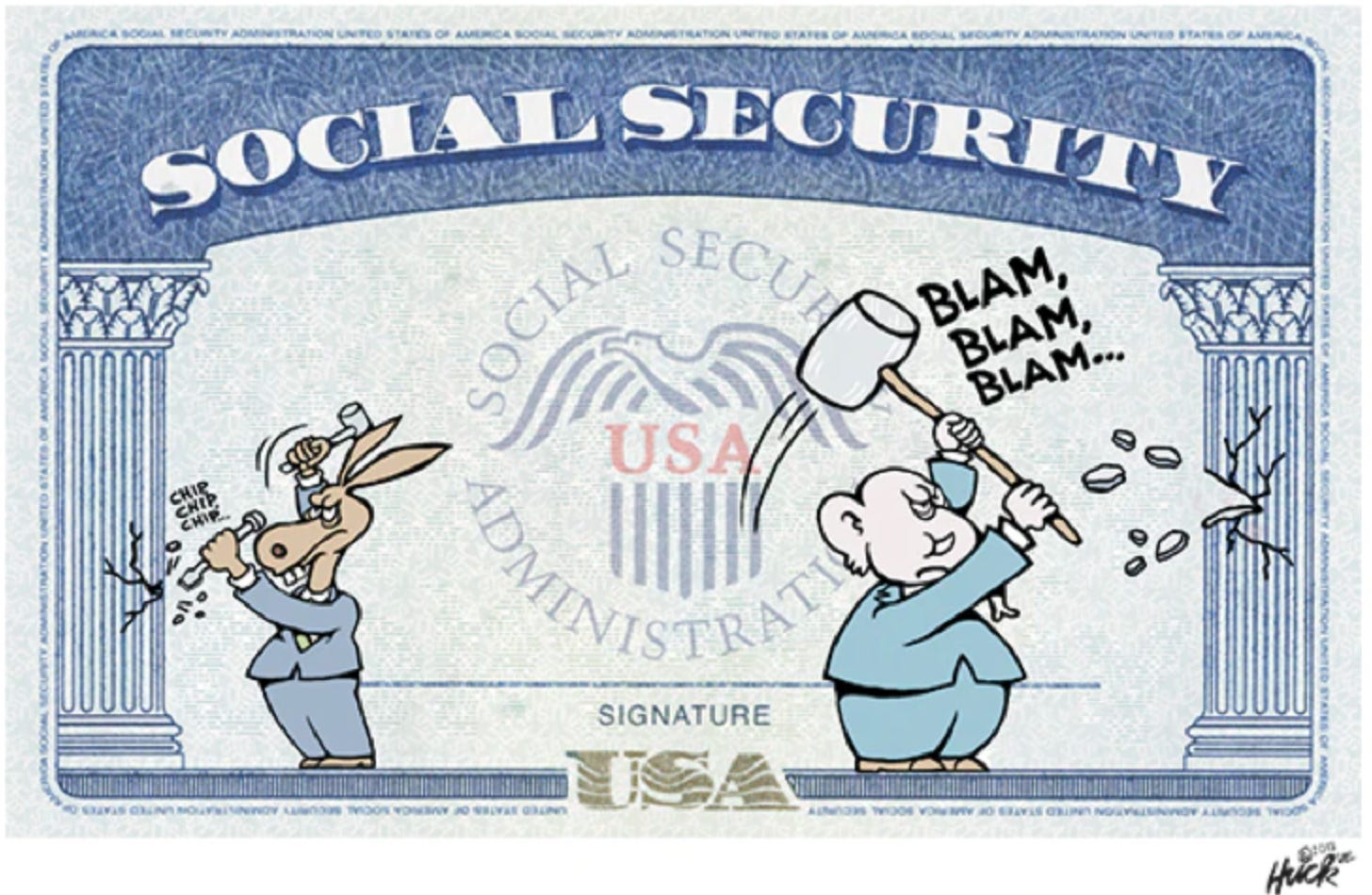
Under current law, OASI, DI, and HI are authorized to pay statutory benefits—i.e. what beneficiaries are entitled to under the law—only if there are adequate financial resources to cover those obligations.

0 件のコメント:
コメントを投稿