If you’re like me, once or twice in your life you have jolted awake from the edge of sleep wondering, How exactly does the government pay for the military? As we all know, the military is an expensive endeavor. In 2019, its budget was $716 billion, an increase of $80 billion over the previous year. Does the Department of Defense have a bank account with that $716 billion in it? If they do, who puts money in it, and where does that money come from? Who exactly will pay Raytheon for that sexy new air-to-air Peregrine missile? And where did that $80 billion come from? New taxes? In 2018? I thought that the only major legislative victory of the Trump administration was a tax cut.
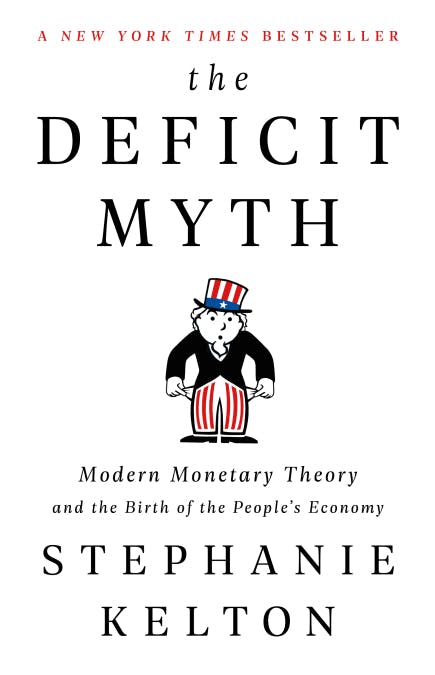
The Deficit Myth: Modern Monetary Theory and the Birth of the People’s Economy
To find the answers, the economist Stephanie Kelton tells us in The Deficit Myth that we only need to look at congressional proceedings. For any government expenditure that isn’t automatic (like interest expenses or welfare programs), the House and Senate debate and then pass bills that require spending. For example, in 2017 the Senate happily voted 89–9 to pass a 1,215-page bill called the National Defense Authorization Act. It authorized $737 billion in spending. Once this bill passed, the Department of Defense could enter into contracts with weapons manufacturers like Raytheon. As soon as the ink dries, the U.S. Treasury instructs its bank, the Federal Reserve, to go into its computers and mark up Raytheon’s bank account. Money enters its account and it begins paying its workers, suppliers, and its CEO Thomas Kennedy’s $1 million salary.
The important thing here is that the Federal Reserve does not dip its hand into a pot of “tax dollars” to pay military contractors, nor is it required to check some mythical account where tax dollars live before it wires the money. In fact, that account doesn’t exist. As former Federal Reserve Chairman Ben Bernanke once noted, when the government pays for things, it is “not taxpayer money. We simply use the computer to mark up the size of the account.” Alan Greenspan, Bernanke’s libertarian predecessor at the Fed further clarified, “There’s nothing to prevent the federal government from creating as much money as it wants and paying it to someone.” The implication is that if Congress can pass a bill that requires some form of spending, the Federal Reserve can and will spend that money without limit, as is the case with the military. This directly contradicts ideas about government money espoused by leading politicians. The most prominent example was in 2009, when a C-SPAN host asked President Barack Obama, “At one point do we run out of money?” to which he responded, “Well, we are out of money now.” These statements are mutually exclusive; only one can prevail. So who is right?
The idea that the U.S. government can’t run out of money is the bedrock of an idea that Kelton is on the vanguard of promoting: Modern Monetary Theory. As the name implies, MMT is a set of newish ideas that maddeningly reopen a question that you’d think only a novice stoner or seven-year-old would dare ask: Where does money come from, and what does it do? MMT argues that money is a legal and political construct and that limits to government spending are not monetary and only mildly economic; they are primarily political. “MMT clarifies what is economically possible,” Kelton writes, “and thus shifts the terrain of policy debates that get hamstrung over questions of financial feasibility.” The book combats the limiting myths of economic reality, including the pervasive idea of a tax-funded federal government that can or can’t “afford” things.
In the early 1990s, MMT sprang partially formed from the mind of the hedge fund investor Warren Mosler. Mosler noticed that while politicians were concerned over deficit spending and raising tax dollars to pay for their initiatives, when you observed how the Treasury, Federal Reserve, and Congress actually worked, this was inaccurate. Taxes were useful for many things: They constrain spending to keep inflation in check, they guide citizens toward economic activities that the government wants to promote, they make the currency valuable by creating demand for it, and they create norms for encouraging or discouraging certain behavior. But they don’t raise money. When you pay your taxes, the Treasury just goes into your bank account and deletes the numbers from your digital balance.
As Zach Helfand notes in a profile of Kelton in the New Yorker, Mosler then peddled his theory in search of an audience. In 1993, he won over a then-private-sector Donald Rumsfeld in a steam room. Rumsfeld in turn introduced Mosler to Arthur Laffer, the conservative economist who devised the specious trickle-down theory of economics that has justified every major regressive corporate tax cut for the last 40 years.
Kelton skeptically encountered Mosler’s ideas on internet forums in the mid-1990s while studying at Cambridge University. She was soon convinced and published a paper in 1998 that became a foundational text for the field (provocatively titled in accordance with Betteridge’s law of headlines: “Can Taxes and Bonds Finance Government Spending?”). She took a teaching position at the MMT hotbed of University of Missouri Kansas City, and in time was consulting with politicians. In 2014, Senator Bernie Sanders appointed her as his chief economist for the Senate Budget Committee, an experience she draws on heavily in her book. Kelton was also an economic adviser to his 2016 presidential run.
As the title of her book suggests, Kelton sets out to dispel a number of myths about how the economy works, how the federal deficit works, and where money comes from. At the center of the story is the role of the taxpayer. “The taxpayer, according to the conventional view,” Kelton writes, “is at the center of the monetary universe because of the belief that the government has no money of its own.” This idea has been repeated so often that it comes off as common sense. Today, there is almost no part of the political spectrum that doesn’t employ its usage. Both sides gripe about their tax dollars paying for something they don’t approve of, whether it is the imperialist network of 800 U.S. military bases around the world or supposedly lavish lifestyles of welfare cheats. Even Bernie Sanders uses it when he purposes that a financial transaction tax will pay for free public colleges. When the House debates proposed legislation, Speaker Nancy Pelosi insists on enforcing the arbitrary PAYGO rule, which demands that new expenditures are balanced by new tax income. The Senate has a similar self-imposed constraint called the Byrd rule, and the so-called “debt ceiling” limits government spending in the same way.
The first problem with this is that, as Kelton writes, “in practice, the federal government almost never collects enough taxes to offset all of its spending.” The second, as noted in the introduction, is that—also in practice—tax income often doesn’t factor into the actual act of spending. And worse, it’s easy for politicians to game the system. Kelton reports that there are professors for hire, like University of Texas law professor Calvin Johnson, who have a litany of ready-made tax revenue schemes for lawmakers to shove into their bills. But if it’s all a sham, how did the tax-funding imperative emerge, and why does it persist?
The centrality of the taxpayer emerged sometime in the 1970s, likely after the establishment of the Senate Budget Committee and the Congressional Budget Office in 1974. It came to its full expression when Margaret Thatcher declared in 1983 that “the state has no source of money, other than the money people earn themselves. If the state wishes to spend more it can only do so by borrowing your savings or by taxing you more.” But didn’t the money come from the government in the first place? MMT says that Thatcher has it backward: The government spends money into the society and then taxes some of it back. Every dollar that is not taxed back is a person’s profit. “The government doesn’t need our money.” Kelton writes, “We need their money.” Intuitively, this seems true. Hard currency in the United States declares it is “Federal Reserve Note.” It’s the government’s money.
If this is true, we need a better understanding of how money gets into society. From a distance you might assume that there is one way—the Treasury printing money—when in fact currency enters society chaotically, from multiple possible vectors. One method is that the U.S. Mint prints paper dollars and coins and then sells them to the Federal Reserve, which then distributes them to banks. But most money is not distributed in hard currency. The Federal Reserve is in charge of adjusting interest rates and private banks’ “reserves,” which theoretically determines how much money they can carry. Then the banks lend that money out to their customers, often by adjusting their customers’ bank balance. In this case, the private bank has just conjured money out of thin air. The Federal Reserve also buys Treasury bonds, which Kelton asserts are like a special version of the U.S. dollar that pays a little interest. All of these banking activities are thought of as monetary policy.
The other way that money is created is not through banks but through fiscal policy, of which military spending and welfare programs are prime examples. When the Federal Reserve marks up a defense contractor’s bank account, here too money originates. Whenever the government directly spends somewhere, money is created. But if money is being created by a variegated, largely uncoordinated bizarre range of actors, what is the limit? The constraint, MMTers argue, is that if too much money enters the system, it can cause inflation. This erodes the value of the currency. Understood this way, MMT argues the limit to government spending is not the amount it brings back in tax dollars, but the amount of inflation that the spending incurs.
The problem, for Kelton, is that since the 1980s we have over-relied on monetary policy (that is, Federal Reserve and Treasury actions) to originate, control, and disburse the money supply. We depend almost entirely on the Federal Reserve’s interest rate tweaks to get money into society, but the Federal Reserve really only opens and closes the spigot on credit, which privileges banks and large corporations that fund themselves primarily through certain types of credit. As we have seen during the recent ongoing economic crisis, the Federal Reserve does not and cannot directly intervene in specific areas that need help, such as for instance restaurants or black and brown communities that have been historically denied access to credit and resources. A fiscal method of controlling inflation and dealing with a crisis would be to enact wage controls, welfare spending, or possibly a jobs guarantee. This might remind you of New Deal programs, and for good reason. That was a time when the government stimulated the economy by giving people jobs and paying them money directly, instead of just expanding credit. The federal government created Social Security, an infusion of government money into the hands of retired citizens. As Kelton notes, all of these successful programs of fiscal spending, including the passage of Medicare, were signed into law with almost no awareness of what they would actually cost. The concerns of justice easily overrode petty questions of governmental deficits, and in the face of crisis, the threat of inflation was low.
Today, the threat of inflation is once again extremely low, even prior to the current economic catastrophe. Inflation since the Great Recession has barely crawled up to the Fed’s desirable goal of 2 percent. The truth is that we are further than ever from an activist government that engages in direct fiscal policy to make sure money and resources are distributed in a just way. The government could be regularly handing out money to people with no ill effects, and yet it almost always refuses to do so. (Except, of course, in the case of the paltry $1,200 checks the Treasury cut.) Furthermore, when it comes to averting disaster for working people and changing society, monetary policy has proven itself to be a limited tool. In response to the coronavirus pandemic, the Federal Reserve had engaged in the extreme limits of monetary policy by lowering interest rates to zero, buying and guaranteeing corporate debt, and in some cases lending money directly to some big businesses. Yet unemployment still exploded, and civil unrest seethes.
MMT argues that money is not an abstraction but a method for facilitating the distribution of real resources. Inflation occurs when too much money is chasing actually scarce resources. If, say, home health care workers were all paid $10 million a year, this would probably make the prices of homes explode. This wouldn’t be good. We should aim to have home health care workers paid as much as possible without raising inflation. Maybe this could be done through wage control, or maybe by limiting the prices of houses, or by placing a high tax on incomes to limit spending. But what the specific policy is, and at what level, is hard to say. It behooves us as a society to debate and figure that out. This is to say that MMT refocuses our attention away from budget squabbles in Congress and back to the real question for any government with complete control over its own currency: How do we best distribute the real resources of a society?
When you consider governing from an MMT lens, you have to consider different questions. Is there enough insulin in the world for every diabetic? Do we have enough concrete and steel to build permanently cheap public housing? Enough asphalt to fix our roads? Enough hospitals to treat the sick? In a wealthy country like the United States, the answer is observably yes. Kelton writes that, “MMT teaches us that if we have the real resources we need … then the money can always be made available.” The taxpayer myth and deficit fears are convenient fables that allow politicians to do nothing about rampant poverty, crumbling infrastructure, or a debt-crushed working class. “If they couldn’t hide behind the deficit myth,” Kelton writes, “what excuse would they use to justify withholding support? It helps to have a bad cop.” (It should be noted that states and cities, because they do not issue their own currency and are often legally mandated to balance their budgets, are technically dependent on tax income to balance their budgets. But federal aid, upon which they all rely, is, in MMT’s lens, limited only by inflation.)
The irony of this conclusion is that it reveals MMT to be an economic theory that demotes economics, from being a field that dictates how, why, and when resources are distributed, to one that is more janitorial; one that is useful primarily to monitor inflation and interest rates. It puts politics back on the steering wheel, theoretically democratizing economic decisions. This is, of course, a dangerous proposition. As we have seen, MMT is already practiced by warmongering politicians who see no problem with unlimited military spending.
But if MMT is a dangerous proposition, it is because democracy itself is a dangerous proposition. That’s why it is inaccurate to describe it as a lefty economic theory, as much of the media does. At best, it reinvigorates some basic functions of the democratic process and provides tools to engage in mortal combat with deficit hawks like Mitch McConnell and Nancy Pelosi. It can’t prescribe change in a particular partisan direction (though Kelton, a liberal, provides a few ideas of her own in the final chapter, like a federal jobs guarantee). MMT is simply a different way to describe the basic mechanisms of how money functions.
“The problem we have today,” Kelton writes, “is that economic policy is often prescribed by people who, despite holding advanced degrees in economics, possess no real understanding of how our monetary system works.” The idea is that a basic understanding of how money works, of MMT precepts, could empower any citizen to fight for a better world. But this will only happen once we reconcile what the country is capable of and what the people are willing to do. “Austerity,” Kelton writes, “is a failure of imagination.” So what kind of society do we want to imagine, if we unshackle ourselves from the language of taxpayer-funded, deficit-diminishing government? Are we willing to stop shoveling resources into the military (and its domestic paramilitary offshoot, police departments) and start diverting them to working-class communities? If everyone deserves to be safe, housed, and prosperous, let’s instruct the Federal Reserve to start marking up some different accounts.
A national debt if it is not excessive will be to us a national blessing; it will be powerfull cement of our union. It will also create a necessity for keeping up taxation to a degree which without being oppressive, will be a spur to industry; remote as we are from Europe and shall be from danger, it were otherwise to be feard our popular maxims would incline us to too great parsimony and indulgence. We labour less now than any civilized nation of Europe, and a habit of labour in the people is as essential to the health and vigor of their minds and bodies as it is conducive to the welfare of the State. We ought not to Suffer our self-love to deceive us in a comparrison, upon these points.
I have spun out this letter to a much greater lenght than I intended. To develope the whole connection of my ideas on the subject and place my plan in the clearest light I have indulged myself in many observations which might have been omitted. I shall not longer intrude upon you[r] patience than to assure you of the sincere sentiments of esteem with which I have the honor to be Sir Your most Obedient and humble servant
HAMILTON: …If we assume the debts, the Union gets a new line of credit, a financial diuretic. How do you not get it? If we’re aggressive and competitive. The union gets a boost. You’d rather give it a sedative?
Voice of the Voiceless - Hip Hopの和訳: 26 - Cabinet Battle #1 和訳
1798年、ナポレオン・ボナパルトの革命フランスとの戦争という危機の到来のなかで、常備陸軍の創設と強力な海軍力(フリゲート12隻)建設に国論をまとめたのもハミルトンであった。このときの7本の論考が『見解 (The Stand)、1798年3~4月』である。そして、ハミルトンは、陸軍大将で総司令官のワシントンに次ぐ、陸軍少将となった。なお、この本格的な米仏全面戦争は、ナポレオンの譲歩で回避された。また、この『見解』で、革命フランスが狂ったイデオロギー信条に基づく侵略の野望を持ち剣でドグマを強制せんとしていると、エドマンド・バークと同様の評価をフランス革命に対して示した。
At a time when we despair of balancing even a single year's budget, Hamilton's Blessing provides much needed perspective - and hope. * Author writes the "Business of America" column in American Heritage magazine and is heard often on public ...
In his tax proposals Hamilton revealed his political philosophy so nakedly as almost to prove his undoing. His doctrine of the blessing of a national debt smacked rather too strongly of English Toryism for the American stomach. A national debt, if it be not excessive, will be to us a national blessing. It will be a powerful cement ...
Alexander Hamilton said, “A national debt, if it is not excessive, will be to us a national blessing.” He believed it was a necessary way for the young country to compete and become powerful. When is a budget deficit too large, however, and when does national debt become excessive? Today, the United States' national debt ...
A NATIONAL DEBT A NATIONAL BLESSING. From a Letter to Robert Morris, 30 April, 1781. A National debt, if it is not excessive, will be to us a national blessing. — See Vol. IV., Page 1 12, of this Work. Alexander Hamilton. 1757-1804.
Edmund Clarence Stedman, Mrs. Ellen Mackay Hutchinson - 1890 - 読む - 他の版
Mr. President, in 1781 Alexander Hamilton, a conservative in his time, said that “a national debt, if it is not excessive, will be to us a national blessing.” Deficit spending has been, as Hamilton So wisely said it could be, a national blessing. Without deficit spending—by both Government and industry—our country could never ...
Two quotations from founding fathers encapsulate the life of America's first national debt. Alexander Hamilton argued that “a national debt, if it is not excessive, will be to us a national blessing. It will be a powerful cement to our union.” Thomas ...
22 Necessary and Optimum Government Debt The national debt, if it is not excessive, will be to us a national blessing. Alexander Hamilton, in a letter to Robert Morris, April 30, 1781. Government Debts as Private Assets Alexander Hamilton may not have had the benefit of modern macroeconomic analysis, but his instincts ...
Hamilton knew debt could have a tremendous impact on the government. He wrote in 1781 that “a national debt, if it is not excessive, will be to us a national blessing.” The United States needed a line of credit, and a modest national debt (not the trillion dollar variety of the modern federal government) would provide a solid ...
A national debt, if it is not excessive, will be to us a national blessing. —Alexander Hamilton Our one and only exemplar from the “sometimes it's okay” camp is Jon Hanson's Good Debt, Bad Debt—Knowing the Difference Can Save Your Financial Life (New York: Portfolio/Penguin, 2005). “Debt is like cholesterol,” the dust ...
6 Ben S. Bernanke, "National and Regional Economic Overview," Charlotte Chamber of Commerce, Charlotte, North Carolina, November 29, 2007. Z lbid. 6 lbid. 6 lbid. ... 5 Jon Dougherty, "Is the United States Flat-Out Broke?"Wor/d ... M "A national debt, if it is not excessive, will be to us a national blessing."— Alexander ...