News flash: The U.S. is one of only two countries that still has a debt limit — and @StephanieKelton says it's time that number changed to one: "This thing serves no useful purpose whatsoever."
— The Mehdi Hasan Show (@MehdiHasanShow) January 12, 2023
Catch her full conversation with @mehdirhasan on @MSNBConPeacock. pic.twitter.com/jM41ZLG28B
| ||||||||||||||||||||||||



| ||||||||||||||||||||||||


| ||||||||||||||||||||||||
https://stephaniekelton.substack.com/p/what-every-american-needs-to-know-a35
What Every American Needs to Know About the Congressional "Pay-For" Game (Part 2)
Why It's a Swing and a Miss For Me
Last week, I wrote about America’s favorite pastime. Baseball, of course. The purpose of the post was to expose the Congressional “pay-for” game for what it really is—political theatre masquerading as sound finance.
I’ve been writing and speaking out about this for more than two decades, and it looks like the message is finally beginning to break through. But we have a long way to go.
The Rich Will “Pay For” It
By now, everyone knows that the Senate passed a bipartisan infrastructure bill, and that it is working on a so-called “soft” infrastructure package that could result in the passage of a $3.5 trillion reconciliation bill in the coming months. My previous post explained how the bipartisan deal was accomplished by calling a “rain delay” on the whole “pay-for” game. Now, everyone is watching to see whether—and how—the next package will be “paid for.”
Within the halls of Congress, this is mostly a numbers-on-paper game. Outside the beltway, it’s more about messaging those numbers. Think “how” versus “who.”
“How will you pay for it?” is the numbers game. This is where lawmakers try to stitch up the legislation so that they come as close as possible—on paper—to being able to claim that they’re not adding to the deficit so the spending is “paid for.” Almost no one on the outside cares how Congress finesses the numbers to play the “pay-for” game. What most people care about is what it means for them. “Who will pay for it?” is the bigger concern for most Americans.
Democrats have settled on an answer to that question. The rich will pay for it.
Following the Biden administration’s lead, Democrats are working to craft legislation that they can message as “fiscally responsible” while allowing the president to keep his promise to the American people.
“So, here’s what I’d do. I start with one rule: No one — let me say it again — no one making under $400,000 will see their federal taxes go up. Period.”
The man who will ultimately stitch up the numbers on the reconciliation package is Senate Budget Committee Chairman, Bernie Sanders (I-VT). In addition to using the media and the press to build support for the $3.5 trillion package, Sanders, a tireless crusader for the working class (and against the “billionaire class”), has taken his case directly to the people of Indiana and Iowa.
The message is simple: It’s time for large, profitable corporations and the richest people in America to pay higher taxes so that everyone else can have a better life.
Many of the lawmakers I have talked with over the years like this messaging. It’s easy to see why. It’s compact enough to fit in a TV sound-bite. And, it answers the inevitable “How will you pay for it?” question in a way that appears both fiscally responsible and morally righteous. Those who have avoided paying their “fair share” of taxes should pony up for the sake of the greater good.
It’s messaging that resonates with the most progressive members of congress. For example, here’s a tweet from Congresswoman Pramila Jayapal (WA-07), Chair of the Congressional Progressive Caucus:
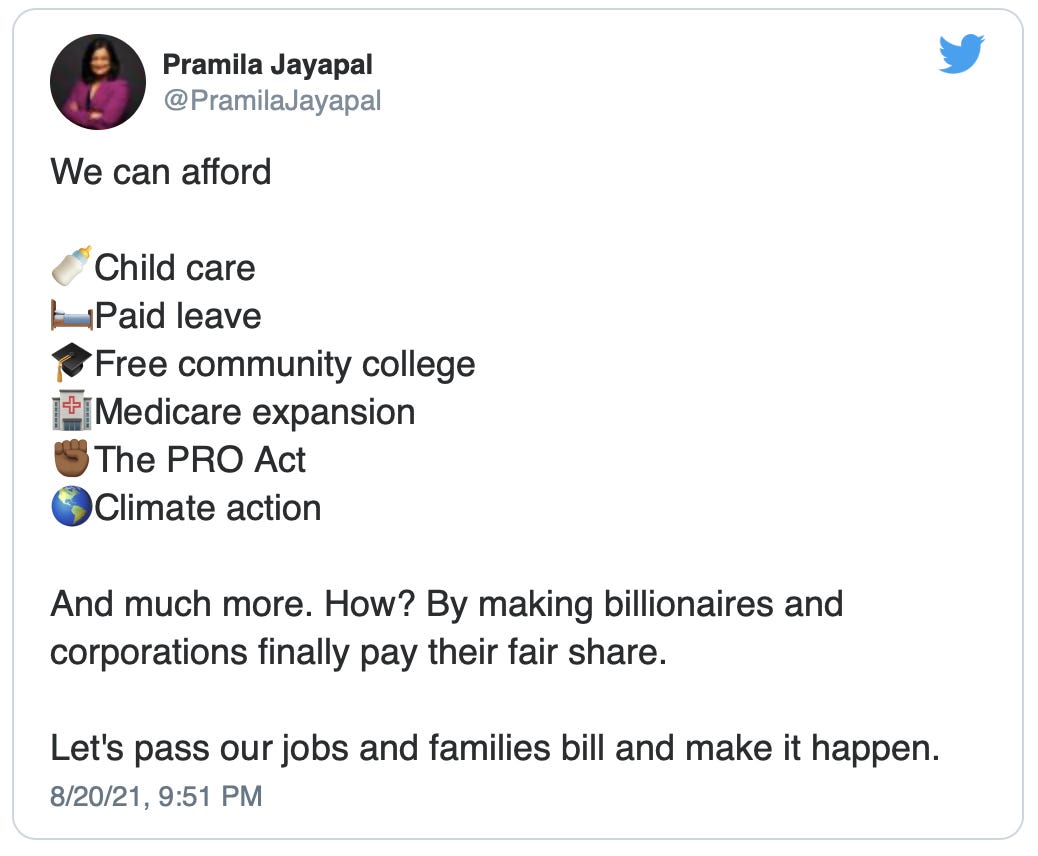
That’s a pretty simple pitch. Let’s build a better society and get the rich to pay for it.
This newsletter is called The Lens for a reason. My research and policy analysis is grounded in a macro framework known as MMT or Modern Monetary Theory. MMT is the lens through which I analyze the macro economy and evaluate economic policy. Please bear that in mind as you read on.
The “Two Itch” Problem
So what happens when we look at the “pay for” debate through an MMT lens?
Peering through the MMT lens, we understand that the federal government—as the issuer of the currency—never needs to raise taxes or borrow from anyone in order to finance its spending. Moreover, the money we send to the IRS in payment of taxes each year isn’t actually used to pay foranything.
It’s true that there is a ledger entry to account for the funds the Treasury collects over time, but the federal government isn’t actually using “taxpayer dollars” to pay for anything.Think about it like this. Delta Airlines issues #SkyMiles, which can be redeemed for air travel by returning them to their issuer. Each day, Delta redeems lots of #SkyMiles. And, throughout the year, Delta awards #SkyMiles to millions of people. These things happen independent of one another. To issue #SkyMiles, more points get typed into a #SkyMiles account. To redeem #SkyMiles, points are deleted from a passenger’s account. Delta doesn’t hold any #SkyMiles in a vault, and it doesn’t use the old miles to issue new ones. It’s just a ledger system, where the issuer keeps one set of entries to keep track of how many new miles are issued and another to record how many old miles are redeemed.
The same thing happens when the federal government spends and redeems its currency in payment of taxes. (The US dollar functions as a tax credit. See here for further reading.) But that’s not what the “pay for” proponents would have us believe.
What we’re hearing is that Democrats are going to tax the rich and use the money to pay for more resilient infrastructure, more affordable housing, better health care, some free college, and much more. Instead of trickle-down, think shifting-down. By shifting money out of the bank accounts of the fat cats on top and into the bank accounts of those below, Democrats promise a world in which we can afford to feed a hungry kid, expand Medicare, and tackle our climate crisis.
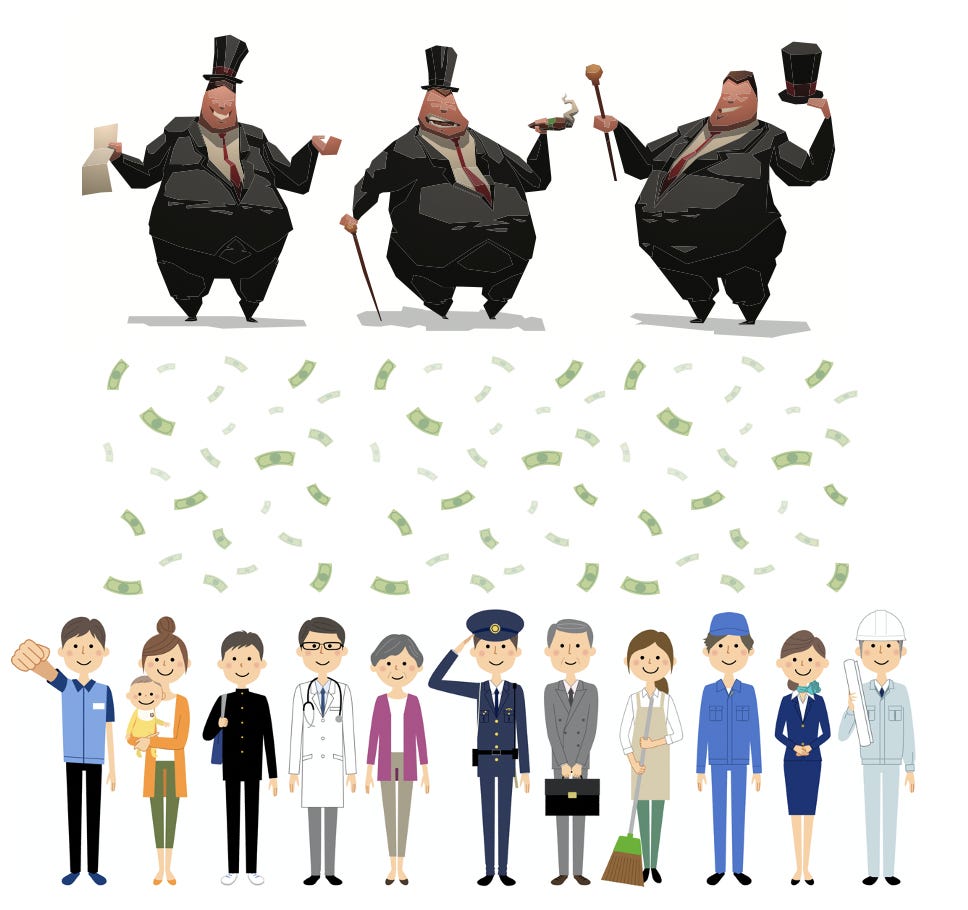
For some Democrats, this looks like a win-win. They get to scratch two itches at once. Soak the rich and build an economy that works for the working class. Robin Hood to the rescue!

So, what’s wrong with that? What am I, some kind of stalking horse for the rich? Shilling MMT to protect the fat cats from paying higher taxes? Hardly.
But I do have a number of problems with the “pay for” game and how it’s being played. Not because I’m opposed to raising taxes on the rich—my keynote at the inaugural conference of the Patriotic Millionaires makes that clear at 2:22:30—but because I filter everything through an MMT lens.
Here’s what I see as the most problematic aspects of the “pay for” game.
It perpetuates the household budgeting fallacy
It makes it harder to do good things
It centers the rich in our collective well-being
It ignores inflation risk
First, and fundamental to MMT, the federal government is the issuer of the currency, and the rest of us are mere mortal currency users. Government budgets don’t work like household budgets. Mapping out a plan to scrape together the revenue to “pay-for” the reconciliation package reinforces a flawed household budgeting narrative. Here I am with Warren Mosler, explaining this almost a decade ago.
Second, if Democrats dig in and commit to fully “paying for” the reconciliation package, they will have to pick—and win—two fights within their own caucus. Not only will they need to hold the entire caucus together around the $3.5 trillion itself, but they’ll need unanimous support for the slew of “pay fors” to keep it all deficit neutral. If we’re being honest, there just isn’t a hearty, party-wide appetite for a wealth tax, raising the corporate income tax rate to 28 percent, or taxing capital gains as ordinary income. Even allowing Medicare to negotiate prescription drug prices might prove too heavy a “pay for” lift for certain Democrats. If that’s the case, then Democrats will have to decide whether they’re willing to do “soft” infrastructure the same way the Senate agreed to do “hard” infrastructure earlier this month, namely by shrugging off the pay-fors and allowing some of the spending to fall onto the deficit.
I’m all for watching lawmakers work to make the tax code more fair, but I’d hate to see the the Democrats start paring back a spending package to “fit” whatever price tag they consider “affordable” given the “revenue” they think they have to work with.Third, and this relates to #2, I have a big problem with centering the rich in this way:
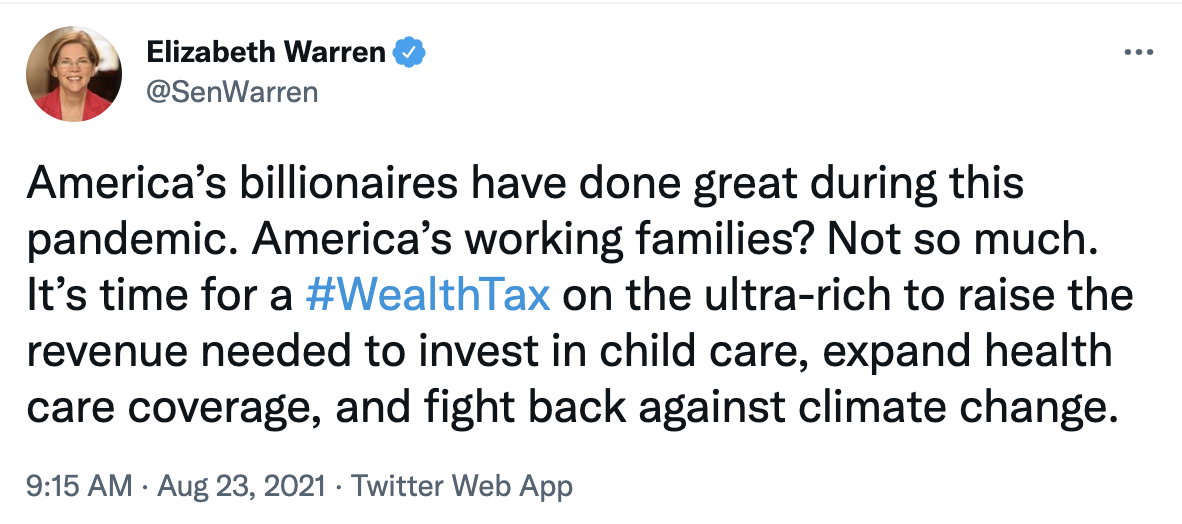
Instead of just building a clean case for a wealth tax, it gets stitched up with the proposed spending so that the means justify the ends. So it becomes an if-then problem. If we can successfully wrest a few trillion from the fat cats at the top of the income distribution, then we can scatter some support down to the rest of our people and our planet. If we can’t get 50 votes to raise trillions to offset the spending, then I guess it’s tough luck for all of those families who were just lifted out of poverty with the stroke of a (deficit spending) pen. No food or shelter for the poor, no care for the elderly, and no action on the climate front. We can’t do it without the rich! They are our “pay-fors.” We need them.
Here’s how I put it when Anand Girihardadas, asked me whether I consider this messaging a problem:
“In addition to getting the economics wrong, I believe it is politically harmful to pretend that we cannot afford to fix our crumbling infrastructure, or care for our people, unless and until we successfully wrest part of Jeff Bezos’ fortune away from him.
And here’s how I put it in The Deficit Myth:
THE CRIME OF the tax bill signed by President Trump in 2017 is not that it added to the deficit but that it used the deficit to provide help to those who needed it least. It has widened inequality, putting more political and economic power into the hands of the few. MMT understands that building a better economy isn’t contingent on raising enough revenue to pay for the things we want. We can, and must, tax the rich. But not because we can’t afford to do anything without them. We should tax billionaires to rebalance the distribution of wealth and income and to protect the health of our democracy. But we don’t need to crack open their piggy banks to eradicate poverty or to have the federal job guarantee with a living wage that Coretta Scott King fought for. We already have the tools we need. Feigning dependence on those with incredible wealth sends the wrong message, making them appear more vital to our cause than they actually are.
Finally, it must be recognized that because of the way the “pay-for” game is being played, Democrats are signaling that they’re more focused on keeping the deficit in check than keeping a watchful eye on inflation. It’s an unpopular observation, so I’ll let my friend Dean Baker make it. (lol)
“Okay, but those points aside, how should we think about proposals to tax the rich from a MMT perspective. First, we know we can raise more money by taxing the rich, so if the point is to raise revenue, that is where the money is.
But we know the point of taxes is not actually to raise revenue, the point is to reduce consumption to decrease demand in the economy. Here’s where the story looks less good. Suppose we tax away 70 percent of the income over $10 million a year of our Silicon Valley billionaires and Wall Street high flyers, instead of the current 37 percent.
Do we think this additional tax bill will reduce the number of times Bill Gates or Jeff Bezos goes out to dinner? Will they take fewer vacations or buy fewer cars, planes, and yachts? While I’m sure the effect will not be zero, especially for lesser billionaires or mere hundred millionaires, taking another $70 billion a year in taxes from these people will not have nearly as large an impact in reducing consumption as taking $70 billion out of the pockets of low and middle income people. (This is just the flip side of the argument that if we want to stimulate the economy in a downturn, a tax cut will be far more effective if it is directed towards people at the middle and the bottom of the income distribution, than people at the top.)”
Now, Dean wrote this back in February 2019, before COVID-19 ravaged our economy. And while it remains true that the tax increases Democrats are pursuing won’t do much to depress their consumption, it’s also less risky to get it wrong today versus back in February 2019, when the unemployment rate was 3.8 percent. It’s also true that many of the things Democrats are pushing for will mitigate inflationary pressures. Negotiating prescription drug prices is a very nice dis-inflationary policy. Medicare-for-All would do even more to dampen health care costs, a major contributor to headline measures of inflation. Building and modernizing physical infrastructure and investing in child care, health care, and education also boost productivity and build capacity over time. So I’m not sounding the inflation alarm bell with respect to the $3.5 trillion. I’m just pointing out that when it comes to the “pay for” game, we’re getting a lot of things wrong.
I have more to say on this, so stay tuned for Part 3. And please consider sharing and subscribing to The Lens so that we can continue this journey together.
Taxes are important for many reasons, and bond sales serve other functions. It can take some time to wrap your head around these arguments because they run completely counter to what we have all been taught. For what it’s worth, I didn’t believe it myself until I spent months researching the actual mechanics of government finance. I wrote about that experience in my book. That research culminated in the peer-reviewed article, which is what eventually got me over the hump.
Self-imposed rules, like the Byrd Rule, are in play and unless/until constraints like that one are removed, Democrats will still find themselves struggling to keep the spending deficit neutral outside the 10-year budget window.
| ||||||||||||||||||||||||
https://stephaniekelton.substack.com/p/what-every-american-needs-to-know-a35
議会の「Pay-For」ゲームについてすべてのアメリカ人が知っておくべきこと (パート 2)
なぜそれがスイングでミス・フォー・ミーなのか
先週、私 は アメリカの好きな娯楽について書きました。もちろん、野球。この投稿の目的は、議会の「ペイ フォー」ゲームの正体を暴露することでした。健全な財政を装った政治劇です。
私はこのことについて 20 年以上にわたって書いたり話したりしてきましたが、そのメッセージがついに 突破し始めたようです . しかし、先は長いです。
金持ちはそれを「支払う」
今では、上院が超党派のインフラ法案を 可決し、今後数か月で3 兆 5,000 億ドルの和解法案が可決される、いわゆる「ソフト」インフラストラクチャ パッケージに取り組んでいることは 誰もが知ってい ます。私の 以前の投稿 では、「有料」ゲーム全体で「雨の遅延」を呼び出すことにより、超党派の取引がどのように達成されたかを説明しました. 今、誰もが次のパッケージが「支払われる」かどうか、そしてどのように支払われるかを見守っています。
議会のホール内では、これはほとんどが紙上の数字のゲームです。環状道路の外では、これらの番号にメッセージを送ることが重要です。「どのように」対「誰が」を考えてください。
「どうやっ て払うの?」数字ゲームです。これは、立法者が立法をつなぎ合わせて、赤字を増やしていないため支出が「支払われる」と主張できるように紙の上でできる限り近づけようとするところです。外部の誰も 、 議会が「有料」ゲームをプレイするためにどのように数字を調整するかを気にしていません。ほとんどの人が気にかけているのは、それが自分にとって何を意味するかということです。「誰 がそれを支払うのですか?」ほとんどのアメリカ人にとってより大きな懸念事項です。
民主党は、その質問に対する答えに落ち着きました。金持ちはそれを支払うでしょう。
バイデン政権に続いて、民主党は、大統領が国民に対する約束を守ることを可能にしながら、「財政的に責任がある」というメッセージを伝えることができる法律の作成に取り組んでいます 。
「それで、これが私がすることです。私は 1 つのルールから始めます。誰も — もう一度言います — 400,000 ドル未満の収入を得る者は、連邦税が上がるのを見ることはありません。限目。"
和解パッケージの数字を最終的にまとめる人物は、上院予算委員会委員長のバーニー・サンダース (I-VT) です。 労働者階級のための(そして「億万長者階級」に反対する)精力的な運動家であるサンダースは 、メディア と マスコミを利用して 3 兆 5,000 億ドルのパッケージへの支持を構築するだけでなく、インディアナ州とアイオワ州の人々に直接訴えを起こしました。
メッセージは単純です。他のすべての人がより良い生活を送ることができるように、大規模で収益性の高い企業とアメリカの最も裕福な人々がより高い税金を支払う時が来ました.
私が何年にもわたって話をしてきた議員の多くは、このメッセージを気に入っています。その理由は簡単にわかります。テレビのサウンドバイトに収まるほどコンパクトです。そして、避けられない「どのように支払うのですか?」に答えます。財政的に責任があり、道徳的に正しいように見える方法で質問します。税金の「公正な分担」を支払うことを避けてきた人々 は、より大きな利益のために 立ち上がるべきです.
これは、最も進歩的な国会議員の共感を呼ぶメッセージです。たとえば 、議会進歩党員集会の議長を務めるプラミラ・ジャヤパル下院議員 (WA-07)のツイートは次のとおりです。
それはかなり単純なピッチです。より良い社会を築き、お金持ちにお金を払ってもらいましょう。
このニュースレターは 、理由からThe Lensと呼ばれています。私の研究と政策分析は、MMT または 現代通貨理論として知られるマクロの枠組みに基づいています。MMT は、私がマクロ経済を分析し、経済政策を評価するレンズです。そのことを頭に入れて読み進めてください。
「2かゆみ」問題
では、MMT のレンズを通して「代償」の議論を見るとどうなるでしょうか?
MMT のレンズを通して見ると、通貨の発行者である連邦政府は、支出の資金を調達するために増税したり、誰かから借りたりする必要がないことがわかります。さらに、私たちが毎年 IRS に納めている税金は、実際に は何の支払いにも使われていません。
財務省が時間の経過とともに収集する資金を説明するための台帳エントリがあることは事実です が、連邦政府は実際には「納税者のドル」を使用して何かを支払うことはありません。このように考えてみてください。デルタ航空は #SkyMiles を発行しており、発行者に返却することで空の旅に交換できます。毎日、デルタ航空は多くの #SkyMiles を利用しています。そして、年間を通じて、デルタ航空は何百万人もの人々に #SkyMiles を提供しています。これらは互いに独立して発生します。#SkyMiles を発行するには、追加のポイントを #SkyMiles アカウントに入力します。#SkyMiles を交換するには、乗客のアカウントからポイントが削除されます。デルタ航空は #SkyMiles を保管庫に保管しておらず、古いマイルを使用して新しいマイルを発行することもありません。これは単なる台帳システムであり、発行者が 1 つのエントリ セットを保持して新しいマイルの発行数を追跡し、別のエントリ セットを保持して古いマイルの交換数を記録します。
連邦政府 が税金の支払いにその通貨を支出し、償還するときも同じことが起こります。(米ドルは税額控除として機能します。詳細については 、こちら を参照してください。) しかし、それは「支払う」支持者が私たちに信じさせるものではありません。
私たちが聞いているのは、民主党が金持ちに課税し、そのお金をより回復力のあるインフラストラクチャ、より手頃な価格の住宅、より良いヘルスケア、無料の大学などの支払いに使用しようとしているということです. トリクルダウンの代わりに 、シフトダウンを考えてください。民主党は、上層部の太った猫の銀行口座から下層部の銀行口座にお金を移すことで、空腹の子供に食事を与え、メディケアを拡大し、気候危機に取り組む余裕のある世界を約束します.
一部の民主党員にとって、これはウィンウィンのように見えます。彼らは一度に2つのかゆみを掻くことができます。金持ちを浸し、労働者階級のために機能する経済を構築します。ロビン・フッドが助けに!
それで、それの何が問題なのですか?金持ちのためのある種のストーキング馬である私は何ですか?太った猫がより高い税金を払うのを防ぐためにMMTをシリングしますか? ほとんど。
しかし、私は「有料」ゲームとそのプレイ方法に多くの問題を抱えています。私が富裕層への増税に反対しているからではありません — Patriotic Millionaires の最初の会議での私の 基調講演 の 2:22:30 でそれが明確になっています — しかし、MMT のレンズを通してすべてをフィルタリングしているからです。
これが、「有料」ゲームの最も問題のある側面として私が見ているものです。
それは家計の誤謬を永続させる
良いことをするのが難しくなる
それは私たちの集合的な幸福の金持ちを中心にしています
インフレリスクを無視
まず、MMT の基本は、連邦政府が通貨の 発行者 であり、残りの私たちは単なる通貨の ユーザーです。政府の予算は、家計のようには機能しません。収入をかき集めて調整パッケージの「支払い」を行う計画を立てることは、欠陥のある家計の物語を補強します。ここで、私は Warren Moslerと一緒に、ほぼ 10 年前にこれを説明しています。
第 2 に、民主党が和解パッケージの完全な「費用負担」を検討してコミットする場合、彼らは自分たちの党員集会で 2 つの戦いを選択し、勝利する必要があります。3 兆 5,000 億ドルをめぐって党員集会全体をまとめる必要があるだけでなく、すべての赤字を中立に保つためには、多くの「代償」に対する全会一致の支持が必要です。正直に言うと、富裕税、法人所得税率を 28% に引き上げること、キャピタルゲインを経常所得として課税することに対する党全体の熱烈な欲求はありません。メディケアに処方薬の価格交渉を許可するだけでも、特定の民主党員にとっては負担が大きすぎるかもしれません . その場合、民主党は、上院が今月初めに「ハード」インフラストラクチャを行うことに同意したのと同じように、「ソフト」インフラストラクチャを行う意思があるかどうかを判断する必要があります。支出が赤字に陥る。
私は議員が税法をより公平にするために努力するのを見るのは大歓迎ですが、民主党が「収入」を考慮して「手頃な」と考える価格に「合わせる」ために支出パッケージを削減し始めるのを見るのは嫌いです.彼らは協力しなければならないと思います。第三に、これは#2に関連しています。私は、このように金持ちを中心に置くことに大きな問題があります。
富裕税の明確な主張を構築する代わりに、手段が目的を正当化するように、提案された支出と結び付けられます。したがって、 if-then 問題になります。 所得分布のトップに いる太った猫から数兆ドルを首尾よく奪い取ることが できれば 、残りの人々と地球に支援を分散させることができます。 支出を相殺するために数兆ドルを集めるために 50 票を獲得できない場合、(赤字支出) ペンのストロークで貧困から抜け出したばかりのすべての家族にとって、それは運が悪いと思い ます. 貧しい人々のための食料も住居も、高齢者へのケアも、気候の最前線での行動もありません。金持ちなしではそれはできません!それらは私たちの「代償」です。必要 です 彼ら。
Anand Girihardadasが、このメッセージを問題だと思うかどうか私に尋ねた とき 、 私は次のように 言いました。
「経済学を誤解することに加えて、ジェフ・ベゾスの財産の一部を首尾よく彼から奪わ ない限り、崩壊しつつあるインフラを修理したり、人々を世話したりする余裕がないふりをすることは、政治的に有害であると私は信じています .
そして、これが私が赤字神話にそれをどのように置くかです :
トランプ大統領が2017年に署名した税法案の罪は、それが赤字を増やしたことではなく、赤字を最も必要としていない人々に援助を提供するために利用したことです. それは不平等を拡大し、より多くの政治的および経済的権力を少数の人々の手に委ねました. MMT は、より良い経済を構築することは、私たちが望むものを支払うのに十分な収入を上げることには左右されないことを理解しています. 私たちは金持ちに課税することができますし、そうしなければなりません。しかし、それらなしでは何もできないからではありません。億万長者に課税して、富と所得の分配を再調整し、民主主義の健全性を保護する必要があります。しかし、貧困を根絶するために彼らの貯金箱を開けたり、コレッタ・スコット・キングが戦った生活賃金で連邦政府の雇用を保証したりする必要はありません. 必要なツールはすでに揃っています。
最後に、「ペイ フォー」ゲームが行われているため、民主党はインフレを監視するよりも財政赤字を抑えることに重点を置いていることを認識しなければなりません。人気のない観察なので、友人の ディーン・ベイカーにやら せます。(笑)
「わかりましたが、それらの点はさておき、MMTの観点から金持ちに課税するという提案についてどのように考えるべきですか. まず、金持ちに課税することでより多くの資金を集めることができることを私たちは知っています。
しかし、税金の目的は実際には歳入を増やすことではなく、消費を減らして経済の需要を減らすことであることを私たちは知っています。ここで、ストーリーがあまり良くないように見えます。シリコン バレーの億万長者とウォール街のハイフライヤーの年間 1000 万ドル以上の収入の 70% を、現在の 37% ではなく、70% に課税するとします。
この追加税法案によって、ビル・ゲイツやジェフ・ベゾスが夕食に出かける回数が減ると思いますか? 休暇を取る回数が減るか、車、飛行機、ヨットの購入量が減るか? 影響がゼロではないことは確かですが、特に億万長者よりも少ない人や単なる億万長者にとっては、これらの人々からさらに年間 700 億ドルの税金を徴収しても、消費を削減する上で、税金から 700 億ドルを徴収するほど大きな影響はありません。低中所得者のポケット。(これは、不況時に経済を刺激したいのであれば、減税は、所得分布の真ん中と底にいる人々に向けられた方がはるかに効果的であるという議論の裏返しです。トップ。)"
さて、ディーンは、COVID-19 が私たちの経済を荒廃させる前の 2019 年 2 月にこれを書いています。民主党が追求している増税が彼らの消費を押し下げることにはならないことは事実ですが、失業率が 3.8% だった 2019 年 2 月に比べて、今日は間違いを犯すリスクが低くなります。また、民主党が推進している多くのことがインフレ圧力を緩和することも事実です。処方薬の価格交渉は、非常に優れたディスインフレ政策です。Medicare-for-All は、医療費を抑えるためにさらに多くのことを行います。これは、主要なインフレ指標の主な要因です。物理的なインフラストラクチャの構築と近代化、育児、ヘルスケア、教育への投資も、生産性を高め、時間の経過とともに能力を構築します。したがって、私は 3.5 兆ドルに関してインフレ警鐘を鳴らしているわけではありません。
これについてはまだ言いたいことがあるので、パート 3 をお楽しみに。また、 この旅を一緒に続けられるよう に、 The Lenの共有と購読を検討してください。

0 件のコメント:
コメントを投稿