説明者:現代の金融理論とは何ですか?

開示声明
スティーブン・ヘイルは、ビンザグ持続可能な繁栄研究所の研究学者として所属しています
パートナー

アデレード大学は、The Conversation AUのメンバーとして資金を提供しています。
 私たちは情報の自由な流れを信じています
クリエイティブ・コモンズ・ライセンスの下で、オンラインまたは印刷物で記事を無料再発行します。
政府支出を削減するために厳しい選択が求められている、いわゆる「予算ブラックホール」を心配していない経済学者の間では、考え方があります。バーニー・サンダースのチーフ経済顧問ステファニー・ケルトン教授のような現代の金融理論の支持者は、オーストラリア政府が予算のバランスをとる必要はなく、代わりに政府に経済のバランスをとるよう求めていると主張しているが、これは全く別のものだと主張している。
現代の金融理論は、ランドール・レイ教授、ステファニー・ケルトン教授、ウォーレン・モスラーのような投資銀行家やファンドマネージャーと一緒に、ビル・ミッチェル教授が1990年代から開発した経済管理へのアプローチです。これは、ハイマン・ミンスキー、ウィン・ゴドリー、アバ・ラーナーなどの前世代の経済学者のアイデアに基づいており、有名な経済学者J.M.ケインズの仕事の解釈は、1980年代までに支配的になったものとは大きく異なっていました。
1980年代までに、ほとんどの人は、失業率が高い時期にのみ、ケインズを財政赤字の擁護者と見なしました。ラーナーは、早くも1943年に機能金融と連邦債務と題した論文で、ケインズ経済学は完全雇用を維持するために必要な政府の赤字を実行することを含み、赤字は標準と見なされるべきであると主張していました。ケインズは、1943年4月に書かれた仲間の経済学者ジェームズ・ミードへの手紙の中で、ラーナーについて「彼の議論は非の打ちどころがない。しかし、天国はそれを渡そうとする人を助けます。
この理論は独自の解釈と批判を集めていますが、持続的な経済成長を回復するための政策立案者の努力を無視し続けている世界経済環境でも牽引力を得ています。
現代の金融理論の中心には3つの中核的な声明があります。最初の2つは次のとおりです。
1)金融主権政府は、純粋に財政予算の制約に直面していません。
2)すべての経済とすべての政府は、生産および消費できるものに関連する現実的および生態学的限界に直面しています。
最初の声明は、広く誤解されているものです。金融主権政府は、独自の通貨と中央銀行、変動為替レート、および重大な外貨債務を持たない政府です。オーストラリアには金融主権政府がある。イギリス、アメリカ、日本もそうです。ユーロ圏諸国は、独自の通貨を持っていないため、金融主権者ではありません。
これらの声明の2番目は、政府が自分で支出しすぎたり、十分な税金を課さないことで、政府がインフレを引き起こす可能性があるという明白な事実を確認します。これが起こると、経済における支出の総レベルは、利用可能なすべての労働力、スキル、物理的資本、技術、天然資源によって生産できるものを超えています。また、間違ったものが多すぎる場合や、間違ったプロセスを使用して消費したいものを生産する場合、自然の生態系を破壊することもできます。
オーストラリア政府は通貨を発行する中央政府です。オーストラリアドルを使い果たすことはできません。オーストラリアドルを借りることを強制されることはありませんが、そうすることを選択することはできず、その債務証券は私たちの金融システムで有用な役割を果たしています。
支出を支払うために私たちに課税する必要もありません。税金はインフレを制限するために存在します。政府と民間の総支出をインフレにならないレベルに保つために、税金を支払う必要があります。
これは、政府の支出と課税が互いに平等でなければならないという意味ではなく、オーストラリアのような国では、これは実際にはめったに起こりません。これは、現代の金融理論の第三の原則につながります。
3) 政府の財政赤字は、他のみんなの財政黒字です。
すべての貸し手には、借り手がいる必要があります。つまり、金融システム全体で、黒字と赤字は常にゼロになります。
これは、1994年以降のオーストラリアの民間部門、世界の他の地域、およびオーストラリア政府部門の財政収支を示す次のチャートで明らかです。
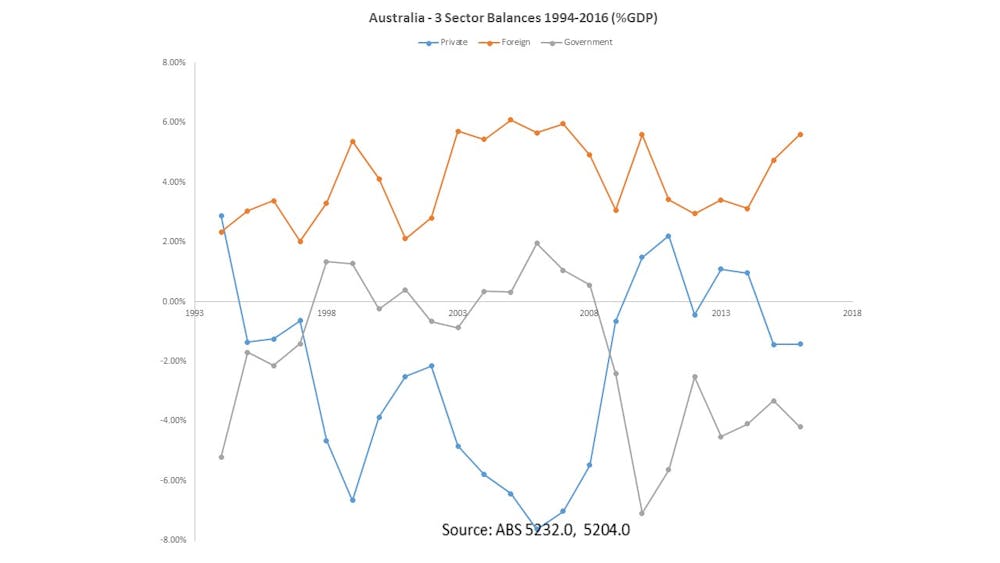
費やすよりも多くを稼ぐすべての貯蓄者のために、それが取るよりも多くを費やす誰かまたは何らかの機関が必要です。民間部門全体がさらに借金をするのではなく貯蓄することを望むなら、政府はおそらく税金よりも多くを費やさなければならないでしょう(世界の他の国々が何をしているかによって異なります)。
それも逆に機能します。民間部門が大きな赤字に陥ったため、ハワード政府は財政黒字しか実行できませんでした。
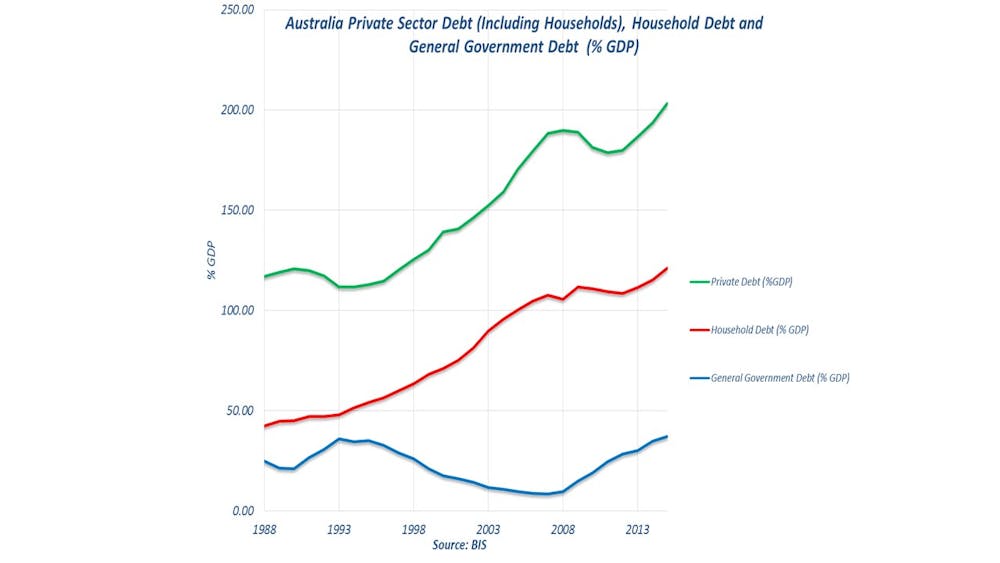
ハワードの年の間に家計の借金は3倍になった。それ以来、私たちは世界で最も高い家計債務対所得比率で他のいくつかの国と結びついています。
したがって、政府はドルを使い果たすことはできません。それは、政府が「酔っ払った船乗りのように費やすべき」、税金を支払う必要がないという意味ではありません。バランスの取れた予算が不要であることを意味します。また、政府の赤字が支援的な役割を果たし、民間部門が貯蓄を構築できることを意味します。
オーストラリア政府はとにかく、ほぼ常に赤字を抱えている。上記のどれも衝撃的であるべきではありません。平均して、連邦以来、左派と右派の両方の政府は赤字を抱えています。あなたは家庭としての政府のその比喩に惑わされたのかもしれません。
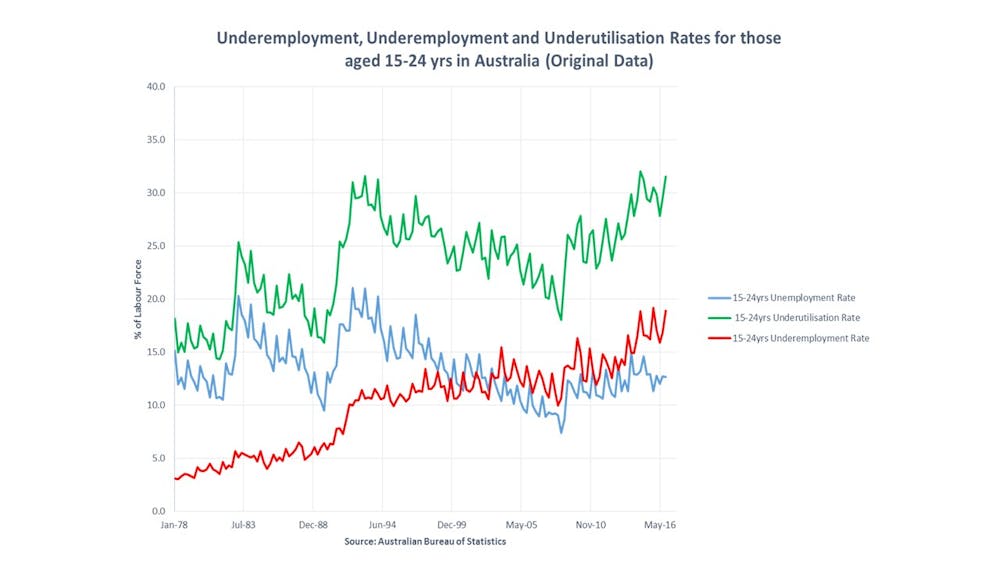
労働力の利用が15%近く、若者の利用が30%以上、民間のバランスシートが脆弱で、グリーンやその他のインフラ投資の必要性が高まっている国では、予算の修復が赤いニシンであることを示唆しています。これは、政府が通貨発行者としての役割を利用して、完全雇用、社会的包摂、生態学的修復、健全な民間部門のバランスシートを促進することができるし、またそうすべきであることを意味します。
現代の金融理論家によると、政治家は現在、重要ではないもの(予算のバランスをとる)に取りつかれており、国の将来にとって重要な多くのことを無視しています。
これは、現代の金融理論のプリズムを通してオーストラリアと世界を見始めるときに得られる視点です。それは現代の金融システムが実際にどのように機能するかの理解に基づいており、その意味では、おそらくまったく物議を醸すべきではありません。
現代の金融理論の提唱者であるビル・ミッチェル教授は、政府が金融主権によって提供された政策空間を利用して雇用保証を導入し、2%以下の失業率への復帰を追求することを提唱しています。これらのレートは、1960年代から1970年代初頭にかけてオーストラリアで達成されました。彼は、連邦政府が資金を提供し、地元で管理する公的雇用プログラムを通じて、完全雇用への復帰を提案しています。彼はこれがインフレである必要があるとは信じていません - 実際、雇用保証は、経済を安定させ、インフレを回避するための現代の金融理論の枠組みの不可欠な部分です。
オーストラリアでは、3つの主要な政党はまだ彼の考えにほとんど注意を払っていない。しかし、彼の仲間の現代の金融理論家は(バーニー・サンダース上院議員と)米国の政府に近づき、昨年、経済問題を理解するための枠組みとして現代の金融理論を促進するという明確な意図を持って、2つのマイクロパーティが設立されました。だから、現代の金融理論の支持者と批評家の両方からもっと多くの話を聞くことが期待できます。
あなたが行く前に...
9万人の専門家がThe Conversationのために書いています。なぜなら、私たちの唯一の議題は、選ばれた少数の人ではなく、誰もが知識を利用できるようにすることで、信頼を再構築し、国民に奉仕することです。これで、週に2回、受信トレイに厳選された記事のリストを受け取ることができます。試してみる?
ジョー・アデトゥンジ
The Conversation UKの編集者
Explainer: what is modern monetary theory?
There is a school of thought among economists who aren't worried about the so called "budget black hole", where tough choices have been called for to reduce government spending. Proponents of modern monetary theory, like Bernie Sanders' chief economic adviser Professor Stephanie Kelton, claim the Australian government need not balance its budget and are instead calling for the government to balance the economy, which they argue is a different thing entirely.
Modern monetary theory is an approach to economic management developed since the 1990s by Professor Bill Mitchell, alongside American academics like Professor Randall Wray, Stephanie Kelton, and investment bankers and fund managers like Warren Mosler. It builds on the ideas of a previous generation of economists, such as Hyman Minsky, Wynne Godley and Abba Lerner, whose interpretation of the work of the famous economist J.M.Keynes was very different from that which became dominant by the 1980s.
By the 1980s, most people saw Keynes as an advocate of budget deficits only during periods of high unemployment. Lerner, as early as 1943, in a paper entitled Functional Finance and the Federal Debt, had argued that Keynesian economics involved running whatever government deficit was necessary to maintain full employment, and that deficits should be seen as the norm. Keynes, in a letter to fellow economist James Meade written in April 1943, said of Lerner, "His argument is impeccable. But heaven help anyone who tries to put it across".
While the theory has attracted its own interpretations and criticism it's also gaining traction in a global economic environment that continues to defy the efforts of policymakers to restore sustained economic growth.
There are three core statements at the heart of modern monetary theory. The first two are:
1) Monetary sovereign governments face no purely financial budget constraints.
2) All economies, and all governments, face real and ecological limits relating to what can be produced and consumed.
The first statement is the one which is widely misunderstood. A monetary sovereign government is one with its own currency and central bank, a floating exchange rate, and no significant foreign currency debt. Australia has a monetary sovereign government. So does the UK, the US and Japan. The Eurozone countries are not monetary sovereigns, as they do not have their own currencies.
The second of these statements confirms the obvious fact that governments can cause inflation, if they choose, by spending too much themselves, or not taxing enough. When this happens, the total level of spending in the economy exceeds what can be produced by all the labour, skills, physical capital, technology and natural resources which are available. We can also destroy our natural ecosystem if produce too many of the wrong things, or use the wrong processes to produce what we want to consume.
The Australian government is a currency-issuing central government. It cannot run out of Australian dollars. It's never forced to borrow Australian dollars, although it can and does choose to do so, and its debt securities play a useful role in our financial system.
It doesn't exactly need to tax us to pay for its spending either. Taxes exist to limit inflation. It's necessary for us to pay taxes to keep total spending – government and private – at a level which will not be inflationary.
This doesn't mean government spending and taxation have to equal each other, and in countries like Australia this rarely happens in practice. This leads to the third principle of modern monetary theory:
3) The government's financial deficit is everybody else's financial surplus.
For every lender, there must be a borrower. That means that across our financial system, surpluses and deficits always add up to zero.
This is clear in the following chart, which shows the financial balances of the Australian private sector, the rest of the world, and the Australian government sector, since 1994.
For every saver who earns more than they spend, there must somebody or some institution which spends more than it takes in. If we want the private sector as a whole to save rather than go further into debt, the government will probably have to spend more than it taxes (depending on what the rest of the world is doing).
It works the other way around too. The Howard government was only able to run fiscal surpluses because the private sector went heavily into deficit.
Household debt trebled during the Howard years. Since then, we have been in a tie with a couple of other countries for the highest household debt to income ratios in the world.
So, the government cannot run out of dollars; that doesn't mean the government should "spend like a drunken sailor" or that we don't have to pay taxes; it does mean balanced budgets are unnecessary. It also means government deficits can play a supportive role, allowing the private sector to build up its saving.
Australian governments have nearly always run deficits anyway. None of the above ought to be shocking. On average, governments of both left and right have run deficits, ever since federation. It just might be that you have been misled by that metaphor of the government as a household.
In a country with nearly 15% underutilisation of labour, over 30% youth underutilisation, fragile private balance sheets, and a growing need for green and other infrastructural investments, it does imply that budget repair is a red herring. This means the government could and should be using its role as the currency issuer to promote full employment, social inclusion, ecological repair, and healthy private sector balance sheets.
Politicians are, according to modern monetary theorists, currently obsessed with something which doesn't matter (balancing their budget), and are ignoring many things which do matter a great deal for the future of the country.
This is the perspective you get when you start to see Australia and the world through the prism of modern monetary theory. It's based on nothing more than a comprehension of how modern financial systems actually work, and in that sense, perhaps it should not be controversial at all.
Modern monetary theory proponent, Professor Bill Mitchell, advocates for governments to use the policy space provided for them by monetary sovereignty to introduce a job guarantee and pursue a return to unemployment rates of 2% or less. These rates were achieved in Australian across the 1960s and early 1970s. He proposes a return to full employment through a federally funded and locally managed program of public employment. He does not believe that this need be inflationary - indeed the job guarantee is an essential part of the modern monetary theory framework for stabilising the economy and avoiding inflation.
In Australia, the three major political parties have as yet paid little attention to his ideas. But his fellow modern monetary theorists got close to government in the USA (with Senator Bernie Sanders) and two micro-parties have been set up in the last year with the express intention of promoting modern monetary theory as a frame for understanding economic issues. So you can expect to hear a lot more from both the proponents and the critics of modern monetary theory.

0 件のコメント:
コメントを投稿