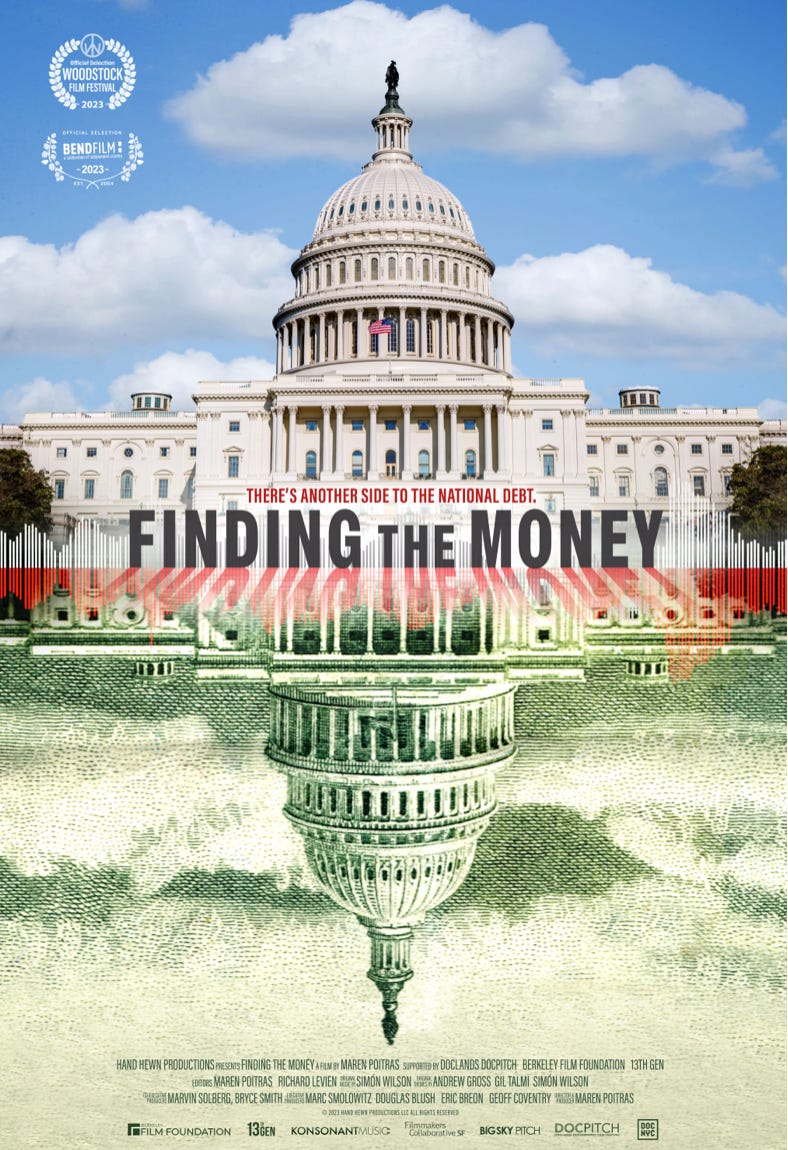
Long before Covid-19 disrupted everything, a filmmaker named Maren Poitras started following me around the country. She filmed me speaking at conferences, teaching, giving interviews, and going about daily life. She attended the Third International MMT Conference at Stony Brook University in September 2019, where she interviewed many of the world's top MMT scholars. She also traveled to St. Croix for in-depth conversations with Warren Mosler.
She discovered that MMT flips a lot of conventional wisdom on its head, and she was fascinated by the idea that economists, policymakers, and others might be thinking about things like money, taxes, deficits, and debt the wrong way round. But she didn't take our word for it. She also sat down with many skeptics and high-profile critics.
The documentary, called Finding the Money, will make its world premier at the Woodstock Film Festival on September 30th.
If you're interested in seeing the film's debut, tickets are $20 and on sale now. If you've never been to Woodstock, NY, it's a neat little town with incredible history. I'll be on hand with other MMT economists (including Randy Wray) for Q&A after the show. When you click on the link, you can choose the Saturday or Sunday screening. I think it defaults to the Saturday option, so be careful to select the other screening if you want to come on Sunday. Then click "order tickets."
Trains are available from NYC to the Rhinecliff station near Woodstock (arrives 10:30am or 12pm) and buses are available from NYC to Woodstock. I hope to see some of you there. If you can't make it to Woodstock, don't worry. Finding the Money will be showing from coast to coast, with at least three more festivals in October and November.
Feature DocumentaryWorld PremiereSpotlight on Women in Film & Media
ABOUT THE FILM: An underdog group of economists is on a mission to instigate a paradigm shift by flipping our understanding of the national debt, and the nature of money, upside down. We follow Stephanie Kelton on a journey through the controversial Modern Monetary Theory or "MMT", to unveil a deeper story about money, injecting new hope and empowering democracies around the world to tackle the biggest challenges of the 21st century: from climate change to inequality.
ABOUT THE FILMMAKER: Maren Poitras's feature documentary debut Finding the Money tells the story of Modern Monetary Theory, a burgeoning economic movement that will revolutionize our ability to tackle the climate crisis. Maren was associate producer on the feature documentaries Enemies of the State (which debuted at Toronto International Film Festival in 2020) and Reality Winner (2023). Based in the Bay Area, Maren studied environmental science and agriculture at UC Berkeley.
Isabella Weber ble latterliggjort da hun hevdet at inflasjonen dels skyldes at selskapene tar ut økt profitt. I dag er «grådighetsinflasjon» blitt et anerkjent begrep. Nå advarer Weber mot å bruke rentehevinger som medisin mot prisveksten. (M+) morgenbladet.no/aktuelt/2023/0…
An absolute bargain for only £25. Some of the sessions and speakers include:
- Who pays for that? A look at Scotland's finances - Monetary Sovereignty - Learned helplessness and the fiscal framework - Scotland – A trading nation
um I Can't Rap I'm sorry
um it is a real honor to be here today
and I'm going to be discussing the need
to transition from an economy
underpinned by extraction to one
centered on sustainability on Justice
and of course on well-being
this year alone we've seen the
devastation of the climate and
environmental crisis the UK experienced
the hottest temperature on record
Millions lost their homes to devastating
floods in Pakistan and parts of the
greater Horn of Africa face the fifth
consecutive failed rainy season while
Nature's decline is unprecedented
a recent un report confirmed what nature
was already telling us we are perilously
off track to meet the Paris agreement
goals without action
urgent and um comprehensive we are
hurtling towards the grave Prospect of a
1.8 degrees Celsius trajectory
underpinning today's urgent and
intertwined crises from inequalities to
the climate and environmental crises is
an unjust and extractive economic system
the time for timid incremental change is
long gone in place of this we need to
fundamentally rewire the operations of
our economy
intrinsically linked to inequality the
causes and distributional consequences
of the climate environmental crisis are
unevenly felt both within and between
countries and Global regions and those
who have contributed the least this
crisis so often face the front or at the
front line
our social class our gender race age
disability and geography for example all
influence how susceptible we are to
facing climate harems
Oxfam found that a billion a
billionaires average annual emissions is
a million times higher than somebody
outside the richest ten percent
in 2020 annual emissions of carbon
dioxide per header population were 0.9
tons in Rwanda in Britain this figure
was 8.3 and the richest one percent in
the UK produced 11 times the carbon
emissions of the poorest 50 percent
the current energy crisis is
underscoring the entrenched inequalities
in our in our inbuilt into our economy
the sheer volatility and cost of our
continued Reliance on fossil fuels and
how the ownership and operations of our
Energy System point to deeper more
systemic failures of a privatized
extractive energy Market
research by Commonwealth found that BP
and shell have remained profitable over
the past decade and during that time
have spent tens of millions of pounds on
shareholder payouts while receiving
hundreds of millions of pounds in tax
benefits and over the past five years
alone the big six energy firms have paid
out the equivalent of 82 percent of
their pre-tax profits in dividends
this latest crisis is emblematic of The
Wider challenges we face in our economy
Footloose private fossil Capital
benefiting from eye-watering profits
while workers face real wage losses fuel
poverty soars and the climate crisis
rages on
what is Scotland's role in contributing
to this
what action can we take to further
um
create a well-being economy well first
and foremost Scotland is a founding
member of course of the well-being
economy governments group and the
country has made important strides to
tackle the climate environmental
emergency not least by committing to
reaching Net Zero um by 2045.
but despite meaningful progress
challenges and indeed opportunities lie
ahead to rapidly decarbonize the economy
as part of a just transition
every economy Still Remains heavily
reliant on fossil fuels an extraction
both in terms of our key sectors and our
jobs an income in wealth inequality
remains scandalously High
while some of the economic levers
required to Steward the just transition
sit at a UK government level for
instance enhancing regulatory Frameworks
and ushering in a new deal of workers
rights to enshrine adjust transition in
decent work Scotland can take further
action to deepen and accelerate the
transition to a genuinely well-being
economy
and I'm going to speak about just four
areas where we can do that the first of
those is in transforming land land
reform is undoubtedly one of the
greatest achievements of the Scottish
Parliament from and from restoring
nature to biodiversity to housing
Justice to repopulating and re-pupling
land land is crucial to um achieving a
well-being economy
but emerging changes to Scotland's rural
land market risk undermining progress
and reinforcing an extractive land
market Scotland's large rural landmass
concentrated pattern of ownership in
land lightly regulated land market and
generous tax and subsidies regime means
that it is highly attractive for
investors seeking to purchase land for
carbon offsetting purposes contributing
to an upwards pressure on rural land
prices
the risk here is that the financial
rewards from the so-called natural
Capital potential could flow to a small
number of private landowners triggering
wider implications from pushing up rents
and making it increasingly difficult for
Rural communities to fulfill their
economic potential
in addition allowing polluters to offset
their emission risks facilitating green
washing on a vast scale
and distracting from the more important
yet much more difficult challenge of
reducing direct emissions
an action can be taken
um not least through creating a
community wealth building approach to
land reform
a few examples of what we can do we can
strengthen Community right to buy we can
introduce a new regulatory a new
statutory power to apply a public
interest test to land over a certain
size
6:00
we can create a mandatory system of
certification for carbon credits and to
ensure much greater scrutiny of sellers
and buyers and we can set out a
long-term ambition to introduce land
value tax
the second area I want to speak about is
perhaps unsurprisingly given the current
context Energy Systems
Energy Systems is an area that requires
UK government action and from reforming
fossil fuel support in our tax system to
developing publicly owned approach to
energy but there are critical areas of
development in Scotland yet while
um Scotland has expanded renewable
energy generation in recent years it's
not yet captured the full potential of
economic benefits both in terms of its
key jobs and scaling those jobs and its
domestic Supply chains critically while
the fossil fuel age has been
characterized by concentrated ownership
the transition to a green economy gives
us a chance to create a more Equitable
Democratic energy infrastructure that's
genuinely fit for the future generating
good unionized green jobs throughout the
country while we do so
there is a need to ensure that
Renewables directly benefit The Wider
public good and indeed communities so
that their benefits do not just flow to
multinationals in north air show but
I've been lucky enough to sit on the
expert group over the past few years
part of their Community wealth building
strategy involves generating clean green
council-owned Renewables projects if
successful these proposed projects could
potentially generate 277 percent of
north air shows and future energy
demands and the excess energy excess
energy could be potentially sold to
other public anchor institutions in the
area
third and linked to the energy crisis
and the current cost of living crisis is
the need to create safe warm affordable
homes for all
fuel poverty is devastating it is
household debt it is homelessness it is
lifelong respiratory and heart
conditions
the current crisis necessitates that we
accelerate home retrofitting as a social
priority but also as a means to tackle
the code objectives of the Scottish
government like reducing fuel poverty
creating jobs in every constituency that
are green and rapidly reducing household
emissions
alongside this um is the need to ensure
that homes are affordable and available
the commitment to expand the social home
stock
um as well as the commitments to ensure
and ensuring new and private renter
protections
and of course the recent
rent freeze marks significant progress
but building a well-being economy means
recognizing that homes are a basic need
not a financial asset for accumulating
wealth
in 2021 rents went up by almost 10 in
Edinburgh and Glasgow and in the
highlands
um and
we see numbers of people in
private rental sector in poverty sorting
and the rent freeze should be a first
step in the first step towards
initiating effective widespread rent
controls
and we should look at establishing
Municipal energy companies as well which
could develop own and deliver low carbon
heat like District heating systems and
efficiency inefficient energy in
infrastructure last but by no means
least
we need to initiate a green
industrial strategy
ensuring that Scotland can prosper from
decarbonization and deliver well-paid
green jobs will require a fundamental
restructure of both our industrial base
and our labor market
essential here is the need to ensure
that Scotland's fossil fuel workers in
our communities are never treated
like
Thatcher treated the coal miners with
action to address historic problems of
chronically low investment low pay and
the prevalence of extractive business
models
this requires a state to shift away from
Simply intervening when Industries and
businesses fail to a proactive role for
the state to Steward a green industrial
strategy this means harnessing policy
levers to accelerate decarbonization and
create a fairer more democratic economy
it means protecting the livelihoods of
those impacted through active labor
market policies it means building on the
fair work agenda and it means scaling
green unionized decent jobs including
through an enhanced domestic
manufacturing base
a green industrial strategy also gives
us an opportunity to look beyond what we
might conventionally see as green jobs
care work for example is not only vital
to delivering the human needs required
for our survival it is also low carbon
in nature it is green work
as such it should be integral to Green
industrial strategy as in technicals any
export-led industry
I'll finish up by saying that the
climate and environmental crises are
incomprehensibly devastating
and those benefiting from an extractive
and unequal economy will fight very hard
for its continuation as will those paid
to represent their interests
but an opportunity exists here to
rapidly decarbonize the economy
challenge power imbalances build worker
power and create a reparative agenda and
Scotland is well placed to deliver a
rewired economy with well-being at its
heart thank you
[Applause]