| ||||||||||||||||||||||||



フィル・ローンへのインタビュー
フィル・ローンへのインタビュー

Phil Lawn introduces the Ecological Economics subject within our Modern Money Lab/Torrens University
スティーヴン・ヘイル
Environmental Sustainability and Economic Growth – Bill Mitchell – Modern Monetary Theory
2013/10/11
http://bilbo.economicoutlook.net/blog/?p=25691Phil Lawn. Ecological Economics and the Genuine Progress Indicator. Lect...
2018/10/04
https://www.youtube.com/watch?v=K7L63x4TBZI?t=23m10s
https://www.youtube.com/watch?v=K7L63x4TBZI
https://www.amazon.co.jp/dp/1566704111/
1. Renewable resources: extract them no faster than they can regenerate.
2. Non-renewable resources: extract them no faster than we can cultivate (substitute) renewable resources to replace depleted non-renewables (therefore keeping the total amount of natural capital intact).
3. Waste: generate waste no faster than the ecosphere can safely assimilate it (Lawn 2018 ).
https://www.amazon.co.jp/dp/1566704111/
https://youtu.be/K7L63x4TBZI?t=23m10s
http://bilbo.economicoutlook.net/blog/?p=25691
1. 再生可能な資源:再生可能な資源よりも早く取り出さない。
2. 非再生可能資源:枯渇した非再生可能資源に代わる再生可能資源を栽培(代替)できる速度よりも早く採取しない(したがって自然資本の総量は維持される)。
3. 廃棄物:生態圏が安全に同化できる速度よりも速く廃棄物を発生させない(Lawn 2018 )。

23:10
Sustainability precepts
1) Renewable Kn (RKn)- extract resources no greater than RKn can regenerate (h≤y) (harvest ≤ yield)
2) Non-renewable Kn (NRKn) - extract resources no greater than we can cultivate RKn to replace depleted
NRKn (thereby keeping total stock of Kn intact)
3) Waste (W)-generate W at a rate no greater than the ecosphere can safely assimilate them (W ≤A)

References
Forstater, M. (2003) ‘Public employment and environmental sustainability’, Journal of Post Keynesian Economics, Spring, 25(3), 385-406 – PDF download.
Lawn, P.A. (2001) Toward Sustainable Development: an ecological economics approach, CRC Press, Boca Raton, Florida.
Tcherneva, P.R. (2009) ‘Evaluating the economic environment viability of Basic Income and Job Guarantees’, in Lawn, P.A. (ed.) Environment and Employment: A Reconciliation, Routledge, London, 184-205.
エコロジカルな持続可能性の3つの原則…
1. 再生可能な資源:再生可能な資源よりも早く取り出さない。
2. 非再生可能資源:枯渇した非再生可能資源に代わる再生可能資源を育成(代替)できる速度よりも速く、それらを抽出しない(したがって、自然資本の総量はそのまま維持される)。
3. 廃棄物:生態圏が安全に同化できる速度よりも速く廃棄物を発生させない(Lawn 2018 )。
Phil Lawn. Ecological Economics and the Genuine Progress Indicator. Lect...
2018/10/04
https://www.youtube.com/watch?v=K7L63x4TBZI?t=23m10s
(後述)

http://bilbo.economicoutlook.net/blog/?p=25691
https://nam-students.blogspot.com/2019/06/31521-phillip-lawn-environmental.html
Interview with Phil Lawn 2022
| ||||||||||||||||||||||||

https://twitter.com/karukarokarukar/status/1376838832776114177?s=21
Environmental Sustainability and Economic Growth – Bill Mitchell – Modern Monetary Theory
2013/10/11
http://bilbo.economicoutlook.net/blog/?p=25691 ]2013/10/11
http://bilbo.economicoutlook.net/blog/?p=25691
https://nam-students.blogspot.com/2019/06/31521-phillip-lawn-environmental.html
https://www.amazon.co.jp/dp/1566704111/
Toward Sustainable Development
An Ecological Economics Approach
Philip A. Lawn
Contents
1 Introduction
I An ecological economic view of the sustainable development concept
2 An overview of the sustainable development concept
3 What is development?
4 What is sustainability?
II Sustainable development, economic theory, and macro policy goals and instruments
6 Sustainable development and an optimal macroeconomic scale
7 Economic efficiency and policy goals and instruments
8 Sustainable development and the role of relative prices
9 Sustainable development and the role of the market
III Sustainable development and the co-evolutionary paradigm
10 The neoclassical economic framework as a product of the Newtonian world view
11 The development of a co-evolutionary-based conceptual framework
12 The market: a co-evolutionary feedback mechanism
IV Toward sustainable development
13 Toward sustainable development: a framework for policy setting and national accounting reform
14 Toward sustainable development: sustainable development indicators
15 Toward sustainable development: policy conclusions and prescriptions
16 Toward sustainable development: the need for moral growth
V Appendices
Appendix 1 The uncancelled benefit account for Australia, 1966-1967 to 1994-1995
Appendix 2 The uncancelled cost account for Australia, 1966-1967 to 1994-1995
Appendix 3 The human-made capital account for Australia, 1966-1967 to 1994-1995
Appendix 4 The natural capital account for Australia, 1966-1967 to 1994-1995
Acronyms
References
Index
持続可能な開発に向けて
エコロジー経済学的アプローチ
フィリップ・A・ローン
目次
1 はじめに
I 持続可能な開発の概念に対する生態経済学的な見方
2 持続可能な開発コンセプトの概要
3 開発とは何か?
4 持続可能性とは何か?
II 持続可能な開発、経済理論、およびマクロ政策の目標と手段
6 持続可能な開発と最適なマクロ経済規模
7 経済効率と政策目標・手段
8 持続可能な開発と相対価格の役割
9 持続可能な開発と市場の役割
III 持続可能な開発と共進化のパラダイム
10 ニュートン的世界観の産物としての新古典派経済フレームワーク
11 共進化に基づく概念枠組みの構築
12 市場:共進化のフィードバック・メカニズム
IV 持続可能な開発に向けて
13 持続可能な発展に向けて:政策設定と国家会計改革のフレームワーク
14 持続可能な発展に向けて:持続可能な開発指標
15 持続可能な発展に向けて:政策の結論と処方箋
16 持続可能な発展に向けて:道徳的成長の必要性
V 付録
付録1 オーストラリアの未解約の給付金勘定。1966-1967年から1994-1995年まで
付録2 オーストラリアの費用勘定(キャンセルなし)。1966-67年から1994-1995年まで
付録3 オーストラリアの人造資本勘定,1966-1967年から1994-1995年まで
補遺 4 オーストラリアの自然資本勘定,1966-1967年から1994-1995年まで
頭字語
参考文献
索引
"The significant problems we face cannot be solved at the same level of thinking we were at when we created them."
Albert Einstein
"私たちが直面する重要な問題は、それを生み出した時と同じレベルの思考では解決できない"
アルバート・アインシュタイン

The MMT Podcast with Patricia Pino & Christian Reilly
Patricia and Christian talk to journalist Stephen Williams, writer and co-editor of "Sustainability and the New Economics". Please help sustain this podcast! Patrons get early access to all episodes and patron-only episodes: https://www.patreon.com/MMTpodcast For an intro to MMT: Listen to our first three episodes: https://www.patreon.com/posts/41742417 And Episode 126 - Dirk Ehnts: How Banks Create Money: https://www.patreon.com/posts/62603318 All our episodes in chronological order: https://www.patreon.com/posts/43111643 Discussed in this episode: Sustainability And The New Economics: https://link.springer.com/book/10.1007/978-3-030-78795-0 Stephen Williams - "A ten-point plan for sustainable prosperity": https://independentaustralia.net/politics/politics-display/a-ten-point-plan-for-sustainable-prosperity-,12058 Bill Mitchell's blog: http://bilbo.economicoutlook.net/blog/ To understand buffer stocks and why they're an important concept - Episode 125 - Sam Levey: Monopoly, Monopsony, And What To Do About Them: https://www.patreon.com/posts/61954971 Warren's Mosler's white paper: http://moslereconomics.com/mmt-white-paper/ Steven Hail's quick MMT explainer: https://theconversation.com/explainer-what-is-modern-monetary-theory-72095 Steven Hail's Modern Money Lab: https://modernmoneylab.org.au/ Our Job Guarantee episodes: Episode 4 - Fadhel Kaboub: What is the Job Guarantee?: https://www.patreon.com/posts/41742701 Episode 47 - Pavlina Tcherneva: Building Resilience - The Case For A Job Guarantee: https://www.patreon.com/posts/36034543 Warren Mosler's Proposals for the Treasury, the Federal Reserve, the FDIC, and the Banking System: https://neweconomicperspectives.org/2010/02/warren-moslers-proposals-for-treasury.html 350 dot org: https://350.org/ More on the Genuine Progress Indicator: https://en.wikipedia.org/wiki/Genuine_progress_indicator More on monetary operations: Episode 20 - Warren Mosler: The MMT Money Story (part 1): https://www.patreon.com/posts/28004824 Episode 126 - Dirk Ehnts: How Banks Create Money: https://www.patreon.com/posts/62603318 Episode 13 - Steven Hail: Everything You Always Wanted To Know About Banking, But Were Afraid To Ask: https://www.patreon.com/posts/41790887 Episode 43 - Sam Levey: Understanding Endogenous Money: https://www.patreon.com/posts/35073683 "An Accounting Model of the UK Exchequer – 2nd edition" by Andrew Berkeley, Richard Tye & Neil Wilson: https://gimms.org.uk/2021/02/21/an-accounting-model-of-the-uk-exchequer/ Our episodes about "An Accounting Model of the UK Exchequer": Part 1: https://www.patreon.com/posts/46352183 Part 2: https://www.patreon.com/posts/46865929 Episodes on inflation: Episode 7: Steven Hail: Inflation, Price Shocks and Other Misunderstandings: https://www.patreon.com/posts/41780508 Episode 65 - Phil Armstrong: Understanding Inflation: https://www.patreon.com/posts/40672678 Episode 104 - John T Harvey: Inflation, Stagflation & Healing The Nation: https://www.patreon.com/posts/52207835 Episode 123 - Warren Mosler: Understanding The Price Level And Inflation: https://www.patreon.com/posts/59856379 Episode 128 - L. Randall Wray & Yeva Nersisyan: What's Causing Accelerating Inflation? Pandemic Or Policy Response?: https://www.patreon.com/posts/63776558 Sign up for alerts from The Gower Initiative For Modern Money Studies about their forthcoming MMT book: https://gimms.org.uk/ A list of MMT-informed campaigns and organisations worldwide: https://www.patreon.com/posts/47900757 We are working towards full transcripts, but in the meantime, closed captions for all episodes are available on our YouTube channel: https://www.youtube.com/channel/UCEp_nGVTuMfBun2wiG-c0Ew/videos Transcript for opening monologue: https://www.patreon.com/posts/69831430?pr=true Cinematic Trailer Bac
Apple Podcastでお聴きください: https://podcasts.apple.com/jp/podcast/the-mmt-podcast-with-patricia-pino-christian-reilly/id1375093518?i=1000574834788
Preface
In October 2021, the United Nations Humans Rights Council voted to recognise a new human right: the right to a “safe, clean, healthy and sustainable environment”. In a three-page document it acknowledged “the importance of a safe, clean, healthy and sustainable environment as critical to the enjoyment of all human rights”. The UN High Commissioner for Human Rights, Michelle Bachelet, has called on member states to “take bold actions to give prompt and real effect to the right to a healthy environment”. While the resolution is yet to go before the UN General Assembly, it is likely to have significant ramifications in legislatures, courts and tribunals around the world. Together with the UN Sustainable Development Goals, there is increasingly nowhere for governments to hide as we confront our long-standing unsustainable practices and the resultant existential risks. Moreover, excessively polluting corporations and acquiescent shareholders will be seen to be violating basic human rights. This book explores a sustainable pathway so all human rights are maximised. One of the themes of this book is that national governments have strong powers to control their economies and their environments – if only they would use them – and are not beholden to corporations or financial markets. Government is in the driver’s seat. Even so, we ask you to keep this new human right to a safe, clean, healthy and sustainable environment at the front of your mind while reading the book – and reflect on whether you are mostly upholding or violating it.
Stephen J. Williams Rod Taylor Silverwater, NSW, Australia Giralang, ACT, Australia October 2021
序文
2021年10月、国連人権理事会は、新たな人権として「安全で清潔かつ健康的で持続可能な環境」に対する権利を認めることを決議した。3ページの文書の中で、「すべての人権の享受に不可欠なものとして、安全で清潔かつ健康的で持続可能な環境の重要性」を認めている。国連人権高等弁務官ミシェル・バチェレは、加盟国に対して「健康的な環境に対する権利を迅速かつ実質的に実現するために大胆な行動をとる」よう呼びかけている。この決議はまだ国連総会に提出されていませんが、世界中の立法府、裁判所、裁判に大きな影響を与える可能性があります。国連の持続可能な開発目標とともに、私たちが長年にわたって行ってきた持続不可能な慣行と、その結果として生じる存亡の危機に直面する中で、政府が隠れる場所はますますなくなってきています。さらに、過度に汚染を進める企業や黙認する株主は、基本的人権を侵害していると見なされるようになるだろう。本書は、すべての人権が最大化されるような持続可能な道筋を探っている。本書のテーマのひとつは、各国政府は経済と環境をコントロールする強力な権限を持っており、それを行使しさえすれば、企業や金融市場の言いなりになることはないということである。政府が運転席に座っているのです。それでも、この本を読みながら、安全で清潔、健康的で持続可能な環境という新しい人権を頭の片隅に置いて、自分がほとんどそれを守っているのか、それとも犯しているのかを考えてみてください。
Stephen J. Williams Rod Taylor オーストラリアNSW州シルバーウォーター オーストラリアACT州ジララン 2021年10月
Contents
SUSTAINABILITY AND THE NEW ECONOMICS: SYNTHESISIN...
1 Introduction
Stephen J. Williams and Philip Lawn
Part I The Current Mess
2 The Earth System, the Great Acceleration and the Anthropocene
Will Steffen
3 Australia's Natural Environment: A Warning for the World
Chris R. Dickman and David B. Lindenmayer
4 Climate Change and Human Health
Colin D. Butler, Ben Ewald, Forbes McGain, Karen Kiang and Ann Sanson
5 How Sustainable Are the UN Sustainable Development Goals?
Kerryn Higgs
Part II How We Got Here
6 The Evolution of Neoliberalism
John Quiggin
7 Population Growth
Ian Lowe
8 A Brief History of The Limits to Growth Debate
Kerryn Higgs
9 The Role of the Fossil Fuel Industry
Ian Dunlop
10 Economic Failures of the IPCC Process
Steve Keen
Part III Designing a Safe and Prosperous Future
11 An Introduction to Ecological Economics: Principles, Indicators, and Policy
Philip Lawn and Stephen J. Williams
12 Energy Systems for Sustainable Prosperity
Mark Diesendorf
13 Climate Change Litigation and Human Rights
Michael Kirby
14 Paying for a Green New Deal: An Introduction to Modern Monetary Theory
Steven Hail
15 Conclusion and Policy Options
Stephen J. Williams and Philip Lawn
Appendices
目次
持続可能性と新しい経済学:統合された経済学とは?
1 はじめに
スティーブン・J・ウィリアムズ,フィリップ・ローン
第1部 現在の混乱
2 地球システム、大加速、人新世
ウィル・ステッフェン
3 オーストラリアの自然環境。世界に対する警告
クリス・R・ディックマン、デヴィッド・B・リンデンマイヤー
4 気候変動と人間の健康
コリン・D・バトラー、ベン・エワルド、フォーブス・マッゲイン、カレン・キアン、アン・サンソン
5 「国連持続可能な開発目標」はどの程度持続可能か?
ケリーン・ヒッグス
第Ⅱ部 我々はいかにしてここに到達したか
6 ネオリベラリズムの進化
ジョン・クィギン
7 人口増加
イアン・ロウ
8 「成長の限界」論争の小史
ケリーン・ヒッグス
9 化石燃料産業の役割
イアン・ダンロップ
10 IPCCプロセスにおける経済的失敗
スティーブ・キーン
第III部 安全で豊かな未来をデザインする
11 エコロジー経済学入門。原則、指標、および政策
フィリップ・ローン、スティーブン・J・ウィリアムズ
12 持続可能な繁栄のためのエネルギーシステム
マーク・ディーゼンドルフ
13 気候変動訴訟と人権
マイケル・カービー
14 グリーン・ニューディールのための支払い:現代通貨理論への導入
スティーブン・ヘイル
15 結論と政策オプション
スティーブン・J・ウィリアムズ、フィリップ・ローン
付録
Contents 1 Introduction 1 Stephen J. Williams and Philip Lawn Part I The Current Mess 2 The Earth System, the Great Acceleration and the Anthropocene 15 Will Steffen 3 Australia’s Natural Environment: A Warning for the World 33 Chris R. Dickman and David B. Lindenmayer 4 Climate Change and Human Health 51 Colin D. Butler , Ben Ewald , Forbes McGain , Karen Kiang and Ann Sanson 5 How Sustainable Are the UN Sustainable Development Goals? 69 Kerryn Higgs Part II How We Got Here 6 The Evolution of Neoliberalism 89 John Quiggin 7 Population Growth 107 Ian Lowe 8 A Brief History of The Limits to Growth Debate 123 Kerryn Higgs 9 The Role of the Fossil Fuel Industry 137 Ian Dunlop 10 Economic Failures of the IPCC Process 161 Steve Keen Part III Designing a Safe and Prosperous Future 11 An Introduction to Ecological Economics: Principles, Indicators, and Policy 185 Philip Lawn and Stephen J. Williams 12 Energy Systems for Sustainable Prosperity 231 Mark Diesendorf 13 Climate Change Litigation and Human Rights 253 Michael Kirby 14 Paying for a Green New Deal: An Introduction to Modern Monetary Theory 279 Steven Hail 15 Conclusion and Policy Options 303 Stephen J. Williams and Philip Lawn Appendices
目次 1 はじめに 1 Stephen J. Williams と Philip Lawn パート I 現在の混乱 2 地球システム、大加速と人新世 15 Will Steffen 3 オーストラリアの自然環境: 世界への警告 33 Chris R. Dickman と David B. Lindenmayer 4 気候変動と人間の健康 51 Colin D. Butler , Ben Ewald , Forbes McGain , Karen Kiang and Ann Sanson 5 国連の持続可能な開発目標はどの程度持続可能か? 69 Kerryn Higgs Part II How We Get Here 6 新自由主義の進化 89 John Quiggin 7 人口増加 107 Ian Lowe 8 成長論争の限界の歴史 123 Kerryn Higgs 9 化石燃料産業の役割 137 Ian Dunlop 10 IPCC プロセスの経済的失敗 161 Steve Keen パート III 安全で豊かな未来の設計11 生態学的経済学の紹介: 原則、指標、と政策 185 Philip Lawn and Stephen J. Williams 12 持続可能な繁栄のためのエネルギーシステム 231 Mark Diesendorf 13 Climate Change Litigation and Human Rights 253 Michael Kirby 14 Paying for a Green New Deal: An Introduction to Modern Monetary Theory 279 Steven Hail 15 結論と政策オプション 303 Stephen J. Williams and Philip Lawn Appendices
© The Author(s), under exclusive license to Springer Nature Switzerland AG 2022 S. J. Williams, R. Taylor (eds.) Sustainability and the New Economics https://doi.org/10.1007/978-3-030-78795-0_1
1. Introduction Stephen J. Williams 1 and Philip Lawn 2 , 3
(1) Silverwater, NSW, Australia
(2) Measuring Genuine Progress, Adelaide, Australia
(3) Torrens University, Adelaide, Australia
Abstract
This chapter introduces the main themes of the book, centred on sustainability. It gives a brief summary of the modern environmental movement from the publication of Rachel Carson’s Silent Spring in 1962. It also briefly touches on the history of neoliberalism as both a reaction to the Keynesian Revolution in economics and the environmental movement. In essence, we argue that world leaders have largely ignored the consistent warnings from scientists and ecological economists on the existential perils of unrelenting growth, especially since the early 1970s. However, we acknowledge a growing chorus of new authoritative voices that are calling for significant and urgent change along the lines of the United Nations Sustainable Development Goals, a global Green New Deal or Just Transition. While welcome, we argue all such prescriptions for ‘sustainability’ will ultimately fail without a recognition of the limits to growth and other key features of sustainability, usually derived from ecological economics. We further argue that the recent emergence of modern monetary theory (a much-improved macroeconomics) provides important insights that complement ecological economics, producing a powerful new economics to guide humanity away from imminent danger towards vastly expanded wellbeing. This book explores the subject of ecological, economic and social sustainability – or simply sustainability. Sustainability tends to be a motherhood term, in that no sensible person could be against it, but it remains imprecise for most people and therefore easy to use and abuse as the occasion demands. Like words such as ‘freedom’ and ‘democracy’, in the hands of the skilled rhetorician, it is particularly useful as it has a positive cachet but no real accountability attached to it. We define what we mean by sustainability in this book’s glossary: we essentially mean limiting humanity’s use or demands of the planet’s physical endowments to the planet’s inherent biocapacity (Earth’s sustainable resource supplies). Within such limits, humankind can comfortably focus on organising itself and its activities to maximise wellbeing. Should both be successfully accomplished, sustainable development is achieved. Overshooting the planet’s biocapacity, if not corrected in time, leads to collapse. As a species, we are presently not living within the planet’s biocapacity. We are not even close, needing about 1.6 Earths to sustain production-consumption, when we have only one Earth (Global Footprint Network 2021 ; Dasgupta Review 2021 , p1). 1 Indeed, after some 60 years of warnings, we are still rapidly heading in the wrong direction, seemingly willing to run the most dangerous experiment ever devised, with no plan B. In the words of the United Nations Environment Programme (UNEP Report 2021 ), we have been “waging a war on nature”, such that we are now in a “planetary emergency” with a “need for a clear break with current trends”. Another way to understand sustainability is to acknowledge that humanity must live off the planet’s ‘income’ and not its capital. We destroy the planet’s capital when we consume resources faster than they can be replaced by nature, meaning that there is even less income (and capital) to live off in the future; while there is decreasing capacity for the planet to absorb wastes. This leads to three principles of ecological sustainability:
1. Renewable resources: extract them no faster than they can regenerate.
2. Non-renewable resources: extract them no faster than we can cultivate (substitute) renewable resources to replace depleted non-renewables (therefore keeping the total amount of natural capital intact).
3. Waste: generate waste no faster than the ecosphere can safely assimilate it (Lawn 2018 ).
1. 再生可能な資源:再生可能な資源よりも早く取り出さない。
2. 非再生可能資源:枯渇した非再生可能資源に代わる再生可能資源を栽培(代替)できる速度よりも早く採取しない(したがって自然資本の総量は維持される)。
3. 廃棄物:生態圏が安全に同化できる速度よりも速く廃棄物を発生させない(Lawn 2018 )。
The publication of Rachel Carson’s book, Silent Spring ( 1962 ), is often viewed as the beginning of the modern environmental movement. In subsequent years came the passage of nascent environmental legislation in the United States (such as the Clean Air Act 1963); Ehrlich’s The Population Bomb (1968); the establishment of the US Environmental Protection Agency in 1970 (the year of the first Earth Day); The United Nations Conference on the Human Environment, held in Stockholm in 1972; and the publication of the Club of Rome report, The Limits to Growth (1972). Other highlights, among many, were the establishment of the Worldwatch Institute in 1975; the release of the United Nations World Charter for Nature in 1982; the Brundtland Report of 1987 ( Our Common Future ); the Montreal Protocol to protect the ozone layer in 1987; the establishment of the Intergovernmental Panel on Climate Change in 1988; the Rio Earth Summit of 1992 (where the United Nations Framework Convention on Climate Change was formed); the Kyoto Protocol on climate change of 1997; the World Summit on Sustainable Development in 2002; the Paris climate agreement of 2015–16; the adoption of the UN Sustainable Development Goals of 2015; and various biodiversity reports that simply go from bad to worse, indicating that we now seem to be in the midst of the sixth mass extinction. 2 The growing awareness of environmental problems from the early 1960s, and the subsequent enactment of environmental regulations to curb industrial excess, did not go unnoticed by the forces of free-market capital. In fact, those forces had coalesced decades earlier in their opposition to the Keynesian Revolution in the years following the Great Depression, when national income in some countries began to be redistributed more evenly. One manifestation of that opposition was economist Friedrich Hayek’s formation of the Mont Pelerin Society in 1947 (Higgs 2014 ). Another landmark was the manifesto written in 1971 by US business lawyer and soon-to-be Supreme Court judge Lewis Powell, and the free-enterprise propaganda machine that flowed from that (Mitchell and Fazi 2017 ). These were the antecedents of the free-market ideology known as neoliberalism, which overtly emerged in the 1970s. While helping to rapidly grow the Gross Domestic Product (GDP) of most countries, neoliberalism has played a major role in the depletion of global resource stocks, biodiversity loss, rising greenhouse gas emissions, the widening gap between rich and poor, both within and between countries, and the destruction of the fabric and self-sufficiency of many communities. Neoliberalism still grinds along, perhaps on life support, as we write this introductory chapter in early 2021. Contrary to what many believe, neoliberalism is not about governments taking a backseat in economic affairs. Whether intentional or not, it is a about governments reconfiguring economies in ways that narrowly privatise the gains generated by the many (rent seeking) while broadly socialising the losses inflicted by the powerful and wealthy few (cost shedding). Countervailing the explosion in environmental destruction of this post-World War II period (the Great Acceleration) and the eventual domination of rudderless hydra-headed capital forever seeking greener pastures (globalisation), was the development of notions of steady-state (non-growing) economies (Daly 1977 ), the formal emergence of ecological economics in the late-1980s, 3 and ideas promoting planned degrowth in countries that had ‘overshot’ their sustainable size (e.g. Hickel 2020 ). This group of ideas are based on ‘limits to growth’ thinking and focus on resource throughput analysis juxtaposed to the planet’s likely capacity to provide ongoing resources and still function in a stable and healthy state. Related ideas include the concept of the Anthropocene, planetary boundaries, doughnut economics, and ecological footprinting (see Glossary, this volume). When Carson published Silent Spring in 1962, Earth’s human population was just over 3 billion and Gross World Product (GWP) was about $US1.5 trillion. Material throughput was about 20 billion tonnes a year. As we write this, the world’s population is approaching 8 billion, and GWP is close to $90 trillion. Total material use is about 100 billion tonnes a year (Carrington 2020 ). Conservative estimates suggest this level of material use is likely to be about twice as much as the planet can sustain, even with vast numbers of people still living in poverty, and that the global economy probably overshot its maximum sustainable scale in the 1970s. How do we explain humanity’s lack of corrective action after almost 60 years of warnings? One answer is that humanity as a whole has not ignored the warnings. Rather, those temporarily in power, particularly in high-income countries, have either suppressed or been wilfully blind to the warnings due to their ideological commitment to growth-based capitalism. This mindset believes that about 3% compound growth every year is normal and healthy for an economy, which amounts to a doubling of the physical size of the economy every 23 years. Moreover, it believes there is no viable, or better, alternative and that it can be continued forever, even as
rates of natural resource use rise and pollution builds to such insane levels that the natural world is on the verge of collapsing (see Chap. 2 of this volume). The absurdity of the assumption that a healthy biosphere is largely irrelevant to human progress seems to escape those with greatest power and influence. Even the Covid-19 pandemic – like other zoonotic diseases associated with habitat destruction – does not dampen the calls for yet more growth. One of the ‘solutions’ offered by the mainstream to fix this dilemma is the belief that humanity will miraculously decouple economic expansion from environmental harm (fast enough and deeply enough), even though no such adequate decoupling has been demonstrated (see Chap. 5 of this volume). This faith in science-technology-efficiency is deeply ironic given that the optimists continue to ignore loud and continual warnings from scientists about the inevitable ecological impact of continued growth (Ripple et al. 2017 ; Bradshaw et al. 2021 ). The better attitude to technology is that societies should operate sustainably at all times and utilise technological advances to increase human wellbeing, not grow the economy further. In other words, a society should not go beyond its sustainable threshold with the hope that a dramatic technological breakthrough will fix the overshoot. Another explanation of the failure to take corrective action is the difficulty of making any paradigm shift in things that matter, especially economics (Cahill 2011 ). Institutions and ways of thinking become entrenched, and systems are developed to defend the status quo and the people who benefit most from it. It is how neoliberal ideology and its first cousin, neoclassical macroeconomics, survived the Global Financial Crisis of 2008. Both were seriously weakened and have been further battered by the coronavirus pandemic. In both cases, an economic lifeline was and has been thrown by governments. With impending economic, social, and ecological shocks in sight, both await a coup de grace. Neoliberalism will hopefully be replaced by a more science-based ‘ideology’ that respects planetary boundaries, such as some form of ecological economics. Neoclassical macroeconomics may be replaced by a more evidenced-based approach, which is likely to be modern monetary theory (MMT). 4 We currently see an increasing convergence between leading promoters of limits-based economic theory, such as Kate Raworth ( 2017 ), MMT macroeconomic perspectives (Kelton 2020 ), and progressive voices like economist Mariana Mazzucato ( 2021 ). This convergence, if it ever occurs, still has some distance to travel, with a belief in ‘green growth’ in high-income countries still stalling the urgent policies needed to correct overshoot.
MMT’s importance is that it disabuses us of the notion that governments of most major economies cannot afford to urgently build renewable-energy infrastructure, provide adequate schools, hospitals, pensions, and other public goods associated with sustainability. Instead of hoping that profit-making entities will save us by investing their financial capital in appropriate technology, we learn that certain governments are only constrained by the availability of real resources that are either idle or can be redirected into urgently-needed projects. That is to say, there is no inherent budget constraint for these ‘monetary-sovereign’ governments, but only a real-resource constraint (see Chap. 14 of this volume). These governments have immense power, unlike the supplicant corporations (foreign or domestic) they usually cow-tow to. Of course, given the resource-throughput overshoot that many countries now suffer from, a realisation that there is no inherent financial constraint does not presage a cornucopian future. However, it does allow us to focus on real constraints centred on natural capital rather than mythical constraints that favour private corporations and the financial sector. In short, MMT allows us to see how governments have the ultimate power to advance wellbeing, if only they would use that power.
Just as some leading economists like Paul Samuelson (1915–2009) preferred to propagate myths about budget constraints for fear of politicians spending like drunken sailors and fuelling inflation (see Chap. 14 ), so too do some in the sustainability community prefer to maintain this myth for fear of accelerating resource throughput. However, maintaining this myth would be a mistake. MMT, with its focus on real resource constraints, provides us with a great opportunity to press for better data and analysis of biocapacity, despite its complexity and uncertainty. This in turn should lead to better policies, such as appropriate caps on resource throughput and the sufficient allocation of the ensuing sustainable resource use rate to the establishment of low resource-intensive and waste-intensive economies. Emerging policy solutions to the existential threats humanity is now facing include the United Nations Sustainable Development Goals and notions of a global Green New Deal (sometimes called a ‘Just Transition’ or ‘Build Back Better’). These ideas all have merit, but will ultimately fail if the key problem is not addressed: namely, confining physical resource throughput to the planet’s biocapacity in an equitable and efficient way – both
internationally and intra-nationally. Given that low-income countries need to expand their economies, this will mean that high-income countries need to significantly contract their economies in a well-managed way, while reducing national inequality and increasing resource use efficiency to maintain or improve overall wellbeing. A good way to start would be for high-income countries to stop exploiting poorer nations: that would help achieve both goals. In the final analysis, all countries need to ascertain their individual biocapacities and confine their resource throughput accordingly. International trade within a ‘globalised’ economy complicates and confuses the issue, but does not absolve humanity from living sustainably while maximising wellbeing. Population growth needs to be addressed almost everywhere in an ethical and evidenced-based way, starting with the provision of family planning services to the 270 million women deprived of modern contraception (Kantorova et al. 2020 ). Other signs of a growing awareness of resource limits and overshoot in the mainstream include: A major synthesis report from the United Nations Environment Programme titled ‘Making Peace With Nature’ (UNEP Report 2021 ). The report clearly warns of global disaster without urgent root-and-branch reform, including assessing limits (‘natural capital accounting’) and abandoning GDP as a proxy measure of progress and wellbeing. 5 A recent vote by the European Parliament’s Committee on the Environment, Public Health and Food Safety to accept a report that advocates for materials-use targets and the pursuit of a circular economy 6 (European Parliament 2021 ). A commitment made by more than 50 countries – the High Ambition Coalition for Nature and People – to protect almost a third of nature by 2030 (Greenfield and Harvey 2021 ), which may become a step towards protecting half of nature via linked corridors in a ‘Global Deal for Nature’ (Dinerstein et al. 2019 ). A strong statement made by the United Nations Secretary-General in support of a new economic paradigm along the lines of ecological economics, with a focus on ‘Earth jurisprudence’ (UN Secretary-General 2020 ). A powerful speech made by the President of Ireland in 2020 where he calls for a “radical paradigm shift” in economics away from neoliberalism and “growth ad infinitum ” towards a steady-state economy – he emphasises that simply putting a “new ‘green’ lens on the existing orthodox growth model will not suffice” (Higgins 2020 ). The increasing trend of national courts to hold their governments to account on meaningful emissions targets (Meheut 2021 ; see also Chap. 13 of this volume). Moreover, there are increasing calls for ‘ecocide’ to be recognised as a crime by the International Criminal Court (ABC RN 2021 ). The call by people’s movements to recognise and respect the ‘Rights of Mother Earth’ ( 2010 ). Even school students, led by the extraordinary Greta Thunberg, can see what most global leaders cannot (School strikes for climate 2020 ). Thunberg’s critique of the “fairy tales of eternal economic growth” in the face of the sixth mass extinction is particularly poignant (Good 2019 ). An acknowledgement within the UK-government-commissioned Dasgupta Review ( 2021 ) that the current global economic and financial system is unsustainable and needs urgent root-and-branch reform. The disease it diagnoses, like the UNEP Report ( 2021 ), is almost identical to the disease this book highlights. Overwhelming support for strong action on the climate emergency according to what is probably the world’s largest survey of public opinion on climate change – the ‘People’s Climate Vote’ conducted by the United Nations Development Programme (UNDP 2021 ). What this book advocates is a similar paradigm shift in political, economic, and ethical thinking to what has been advocated above. It is doubtful whether sustainability will be achieved without it. Placing band-aids on, or making cosmetic changes to, the current system will not do. Moreover, the pace of change must be swift to avoid catastrophic outcomes, knowing that some adverse outcomes are already ‘locked in’ for the immediate future (see Chap. 2 of this volume). These unavoidable outcomes are the price of inaction over the past 60 years where, firstly, the costs of GDP growth have been overlooked, and secondly, humankind’s resource demands have been allowed to overtake the Earth’s sustainable resource supplies. Because of the former, we now have uneconomic malignant growth in many places (additional costs exceeding the additional benefits) (see Chap. 11 of this volume). If we are lucky, we have ten short years to turn the ship around. The focus must now turn away from the purblind pursuit of expanding the physical size of economies to a focus on maximising wellbeing within planetary boundaries. This will mean improving what we produce, producing new goods more efficiently, ensuring national income – and therefore the goods purchased with it – are equitably distributed, and achieving full employment without the need for constant expansion of the economy (for example, by redefining full-time hours, sharing jobs around, and implementing a government Job Guarantee scheme). A range of wellbeing measurements will need to be improved and focused on. This process is under way, but needs significant support from all world leaders, including the United Nations. 7 Should we move away from obsessing about the size of national economies and seeking prestige at international forums based on quantity instead of quality, international tensions would decrease substantially. Continuing GDP growth requires a globalised economy supported by a range of international institutions and arrangements that severely affects many countries – mostly low-income nations – as a result of the appropriation of their raw materials and the exploitation of their labour. As we write this, the Doomsday Clock is set at 100 seconds to midnight (Bulletin of the Atomic Scientists 2021 ). Recent events in the United States, culminating in a violent mob storming the Capitol building to prevent the transfer of power after a legitimate election, highlights the precarious nature of current circumstances. In what is one of the richest countries on Earth, the dangers of inequality, poor education, poor employment prospects, free markets that decimate economic sectors, a degraded democracy where money talks and people lose respect for institutions, truth as an option depending on the circumstances, and an unregulated internet that operates like the Wild West, are all on display. While the following chapters explore humanity’s global predicament, the reader will find many references to Australia where the authors have particular expertise. Australia provides an excellent example of ‘greed over human need’ and how not to create a sustainable society. It was the home of the oldest continuous culture on Earth – about 60,000 years old – until colonised in 1788. It has taken less than 250 years for a relatively small human population (although growing rapidly in recent decades) to significantly harm the nation’s ecology by pursuing a high-growth philosophy (see Chap. 3 of this volume). Australia is a large landmass, yet suffers from a severe biodiversity crisis and other ecological ailments with what may seem to be a relatively modest 26 million human inhabitants. 8 Successive Australian governments adopted the neoliberal mindset enthusiastically from the 1980s onwards, with tariff reductions, privatisation of state assets, deregulation of financial and labour markets, tax cuts, the valorisation of ‘free markets’ and obsessions with government budget surpluses. The resultant unemployed were branded as lazy while inequality steadily rose. Governments exploited the egalitarian myth of Australia as the land of the ‘fair go’, whose inhabitants were the descendants of exceptional military heroes, outstanding yeomen farmers and superhuman athletes. If you didn’t succeed in Australia, it was your own fault, not the economic model. This has tended to breed a somewhat self-satisfied population with large pockets of entitlement and ugly nationalism. There is not sufficient recognition that the country’s wealth is mostly a product of (once) abundant natural resources that the mainly Anglo-European human population did not create, but either took by force from the indigenous population or later inherited. This natural wealth is rapidly being destroyed through greed and stupidity. All the while, enough Australian voters have tolerated inept politicians who predominantly serve wealthy political donors, including fossil fuel companies, rather than advancing human wellbeing. The wheels are greased by highly concentrated media ownership, with the anti-science Murdoch news empire at the centre. Australia is also a country whose head of state is actually the monarch of a foreign power (the United Kingdom). It is also unusual in being the only Western democracy without a Bill of Rights (or Charter of Rights, see Chap. 13 of this volume). Such complacency may well be a product of its hedonistic ‘she’ll be right’ lifestyle – a lifestyle that one could admire if it wasn’t debased by overconsumption, the sometimes-appalling treatment of refugees and an inability to fully respect the rights and wishes of the indigenous population. 9 Australians are increasingly experiencing the direct terror of climate change (abnormal fire, flood, drought, coral bleaching, coastal erosion) yet, as we write this, our national conservative government is still a cheerleader for fossil fuels and has patronised the rest of the world at US President Biden’s Climate summit (coinciding with Earth Day 2021) with transparent inanities about its emissions reductions (Hughes and Steffen 2021 ). Only strong sanctions from the rest of the world are likely to heal Australia’s ailing polity in the short-to medium-term, with improved
education a corrective in the longer term. What are the chances of twenty-first-century humanity avoiding a full-scale disaster, given that civilisational collapse has mostly been the norm rather than the exception over recorded history (Tainter 1988 )? We return to this point in this book’s concluding chapter. But our collective actions so far on addressing the clear and present danger of climate change does not bode well for even larger reforms (see Chap. 2 of this volume). The nationally determined contributions (emissions targets) of the 2015 Paris Agreement are woefully inadequate, yet even these are unlikely to be met: The 2015 Paris Agreement aims to keep global warming by 2100 to below 2 °C, with 1.5 °C as a target. To that end, countries agreed to reduce their emissions by nationally determined contributions (NDCs). Using a fully statistically based probabilistic framework, we find that the probabilities of meeting their nationally determined contributions for the largest emitters are low, e.g. 2% for the USA and 16% for China. On current trends, the probability of staying below 2 °C of warming is only 5%, but if all countries meet their nationally determined contributions and continue to reduce emissions at the same rate after 2030, it rises to 26%. If the USA alone does not meet its nationally determined contribution, it declines to 18%. To have an even chance of staying below 2 °C, the average rate of decline in emissions would need to increase from the 1% per year needed to meet the nationally determined contributions, to 1.8% per year (Liu and Raftery 2021 , emphasis added). Note that no amount of warming can be considered safe, even as 1.5 °C of average warming slips away from us and something less than 2 °C of warming seems like an increasingly optimistic, yet dystopian goal (IPCC Special Report 2018 , Chap. 3 ). The remainder of the book is structured as follows: Part I of this book outlines the current mess, with a focus on: The Earth System, the Great Acceleration and the Anthropocene The parlous state of Australia’s natural environment (warning to the world) Health issues relating to climate change Shortcomings with the UN Sustainable Development Goals. Part II examines issues relating to how the mess evolved, with a focus on: The evolution of neoliberalism Population growth The Club of Rome’s Limits to Growth report of 1972 The role of the fossil fuel industry Economic failures of the Intergovernmental Panel on Climate Change. Part III focuses on solutions: An introduction to ecological economics Energy systems for sustainable prosperity Climate change litigation and human rights Paying for a Green New Deal via an understanding of modern monetary theory Concluding remarks and policy formulation. The main takeaway message from the book is that nations should aim for a steady-state economy of an optimum size and urgently abandon the discredited cult of perpetual economic growth. This is best achieved by setting strict limits on natural resource throughput via a cap-auction-trade system (see Chap. 15 and Appendix 3 of this volume) softened by equity-guaranteeing distributional institutions.
© The Author(s), under Exclusive license to Springer Nature Switzerland AG 2022 SJ Williams, R. Taylor (eds.) Sustainability and the New Economics https://doi.org/10.1007/978-3-030-78795-0_1 1. はじめに Stephen J. Williams 1 and Philip Lawn 2, 3 (1) Silverwater, NSW, Australia (2) Measuring Genuine Progress, Adelaide, Australia (3) Torrens University, Adelaide, Australia
要約
この章では、サステナビリティをテーマにした本。1962 年に出版されたレイチェル・カーソンの『沈黙の春』から、現代の環境運動を簡単に要約している。また、経済学におけるケインジアン革命と環境運動の両方に対する反動としての新自由主義の歴史にも簡単に触れている。本質的に、特に 1970 年代初頭以降、世界の指導者たちは、容赦ない成長が実存を脅かすという、科学者やエコロジカル エコノミストからの一貫した警告をほとんど無視してきたと私たちは主張します。しかし、私たちは、国連の持続可能な開発目標、グローバルなグリーン ニューディール、または公正な移行に沿った重大かつ緊急の変化を求める新しい権威ある声の合唱が増えていることを認識しています。歓迎すべきことではありますが、「持続可能性」に対するそのようなすべての処方箋は、成長の限界や、通常は生態学的経済学から導き出される持続可能性のその他の重要な特徴を認識しなければ、最終的には失敗するだろうと私たちは主張します。さらに、最近の現代貨幣理論(大幅に改善されたマクロ経済学)の出現は、生態学的経済学を補完する重要な洞察を提供すると主張します。人類を差し迫った危険から遠ざけ、幸福を大幅に拡大するための強力な新しい経済学を生み出します。この本は、生態学的、経済的、社会的な持続可能性、または単に持続可能性の主題を探求しています。サステナビリティは、分別のある人がそれに反対することができないという点で、母性の用語になる傾向がありますが、ほとんどの人にとっては不正確なままであり、そのため、必要に応じて簡単に使用したり乱用したりできます. 「自由」や「民主主義」などの言葉のように、熟練した修辞学者の手に渡れば、それは肯定的なカシェを持っているが、実際の説明責任が付随していないため、特に有用です。この本の用語集では、持続可能性の意味を定義しています。本質的には、人類による地球の物理的資質の使用または要求を、地球固有のバイオキャパシティ (地球の持続可能な資源供給) に制限することを意味します。そのような制限の中で、人類は、ウェルビーイングを最大化するために、自分自身とその活動を組織化することに快適に集中できます。両方がうまく達成されれば、持続可能な開発が達成されます。地球のバイオキャパシティを超過すると、時間内に修正しなければ、崩壊につながります。種として、私たちは現在、地球のバイオキャパシティの範囲内で生活していません。地球が 1 つしかない場合、生産と消費を維持するには約 1.6 個の地球が必要です (Global Footprint Network 2021 ; Dasgupta Review 2021 , p1)。1 実際、約 60 年間の警告の後、私たちはまだ間違った方向に急速に進んでおり、計画 B なしで、これまでに考案された中で最も危険な実験を喜んで実行しているように見えます。 、私たちは「自然との戦い」を続けてきました。そのため、私たちは現在、「現在の傾向と明確に決別する必要がある」「惑星の緊急事態」に陥っています。持続可能性を理解するもう 1 つの方法は、人類は地球の資本ではなく、地球の「収入」で生活しなければならないことを認識することです。自然に取り替えられるよりも速く資源を消費すると、地球の資本が破壊されます。つまり、将来生活するための収入(および資本)がさらに少なくなります。一方で、地球が廃棄物を吸収する能力は低下しています。これは、生態系の持続可能性の 3 つの原則につながります。
これは、エコロジカルな持続可能性の3つの原則につながります。
1. 再生可能な資源:再生可能な資源よりも早く取り出さない。
2. 非再生可能資源:枯渇した非再生可能資源に代わる再生可能資源を育成(代替)できる速度よりも速く、それらを抽出しない(したがって、自然資本の総量はそのまま維持される)。
3. 廃棄物:生態圏が安全に同化できる速度よりも速く廃棄物を発生させない(Lawn 2018 )。
Rachel Carson の著書 Silent Spring (1962) の出版は、現代の環境運動の始まりと見なされることがよくあります。その後、米国では初期の環境法が可決されました (1963 年の大気浄化法など)。Ehrlich の人口爆弾 (1968 年)。1970 年 (最初のアースデイの年) に米国環境保護庁が設立されました。1972 年にストックホルムで開催された国連人間環境会議。ローマクラブの報告書「成長の限界」(1972年)の出版。その他のハイライトは、1975 年にワールドウォッチ研究所が設立されたことです。1982 年の国連世界自然憲章の発表。1987 年のブルントラント報告 (私たちの共通の未来); 1987 年にオゾン層を保護するためのモントリオール議定書。1988 年の気候変動に関する政府間パネルの設立。1992 年のリオ地球サミット(気候変動に関する国連枠組条約が結成された場所)。1997 年の気候変動に関する京都議定書。2002 年の持続可能な開発に関する世界サミット。2015 ~ 16 年のパリ気候協定。2015 年の国連持続可能な開発目標の採択。さまざまな生物多様性の報告は、単純に悪化の一途をたどっており、現在、私たちが 6 回目の大量絶滅の真っ只中にいるように見えることを示しています。2 1960 年代初頭からの環境問題に対する意識の高まりと、その後の過剰な産業を抑制するための環境規制の制定は、自由市場資本の力によって見過ごされることはありませんでした。実際には、これらの勢力は、数十年前に大恐慌後の数年間にケインジアン革命に反対して合体し、一部の国では国民所得がより均等に再分配され始めました。1947年に経済学者フリードリヒ・ハイエクがモン・ペレリン協会を設立したことは、その反対の現れの1つだった(Higgs 2014)。別のランドマークは、1971 年に米国のビジネス弁護士であり、間もなく最高裁判所の裁判官になるルイス・パウエルによって書かれたマニフェストと、そこから流れた自由企業のプロパガンダ マシンでした (Mitchell and Fazi 2017)。これらは、1970 年代に明らかに出現したネオリベラリズムとして知られる自由市場のイデオロギーの前例でした。新自由主義は、ほとんどの国の国内総生産 (GDP) を急速に成長させる一方で、世界の資源ストックの枯渇、生物多様性の損失、温室効果ガス排出量の増加、国内および国間の富裕層と貧困層の格差の拡大、多くのコミュニティの構造と自給自足の破壊。多くの人が信じていることとは反対に、新自由主義とは政府が経済問題で後回しになることではありません。意図的であろうとなかろうと、それは政府が経済を再構成し、多くの人々によって生み出された利益を狭義に民営化し(レントシーキング)、権力と裕福な少数の人々によってもたらされた損失を広く社会化する(コストシェディング)ことです。この第二次世界大戦後の環境破壊の爆発 (グレート・アクセラレーション) と、より緑豊かな牧草地を永遠に求める舵のないヒドラ頭の資本の最終的な支配 (グローバリゼーション) を相殺するのが、定常状態 (非成長) の概念の発展でした。 ) 経済 (Daly 1977 )、1980 年代後半の生態学的経済学の正式な出現 3、および持続可能な規模を「オーバーショット」した国での計画的な脱成長を促進するアイデア (eg Hickel 2020 )。このグループのアイデアは、「成長の限界」の考え方に基づいており、進行中のリソースを提供し、安定した健全な状態で引き続き機能する可能性のある地球の能力と並置されたリソース スループット分析に焦点を当てています。関連するアイデアには、人新世、惑星境界、ドーナツ経済学、エコロジカル フットプリントの概念が含まれます (用語集、この巻)。カーソンが 1962 年に沈黙の春を出版したとき、地球の人口は 30 億人をわずかに超え、世界総生産 (GWP) は約 1.5 兆ドルでした。材料のスループットは年間約 200 億トンでした。これを書いている現在、世界の人口は 80 億人に近づき、GWP は 90 兆ドル近くに達しています。材料の総使用量は、年間約 1,000 億トンです (Carrington 2020)。保守的な見積もりによると、このレベルの物質使用は、膨大な数の人々がまだ貧困状態にあるとしても、地球が維持できる量の約 2 倍になる可能性が高く、世界経済はおそらく 1970 年代の最大の持続可能な規模を超えていると示唆されています。ほぼ 60 年にわたって警告が発せられてきたにもかかわらず、人類が是正措置を講じていないことをどのように説明できるでしょうか? 1 つの答えは、人類全体が警告を無視していないということです。むしろ、一時的に権力を握っているもの、特に高所得国では、成長に基づく資本主義へのイデオロギー的コミットメントのために、警告を抑圧するか、故意に無視してきました。この考え方は、毎年約 3% の複利成長が経済にとって正常で健全であると考えており、これは 23 年ごとに経済の物理的規模が 2 倍になることを意味します。さらに、実行可能な代替案やより良い代替案はなく、永久に継続できると考えています。
天然資源の使用率が上昇し、汚染が異常なレベルに達して、自然界が崩壊の危機に瀕している (この巻の第 2 章を参照)。健全な生物圏は人間の進歩とはほとんど無関係であるという仮定の不条理は、最大の権力と影響力を持つ人々を逃れているようです. Covid-19 のパンデミックでさえ、生息地の破壊に関連する他の人獣共通感染症と同様に、さらなる成長を求める声を弱めることはありません。このジレンマを解決するために主流が提供する「解決策」の 1 つは、人類が奇跡的に経済拡大を環境への害から切り離す (十分に速く、十分に深く) という信念です。この巻)。楽観主義者が、継続的な成長の避けられない生態系への影響に関する科学者からの大声で絶え間ない警告を無視し続けていることを考えると、この科学技術効率への信頼は非常に皮肉です (Ripple et al. 2017 ; Bradshaw et al. 2021)。テクノロジーに対するより良い姿勢は、社会が常に持続可能に機能し、テクノロジーの進歩を利用して人間の福利を向上させるべきであり、経済をさらに成長させるべきではないということです。言い換えれば、劇的な技術的ブレークスルーがオーバーシュートを修正することを期待して、社会はその持続可能な限界を超えてはなりません. 是正措置をとらないことのもう 1 つの説明は、重要なこと、特に経済学においてパラダイムシフトを起こすことが難しいことです (Cahill 2011)。制度や考え方が定着し、そして、現状とそれから最も恩恵を受ける人々を守るためのシステムが開発されています。新自由主義のイデオロギーとその最初のいとこである新古典主義のマクロ経済学が、2008 年の世界金融危機をどのように生き延びたかは、このようにして証明されました。どちらの場合も、経済のライフラインは政府によって提供されてきましたし、提供されてきました。差し迫った経済的、社会的、および生態学的ショックが目の前にあり、どちらもとどめの一撃を待っています。新自由主義は、地球の境界を尊重する、より科学に基づく「イデオロギー」に取って代わられることを願っています。新古典主義のマクロ経済学は、より証拠に基づいたアプローチに取って代わられる可能性があり、それは現代貨幣理論 (MMT) である可能性が高いです。4 現在、ケイト・ラワース (2017)、MMT マクロ経済的展望 (ケルトン 2020) などの限界に基づく経済理論の主要な推進者と、経済学者のマリアナ・マズカート (2021) のような進歩的な声の持ち主の間で、収斂が進んでいます。高所得国では「グリーン成長」が信じられているため、オーバーシュートを是正するために必要な緊急の政策が停滞しているため、この収斂が実現したとしても、まだまだ先は長いと思われます。
MMT の重要性は、ほとんどの主要経済国の政府が、再生可能エネルギー インフラストラクチャを緊急に構築し、十分な学校、病院、年金、および持続可能性に関連するその他の公共財を提供する余裕がないという考えを、私たちに誤解させないことです。営利団体が適切な技術に資金を投資することで私たちを救ってくれることを期待する代わりに、特定の政府は、使用されていない、または緊急に必要なプロジェクトにリダイレクトできる実際のリソースの利用可能性によってのみ制約を受けていることがわかります. つまり、これらの「通貨主権」政府には固有の予算制約はなく、実物資源の制約があるだけです (この巻の第 14 章を参照)。これらの政府は、彼らが通常屈服するサプリカント企業 (外国または国内) とは異なり、計り知れない力を持っています。もちろん、多くの国が現在苦しんでいる資源スループットのオーバーシュートを考えると、固有の財政的制約がないことを認識しても、豊かな未来を予感させるものではありません. ただし、民間企業や金融セクターに有利な神話上の制約ではなく、自然資本を中心とした実際の制約に焦点を当てることができます。要するに、MMT を使用すると、政府がその力を使用する場合にのみ、幸福を促進する究極の力を政府がどのように持っているかを確認できます。
ポール・サミュエルソン (1915–2009) のような主要な経済学者の一部が、政治家が酔っ払った船員のように支出してインフレを加速させることを恐れて、予算の制約に関する神話を広めることを好んだのと同じように (第 14 章を参照)、持続可能性コミュニティの何人かは、これを維持することを好みます。リソースのスループットが加速することを恐れる神話。ただし、この神話を維持することは間違いです。MMT は、実際の資源の制約に重点を置いており、その複雑さと不確実性にもかかわらず、バイオキャパシティのより良いデータと分析を求める絶好の機会を提供してくれます。これは、より良い政策につながるはずです。資源スループットの適切な上限や、その後の持続可能な資源利用率を、資源集約型で廃棄物集約型の経済の確立に十分に配分することなどです。人類が現在直面している実存的な脅威に対する新たな政策的解決策には、国連の持続可能な開発目標と、グローバルなグリーン ニューディール (「公正な移行」または「より良い再建」と呼ばれることもある) の概念が含まれます。これらのアイデアにはすべてメリットがありますが、重要な問題に対処しなければ、最終的には失敗に終わります。人類が現在直面している実存的な脅威に対する新たな政策的解決策には、国連の持続可能な開発目標と、グローバルなグリーン ニューディール (「公正な移行」または「より良い再建」と呼ばれることもある) の概念が含まれます。これらのアイデアにはすべてメリットがありますが、重要な問題に対処しなければ、最終的には失敗に終わります。人類が現在直面している実存的な脅威に対する新たな政策的解決策には、国連の持続可能な開発目標と、グローバルなグリーン ニューディール (「公正な移行」または「より良い再建」と呼ばれることもある) の概念が含まれます。これらのアイデアにはすべてメリットがありますが、重要な問題に対処しなければ、最終的には失敗に終わります。
国際的にも国内的にも。低所得国が経済を拡大する必要があることを考えると、これは、高所得国が適切に管理された方法で経済を大幅に縮小する必要があることを意味します。その一方で、国民の不平等を減らし、資源の使用効率を高めて、全体的な幸福を維持または改善する必要があります。高所得国が貧しい国を搾取するのをやめるのが良い方法です。それは両方の目標を達成するのに役立ちます。最終的な分析では、すべての国が個々のバイオキャパシティを確認し、それに応じて資源スループットを制限する必要があります。「グローバル化された」経済内での国際貿易は問題を複雑にし、混乱させますが、幸福を最大化しながら持続的に生きることから人類を解放するわけではありません. 人口増加は、倫理的かつ証拠に基づいた方法でほぼすべての場所で対処する必要があります。近代的な避妊を奪われた 2 億 7000 万人の女性に家族計画サービスを提供することから始めます (Kantorova et al. 2020)。主流における資源の限界と行き過ぎに対する意識の高まりを示すその他の兆候には、次のようなものがあります。報告書は、限界を評価し(「自然資本会計」)、進歩と幸福の代用尺度としてGDPを放棄することを含む、根本的な改革を緊急に行わなければ、世界的な災害について明確に警告しています。5 欧州議会の環境、公衆衛生、食品安全に関する委員会による最近の投票により、材料使用の目標と循環型経済の追求を支持する報告書を受け入れることができました 6 (欧州議会 2021)。2030 年までに自然のほぼ 3 分の 1 を保護するという 50 を超える国 (自然と人々 のための高志連合) によるコミットメント (Greenfield and Harvey 2021)。 Global Deal for Nature' (Dinerstein et al. 2019)。「地球法学」に焦点を当てた、生態学的経済学に沿った新しい経済パラダイムを支持する国連事務総長による強力な声明 (国連事務総長 2020)。2020 年にアイルランド大統領が行った強力な演説で、新自由主義から離れた経済学の「根本的なパラダイム シフト」と、定常状態の経済に向けた「無限の成長」を求めています。既存のオーソドックスな成長モデルのレンズでは十分ではありません」 (Higgins 2020 )。意味のある排出量目標について自国の政府に責任を負わせようとする各国裁判所の増加傾向 (Meheut 2021 ; 本書の第 13 章も参照)。さらに、「エコサイド」が国際刑事裁判所によって犯罪として認められるよう求める声が高まっています (ABC RN 2021 )。「母なる地球の権利」を認識し、尊重するという人々の運動による呼びかけ (2010)。並外れたグレタ・トゥーンベリ率いる学校の生徒でさえ、ほとんどの世界的指導者には見えないものを見ることができます (気候変動のための学校ストライキ 2020)。6度目の大量絶滅に直面した際の「永遠の経済成長のおとぎ話」に対するトゥーンベリの批判は特に痛烈である (Good 2019 )。英国政府が委託したダスグプタ レビュー (2021 年) における、現在の世界経済および金融システムは持続不可能であり、根本的な改革が緊急に必要であるという認識。それが診断する疾患は、UNEP レポート (2021) のように、この本が強調する疾患とほぼ同じです。国連開発計画 (UNDP 2021) が実施した気候変動に関する世論のおそらく世界最大の調査である「人々の気候投票」によると、気候の緊急事態に対する強力な行動に対する圧倒的な支持。この本が提唱しているのは、政治的、経済的、倫理的思考における、上記で提唱されたものと同様のパラダイム シフトです。それなしで持続可能性が達成されるかどうかは疑わしい。現在のシステムでは、バンドエイドを装着したり、表面的な変更を加えたりすることはできません。さらに、壊滅的な結果を回避するために、変更のペースは迅速でなければなりません。いくつかの不利な結果が、近い将来にすでに「固定」されていることを知っているからです (本書の第 2 章を参照)。これらの避けられない結果は、過去 60 年間の不作為の代償であり、第一に、GDP 成長のコストが見落とされ、第二に、人類の資源需要が地球の持続可能な資源供給を追い越すことを許されてきました. 前者のせいで、私たちは現在、多くの場所で不経済な悪性成長を遂げています (追加の利益を超える追加の費用) (本書の第 11 章を参照)。運が良ければ、船を好転させるのに 10 年という短い期間があります。経済の物理的規模を拡大するという盲目的な追求から、惑星の境界内での幸福を最大化することに焦点を当てる必要があります。これは、私たちが生産するものを改善し、新しい商品をより効率的に生産し、国民所得を確保し、それによって購入される商品を公平に分配し、経済の絶え間ない拡大を必要とせずに完全雇用を達成することを意味します(たとえば、完全雇用を再定義することによって)。 -時間、仕事の共有、および政府の仕事保証制度の実施)。さまざまなウェルビーイング測定を改善し、集中する必要があります。このプロセスは進行中ですが、国連を含むすべての世界の指導者からの多大な支援が必要です。7 国内経済の規模に執着したり、質ではなく量に基づいて国際フォーラムで名声を求めたりすることをやめれば、国際的な緊張は大幅に低下するでしょう。継続的な GDP 成長には、原材料の流用と労働力の搾取の結果として、多くの国 (主に低所得国) に深刻な影響を与えるさまざまな国際機関と取り決めによって支えられたグローバル化された経済が必要です。これを書いている時点で、終末時計は 100 秒から真夜中に設定されています (2021 年原子力科学者紀要)。米国での最近の出来事は、合法的な選挙後の権力の移譲を阻止するために国会議事堂の建物を襲撃する暴力的な暴徒で最高潮に達し、現在の状況の不安定な性質を浮き彫りにしています。地球上で最も裕福な国の 1 つであるこの国では、不平等の危険性、貧弱な教育、劣悪な雇用の見通し、経済部門を破壊する自由市場、金の話し合いと人々が制度に対する敬意を失う劣化した民主主義、状況に応じたオプションとしての真実と、野生の西部のように動作する規制されていないインターネットがすべて展示されています. 次の章では、人類の世界的な苦境を探りますが、読者は、著者が特定の専門知識を持っているオーストラリアへの多くの言及を見つけるでしょう. オーストラリアは、「人間のニーズに対する貪欲」と、持続可能な社会を作成しない方法の優れた例を提供します. 1788 年に植民地化されるまで、約 60,000 年前の、地球上で最も古い継続的な文化の本拠地でした。比較的少数の人口が (ここ数十年で急速に増加していますが)、250 年もかからずに、高成長の哲学を追求する(本書の第 3 章を参照)。オーストラリアは広大な大陸であり、しかし、深刻な生物多様性の危機やその他の生態系の病気に苦しんでおり、人口は 2,600 万人という比較的控えめに見えるかもしれません。8 歴代のオーストラリア政府は、1980 年代以降、関税引き下げ、国有資産の民営化、金融および労働市場の規制緩和、減税、「自由市場」の価値化、および政府予算の黒字への強迫観念とともに、新自由主義の考え方を熱狂的に採用した。その結果、失業者は怠け者の烙印を押され、不平等は着実に拡大しました。政府は、オーストラリアの平等主義の神話を「フェア ゴー」の国として利用しました。オーストラリアの住民は、並外れた軍事的英雄、傑出した自作農、超人的なアスリートの子孫でした。オーストラリアで成功しなかったのは、経済モデルではなく、あなた自身のせいです。これは、権利の大きなポケットと醜いナショナリズムを持った、やや自己満足的な人口を生み出す傾向があります. 国の富の大部分は、主に英欧系の人口が作り出したのではなく、先住民から力ずくで奪ったか、後に受け継いだ豊富な天然資源の (かつての) 産物であるという十分な認識がありません。この自然の富は、貪欲と愚かさによって急速に破壊されています。その間ずっと、十分な数のオーストラリアの有権者が、人間の福祉を向上させるよりも、化石燃料会社を含む裕福な政治的寄付者に主に仕える無能な政治家を容認してきました. 車輪は、反科学のマードック・ニュース帝国を中心に、非常に集中したメディアの所有権によって潤滑されています。オーストラリアはまた、国家元首が実際には外国勢力 (英国) の君主である国でもあります。また、権利章典 (または権利憲章、本書の第 13 章を参照) を持たない唯一の西側民主主義国であることも珍しいことです。そのような自己満足は、その快楽主義的な「彼女は正しい」ライフスタイルの産物である可能性があります。過剰消費、時にはぞっとするような難民の扱い、権利を完全に尊重することができないことによって価値が低下しなければ、賞賛できるライフスタイルです。先住民の願い。9 オーストラリア人は、気候変動の直接的な恐怖 (異常な火災、洪水、干ばつ、サンゴの白化、海岸侵食) をますます経験していますが、これを書いている現在、私たちの保守的な政府は依然として化石燃料のチアリーダーであり、米国のバイデン大統領の気候変動サミット (2021 年のアースデイと時を同じくして) で、その排出削減について透明な愚かさで世界中をひいきにしてきました (Hughes and Steffen 2021 )。世界の他の国々からの強力な制裁のみが、短期から中期的にオーストラリアの病んでいる政治を癒す可能性が高く、
教育は長期的には矯正です。記録された歴史の中で、文明の崩壊が例外ではなくほとんどが標準であったことを考えると、21 世紀の人類が全面的な災害を回避できる可能性はどれくらいでしょうか (Tainter 1988)。この本の最後の章でこの点に戻ります。しかし、気候変動の明白かつ現在の危険に対処するためのこれまでの私たちの共同行動は、さらに大きな改革の前兆とはなりません (本書の第 2 章を参照)。2015 年のパリ協定の各国が決定した貢献 (排出目標) はひどく不十分ですが、それでも達成される可能性は低いです。 . そのために、各国は、国が決定した貢献 (NDCs) によって排出量を削減することに合意しました。完全に統計に基づいた確率論的フレームワークを使用すると、最大の排出国について国ごとに決定された貢献を満たす確率は低く、たとえば米国で 2%、中国で 16% であることがわかります。現在の傾向では、温暖化を 2 °C 未満に抑える確率はわずか 5% ですが、すべての国が各国で決められた貢献を達成し、2030 年以降も同じ割合で排出量を削減し続けると、26% に上昇します。米国だけが国ごとに決定された貢献を満たしていない場合、それは 18% に低下します。2 °C 未満にとどまる可能性を均一にするには、排出量の平均減少率を、国が決定した貢献を満たすために必要な年 1% から、年 1.8% に増加させる必要があります (Liu and Raftery 2021、強調追加) )。温暖化の量が 1 であっても、安全とは見なされないことに注意してください。5 °C の平均気温上昇は私たちから遠ざかり、2 °C 未満の気温上昇はますます楽観的ではあるもののディストピア的な目標のように見えます (IPCC 特別報告書 2018、第 3 章)。本書の残りの部分は次のように構成されています: この本のパート I では、以下に焦点を当てて現在の混乱を概説します。気候変動に関する国連の持続可能な開発目標の欠点。パート II では、混乱がどのように発展したかに関する問題を、次の点に焦点を当てて検討します。パート III はソリューションに焦点を当てています。生態学的経済学の紹介 持続可能な繁栄のためのエネルギーシステム 気候変動訴訟と人権 現代の金融理論の理解によるグリーンニューディールへの支払い 総括と政策策定. この本から得られる主なメッセージは、各国は最適な規模の定常状態の経済を目指し、信用を失った永続的な経済成長のカルトを早急に放棄すべきだということです。これは、資本を保証する流通機関によって緩和されたキャップオークショントレードシステム(この巻の第15章と付録3を参照)を介して天然資源のスループットに厳しい制限を設定することによって最もよく達成されます.


References
ABC RN (2021) Ecocide: making environmental damage an international crime. Future Tense, 7 February. https://www.abc.net.au/radionational/programs/futuretense/ecocide:-making-environmental-damage-an-international-crime/13047838 . Accessed 12 Feb 2021
Bradshaw CJA, Ehrlich PR, Beattie A et al (2021) Underestimating the challenges of avoiding a ghastly future. Front Conserv Sci. https://doi.org/10.3389/fcosc.2020.615419
Bulletin of the Atomic Scientists (2021) Doomsday clock statement. https://thebulletin.org/doomsday-clock/current-time/ . Accessed 1 Feb 2021
Cahill D (2011) Why does neoclassical thinking still dominate economics? The Conversation, 17 October. https://theconversation.com/why-does-neoclassical-thinking-still-dominate-economics-3861 . Accessed 9 Feb 2021
Carrington D (2020) World’s consumption of materials hits record 100bn tonnes a year. The Guardian, January 22. https://www.theguardian.com/environment/2020/jan/22/worlds-consumption-of-materials-hits-record-100bn-tonnes-a-year . Accessed 2 Feb 2021
Carson R (1962) Silent spring. Houghton Mifflin, Boston Daly HE (1977) Steady-state economics. W.H. Freeman, San Francisco Dasgupta Review (2021) The economics of biodiversity: the Dasgupta Review (headline messages). https://assets.publishing.service.gov.uk/government/uploads/system/uploads/attachment_data/file/957629/Dasgupta_Review_-_Headline_Messages.pdf . Accessed 13 Feb 2021
Dinerstein E, Vynne C, Sala E et al (2019) A global deal for nature: guiding principles, milestones, and targets. Sci Adv. https://doi.org/10.1126/sciadv.aaw2869
European Parliament (2021) MEPs call for binding 2030 targets for materials use and consumption footprint. Press release 27 January. https://www.europarl.europa.eu/news/en/press-room/20210122IPR96214/meps-call-for-binding-2030-targets-for-materials-use-and-consumption-footprint . Accessed 1 Feb 2021
Global Footprint Network (2021). https://www.footprintnetwork.org . Accessed 13 Feb 2021
Good JE (2019) Greta Thunberg’s radical climate change fairly tale is exactly the story we need. The Conversation, 28 September. https://theconversation.com/greta-thunbergs-radical-climate-change-fairy-tale-is-exactly-the-story-we-need-124252 . Accessed 10 Feb 2021
Greenfield P, Harvey F (2021) More than 50 countries commit to protection of 30% of Earth’s land and oceans. The Guardian, January 11. https://www.theguardian.com/environment/2021/jan/11/50-countries-commit-to-protection-of-30-of-earths-land-and-oceans . Accessed 3 Feb 2021
Hickel J (2020) Less is more: how degrowth will save the world. Heinemann, London Higgins MD (2020) Speech at the Engineers Ireland annual conference. https://president.ie/en/media-library/speeches/climate-action-and-the-role-of-engineers . Accessed 23 Apr 2021
Higgs K (2014) Collision course: endless growth on a finite planet. MIT Press, Cambridge Crossref Hughes L, Steffen W (2021) Spot the difference: as world leaders rose to the occasion at the Biden climate summit, Morrison faltered. The Conversation. https://theconversation.com/spot-the-difference-as-world-leaders-rose-to-the-occasion-at-the-biden-climate-summit-morrison-faltered-159295 . Accessed 24 Apr 2021
IPCC Special Report (2018) Global warming of 1.5°C (SR15). https://www.ipcc.ch/sr15/ . Accessed 13 Feb 2021 Kantorava V, Wheldon MC, Ueffing P et al (2020) Estimating progress towards meeting women’s contraceptive needs in 185 countries: a Bayesian hierarchical modelling study. PLoS Med. https://doi.org/10.1371/journal.pmed.1003026
Kelton S (2020) The deficit myth: modern monetary theory and how to build a better economy. John Murray, London
Lawn P (2018) Lecture given to economic students at Adelaide University, October 2018. https://www.youtube.com/watch?v=K7L63x4TBZI (at 23 mins). Accessed 1 Dec 2020
[
Phil Lawn. Ecological Economics and the Genuine Progress Indicator. Lect...
2018/10/04
https://www.youtube.com/watch?v=K7L63x4TBZI?t=23m10s


2. Production
• Production involves the rearrangement of m/e embodied in the incoming R flow through the use of R-transforming
agents (Kh and L) to add use value to the m/e embodied in the resources
• Production is a 'value-adding' process
Kh
I.
100 m/e
UV - 10 utils
g&s inc. Kh (Q)
50 m/e
Production UV-40 utils
50 m/e
50 m/e
-100 m/e
(W)
THE UNIVERSITY
of ADELAIDE
2. 生産
- 生産は、流入するRフローに含まれるm/eを、R変換エージェント(KhとL)を用いて再配列し、資源に含まれるm/eに利用価値を付加する。
- 生産は「付加価値」プロセスである
Kh
I.
100 m/e
UV - 10ユーティリティ
g&s inc. Kh (Q)
50m/e
プロダクションUV-40
50m/e
50m/e
-100 m/e
(W)
アデレード大学
ADELAIDEの

3. Technology in production
・Technical efficiency of production (E)
・E = Q/R, where
・Q = m/e embodied in g&s produced
・R = m/e embodied in R input
• 1st law of thermodynamics
・m/e cannot be created or destroyed
・quantity of m/e entering economy as R = quantity of m/e eventually exiting the economy as W
・2nd law of thermodynamics (Entropy Law)
• quality of m/e entering economy as R is better than quality of m/e eventually exiting the economy as W
・by quality, I mean the availability of m/e for future production purposes
• Can't have 100% technical efficiency of production (E < 1)
.
• Technological progress merely reduces the waste immediately generated through production
THE UNIVERSITY of ADELAIDE
3. 生産における技術
生産の技術効率(E)
E = Q/R, ただし
Q=生産される材料に含まれる量(m/e)。
R=投入するRのm/e
- 熱力学の第1法則
m/eは生成も破壊もできない
Rとして経済に流入するm/eの量=Wとして最終的に経済から流出するm/eの量
熱力学の第2法則(エントロピーの法則)
- Rとして経済に流入する質は、Wとして経済から流出する質より優れている。
品質とは、将来の生産に利用できる量という意味
- 生産の技術効率は100%にならない (E < 1)
- 技術進歩は、生産によって直ちに発生する廃棄物を減らすだけである。
アデレード大学


5. Ecological sustainability
• Because we need a minimum, irreducible input of R (and therefore min. W is generated) to produce and maintain the economy, and only Kn can: (i) provide a constant flow of R; (ii) and safely assimilate W up to a point, ecological sustainability requires a minimum stock of kn
・Must keep Kn intact
・How?
Sustainability precepts
• 1) Renewable Kn (RKn)- extract resources no greater than RKn can regenerate (h≤y) (harvest ≤ yield)
・2) Non-renewable Kn (NRKn)- extract resources no greater than we can cultivate RKn to replace depleted NRKn (thereby keeping total stock of Kn intact)
・3) Waste (W)-generate W at a rate no greater than the ecosphere can safely assimilate them (W ≤A)
THE UNIVERSITY of ADELAIDE
5. エコロジーの持続可能性
- 経済を生産し維持するためには、最小限の還元できないRの投入が必要であり(したがって最小限のWが生成される)、Knのみが可能であるからである。(i)Rを一定量供給し、(ii)Wをある点まで安全に同化できるのはKnだけであるため、生態学的持続可能性にはKnの最小ストックが必要である。
Knを維持しなければならない
どのように?
持続可能性の前提条件
- 1)再生可能なKn(RKn)-RKnの再生能力(h≦y)を超えない範囲で資源を採取する(収穫量≦収量)。
2) Non-Renewable Kn (NRKn) -枯渇したNRKnを補うためにRKnを栽培できる量よりも多く資源を採取しない(それによってKnの総ストックを維持する)。
3)廃棄物(W)-生態圏が安全に吸収できる量以上のWを発生させない(W≦A)。
アデレード大学(The UNIVERSITY of ADELAIDE
W=廃棄物
Modern Money Doughnuts rewind episode 4 Phil Lawn
2022/06/22
12:00:

1970年に転換?★
Phil Lawn Discusses the Genuine Progress Indicator at the University of ...
2018/10/09


Steven Hail Exposing the Myth of a Budget Emergency Mayo Greens Public Forum Adelaide Box Factory July 2014 Part Six of
Six
(4) LinkedIn
https://www.linkedin.com/in/anna-mihaylov-bb856116/?originalSubdomain=au
Anna Mihaylov
Academic Director- Business and Finance at Kaplan Business School


Sustainability: The New Economics with Stephen Williams and Phil Lawn
2022/01/12
以下のpodcastと同内容
Sustainability: The New Economics with Stephen Williams and Phil Lawn
Macro N Cheese
2022/01/08
Stephen Williams and Philip Lawn join Steve to discuss the forthcoming book, Sustainability and the New Economics: Synthesising Ecological Economics and Modern Monetary Theory, which Williams co-edited. The book brings together sustainability, ecological economics, and MMT.
Apple Podcastでお聴きください: https://podcasts.apple.com/jp/podcast/macro-n-cheese/id1453085489?i=1000547276567
Sustainable Prosperity Indicators: Dr Philip Lawn
2021/04/21
181227 Philip Lawn - Resource Decoupling (ERA meeting)
2019/06/29
]
Liu PR, Raftery AE (2021) Country-based rate of emissions reductions should increase by 80% beyond nationally determined contributions to meet the 2 °C target. Commun Earth Environ 2:29. https://doi.org/10.1038/s43247-021-00097-8
[ADS
https://ui.adsabs.harvard.edu/abs/2021ComEE...2...29L/abstract
Crossref
https://www.nature.com/articles/s43247-021-00097-8
PubMed
PubMedCentral
https://www.ncbi.nlm.nih.gov/pmc/articles/PMC8064561/ ]
Mazzucato M (2021) Tweet of 2 February at https://twitter.com/MazzucatoM/status/1356361775277613059 . Accessed 3 Feb 2021
Meheut C (2021) Court faults France over ‘ecological damage’ from its emissions levels. New York Times, 3 February. https://www.nytimes.com/2021/02/03/world/europe/france-emissions-court.html . Accessed 4 Feb 2021
Mitchell, Fazi (2017) Reclaiming the state: a progressive vision of sovereignty for a post-neoliberal world. Pluto, London Crossref
Raworth K (2017) Doughnut economics: seven ways to think like a 21st century economist. Random House, London
Rights of Mother Earth (2010) World’s people’s conference on climate change and the Rights of Mother Earth. https://pwccc.wordpress.com/category/working-groups/ . Accessed 10 Feb 2021
Ripple WJ, Wolf C, Newsome TM et al (2017) World scientists’ warning to humanity: a second notice. Bioscience, v67 12, pp. 1026–1028, https://doi.org/10.1093/biosci/bix125
School strikes for climate (2020). https://www.abc.net.au/news/2020-09-25/global-student-strike-for-climate-action/12702434 . Accessed 10 Feb 2021
Tainter JA (1988) The collapse of complex societies. Cambridge University Press, Cambridge
UN Secretary-General (2020) Harmony with nature. Report of the Secretary-General pursuant to General Assembly resolution 74/224, 28 July. https://documents-dds-ny.un.org/doc/UNDOC/GEN/N20/199/25/PDF/N2019925.pdf?OpenElement . Accessed 2 Feb 2021
UNDP (2021) People’s climate vote. Internal news report 27 January. https://www.undp.org/content/undp/en/home/news-centre/news/2021/Worlds_largest_survey_of_public_opinion_on_climate_change_a_majority_of_people_call_for_wide_ranging_action.html . Accessed 19 Feb 2021
UNEP Report (2021) Making peace with nature: a scientific blueprint to tackle the climate, biodiversity and pollution emergencies (key messages and executive summary). https://wedocs.unep.org/xmlui/bitstream/handle/20.500.11822/34949/MPN_ESEN.pdf . Accessed 19 Feb 2021

参考文献
ABC RN (2021) エコサイド: 環境破壊を国際犯罪にする。未来時制、2月7日。https://www.abc.net.au/radionational/programs/futuretense/ecocide:-making-environmental-damage-an-international-crime/13047838 . 2021 年 2 月 12 日にアクセス
アクセス日 2021 年 2 月 12 日 Bradshaw CJA、Ehrlich PR、Beattie A ら (2021 年) 恐ろしい未来を回避するという課題を過小評価する。フロントコンサーブ科学。https://doi. org/ 10. 3389/ fcosc. 2020. 615419 Bulletin of the Atomic Scientists (2021) Doomsday clock statement. https:// thebulletin. org/ doomsday-clock/ current-time/ . アクセス日 2021 年 2 月 1 日 Cahill D (2011) なぜ新古典派の考え方がいまだに経済学を支配しているのか? The Conversation、10 月 17 日。https://theconversation.com/why-does-neoclassical-thinking-still-dominate-economics-3861 . アクセス日 2021 年 2 月 9 日 Carrington D (2020) 世界の材料消費量は、年間 1,000 億トンという記録に達しています。ガーディアン紙、1 月 22 日。年 。アクセス日 2021 年 2 月 2 日 Carson R (1962) Silent spring. Houghton Mifflin、Boston Daly HE (1977) 定常状態の経済学。WH フリーマン、サンフランシスコ ダスグプタ レビュー (2021) 生物多様性の経済学: ダスグプタ レビュー (見出しメッセージ)。https:// assets. publishing. service. gov. uk/ government/ uploads/ system/ uploads/ attachment_ data/ file/ 957629/ Dasgupta_ Review_ -_ Headline_ Messages. pdf . アクセス日 2021 年 2 月 13 日 Dinerstein E, Vynne C, Sala E et al (2019) 自然に対する世界的な取り決め: 指針となる原則、マイルストーン、および目標。科学アドバンテージ https:// doi. org/ 10. 1126/ sciadv. aaw2869 欧州議会 (2021) MEP は、材料の使用と消費フットプリントに関する拘束力のある 2030 年の目標を求めています。1月27日のプレスリリース。https://www. europarl. europa. eu/ news/ en/ press-room/ 20210122IPR96214 / meps-call-for-binding-2030-targets-for-materials-use- and-consumption-footprint . 2021 年 2 月 1 日にアクセスしたグローバル フットプリント ネットワーク (2021)。https://www. footprintnetwork . org . アクセス日 2021 年 2 月 13 日 Good JE (2019) グレタ トゥーンベリの急進的な気候変動のおとぎ話は、まさに私たちが必要としている話です。The Conversation、9 月 28 日。https:// theconversation. com/ greta-thunbergs-radical-climate-change-fairy-tale-is-exactly-the-story-we-need-124252 . アクセス日 2021 年 2 月 10 日 Greenfield P、Harvey F (2021) 50 を超える国が、地球の陸地と海の 30% を保護することを約束しています。The Guardian、1 月 11 日。陸と海。アクセス日 2021 年 2 月 3 日 Hickel J (2020) Less is more: degrowth will save the world. Heinemann、ロンドン Higgins MD (2020) Engineers Ireland 年次会議でのスピーチ。https://社長. ie/ en/ media-library/ speeches/ climate-action-and-the-role-of-engineers. アクセス日 2021 年 4 月 23 日 Higgs K (2014) 衝突コース: 有限の惑星での無限の成長。MIT Press, Cambridge Crossref Hughes L, Steffen W (2021) Spot the difference: バイデン気候サミットで世界の指導者たちが立ち上がったとき、モリソンは動揺した. 会話。https://theconversation.com/spot-the-difference-as-world-leaders-rose-to-the-occasion-at-the-biden-climate-summit-morrison-faltered-159295 . 2021 年 4 月 24 日にアクセス IPCC 特別報告書 (2018) 1.5°C の地球温暖化 (SR15)。https://www. ipcc. ch/ sr15/ . アクセス日 2021 年 2 月 13 日 Kantorava V、Wheldon MC、Ueffing P et al (2020) 185 か国の女性の避妊ニーズを満たすための進捗状況の推定: ベイジアン階層モデリング研究。PLoS Med. https://doi. org/ 10. 1371/ journal. pmed. 1003026 Kelton S (2020) 赤字神話: 現代の通貨理論とより良い経済を構築する方法.
John Murray、London Lawn P (2018) 2018 年 10 月、アデレード大学で経済学生を対象とした講義。 https://www.youtube.com/watch?v=K7L63x4TBZI (23 分) 2020 年 12 月 1 日にアクセス
Liu PR, Raftery AE (2021) 2 °C 目標を達成するためには、国別の排出削減率を、国が決定した貢献よりも 80% 増加させる必要があります。共同地球環境 2:29。https://doi.org/10.1038/s43247-021-00097-8 Raftery AE (2021) 2 °C 目標を達成するには、国ごとの排出削減率を、国が決定した貢献よりも 80% 増加させる必要があります。共同地球環境 2:29。https://doi.org/10.1038/s43247-021-00097-8 Raftery AE (2021) 2 °C 目標を達成するには、国ごとの排出削減率を、国が決定した貢献よりも 80% 増加させる必要があります。共同地球環境 2:29。https://doi.org/10.1038/s43247-021-00097-8
ADS Crossref PubMed PubMedCentral Mazzucato M (2021) Tweet of 2 2 February at https:// twitter. com/ MazzucatoM/ status/ 1356361775277613 059 . 2021 年 2 月 3 日にアクセス Meheut C (2021) 法廷は、フランスの排出レベルによる「生態系への損害」についてフランスを非難。ニューヨーク タイムズ、2 月 3 日。https://www. nytimes. com/ 2021/ 02/ 03/ world/ europe/ france-emissions-court. html . 2021 年 2 月 4 日にアクセス Mitchell, Fazi (2017) 国家を取り戻す: 新自由主義後の世界のための主権の進歩的なビジョン。冥王星、ロンドン Crossref Raworth K (2017) ドーナツ経済学: 21 世紀の経済学者のように考える 7 つの方法。ランダム ハウス、ロンドン 母なる大地の権利 (2010) 気候変動と母なる大地の権利に関する世界の人々の会議。https://pwccc.wordpress.com/category/working-groups/ . アクセス日 2021 年 2 月 10 日 Ripple WJ、Wolf C、Newsome TM et al (2017) 世界の科学者による人類への警告: 2 度目の通知。Bioscience, v67 12, pp. 1026–1028, https://doi. org/ 10. 1093/ biosci/ bix125気候のための学校ストライキ (2020). https://www.abc.net.au/ news/ 2020-09-25/ global-student-strike-for-climate-action/ 12702434 . アクセス日 2021 年 2 月 10 日 Tainter JA (1988) 複雑な社会の崩壊。ケンブリッジ大学出版局、ケンブリッジ国連事務総長 (2020) 自然との調和。総会決議 74/224 に基づく事務総長の報告、7 月 28 日。https://documents-dds-ny.un.org/doc/UNDOC/GEN/N20/199/25/PDF/N2019925.pdf?OpenElement . 2021 年 2 月 2 日にアクセス UNDP (2021) 人々の気候投票。1月27日の内部報道。https://www.undp. org/ content/ undp/ en/ home/ news-centre/ news/ 2021/ Worlds_ largest_ survey_ of_ public_ opinion_ on_ climate_ change_ a_ majority_ of_ people_call_for_wide_ranging_action.html . 2021 年 2 月 19 日にアクセスされた UNEP 報告書 (2021 年) 自然と平和を築く: 気候、生物多様性、汚染の緊急事態に取り組むための科学的青写真 (主要なメッセージとエグゼクティブ サマリー)。https://wedocs.unep.org/xmlui/bitstream/handle/20.500.11822/34949/MPN_ESEN.pdf . 2021 年 2 月 19 日にアクセス
Footnotes
1 The global ecological footprint was 1.7 times global biocapacity immediately prior to the 2020 coronavirus pandemic. It has since fallen to a factor of 1.6. Since this decline was not the result of explicit measures to reduce humankind’s resource demands, amelioration of the pandemic is likely to restore the ratio to 1.7. 2 A sustainable development ‘timeline’ (history) from 1962 to 2012, published by the International Institute for Sustainable Development, can be found at https://www.iisd.org/publications/sustainable-development-timeline-2012 3 Its antecedents go back much earlier than this. 4 MMT is not a set of policies, but an explanation of how the macroeconomic system works today, for good or ill. Only by understanding it correctly can we hope to improve it for the better. 5 Note that this report still advocates for “sustainable economic growth and decent work for all” in line with the UN Sustainable Development Goals (SDG8) although this is primarily directed at low-income countries. It also seems to use a conventional macroeconomic framing of limited financial capital, when the actual limit is real resources, sustainably managed. Monetary-sovereign governments have unlimited fiscal capacities (see Chap. 14 , this volume). 6 The feasibility of a truly circular economy is highly questionable due to the mostly linear nature of matter-energy conversion (see Glossary). 7 The United Nations developed a Human Development Index in 1990, with an upgrade in 2020 to include more relevant data. There are other worthy indexes, including happiness indexes, the Sustainable Development Index, and the Genuine Progress Indicator (GPI, see Chap. 11 of this volume). The UNEP ( 2021 ) has explicitly endorsed the GPI. 8 Australia’s population is not really modest when one understands the nature of the mostly arid and semi-arid continent, that was prone to natural disasters like drought, fire and flood even before anthropogenic climate change. 9 Lest this sound too harsh, we acknowledge that Australia was an early adopter of voting rights for women; is the birthplace of the original Green political party; has enacted Native Title land rights in some cases; and is home of the world-famous Sydney Gay and Lesbian Mardi Gras festival.
Part I The Current Mess
脚注
1 世界のエコロジカル フットプリントは、2020 年のコロナウイルス パンデミックの直前まで、世界のバイオキャパシティの 1.7 倍でした。その後、1.6 倍に減少しました。この減少は、人類の資源需要を削減するための明確な措置の結果ではないため、パンデミックの改善により、この比率は 1.7 に回復する可能性があります。2 国際持続可能開発研究所が発行した 1962 年から 2012 年までの持続可能な開発の「タイムライン」(歴史)は、https://www.iisd.org/publications/sustainable-development-timeline で確認できます。 -2012 3 その前例は、これよりずっと前にさかのぼります。4 MMT は一連の政策ではなく、今日のマクロ経済システムが良くも悪くもどのように機能するかを説明するものです。それを正しく理解することによってのみ、より良い方向に改善することが期待できます。5 このレポートは、主に低所得国を対象としていますが、国連の持続可能な開発目標 (SDG8) に沿って「すべての人に持続可能な経済成長とディーセント ワーク」を提唱していることに注意してください。また、実際の限界は持続可能に管理された実物資源である場合、制限された金融資本の従来のマクロ経済的枠組みを使用しているようです。金融主権政府には、無制限の財政能力があります(本書の第 14 章を参照)。6 真の循環型経済の実現可能性は、物質とエネルギーの変換がほぼ線形であるため、非常に疑わしいものです (用語集を参照)。7 国連は 1990 年に人間開発指数を開発し、2020 年にはより関連性の高いデータを含むようにアップグレードしました。幸福指数、持続可能な開発指数、および本物の進行状況インジケーター (GPI、このボリュームの第 11 章を参照)。UNEP (2021) は GPI を明示的に支持しています。8 オーストラリアの人口は、人為的な気候変動以前から干ばつ、火事、洪水などの自然災害に見舞われていた大部分が乾燥または半乾燥の大陸の性質を理解すると、それほど控えめではありません。9 言い過ぎに聞こえるかもしれませんが、私たちは、オーストラリアが女性の投票権を早期に採用したことを認めています。元の緑の政党の発祥の地です。場合によってはネイティブ タイトルの土地の権利を制定しました。世界的に有名なシドニー ゲイ アンド レズビアン マルディグラ フェスティバルの本拠地でもあります。人為的な気候変動が起こる前から、干ばつ、火事、洪水などの自然災害に見舞われていました。9 言い過ぎに聞こえるかもしれませんが、私たちは、オーストラリアが女性の投票権を早期に採用したことを認めています。元の緑の政党の発祥の地です。場合によってはネイティブ タイトルの土地の権利を制定しました。世界的に有名なシドニー ゲイ アンド レズビアン マルディグラ フェスティバルの本拠地でもあります。人為的な気候変動が起こる前から、干ばつ、火事、洪水などの自然災害に見舞われていました。9 言い過ぎに聞こえるかもしれませんが、私たちは、オーストラリアが女性の投票権を早期に採用したことを認めています。元の緑の政党の発祥の地です。場合によってはネイティブ タイトルの土地の権利を制定しました。世界的に有名なシドニー ゲイ アンド レズビアン マルディグラ フェスティバルの本拠地でもあります。
パート I 現在の混乱
…
★
Ecological Footprint - Global Footprint Network
https://www.footprintnetwork.org/our-work/ecological-footprint/
2021年のアース・オーバーシュート・デーはいつ?日本の資源利用の状況は?| 環境・CSR・サステナビリティ戦略に役立つ情報サイト おしえて!アミタさん
2021年のアース・オーバーシュート・デーはいつ?日本の資源利用の状況は?
 Image by Hans Braxmeier from Pixabay
毎年、人間が地球の許容量を超えてどれだけの資源を利用しているかを示す指標として、世界的に公表されているアース・オーバーシュート・デー。
本記事では、2021年のアース・オーバーシュート・デーはいつなのか、日本の資源利用の状況や改善策についてお伝えします。
アース・オーバーシュート・デーとは? 2021年はいつ?
アース・オーバーシュート・デーは、人類が消費している自然資源の量が、1年間に地球が再生できる自然資源の量を上回る日を示します。そのため、毎年アース・オーバーシュート・デーは変わりますが、2021年のアース・オーバーシュート・デーは7月29日と発表されました。
この日以降、人類は地球が再生できない量の資源を消費することになります。つまり、自然資源を赤字状態で消費し続けていることになり、未来の資源を切り崩して生活している状態と言えます。
アース・オーバーシュート・デーは、毎年、国際シンクタンクのグローバル・フットプリント・ネットワーク(以下、GFN)が発表しており、その年のエコロジカル・フットプリントやバイオキャパシティに応じて計算されています。
アース・オーバーシュート・デー
=(地球のバイオキャパシティ/人類のエコロジカル・フットプリント)x 365
| バイオキャパシティ | 地球が生産・吸収できる生態系サービスの供給量 |
| エコロジカル・フットプリント | 人類が消費する資源を生産したり、社会経済活動から発生するCO2を吸収したりするのに必要な生態系サービスの需要量を地球の面積で表した指標。6種類に分かれている。 |
次に、世界のバイオキャパシティとエコロジカル・フットプリントの推移を見ていきましょう。
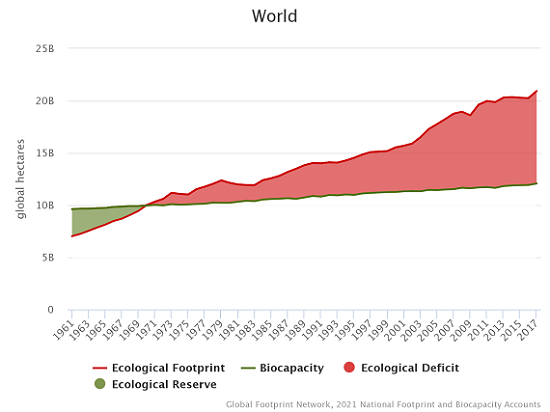
図:1961年以降の世界のエコロジカル・フットプリントとバイオキャパシティのギャップ
出典:グローバル・フットプリント・ネットワーク
このグラフを見ると、エコロジカル・フットプリント(需要)が右肩上がりに増え続けており、1970年以降はエコロジカル・フットプリント(需要)がバイオキャパシティ(供給)を上回っていることがわかります。つまり、1970年以降から現在までの50年間、私たちは、未来の資源を切り崩して消費し続けていることになります。
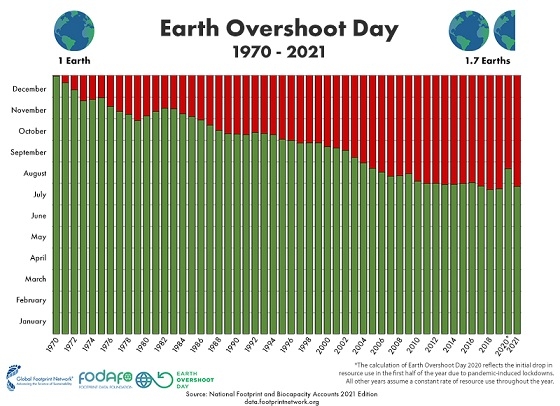
図:1970年から2021年のアース・オーバーシュート・デーの推移
出典:GlobalFootprintNetworkwww.footprintnetwork.org
アース・オーバーシュート・デーの推移は上記の通りです。この図から過去20年間で2カ月間も早まっていることがわかります。2020年は、新型コロナウイルスの影響もあり8月22日と一時的に改善しましたが、2021年は1カ月早い結果となりました。
日本の状況は?国別の資源利用状況
国別のアース・オーバーシュート・デーをみた場合、どのような結果が出るのでしょうか。
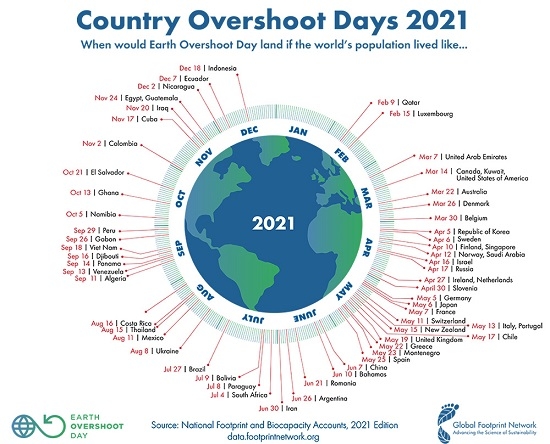
図:2021年 国別のオーバーシュートデー
出典:GlobalFootprintNetworkwww.footprintnetwork.org
最も早くアース・オーバーシュート・デーを迎えるのは、カタールの2021年2月9日です。上記の図に載っていない国、例えばバングラデシュやハイチなどは、自国が1年間で生産・吸収できる自然資源の供給内に収まっており、アース・オーバーシュート・デーを迎えません。
2021年の日本のアース・オーバーシュート・デーは5月6日となり、世界のアース・オーバーシュート・デーより2カ月早い結果となりました。この結果は、地球上のすべての人々が日本人と同じような消費行動をした場合を想定して算出されています。
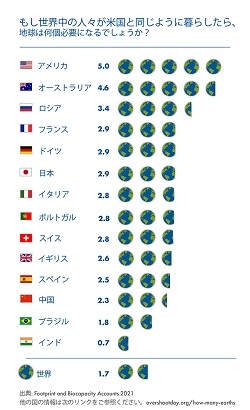 | なお、地球上のすべての人々が日本人と同じような消費行動をした場合、地球2.9個分の資源が必要だと示すデータもあります。 |
| 出典:GlobalFootprintNetworkwww.footprintnetwork.org |
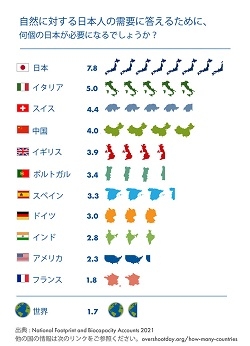 | さらに左記の図は、各国の人々の需要を自国内の自然資源のみで満たそうとした場合、その国の資源が何個分必要かを示した図となります。 |
| 出典:GlobalFootprintNetworkwww.footprintnetwork.org |
エコロジカル・フットプリントとバイオキャパシティの国別のデータは下記です。日本は、エコロジカル・フットプリントに対して、自国のバイオキャパシティが釣り合っていない状況だということがわかります。バイオキャパシティを増やすことは容易ではないため、消費量であるエコロジカル・フットプリントを低減していく必要があります。
▼エコロジカル・フットプリント/バイオキャパシティ 国別ランキング
| エコロジカル・フットプリント(需要) | バイオキャパシティ(供給) |
| 1位 中国 | 1位 ブラジル |
| 2位 アメリカ | 2位 中国 |
| 3位 インド | 3位 アメリカ |
| 4位 ロシア | 4位 ロシア |
| 5位 日本 | 5位 インド |
| - | 25位 日本 |
出典:グローバル・フットプリント・ネットワーク公開情報からアミタ株式会社が作成
考えられる解決策は?深刻なカーボン・フットプリントの課題
GFNの調査によると、2021年のアース・オーバーシュート・デーが早まった主な要因は、カーボン・フットプリントの増加(2020年から6.6%増加)と世界の森林のバイオキャパシティの減少(2020年から0.5%減少)であるといわれています。バイオキャパシティの減少は、主にアマゾンの森林伐採が急増したことによるもので、2021年の予測では森林伐採が前年比で最大43%増加していると言われています。
ここで、エコロジカル・フットプリントの内訳を見てみましょう。
エコロジカル・フットプリントは、人類が環境に与えている負荷を6種類の土地面積に置き換えています。
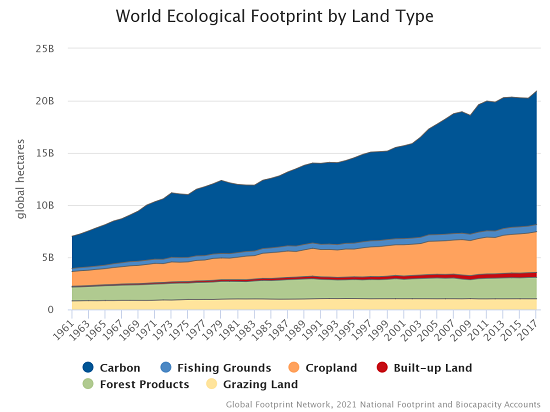
図:土地面積の種類別で表した世界のエコロジカル・フットプリント
出典:グローバル・フットプリント・ネットワーク
青 | : | カーボン・フットプリント(Carbon) 排出された二酸化炭素を吸収するために必要な森林面積の総量 |
水色 | : | 漁場(Fishing Grounds) 様々な魚種の持続可能な漁獲高の最大推計値を利用して計算 |
橙色 | : | 耕作地(Cropland) 人間が消費する食物や繊維物、家畜の飼料、油、穀物そしてゴムを生産するのに使用される土地面積 |
赤色 | : | 生産能力阻害地(Built-up Land) |
緑 | : | 森林地(Forest Products) |
黄色 | : | 牧草地(Grazing Land) |
中でも大きな負荷を与えているのが、主に化石燃料の利用によって排出されたCO2による負荷(カーボン・フットプリント)であり、エコロジカル・フットプリントの約60%を占めています。GFNは、カーボン・フットプリントを現状よりも50%削減すれば、93日つまり約3カ月、アース・オーバーシュート・デーを遅らせることができると試算しています。これらの情報から世界的に見ても、脱炭素への取り組みは欠かせない要素といえるでしょう。
今後は「資源の循環」が重視される
また、自然資源を大量に消費しなくて良い、資源循環の仕組みを作ることが重要と考えます。2020年12月、国際的な総合科学ジャーナル「Nature」に掲載された論文によると、2020年にはじめて、人間が作り出した人工物の質量が地球上の生物体量を上回ったという内容が公表されました。
生産や廃棄に大量のエネルギーが必要となる人工物は、20世紀初頭では生物体量の約3%に過ぎませんでしたが、今や地球上の生物体量を上回っているのです。このペースが続くと、20年後には人工物量が生物量の3倍近くに達すると予測されており、人工物の増加は生態系や気候変動に重大な影響を及ぼします。自然資源を大量に消費せず、エネルギーの利用量を抑えていくためにも、今後、資源循環の仕組みづくりをしていくことはますます重要になってくると考えられます。
参考情報
- Earth Overshoot Day Webサイト:https://www.overshootday.org/2021-calculation/
- Global Footprint Network National Footprint and Biocapacity Accounts, 2021 Edition Downloaded July 26, 2021 from https://data.footprintnetwork.org.
事業創出プログラム「Cyano Project(シアノプロジェクト)」を提供
「Cyano Project(シアノプロジェクト)」は、企業が「イノベーションのジレンマ」に陥ることなく、時代や社会の変化に合わせて新たな価値を創出し、経営と社会の持続性を高めることを目的とした約3年間の事業創出プログラムです。
特設サイトはこちら:https://www.cyano-amita.com/
執筆者プロフィール(執筆時点)
桂山 詩帆(かつらやま しほ)
アミタ株式会社
インテグレートグループ カスタマーリレーションチーム
小杉 日奈子(こすぎ ひなこ)
アミタ株式会社
インテグレートグループ カスタマーリレーションチーム
https://clintballinger.com/2020/02/28/1000-castaways-mmt-ecological-economics-a-review-by-prof-phil-lawn/
1000 Castaways, MMT & Ecological Economics: A Review by Prof. Phil Lawn
1000の漂流者、MMT、生態経済学:教授によるレビューフィル・ローン
1000キャスタウェイ:経済学の基礎、経済学、マクロ経済学、MMT
2020年2月28日
[この記事は、現在フリンダース大学のサウスゲート健康社会・平等研究所の研究責任者であり、アデレード大学の経済学の客員講師であるフィリップ・ローン准教授によって書かれました。これは、彼が親切に共有することに同意した1000の漂流者:経済学の基礎の非公式レビューです。]
「MMTの帽子をかぶった私から始めて、いくつかのコメント。私はあなたが経済の金融面を説明する方法と、通貨システムの発展と経済の生産能力の構築を説明するために使用したストーリーラインがとても気に入りました。システム1(水平マネー)とシステム2(垂直マネー)の二分法は特に便利です。
さて、私の生態経済学の帽子をかぶっています。あまりにも批判的に聞こえることなく、私はあなたが「本当の」リソースとその完全な利用に関して言ったことに2つの問題を抱えていました。私はあなたがすべての実際の生産的な入力を均質で置換可能であるかのようにまとめることに問題がありました(あなたのボックスイラスト)が、MMTの原則に焦点を当てるために物事をシンプルに保とうとしていたかもしれないことを認識しています。
生態経済学者は、天然資源は資本や労働とは大きく異なると考えている。資本と労働は、生産プロセスの資源変革エージェントです。天然資源は、生産を通じて有用な商品やサービス(新しい資本を含む!)に変換するものを構成します。私たちは、資本、労働、天然資源(K、L、R)を比較的一定の割合で使用する傾向があり、新しい技術では時間の経過とともに徐々に変化します。
短期的には、より多くの出力を生成したい場合は、比較的固定された割合(入力ベクトル)でより多くのK、L、およびRを使用します。私たちが生産できるものの限界(最大生産能力)は、これら3つの生産要因の中で最も制限によって決定されます(ケインズは「戦争の支払い方法」、18-19ページでこれを認識しました)。新しい商品やサービスに変身するために天然資源が不足すると、残りのKとLは利用できなくなる。労働は、ほとんどの国にとって生産の制限要因(LFP)である傾向がありますが、悲しいことに、これらの国は多くの労働力を十分に活用されていませんが、ほとんどの国が生態圏がそれらを再生できるよりも高い割合で環境から天然資源を抽出しているからです。ほとんどの国では、生態学的フットプリント(EF)(資源使用率または資源需要)がバイオキャパシティ(BC)(持続可能な資源供給)よりも高い。グローバルレベルでは、グローバルエコロジカルフットプリント(EF)はグローバルバイオキャパシティ(BC)よりも70%大きい。したがって、世界経済は生態学的に持続不可能なレベルで活動しています。生態学的赤字国が天然資源使用率(EF)をバイオキャパシティに限定した場合、多くの人が天然資源が労働ではなく生産の制限要因(LFP)であることに気付くでしょう。
生産LFPの制限要因が何であれ、生産のすべての利用可能な要因が完全に使用される可能性は低いです(つまり、私たちはあなたの本で話す箱の中のすべてを使い果たすことはありません)。未使用のものが丸太やハンマーであるかどうかは関係ありません。使われるものが人間(労働)であれば、それは非常に重要です。したがって、目的は、(i)労働がLFPであること、および(ii)すべての労働が雇用されることを保証するために支出レベルが十分であることを保証することです。
私は(MMTの人々の中には、私がこれらの用語で話すのが好きではない人もいますが)、ジョブ保証は二重機能を果たすことができると信じています。まず、国が生態学的限界内でうまく運営されており、したがって実際の生産量(GDP)の増加が生態学的に持続可能になる場合、JGは政府の支出をf / Eを達成し維持するために必要なレベルに自動的に増やすことで、労働の完全な雇用を達成することができます。これはJG擁護者の標準的な立場です。
2番目のケースでは、国が生態学的フットプリントをバイオキャパシティに合わせるために天然資源使用率を削減(したがって、GDPを減少させる必要があるため、一部の人々によって減少と呼ぶ)、JGは有給作業を通じて制限されたGDPを配給し、生態学的に持続可能なGDPレベルと一致するようにGDPの完全な雇用レベルをもたらすことができます。
[芝生教授は続けます...]
「JGの最初の従来の見解では、JGはGDPをGDPの完全な雇用レベルまで引き上げ、それによって失業格差を埋めます。2番目の例では、JGはGDPの完全な雇用レベルを生態学的に持続可能なGDPレベルに戻すことで、失業格差を埋めます。いずれにせよ、JGの美しさは、労働が常にLFPであることを保証することです。これは、労働の完全な雇用を達成するために必要です。私たちはあなたの箱の中のすべての労働力を使用しますが、必ずしもすべての資本と利用可能な天然資源を使用するわけではありません。
2番目の問題は、私たちが実際にGDPの生態学的に持続可能なレベルで運営したいかどうかに関連しています。JGは、私たちが運営するGDPのレベルに関係なく、完全な雇用があることを保証します。したがって、それが自動的に解決されることを知って、完全な雇用の問題を脇に置くことができます。特定のレベルのGDPを生み出すことに関連する利点とコストがあります。会議で発表した本物の進捗指標(GPI)は、これらの利点とコストをマクロ経済レベルで測定しようとしています。GPIを最大化するGDPのレベルは、最大持続可能率(「最適なマクロ経済規模」とも呼ばれる)よりもかなり低いものである可能性が高く、実際にはおそらくそうかもしれません。もしそうなら、JGが所定の位置にあると仮定して、すべての労働力が使用されますが、さらに少ない天然資源と資本が必要になります。したがって、箱の中にあるものよりもさらに少なく使用されます。資本の場合、現在自由に使えるものよりもはるかに少ないものが必要な場合は、そもそもそれほど蓄積しない可能性が高いと言えるかもしれません。必要以上に多くの資本を蓄積しても意味はなく、それ自体が大きなコストになります。
私はあなたに少し厳しくなったような気がします[注:彼は全く厳しくありませんでした
私の生態経済学ベースの批判はさておき、MMTの原則を学ぶために誰かを本に導かなければならない場合、私は非常に少数の本のいずれかを選ぶことができます。あなたの本を読んだら、私はそれをその短い本のリストに含めます。あなたの本が多くの人々に読まれれば、それは素晴らしいサービスになるでしょう。
乾杯、
フィル
[この記事は、現在フリンダース大学のサウスゲート健康社会・平等研究所の研究責任者であり、アデレード大学の経済学の客員講師であるフィリップ・ローン准教授によって書かれました。これは、彼が親切に共有することに同意した1000の漂流者:経済学の基礎の非公式レビューでした。]
“Some comments, starting with me wearing an MMT hat. I very much liked the way you described the monetary side of the economy and the storyline you have used to explain the development of a monetary system and the building up of an economy’s productive capacity. The System One (horizontal money) and System Two (vertical money) dichotomy is especially useful.
Now, wearing my Ecological Economics hat. Without wanting to sound too critical, I had two problems with what you said regarding ‘real’ resources and their full utilisation. I had a problem with you lumping all real productive inputs together as if they are homogenous and substitutable (your box illustration), although I do realise that you may have been trying to keep things simple in order to focus on the MMT principles.
Ecological Economists consider natural resources to be very distinct from capital and labour. Capital and labour are the resource-transforming agents of the production process. Natural resources constitute the stuff we transform via production into useful goods and services (including new capital!) We tend to use capital, labour, and natural resources (K, L, and R) in relatively fixed proportions, which only gradually changes over time with new technology.
In the short-run, if we want to produce more output, we use more K, L, and R in relatively fixed proportions (a vector of inputs). The limit to what we can produce (maximum productive capacity) is determined by the most limiting of these three production factors (Keynes recognised this in his “How to Pay for the War”, pages 18-19). If we run out of natural resources to transform into new goods and services, then the remaining K and L go unutilised. Labour tends to be the limiting factor of production (LFP) for most countries—although, sadly, these countries leave a lot of labour underutilised—only because most countries extract natural resources from the environment at a greater rate than the ecosphere can regenerate them. Most countries have an Ecological Footprint (EF) (resource use rate or resource demand) greater than their Biocapacity (BC) (sustainable resource supply). At the global level, the global Ecological Footprint (EF) is 70% greater than global Biocapacity (BC). Hence the global economy is operating at ecologically unsustainable levels. If ecological deficit countries were to confine their rate of natural resource use (EF) to their Biocapacity, many would find that natural resources would be the limiting factor of production (LFP), not labour.
Regardless of what the limiting factor of production LFP is, it is unlikely that all available factors of production will be completely used (i.e., we wouldn’t use up everything inside the box you talk about in your book). It doesn’t matter too much if what goes unused is a log or a hammer. It matters a lot if what goes unused is a human being (labour). The aim must therefore be to ensure: (i) that labour is the LFP; and (ii) that spending levels are sufficient to ensure all labour is employed.
I believe (although some MMT people don’t like me talking in these terms) that the Job Guarantee can serve a dual function. Firstly, where a country is operating well within its ecological limits, and thus where an increase in its real output (GDP) will be ecologically sustainable, the JG can achieve full employment of labour by automatically increasing govt spending to the level required to achieve and maintain f/e. This is the standard position of JG advocates.
In the second case, where a country has to reduce its rate of natural resource use (and therefore reduce its GDP – referred to by some people as degrowth) to bring its Ecological Footprint into line with its Biocapacity, the JG can ration the restricted GDP through paid work and thus bring the full employment level of GDP into line with an ecologically sustainable level of GDP.”
[Professor Lawn continues…]
“In the first, more conventional view of the JG, the JG increases GDP up to the full employment level of GDP, thereby closing the unemployment gap. In the second instance, the JG closes the unemployment gap by shifting the full employment level of GDP back to an ecologically sustainable level of GDP. Either way, the beauty of the JG is that ensures labour is always the LFP, which is necessary to achieve the full employment of labour. We end up using all the labour in your box but not necessarily all capital and available natural resources.
Putting aside my Ecological Economics based criticisms, If I had to direct someone to a book in order to learn some MMT principles, I could choose any one of a very small number of books. Having read your book, I would include it in that short list of books. If your book is read by a lot of people, it will do a great service.”
Cheers,
Phil
https://finance.yahoo.co.jp/brokers-hikaku/experts/questions/q10265054390
追記:
オーストラリアのPhil Lawn は環境経済学の一環にMMTを取り入れている。そしてGDPに代わる新たな持続可能な指標GPI(Genuine progress indicator、真の進歩の指標)
を提示している。これは廃棄物などを考慮したもの。その原則は3つ。
1. 再生可能な資源:再生可能な資源よりも早く取り出さない。
2. 非再生可能資源:枯渇した非再生可能資源に代わる再生可能資源を育成(代替)できる速度よりも速く、それらを抽出しない(したがって、自然資本の総量はそのまま維持される)。
3. 廃棄物:生態圏が安全に同化できる速度よりも速く廃棄物を発生させない(Lawn 2018 )。
Phil Lawn. Ecological Economics and the Genuine Progress Indicator. Lect...
2018/10/04

0 件のコメント:
コメントを投稿