The Spectrum of Monetary Sovereignty
To argue that MMT could be policy-relevant for developing countries does not imply that policy recommendations for developed countries would apply to them fully and evenly. Owing to the specific constraints faced by developing countries, the claim has to be more modest. As Randall Wray writes: “MMT can offer useful advice even if it cannot offer a magic wand to wish away all the problems faced by developing nations.”
通貨主権のスペクトル
MMTが発展途上国にとって政策に関連している可能性があると主張することは、先進国の政策提言が完全かつ均等に適用されることを意味するものではありません。発展途上国が直面する特定の制約により、その主張はより控えめでなければならない。ランドール・レイが書いているように、「MMTは、発展途上国が直面するすべての問題を願う魔法の杖を提供できなくても、有用なアドバイスを提供することができます。」
Sylla, N.S., 2020. Modern monetary theory in the periphery. Rosa-Luxemburg-Stiftung. Available at: https://www.rosalux.de/en/news/id/41764/modern-monetary-theory-in-the-periphery. ★★
金ピカ本
10・5│MMTと外的制約──固定相場か変動相場か、それが問題だ
…
国内資源の完全雇用は、裕福な先進国よりも途上国にとってずっと重要だが、現実はまったく逆である。政府が自らに雇用を提供する支出能力がないと考えているので、失業率は途上国の方がずっと高い。それゆえMMTは、途上国が直面するすべての問題を消してしまう魔法の杖を提供できないとしても、有用なアドバイスを提供できる。
10・6│貨幣の文化的遺伝子
本書の初版刊行以降、MMTは一気に広まり、確かにブログの世界で1つの流れを作った。我々に相変わらず足りないのは、どのように説明するかという点である。我々は、人々を怖がらせるのをやめなければならない。問題は理論ではなく、表現にある。
MMTに対する反応は主に道徳的なものである。これは評論家に対する皮肉ではない。ジョージ・レイコフが言うように、あなたはすべてのことを、表現を通して理解する。あなたはメタファーがなければ理解することができない──物語がなければ考えることができないのだ。
Offering by Spiridione Roma 1778 、Neoliberalism's Colonial Origins By Ndongo Samba Sylla 2021
https://love-and-theft-2014.blogspot.com/2022/08/spiridione-roma-17371781.html @


The East Offering its Riches to Britannia (1778)
上は以下の記事に参考画像として使われた有名な絵。
Neoliberalism’s Colonial Origins (Essay) – Money on the Left
By Ndongo Samba Sylla
The East Offering its Riches to Britannia (1778)
Spiridione Roma
Spiridione Roma (Greek: Σπυρίδων Ρώμας (1737–1781), also known as Spiridon or Spyridon Romas, was a Greek-Italian painter, best known for his work in England.[1][2][3]
| ||||||||||||||||||||||||



https://twitter.com/moneyontheleft/status/1524846232627204110?s=21
「植民地時代のアフリカの歴史をその財政的および金銭的側面を通して研究した人々にとって、植民地時代のマクロ経済学と新自由主義のマクロ経済学の間の類似点は目を見張るものがあります。」
| ||||||||||||||||||||||||

https://twitter.com/edi_tweets/status/1533876069056618496?s=21
| ||||||||||||||||||||||||

https://twitter.com/nssylla/status/1521870015611518978?s=21

Mali: souveraineté monétaire et la Cédéao, Avec l'économiste Ndongo Samba Sylla 仏語
https://youtu.be/SaVf5sC1cM8
2022/03/31
The Return of Inflation - Ndongo Samba Sylla 英語
2022/05/13
https://youtu.be/2ppUCYtjGIk
2022/05/18


On May 13, 2022, Ndongo Samba Sylla spoke at a panel discussion entitled "The return of inflation: Realities, Perceptions,
Politics. You can watch the entire event at https://youtu.be/YBtGIA4urDE
Ndongo Samba Sylla is a Research and Programme Manager for the Rosa Luxemburg Foundation. He is the co-author of
Africa's Last Colonial Currency (Pluto, 2021). He is is head of programmes at the Rosa Luxemburg Foundation is well-known
for his books published by Pluto: The Fair Trade Scandal: Marketing Poverty to Benefit the Rich (2014) and Africa's Last
Colonial Currency. The CFA Franc Story (2021).
ニューインターナショナリストがセネガルの開発経済学の専門家に行ったインタビューによれ ... https://newint.org/features/2022/06/08/interview-ndongo-samba-sylla ...
https://www.facebook.com/Professionals.Association.for.Promotion.of.SDGs/posts/2003178406718094

ンドンゴ・サンバ・シラ
Ndongo Samba Sylla
https://twitter.com/nssylla?s=21
@nssylla
[セネガルの経済学者]
財政および金銭的側面を通じて植民地時代のアフリカの歴史を研究した人々にとって、植民地時代のマクロ経済学と新自由主義マクロ経済学の類似点が顕著です。新自由主義時代を植民地主義のアバターとして見たいと思う
かもしれません。実際、新自由主義時代(1980年から2021年)の財政および金融パラダイムの根底にある主な原則(サウンドファイナンス、回帰課税システム、中央銀行の独立性、寡頭主義銀行による信用システムの方向性)は、すでにヨーロッパの植民地、特にアフリカで適用されていました。
新自由主義時代には、健全な金融は、マクロ経済管理の原則として、政府は財政赤字を回避し、財政黒字を熱望すべきであるという考えに基づいています。現代通貨理論(MMT)が示すように、この見解は、世帯と統治通貨発行者の間の誤解を招く類推に基づいています。実際、世帯が純貯蓄を増やすことが望ましいかもしれませんが、独自の通貨を発行する政府は、必ずしもバランスの取れた予算や予算の黒字を実行することに関心を持っているとは限りません。その財政赤字には、その正確なカウンターパートとして、非政府部門の金融黒字があります。政府部門がバランスの取れた予算を持つことを望むなら、これは、世界の他の国々が国内経済に対して赤字の立場にある場合にのみ、国内民間部門(世帯および企業)が金融黒字を達成できることを意味します。
植民地時代には、健全な金融は今日よりもはるかに基本的で透明な正当性を持っていました。本質的に帝国の教義として、大都市は自己資金調達であるはずの植民地企業に財政的に参加するつもりはないということにまでさわった。歴史家が言うように、「植民地時代の自給自足政策」は、植民地化された領土が軍事征服の費用、植民地政権の現在の支出、およびそれらの投資支出を支払わなければならないことを暗示しました。大都市は、植民地の財政状況がそれを必要とするときに、補助金やローンを付与することによって散発的に介入することになっていました。
植民地企業の高価または不採算の性格に関する大都市のレトリックにもかかわらず、実際には、後者は本質的に税金と強制労働を通じて植民地によって資金提供されていたということです。大都市からの公共移転は、アフリカ大陸の2つの旧および最も重要な大都市大国であるフランスとイギリスの両方にとって比較的マイナーでした。
大都市政府が植民地の金融業務を支配していたため、彼らは植民地政権を通じて、徐々に税金が徴収される勘定単位を課すことができた。これは、MMTが教えているように、本質的な財政的制約がないことを意味しました。原則として、彼らは地元の支出を賄うために税金に頼らなかった。しかし、植民地経済政策の抜粋的な方向性のために、財政空間を拡大する可能性は使用されなかった。
バランスの取れた予算を実行する選択は、植民地政府が通常、民間部門(特に先住民族の民間部門)の純金融資産を生み出さなかったことを暗示した。民間部門による金融資産の蓄積、したがって国内所得と税収の成長は、外部の金融バランスに依存していました。
この抽出的オリエンテーションは、植民地時代の金銭的取り決めと、最初からオリゴポリスティック銀行が支配する銀行部門の行動によって強調されました。財政緊縮と並行して、植民地と大都市の間の自由な資本移動の文脈における植民地通貨と大都市通貨の間の固定パリティと、(大英帝国の通貨委員会と同様に)外国為替準備金で完全にマネーサプライをカバーする義務は、金融政策に非常に制限的な性格を与えました。民間銀行は、抽出活動とは対照的に生産的な活動に資金を提供しない自由という自由を持って信用システムを組織すべきであり、植民地政府はバランスの取れた予算を維持するべきだという考えは、帝国の信条の一部でした。
西アフリカの主要な英国植民地では、イギリス西アフリカ銀行とバークレイズDCOは、20世紀の最初の60年間、ほとんど挑戦されていない支配を樹った。メトロポリタン銀行の役割は、一般的に、信用へのアクセスの差別を通じて地元の起業家を犠牲にして大都市企業の利益を保護することでした。また、一次製品の輸出の短期資金調達と、大都市への地域経済黒字(金融貯蓄)の移転を促進することもありました。
キャプティブマーケットと安価な原材料供給源として、植民地帝国も大都市の金融弁の役割を果たしました。イングランドの場合、最も資源が豊富な植民地による外国為替準備金の過剰蓄積は、その財政の安定性とロンドンのマネーマーケットにおける再発流動性危機の緩和に大きく貢献しました。
19世紀の最後の数十年間、イギリスはドイツと米国に対する産業と商業の優位性を失っていた。この文脈では、イングランドはインドの外部黒字を支配したおかげで、国際金本位制と財務リーダーシップの両方を維持することができました。第二次世界大戦後、ナイジェリアとガーナはスターリング地域で同様の役割を果たした。イギリスからこれら2つの領土への資本輸出は、ロンドンで蓄積したスターリング残高よりも低かった。これらの外部黒字は、輸入の大幅な削減によって構築されました。これは、片思いの輸出の概念によって説明されている現実です。
今日では、新自由主義の下で、グローバルサウスの多くの国にとって、バランスの取れた予算と輸出に与えられた優先事項、地元の資源が十分に活用されていない文脈での外国為替準備金の過剰蓄積、外国銀行や金融機関の支配的な役割、「本当の」経済の資金調達不足などはすべて、植民地時代との継続性の要素を表しています。
新自由主義経済学は、貿易と金融の流れがかつて正式な植民地帝国の共存によって作成された障壁によってますます妨げられなくなる文脈における植民地経済学の論理の反復です。新自由主義では、後者はグローバル化された資本のネットワークと機関に置き換えられます。グローバルノースでは、植民地時代の経済論理のこの追求は、労働者階級の以前の社会経済的および政治的成果が損なうこと、したがって国内の不平等の拡大を伴います。労働者階級権力の弱体化に次ぐグローバルサウスのほとんどでは、新自由主義は、デフレ政策の賦課、強制的な「自由貿易」、民営化、金融自由化を通じて、国家と人々の自己決定権を抑圧することで構成されてきました。
このような向きで壊れるには、MMTは少なくとも2つの面で価値があります。一方、植民地時代のマクロ経済学の構成原則(財政当局と通貨当局の厳格な分離、健全な財政、輸出の優先順位、外部準備金の過剰蓄積、外国金融への依存など)を批判する要素を提供します。一方、MMTは、不利な外部環境であっても、グローバルサウスの国々が通常認められているよりも大きな財政空間を作り出すことができることを強調することで、国内資源の動員に関する経済政策の方向転換することができます。
共有された持続可能な繁栄を達成するには、新自由主義の植民地経済学に対する強い認識論的挑戦が必要です。また、植民地主義の経済論理を再現する支配の世界的な構造に対処すること、公共政策の方向性、経済資源や手段の管理を大衆統制に提出するなど、他のいくつかの面で協調的な努力が必要になります。
https://moneyontheleft.org/2021/06/14/neoliberalisms-colonial-origins/By Ndongo Samba Sylla
For those who have studied the history of colonial Africa through its fiscal and monetary dimensions, the similarities between colonial macroeconomics and neoliberal macroeconomics are striking. One might be tempted to see the neoliberal era as an avatar of colonialism. Actually, the main principles underlying the fiscal and monetary paradigm of the neoliberal era (1980 – 2021)—sound finance, regressive taxation systems, central bank independence, and the direction of the credit system by oligopolistic banks—were already applied in the European colonies, particularly in Africa.
In the neoliberal era, sound finance, as a principle of macroeconomic management, is based on the idea that governments should avoid fiscal deficits and should even aspire to fiscal surpluses. As Modern Monetary Theory (MMT) shows, this view is based on the misleading analogy between a household and a governing currency-issuer. Indeed, while it may be desirable for households to build up net savings, a government that issues its own currency may not always have an interest in running a balanced budget or even budget surpluses. For its fiscal deficit has as its exact counterpart the financial surplus of the non-government sector. If the government sector wishes to have a balanced budget, this means that the domestic private sector (households and businesses) will only be able to achieve a financial surplus if the rest of the world is in a deficit position vis-à-vis the domestic economy.
During colonial times, sound finance had much more basic and transparent justifications than it does today. As an imperial doctrine by essence, it amounted to saying that the metropolis did not intend to participate financially in the colonial enterprise, which was supposed to be self-financing. The "colonial self-sufficiency policy," as historians call it, implied that the colonized territories had to pay for the costs of military conquest, the current expenditures of the colonial administrations as well as their investment expenditures, which were often oriented towards infrastructure projects that favored the profitability of private metropolitan capital. The metropolis was just supposed to intervene sporadically, by granting subsidies or loans, when the financial situation of the colonies required it.
In spite of the metropolitan rhetoric on the expensive or unprofitable character of the colonial enterprise, the fact is that the latter had been financed essentially by the colonies, through taxes and forced labor. Public transfers from the metropolis had been relatively minor, both for France and England, the two former and most important metropolitan powers on the African continent.
Since metropolitan governments ruled the monetary operations of their colonies, they managed through the colonial administrations to gradually impose a unit of account in which taxes would be collected. This meant, as MMT teaches, that they had no intrinsic financial constraint. In principle they did not depend on taxes to finance their local expenditures. The possibility to expand their fiscal space was not used, however, owing to the extractive orientation of colonial economic policy.
The choice to run balanced budgets implied that the colonial government did not usually create net financial wealth for the private sector (and in particular for the indigenous private sector). The accumulation of financial wealth by the private sector—and thus growth of domestic income and tax revenues—was made dependent on the external financial balance.
This extractive orientation was accentuated by colonial monetary arrangements and by the behavior of the banking sector, dominated from the outset by oligopolistic banks. In parallel with fiscal austerity, the fixed parity between the colonial and metropolitan currencies in a context of free capital mobility between the colonies and the metropolis and the obligation to cover the money supply entirely with foreign exchange reserves (as with the currency boards in the British Empire) gave a highly restrictive character to monetary policy. The idea that private banks should organize the credit system with some freedom—the freedom not to finance productive activities as opposed to extractive activities—while colonial governments should maintain balanced budgets was part of the imperial credo.
In the major British colonies in West Africa, the Bank of British West Africa and Barclays DCO ruled almost unchallenged for the first six decades of the 20th century. The role of metropolitan banks had generally been to protect the interests of metropolitan businesses at the expense of local entrepreneurs through discrimination in access to credit. It had also consisted in facilitating the short-term financing of the exports of primary products as well as the transfer of local economic surpluses (financial savings) to the metropolis.
As captive markets and cheap sources of supply of raw materials, colonial empires also played the role of financial valve for the metropolises. In the case of England, the over-accumulation of foreign exchange reserves by its most resource-rich colonies had contributed significantly to its financial stability and to the alleviation of recurrent liquidity crises on the London money market.
During the last decades of the 19th century, England had lost its industrial and commercial edge over Germany and the United States. In this context, England was able to maintain both the international gold standard and its financial leadership only thanks to its control over India's external surpluses. In the aftermath of the Second World War, Nigeria and Ghana played a similar role in the sterling area. Capital exports from England to these two territories were lower than the sterling balances they had accumulated in London. These external surpluses were built up through a drastic reduction in their imports, a reality described by the concept of unrequited exports.
Nowadays, under neoliberalism, for many countries of the Global South, the priority given to balanced budgets and exports, the over-accumulation of foreign exchange reserves in a context where their local resources are under-utilized, the dominant role of foreign banks and financial institutions, the under-financing of the "real" economy, etc., all represent elements of continuity with the colonial period.
Neoliberal economics, it could be argued, is an iteration of the logic of colonial economics in a context where trade and financial flows are less and less hampered by the barriers once created by the coexistence of formal colonial empires. With neoliberalism, the latter are replaced with the networks and agencies of globalized capital. In the Global North, this pursuit of colonial economic logic entails an undermining of the previous socioeconomic and political achievements of working classes and hence a widening of within-country inequalities. In most of the Global South, next to the weakening of working classes power, neoliberalism has consisted in suppressing nations and peoples right to self-determination through the imposition of deflationary policies, forced "free trade," privatization and financial liberalization.
To break with such an orientation, MMT is valuable in at least two aspects. On the one hand, it provides the elements for a critique of the constitutive principles of colonial macroeconomics (rigid separation between fiscal authority and monetary authority, sound finance, priority to exports, over-accumulation of external reserves, dependence on foreign finance, etc.). On the other hand, MMT allows us to reorient economic policy around the mobilization of domestic resources by emphasizing that, even in an unfavorable external environment, the countries of the Global South can create a fiscal space that is larger than usually admitted.
Achieving shared and sustainable prosperity will necessitate a strong epistemic challenge to neoliberalism's colonial economics. It will also require concerted efforts on several other fronts: addressing global structures of domination that reproduce the economic logic of colonialism; submitting to popular control the orientation of public policies as well as the management of economic resources and instruments.
Spiridione Roma
The Offering
オファリングのテーマの中心は、左側の岩の多い高い玉座に座っている公正な天使のような女性によるブリタニアの描写です。彼女の目の前には、インドを代表する浅黒い肌の女性がいます。さらにひざまずいているもう一人の女性は中国です。インドは、彼女の王冠とルビーと真珠をブリタニアに捧げている。 1778年までに、東インド会社はエリザベス1世によってインディーズで取引する最初の憲章を受け取ってからすでに178年を完了していました。それまでに、同社は世界で最も繁栄している事業体の1つになっていた。 同社の会長...
Read more at: https://www.deccanherald.com/content/587136/follow-trail-paint.html
イタリアの芸術家、スピリディオーネ
Follow this trail of paint... | Deccan Herald
Read more at: https://www.deccanherald.com/content/587136/follow-trail-paint.html
Spiridione Roma
The Offering
この絵の具の跡をたどってください...| デカン・ヘラルド
https://www.deccanherald.com/content/587136/follow-trail-paint.html
Follow this trail of paint...
By 1778, the East India Company had already completed 178 years since receiving its first charter to trade in the Indies by Queen Elizabeth I. By then, the company had become one of the most prosperous entities in the world.
The chairman and the 24 directors of the company had moved to their opulent office, the East India House, on Leadenhall Street in London. The John Company, as it had come to be known, had established territorial control of 7% of India.
The board of directors, in all their vainglory, commissioned the well-known Italian artist of the time, Spiridione Roma, for a spectacular illustration of how Britain had enriched Britannia by monopolising trade with India, China, and Indonesia.
The directors wanted Spiridione to depict the virtually divine, ordained pre-eminence of Britain over the East, and how Asia was willingly offering its riches to Britannia through the trading supremacy established by the East India Company.
Spiridione’s painting, measuring 10 feet across and 8 feet high, was fixed to the ceiling of the company’s Revenue Committee room, where the fat-cat directors monitored the flow of wealth from the East. The painting was brazenly titled The Offering.
Central to the theme in The Offering is the depiction of Britannia by a fair angelic lady sitting on a rocky high-throne to the left. In front of her is a dark-skinned lady representing India. Yet another lady kneeling is China. India is shown offering her crown, along with rubies and pearls, to Britannia.
China presents her tribute in the form of a chest of tea and porcelain. From the palm grove to the right, Indonesian labourers are shown carrying spices. Bales of cloth are brought in by an elephant and a camel. Mercury, the God of Commerce, is shown directing the labourers westward.
At Britannia’s feet sits the imposing British Lion and the bearded Old Father Thames. Far beyond in the ocean, a ship belonging to the John Company is sailing with the treasures of the East.
The East India House was adorned with several other similar depictions of Britain’s hegemony over Asia. Many artefacts looted from India were displayed in there, including the French-made automated tiger of Tipu Sultan.
However, there were many prominent citizens in Britain who were appalled by the blatant exploitation of the East by the John Company. Paradoxically, many politicians were shareholders in the East India Company. They turned a blind eye to the unethical actions of the company in India and elsewhere.
The 1857 uprising brought an end to East India Company’s rule in India. The John Company was so discredited by then that the East India House was brought down in 1861. Most of the artefacts were moved to other museums.
The Offering was shifted to the India office. It was later moved to the Foreign and Commonwealth Office in Whitehall, and still remains mounted on the Gurkha staircase.
この絵の具の跡をたどってください...| デカン・ヘラルド
https://www.deccanherald.com/content/587136/follow-trail-paint.html
絵の具の跡をたどってください...
1778年、東インド会社は、エリザベス1世からインド貿易の最初の勅許を得てからすでに178年を経過していた。
会長以下24人の取締役は、ロンドンのリーデンホール・ストリートにある豪華なオフィス「イースト・インディア・ハウス」に移っていた。ジョン・カンパニーと呼ばれるようになった会社は、インドの7%を領土として支配権を確立していた。
取締役会は見栄を張って、当時有名だったイタリアの画家スピリディオーネ・ローマに、イギリスがインド、中国、インドネシアとの貿易を独占してブリタニアをいかに豊かにしたか、壮大なイラストを依頼したのである。
役員たちはスピリディオーネに、イギリスが東洋に対して事実上神から与えられた優位性を持ち、東インド会社が確立した貿易の優位性によって、アジアがいかに進んでブリタニアに富を提供しているかを描かせたかったのです。
スピリディオーネの絵は、横10フィート、縦8フィートの大きさで、会社の収入委員会の部屋の天井に固定され、太っちょの取締役たちが東洋からの富の流れを監視していた。その絵のタイトルは「The Offering」。
献金」のテーマの中心は、左側の岩の高台に座る天使のような美しい女性によるブリタニアの描写である。その前にいるのは、インドを表す肌の色の濃い女性。さらにもう一人、ひざまずいている女性は中国である。インドは王冠とルビーと真珠をブリタニアに捧げています。
中国は茶箪笥と陶磁器という形で貢ぎ物を差し出しています。右側の椰子林からは、インドネシアの労働者が香辛料を運んでいる様子が描かれています。象とラクダが布を運んでいる。商いの神マーキュリーは、労働者たちに西へ向かうよう指示している様子が描かれています。
ブリタニアの足元には堂々とした英国のライオンと髭を生やしたテムズ爺が座っている。遥か海の向こうでは、ジョン会社の船が東洋の宝物を積んで航海している。
東インド会館には、英国のアジアに対する覇権を示す同様の描写が他にもいくつか飾られていた。インドから略奪された品物も多く、フランス製のティプ・スルタンの自動トラなどもそこに展示されていた。
しかし、イギリスには、ジョン・カンパニーによる東洋の露骨な搾取に憤慨した著名な市民がたくさんいた。逆説的だが、多くの政治家が東インド会社の株主であった。彼らは、インドなどでの同社の非倫理的な行為に目をつぶっていた。
1857年の蜂起によって、東インド会社のインド支配は終わりを告げた。1861年には東インド会館が破壊されるほど、ジョン・カンパニーの信用は失墜していた。ほとんどの遺品は、他の博物館に移されました。
献上品はインド事務所に移されました。その後、ホワイトホールの外務英連邦省に移され、現在もグルカ階段に取り付けられたままになっています。
Spiridione Roma
Spiridione Roma (Greek: Σπυρίδων Ρώμας (1737–1781), also known as Spiridon or Spyridon Romas, was a Greek-Italian painter, best known for his work in England.[1][2][3]
Biography
He was born in Corfu, then a territory of the Republic of Venice. Little is written about his biography and training. He is best known for an allegorical ceiling piece, The East Offering its Riches to Britannia (1778), commissioned by the East India Company for the Revenue Committee Room in the East India House in London.[4] The painting generally represents the era's panegyric to Britain's imperial and colonialist domination.[5] The painting is described in Gentleman's Magazine (1778) as follows:
The principal figure represents Britannia seated on a rock, to signify the firmness and stability of the empire; and as guardian and protectress of the Company, who are denoted by children behind Britannia, and overshadowed by her veil. The union of the old and new Companies is expressed by two children embracing each other, and one of them placed sitting on the upper part of the rock, to show the firm basis on which the present Company stands; on the other part of the rock the child climbing up towards the summit is intended to express the prospect of the Company’s continuance.
Britannia is characterised by the usual emblems of the shield and spear, and guarded by a lion, which lays tamely by her side, pleased with the offerings made her from the different East-Indian provinces. At the foot of the rock lays the genius of the Ganges, in a majestic attitude, pouring out his whole stream on Britannia’s footstool. The various provinces are represented under the Conduct of Mercury, the god of merchandise, eagerly pressing to deposit their different produce and manufactures before the throne of Britannia. Calcutta (the capital settlement of the Company in Bengal) presents a basket with pearls and other rich jewels, which Britannia receives. China is characterised by jars of porcelain and chests of tea; the produce of Madras and Bombay by a corded bale; Bengal is denoted by an elephant, palm-trees and a camel.
Persia appears at a distance bringing silks, drugs, and other effects, and with her are to be supposed all the rest of the provinces; which the artist could not describe on the canvas without crowding or destroying the whole composition, and harmony of the picture. At a distance is an Indiaman under sail, laden with the treasure of the East, an emblem of that commerce from which both Britain and the Company derive great and singular advantages.[6]
The painting is now in the Foreign and Commonwealth Office in London.[7]A reproduction is held in the British Library in London. Other works by Roma in the British National Trust collections include An Illusionistic Gothic Patron's Pew, in the Extension of the Chapel (c.1769/1771).[8]
References
- Drakopoulou, Eugenia (2016). "Pittura Romeica in Italy: Artistic transfers across the Adriatic sea (18th - 19th centuries) Volume 13". The Historical Review/La Revue Historique. Athens GR: National Hellenic Research Foundation. 13: 17, 20. doi:10.12681/hr.11553.none
- Hatzidakis, Manolis & Drakopoulou, Eugenia (1997). Greek painters after the fall (1450-1830) Volume B. Athens GR: Center for Modern Greek Studies E.I.E. pp. 205–208.none
- Staff Writers (6 August 2021). "The unknown great Corfiot-European painter Spyridon Romas". Corfuland. Retrieved 6 August 2021.none
- Gentleman's Magazine 48 (1778), 628-29.
- The Ideologies of the Raj, Cambridge, page 18.
- "Genetleman's Magazine". 48. 1778: 628–29.none Cite journal requires
|journal=(help) - The painting is discussed in Phiroze Vasunia, ‘Memories of Empire', in the Oxford World History of Empire, vol. 1: The Imperial Experience, edited by Peter Fibiger Bang, C. A. Bayly, and Walter Scheidel (Oxford, 2021), pp. 497–522.
- The History and Antiquities of London, Westminster, Southwark, and Parts Adjacent, page 492.
 | This article about an Italian painter born in the 18th century is a stub. You can help Wikipedia by expanding it. |
 | This biographical article about a painter from England is a stub. You can help Wikipedia by expanding it. |
スピリディオネ・ローマ

スピリディオネ・ローマ(ギリシャ語:ΣπυρίδωνΡώμας(1737-1781)は、スピリドンまたはスピリドン・ローマとしても知られ、ギリシャ系イタリアの画家で、イギリスでの彼の作品で最もよく知られています。[1][2][3]
伝記[編集]
彼は当時ヴェネツィア共和国の領土であったコルフ島で生まれた。彼の伝記と訓練についてはほとんど書かれていません。彼は、ロンドンの東インドハウスの収益委員会室のために東インド会社から委託された寓意的な天井作品、ブリタニアに富を提供する東(1778)で最もよく知られています。[4] この絵画は一般的に、英国の帝国と植民地主義の支配に対する時代のパネギリックを表しています。[5] この絵はジェントルマンズマガジン(1778)に次のように記載されています。
この絵は現在、ロンドンの外務省にあります。7] 複製はロンドンの大英図書館で行われます。ブリティッシュ・ナショナル・トラスト・コレクションのローマの他の作品には、チャペルの拡張(1769/1771年頃)の幻想的なゴシック・パトロンのピューが含まれます。[8]
参考文献[編集]
- ^ ドラコプル、ユージニア(2016)。「イタリアのピットゥーラ・ロミカ:アドリア海を渡る芸術的移転(18世紀から19世紀)第13巻」。歴史的レビュー/ラ・レビューの歴史。アテネGR:国立ギリシャ研究財団。13:17、20.doi:10.12681/hr.11553。
- ^ Hatzidakis, Manolis & Drakopoulou, Eugenia (1997).秋の後のギリシャの画家(1450-1830)B巻。アテネGR:現代ギリシャ研究センターE.I.E.pp.205-208。
- ^ スタッフライター(2021年8月6日)。「未知の偉大なコルフィオ・ヨーロッパの画家スピリドン・ローマス」。コルフランド。2021年8月6日取得。
- ^ 紳士誌48(1778)、628-29。
- ^ ラージのイデオロギー、ケンブリッジ、18ページ。
- ^ 「Genetleman's Magazine」。48です。1778:628-29。
{{cite journal}}: Cite journal requires|journal=(help) - ^ この絵は、オックスフォード世界帝国史のフィロゼ・ヴァスニア「帝国の記憶」で議論されています。1:帝国体験、ピーター・フィビガー・バン編、C.A。ベイリーとウォルター・シャイデル(オックスフォード、2021年)、pp.497-522。
- ^ ロンドン、ウェストミンスター、サザーク、隣接する部品の歴史と骨董品、492ページ。


https://newint.org/features/2022/06/08/interview-ndongo-samba-sylla?fbclid=IwAR0Th32j7XlQI74zzDDZGB1qYLCIrxeRuv2aXVN20lUfvXxnrm-YfWtxbXU
The interview: Ndongo Samba Sylla
Report
11 July 2022 ★

Ndongo S Syllaは、ネオ植民地主義は時代遅れの用語だと信じている。彼をもっと心配しているのは、アフリカのエリートが企業の国境を越えた利益と同盟しているアフリカの自由主義の傾向です。
私たちは、彼がローザ・ルクセンブルク財団のダカール事務所で働いているセネガルの首都から電話で話します。シラは、西洋金融との関係がどのように経済的自立を妨げ続けているかを説明します。彼は是正を提供しています:セネガルとアフリカ大陸はより広く、現在の搾取的、輸出ベースの自由貿易モデルから逃れ、代わりに親人と生態学である政策を策定することができます。
シラは、21世紀のアフリカの経済と金融主権の共同編集者であり、フェアトレードスキャンダルの著者であり、アフリカの最後の植民地通貨:CFAフランストーリーの共著者です。
セネガルは多額の債務貧困国に分類され、世界で最も高い外部債務の1つです。どうやってここに来たの?
最初に言うべきことは、GDPの70%を占めるセネガルの債務は、世界で最も負債のある国から遠く離れていることを意味するということです。例えば、日本にはGDPに対する負債比率が250パーセントある。違いは、借金は日本円で保有されているため、決して破産することはできませんが、セネガルは外貨建てです。
それで、どうやってここに来たの?さて、1967年以来、私たちは構造的な貿易赤字の状況にあります。現在の政府の主な経済青写真である「Plan Senegal Emergent」を見ると、インフラプロジェクトのリストにすぎません。それは主にフランス企業に利益をもたらしました。2019年、私たちの輸入は輸出の2倍の価値であり、貿易赤字はGDPの10%以上でした。
資金調達する唯一の方法は、送金、外国直接投資、または外貨での債務の発行、ユーロ債などの商品を通じてです。
2018年、私たちは2つのユーロ債を発行しました。金利は、投資銀行による信用リスクの評価に基づいて設定されます。10億ドル相当の債券の1つについて、レートは6.75%です。したがって、30年以上にわたり、私たちは2倍の返済ことになります。私たちは新しい借金を発行することで現在の借金を支払います。独立以来、それはセネガルの開発モデルでした。それは古典的なポンジスキームです。
現在の政府が追求する経済モデルについて詳しく教えていただけますか?
彼らのモデルは外国為替の探求によって定義される。私たちの政府の論理は、彼らが「資金不足している」ので、外国人投資家や資本にとって国を魅力的にしなければならないということです。そして、彼らはEUとの貿易取引、または中国との取引を通じてそれを行います。
私たちには、投資促進庁(APIX)のような政府機関があり、その唯一の仕事は外国投資を引き付けることです。これは彼らの唯一の光学系です。彼らは生態学的損害、または長期的に国際収支に対する外国投資の結果を考慮していません。
広告
政府は健康、仕事、環境への影響に興味がない。彼らは、この合意を通じて、例えば欧州連合から100万ドルを受け取り、「これはこれまたはそれに対処するのに役立つだろう」と言います。それは純粋で短期的な財務推論です。そして私にとって、これは反開発と反人々です。しかし、それは彼らがどのように機能するかです。
欧米の貿易相手国は政府の決定にどのような圧力をかけていますか?
欧州連合、ロシア、中国はすべて、私たちの魚や他の魚介類のような製品へのアクセスを望んでいます。そして、一般的に、そのアクセスを確保するために、彼らは公正で民主的で透明な方法で交渉されていない貿易協定を結んでいます。このセクターで働く俳優が相談されなかったり、満足していないため、最新の取引はスキャンダルであると新聞で読むことがよくあります。
フランスは常に私たちの主要な貿易相手国でしたが、それは減少しており、量ではなく、シェアです。中国はますます存在感が高きている。フランス政府は、Total Energies(旧Total)のような企業にアクセスするために政治的レバーを使用しています。彼らは入札に含まれていないときに、私たちの石油とガスの埋蔵量を探索するライセンスを付与されました。石油部門の大臣は抗議して辞任した。
ウクライナでの戦争とロシアのガスへの依存を減らすEUの意志により、石油とガスの供給、グリーン水素などのエネルギーを確保するために、アフリカ大陸に対する一種の「スクランブル」があります。ドイツのオラフ・ショルツ首相は、セネガルへの最近の訪問中に、マッキー・サル大統領とガス取引を交渉しました。
新自由主義正統派はセネガルの金融部門で支配的な哲学だと思いますか?
はい。APIXの人たちは、世界銀行、フランスまたはヨーロッパの開発機関を喜ばせたい人々です。彼らは信頼できるようです:言語、彼らが着ている服。彼らは良いマネージャーとして認識されたいと思っています。なぜなら、ある時点で、彼らは貿易交渉人として、または世界銀行のために働き続けるかもしれないからです。
私はこれを利益相反だと考えています。首相や財務大臣を務める人々のほとんどは、グローバル金融界から来ており、グローバル金融の利益に反することはありません。
2020年、ベナンの財務大臣はアフリカ諸国の対外債務の取り消しに反対した。それが人々の考え方です:彼らは外国投資に有益な方法で私たちの国をフォーマットする必要があります。通常、彼らは「開発」である可能性のある外国投資とは対照的に、抽出主義者である投資のみを引き付けます。
セネガルはどのようにして西洋の貿易相手国への依存を減らすことができますか?
1つの解決策は、ブロックとして交渉することです。しかし、これは欧米列強が使用する分裂と支配戦略では難しいことが証明されています。2000年以来、EUは西アフリカとの経済パートナーシップ協定(EPA)(貿易自由化協定)に署名するために懸命に取り組んできました。ナイジェリアはその主なブロックでしたが、コートジボワールとガーナは暫定協定を別々に交渉しています。
「最小先進国」として、セネガルはEPAに署名する義務がない。セネガルの貿易専門家による研究は、私たちが負けることを示しています。しかし、EUが圧力をかけ、大統領のマッキー・サルがEUと良好な関係にあるため、とにかく署名しました。彼は西洋の利益の忠実な同盟国です。
どのような代替経済モデルが浮上していると思いますか?
私たちは自立し、反資本主義の枠組みのために行かなければならない。それは自閉症を意味するのではなく、人々に利益をもたらす方法で関係を再交渉することを意味します。
このモデルは試行錯誤によって発明されなければならない。例えば、スーダンは2018年の外国為替危機の後、輸入食品を購入できなくなったため、農業生産性を高めるために動いた。
経済的自立は最も重要ですが、資本主義の下で達成することは困難です。より持続可能で豊かな社会を望むなら、私たちは「お金が不足している」という考えを破らなければなりません。主権通貨を発行する国は、現地で利用可能なリソースに基づいてプロジェクトに資金を提供することができます。これは基本的な現代通貨理論であり、強力なアイデアです。
変化への希望を与えるものは何ですか?
特にフランス語圏諸国では、いくつかの変化がありました。私たちの大統領はかつてフランスの知事のように振る舞っていましたが、これは変わり始めています。そして、解放に対する前向きな欲求がわかります。アフリカの若者はもはや提供されているものに満足していない。彼らは仕事を望んでいます...ある時点で、彼らはもはや現在利用可能なものに満足しないでしょう。
しかし、人々は資本主義がどのように機能するかを理解するために、単に「反植民地時代」であることから焦点を広げる必要があります。私たちがアフリカで経験していることは、もはやネオ植民地主義とは表現できません。それは時代遅れの用語です。私にとって、私たちはグローバリズムの時代に生きています。勝つのは資本の抽象的な論理です。
私たちの状況は、入植者のいない植民地主義のようなものです。これは、この目に見えない植民地時代の論理がアフリカ人によって実装できることを意味します。この傾向は悪質です - 私はそれをアフロ自由主義と呼んでいます。
開発と生態学の新しいビジョンを開発するには、政治に影響を与えるために強力な連合を構築する必要があります。これは可能です:それは良いリーダーシップと良い文脈に依存します。
★
The Senegalese development economist speaks to Hazel Healy about monetary sovereignty, debt – and the perils of Afro-liberalism.
Ndongo S Sylla believes neo-colonialism is an outdated term. More worrying for him is the trend of Afro-liberalism, which sees African elites allied with corporate transnational interests.
We speak over the phone from the Senegalese capital, where he works at the Dakar office of the Rosa Luxemburg Foundation. Sylla explains how ties to Western finance continue to obstruct economic independence. He offers a corrective: that Senegal – and the African continent more widely – could escape the current exploitative, export-based, free-trade model and instead develop a policy that is pro-people and ecology.
Sylla is the co-editor of Economic and Monetary Sovereignty in 21st Century Africa, author of The Fair Trade Scandal and co-author of Africa’s Last Colonial Currency: the CFA Franc Story.
Senegal is classified as a Heavily Indebted Poor Country, with one of the highest external debts in the world. How did it get here?
The first thing to say is that Senegal’s debt, at 70 per cent of GDP, means it is far from the world’s most indebted country. Japan has a 250 per cent debt to GDP ratio, for example. The difference is that its debt is held in Japanese yen so it can never be insolvent, while Senegal’s is denominated in foreign currency.
So how did we get here? Well, since 1967 we have been in a situation of structural trade deficit. If you look at the ‘Plan Senegal Emergent’, the main economic blueprint of the current government, it’s just a list of infrastructure projects. It has mainly benefited French companies. In 2019 our imports were twice the value of our exports and our trade deficit was more than 10 per cent of GDP.
The only way to finance that is through remittances, foreign direct investment or issuing debt in foreign currency – through instruments like Eurobonds.
In 2018 we issued two Eurobonds. The interest rate is set based on an evaluation of credit risk by investment banks. For one of the bonds valued at $1 billion, the rate is 6.75 per cent. So over 30 years, we will end up paying back twice as much. We pay the current debt by issuing new debt. Since independence, that has been the development model of Senegal. It’s a classic Ponzi scheme.
Can you tell us more about the economic model pursued by the current government?
Their model is defined by a quest for foreign exchange. Our government’s logic is that they ‘lack funding’, so they have to make the country attractive for foreign investors and capital. And they do that through trade deals with the EU, or by doing business with China.
We have government bodies like the Agency for the Promotion of Investment (APIX) whose sole job is to attract foreign investment. This is their only optic; they do not factor in ecological damage, or the consequences of foreign investment on the balance of payments over the long term.
The government is not interested in the consequences for health, jobs, or the environment. They say through this agreement they will receive, say, $1 million from the European Union and ‘this will help us to address this or that’. That is pure, short-termist financial reasoning. And for me this is anti-development and anti-people. But that’s how they function.
What pressures do Western trading partners exert on government decisions?
The European Union, Russia and China all want access to products like our fish and other seafood. And, generally, to secure that access, they make trade agreements that are not negotiated in a fair, democratic and transparent way. Often you will read in the newspapers that latest deal is a scandal because the actors who work in this sector were not consulted, or are not happy.
France has always been our main trading partner but it is in decline, not in volume but in share. China has more and more presence. The French government uses political levers to get access for its companies like Total Energies [formerly Total]. They were granted a licence to explore our oil and gas reserves when they weren’t even included in the tender. Our oil sector minister resigned in protest.
With the war in Ukraine and the EU’s will to reduce its dependence on Russian gas, there is a kind of ‘scramble’ towards the African continent in order to secure oil and gas supplies, as well as energies such as green hydrogen. German chancellor Olaf Scholz negotiated gas deals with our president Macky Sall during a recent visit to Senegal.
Would you say neoliberal orthodoxy is the dominant philosophy in the finance sector in Senegal?
Yes. The guys in APIX are people who want to please the World Bank, the French or European development agencies. They seem credible: the language, the clothes they wear. They want to be perceived as good managers because at some point, they might go on to work as a trade negotiator, or for the World Bank.
I see this as a conflict of interest. Most of the people who serve as prime ministers or ministers of finance come from global financial circles – and they will never go against the interests of global finance.
In 2020 Benin’s finance minister argued against the cancellation of African countries’ external debt. That’s the way those people think: they have to format our countries in a way that will be beneficial to foreign investment. Usually, they only attract investments that are extractivist in contrast with foreign investment that could be ‘developmental’.
How can Senegal reduce reliance on Western trading partners?
One solution would be to negotiate as a block. But this has proved difficult with the divide-and-rule strategy used by Western powers. Since 2000, the EU worked hard to sign Economic Partnership Agreements (EPAs) – trade liberalization agreements – with West Africa. Nigeria has been the main block to that while Côte d’Ivoire and Ghana have separately negotiated interim agreements.
As a ‘Least Developed Country’ Senegal is not obliged to sign EPAs. Studies by Senegalese trade experts show that we will lose out. But we have signed them anyway, since the EU applies pressure and our president, Macky Sall, is on good terms with the EU. He is a loyal ally of Western interests.
What alternative economic models do you see emerging?
We have to be self-reliant and go for an anti-capitalist framework. That doesn’t mean autarky, it means renegotiating relationships in a way that benefits the people.
This model will have to be invented by trial and error. Sudan, for example, after its foreign exchange crisis in 2018, moved to increase its agricultural productivity because it could no longer buy imported food.
Financial independence is paramount, but it’s difficult to achieve under capitalism. If we want more sustainable and prosperous societies, we have to break with the idea that we ‘lack money’. Any country that issues a sovereign currency could finance projects based on resources it has available locally – that’s basic Modern Monetary Theory, and it’s a powerful idea.
What gives you hope for change?
There have been some shifts, especially in Francophone countries. Our presidents used to act like French governors but this is starting to shift. And I do see a positive desire for emancipation. African youth are no longer happy with what is on offer. They want jobs… Past a certain point they will no longer be satisfied with what is currently available.
But people have to broaden their focus from being simply ‘anti-colonial’ to understand how capitalism works. What we are experiencing in Africa can no longer be described as neo-colonialism – that’s an outdated term. For me, we’re living in an era of globalism. It’s the abstract logic of capital that prevails.
Our situation is like colonialism without a colonizer. This implies that this invisible colonial logic can be implemented by Africans. This trend is vicious – I call it Afro-liberalism.
To develop new visions of development and ecology, we will need to build strong coalitions to have influence over our politics. This is possible: it depends on good leadership and a good context.

This article is from the July-August 2022 issue of New Internationalist.
- Discover unique global perspectives
- Support cutting-edge independent media
- Magazine delivered to your door or inbox
- Digital archive of over 500 issues
- Fund in-depth, high quality journalism
★★
https://www.rosalux.de/en/news/id/41764/modern-monetary-theory-in-the-periphery
NEWS | 02/26/2020 Analysis of Capitalism - Social Movements / Organizing - International / Transnational - Alternatives to Society - Global Solidarity Modern Monetary Theory in the Periphery
What does MMT have to offer developing nations?
Last year, five Republican senators made a political move unprecedented in a formally democratic country like the United States: they introduced a resolutioncalling on the US Senate to condemn an economic theory the implementation of which would “pose a clear danger to the economy of the United States”. They were talking about Modern Monetary Theory, or MMT. But what was so outrageous about the incriminated economic theory that it deserved the rejection and anger of right-wing politicians in the first place?
MMT postulates many things that appear rather obvious when we think about them seriously, but are often hidden from the broader public. It states, for example, that money can never run out, that governments with a sovereign currency are not limited in their spending by the taxes they collect, that unemployment is neither inevitable nor a necessary evil in order to achieve price stability (as monetarily sovereign governments are able to pursue a policy of full employment preserving price stability), and that the size of both the deficit and debt of a monetarily sovereign government such as the US matters less than the essential economic objectives they serve.
Ndongo Samba Sylla is a development economist at the Rosa-Luxemburg-Stiftung’s West Africa Office in Dakar, Senegal, and co-author of the forthcoming book, The Last Colonial Currency: A History of the Franc CFA (Pluto Press, 2020).
MMT is a macroeconomic approach that a number of heterodox economists have developed over three decades, describing how the monetary system and government fiscal operations work in countries that issue a sovereign currency. It is increasingly gaining media attention, not least because of the inspiration it provides to proponents of a Green New Deal in the US, Europe, and other rich countries. According to its main authors, MMT is not “ultimately” about money. Money is just a prerequisite for addressing the more important issue of mobilizing domestic resources for the full employment of the labour force and other public endeavours.
MMT’s emphasis on domestic resource mobilization is what makes its exploration worthwhile for developing countries, i.e. countries that often have abundant resources but fail to mobilize them effectively. Although most MMT literature focuses on rich countries, and although MMT is not a theory of development, it can be used as a heuristic lens through which to examine economic problems in peripheral countries. Before we can consider the relevance of MMT in economically dependent countries with limited monetary sovereignty, however, we must first discuss what monetary sovereignty really means and what some of the objections to MMT are in developing countries.
What Does It Mean to Be Monetarily Sovereign?
According to L. Randall Wray, one of the main figures behind MMT, a country is a sovereign currency issuer if it meets the following conditions:
- “the National government chooses a money of account in which the currency is denominated;
- the National government imposes obligations (taxes, fees, fines, tribute, tithes) denominated in the chosen money of account;
- the National government issues a currency denominated in the money of account, and accepts that currency in payment of the imposed obligations; and
- if the National government issues other obligations against itself, these are also denominated in the chosen money of account, and payable in the national government’s own currency.”
The latter condition means that the government does not incur debt denominated in foreign currency. According to Wray, “a fifth, important consideration” is to have a floating exchange rate, as it provides more fiscal leeway for the government.
MMT makes a key distinction between currency users and currency issuers. Households, for instance, are currency users. As such, they face budgetary constraints: they have to balance their income and spending. A sovereign currency issuer, by contrast, has no intrinsic financial constraints, meaning that it can never “run out of money”—it can never become insolvent in its own currency, and can thus in principle finance anything that can be purchased in that currency. Moreover, in principle it has the ability to set the interest rate on the obligations it issues. That said, monetarily sovereign governments may choose to restrict their fiscal room for manoeuvre—for example, by capping the permitted level of government deficit and debt.
MMT contradicts the “sound finance” perspective, which wrongly equates sovereign currency issuers with households. This theoretical mistake obscures the real meaning of the public deficit and often leads to disastrous economic policies. Indeed, the sectoral balance approach shows that the government’s financial deficit—government spending in excess of its revenues—corresponds exactly to the financial surplus of the non-government sector. In other words, the government deficit represents a surplus for the non-governmental sector. If for whatever reason the government is forced to run a financial surplus—government spending less than its revenues—the non-governmental sector will necessarily have to run a financial deficit. In the absence of strong external demand (i.e., a current account surplus), this will generally translate into lower growth and net job creation.
From an MMT perspective, there is therefore little point to sovereign currency issuers trying to cap the public deficit and debt. Instead, they must, within the limits of the real resources at their disposal, deficit-spend in order to tackle the most pressing “deficits” as expressed in real terms: unemployment and underemployment, lack of access to healthcare and education, lack of housing and infrastructure, etc. Contrary to hasty interpretations, MMT does not argue that governments can run deficits as they see fit. It acknowledges that sovereign currency issuers have a real constraint: inflation. Their ability to run deficits is limited by the real resources at their disposal. If additional net government spending cannot stimulate the domestic economy due to supply-side rigidities, inflation will be the result. However, unlike the neoliberal approach that achieves price stability (of goods and services) by maintaining high unemployment, MMT instead proposes a “job guarantee” as an instrument faciliating both price stability and full employment.
Owing to its iconoclastic nature and its renewed media attention, MMT is increasingly debated and criticized by both mainstream and heterodox economists. Surprisingly, the case of developing countries is sometimes used to argue against MMT. Two frequent but contradictory criticisms, expressed mostly on social media and in non-academic works, are levelled at MMT: that MMT cannot be “applied” in developing countries, and that its “implementation” in developing countries would lead to hyperinflation.
Is MMT Relevant Outside of Wealthy Countries?
The view that MMT cannot be “applied” in developing countries is so unspecific that it is necessarily false. What exactly could not be “applied”? MMT theoretical insights or MMT-inspired policy prescriptions? Accepting this view implies endorsing the questionable assumption that each of the theoretical pillars of MMT—chartalism, endogenous money, sectoral balance approach, functional finance, and the job guarantee—has no relevance in terms of empirical analysis beyond the context of wealthy countries. As a descriptive tool, the sectoral balance approach is valid in both rich and peripheral countries. As a guide for economic policy, functional financeis no doubt much more useful for developing countries than sound finance principles.
It is somewhat ironic that one of the best-performing analytical frameworks for understanding the monetary and fiscal dimensions of colonialism is considered to be irrelevant for most of the former colonies we now call “developing countries”. In fact, MMT is much better placed than rival approaches to account for the transition from indigenous to colonial currencies.
The history of monetary colonialism in Africa offers many illustrations of the chartalist principle that “taxes drive money”. In most cases, economic exploitation of the colonies presupposed monetary unification and centralization in the hands of their respective metropolis. The prohibition of indigenous currencies went hand-in-hand with the obligation of the colonized population to pay taxes in the currency defined by the metropolis.
For the colonial powers, taxes—especially direct taxes—were not intended to “finance” the colonial enterprise, but rather to create demand for the metropolitan currency and thereby reorient the structures of production, consumption, and exchange according to metropolitan needs. In order to be able to pay taxes and thus have access to metropolitan currency, African populations had to work, willingly or unwillingly, in the sectors on which the colonial administration was ready to spend. This was the case in Nigeria and in most African colonies, as Toyin Falola and Matthew M. Heaton observe: “The imposition of direct taxes made it virtually impossible for Nigerians to avoid participating in the colonial economy to some degree. In order to pay taxes and keep individuals and their families on the good side of the law, many Nigerians found themselves engaged in the wage labor force at least part-time.”
Colonial powers such as Great Britain and France therefore faced no intrinsic financial constraints in their colonies. They could afford all of the goods and services that could be purchased in their own currency. But they did face a real constraint in terms of resources: initially, most workers simply did not want to get involved in the colonial economy.
MMT = Hyperinflation?
The criticism that MMT’s “implementation” in developing countries would lead to hyperinflation is also unfounded. It is based on a simplistic conception that wrongly equates MMT with an approach unconditionally promoting large public deficitsfinanced by “printing money”. Above all, it is based on an ignorance of the nature of hyperinflation, the causes of which are often wrongly confused with those of inflation.
Hyperinflation as a phenomenon has been extremely rare in modern history: based on a monthly definition (monthly inflation rate above 50 percent for thirty consecutive days), 57 episodes have been recorded since 1900. Venezuela is the latest case to date. The first two “waves” of hyperinflation occurred in the wake of each of the two World Wars. The majority of other hyperinflation episodes were observed between 1973 and 1990 following the collapse of the Bretton-Woods system, and in the early 1990s with the fall of the Soviet bloc and state socialism in Eastern Europe. In Africa, despite the many experiences of monetary mismanagement, only three countries out of 55 have experienced hyperinflation: the Democratic Republic of Congo (formerly Zaire), Angola, and Zimbabwe.
Three factors have generally been necessary to trigger a hyperinflationary spiral: internal political instability (e.g. civil conflicts), a fraying of the economic fabric (decline in production, disruption of supply chains, etc.), and a hostile external environment (wars, economic reparations, trade and financial embargoes, etc.). Of the three factors, the hostile external environment has generally been the most decisive.
In most episodes of hyperinflation, recourse to the “money printing press” was not the initial cause but rather a consequence of economic decline and lack of external assistance. In fact, hyperinflation is never primarily a monetary phenomenon. Rather, it is often a geopolitical phenomenon that emerges in countries facing considerable political and economic difficulties when the international community fails to provide adequate support. Hyperinflation is therefore more indicative of a major flaw in the multilateral system than a simple tale of monetary mismanagement or fiscal irresponsibility.
In any case, the hypothesis that hyperinflation is ipso facto the result of government fiscal activism is not backed up by the facts, as He Liping underlines in Hyperinflation. A World History: “as long as a government has the ability to borrow either domestically or internationally at reasonable cost, a budget deficit—no matter how large it is—should not necessarily lead to hyperinflation or even result in significant inflation. It is a government’s inability to borrow that leads to adoption of inflationary policy and eventually causes hyperinflation amidst policy and institutional failures during anti-inflation programs.”
The Spectrum of Monetary Sovereignty
To argue that MMT could be policy-relevant for developing countries does not imply that policy recommendations for developed countries would apply to them fully and evenly. Owing to the specific constraints faced by developing countries, the claim has to be more modest. As Randall Wray writes: “MMT can offer useful advice even if it cannot offer a magic wand to wish away all the problems faced by developing nations.”
With the exception of countries in currency unions (such as countries using the CFA franc) or that are dollarized, developing countries are formally sovereign in monetary terms—in the sense that they have a national central bank that issues the currency in which they collect domestic taxes. However, they are almost never monetarily sovereign in an MMT sense. This has less to do with the nature of their exchange rate regime than with the fact that they are often obliged to be indebted in foreign currency. Africa is an excellent example of this predicament. According to the World Bank, in 2018 Algeria and Nigeria, both hydrocarbon-rich countries, were the two African countries closest to meeting the zero foreign currency sovereign debt requirement, with a government external debt/GDP ratio of about 0.7 percent and 6.6 percent, respectively.
Developing countries’ structural indebtedness in foreign currency is a symptom of their multifaceted dependencies. While developed countries can finance their external deficits in their own currencies (either directly or by converting them into appropriate currencies through foreign exchange markets), this option is generally not available to developing countries whose currencies are not in demand on foreign exchange markets. In addition to this monetary asymmetry, developing countries are dependent on developed countries as outlets for their exports and as sources for imports of intermediate and capital goods. In these circumstances, foreign currency indebtedness—as well as the promotion of foreign direct investment—seems unavoidable for developing countries, as it enables them to obtain foreign exchange reserves to pay for essential imports and previously contracted debt. Even a “success story” like South Korea could not do without foreign debt.
Owing to their monetary, financial, technological, economic, and military subordination, the governments of developing countries clearly do not enjoy the same fiscal leeway as those of developed countries. This point is acknowledged by some MMT researchers who describe a “spectrum of monetary sovereignty”, a continuum along which countries are ranked according to their government’s degree of financial independence. Although the “external constraint” faced by developing countries actually acts as a severe “inflation constraint”, its existence does not suffice to oppose MMT. After all, from an MMT perspective, the question is how, given this external constraint, to maximize fiscal leeway for governments in developing countries? It is unclear to what extent MMT critics have provided an alternative and more satisfactory theoretical account on this specific issue.
Mobilizing Existing Resources for Change
Despite their limited monetary sovereignty, developing countries do not lack real resources—land, workers, raw materials, etc. The problem is rather that these real resources are not used (especially the labour force) or not used in a way that benefits the vast majority of the population. In this context, MMT’s main recommendation for developing countries is to do their best to mobilize local resources by giving priority to financing in local currency over external financing (see here, here and here) as much as possible. Indeed, external financial flows—particularly aid, foreign direct investment, and debt—only appear to “finance” developing countries. Often, they are mechanisms for draining the economic surplus from developing countries.
Jan Kregel, a renowned economist and MMT fellow-traveler, recommends a development strategy for developing countries based on mobilizing their labour force. The objective would be to achieve full employment through a job guarantee or “employment of last resort” programme that would be financed with local resources in order to avoid external debt. It could be designed in such a way as to stimulate local production of imported goods (such as food products) so as not to increase the import bill and thus, indirectly, the need for external finance. According to Kregel, this strategy can only be successful if governments in developing countries run budget deficits.
The difficulty is that international financial institutions are sound finance enthusiasts who are not really interested in development. They ensure that developing countries are able to pay their external debts and open more of their economies to international trade and finance. This helps to explain why developing countries finance the rich countries through net resources transfers, rather than the other way round.
While MMT authors like William Mitchell acknowledge that developing countries’ “specific problems cannot be easily overcome just by increasing fiscal deficits”, their framework makes it clear that the latter must “choose” the sector in which they want to run a deficit, keeping in mind that the three sectors (government, private, external) cannot be in surplus at the same time. A sustained private sector deficit is undesirable because it means impoverishment of domestic households and enterprises. An external surplus is not necessarily desirable, either, because it means a net resources transfer to rich countries. A budget deficit is often desirable and necessary because developing countries cannot all be in a situation of external surplus (or deficit) at the same time.
These sectoral balance considerations are relevant in light of the discussions on a Global Green New Deal. In the absence of net resource transfers from rich countries—especially technology transfers—the Green New Deal in the Global North might translate into a “Grey New Deal” in the Global South: a further outsourcing of ecological damage and economic costs from the Global North to the Global South.
In a nutshell, the adoption of an MMT perspective helps to highlight the inadequacy of the macroeconomic management framework in developing countries, which is oriented towards the preservation of financial balances rather than the mobilization of domestic resources, but also that of the global economic system, which works in the direction of polarization. This is not a new finding, but it is not without interest to reiterate it from a new point of view.
★★★
https://www.rosalux.de/en/publication/id/41284/modern-monetary-theory-a-tool-for-the-global-south
NEWS | 11/22/2019 Inequality / Social Struggles - Analysis of Capitalism - Economic / Social Policy - Africa - North Africa - Alternatives to Society Modern Monetary Theory: A Tool for the Global South?
In conversation with Dr. Fadhel Kaboub
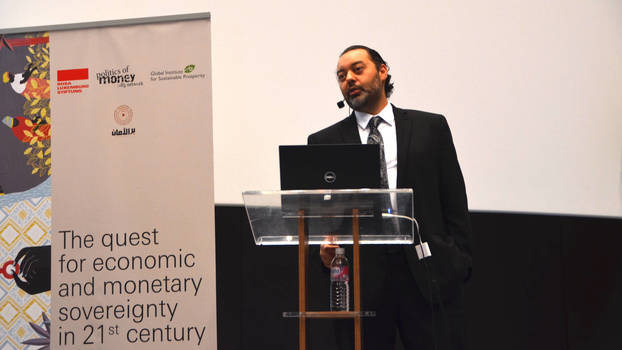
The conference “The Quest for Economic and Monetary Sovereignty in 21st Century Africa” was held from 6–9 November in Tunis, hosted by the Rosa-Luxemburg-Stiftung’s North Africa Office and the Global Institute for Sustainable Prosperity (GISP). GISP President Fadhel Kaboub opened the conference on the morning of 7 November and led the closing session on 9 November. Kaboub is an advocate of Modern Monetary Theory (MMT), an approach that views states as the source of money creation through the issuing of currency, and taxation as the destruction of that money supply. In this formulation, states do not use taxes to fund policies but rather create funding through issuing currencies, while taxation is used to curb inflation or disincentivize social practices that are seen as harmful, such as pollution or extreme inequality. MMT has grown increasingly popular among left-leaning politicians in North America and Western Europe, and is beginning to make its way into African political discourse as well.
Kaboub believes that MMT could serve as the foundation for better development policies in the Global South—one of several issues debated over the three-and-a-half days in Tunis. Other conference attendees offered perspectives on the problems facing sovereignty in Africa, bringing up issues such as the use of currencies pegged to the euro, food dependence, financialization, division along nation-state borders, and military interventions from the Global North. Regarding strategies to resolve the problem of sovereignty, one broad theme brought up repeatedly was “delinking”—a strategy Samir Amin developed for Global South countries to shape development strategies according to internal needs, prioritizing this logic over that of conforming to global forces of trade and value.
Fadil Aliriza, co-founder and editor-in-chief of the Tunisian news portal Meshkal, sat down with Fadhel Kaboub on the side-lines of the conference to get his perspective on what exactly MMT is and is not, and how he thinks Tunisia and other countries in the Global South could utilize it as a tool to develop their economies and adjust imbalances between themselves and the Global North.
FA: Do you think the passage of the Central Bank Independence Law in 2016 was a watershed moment in Tunisia, moving in another direction in terms of monetary sovereignty?
FK: It is moving in another direction for many reasons, not just central bank independence, but the structural issues in my presentation today and the MMT podcast are not getting any better, they get worse and worse over time. We heard the director of monetary policy today from the Central Bank recognizing exactly what I described this morning, namely the huge imports of cereals, wheat, and what she described as “weaknesses in attracting foreign direct investment”. So they do recognize the structural issues, but they insist on this inflation targeting, knowing for a fact that there’s nothing you can do by raising interest rates—independently or not independently of the government.
How is raising interest rates in the Tunisian economy going to change OPEC policies in the Middle East? How is raising interest rates going to change wheat prices coming from Ukraine or from Russia? That’s the “independent” part. We’re not getting close to any solutions, so that’s why I insist that the solutions are to be found outside the Central Bank, and policies that actually recognize and target the sources of inflation. I always joke that inflation targeting policies should be run by the Ministry of Agriculture or renewable energy commissions, not the Central Bank.
Fadhel Kaboub is an Associate Professor of Economics at Denison University and President of the Global Institute for Sustainable Prosperity, and co-organized the recent conference “The Quest for Economic and Monetary Sovereignty in 21st Century Africa”. Fadil Aliriza is co-founder and editor-in-chief of the Tunisian news portal Meshkal. Maisie Odoneassisted in the recording and transcription of the interview.
That’s why I use this metaphor as a joke, but it’s really true that central bankers are like the kids in the backseat thinking they’re driving the car. But who’s sitting in the backseat? It’s OPEC, price setters in the food industry, corrupt networks. It’s the price setters who actually drive inflation. It’s the structural weaknesses of the economy and the Central Bank on its own—whether independent or not they have no jurisdiction in that area. The ministries and government leadership that has jurisdiction in that area do not recognize those weaknesses.
After the Tunisian Central Bank official Rym Kolsi’s presentation, Daniela Gabor mentioned that, given the data she showed, it’s not the interest rate that’s having an effect on inflation in Tunisia, but what she called the “exchange pass through rate”. Can you explain what that means?
FK: This is what economists call the “pass through effect”: a depreciation of the exchange rate and the impact on inflation. That’s why bankers are obsessed with stabilizing the exchange rate, as they see it as a way to protect local consumers from the inflation effect. But it’s a Band-Aid solution, because how do you stabilize the exchange rate? By getting a loan from the IMF, and now you have an external debt putting more pressure on your exchange rate in the future. You haven’t fixed the structural issues that caused the problem in the first place, which is food sovereignty, energy sovereignty, etc. All of the solutions we see are temporary and rely on small periods of relief and limited success which is completely independent of central bank policy.
Another hidden problem that the central bank director mentioned today, which we haven’t discussed so far, is the olive oil industry. Tunisians are very proud of our huge harvests as one of the top producers of olive oil in the world. We have this misperception that a successful season producing olive oil brings economic benefits to the Tunisian economy in terms of export revenues, but that’s not always the case. When you think of who the key power players in the olive oil industry are, it’s not Tunisian farmers. They’re the weakest players. Collectively they produce a large amount, but individually they’re very weak. The key players in the global market are Spanish and Italian companies, who dominate the global supply chain and extract the highest value added from the industry. When you buy a bottle of olive oil in Europe or the US, most of the price is for the supply chain, marketing, and bottle design, not for the actual raw material coming from Tunisian farmers. It’s the same problem: the value-added content is very weak.
The related problem is that because they dominate the global supply chain, Spanish and Italian companies collectively have five years’ worth of global olive oil supply. We could completely stop olive oil production in Tunisia and the rest of the world for five years, and they could supply global demand. It’s a strategic reserve. Which means, as a small farmer in Tunisia, how do you negotiate? They actually come and buy your supply a year in advance, before you produce it. They set the price, and they pay you in advance. And what do you have to say as a small farmer? They say “take it or leave it”, and if you don’t take the deal they’re not going buy from you, and what do they tell you? “Good luck selling it!” This is the power structure that we’re talking about at the global level. The olive oil industry looks like a huge success story, but it’s still at the bottom of the food chain globally, and it’s still at the mercy of the Italian and Spanish companies. This is not just a Tunisian problem—it applies to all farmers across the African continent.
Just to pin you down on the Central Bank Independence Law: it’s largely overlooked in the history of the last few years of the Tunisian economy, but was there a real effect in terms of policy space for the Tunisian government?
It certainly reduced policy space and the likelihood of implementing the policies that I was talking about today, because it creates an obstacle between what the government’s vision could be for implementing an employment-driven economic growth policy focusing on mobilizing domestic resources, and the need for the Central Bank to coordinate its actions to meet those policy requirements. It doesn’t mean it’s impossible, because I still think the parliament in the fiscal policy space has the upper hand if they have the political will and the vision to take action.
You mean if parliamentarians were to draft the spending bill instead of the government ministries? If they took the initiative?
Yes, because we have to realize that in a democracy, ministries—including the Central Bank—are sub-branches of the government. You can give them independence as a political entity, and in the same way you can mandate that they operate in a different way. In that sense, if parliamentarians are empowered with a vision for economic development and see a clear path to better economic and democratic outcomes, then it shouldn’t take too long for them to draft new laws that reflect that.
That’s why I always insist on the importance of having a political vision within the parliament, within the ministries and the monetary policy guys. They’re the ones sitting in the backseat. We give them too much credit for their influence over the economy. We allow them to run with it, but they really have very little impact. They do more damage than good.
You mean the bureaucrats? The independent Central Bank?
Yes, because they don’t know what they’re doing. Many of them have admitted this. The Federal Reserve admitted last year that we have no valid theory of inflation. Last month Mario Draghi asked European governments to do their part by looking at ideas like MMT and taking action on the fiscal side, because there’s not much we can do.
Do you see many politicians in Tunisia who are open to the idea, who have an appetite for looking at things through an MMT lens?
Not yet. Except for one of the MPs [Jamila Ksiksi, Ennahdha] who was here today, she seemed to be inspired by this. But so far, from the time of the revolution until the last presidential election, none of the political parties really had an alternative vision. Those that did lacked the political popular mandate to take bold action. There’s a lot of tension in Tunisian society, in politics—a fear of bold action because it brings bad memories of government dominating and taking aggressive action. It’s a very nascent democratic process. There’s always a lot of resistance to some government or political entity taking aggressive structural actions, because it brings that phobia about dictatorship. Economic action requires really deep structural reforms and shifting gears on a macro scale, but I haven’t seen anybody in the political realm willing to do that kind of transformation. That’s why everything we heard until the last presidential election was tinkering around the edges, doing things with less corruption, with more precision and efficiency. But it’s the same things. Now, since the presidential election, there’s a new window of opportunity with a president [Kais Saied] who has a huge popular mandate and a huge amount of political capital.
Saied seems to have put social issues at the forefront of his campaign.
His mind is on the right issues. The question is does he or his team have a true alternative economic strategy, or is he going to embrace the same ideas we have tried over the last seven years, under the Ben Ali regime, and in so many other countries—just applied with a bit more integrity and transparency. We want integrity, transparency, we want all of it—but we also want new ideas. Having this much political capital and this much trust from the pubic, and then applying the same policies and receiving the same results—that would be a big waste of that political capital and a huge missed opportunity.
Sometimes new things in Tunisia come not from politicians but from the streets. The Fech Nstannew movement did not propose a new policy beyond rejecting the 2018 budget. But now there is this giant Facebook group with 1.5 million members about consumption in Tunisia, and they seem to have had some success in shaping prices. You’re talking about the central bank not really being able to change prices, but here we have 1.5 million consumers seemingly having this kind of effect. What do you think?
I think it’s encouraging. It’s one thing to have an economic vision like I presented, it’s another thing to have a PM or president who says “Let’s think about this idea”, and it’s yet another to have 1.5 million people on the streets saying “We believe in this idea and we want to drive it forward”. The missed opportunities with social movements like in Lebanon and Chile, and even in Tunisia during the revolution, is that social movements are very clear about what they don’t like. They’re very clear about not liking inequality, outcomes of socioeconomic exclusion, the cost of living… they’re very clear about what they don’t like and about wanting something different. The weakness in that popular movement is usually not having a true, well-formulated set of demands that produce that alternative economic system other than less corruption, better democratic process, and better results. But how do you get better results? Getting rid of corruption is an element, but it’s not the only element. The weakness of a lot of these social movements is they get rid of corruption, elect a new government, better accountability, but then apply the same policies that produce the same inequality. Then, ten years later we’re back to square one with the same social movement saying we don’t like this government.
I saw someone on social media today placing your ideas next to Samir Amin’s ideas, and while listening to you speak it sounded like “delinking” was in the background. Is that an idea that you feel like makes sense from a Tunisian perspective, or from other developing countries?
I’m a big fan of big ideas, and Amin is one of them. Jan Kregel [who also presented at the conference] and other big thinkers are very influential in my work. But I’m an academic, so I get into all of those ideas. It’s fun to debate them and learn from them and build on them. I’m also very solutions-oriented, policy-oriented. I like to talk with the public, the media, policy makers and all of those groups. A small minority are interested in the big ideas in the academic sense of the term, but they want more practical solutions.
One of the things I think I was able to do over the last few years was to translate a lot of the old ideas and new ideas, bring them in the contemporary context and bring some of the practical solutions that people can believe in—politically, socially, and economically—and realize that this is within reach, not pie-in-the-sky impossible transformation.
By “within reach”, we’re not saying it will be easy. But people can picture their life in their economy and their society in a better position within their lifetime. They can see a clear path towards that vision, which is only activated within that participatory democracy with structural reforms that are inclusive—not exclusive to a small elite at the Central Bank or Ministry of Finance. That’s why Tunisia’s this wonderful opportunity for creating things, because we do have the mass movement. We have people who believe in the democratic process—not just on the streets, but MPs, people truly believe in the democratic process and want to preserve it and celebrate it and are willing to give up political space to celebrate the democratic process. This is a huge opportunity where the political spectrum is on board, the streets are on board. We’re missing this one piece that I’m trying to articulate. I think we are unstoppable if we do that.
Some people seem to worry about MMT and finding ways to avoid foreign currency. If I understand correctly, many countries built up foreign currency reserves after the Volcker shock as a sort of defence mechanism. There seems to be a necessity for Tunisia to have foreign currency reserves to bring in medicines and everything, but it’s not necessarily clear what these reserves are being used for. Rather, people who are well-connected or certain businesses are bringing in luxury goods.
There is some of that, and you can get rid of it targeting by corruption and these entities. But I always push back against calling them “currency reserves”, because it creates this illusion that we have excessive amounts of reserves of foreign currency, when we actually have a massive amount of external debt. Even the central banker today mentioned the level of foreign currency reserves, which are usually calculated in terms of days’ worth of imports of basic necessities. In other words, if we go back to the period of Tunisian debt crises, the days’ worth of reserves dropped from the IMF’s threshold—which was 90 days’ worth of reserves—to five or six days. That means after six days the country would not have any resources to import wheat for bread or gasoline, which means you will have riots on the streets. In fact, there wereriots on the streets.
The idea behind building up reserves is to give the economy a buffer time period to absorb temporary shocks—economic crises or depreciation of the currency—to give the Central Bank 90 days’ worth of imports before the riots start on the streets. That’s an important thing to recognize, that this is not a luxurious surplus that we have.
But the other part of the question is corruption, which was brought up today by Chafik [Ben Rouine, cofounder of the Tunisian Observatory of Economy who chaired the conference panel with Kolsi] in his questions concerning export-oriented Tunisian companies with an exclusive privilege, namely being able to offshore. That’s where you see some of the corruption, where some of the managers of these companies can buy their BMWs and bring them into the country. The Central Bank is not okay with the corruption part of it, but they’re okay with giving them that incentive because presumably they’ll import better technology and there will be some kind of transfer of technology in Tunisia, which she [Rym Kolsi, director of monetary policy at the Central Bank of Tunisia] tried to emphasize today. But show me the positive effect of transfer of technology in the last 30–40 years and then I’ll believe you. It’s not there.
I’m personally very curious about what it means for Tunisia to have a national currency that’s not pegged, not something every country has. We heard about the CFA franc, which is pegged to the euro and previously the French franc. Did having a sovereign currency at the time of independence mean that Tunisia could do things it couldn’t under colonialism? Was there a sense of this sovereign currency being a part of the independence struggle?
There are two aspects. One is the fact that France didn’t really care very much about the Tunisian economy. It wasn’t even planning to colonize Tunisia, it was sort of an accident. It was a bothersome group of people across the border from Algeria, so they thought “What the heck, let’s take that country too.” It wasn’t as important as the other colonies from a natural resource or economic strategy perspective. Letting go of Tunisia wasn’t a huge loss to the French economy. It wasn’t a struggle to transition to the Tunisian dinar.
In a sense, maybe the Algerian experience was more problematic because the dinar that circulated in Tunisia said “Bank of Algeria” on it, and then it would say “circulated in Tunisia”. Tunisia was an extension of the monetary system that France had for Algeria, which was considered French territory and was not up for negotiation. In that sense, there wasn’t much resistance to creating a national currency from the French.
Plus, you have to realize that, as a postcolonial country on day one of independence, you have a president, your parliament, and your money. What are you going to do on day one? Are you going to continue producing and selling the same stuff you’ve been producing? The day after independence it will be the same.
After colonialism, it was actually made worse because you tried to accelerate it. You’re now in charge of the economy. You want to generate more revenues for exports, so you keep using the same structures. You’re still extracting from the same mines, shipping to the same ports, and delivering to the same customers in Europe. In that sense, removing French troops from Tunisia didn’t really change the economic benefits France had. Now you have political sovereignty, you have your own president and flag and national anthem. Economically, you’re still serving the same structures.
Even if you technically have your own currency, that’s not the full picture of what you want in terms of economic sovereignty?
If you have to fix your exchange rate and your economic production system is the same, except now it’s governed by your own people doing damage to your own economy, because that’s the vision they see for economic benefits. Then you go to import substitution industrialization (ISI), that kind of internal development, and that was done in a very corrupt way where a small group of elites got subsidies from the state to build factories and what would become the core structure of the Tunisian economy under Bourguiba’s regime. But it created this wealthy business elite that was highly subsidized and wasn’t delivering the productivity and competitiveness level the Koreans or Singapore or Japan were developing around the same time.
Well, you had to import capital goods, often with loans, to carry out ISI. In Tunisia’s case a lot of that was coming from the US, right?
By the time you get to the free trade and globalization era Tunisian manufacturers were crushed by foreign competition, and now they have to be a small subcomponent of the global supply chain. They don’t have horizontal integration of industries. They have this vertical integration to produce one small component of the supply chain, and are completely dependent on global demand. When global demand increases because of events in the US or decreases because of events in China, they are affected domestically and there’s nothing they can do about it. The Central Bank raising or lowering interest rates is not going to change the fact that the US is in a recession, or China decided to switch demand from this to that.
My last question is a theoretical question. Is MMT post-Keynesianism? Where does it fit in theoretically? Would you say that MMT can be thought of outside the bounds of capitalism, and what’s its relation to capitalism?
Before there was anything called MMT, all the MMT ideas that we discussed today came fundamentally from post-Keynesian economics and institutional economics, heterodox economics traditions outside of the mainstream. What MMT economists have done is build on those two traditions and add this lens that clarifies what monetary sovereignty is. This lens allows you to estimate how much fiscal policy space you have before you start running into inflation. MMT provides a lens that says structural issues drive inflation, not government spending. It depends on which industry. What determines inflation is productive capacity, market power, corruption, these things. In that sense, I see MMT as a continuation of these two traditions and I don’t think there would be an MMT without them.
In terms of capitalism or beyond capitalism, once you have that lens that says “This is how much fiscal policy space you have, and this is how much you have before you run into inflation, and this is what causes inflation”—market power and productive capacity—then you can take that descriptive knowledge of how the system works and decide to take advantage of this additional fiscal policy space to, for example, invade Canada. It’s a political choice, nothing to do with MMT. Or you can say, “Let’s take this additional fiscal policy space to provide universal healthcare for people regardless of their employment level”, or we can use this fiscal policy space to fight climate change because it’s a national priority. Let’s use this fiscal policy space to reduce inequality, to enhance the democratic process, to weaken the oligarchs and this power and influence and politics in the economy. These are political choices.
You can take the MMT vision and make things worse or you can take the MMT vision and make things better, and that’s why it’s very important for this to be cantered within the democratic process, so that we get the better outcomes that serve the needs of people. If we allow this MMT knowledge to become a private vision for the oligarchs and the military industrial complex, they’re going take it and they’re going to use it. That’s why it’s important to bring it into the public discourse. We have to call their bluff, the elites who say “If you spend more it’s going to cause inflation and you’re going turn into a Venezuela.” Calling their bluff means we know better, and this gun you’re holding, hijacking the economy, isn’t a real gun. It’s a water pistol. You’re bluffing. We know better because we know what causes inflation, we know the fiscal space we have, and we know that taxing the rich is not about getting their money or their permission to spend.
Taxing the rich, polluters, and speculators is not because we need their permission to fund health and education and climate change, but because we want to reduce inequalities, pollution, their market power, reduce corruption. That’s where the MMT lens helps us to decouple spending from taxing. Both are extremely important, but they’re not linked in the way we usually think they are and they’re hijacking the economy by saying “If you don’t raise tax revenues for this, you’re not going to have your healthcare.”
But it would have impacts on the globalization project, right? MMT means you would need to have a shift in the ways countries expect to use and consume.
Absolutely, but I wouldn’t go all the way to the point where you would say MMT is pro-capitalist or anti-capitalist. MMT just says: “This is how the capitalist system works today”, and then tries to take it and transform the system in ways that people will decide which way. You can still be export-oriented, pro-tourism, part of the global supply chain, but now you do it more strategically to serve the needs of your economy. I’ll leave it at that. It’s not one extreme or the other. It’s interesting, we’re getting more and more of these questions to help people realize that this is sort of a technical solution to the existing system, and the politics of it you can take in whichever direction you want.
Especially if you think of neoliberalism as a time period, this sort of late-stage capitalism, and whether we’re moving to reshaping capitalism or moving past capitalism is on so many people’s minds—do you think MMT could be the next thing?
There’s no one form of capitalism. As Minsky used to say, there are 57 varieties of capitalism—just like ketchup. I think MMT has the potential to form another kind of capitalism. It has the potential to move beyond capitalism. But it’s not the binary “capitalism versus socialism versus communism”. There’s a wide spectrum of potential political systems. I think the choice has to be democratic. It has to be participatory. And I think it has to come with the desired economic outcomes, with the democratic and personal political freedoms that everybody aspires to. Whatever system that happens to be, we will invent a name for it and then we will just have it, so we will add another “ism” to it.
★★★★
ーー

0 件のコメント:
コメントを投稿