| ||||||||||||||||||||||||



| ||||||||||||||||||||||||


Bloomberg Barclays U.S. Aggregate Corporate Investment Grade Option-Adjusted Spread (%)
ブルームバーグ・バークレイズ米国総合法人投資適格オプション調整後スプレッド(%)

| ||||||||||||||||||||||||

The Bear Market Bounce Will Be Short-Lived

弱気市場の反発は短命になる
最近の弱気相場の上昇に気を取られてはいけません。私たちは、上げ潮がすべてのボートを持ち上げるのとは正反対の環境に入りました。これは、優れたストックピッカーにとって恩恵となります。
8月の猶予
多くの人が安堵のため息をついています。悲惨な上半期の後、流血は7月に終わったように見え、株式やその他のリスク資産にとって素晴らしい月となった。Nasdaq 100 は、安値から 20% 上昇するウィスカー内で、新しい強気市場に入ろうとしています。
しかし、現在の市場はかなり無気力で、センチメントを一定の方向に動かす触媒を探しています。最近の米国の経済データは、明らかにまちまちなので役に立ちませんでした。今週のインフレデータが次の大きな動きの原動力になるとは思いませんが、インフレがピークに達したことが確認されれば、リスク資産は最近の上昇を維持できるはずです。インフレが企業のマージンを侵食するため、収益の逆風により、それ以上の利益は制限されます。
活動が再開するのは9月。コアインフレが再び回復しても驚かないでください。いずれにせよ、債券市場は、連邦準備制度理事会が長期にわたって利上げを続けるという決定を過小評価しています。連邦準備制度理事会が再び会合するとき、FRB の資金率が 4 分の 3 パーセンテージ ポイント引き上げられると期待するだけではありません。また、2022 年末と 2023 年末の金利とインフレの予測を引き上げる可能性が高いです。それは、市場の次の大きな動きを促進するのに十分なはずです。今回の方向性は下向きになるでしょう。
次の手を呼び出す
その間、市場はホールドパターンになると予想されます。バンク・オブ・アメリカのストラテジストは、S&P 500 が 3,800 から 4,200 の範囲で取引されると予想していると述べており、基本的には 9 月の FRB の会合まで足踏み状態です。
次の大きな動きになると、2 つの物語が展開されます。一方では、「ゴルディロックスのシナリオ」があります。ここでは、FRB が金利を引き上げていますが、米国企業のマージンは維持されており、FRB のボスであるジェローム・パウエルが望んでいることを示唆した、尊敬されているソフトな着陸が得られます。7 月の市場の回復は、この見解の最良の市場の現れです。その傾向は今流行しています。
急増の象徴はJPモルガンのマルコ・コラノビッチであり、彼は米国が 不況 を完全に回避すると言ってきた。そして彼は、投資家の弱気のピークは過ぎ去ったと考えているため、株価はさらに上昇すると見 ています。
「活動の見通しは依然として厳しいものですが、下半期に移行するにつれて、株式のリスクと報酬はより魅力的に見えると考えています。」
そして、「くまシナリオ」。これは基本的に、マージンと収益のハードランディングであり、リスク資産の再計算を余儀なくされています。この結果は、投資家の巨大なコホートが不況を思いっきり叫んでいることによって支えられており、GDP データの 2 つの否定的な四半期ごとの印刷物と初期の失業保険申請の増加によって支えられています。彼らは6月まで優勢でした。しかし、彼らは最近後れを取っています。
まだ不況に陥っているとは思いませんが、最終的には不況に陥り、利益率と収益が軟化すると考えています。 ゴールドマン・サックスとモルガン・スタンレーがその側にいます 。
モルガン・スタンレーのマイケル・J・ウィルソン氏とゴールドマンのデビッド・J・コスティン氏はいずれも、容赦ないコスト圧力により、企業の利益率は来年縮小すると予想している、と別のメモで書いている. 米国株式市場で最も声高な弱気派の 1 人であるウィルソン氏によると、「上昇の最良の部分は終わった」。
名目利回りとインフレ調整後利回りの両方の崩壊におけるこの物語の市場の痕跡は、特に企業の借り手がより低い利回りを得るために猶予を利用することで、いくつかのマイナス面を減少させます。
全体としては、正反対の 2 つの物語が形成されているため、この次の動きが正しいと見なすことで、優れたパフォーマンスを発揮する余地は十分にあります。
数字で
- 5.9%2022 年 6 月までのコア消費者物価上昇率
ゴルディロックスは景気後退を信じていない
しかし、経済データは何を教えてくれるでしょうか? 米国の世帯を総合的に捉えると、賃金と雇用の増加が続いています。したがって、彼らは使い続けます。私は 先週これについて話しました。そして当時、私は失業保険申請の増加が過熱した雇用市場を冷やし、よりソフトな(必ずしも「ソフト」ではない)着陸を可能にしていると考えていました. しかし、金曜日に発表された大ヒットの雇用統計によると、失業率は 50 年間で最低の 3.5% であり、50 万以上の雇用が経済に追加されました。つまり、米国経済、つまりインフレには足がついているということです。
そのため、米国経済が FRB のインフレ懸念を和らげるほど減速しているかどうかははっきりしていません。一方、食品やエネルギーの価格は下落しているが、家賃などの主要な商品やサービスの価格は依然として上昇している。
投資家(および連邦準備制度理事会)が判断するのは、紛らわしい状況です。そのため、データのさまざまな解釈への扉が開かれたままになります。
複数の市場における最近の値動きが私に教えてくれるのは、ゴルディロックスのシナリオを信じている人々が現在市場を支配していることです。そして、それは財政状況を緩和するのに役立ちました。
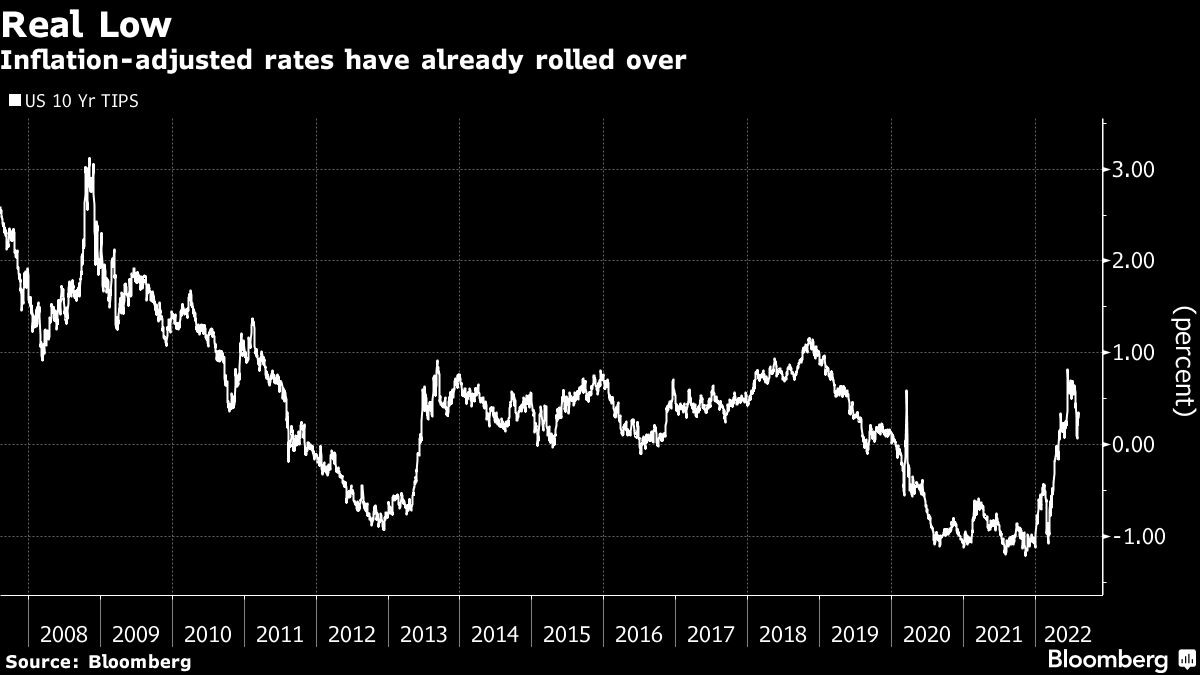
実質金利は、金融環境がいかに緩いかを示しています。このサイクルでは、実質 10 年物金利は、FRB が前回利上げを行った 2018 年後半の水準には達していません。そして、彼らはそれらのレベルから約0.8パーセント下がっています.
リスク資産はそれに応じて反応しました。私たちは、ハイテクに重きを置くナスダック 100 が強気市場のテリトリーと戯れていることを知っています。

しかし、S&P 500 も 13 ~ 14% 上昇しています。ダウ・ジョーンズ工業株平均は10%以上上昇しています。債券の世界では、社債 ETF に目を向ければ、債券がどれだけうまく機能しているかがわかります。iShares の投資適格 ETF の LQD は 6% 上昇し、ハイイールド ETF HYG は 7% 上昇しました。負けないように、最長デュレーションの国債 ETF TLT は 6 月の安値から 9% 以上上昇しています。
それは単なるゴルディロックスの話ではなく、景気後退をまったく想定していない市場でさえあるかもしれません。たとえば、ブルームバーグ インテリジェンスは、ブルームバーグ米国企業ハイイールド債インデックスのオプション調整後のスプレッドが 7 月に 469 ベーシス ポイントで終了したと述べています。
FRBとの戦い
連邦準備制度理事会はおそらくこれに満足することはできません. 彼らの現在の役割は、金融環境を引き締めるために金利を上げてインフレを抑えることです。定義上、金融状況が緩和している場合、彼らはそれを行うことができません。基本的にFRBのジャンボ利上げへのピボットを先導した後、中央銀行が積極的なインフレ抑制姿勢を維持しているため、市場は現在、あらゆる段階でFRBと戦っています。
これらすべての強気シグナルを 1 つの市場スローガンに結び付ける必要があるとすれば、それは「Fed the Fed」になります。基本的に、市場は、米国経済が弱体化し始めると、FRBがインフレ追跡体制を突然停止し、利下げを開始するために尻尾を向けるというシグナルを発しています。そうすれば、インフレは問題になりません。
しかし、FRB 当局者の話を聞くと、継続するという彼らの決意は明らかです。FRB のミシェル・ボウマン総裁は最近、4 分の 3 のパーセンテージ・ポイントの引き上げを継続することを主張しました。
「私の見解では、インフレが一貫して意味のある持続的な方法で低下するのを見るまで、同様の規模の上昇が検討されるべきだ」
これにより、9 月の Fed ファンド レートは 3.25% になり、年内にあと 2 回の政策会議が残っています。
連邦準備制度理事会が 6 月に年末までに期待の中央値が 3.4% になると語ったことを考えると、FRB が 9 月までに事実上利上げを完了するか、その月に発表される予測に大きな上昇傾向が見られることを示唆しています。6月の予測は、FRBが追跡するインフレ率(コアPCE)が今日の4.8%から年央には4.3%に低下することに基づいているため、どちらの解釈も妥当です。
しかし、コア PCE が引き続き上昇している場合、9 月以降はさらなる利上げが予想されます。そして、それはより可能性の高いシナリオです。ブルームバーグ・エコノミクスは、コア消費者物価指数が下落ではなく上昇すると予想していると述べています。発表されるレポートでは、5.9% から 6.2% になり、年末までには 7% になる可能性もある (ブルームバーグの端末ユーザー は、分析についてはここをクリックしてください)。
このシナリオでは、2023 年初頭に利下げが行われるどころか、FRB は 2022 年に現在の予測よりもさらに利上げし、2023 年も引き続き利上げを行うことになります。
連邦準備制度理事会がインフレ目標を放棄しない限り、弱気派がこの場合優位に立つでしょう。より穏やかなインフレ見通しは、ゴルディロックスの信者に有利に働くでしょう。
では、最大のリスクはどこにあるのでしょうか?
すべての資産が平等に作られているわけではありません。最大の脆弱性はどこにあるのでしょうか? デュレーションに敏感なリスク資産にあると思います。これは、予測されるキャッシュ フローが将来にわたって最も大きく重み付けされている資産を意味します。それは、高成長株、低格付けのハイイールド債、長期投資適格および米国債です。連邦準備制度理事会が金利を引き上げており、それを維持する可能性が高い場合、それらの将来のキャッシュフローの価値は大幅に低下し、それらの資産の価値が低下します.
軽減要因はイールドカーブです。数週間前 、私は 米国債の利回り曲線が 0.5 パーセント ポイントも反転しているのを見ていると言いました。そして最近のデータは、私たちがすでにほとんどそこにいることを示しています。しかし、FRBが利上げのラインを維持する場合、その反転は増加するはずです。つまり、将来のキャッシュ フローの価値は、FRB の利上げの影響を受けにくくなります。
たとえば、私は、FRB の資金金利が 4.5% に上昇した場合、長期利回りが 4% に上昇する可能性があると仮定しました。これは現在よりも 1 ポイント以上高いですが、FRB の目標金利よりも 0.5 ポイント低くなっています。しかし、まだ道半ばであり、利回り曲線はすでに 50 ベーシス ポイント近く反転しています。ブルームバーグ エコノミクスが予測した FRB が 5% の Fed ファンド レートで引き締めサイクルを終了するというコンセンサス外の予測が正しいと証明された場合 (ブルームバーグ ターミナルの購読者向けのリンクは こちら)、最大 100 ベーシス ポイントの反転が得られる可能性があります。それが私の新しいボギーです。
しかし、覚えておいてほしいのは、割引率で得たすべての利益は、不況の深刻さと収益の打撃で失われるということです。ほとんどの企業にとって、景気後退と金利上昇の組み合わせは、曲線の逆転と割引率の低下よりもはるかに重要です。そしてそれは、株式、ハイイールド債、長期債が大きな打撃を受けることを意味します。
これがどのように展開するかについて、もう 1 つ考えさせてください。勝者と敗者の間には大きなばらつきがあります。最近、掘り出し物を探してアウトレットで買い物をしていました。そして、店が開いた午前10時に売り込み、欲しいものが確実に手に入るようにしました。私も15分早く着きました!驚いたことに、いくつかの店の外にはすでに列を作って待っている人がいましたが、まったく人通りのない店もありました。多くの買い物客が掘り出し物を探していましたが、在庫を大幅に値下げしていたのは一部の店舗だけでした。皮肉なことに、そうでないのは人が並んでいる場所でした。
今後数か月のうちに、決算報告や利益警告でその結果が明らかになることが期待されます。このマクロ環境は、勝者と敗者の間に大きな不一致を生み出します。一部の企業 (強力なブランド、堅牢な在庫管理、または正当な価格決定力を持つ企業) は、ほとんど見逃すことはありません。他のものは、インフレの猛攻撃と消費者支出の減少により沈没するでしょう。
私たちは、上げ潮がすべてのボートを持ち上げるのとは正反対の環境に入りました。これは、優れたストックピッカーにとって恩恵となります。
あなたの意見は重要です
耳を傾けながら、アセットアロケーションについてご意見をお聞かせください。今週の MLIV Pulse 調査は、株式と債券の 60/40 ポートフォリオ配分のメリットに焦点を当てています。こちらの機密アンケートで、戦略に対するあなたの見通しを共有してください 。前もって感謝します。
今週の名言
私のレーダー上のもの
Don’t be carried away by the recent bear-market rally. We have entered an environment which is the exact opposite of a rising tide lifting all boats. That will be a boon for good stock pickers.
August Reprieve
Many people are breathing a sigh of relief. After a miserable first half of the year, the bloodletting appeared to be over in July, which turned out to be a stellar month for stocks and other risk assets. The Nasdaq 100 is about to enter a new bull market, within a whisker of rising 20% from its lows.
But markets are pretty listless right now, looking for a catalyst to move sentiment measurably in one direction. Recent US economic data haven’t helped because they’ve been decidedly mixed. I don’t expect this week’s inflation data will be the impetus for the next big move either — though a confirmation that inflation has peaked should allow risk assets to hold on to recent gains. Any further gains would be limited due to earnings headwinds as inflation eats into corporate margins.
It’s September when the action begins again. Don’t be surprised if core inflation bounces back up again. Regardless, bond markets are underpricing the Federal Reserve’s determination to keep raising interest rates for longer. When the Fed meets again, not only should we expect it to raise the the Fed funds rate by three-quarters of a percentage point. They are also likely to have raised their projections for rates and inflation at the end of 2022 and 2023. That should be enough to drive the next big move in markets — and the direction this time will be downward.
Calling the next move
In the meantime, expect markets to be in a holding pattern. Bank of America strategists have said they expect the S&P 500 to trade in a range of 3,800 to 4,200, basically just treading water until the Fed’s September meeting.
When it comes to the next major move, two narratives are unfolding. On the one side, there’s “the Goldilocks scenario”. Here, the Fed jacks up rates but US corporate margins hold up as we get the venerated softish landing Fed boss Jerome Powell has signaled he wants. The July market comeback is the best market manifestation of this view. That trend is in vogue right now.
Emblematic of the surge is JP Morgan’s Marko Kolanovic, who has been saying the US will avoid a recession altogether. And he sees shares rising further still because he believes peak investor bearishness is behind us.
“Although the activity outlook remains challenging, we believe that the risk-reward for equities is looking more attractive as we move through the second half.”
Then, there’s “the Bear scenario”. That’s basically a hard landing for margins and earnings, which forces a renewed reckoning for risk assets. This outcome is underpinned by a giant cohort of investors screaming recession at the top of their lungs and bolstered by two negative quarterly prints of GDP data and rising initial jobless claims. They had the upper hand through June. But they’ve been on the back foot of late.
While I don’t think we’re in a recession just yet, I do see a recession eventually and softness for margins and earnings. You have Goldman Sachs and Morgan Stanley taking that side.
Both Morgan Stanley’s Michael J. Wilson and Goldman’s David J. Kostin expect corporate profit margins to contract next year given unrelenting cost pressures, they wrote in separate notes. According to Wilson, who has been one of the most vocal bears on US stocks, “the best part of the rally is over.”
The market imprint of this narrative in the collapse in both nominal and inflation-adjusted yields diminishes some of the downside — especially with corporate borrowers taking advantage of the reprieve in order to get lower yields.
Overall though, with two diametrically-opposed narratives forming, there is plenty of scope for outperformance in calling this next move right.
By the numbers
- 5.9%Core Consumer Price Inflation through June 2022
Goldilocks doesn’t believe in recessions
What do the economic data tell us though? If you take a composite picture of US households, they’re continuing to see wage and employment gains. And, therefore, they continue to spend. I spoke to this last week. And at that time I was thinking that rising jobless claims were cooling an overheated employment market, allowing for a softer (though not necessarily ‘softish’) landing. But the blockbuster jobs report that came out on Friday showed unemployment at a five-decade low of 3.5% and over 500,000 jobs added to the economy. That says the US economy — and, therefore, inflation -- has legs.
And so, it really isn’t clear whether the US economy is decelerating enough to assuage the Fed’s inflation fears. Meanwhile, while food and energy prices have come down, core goods and services prices like rents are still rising.
It’s a confusing picture for investors (and the Fed) to discern. And so, it leaves the door open to a wild array of interpretations of the data.
What recent price action in multiple markets tells me is that believers in the Goldilocks scenario are controlling the markets right now. And that’s helped loosen financial conditions.
Real rates show how loose financial conditions are. In this cycle, real 10-year rates haven’t even made it to late-2018 levels when the Fed was last hiking. And they’re down some eight-tenths of a percentage point from those levels.
Risk assets have responded accordingly. We know the tech-heavy Nasdaq 100 is flirting with bull market territory.
But the S&P 500 has also seen 13-14% gains. And the Dow Jones Industrial Average has gained more than 10%. In the fixed income world, look no further than the corporate bond ETFs to see how well bonds have done. iShares’ Investment Grade ETF LQD is up 6% and the High Yield ETF HYG is up 7%. Not to be outdone, the longest duration Treasury ETF TLT is up over 9% from June lows.
That’s not just Goldilocks stuff, it may even be a market that’s priced for no recession at all. Bloomberg Intelligence, for example says that the option-adjusted spread for the Bloomberg US Corporate High Yield Bond Index finished July at 469 basis points, well below recession gauges pointing to spreads of 750-800 basis points.
Fighting the Fed
The Fed can’t possibly be happy with this. Their role right now is to slow inflation by raising interest rates in order to tighten financial conditions. By definition, they can’t do that if financial conditions are loosening. After basically front-running the Fed’s pivot to jumbo rate hikes, the market is now fighting the Fed every step of the way as the central bank maintains an aggressive anti-inflation posture.
If I had to link all these bullish signals into one market slogan, it would be “fight the Fed.” Basically, the markets are signaling that the Fed will abruptly halt its inflation-chasing regime and turn tail to start cutting rates when the US economy starts to weaken. And when they do, inflation won’t be a problem.
But if you listen to Fed officials, their determination to keep going is clear. Fed Governor Michelle Bowman recently argued for continuing with the three-quarters percentage point hikes.
“My view is that similarly sized increases should be on the table until we see inflation declining in a consistent, meaningful, and lasting way.”
That would get us to 3.25% on the Fed funds rate in September, with two more policy meetings left in the year.
Given the Fed told us in June that the median expectation was for 3.4% by the end of the year, it suggests either the Fed would be effectively done hiking by September or that we will see a big upward swing in projections released that month. Both interpretations are plausible since the June projections are predicated on an inflation figure which the Fed tracks — the core PCE — getting down from 4.8% today to 4.3% at mid-year.
But if core PCE remains elevated, we should expect more rate increases beyond September. And that’s the more likely scenario. Bloomberg Economics says that it expects the core consumer price index to accelerate, not decline. They see it going from 5.9% to 6.2% in the report to be released and maybe even 7% by year end (Bloomberg terminal users click here for the analysis.)
Under this scenario, far from being done and even cutting rates early in 2023, the Fed would be raising rates further than the current projection in 2022 and continue to do so in 2023.
Unless the Fed abandons its inflation goal, the Bears will have the upper hand in this case. A more benign inflation outlook will favor Goldilocks believers.
Where are the biggest risks then?
Not all assets are made equal, so where are the biggest vulnerabilities? I would say it’s in duration-sensitive risk assets. And by that I mean assets whose projected cash flows are most heavily weighted well into the future. That’s high-growth stocks, lower-rated high yield bonds and long-term investment grade and Treasury debt. If the Fed is raising rates and is likely to keep them high, the value of those future cash flows falls considerably, reducing the value of those assets.
The mitigating factor is the yield curve. A few weeks ago I told you I see the Treasury yield curve inverting as much as a half-percentage point. And recent data show we’re almost there already. But if the Fed holds the line on rate hikes, that inversion should increase. That means the value of future cash flows would be less sensitive to Fed rate hikes.
For example, I posited that if the Fed funds rates rises to 4.5%, long-term yields could rise to 4%. That’s more than a percentage point higher than we see now but a half percentage point less than the Fed’s target rate. But we are only halfway there and the yield curve is already inverted by nearly those 50 basis points. If Bloomberg Economics’ out-of-consensus forecast for the Fed to end its tightening cycle with a 5% Fed funds rate proves right (link for Bloomberg Terminal subscribers here), then you could get up to 100 basis points of inversion. That’s my new bogey.
But remember, for all the gains you make up on discount rates, you lose on the severity of the recession and the earnings hit. For most companies, the combination of a recession and higher rates will far outweigh the curve inversion and lower discount rates. And that will mean equities, high-yield and long duration bonds will get hit hard.
I want to leave you with one other thought on how this plays out: There will be a wide dispersion between winners and losers. I was shopping at the outlets recently, looking for bargains. And I pitched up at 10 a.m. when the stores opened to make sure I got what I wanted. I even got there 15 minutes early! And lo and behold, there were people already waiting in line outside some stores while others had no foot traffic at all. While tons of shoppers were looking for bargains, only some of the stores were heavily discounting their inventory. Ironically, the ones that weren’t were those where people were lining up.
Expect to see that outcome play out in earnings calls and profit warnings in the months ahead. This macro environment creates a wide discrepancy between winners and losers. Some companies — those with strong brands or robust inventory management or legitimate pricing power — will hardly miss a beat. Others will sink under the onslaught of inflation and lower consumer spend.
We have entered an environment which is the exact opposite of a rising tide lifting all boats. That will be a boon for good stock pickers.
Your opinion matters
While I have your ear, let me ask your opinion about asset allocation. This week's MLIV Pulse survey focuses on the merits of the 60/40 portfolio allocation of stocks and bonds. Please share your outlook for the strategy in our confidential survey here. Thanks in advance.

0 件のコメント:
コメントを投稿