https://www.gtk.fi/en/current/a-bottom-up-insight-reveals-replacing-fossil-fuels-is-even-more-enormous-task-than-thought/
A Bottom-up Insight Reveals: Replacing Fossil Fuels is Even More Enormous Task Than Thought
Replacing the existing fossil fuel powered system, using renewable energy technologies, for the entire human population is even more enormous task than thought, reveals the report made by Associate Research Professor Simon Michaux from Geological Survey of Finland GTK. Required extra energy and materials may form a bottleneck even if we could reduce consumption and material needs via circular economy and regulation.

"We are observing a large increase of investments that would be sufficient to transform our industrial ecosystem fossil free in 2-3 decades. Moreover, this transition should also cope with the future energy and material needs emerging from overall population growth", says Simon Michaux.
The open file report addresses the challenges around the ambitious task of phasing out fossil fuels (oil, gas, & coal) that are currently used in vehicle Internal Combustion Engine technology (ICE) and for electrical power generation.
This report has produced new numbers that are quite different to previous studies. This could be due in part to the difference in paradigm that defined these studies. A novel bottom-up approach (as opposed to the typical top-down approach) was used to make the calculations presented here. Previous studies have also tended to focus on estimated costs of production and CO2 footprint metrics, whereas the present report is based on the physical material requirements. All data, figures and diagrams have been created or reproduced from publicly available sources and are cited appropriately.
Small-scale solutions won't scale-up to meet the global need
Many of the solutions discussed in the open literature might work quite well at a comparatively small-scale but cannot function when scaled-up to a global scope to mimic the size of the existing fossil fuel sourced system. Usually, the bottleneck making this happen is the quantity of minerals required, the manufacturing capacity, or simply the required time to roll out production. Most analysts examine only one part of the ecosystem or only one function in isolation, where what is really required is a holistic systems network engineering approach, that honors the inherent complexity. That approach has been presented here.
Energy is the master resource
Key takeaways:
- Energy is the master resource
- The task to phase out fossil fuels is much larger than the current paradigm allows for
- Current planning for the phasing out of fossil fuels has significantly underestimated the size of the task
- Biofuel and Biomass are needed but cannot be scaled-up (Scenario D)
- Nuclear will be needed but cannot replace fossil fuel power generation (Scenario E) and
- Non-fossil fuel systems may not be effective enough to replace fossil fuel systems.
We are required to address these challenges in a 20 – 50-year time frame.
The role of minerals in the transition away from fossil fuels, is critically important, yet misunderstood
To address the multiple large-scale tasks currently facing humanity, a reliable energy source that is available to most of the human population with an ERoEI ratio of something like 50:1 is required, which is higher than both existing fossil fuel systems and much higher than renewable energy systems. Without this, plans for future development will have to let go of many current assumptions relating to maintaining existing consumption patterns.
The role of minerals in the transition away from fossil fuels, is critically important, yet misunderstood. Due the nature of the challenge, geoscientists are required to take part in planning for the future.
More Information
Simon Michaux, Associate Research Professor, Geological Survey of Finland
simon.michaux@gtk.fi, tel. +358295032159
Geological Survey of Finland: Solutions for more sustainable growth
The Geological Survey of Finland (GTK) produces impartial and objective research data and services in support of decision-making in industry, academia, and wider society. GTK employs more than 400 experts specialising in the mineral economy, circular economy, solutions related to energy, water and the environment, as well as digital solutions. GTK is a research institution governed by the Finnish Ministry of Employment and the Economy, operating in Finland and globally.

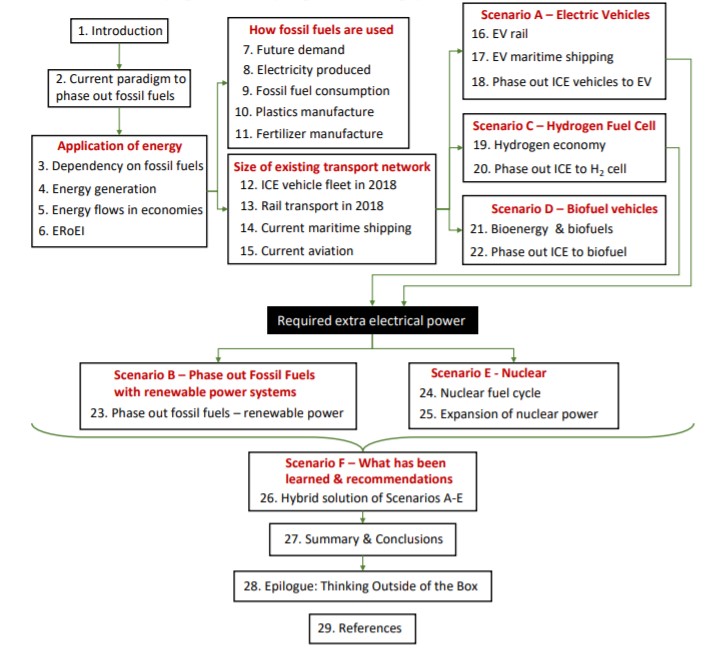
1. Introduction
2. Current paradigm to phase out fossil fuels
Application of energy
3. Dependency on fossil fuels
4. Energy generation
5. Energy flows in economies
6. EROEI
How fossil fuels are used
7. Future demand
8. Electricity produced
9. Fossil fuel consumption
10. Plastics manufacture
11. Fertilizer manufacture
Size of existing transport network
12. ICE vehicle fleet in 2018
13. Rail transport in 2018
14. Current maritime shipping
15. Current aviation
Scenario A - Electric Vehicles
16. EV rail
17. EV maritime shipping
18. Phase out ICE vehicles to EV
Scenario C-Hydrogen Fuel Cell
19. Hydrogen economy
20. Phase out ICE to H₂ cell
Scenario D - Biofuel vehicles
21. Bioenergy & biofuels
22. Phase out ICE to biofuel
Required extra electrical power
Scenario B-Phase out Fossil Fuels with renewable power systems
23. Phase out fossil fuels-renewable power
Scenario E-Nuclear
24. Nuclear fuel cycle
25. Expansion of nuclear power
Scenario F-What has been learned & recommendations
26. Hybrid solution of Scenarios A-E
27. Summary & Conclusions
28. Epilogue: Thinking Outside of the Box
29. References
ボトムアップの洞察が明らかに: 化石燃料を置き換えることは、考えられていたよりもさらに膨大な作業です。GTK
https://www.gtk.fi/en/current/a-bottom-up-insight-reveals-replacing-fossil-fuels-is-even-more-enormous-task-than-thought/
ボトムアップの洞察が明らかにする: 化石燃料を置き換えることは、考えられているよりもさらに大きな作業です
再生可能エネルギー技術を使用して既存の化石燃料を動力源とするシステムを人類全体のために置き換えることは、考えられているよりもはるかに大きな作業である、とフィンランド地質調査所 GTK の副研究教授 Simon Michaux が作成したレポートが明らかにしています。循環経済と規制によって消費と材料の必要性を削減できたとしても、必要な余分なエネルギーと材料がボトルネックになる可能性があります。
「私たちは、産業エコシステムを化石燃料のない状態に 2 ~ 30 年で変換するのに十分な投資の大幅な増加を観察しています。さらに、この移行は、全体的な人口増加から生じる将来のエネルギーと材料のニーズにも対処する必要があります」とSimon Michaux氏は言います。 .
このオープン ファイル レポートは、自動車の内燃機関技術 (ICE) や発電に現在使用されている化石燃料 (石油、ガス、石炭) を段階的に廃止するという野心的な課題に取り組んでいます。
このレポートは、以前の研究とはまったく異なる新しい数値を生み出しました。これは、これらの研究を定義したパラダイムの違いに部分的に起因する可能性があります。ここに示す計算には、(典型的なトップダウンのアプローチとは対照的に) 新しいボトムアップのアプローチが使用されました。以前の研究では、推定生産コストと CO2 フットプリント指標に焦点を当てる傾向がありましたが、今回のレポートは物理的な材料要件に基づいています。すべてのデータ、図、および図は、公開されている情報源から作成または複製されており、適切に引用されています。
小規模なソリューションは、グローバルなニーズに合わせてスケールアップできません
公開されている文献で議論されている解決策の多くは、比較的小規模であれば非常にうまく機能するかもしれませんが、既存の化石燃料供給システムの規模を模倣するために地球規模の範囲にスケールアップすると機能しなくなります。通常、これを実現するボトルネックは、必要な鉱物の量、製造能力、または単に生産を展開するのに必要な時間です。ほとんどのアナリストは、エコシステムの一部のみ、または 1 つの機能のみを個別に調べます。実際に必要なのは、固有の複雑さを尊重する全体的なシステム ネットワーク エンジニアリング アプローチです。そのアプローチがここに示されています。
エネルギーはマスターリソースです
重要ポイント:
- エネルギーはマスターリソースです
- 化石燃料を段階的に廃止するという課題は、現在のパラダイムが許容するよりもはるかに大きい
- 化石燃料の段階的廃止に関する現在の計画では、タスクの規模が大幅に過小評価されています
- バイオ燃料とバイオマスは必要だがスケールアップできない (シナリオ D)
- 原子力は必要になるが、化石燃料発電に取って代わることはできない (シナリオ E)
- 非化石燃料システムは、化石燃料システムに取って代わるほど効果的ではないかもしれません。
これらの課題に 20 年から 50 年の時間枠で取り組む必要があります。
化石燃料からの移行における鉱物の役割は非常に重要ですが、誤解されています
現在人類が直面している複数の大規模なタスクに対処するには、50:1 程度の ERoEI 比でほとんどの人口が利用できる信頼性の高いエネルギー源が必要です。これは、既存の化石燃料システムよりも高く、はるかに高いです。再生可能エネルギーシステムよりも。これがなければ、将来の開発計画では、既存の消費パターンの維持に関する現在の多くの仮定を手放す必要があります。
化石燃料からの移行における鉱物の役割は非常に重要ですが、誤解されています。課題の性質上、地球科学者は将来の計画に参加する必要があります。
詳しくは
Simon Michaux、准研究教授、フィンランド地質調査所
simon.michaux@gtk.fi , tel. +358295032159
Geological Survey of Finland: より持続可能な成長のためのソリューション
Geological Survey of Finland (GTK) は、産業界、学界、およびより広い社会における意思決定を支援するために、公平で客観的な研究データとサービスを提供しています。GTK は、ミネラル エコノミー、サーキュラー エコノミー、エネルギー、水、環境に関連するソリューション、およびデジタル ソリューションを専門とする 400 人以上の専門家を雇用しています。GTK は、フィンランド雇用経済省が管轄する研究機関であり、フィンランドおよび世界的に活動しています。

0 件のコメント:
コメントを投稿