中野剛志 2021/12/04 日本経済が成長しなくなった、あまりにも「残念」な理由

Upward Mobility in a High-Pressure Economy - Brookings ...
- PDFAM OKUN 著被引用数: 332 — ARTHUR M. OKUN*. Brookings Institution. Upward. Mobility in a. High-pressure Economy. THE CHOICE OF AN AGGREGATE TARGET of resource utilization remains.
アーサー・M・オークン (Arthur M. Okun), 1928-1980
https://cruel.org/econthought/profiles/okun.htmlオーカンという表記もある。オークンの法則で有名、というか実質的にこれしか知られていない。ジャージー・シティ生まれ、コロンビア大学に入ってそのまま博士号を取得した後にイェール大で教鞭をとり、後にケネディ政権下の Council of Economic Advisors で活躍している。著作を見ても経済予測や政策と経済の関係など、理論よりは政策よりのものが多く、理論家というよりは政策エコノミストに近いかもしれない。
実質GDPの変化 (実質 GDP 成長率) と失業率の変化のあいだには統計的に直線で近似される関係が観測されるという経験則である。かれがこれを発見したのは 1960 年代初期で、失業率が1%下がると実質GNPが 3% ほど上がる、という関係がアメリカ経済では見られていた。また現在の日本では、失業率が 1% 下がると GDP 成長は 6% になるという関係が見られている。
この法則はすばらしくよく成立していて、同僚トービンをして「マクロ経済で最も信頼のおける経験則の一つ」と言わしめたものではあるけれど、なぜそうなるのか、という因果関係の説明はまったくない。オークンがデータを見ていて発見した関係でしかない。オークン在籍中の CEA は、このデータを使って失業率を下げるメリットがいかに大きいかを大統領に納得させ、これがケネディ政権の大幅な減税策につながっている。
またかれは、社会の経済格差の是正も重大事項と考えており、その手段として累進課税の強化を訴えていた。
アーサー・オークンの主要著作
- "A Review of Some Economic Forecasts for 1955-57", 1959, Econometrica
- "On the Appraisal of Cyclical Turning Point Predictors", 1960, Journal of Business
- "The Value of Anticipations Data in Forecasting National Product", 1960, in Quality and Economic Significance of Anticipations Data
- "Potential GNP: Its measurement and significance", 1962, Proceedings of ASA
- "Comment on Friedman's and Schwartz's Money and Business Cycles", 1963, REStat
- "Investment Demand at Full Employment", 1963, Proceedings of ASA
- Monetary Policy, Debt Management and Interest Rates: A Quantitative Appraisal", 1963, in Stabilization Policies
- The Political Economy of Prosperity, 1970.
- "Upward Mobility in a High-Pressure Economy", 1973, BPEA
- "Inflation: Its mechanics and welfare costs", 1975, BPEA
- Equality and Efficiency: the Big Tradeoff , 1975.
- "Efficient Disinflationary Policies", 1978, AER
- "Rational Expectations with Misperceptions as a Theory of the Business Cycle", 1980, JMCB
- Prices and Quantities: A macroeconomic analysis. 1981.
- Economics for Policymaking: Selected Essays, 1983
アーサー・オークンに関するリソース
- Biography of Authur M. Okun, The Concise Encyclopedia of Economics
- "Okun's Law Revisited: Should We Worry about Low Unemployment?" by David Altig, Terry Fitzgerald, and Peter Rupert, May 15, 1997
- オークンの法則――クルーグマン論文からの引用. オークンの法則が実に見事に日本にあてはまることを示したページ by 黒木玄

マクロ経済学と日本経済 - 61 ページ
https://diamond.jp/articles/-/289179
日本経済が成長しなくなった、あまりにも「残念」な理由
財政政策の「古い見解」vs「新しい見解」
「積極財政は単なるバラマキ」「財政出動はカンフル剤に過ぎない」などの言説が、日本では主流だ。しかし、2010年代のアメリカでは経済政策の考え方に大転換が起き、これらの言説は「古い見解」と見なされるようになり、「積極財政こそが経済成長を生み出す」という「新しい見解」が主流となった。そして、バイデン政権による画期的な大規模財政出動が現実のものとなったのだ。なぜ、そのような大転換が起きたのか? なぜ、「新しい見解が正しい」と言えるのか? 最新刊『変異する資本主義』(ダイヤモンド社)で、アメリカの経済政策の最前線を分析した中野剛志氏が解説する。
 写真はイメージです Photo: Adobe Stock
 アメリカで起きた経済政策論の「大転換」
『変異する資本主義』の第一章でも論じたように、アメリカにおける主流派経済学の政策論は、2010年代中に、大きく変わった。①
オバマ政権下で大統領諮問委員会委員長を務めたジェイソン・ファーマンによれば、かつて主流派経済学者は、積極財政について「短期的な景気刺激策としては有効かもしれないが、長期的な経済成長には効果がない」と主張していた。
積極財政は金利を上昇させて民間投資を抑制する(クラウディングアウト)だろうというのが、その理由の一つである。ほかならぬファーマン自身も、かつてはそう考えて、積極財政に否定的であった。②
日本でも、経済学者や評論家が「財政出動は、単なるカンフル剤に過ぎない。経済成長のためには、構造改革などによって生産性を向上させる成長戦略が必要だ」という主張をするのを、よく耳にしたことがあるだろう。
ところが、2016年、ファーマンは、それはもはや「古い見解」だと断じたのである。
では、主流派経済学の「新しい見解」とは、どういうものか。
低金利の状況下では、財政刺激策は非常に有効であり、民間投資を抑制するどころか、逆に呼び込む(クラウディング・イン)ことすらある。その結果、金利は上昇するかもしれないが、それは好ましいことである。さらに、財政支出先が適正なものであるならば、財政拡張は継続してもよい。これが主流派経済学の「新しい見解」だというのである。③
同じ年、連邦準備制度理事会(FRB)の議長を務め、現在は財務長官である経済学者ジャネット・イエレンもまた、「危機後のマクロ経済研究」(注1)という注目すべき講演を行っている。ここで言う「危機」とは、2008年の世界金融危機のことである。
(注1)Janet L. Yellen, ‘Macroeconomic Research After the Crisis,’ 60th Annual Economic Conference, Boston, Massachusetts, October 14, 2016★
この講演でイエレンは、ファーマンの言う「古い見解」は間違いだったと主張したのである。何が間違いだったのか。
2008年の世界金融危機は、積極的な財政金融政策によって、とりあえず克服され、景気は回復した。ところが、危機後の経済成長率は、危機前の水準に戻ることはなく、低位で推移したのである。それは、なぜか。
イエレンは、世界金融危機による需要の急減が、供給側にもダメージを与え、しかも後遺症(経済学では「履歴効果」と言う)として残った結果、潜在的な経済成長力が低下したのではないかと考えた。
そこで彼女は、1970年代にアーサー・オークンが論じた「高圧経済(high pressure economy)」なる概念を持ち出した。「高圧経済」とは、需要が十分にあって、労働市場がタイトな状態の経済を指す。言わば、デマンドプル・インフレの傾向にある経済である。
この高圧経済の下では、大きな需要が存在することから、企業は積極的な投資を行って、生産能力を拡大する。また、技術開発投資や起業も活発に行われる。雇用機会が十分にあり、労働市場がタイトであるため、労働力はより生産的な仕事へと移動する。
したがって、政府が公共投資によって、需要を拡大し、高圧経済の状態を作り出すことができれば、民間投資が誘発され、供給力が高まり、経済成長が可能になる。しかも、高圧経済を維持するためには、政府は財政支出を一時的に拡大するだけではなく、長期間、継続する必要があるかもしれない。
端的に言えば、積極的な財政金融政策は、もはや単なるカンフル剤ではなく、長期の成長戦略でもあるということだ。これは、ファーマンの言う「新しい見解」である。
この「新しい見解」を表明したイエレンが、バイデン政権下で財務長官に就任したのである。
①
②
Options to Close the Long-run Fiscal Gap Jason Furman
2007
https://www.brookings.edu/wp-content/uploads/2016/06/furman20070131S-1.pdf
③
The New View of Fiscal Policy and Its Application Jason Furman1
2016
日本経済が成長しなくなった、あまりにも「残念」な理由
財政政策の「古い見解」vs「新しい見解」
積極財政が経済成長をもたらす
では、財政政策が経済成長をもたらすという「新しい見解」は正しいのであろうか。
ここに、クレディセゾン主任研究員の島倉原氏が作成した図がある。OECD33ヵ国と中国について、1997年から2015年の間の財政支出の伸び率と名目GDP成長率の相関をとったものである。
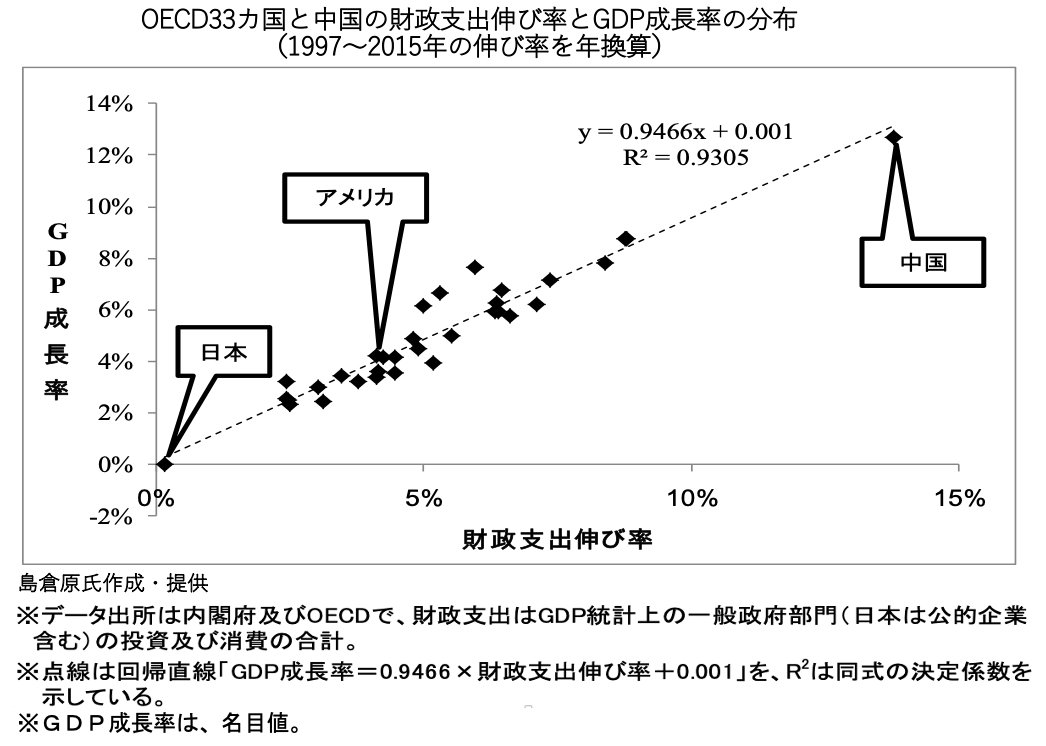
見て明らかな通り、極めて高い相関がある。そして、財政支出の伸び率が最も低く、GDP成長率も最低水準にあるのが、日本である。
過去20年の間、どの国よりも財政支出を抑制し続け、そしてどの国よりも成長しなかった国、それが日本なのだ。
「古い見解」に固執する健全財政論者は、この不都合な図を見せられると狼狽え、苦し紛れに「これは、相関関係であって、因果関係ではない」と言い放つのが常である。
要するに、「財政支出の拡大が経済成長をもたらしたのではなく、経済が成長したから財政支出が増えたのかもしれないではないか」と言いたいわけだ。
もちろん、この図だけでは、因果関係は説明できない。
しかし、積極財政が経済成長をもたらすという因果関係については、すでにイエレンが説明した通りである。
他方、「経済が成長したから財政支出が伸びた」という因果関係を想定するのは、相当に無理がある。
なぜなら、もし、財政支出を拡大しても経済成長はできないという「古い見解」が正しいならば、経済が成長したからといって、それに合わせて財政支出を増やさなければならない理由はないだろう。むしろ、財政支出を積極的に抑制することで、経済を成長させた国があってもいいはずだ。
ところが、先ほどの図には、「経済成長率は高いが、財政支出の伸び率は低い」という国はないのである。
また、積極財政は、インフレ圧力をもたらす。「古い見解」を信じる日本の健全財政論者に至っては、積極財政は制御不能なインフレを引き起こすと主張し、デフレ不況下での財政出動にすら反対してきたはずだ。だとすると、経済が成長したら財政支出を増やすなどという財政運営をしたら、極端なインフレになるはずであろう。
ところが、先ほどの図にある通り、日本以外の国は、すべて日本よりも財政支出の伸び率が高いにもかからず、この中に過剰なインフレで苦しんだ国など一つとしてないのである。
ということは、この図は、やはり積極財政が経済を成長させるという「新しい見解」を裏付けるものと解釈すべきなのだ。
すでにバイデン政権は、イエレン財務長官の下で「新しい見解」を採用し、積極財政路線へと転換した(なお、現在、アメリカではインフレが進んでいるが、これは原油高や物流の混乱など供給側に起因するコストプッシュ・インフレであって、財政政策によるものではない。参照資料1 参考資料2)。
ところが、日本は、依然として「古い見解」が幅を利かせている。
それどころか、矢野康治・財務次官が「財務次官、モノ申す「このままでは国家財政は破綻する」(『文藝春秋』(11月号))という論文を大真面目に発表し、それを経済学者やマスメディアあるいは財界人がこぞって賞賛するという有様である。日本経済が成長しなくなったのも当然であろう。間違った「古い見解」を改められないのだから。
なお、この財政政策の「古い見解」vs「新しい見解」を巡っては、12月10日発売の『文藝春秋』(1月号)において、健全財政論者の小林慶一郎氏と対談を行っているので、併せて参照されたい。
(注1)Janet L. Yellen, 'Macroeconomic Research After the Crisis,' 60th Annual Economic Conference, Boston, Massachusetts, October 14, 2016
1971年神奈川県生まれ。評論家。専門は政治経済思想。1996年、東京大学教養学部(国際関係論)卒業後、通商産業省(現・経済産業省)に入省。2000年よりエディンバラ大学大学院に留学し、政治思想を専攻。2001年に同大学院より優等修士号、2005年に博士号を取得。2003年、論文"Theorising Economic Nationalism"(Nations and Nationalism)でNations and Nationalism Prizeを受賞。主な著書に山本七平賞奨励賞を受賞した『日本思想史新論』(ちくま新書)、『TPP亡国論』『世界を戦争に導くグローバリズム』(集英社新書)、『富国と強兵』(東洋経済新報社)、『国力論』(以文社)、『国力とは何か』(講談社現代新書)、『保守とは何だろうか』(NHK出版新書)、『官僚の反逆』(幻冬社新書)、『目からウロコが落ちる奇跡の経済教室【基礎知識編】』『全国民が読んだら歴史が変わる奇跡の経済教室【戦略編】』(KKベストセラーズ)、『小林秀雄の政治学』(文春新書)、『変異する資本主義』(ダイヤモンド社)など。
https://www.project-syndicate.org/commentary/us-supply-chain-coordination-problem-by-james-k-galbraith-2021-11?barrier=accesspaylog
The Choking of the Global Minotaur

AUSTIN – A supply chain is like a Rorschach Test: each economic analyst sees in it a pattern reflecting his or her own preconceptions. This may be inevitable, since everyone is a product of differing educations, backgrounds, and prejudices. But some observed patterns are more plausible than others.
Consider the following sampling of perspectives. For Jason Furman, formerly US President Barack Obama’s chief economic adviser, and Lawrence H. Summers, a former US secretary of the treasury, today’s supply-chain problem is one of excessive demand. According to Furman, it is a “high class” issue that reflects a strong economy. The “original sin” was the American Rescue Plan, which provided too much support through funds disbursed directly to US households.
For John Tamny of RealClearMarkets, the supply-chain problem is one of “central planning.” Had President Joe Biden’s administration not sent directives to port managers, free markets would have sorted everything out. And for Awi Federgruen, a professor of management at the Columbia Business School, the issue is inefficiency, the remedy for which is to work harder and do more with less.
We hope you're enjoying Project Syndicate.
To continue reading and receive unfettered access to all content, subscribe now.
orUnlock additional commentaries for FREE by registering.
Already have an account? Log in
For more than 25 years, Project Syndicate has been guided by a simple credo: All people deserve access to a broad range of views by the world's foremost leaders and thinkers on the issues, events, and forces shaping their lives. At a time of unprecedented uncertainty, that mission is more important than ever – and we remain committed to fulfilling it.
But there is no doubt that we, like so many other media organizations nowadays, are under growing strain. If you are in a position to support us, please subscribe now.
As a subscriber, you will enjoy unlimited access to our On Point suite of long reads, book reviews, and insider interviews; Big Picture topical collections; Say More contributor interviews; Opinion Has It podcast features; The Year Ahead magazine, the full PS archive, and much more. You will also directly support our mission of delivering the highest-quality commentary on the world's most pressing issues to as wide an audience as possible.
By helping us to build a truly open world of ideas, every PS subscriber makes a real difference. Thank you.
参考資料2
https://www.project-syndicate.org/commentary/inflation-not-macroeconomic-problem-for-fed-by-james-k-galbraith-2021-11?barrier=accesspaylog
Whipping Up America's Inflation Bogeyman

AUSTIN – The headline chosen for Harvard economist Jason Furman’sNovember 15 commentary in the Wall Street Journal was both apt and sad. It was apt, because it repurposed then-President Gerald Ford’s “Whip Inflation Now” slogan from 1974, and sad because Furman’s advice comes straight from that era – and because his prescriptions could reprise the economic and political disasters of those years.
Furman, formerly the chair of President Barack Obama’s Council of Economic Advisers, writes that “ultimately inflation is a macroeconomic problem,” meaning it is an issue that afflicts the economy as a whole. In exploring the causes of the problem, Furman writes of “rapid recovery,” “tight labor markets,” excessive fiscal stimulus, and too-easy money. The US economy, in his telling, has too much spending pressing on its capacity to produce. It is too big.
Except that it’s not. According to the latest GDP report, the actual size of the US economy – measured in inflation-adjusted dollars – is still smallerthan it was in the last quarter of 2019. Americans are spending and producing in real terms less now than we did then. For all the hot air about high growth rates, low interest rates, and big deficits, America is not even back to the starting gate. That means there is no way that our current inflation rate is “macroeconomic.”
We hope you're enjoying Project Syndicate.
To continue reading and receive unfettered access to all content, subscribe now.
orUnlock additional commentaries for FREE by registering.
Already have an account? Log in
For more than 25 years, Project Syndicate has been guided by a simple credo: All people deserve access to a broad range of views by the world's foremost leaders and thinkers on the issues, events, and forces shaping their lives. At a time of unprecedented uncertainty, that mission is more important than ever – and we remain committed to fulfilling it.
But there is no doubt that we, like so many other media organizations nowadays, are under growing strain. If you are in a position to support us, please subscribe now.
As a subscriber, you will enjoy unlimited access to our On Point suite of long reads, book reviews, and insider interviews; Big Picture topical collections; Say More contributor interviews; Opinion Has It podcast features; The Year Ahead magazine, the full PS archive, and much more. You will also directly support our mission of delivering the highest-quality commentary on the world's most pressing issues to as wide an audience as possible.
By helping us to build a truly open world of ideas, every PS subscriber makes a real difference. Thank you.
★
Speech by Chair Yellen on macroeconomic research after the crisis - Federal Reserve Board
https://www.federalreserve.gov/newsevents/speech/yellen20161014a.htm
Macroeconomic Research After the Crisis
October 14, 2016
Chair Janet L. Yellen
At "The Elusive 'Great' Recovery: Causes and Implications for Future Business Cycle Dynamics" 60th annual economic conference sponsored by the Federal Reserve Bank of Boston, Boston, Massachusetts
Watch live: https://www.bostonfed.org/live
Extreme economic events have often challenged existing views of how the economy works and exposed shortcomings in the collective knowledge of economists. To give two well-known examples, both the Great Depression and the stagflation of the 1970s motivated new ways of thinking about economic phenomena. More recently, the financial crisis and its aftermath might well prove to be a similar sort of turning point. Today I would like to reflect on some ways in which the events of the past few years have revealed limits in economists' understanding of the economy and suggest several important questions I hope the profession will try to answer. Some of these questions are not new, though recent events have made them more urgent. Appropriately, some are addressed by the papers prepared for this conference. Pursuing answers to these questions is vital to the work of Federal Reserve and other economic policymakers, and the Fed is likewise engaged in ongoing research to seek answers.
The Influence of Demand on Aggregate Supply
The first question I would like to pose concerns the distinction between aggregate supply and aggregate demand: Are there circumstances in which changes in aggregate demand can have an appreciable, persistent effect on aggregate supply?
Prior to the Great Recession, most economists would probably have answered this question with a qualified "no." They would have broadly agreed with Robert Solow that economic output over the longer term is primarily driven by supply--the amount of output of goods and services the economy is capable of producing, given its labor and capital resources and existing technologies. Aggregate demand, in contrast, was seen as explaining shorter-term fluctuations around the mostly exogenous supply-determined longer-run trend.1 This conclusion deserves to be reconsidered in light of the failure of the level of economic activity to return to its pre-recession trend in most advanced economies. This post-crisis experience suggests that changes in aggregate demand may have an appreciable, persistent effect on aggregate supply--that is, on potential output.2
The idea that persistent shortfalls in aggregate demand could adversely affect the supply side of the economy--an effect commonly referred to as hysteresis--is not new; for example, the possibility was discussed back in the mid-1980s with regard to the performance of European labor markets.3 But interest in the topic has increased in light of the persistent slowdown in economic growth seen in many developed economies since the crisis. Several recent studies present cross-country evidence indicating that severe and persistent recessions have historically had these sorts of long-term effects, even for downturns that appear to have resulted largely or entirely from a shock to aggregate demand.4 With regard to the U.S. experience, one study estimates that the level of potential output is now 7 percent below what would have been expected based on its pre-crisis trajectory, and it argues that much of this supply-side damage is attributable to several developments that likely occurred as a result of the deep recession and slow recovery.5 In particular, the study finds that in the wake of the crisis, the United States experienced a modest reduction in labor supply as a result of reduced immigration and a fall in labor force participation beyond what can be explained by cyclical conditions and demographic factors, as well as a marked slowdown in the estimated trend growth rate of labor productivity. The latter likely reflects an unusually slow pace of business capital accumulation since the crisis and, more conjecturally, the sharp decline in spending on research and development and the very slow pace of new firm formation in recent years.6
If we assume that hysteresis is in fact present to some degree after deep recessions, the natural next question is to ask whether it might be possible to reverse these adverse supply-side effects by temporarily running a "high-pressure economy," with robust aggregate demand and a tight labor market. One can certainly identify plausible ways in which this might occur. Increased business sales would almost certainly raise the productive capacity of the economy by encouraging additional capital spending, especially if accompanied by reduced uncertainty about future prospects. In addition, a tight labor market might draw in potential workers who would otherwise sit on the sidelines and encourage job-to-job transitions that could also lead to more-efficient--and, hence, more-productive--job matches.7 Finally, albeit more speculatively, strong demand could potentially yield significant productivity gains by, among other things, prompting higher levels of research and development spending and increasing the incentives to start new, innovative businesses.
Hysteresis effects--and the possibility they might be reversed--could have important implications for the conduct of monetary and fiscal policy. For example, hysteresis would seem to make it even more important for policymakers to act quickly and aggressively in response to a recession, because doing so would help to reduce the depth and persistence of the downturn, thereby limiting the supply-side damage that might otherwise ensue. In addition, if strong economic conditions can partially reverse supply-side damage after it has occurred, then policymakers may want to aim at being more accommodative during recoveries than would be called for under the traditional view that supply is largely independent of demand.
More research is needed, however, to better understand the influence of movements in aggregate demand on aggregate supply.8 From a policy perspective, we of course need to bear in mind that an accommodative monetary stance, if maintained too long, could have costs that exceed the benefits by increasing the risk of financial instability or undermining price stability. More generally, the benefits and potential costs of pursuing such a strategy remain hard to quantify, and other policies might be better suited to address damage to the supply side of the economy.
Heterogeneity
My second question asks whether individual differences within broad groups of actors in the economy can influence aggregate economic outcomes--in particular, what effect does such heterogeneity have on aggregate demand?
Many macroeconomists work with models where groups of individual actors, such as households or firms, are treated as a single "representative" agent whose behavior stands in for that of the group as a whole. For example, rather than explicitly modeling and then adding up the separate actions of a large number of different households, a macro model might instead assume that the behavior of a single "average" household can describe the aggregate behavior of all households.
Prior to the financial crisis, these so-called representative-agent models were the dominant paradigm for analyzing many macroeconomic questions. However, a disaggregated approach seems needed to understand some key aspects of the Great Recession. To give one example, consider the effects of negative housing equity on consumption. Although households typically reduce their spending in response to wealth declines, the many households whose equity positions in their homes were actually driven negative by the reduction in house prices may have curtailed their spending even more sharply because of a markedly reduced ability to borrow. Such a development, in turn, would shift the relationship between housing equity (which remained solidly positive in the aggregate) and consumer spending for the economy as a whole. Such a shift in an aggregate relationship would be difficult to understand or predict without using disaggregated data and models.
More generally, studying the effects of household and firm heterogeneity might help us better account for the severity of the recession and the slow recovery. At the household level, recent research finds that heterogeneity can amplify the effects of adverse shocks, a result that is largely driven by households with very little net worth that sharply increase their savings in a recession.9 At the firm level, there is evidence that financial constraints had a particularly large adverse effect on employment at small firms and the start-up of new firms, factors that may be part of the explanation for the Great Recession's long duration and the subsequent slow recovery.10More generally, if larger firms seeking to expand have better access to credit than smaller ones, overall growth in investment and employment could depend in part on the distribution of sales across different types of businesses. Modeling any of these issues quantitatively will likely require the use of a heterogeneous-agent framework.
Economists' understanding of how changes in fiscal and monetary policy affect the economy might also benefit from the recognition that households and firms are heterogeneous. For example, in simple textbook models of the monetary transmission mechanism, central banks operate largely through the effect of real interest rates on consumption and investment. Once heterogeneity is taken into account, other important channels emerge. For example, spending by many households and firms appears to be quite sensitive to changes in labor income, business sales, or the value of collateral that in turn affects their access to credit--conditions that monetary policy affects only indirectly. Studying monetary models with heterogeneous agents more closely could help us shed new light on these aspects of the monetary transmission mechanism.
While the economics profession has long been aware that these issues matter, their effects had been incorporated into macro models only to a very limited extent prior to the financial crisis.11 I am glad to now see a greater emphasis on the possible macroeconomic consequences of heterogeneity, including in work by economists at the Federal Reserve.12Nevertheless, the various linkages between heterogeneity and aggregate demand are not yet well understood, either empirically or theoretically. More broadly, even though the tools of monetary policy are generally not well suited to achieve distributional objectives, it is important for policymakers to understand and monitor the effects of macroeconomic developments on different groups within society.
Financial Linkages to the Real Economy
My third question concerns a key issue for monetary policy and macroeconomics that is less directly addressed by this conference: How does the financial sector interact with the broader economy?
In light of the housing bubble and subsequent events, policymakers clearly need to better understand what kinds of developments contribute to financial crises. What is the relationship between the buildup of excessive leverage and the value of real estate and other types of collateral, and what factors impede or facilitate the deleveraging process that follows? Does the economic fallout from a financial crisis depend on the particulars of the crisis, such as whether it involves widespread damage to household balance sheets? How does the nature and degree of the interconnections between financial firms affect the propagation and amplification of stress through the financial system and overall economy? Finally--and most importantly--what can monetary policy and financial oversight do to reduce the frequency and severity of future crises?
Although the scope of these questions extends beyond the themes of this conference, it does include issues that are closely related. Consider the influence of balance sheet conditions and noninterest credit terms on spending and overall activity--an area where it is important to take account of differences across individual households and firms, as I just noted. Research on this topic has, of course, been ongoing for some time, and it has expanded greatly in the wake of the financial crisis.13 But I believe we have a lot more to learn about the ways in which changes in underwriting standards and other determinants of credit availability interact with interest rates to affect such things as consumer spending, housing demand and home prices, business investment (especially for small firms), and the formation of new firms.14 For example, is the persistent increase in the personal saving rate that we have observed since the collapse of the housing bubble primarily a result of a sustained shift toward more prudent underwriting standards by lenders? Is it something that will ultimately prove transitory once householdsfinish repairing their balance sheets or become more confident about their future prospects for employment and income?15 The answer to thislatter question could have significant implications for the longer-run normal, or neutral, level of interest rates and thus for the conduct of monetary policy.
Inflation Dynamics
My fourth question goes to the heart of monetary policy: What determines inflation?
From my perspective, the standard framework for thinking about inflation dynamics used by central bank economists and others prior to the financial crisis remains conceptually useful today. A simple description of this framework might go something like this:16 Inflation is characterized by an underlying trend that has been essentially constant since the mid-1990s; previously, this trend seemed to drift over time, influenced by actual past inflation or other economic conditions. Theory and evidence suggest that this trend is strongly influenced by inflation expectations that, in turn, depend on monetary policy. In particular, the remarkable stability of various measures of expected inflation in recent years presumably represents the fruits of the Federal Reserve's sustained efforts since the early 1980s to bring down and then stabilize inflation at a low level. The anchoring of inflation expectations that has resulted from this policy does not, however, prevent actual inflation from fluctuating from year to year in response to the temporary influence of movements in energy prices and other disturbances. In addition, inflation will tend to run above or below its underlying trend to the extent that resource utilization--which may serve as an indicator of firms' marginal costs--is persistently high or low.17
While this general framework for thinking about the inflation process remains useful, questions about some of its quantitative features have arisen in the wake of the Great Recession and the subsequent slow recovery. For example, the influence of labor market conditions on inflation in recent years seems to be weaker than had been commonly thought prior to the financial crisis. Although inflation fell during the recession, the decline was quite modest given how high unemployment rose; likewise, wages and prices rose comparatively little as the labor market gradually recovered. Whether this reduction in sensitivity was somehow caused by the recession or instead pre-dated it and was merely revealed under extreme conditions is unclear.18 Either way, the underlying cause is unknown. Does the reduced sensitivity reflect structural changes, such as globalization or a greater role for intangible capital in production that have reduced the importance of cyclical swings in domestic activity for firms' marginal costs and pricing power? Or does it perhaps reflect the well-documented reluctance--or, alternatively, limited ability--of firms to cut the nominal wages of their employees, which could help to explain the relatively moderate movements in inflation we saw during and after the recession?19
Another gap in our knowledge about the nature of the inflation process concerns expectations. Although many theoretical models suggest that actual inflation should be most closely related to short-run inflation expectations, as an empirical matter, measures of long-run expectations appear to explain the data better.20 Yet another unresolved issue concerns whose expectations--those of consumers, firms, or investors--are most relevant for wage and price setting, a point on which theory provides no clear-cut guidance. More generally, the precise manner in which expectations influence inflation deserves further study.21
Perhaps most importantly, we need to know more about the manner in which inflation expectations are formed and how monetary policy influences them. Ultimately, both actual and expected inflation are tied to the central bank's inflation target, whether that target is explicit or implicit.22 But how does this anchoring process occur? Does a central bank have to keep actual inflation near the target rate for many years before inflation expectations completely conform? Can policymakers instead materially influence inflation expectations directly and quickly by simply announcing their intention to pursue a particular inflation goal in the future? Or does the truth lie somewhere in between, with a change in expectations requiring some combination of clear communications about policymakers' inflation goal, concrete policy actions to demonstrate their commitment to that goal, and at least some success in moving actual inflation toward its desired level in order to demonstrate the feasibility of the strategy? Although historical experience suggests that changing the public's inflation expectations would be neither quick nor easy, it is not clear which of these possibilities is correct.23
With nominal short-term interest rates at or close to their effective lower bound in many countries, the broader question of how expectations are formed has taken on heightened importance. Under such circumstances, many central banks have sought additional ways to stimulate their economies, including adopting policies that are directly aimed at influencing expectations of future interest rates and inflation. The unusually explicit and extended guidance about the likely future path of the federal funds rate that was provided by the FOMC from 2011 through 2014 is an example of such a policy, as is the Bank of Japan's upward revision to its official inflation objective in 2013. Moreover, these and other expectational strategies may be needed again in the future, given the likelihood that the global economy may continue to experience historically low interest rates, thereby making it unlikely that reductions in short-term interest rates alone would be an adequate response to a future recession.24
For all of these reasons, I hope that researchers will strive to improve our understanding of inflation dynamics and its interactions with monetary policy.
International Linkages
Before closing, let me mention one additional area where more study is needed--the effects of changes in U.S. monetary policy on financial and economic conditions in the rest of the world and the ways in which those foreign effects can feed back to influence conditions here at home. Of course, cross-country monetary policy spillovers have been the subject of scholarly debate since the Great Depression, and much of the formal analysis of this topic dates back to the early 1960s.25 But this issue has received renewed interest with the advent of unconventional monetary policies after the Great Recession and, more recently, the divergence of monetary policies among major advanced-economy central banks.
Broadly speaking, monetary policy actions in one country spill over to other economies through three main channels: changes in exchange rates; changes in domestic demand, which alter the economy's imports; and changes in domestic financial conditions--such as interest rates and asset prices--that, through portfolio balance and other channels, affect financial conditions abroad. Research by Federal Reserve staff suggests that, all told, U.S. monetary policy spillovers to other economies are positive--that is, policies designed to provide stimulus to the U.S. economy also boost activity abroad, as negative effects of dollar depreciation are offset by positive effects of higher U.S. imports and easier foreign financial conditions.26 However, this issue is far from settled, as are a host of other related questions, including the following: Do U.S. monetary policy actions affect advanced and emerging market countries differently? Do conventional and unconventional monetary policies spill over to other countries differently? And to what extent are U.S. interest rates and financial conditions influenced by easing measures abroad?
Conclusion
In closing, I would like to commend the Federal Reserve Bank of Boston for organizing this conference and fostering research and debate on questions vital to our understanding of the economy. Answering these questions will help the Federal Reserve's efforts to promote a healthy economy, and I am grateful for the opportunity to speak to you today and be part of this important discussion.
References
Agnello, Luca, and Ludger Schuknecht (2011). "Booms and Busts in Housing Markets: Determinants and Implications," Journal of Housing Economics, vol. 20 (September), pp. 171-90.
Akerlof, George A., William T. Dickens, and George L. Perry (1996). "The Macroeconomics of Low Inflation (PDF)," Brookings Papers on Economic Activity, no. 1, pp. 1-76.
Akerlof, George A., Andrew K. Rose, and Janet L. Yellen (1988). "Job Switching and Job Satisfaction in the U.S. Labor Market (PDF)," Brookings Papers on Economic Activity, no. 2, pp. 495-594.
Ammer, John, Michiel De Pooter, Christopher Erceg, and Steven Kamin (2016). "International Spillovers of Monetary Policy," IFDP Notes. Washington: Board of Governors of the Federal Reserve System, February 8.
Auclert, Adrien (2016). "Monetary Policy and the Redistribution Channel (PDF)," unpublished paper, Stanford University, Department of Economics, January.
Bernanke, Ben S., and Mark Gertler (1989). "Agency Costs, Net Worth, and Business Fluctuations," American Economic Review, vol. 79 (March), pp. 14-31.
Bernanke, Ben S., Mark Gertler, and Simon Gilchrist (1999a). "The Financial Accelerator in a Quantitative Business Cycle Framework," in John B. Taylor and Michael Woodford, eds., Handbook of Macroeconomics, vol. 1C. Amsterdam: Elsevier, pp. 1341-93.
Bernanke, Ben S., Thomas Laubach, Frederic S. Mishkin, and Adam S. Posen (1999b). Inflation Targeting: Lessons from the International Experience. Princeton, N.J.: Princeton University Press.
Blanchard, Olivier (2016). "The Phillips Curve: Back to the '60s?" American Economic Review, vol. 106 (May), pp. 31-34.
Blanchard, Olivier, Eugenio Cerutti, and Lawrence Summers (2015). "Inflation and Activity--Two Explorations and Their Monetary Policy Implications (PDF)," IMF Working Paper WP/15/230. Washington: International Monetary Fund, November.
Blanchard, Olivier J., and Lawrence H. Summers (1986). "Hysteresis and the European Unemployment Problem," in Stanley Fischer, ed., NBER Macroeconomics Annual 1986, vol. 1. Cambridge, Mass.: MIT Press, pp. 15-90.
Blinder, Alan S., and Janet L. Yellen (2001). The Fabulous Decade: Macroeconomic Lessons from the 1990s. New York: Century Foundation Press.
Cerra, Valerie, and Sweta Chaman Saxena (2008). "Growth Dynamics: The Myth of Economic Recovery," American Economic Review, vol. 98 (March), pp. 439-57.
Chaney, Thomas, David Sraer, and David Thesmar (2012). "The Collateral Channel: How Real Estate Shocks Affect Corporate Investment," American Economic Review, vol. 102 (October), pp. 2381-409.
Chodorow-Reich, Gabriel (2014). "The Employment Effects of Credit Market Disruptions: Firm-Level Evidence from the 2008-9 Financial Crisis," Quarterly Journal of Economics, vol. 129 (February), pp. 1-59.
Clark, Todd E., and Troy Davig (2008). "An Empirical Assessment of the Relationships among Inflation and Short- and Long-Term Expectations (PDF)," Research Working Paper RWP 08-05. Kansas City: Federal Reserve Bank of Kansas City, November.
Clementi, Gian Luca, and Berardino Palazzo (2016). "Entry, Exit, Firm Dynamics, and Aggregate Fluctuations," American Economic Journal: Macroeconomics, vol. 8 (July), pp. 1-41.
Daly, Mary C., and Bart Hobijn (2014). "Downward Nominal Rigidities Bend the Phillips Curve," Journal of Money, Credit and Banking, vol. 46 (October), pp. 51‑93.
Del Negro, Marco, Marc P. Giannoni, and Frank Schorfheide (2015). "Inflation in the Great Recession and New Keynesian Models," American Economic Journal: Macroeconomics, vol. 7 (January), pp. 168-96.
Dokko, Jane, Brian M. Doyle, Michael T. Kiley, Jinill Kim, Shane Sherlund, Jae Sim, and Skander Van Den Heuvel (2011). "Monetary Policy and the Global Housing Bubble," Economic Policy, vol. 26 (April), pp. 237-87.
Duygan-Bump, Burcu, Alexey Levkov, and Judit Montoriol-Garriga (2015). "Financing Constraints and Unemployment: Evidence from the Great Recession," Journal of Monetary Economics, vol. 75 (October), pp. 89-105.
Fair, Ray C. (2004). Estimating How the Macroeconomy Works.Cambridge, Mass.: Harvard University Press.
Fallick, Bruce C., Michael Lettau, and William L. Wascher (2016). "Downward Nominal Wage Rigidity in the United States during and after the Great Recession (PDF)," Finance and Economics Discussion Series 2016-001. Washington: Board of Governors of the Federal Reserve System, January.
Faust, Jon, and Jonathan H. Wright (2013). "Forecasting Inflation," in Graham Elliott and Allan Timmermann, eds., Handbook of Economic Forecasting, vol. 2A. Amsterdam: Elsevier, pp. 3-56.
Fernald, John G. (2015). "Productivity and Potential Output before, during, and after the Great Recession," in Jonathan A. Parker and Michael Woodford, eds., NBER Macroeconomics Annual 2014, vol. 29. Chicago: University of Chicago Press, pp. 1-51.
Fleming, J. Marcus (1962). "Domestic Financial Policies under Fixed and under Floating Exchange Rates," International Monetary Fund Staff Papers, vol. 9 (November), pp. 369-80.
Fukuda, Yoshiyuki, Yuki Kimura, Nao Sudo, and Hiroshi Ugai (2013). "Cross-Country Transmission Effect of the U.S. Monetary Shock under Global Integration (PDF)," Bank of Japan Working Paper Series 13-E-16. Tokyo: BOJ, November.
Georgiadis, Georgios (2015). "Determinants of Global Spillovers from U.S. Monetary Policy (PDF)," ECB Working Paper Series 1854. Frankfurt am Main, Germany: European Central Bank, September.
Gertler, Mark, and Peter Karadi (2015). "Monetary Policy Surprises, Credit Costs, and Economic Activity," American Economic Journal: Macroeconomics, vol. 7 (January), pp. 44-76.
Glick, Reuven, and Sylvain Leduc (2015). "Unconventional Monetary Policy and the Dollar: Conventional Signs, Unconventional Magnitudes (PDF)," Working Paper Series 2015-18. San Francisco: Federal Reserve Bank of San Francisco, November.
Gordon, Robert J. (2013). "The Phillips Curve Is Alive and Well: Inflation and the NAIRU during the Slow Recovery (PDF)," NBER Working Paper Series 19390. Cambridge, Mass.: National Bureau of Economic Research, August.
Gornemann, Nils, Keith Kuester, and Makoto Nakajima (2016). "Doves for the Rich, Hawks for the Poor? Distributional Consequences of Monetary Policy (PDF)," International Finance Discussion Papers 1167. Washington: Board of Governors of the Federal Reserve System.
Gourio, Francois, Todd Messer, and Michael Siemer (2016). "Firm Entry and Macroeconomic Dynamics: A State-Level Analysis," American Economic Review, vol. 106 (May), pp. 214-18.
Guvenen, Fatih (2011). "Macroeconomics with Heterogeneity: A Practical Guide (PDF)," Federal Reserve Bank of Richmond, Economic Quarterly, vol. 97 (Third Quarter), pp. 255-326.
Holzer, Harry J., Steven Raphael, and Michael A. Stoll (2006). "Employers in the Boom: How Did the Hiring of Less-Skilled Workers Change during the 1990s?" Review of Economics and Statistics, vol. 88 (May), pp. 283-99.
Howard, Greg, Robert Martin, and Beth Anne Wilson (2011). "Are Recoveries from Banking and Financial Crises Really So Different? (PDF)" International Finance Discussion Papers 1037. Washington: Board of Governors of the Federal Reserve System, November.
Ilzetski, Ethan, and Keyu Jin (2013). "The Puzzling Change in the International Transmission of U.S. Macroeconomic Policy Shocks (PDF)," working paper. London: London School of Economics, February.
Justiniano, Alejandro, Giorgio Primiceri, and Andrea Tambalotti (2015). "Household Leveraging and Deleveraging," Review of Economic Dynamics, vol. 18 (January), pp. 3-20.
Kaplan, Greg, Benjamin Moll, and Giovanni L. Violante (2016). "Monetary Policy According to HANK," NBER Working Paper Series 21897. Cambridge, Mass.: National Bureau of Economic Research, January.
Kashyap, Anil K., and Jeremy C. Stein (2000). "What Do a Million Observations on Banks Say about the Transmission of Monetary Policy?"American Economic Review, vol. 90 (June), pp. 407-28.
Katz, Lawrence F., and Alan B. Krueger (1999). "The High-Pressure U.S. Labor Market of the 1990s (PDF)," Brookings Papers on Economic Activity,no. 1, pp. 1-87.
Khan, Aubhik, and Julia K. Thomas (2013). "Credit Shocks and Aggregate Fluctuations in an Economy with Production Heterogeneity," Journal of Political Economy, vol. 121 (December), pp. 1055-107.
Kiley, Michael T. (2008). "Monetary Policy Actions and Long-Run Inflation Expectations (PDF)," Finance and Economics Discussion Series 2008-03. Washington: Board of Governors of the Federal Reserve System, February.
Krueger, Dirk, Kurt Mitman, and Fabrizio Perri (2016). "Macroeconomics and Household Heterogeneity," CEPR Discussion Paper 11038. London: Centre for Economic Policy Research, June.
Krusell, Per, and Anthony A. Smith, Jr. (1998). "Income and Wealth Heterogeneity in the Macroeconomy," Journal of Political Economy, vol. 106 (October), pp. 867-96.
Martin, Robert F., Teyanna Munyan, and Beth Anne Wilson (2015). "Potential Output and Recessions: Are We Fooling Ourselves? (PDF)" International Finance Discussion Papers 1145. Washington: Board of Governors of the Federal Reserve System, September.
Mavroeidis, Sophocles, Mikkel Plagborg-Moller, and James H. Stock (2014). "Empirical Evidence on Inflation Expectations in the New Keynesian Phillips Curve," Journal of Economic Literature, vol. 52 (March), pp. 124-88.
Mian, Atif, Kamalesh Rao, and Amir Sufi (2013). "Household Balance Sheets, Consumption, and the Economic Slump," Quarterly Journal of Economics, vol. 128 (November), pp. 1687-726.
Mundell, Robert A. (1963). "Capital Mobility and Stabilization Policy under Fixed and Flexible Exchange Rates," Canadian Journal of Economics and Political Science, vol. 29 (November), pp. 475-85.
Okun, Arthur M. (1973). "Upward Mobility in a High-Pressure Economy," Brookings Papers on Economic Activity, no. 1, pp. 207-52.
Parker, Jonathan A., Nicholas S. Souleles, David S. Johnson, and Robert McClelland (2013). "Consumer Spending and the Economic Stimulus Payments of 2008," American Economic Review, vol. 103 (October), pp. 2530-53.
Peek, Joe, and Eric S. Rosengren (2013). "The Role of Banks in the Transmission of Monetary Policy," Public Policy Discussion Papers 13-5. Boston: Federal Reserve Bank of Boston, September.
Peek, Joe, Eric S. Rosengren, and Geoffrey M.B. Tootell (2003). "Identifying the Macroeconomic Effects of Loan Supply Shocks," Journal of Money, Credit and Banking, vol. 35 (December), pp. 931-46.
Quadrini, Vincenzo, and Jose-Víctor Rios-Rull (2015). "Inequality in Macroeconomics," in Anthony B. Atkinson and Francois Bourguignon, eds., Handbook of Income Distribution, vol. 2B. Amsterdam: Elsevier, pp. 1229-302.
Reifschneider, Dave, William Wascher, and David W. Wilcox (2015). "Aggregate Supply in the United States: Recent Developments and Implications for the Conduct of Monetary Policy," IMF Economic Review,vol. 63 (May), pp. 71-109.
Siemer, Michael (2014). "Firm Entry and Employment Dynamics in the Great Recession (PDF)," Finance and Economics Discussion Series 2014-56. Washington: Board of Governors of the Federal Reserve System, August.
Solow, Robert M. (1997). "Is There a Core of Usable Macroeconomics We Should All Believe In?" American Economic Review, vol. 87 (May), pp. 230-32.
Sterk, Vincent, and Silvana Tenreyro (2016). "The Transmission of Monetary Policy through Redistributions and Durable Purchases (PDF)," CEP Working Paper 2016/1. Zurich: Council on Economic Policies, January.
Summers, Laurence H. (2014). "Reflections on the ‘New Secular Stagnation Hypothesis,'" in Coen Teulings and Richard Baldwin, eds., Secular Stagnation: Facts, Causes, and Cures. London: Centre for Economic Policy Research, pp. 27-38.
Yellen, Janet L. (2015). "Inflation Dynamics and Monetary Policy," speech delivered at the Philip Gamble Memorial Lecture, University of Massachusetts at Amherst, Amherst, Mass., September 24.
Yellen, Janet L. (2016). "The Federal Reserve's Monetary Policy Toolkit: Past, Present and Future," speech delivered at "Designing Resilient Monetary Policy Frameworks for the Future," a symposium sponsored by the Federal Reserve Bank of Kansas City, held in Jackson Hole, Wyoming, August 26.
1. See Solow (1997). Return to text
2. Or, as Summers (2014) asked in a pithy inversion of Say's law, is it true that "lack of demand creates lack of supply?" (p. 37). Return to text
3. As Blanchard and Summers (1986) discuss, the question at the time was whether the long-run equilibrium, or "natural," rate of unemployment in European economies had been permanently raised by previous periods of high actual unemployment. Return to text
4. For example, see Cerra and Saxena (2008); Howard, Martin, and Wilson (2011); Martin, Nunyan, and Wilson (2014); and Blanchard, Cerutti, and Summers (2015). Return to text
5. See Reifschneider, Wascher, and Wilcox (2015). Return to text
6. Fernald (2015), however, argues that much of the apparent slowdown in U.S. potential GDP growth began prior to the 2007-09 recession. Return to text
7. See Okun (1973) for an early discussion of the benefits of a high-pressure economy. Importantly, not all of these benefits might show up as measured output, but they would nonetheless be welfare improving--for example, higher job satisfaction from better matches between workers and employers, as noted by Akerlof, Rose, and Yellen (1988). Return to text
8. For example, the experience of the 1990s might seem to provide a natural case study of whether reverse hysteresis is possible. Unfortunately, most studies of the labor market during this period do not directly speak to this issue, although Holzer, Raphael, and Stoll (2006) investigate changes in employers' willingness to hire less-skilled workers during these years, while Katz and Krueger (1999) and my own study with Blinder (2001) explore the somewhat related question of how the U.S. economy was able to simultaneously experience rapid growth, low unemployment, and low inflation in the late 1990s. Return to text
9. See Krueger, Mitman, and Perri (2016). Return to text
10. On the role of financing constraints for firm employment, see Siemer (2014); Chodorow-Reich (2014); and Duygan-Bump, Levkov, and Montoriol-Garriga (2015). A general-equilibrium model with heterogeneity among firms and credit frictions is studied in Khan and Thomas (2013). For the role of entry and exit in macroeconomic dynamics, see Clementi and Palazzo (2016) as well as Gourio, Messer, and Siemer (2016). Return to text
11. For early quantitative work on the relationship between income and wealth heterogeneity and the macroeconomy, see Krusell and Smith (1998). Return to text
12. Guvenen (2011) reviews several issues related to macroeconomics with heterogeneity. For an overview of the interactions between distribution and aggregate outcomes, see the work by Quadrini and Rios-Rull (2015). For recent work on the effects of monetary policy in models with heterogeneous agents, see Kaplan, Moll, and Violante (2016); Gornemann, Kuester, and Nakajima (2016); Auclert (2016); and Sterk and Tenreyro (2016). Return to text
13. For an example of early research on this topic, see Bernanke and Gertler (1989). Other important pre-crisis studies include the development of the financial accelerator model by Bernanke and others (1999a) and work by Kashyap and Stein (2000) and Peek, Rosengren, and Tootell (2003) on the bank balance sheet channel and the effects of bank loan supply shocks. For a more recent summary of the role of banks in the monetary transmission mechanism, see Peek and Rosengren (2013). Chaney, Sraer, and Thesmer (2012) provide evidence for the collateral channel of real estate for corporate investment, while Mian, Rao, and Sufi (2013) examine the influence of household balance sheets on consumption. Return to text
14. More empirical work would be useful to disentangle the spending effects that result from changes in credit conditions from those that result from movements in interest rates, as estimates of the latter likely often inadvertently incorporate the former. Most empirical models of the overall economy do not explicitly control for the influence of noninterest credit factors on consumption and investment; as a result, estimated interest rate effects will partially reflect the influence of these factors to the extent these factors are correlated with interest rates. There are many reasons to suspect that this is the case. Movements in interest rates influence a firm's cash flow and the value of its collateral, all else being equal. Higher interest rates also adversely affect consumer spending and especially residential investment, both by forcing households to devote a greater portion of their income to debt service and by making it more difficult to qualify for a loan because of maximum payment-to-income rules. Evidence for these effects is provided by Gertler and Karadi (2015), who show that relatively small changes in short-term interest rates are correlated with large movements in credit costs. Such correlations and interactions may explain why some types of spending appear to be more correlated with movements in nominal interest rates than with real interest rates; see Fair (2004, ch. 3) for evidence on this point. Finally, the relative contributions of relaxed lending standards, low interest rates, and other factors to housing bubbles, both in the United States and abroad, remains an open and unsettled topic; Agnello and Shucknecht (2011) present cross-country evidence that monetary policy plays an important role, while Dokko and others (2011) argue that monetary policy was a minor influence in the most recent episode. Return to text
15. See Mian, Rao, and Sufi (2013) for an assessment of the role of leverage and housing wealth shocks in driving consumption during the Great Recession. Work by Justiniano, Primiceri, and Tambalotti (2015) suggests that debt overhang alone cannot explain the slow recovery from the Great Recession. Return to text
16. See Yellen (2015) for a more extensive discussion. Return to text
17. In the economic literature, this general description of the inflation process is referred to as the expectations-augmented Phillips curve. In its simplest form, the Phillips curve relates inflation to expected inflation and the intensity of resource utilization in the economy. In practice, however, empirical specifications also typically include measures of supply shocks, such as changes in the relative prices of energy or imported goods, as additional determinants. Two well-known variants of the Phillips curve are the traditional "accelerationist" specification and the so-called New Keynesian Phillips curve; the former approximates inflation expectations using a moving average of past inflation, while the latter assumes that inflation expectations are "rational" and consistent with the predictions of a structural model of the entire economy. Some adherents of either type of Phillips curve argue that their preferred model can explain the behavior of inflation during and after the financial crisis. For example, Gordon (2013) presents evidence in favor of an accelerationist model, while Del Negro, Giannoni, and Schorfheide (2015) make this claim for a New Keynesian model. Return to text
18. See Blanchard (2016) for evidence on how the responsiveness of inflation to resource utilization has changed over time. Interestingly, research suggests that this sensitivity began declining well before the crisis. Return to text
19. For an early discussion of the potential macroeconomic effects of downward nominal wage rigidity, see Akerlof, Dickens, and Perry (1996). More recently, Daly and Hobijn (2014) develop a model in which the reluctance or inability of firms to cut nominal wages (or both) creates important nonlinearities in the relationship between labor utilization and wage inflation. Finally, Fallick, Lettau, and Wascher (2015) review the evidence for downward nominal wage rigidity in recent years and explore the ways in which it has interacted with labor market stress over time. Return to text
20. Specifically, survey measures of long-run inflation expectations are broadly correlated with estimates of inflation's longer-term trend. See Clark and Davig (2008); see also Faust and Wright (2013, who make a related point in the context of inflation forecasting. Return to text
21. As Mavroeidis, Plagborg-Moller, and Stock (2014) conclude from their exhaustive survey, empirical estimates of the New Keynesian inflation equation are "unable to pin down the role of expectations in the inflation process sufficiently accurately for the results to be useful for policy analysis" (p. 172). Return to text
22. For a discussion of the theoretical and empirical influence of monetary policy on inflation in the context of a formal inflation-targeting regime, see Bernanke and others (1999b). Return to text
23. See Kiley (2008) for a discussion of the relationship between U.S. monetary policy and survey measures of long-run inflation expectations; his results suggest that it took many years for the Federal Reserve to succeed in anchoring long-run expectations at a low level. In a similar vein, Bernanke and others (1999b) conclude that inflation expectations "respond only after a lag following declines in [actual] inflation" (p. 298) based on their study of the effects of adopting inflation targeting in different countries. Return to text
24. I discussed this likelihood in a recent speech (Yellen, 2016). Return to text
25. See Mundell (1963) and Fleming (1962). Return to text
26. See Ammer, De Pooter, Erceg, and Kamin (2016). Other recent research on this topic includes Fukuda, Kimura, Sudo, and Ugai (2013); Georgiadis (2015); Glick and Leduc (2015); and Ilzetski and Jin (2013). Return to text
https://www.project-syndicate.org/commentary/us-supply-chain-coordination-problem-by-james-k-galbraith-2021-11?バリア= accesspaylog
グローバルミノタウルスの窒息
オースティン–サプライチェーンはロールシャッハテストのようなものです。各経済アナリストは、自分の先入観を反映したパターンをその中に見ています。誰もが異なる教育、背景、偏見の産物であるため、これは避けられないかもしれません。しかし、観察されたパターンの中には、他のパターンよりももっともらしいものがあります。
次の視点のサンプリングを検討してください。以下のために ジェイソン・ファーマン、かつて米国のバラク・オバマ大統領のチーフ経済顧問、および ローレンス・H・サマーズ、財務省の元米長官、今日のサプライチェーンの問題は、過剰な需要の一つです。ファーマンによれば、それは強い経済を反映する「高級」問題です。「原罪」はアメリカの救助計画であり、米国の家計に直接支払われた資金を通じてあまりにも多くの支援を提供しました。
RealClearMarketsのJohnTamnyにとって、サプライチェーンの問題は「中央計画」の1つです。ジョー・バイデン大統領の政権が港湾管理者に指示を送っていなかったら、自由市場はすべてを整理していたでしょう。そして、コロンビアビジネススクールの経営学教授であるAwi Federgruenにとって、問題は非効率性であり、その救済策は、より一生懸命働き、より少ない労力で より多くのことを行うことです。
私たちは、あなたが楽しんでいる願って プロジェクトシンジケートを。
読み続けて、すべてのコンテンツに自由にアクセスできるようにするには、今すぐ購読してください。
また登録することにより、無料で追加の解説のロックを解除します。
すでにアカウントをお持ちですか? ログイン
25年以上にわたり、 Project Syndicate は単純な信条に基づいて指導されてきました。すべての人々は、自分たちの生活を形作る問題、出来事、力について、世界の第一人者や思想家による幅広い見解にアクセスする価値があります。前例のない不確実性の時代に、その使命はこれまで以上に重要です–そして私たちはそれを果たすことにコミットし続けます。
しかし、今日の他の多くのメディア組織と同様に、私たちがますます緊張していることは間違いありません。 あなたが私たちをサポートする立場にあるなら、今すぐ購読してください 。
購読者は、On Point スイートのロングリード、書評、インサイダーインタビューに無制限にアクセスできます 。 全体像のトピックコレクション。 より多くの 寄稿者のインタビューを言う; Opinion HasIt ポッドキャスト機能。 Year Ahead マガジン、完全な PS アーカイブなど。また、世界で最も差し迫った問題について最高品質の解説をできるだけ多くの聴衆に届けるという私たちの使命を直接サポートします。
真にオープンなアイデアの世界を構築するのを支援することで、すべての PS サブスクライバーは真の違いを生み出します。 ありがとうございました。
参考資料2
https://www.project-syndicate.org/commentary/inflation-not-macroeconomic-problem-for-fed-by-james-k-galbraith-2021-11 ?barrier = accesspaylog
アメリカのインフレボギーマンをかき立てる
オースティン–ハーバード大学のエコノミストであるジェイソンファーマンの11月15日 のウォールストリートジャーナルの解説に 選ばれた見出し は、適切で悲しいものでした。1974年から当時のジェラルドフォード大統領の「ホイップインフレナウ」のスローガンを転用したため、そしてファーマンのアドバイスがその時代から直接来たため、そして彼の処方箋が当時の経済的および政治的災害を再現する可能性があるため、それは適切でした。
元バラク・オバマ大統領の経済顧問評議会の議長であったファーマンは、「最終的にインフレはマクロ経済問題である」と述べています。これは、経済全体を苦しめる問題であることを意味し ます。 問題の原因を探る際に、ファーマンは「急速な回復」、「タイトな労働市場」、過度の財政刺激策、そしてあまりにも簡単なお金について書いています。彼の話では、米国経済は生産能力を圧迫するために多額の支出をしている。それは あまりにも大きいです。
そうでないことを除いて。よると 、最新のGDPレポート、 実際のサイズ 米国経済の-インフレ調整後のドルで測定された-はまだ 小さく、それは2019年のアメリカ人の最後の四半期に支出し、実質ベースで生産されていたよりも 少ない 今、私たちは、その後したより。高い成長率、低い金利、そして大きな赤字についてのすべての熱気のために、アメリカはスタートゲートにさえ戻っていません。つまり 、現在のインフレ率が「マクロ経済」であるということはあり得ないということです 。
私たちは、あなたが楽しんでいる願って プロジェクトシンジケートを。
読み続けて、すべてのコンテンツに自由にアクセスできるようにするには、今すぐ購読してください。
また登録することにより、無料で追加の解説のロックを解除します。
すでにアカウントをお持ちですか? ログイン
25年以上にわたり、 Project Syndicate は単純な信条に基づいて指導されてきました。すべての人々は、自分たちの生活を形作る問題、出来事、力について、世界の第一人者や思想家による幅広い見解にアクセスする価値があります。前例のない不確実性の時代に、その使命はこれまで以上に重要です–そして私たちはそれを果たすことにコミットし続けます。
しかし、今日の他の多くのメディア組織と同様に、私たちがますます緊張していることは間違いありません。 あなたが私たちをサポートする立場にあるなら、今すぐ購読してください 。
購読者は、On Point スイートのロングリード、書評、インサイダーインタビューに無制限にアクセスできます 。 全体像のトピックコレクション。 より多くの 寄稿者のインタビューを言う; Opinion HasIt ポッドキャスト機能。 Year Ahead マガジン、完全な PS アーカイブなど。また、世界で最も差し迫った問題について最高品質の解説をできるだけ多くの聴衆に届けるという私たちの使命を直接サポートします。
真にオープンなアイデアの世界を構築するのを支援することで、すべての PS サブスクライバーは真の違いを生み出します。 ありがとうございました。
★
危機後のマクロ経済研究に関するイエレン議長のスピーチ-連邦準備制度理事会
https://www.federalreserve.gov/newsevents/speech/yellen20161014a.htm
危機後のマクロ経済研究
2016年10月14日
ジャネット・L・イエレン議長
マサチューセッツ州ボストンの連邦準備銀行が主催する「とらえどころのない「素晴らしい」回復:将来の景気循環のダイナミクスの原因と影響」で第60回年次経済会議
ライブで見る:https: //www.bostonfed.org/live
極端な経済イベントは、経済がどのように機能するかについての既存の見解にしばしば挑戦し、経済学者の集合的な知識の欠点を明らかにしました。2つのよく知られた例を挙げれば、1970年代の大恐慌とスタグフレーションの両方が、経済現象についての新しい考え方を動機付けました。最近では、金融危機とその余波が同様のターニングポイントになる可能性があります。今日は、過去数年間の出来事が経済学者の経済理解の限界を明らかにしたいくつかの方法を振り返り、専門家が答えようとするいくつかの重要な質問を提案したいと思います。これらの質問のいくつかは新しいものではありませんが、最近の出来事により緊急性が高まっています。適切には、いくつかはこの会議のために準備された論文によって扱われます。
総供給に対する需要の影響
私が提起したい最初の質問は、総供給と総需要の区別に関するもの です。総需要の変化が総供給にかなりの持続的な影響を与える可能性がある状況はありますか?
大不況以前は、ほとんどのエコノミストはおそらくこの質問に修飾された「いいえ」で答えていたでしょう。彼らはロバート・ソローに広く同意し、長期的な経済生産は主に供給によって推進されます。つまり、労働力と資本の資源と既存の技術を考えると、経済が生産できる財とサービスの生産量です。対照的に、総需要は、主に外因性の供給によって決定される長期的な傾向の周りの短期的な変動を説明するものとして見られました。1 この結論は、経済活動のレベルがほとんどの先進国で景気後退前の傾向に戻らなかったことを踏まえて、再考する価値があります。この危機後の経験は、総需要の変化が総供給、つまり潜在GDPにかなりの持続的な影響を与える可能性があることを示唆しています。2
総需要の持続的な不足が経済の供給側に悪影響を与える可能性があるという考え(一般にヒステリシスと呼ばれる効果)は新しいものではありません。たとえば、1980年代半ばに、ヨーロッパの労働市場のパフォーマンスに関してその可能性が議論されました。3 しかし、危機以降、多くの先進国で見られた経済成長の持続的な減速に照らして、このトピックへの関心は高まっています。最近のいくつかの研究は、深刻で持続的な景気後退が歴史的にこの種の長期的な影響を及ぼしてきたことを示す国を超えた証拠を示しています。4 米国の経験に関して、ある研究では、潜在GDPのレベルは、危機前の軌道に基づいて予想されていたレベルを7%下回ると推定しており、この供給側の被害の多くは、いくつかの進展に起因すると主張しています。これは、深刻な景気後退と回復の遅れの結果として発生した可能性があります。5 特に、この調査では、危機をきっかけに、米国は移民の減少と労働力の参加の減少の結果として、周期的な条件と人口統計学的要因によって説明できるものを超えて、労働供給の適度な減少を経験したことがわかりました。労働生産性の推定トレンド成長率の著しい減速と同様に。後者は、危機以降の企業資本蓄積のペースが異常に遅いこと、そしてより推測的には、研究開発への支出の急激な減少と、近年の新会社設立のペースが非常に遅いことを反映している可能性があります。6
深刻な景気後退の後にヒステリシスが実際にある程度存在すると仮定すると、当然の次の質問は、堅調な総需要で一時的に「高圧経済」を実行することによって、これらの供給サイドの悪影響を逆転させることができるかどうかを尋ねることです。需要とタイトな労働市場。これが発生する可能性のあるもっともらしい方法を確かに特定することができます。事業売上高の増加は、特に将来の見通しに関する不確実性の減少を伴う場合、追加の設備投資を奨励することにより、ほぼ確実に経済の生産能力を高めるでしょう。さらに、タイトな労働市場は、そうでなければ傍観し、仕事から仕事への移行を促進する潜在的な労働者を引き込む可能性があり、それはまた、より効率的な、したがってより生産的な仕事の一致につながる可能性があります。7 最後に、より投機的ではありますが、強い需要は、とりわけ、より高いレベルの研究開発支出を促し、新しい革新的なビジネスを開始するインセンティブを高めることによって、生産性を大幅に向上させる可能性があります。
ヒステリシス効果(およびそれらが逆転する可能性)は、金融および財政政策の実施に重要な影響を与える可能性があります。たとえば、ヒステリシスは、景気後退の深さと持続性を減らし、それによって供給側の損害を制限するのに役立つため、景気後退に対応して迅速かつ積極的に行動することが政策立案者にとってさらに重要になるように思われます。続く。さらに、強い経済状況が発生後に供給側の被害を部分的に逆転させることができる場合、政策立案者は、供給は需要からほとんど独立しているという従来の見解の下で求められるよりも、回復中により柔軟になることを目指したいと思うかもしれません。
ただし、総需要の動きが総供給に与える影響をよりよく理解するには、さらに研究が必要です。8 政策の観点からは、もちろん、緩和的な金融スタンスが長すぎると、金融不安のリスクを高めたり、物価の安定を損なうことによって、利益を超えるコストがかかる可能性があることを念頭に置く必要があります。より一般的には、そのような戦略を追求することの利益と潜在的なコストは定量化するのが難しいままであり、他の政策は経済の供給側への損害に対処するためにより適しているかもしれません。
不均一性
私の2番目の質問は、経済における幅広いアクターのグループ内の個人差が総需要に影響を与える可能性があるかどうか、特に、そのような不均一性が総需要に どのような影響を与えるかを尋ねます。
多くのマクロ経済学者は、家計や企業などの個々のアクターのグループが、グループ全体の行動を表す単一の「代表的」エージェントとして扱われるモデルを使用しています。たとえば、マクロモデルでは、多数の異なる世帯の個別のアクションを明示的にモデル化して合計するのではなく、単一の「平均的な」世帯の行動がすべての世帯の集合的な行動を表すことができると想定する場合があります。
金融危機以前は、これらのいわゆる代表的エージェントモデルは、多くのマクロ経済問題を分析するための主要なパラダイムでした。ただし、大不況のいくつかの重要な側面を理解するには、細分化されたアプローチが必要と思われます。一例を挙げると、住宅資産のマイナスが消費に与える影響を考えてみましょう。家計は通常、富の減少に応じて支出を削減しますが、家計のエクイティポジションが実際にマイナスに転じた多くの家計 住宅価格の低下により、借り入れ能力が著しく低下したため、支出がさらに大幅に削減された可能性があります。そのような発展は、今度は、住宅の公平性(全体として堅実にプラスを維持した)と経済全体の個人消費との関係を変えるでしょう。集約された関係のこのような変化は、分解されたデータとモデルを使用せずに理解または予測することは困難です。
より一般的には、家計と企業の異質性の影響を研究することは、景気後退の深刻さと回復の遅れをよりよく説明するのに役立つかもしれません。家計レベルでは、最近の調査によると、不均一性が悪影響の影響を増幅する可能性があります。その結果は、主に純資産がほとんどない家計によって引き起こされ、不況時の貯蓄が大幅に増加します。9 企業レベルでは、財政的制約が中小企業の雇用と新会社の立ち上げに特に大きな悪影響を及ぼしたという証拠があります。これは、大不況の長期とその後の低迷の説明の一部である可能性があります。回復。10より一般的には、拡大しようとしている大企業が中小企業よりも信用へのアクセスが良い場合、投資と雇用の全体的な成長は、さまざまな種類の事業にわたる売上の分配に部分的に依存する可能性があります。これらの問題のいずれかを定量的にモデル化するには、異種エージェントフレームワークを使用する必要があります。
財政および金融政策の変化が経済にどのように影響するかについての経済学者の理解は、家計と企業が異質であるという認識からも恩恵を受けるかもしれません。たとえば、金融伝達メカニズムの単純な教科書モデルでは、中央銀行は主に消費と投資に対する実質金利の影響を通じて運営されています。異質性が考慮されると、他の重要なチャネルが出現します。たとえば、多くの家計や企業による支出は、労働所得、事業売上高、または担保の価値の変化に非常に敏感であるように見えます。これは、信用へのアクセスに影響を及ぼします。これは、金融政策が間接的にのみ影響を与える条件です。異種エージェントを使用して金融モデルをより綿密に研究することで、金融伝達メカニズムのこれらの側面に新たな光を当てることができます。
経済学の専門家はこれらの問題が重要であることを長い間認識してきましたが、それらの影響は金融危機の前にごく限られた範囲でのみマクロモデルに組み込まれていました。11 私は今、連邦準備制度のエコノミストによる研究を含め、異質性のマクロ経済的影響の可能性がより強調されているのを見てうれしく思います。12それにもかかわらず、不均一性と総需要の間のさまざまな関連性は、経験的または理論的にはまだ十分に理解されていません。より広義には、金融政策のツールは一般に分配目標を達成するのにあまり適していないが、政策立案者が社会内のさまざまなグループに対するマクロ経済の発展の影響を理解し監視することは重要である。
実体経済との金融のつながり
私の3番目の質問は、この会議ではあまり直接取り上げられていない金融政策とマクロ経済の重要な問題に関するもの です。金融セクターはより広い経済とどのように相互作用するのでしょうか。
住宅バブルとその後の出来事に照らして、政策立案者は、どのような進展が金融危機に寄与するのかをよりよく理解する必要があることは明らかです。過剰なレバレッジの蓄積と不動産およびその他の種類の担保の価値との関係はどのようなものであり、その後のレバレッジ解消プロセスを妨げたり促進したりする要因は何ですか?金融危機による経済の落ち込みは、家計のバランスシートへの広範な損害を伴うかどうかなど、危機の詳細に依存しますか?金融会社間の相互接続の性質と程度は、金融システムと経済全体を通じたストレスの伝播と増幅にどのように影響しますか?最後に、そして最も重要なこととして、将来の危機の頻度と深刻さを軽減するために、金融政策と金融監視は何ができるでしょうか。
これらの質問の範囲はこの会議のテーマを超えていますが、密接に関連する問題も含まれています。バランスシートの状態と無利息の信用条件が支出と全体的な活動に与える影響を考慮してください。これは、先ほど述べたように、個々の家計や企業間の違いを考慮することが重要な領域です。もちろん、このトピックに関する研究はしばらくの間進行中であり、金融危機をきっかけに大幅に拡大しました。13 しかし、引受基準の変更やその他の信用力の決定要因が金利と相互作用して、個人消費、住宅需要、住宅価格、事業投資(特に中小企業の場合)などに影響を与える方法については、さらに多くのことを学ぶ必要があると思います。 )、そして新しい会社の形成。14 たとえば、住宅バブルの崩壊以降に観察された個人貯蓄率の持続的な上昇は、主に貸し手によるより慎重な引受基準への持続的なシフトの結果でしょうか。家計がバランスシートの修復を終えたら、それは最終的に一時的なものになるのでしょうか、それとも将来の雇用と収入の見通しについてより自信を持つようになるのでしょうか。15 この後者の質問に対する答えは、長期的な通常の、または中立的な金利水準、ひいては金融政策の実施に重大な影響を与える可能性があります。
インフレのダイナミクス
私の4番目の質問は、金融政策の核心にあり ます。何がインフレを決定するのでしょうか。
私の見解では、金融危機の前に中央銀行のエコノミストやその他の人々が使用していたインフレのダイナミクスについて考えるための標準的なフレームワークは、今日でも概念的に有用です。このフレームワークの簡単な説明は次のようになります。16 インフレは、1990年代半ばから本質的に一定である根本的な傾向によって特徴付けられます。以前は、この傾向は、実際の過去のインフレやその他の経済状況の影響を受けて、時間の経過とともに変化するように見えました。理論と証拠は、この傾向がインフレ期待に強く影響され、それが金融政策に依存することを示唆しています。特に、近年の予想インフレのさまざまな指標の目覚ましい安定性は、おそらく、1980年代初頭以来、インフレを低下させ、その後低水準で安定させるための連邦準備制度の継続的な努力の成果を表しています。しかし、この政策から生じたインフレ期待の定着は、エネルギー価格の変動やその他の混乱の一時的な影響に応じて、実際のインフレが毎年変動するのを防ぎます。さらに、インフレは、企業の限界費用の指標となる可能性のある資源利用率が持続的に高いまたは低い程度まで、その基礎となる傾向を上回ったり下回ったりする傾向があります。17
インフレプロセスについて考えるためのこの一般的な枠組みは依然として有用ですが、その定量的特徴のいくつかについての疑問は、大不況とその後のゆっくりとした回復の結果として生じました。たとえば、近年の労働市場の状況がインフレに与える影響は、金融危機以前に一般的に考えられていたものよりも弱いようです。不況の間にインフレは低下しましたが、失業率がどれほど高くなったのかを考えると、低下はかなり穏やかでした。同様に、労働市場が徐々に回復したため、賃金と物価は比較的わずかに上昇した。この感度の低下が何らかの形で景気後退によって引き起こされたのか、それともそれ以前のものであり、極端な条件下で単に明らかにされたのかは不明です。18 いずれにせよ、根本的な原因は不明です。感度の低下は、グローバリゼーションや、企業の限界費用と価格決定力に対する国内活動の周期的な変動の重要性を低下させた生産における無形資産のより大きな役割などの構造的変化を反映していますか?それとも、景気後退の最中とその後に見られたインフレの比較的穏やかな動きを説明するのに役立つ可能性のある、企業の従業員の名目賃金を削減することへの十分に文書化された抵抗、あるいは限られた能力を反映しているのでしょうか?19
インフレプロセスの性質に関する知識のもう1つのギャップは、期待に関係しています。多くの理論モデルは、実際のインフレは短期 的なインフレ期待と最も密接に関連しているべきであることを示唆していますが 、経験的な問題として、長期 的な期待の測定は データをよりよく説明しているようです。20 さらに別の未解決の問題は、 消費者、企業、投資家の期待が賃金と価格の設定に最も関連しているという懸念 であり、理論が明確なガイダンスを提供していない点です。より一般的には、期待がインフレに影響を与える正確な方法は、さらに研究する価値があります。21
おそらく最も重要なことは、インフレ期待が形成される方法と、金融政策がそれらにどのように影響するかについてもっと知る必要があるということです。最終的に、実際のインフレと予想されるインフレの両方が、中央銀行のインフレ目標が明示的であろうと暗黙的であろうと、その目標に結び付けられます。22 しかし、この固定プロセスはどのように発生しますか?中央銀行は、インフレ期待が完全に一致する前に、実際のインフレを何年もの間目標レートの近くに維持する必要がありますか?代わりに、政策立案者は、将来特定のインフレ目標を追求する意図を発表するだけで、インフレ期待に直接かつ迅速に実質的に影響を与えることができますか?あるいは、真実はその中間にあり、期待の変化には、政策立案者のインフレ目標に関する明確なコミュニケーション、その目標へのコミットメントを示すための具体的な政策行動、および実際のインフレを望ましいレベルに向けて動かすことに少なくともある程度の成功が必要です。戦略の実現可能性を実証するために?歴史的な経験は、国民のインフレ期待を変えることは迅速でも簡単でもないことを示唆していますが、23
多くの国で名目短期金利が実効下限に近いかそれに近いため、期待がどのように形成されるかという幅広い問題がますます重要になっています。このような状況下で、多くの中央銀行は、将来の金利とインフレの期待に直接影響を与えることを目的とした政策を採用するなど、経済を刺激するための追加の方法を模索してきました。2011年から2014年にFOMCによって提供されたフェデラルファンド金利の予想される将来の道筋についての異常に明示的で拡張されたガイダンスは、2013年の日本銀行の公式インフレ目標の上方修正と同様にそのような政策の例です。さらに、これらおよびその他の期待戦略は、将来再び必要になる可能性があります。24
これらすべての理由から、研究者がインフレのダイナミクスとその金融政策との相互作用についての理解を深めるために努力することを願っています。
国際的なつながり締めくくりの
前に、さらに研究が必要なもう1つの分野、つまり、米国の金融政策の変更が世界の他の地域の金融および経済状況に及ぼす影響と、それらの外国の影響が影響にフィードバックする方法について述べておきます。ここの家の状態。もちろん、大恐慌以来、国を超えた金融政策の波及効果は学術的な議論の対象となっており、このトピックの正式な分析の多くは1960年代初頭にさかのぼります。25 しかし、この問題は、大不況後の型破りな金融政策の出現と、最近では主要な先進経済中央銀行間の金融政策の相違により、新たな関心を集めています。
大まかに言えば、ある国の金融政策行動は、次の3つの主要な経路を通じて他の経済に波及します。経済の輸入を変える内需の変化。ポートフォリオのバランスやその他のチャネルを通じて、海外の財政状態に影響を与える、金利や資産価格などの国内の財政状態の変化。連邦準備制度理事会のスタッフによる調査によると、他の経済への米国の金融政策の波及効果はプラスである。つまり、ドル安のマイナスの影響はプラスの効果によって相殺されるため、米国経済に刺激を与えるように設計された政策は海外でも活動を後押しする。より高い米国の輸入とより簡単な外国の財政状態の。26 しかし、以下を含む他の多くの関連する質問がそうであるように、この問題は解決にはほど遠いです:米国の金融政策行動は先進国と新興市場国に異なった影響を及ぼしますか?従来型と非従来型の金融政策は他の国に異なって波及しますか?そして、米国の金利と財政状態は、海外での緩和策によってどの程度影響を受けますか?
結論
最後に、ボストン連邦準備銀行がこの会議を開催し、経済の理解に不可欠な質問についての研究と討論を促進したことを称賛したいと思います。これらの質問に答えることは、健全な経済を促進するための連邦準備制度の努力を助けるでしょう、そして私は今日あなたと話し、この重要な議論の一部となる機会に感謝しています。
参考文献
Agnello、Luca、およびLudger Schuknecht(2011)。「住宅市場のブームとバスト:決定要因と影響」、 Journal of Housing Economics、 vol。20(9月)、pp.171-90。
Akerlof、George A.、William T. Dickens、およびGeorge L. Perry(1996)。「低インフレのマクロ経済学(PDF)」 、経済活動に関するブルッキングスの論文、 no。1、pp。1-76。
Akerlof、George A.、Andrew K. Rose、およびJanet L. Yellen(1988)。「米国の労働市場における転職と職務満足(PDF)」 、経済活動に関するブルッキングスの論文、 no。2、pp。495-594。
Ammer、John、Michiel De Pooter、Christopher Erceg、およびSteven Kamin(2016)。「金融政策の国際的な波及効果」、IFDPノート。ワシントン:連邦準備制度理事会、2月8日。
Auclert、Adrien(2016)。「金融政策と再分配チャネル(PDF)」、未発表の論文、スタンフォード大学、経済学部、1月。
Bernanke、Ben S.、およびMark Gertler(1989)。「エージェンシーコスト、純資産、およびビジネス変動」、 American Economic Review、 vol。79(3月)、14-31ページ。
Bernanke、Ben S.、Mark Gertler、およびSimon Gilchrist(1999a)。「定量的景気循環フレームワークにおける金融加速器」、ジョン・B・テイラーとマイケル・ウッドフォード編 、マクロ経済学ハンドブック、 vol。1C。アムステルダム:エルゼビア、1341-93ページ。
Bernanke、Ben S.、Thomas Laubach、Frederic S. Mishkin、およびAdam S. Posen(1999b)。 インフレターゲティング:国際的な経験からの教訓。 プリンストン、NJ:プリンストン大学出版局。
ブランチャード、オリヴィエ(2016)。「フィリップス曲線:60年代に戻る?」 American Economic Review、 vol。 106(5月)、31-34ページ。
ブランチャード、オリヴィエ、ユージェニオセルッティ、ローレンスサマーズ(2015)。「インフレと活動-2つの調査とその金融政策への影響(PDF)」、IMFワーキングペーパーWP / 15/230。ワシントン:国際通貨基金、11月。
ブランチャード、オリヴィエJ.、およびローレンスH.サマーズ(1986)。「ヒステリシスとヨーロッパの失業問題」、スタンレー・フィッシャー編、 NBER Macroeconomics Annual 1986、 vol。1.マサチューセッツ州ケンブリッジ:MIT Press、pp。15-90。
Blinder、Alan S.、およびJanet L. Yellen(2001)。 素晴らしい10年:1990年代からのマクロ経済の教訓。 ニューヨーク:センチュリーファンデーションプレス。
Cerra、Valerie、およびSweta Chaman Saxena(2008)。「GrowthDynamics:The Myth of Economic Recovery」、 American Economic Review、 vol。98(3月)、pp.439-57。
Chaney、Thomas、David Sraer、およびDavid Thesmar(2012)。 「担保チャネル:不動産ショックが企業投資にどのように影響するか」、 American Economic Review、 vol。102(10月)、pp.2381-409。
Chodorow-Reich、ガブリエル(2014)。「信用市場の混乱の雇用への影響:2008-9年の金融危機からの企業レベルの証拠」、 Quarterly Journal of Economics、 vol。129(2月)、pp.1-59。
クラーク、トッドE.、およびトロイダヴィグ(2008)。「インフレと短期および長期の期待との関係の実証的評価(PDF)」、リサーチワーキングペーパーRWP08-05。カンザスシティ:11月のカンザスシティ連邦準備銀行。
クレメンティ、ジャンルカ、ベラルディーノパラッツォ(2016)。 「参入、退出、企業のダイナミクス、および総計の変動」、 American Economic Journal:Macroeconomics、 vol。8(7月)、pp.1-41。
Daly、Mary C.、およびBart Hobijn(2014)。「下向きの名目硬直性はフィリップス曲線を曲げる」、 Journal of Money、Credit and Banking、 vol。46(10月)、51〜93ページ。
Del Negro、Marco、Marc P. Giannoni、およびFrank Schorfheide(2015)。「大不況とニューケインジアンモデルのインフレ」、 American Economic Journal:Macroeconomics、 vol。7(1月)、pp.168-96。
Dokko、Jane、Brian M. Doyle、Michael T. Kiley、Jinill Kim、Shane Sherlund、Jae Sim、およびSkander Van Den Heuvel(2011)。「金融政策と世界の住宅バブル」、 経済政策、 vol。26(4月)、pp.237-87。
Duygan-Bump、Burcu、Alexey Levkov、およびJudit Montoriol-Garriga(2015)。「資金調達の制約と失業:大不況からの証拠」、 Journal of Monetary Economics、 vol。75(10月)、89-105ページ。
フェア、レイC.(2004)。 マクロ経済がどのように機能するかを推定する。マサチューセッツ州ケンブリッジ:ハーバード大学出版局。
ファリック、ブルースC.、マイケルレタウ、ウィリアムL.ワッシャー(2016)。「大不況中およびその後の米国における下向きの名目賃金の硬直性(PDF)」、金融および経済ディスカッションシリーズ2016-001。ワシントン:連邦準備制度理事会、1月。
ファウスト、ジョン、ジョナサンH.ライト(2013)。「インフレの予測」、グラハム・エリオットとアラン・ティンマーマン編 、経済予測ハンドブック、 vol。2A。アムステルダム:エルゼビア、pp.3-56。
フェルナルド、ジョンG.(2015)。「大不況の前、最中、後の生産性と潜在産出量」、ジョナサンA.パーカーとマイケルウッドフォード編、 NBER Macroeconomics Annual 2014、 vol。29.シカゴ:シカゴ大学出版局、pp。1-51。
フレミング、J。マーカス(1962年)。「固定相場制および変動相場制の下での国内金融政策」、 国際通貨基金スタッフペーパー、 vol。9(11月)、pp.369-80。
福田義之、木村有希、須藤直、宇外宏(2013)。「グローバル統合下での米国の金融ショックのクロスカントリー伝達効果(PDF)」、日本銀行ワーキングペーパーシリーズ13-E-16。東京:日銀、11月。
ジョージアディス、ゲオルギオス(2015)。「米国の金融政策からのグローバルな波及効果の決定要因(PDF)」、ECBワーキングペーパーシリーズ1854。フランクフルト・アム・メイン、ドイツ:欧州中央銀行、9月。
ガートラー、マーク、ピーターカラディ(2015)。「金融政策の驚き、信用コスト、および経済活動」、 American Economic Journal:Macroeconomics、 vol。7(1月)、44-76ページ。
Glick、Reuven、およびSylvain Leduc(2015)。「非伝統的な金融政策とドル:従来の兆候、非伝統的な大きさ(PDF)」、ワーキングペーパーシリーズ2015-18。サンフランシスコ:サンフランシスコ連邦準備銀行、11月。
ゴードン、ロバートJ.(2013)。「フィリップス曲線は健在です:ゆっくりとした回復中のインフレとNAIRU(PDF)」、NBERワーキングペーパーシリーズ19390。マサチューセッツ州ケンブリッジ:全米経済研究所、8月。
Gornemann、Nils、Keith Kuester、およびMakoto Nakajima(2016)。「金持ちのための鳩、貧しい人々のための鷹?金融政策の分配の結果(PDF)」、国際金融ディスカッションペーパー1167。ワシントン:連邦準備制度の理事会。
Gourio、Francois、Todd Messer、およびMichael Siemer(2016)。「企業参入とマクロ経済のダイナミクス:州レベルの分析」、 American Economic Review、 vol。106(5月)、214〜18ページ。
Guvenen、Fatih(2011)。「不均一性を伴うマクロ経済学:実用ガイド(PDF)」、リッチモンド連邦準備銀行、 経済四半期、 vol。97(第3四半期)、255〜326ページ。
Holzer、Harry J.、Steven Raphael、およびMichael A. Stoll(2006)。「ブームの雇用者:1990年代に、スキルの低い労働者の雇用はどのように変化しましたか?」 経済学と統計学のレビュー、 vol。88(5月)、pp.283-99。
ハワード、グレッグ、ロバートマーティン、ベスアンウィルソン(2011)。「銀行と金融危機からの回復は本当に非常に異なっていますか?(PDF)」国際金融ディスカッションペーパー1037。ワシントン:連邦準備制度理事会、11月。
Ilzetski、Ethan、およびKeyu Jin(2013)。「米国のマクロ経済政策ショックの国際的伝達における不可解な変化(PDF)」、ワーキングペーパー。ロンドン:ロンドンスクールオブエコノミクス、2月。
Justiniano、Alejandro、Giorgio Primiceri、Andrea Tambalotti(2015)「家計のレバレッジとデレバレッジ」 、経済力学のレビュー、 vol。18(1月)、pp.3-20。
Kaplan、Greg、Benjamin Moll、およびGiovanni L. Violante(2016)。「HANKによる金融政策」、NBERワーキングペーパーシリーズ21897。マサチューセッツ州ケンブリッジ:全米経済研究所、1月。
Kashyap、Anil K.、およびJeremy C. Stein(2000)。「銀行に関する何百万もの観察は、金融政策の伝達について何と言っていますか?」American Economic Review、 vol。90(6月)、pp.407-28。
Katz、Lawrence F.、およびAlan B. Krueger(1999)。「1990年代の高圧米国労働市場(PDF)」 、経済活動に関するブルッキングスの論文、 no。1、pp。1-87。
Khan、Aubhik、およびJulia K. Thomas(2013)。「生産の不均一性を伴う経済における信用ショックと総計の変動」、 Journal of Political Economic、 vol。121(12月)、1055-107ページ。
カイリー、マイケルT.(2008)。「金融政策行動と長期インフレ期待(PDF)」、金融と経済のディスカッションシリーズ2008-03。ワシントン:連邦準備制度理事会、2月。
Krueger、Dirk、Kurt Mitman、およびFabrizio Perri(2016)。「マクロ経済学と家計の不均一性」、CEPRディスカッションペーパー11038。ロンドン:経済政策研究センター、6月。
Krusell、Per、およびAnthony A. Smith、Jr。(1998)。「マクロ経済学における所得と富の不均一性」、 Journal of Political Economic、 vol。106(10月)、pp.867-96。
Martin、Robert F.、Teyanna Munyan、およびBeth Anne Wilson(2015)。「潜在産出量と景気後退:私たちは自分自身をだましているのか?(PDF)」国際金融ディスカッションペーパー1145。ワシントン:連邦準備制度理事会、9月。
Mavroeidis、Sophocles、Mikkel Plagborg-Moller、およびJames H. Stock(2014)。「ニューケインジアンのフィリップス曲線におけるインフレ期待に関する実証的証拠」、 Journal of EconomicLiterature、 vol。52(3月)、124-88ページ。
Mian、Atif、Kamalesh Rao、およびAmir Sufi(2013)。「家計のバランスシート、消費、および景気低迷」、 Quarterly Journal of Economics、 vol。128(11月)、pp.1687-726。
マンデル、ロバートA.(1963年)。「固定相場制と変動相場制の下での資本移動と安定化政策」、 Canadian Journal of Economics and Political Science、 vol。29(11月)、pp.475-85。
オクン、アーサーM.(1973)。「高圧経済における上向きの流動性」 、経済活動に関するブルッキングスの論文、 no。1、pp.207-52。
パーカー、ジョナサンA.、ニコラスS.スーレレス、デイヴィッドS.ジョンソン、ロバートマクレランド(2013)。「2008年の消費者支出と経済刺激策」、 American Economic Review、 vol。103(10月)、2530〜53ページ。
ピーク、ジョー、エリックS.ローゼングレン(2013)。「金融政策の伝達における銀行の役割」、公共政策ディスカッションペーパー13-5。ボストン:ボストン連邦準備銀行、9月。
Peek、Joe、Eric S. Rosengren、およびGeoffrey MB Tootell(2003)。「ローン供給ショックのマクロ経済効果の特定」、 Journal of Money、Credit and Banking、 vol。35(12月)、931〜46ページ。
Quadrini、Vincenzo、およびJose-VíctorRios-Rull(2015)。「マクロ経済学における不平等」、アンソニー・B・アトキンソンとフランソワ・ブルギニョン編 、所得分配ハンドブック、 vol。2B。アムステルダム:エルゼビア、pp.1229-302。
Reifschneider、Dave、William Wascher、およびDavid W. Wilcox(2015)。「米国の総供給:金融政策の実施に対する最近の進展と影響」、 IMF Economic Review、 vol。63(5月)、71-109ページ。
シーマー、マイケル(2014)。「大不況における企業の参入と雇用のダイナミクス(PDF)」、金融と経済のディスカッションシリーズ2014-56。ワシントン:連邦準備制度理事会、8月。
Solow、Robert M.(1997)。「私たち全員が信じるべき使用可能なマクロ経済学の中核はありますか?」 American Economic Review、 vol。87(5月)、230〜32ページ。
Sterk、Vincent、およびSilvana Tenreyro(2016)。「再分配と耐久性のある購入による金融政策の伝達(PDF)」、CEPワーキングペーパー2016/1。チューリッヒ:経済政策評議会、1月。
サマーズ、ローレンスH.(2014)。CoenTeulingsおよびRichardBaldwin編、「長期停滞:事実、原因、および治療法」の「「新しい長期停滞仮説」に関する考察」 。 ロンドン:経済政策研究センター、27-38ページ。
イエレン、ジャネットL.(2015)。「インフレのダイナミクスと金融政策」、マサチューセッツ大学アマースト校、マサチューセッツ州アマーストのフィリップギャンブル記念講演会で9月24日に行われたスピーチ。
イエレン、ジャネットL.(2016)。「連邦準備制度の金融政策ツールキット:過去、現在、未来」、8月26日、ワイオミング州ジャクソンホールで開催されたカンザスシティ連邦準備銀行主催のシンポジウム「未来のためのレジリエントな金融政策フレームワークの設計」でのスピーチ。
1. Solow(1997)を参照してください。 テキストに戻る
2. または、Summers(2014)がセイの法則のひどい逆転で尋ねたように、「需要の欠如は供給の欠如を生み出す」というのは本当ですか?(p.37)。 テキストに戻る
3. Blanchard and Summers(1986)が論じているように、当時の問題は、ヨーロッパ経済における長期均衡、つまり「自然」失業率が、過去の高い実際の失業率によって恒久的に上昇したかどうかでした。 テキストに戻る
4. たとえば、Cerra and Saxena(2008)を参照してください。ハワード、マーティン、ウィルソン(2011); マーティン、ヌニヤン、ウィルソン(2014); およびBlanchard、Cerutti、およびSummers(2015)。 テキストに戻る
5. Reifschneider、Washer、およびWilcox(2015)を参照してください。 テキストに戻る
6. しかし、Fernald(2015)は、米国の潜在GDP成長率の明らかな減速の多くは、2007-09年の景気後退の前に始まったと主張しています。 テキストに戻る
7. 高圧経済の利点に関する初期の議論については、Okun(1973)を参照してください。重要なことに、これらの利点のすべてが測定された出力として表示されるわけではありませんが、それでも福祉は向上します。たとえば、Akerlof、Rose、およびYellen(1988)が指摘しているように、労働者と雇用者のより良い一致による仕事の満足度の向上です。 テキストに戻る
8. たとえば、1990年代の経験は、逆ヒステリシスが可能かどうかの自然なケーススタディを提供しているように見えるかもしれません。残念ながら、この期間の労働市場に関するほとんどの研究は、この問題を直接語っていませんが、Holzer、Raphael、およびStoll(2006)は、これらの年の間に熟練度の低い労働者を雇用する雇用者の意欲の変化を調査しています。 1999)と私自身のBlinder(2001)の研究は、1990年代後半に、米国経済が急速な成長、低失業率、低インフレを同時に経験することができたという、いくぶん関連する問題を探求しています。 テキストに戻る
9. Krueger、Mitman、およびPerri(2016)を参照してください。 テキストに戻る
10. 企業雇用のための資金調達制約の役割については、Siemer(2014)を参照してください。Chodorow-Reich(2014); およびDuygan-Bump、Levkov、およびMontoriol-Garriga(2015)。企業間の不均一性と信用摩擦を伴う一般均衡モデルは、Khan and Thomas(2013)で研究されています。マクロ経済のダイナミクスにおける出入りの役割については、Clementi and Palazzo(2016)、およびGourio、Messer、Siemer(2016)を参照してください。 テキストに戻る
11. 所得と富の不均一性とマクロ経済との関係に関する初期の定量的研究については、Krusell and Smith(1998)を参照してください。 テキストに戻る
12. Guvenen(2011)は、異質性を伴うマクロ経済学に関連するいくつかの問題をレビューしています。分布と集計結果の間の相互作用の概要については、Quadrini and Rios-Rull(2015)の作業を参照してください。異種エージェントを使用したモデルにおける金融政策の影響に関する最近の研究については、Kaplan、Moll、およびViolante(2016)を参照してください。Gornemann、Kuester、およびNakajima(2016); Auclert(2016); およびSterkand Tenreyro(2016)。 テキストに戻る
13. このトピックに関する初期の研究の例については、Bernanke and Gertler(1989)を参照してください。その他の重要な危機前の研究には、Bernankeらによる金融加速器モデルの開発(1999a)、Kashyap and Stein(2000)およびPeek、Rosengren、Tootell(2003)による銀行のバランスシートチャネルと銀行ローンの供給ショック。金融伝達メカニズムにおける銀行の役割のより最近の要約については、Peek and Rosengren(2013)を参照してください。Chaney、Sraer、およびThesmer(2012)は、企業投資のための不動産の担保チャネルの証拠を提供し、Mian、Rao、およびSufi(2013)は、家計のバランスシートが消費に与える影響を調べています。 テキストに戻る
14. 後者の推定はしばしば不注意に前者を組み込んでいるため、より経験的な研究は、信用状態の変化から生じる支出効果を金利の変動から生じる支出効果から解きほぐすのに役立つでしょう。経済全体のほとんどの経験的モデルは、消費と投資に対する無利子の信用要因の影響を明示的に制御していません。結果として、推定金利効果は、これらの要因が金利と相関している限り、これらの要因の影響を部分的に反映します。これが事実であると疑う理由はたくさんあります。金利の変動は、企業のキャッシュフローと担保の価値に影響を及ぼします。それ以外はすべて同じです。より高い金利はまた、個人消費、特に住宅投資に悪影響を及ぼします。家計に収入の大部分を債務返済に充てさせることと、収入に対する支払いのルールが最大であるためにローンの資格を得るのをより困難にすることの両方によって。これらの影響の証拠は、Gertler and Karadi(2015)によって提供されています。彼らは、短期金利の比較的小さな変化が、信用コストの大きな動きと相関していることを示しています。このような相関関係と相互作用は、ある種の支出が 実質 金利よりも名目金利。この点に関する証拠については、Fair(2004、ch。3)を参照してください。最後に、米国と海外の両方で、緩和された貸付基準、低金利、およびその他の要因が住宅バブルに相対的に貢献していることは、未解決で未解決のトピックのままです。Agnello and Shucknecht(2011)は、金融政策が重要な役割を果たしているという国を超えた証拠を提示し、Dokkoら(2011)は、金融政策が最新のエピソードでは小さな影響であったと主張しています。 テキストに戻る
15. 大不況期の消費促進におけるレバレッジと住宅資産ショックの役割の評価については、Mian、Rao、and Sufi(2013)を参照してください。Justiniano、Primiceri、およびTambalotti(2015)の研究は、債務超過だけでは大不況からの回復が遅いことを説明できないことを示唆しています。 テキストに戻る
16. より広範な議論については、Yellen(2015)を参照してください。 テキストに戻る
17. 経済学の文献では、インフレプロセスのこの一般的な説明は、期待値が増大したフィリップス曲線と呼ばれています。最も単純な形式では、フィリップス曲線はインフレを予想インフレと経済における資源利用の強度に関連付けます。ただし、実際には、経験的仕様には通常、追加の決定要因として、エネルギーや輸入品の相対価格の変化などの供給ショックの測定値も含まれています。フィリップス曲線の2つのよく知られた変形は、従来の「加速主義」仕様と、いわゆるニューケインジアンフィリップス曲線です。前者は過去のインフレの移動平均を使用してインフレ期待を概算し、後者はインフレ期待が「合理的」であると想定します 経済全体の構造モデルの予測と一致しています。どちらのタイプのフィリップス曲線の支持者も、彼らの好ましいモデルが金融危機の最中とその後のインフレの振る舞いを説明できると主張しています。たとえば、Gordon(2013)は加速主義モデルを支持する証拠を提示し、Del Negro、Giannoni、およびSchorfheide(2015)はニューケインジアンモデルについてこの主張をしています。 テキストに戻る
18. 資源利用に対するインフレの反応性が時間とともにどのように変化したかについての証拠については、Blanchard(2016)を参照してください。興味深いことに、調査によると、この感度は危機のかなり前に低下し始めました。 テキストに戻る
19. 名目賃金の下方硬直性の潜在的なマクロ経済効果の初期の議論については、Akerlof、Dickens、およびPerry(1996)を参照してください。最近では、Daly and Hobijn(2014)は、企業が名目賃金を削減することを躊躇するか、できないこと(またはその両方)が、労働利用と賃金インフレの関係に重要な非線形性を生み出すモデルを開発しています。最後に、Fallick、Lettau、およびWasher(2015)は、近年の名目賃金の下方硬直性の証拠をレビューし、それが時間の経過とともに労働市場のストレスとどのように相互作用してきたかを探ります。 テキストに戻る
20. 具体的には、長期的なインフレ期待の調査指標は、インフレの長期的な傾向の推定値と広く相関しています。Clark and Davig(2008)を参照してください。ファウストとライト(2013年、インフレ予測の文脈で関連する論点を述べています。テキストに戻る)も参照してください。
21. Mavroeidis、Plagborg-Moller、およびStock(2014)が徹底的な調査から結論付けているように、ニューケインジアンのインフレ方程式の経験的推定は、「結果が有用であるために、インフレプロセスにおける期待の役割を十分に正確に特定することはできません。政策分析のために」(p.172)。 テキストに戻る
22. 正式なインフレターゲット制度の文脈におけるインフレに対する金融政策の理論的および経験的影響の議論については、Bernankeら(1999b)を参照してください。 テキストに戻る
23. 米国の金融政策と長期インフレ期待の調査指標との関係については、Kiley(2008)を参照してください。彼の結果は、連邦準備制度が長期的な期待を低水準で定着させることに成功するのに何年もかかったことを示唆しています。同様に、Bernankeら(1999b)は、さまざまな国でインフレターゲットを採用した場合の影響に関する研究に基づいて、インフレ期待は「[実際の]インフレの低下に続く遅れの後にのみ応答する」(p.298)と結論付けています。 テキストに戻る
24. 最近のスピーチで、この可能性について話し合いました(Yellen、2016年)。 テキストに戻る
25. Mundell(1963)およびFleming(1962)を参照してください。 テキストに戻る
26. Ammer、De Pooter、Erceg、およびKamin(2016)を参照してください。このトピックに関する他の最近の研究には、福田、木村、須藤、および宇外(2013)が含まれます。ジョージアディス(2015); Glick and Leduc(2015); およびIlzetskiand Jin(2013)。 テキストに戻る

0 件のコメント:
コメントを投稿