| ||||||||||||||||||||||||



http://www.let.rug.nl/usa/presidents/franklin-delano-roosevelt/state-of-the-union-1934.php
State of the Union 1934 - 3 January 1934
Franklin Delano Roosevelt
Mr. President, Mr. Speaker, Senators, and Representatives in Congress, I come before you at the opening of the regular session of the Seventy-third Congress not to make requests for special or detailed items of legislation; I come, rather, to counsel with you, who, like myself, have been selected to carry out a mandate of the whole people in or order that without partisanship you and I may cooperate to continue the restoration of our national well-being and, equally important, to build on the ruins of the past a new structure designed better to meet the present problems of modern civilization.
Such a structure includes not only the relations of industry and agriculture and finance to each other but also the effect which all of these three have on our individual citizens and on the whole people as a nation.
Now that we are definitely in the process of recovery, lines have been rightly drawn between those to whom this recovery means a return to old methods -- and the number of these people is small -- and those for whom recovery means a reform of many of our ways of thinking, and therefore, of may of our social and economic arrangements.
Civilization cannot go back; civilization must not stand still. We have undertaken new methods. It is our task to perfect, to improve, to alter when necessary, but in all cases to go forward. To consolidate what we are doing, to make our economic and social structure capable of dealing with modern life, is the joint task of the legislative, the judicial, and the executive branches of the National Government.
Without regard to party, the overwhelming majority of our people seek a greater opportunity for humanity to prosper and find happiness. They recognize that human welfare has not increased, and does not increase, through mere materialism and luxury, but that it does progress through integrity, unselfishness, responsibility, and justice.
In the past few months, as a result of our action, we have demanded of many citizens that they surrender certain licenses to do as they please in their business relationships; but we have asked this in exchange for the protection which the state can give against exploitation by their fellow men or by combinations of their fellow men.
I congratulate this Congress upon the courage, the earnestness, and the efficiency with which you met the crisis at the special session. It was your fine understanding of the national problem that furnished the example which the country has so splendidly followed. I venture to say that the task confronting the First Congress of 1789 was no greater than your own.
I shall not attempt to set forth either the many phases of the crisis which we experienced last March, nor the many measures which you and I undertook during the special session that might initiate recovery and reform.
It is sufficient that I should speak in broad terms of the results of our common counsel.
The credit of the government has been fortified by drastic reduction in the cost of its permanent agencies through the Economy Act.
With the twofold purpose of strengthening the whole financial structure and of arriving eventually at a medium of exchange which will have over the years less variable purchasing and debt-paying power for our people than that of the past, I have used the authority granted me to purchase all American-produced gold and silver and to buy additional gold in the world markets. Careful investigation and constant study prove that in the matter of foreign-exchange rates certain of our sister nations find themselves so handicapped by internal and other conditions that they feel unable at this time to enter into stabilization discussions based on permanent world-wide objectives.
The overwhelming majority of the banks, both National and State, which reopened last spring, are in sound condition and have been brought within the protection of Federal insurance. In the case of those banks which were not permitted to reopen, nearly $600,000,000 of frozen deposits are being restored to the depositors through the assistance of the National Government.
We have made great strides toward the objectives of the National Industrial Recovery Act, for not only have several millions of our unemployed been restored to work but industry is organizing itself with a greater understanding that reasonable profits can be earned while at the same time protection can be assured to guarantee to labor adequate pay and proper conditions of work. Child labor is abolished. Uniform standards of hours and wages apply today to 95 percent of industrial employment within the field of the National Industrial Recovery Act. We seek the definite end of preventing combinations in furtherance of monopoly and in restraint of trade, while at the same time we seek to prevent ruinous rivalries within industrial groups which in many cases resemble the gang wars of the underworld and in which the real victim in every case is the public itself.
Under the authority of Congress we have brought the component parts of each industry together around a common table, just as we have brought problems affecting labor to a common meeting ground. Though the machinery, hurriedly devised, may need readjustment from time to time, nevertheless I think you will agree with me that we have created a permanent feature of our modernized industrial structure and that it will continue under the supervision, but not the arbitrary dictation of Government itself.
You recognized last spring that the most serious part of the debt burden affected those who stood in danger of losing their farms and homes. I am glad to tell you that refinancing in both of these cases is proceeding with good success and in all probability within the financial limits set by Congress.
But agriculture had suffered from more than its debts. Actual experience with the Agricultural Adjustment Act leads to my belief that thus far the experience of seeking a balance between production and consumption is succeeding and has made progress entirely in line with reasonable prices to parity. I continue in my conviction that industrial progress and prosperity can only be attained by bringing the purchasing power of that portion of our population which in one form or another is dependent upon agriculture up to a level which will restore a proper balance between every section of the country and every form of work.
In this field, through carefully planned flood-control, power-development, and land-use policies in the Tennessee Valley and in other great watersheds, we are seeking the elimination of waste, the removal of poor lands, from agriculture, and the encouragement of small local industries, thus furthering this principle of a better-balanced national life. We recognize the great ultimate cost of the application of this rounded policy to every part of the Union. Today we are creating heavy obligations to start the work, and because of the great unemployment needs of the moment. I look forward, however, to the time in the not distant future when annual appropriations, wholly covered by current revenue, will enable the work to proceed with a national plan. Such a national plan will, in a generation or two, return many times the money spent on it; more important, it will eliminate the use of inefficient tools, conserve and increase natural resources, prevent waste, and enable millions of our people to take better advantage of the opportunities which God has given our country.
I cannot, unfortunately, present to you a picture of complete optimism regarding world affairs.
The delegation representing the United States has worked in close cooperation with the other American Republics assembled at Montevideo to make that conference an outstanding success. We have, I hope, made it clear to our neighbors that we seek with them future avoidance of territorial expansion and of interference by one nation in the internal affairs of another. Furthermore, all of us are seeking the restoration of commerce in ways which will preclude the building up of large favorable trade balances by one nation at the expense of trade debits on the part of other nations.
In other parts of the world, however, fear of immediate future aggression, and with this the spending of vast sums on armament and the continued building up of defensive trade barriers, prevents any great progress in peace or trade agreements. I have made it clear that the United States cannot take part in political arrangements in Europe, but that we stand ready to cooperate at any time in practicable measures on a world basis looking to immediate reduction of armaments and the lowering of barriers against commerce.
I expect to report to you later in regard to debts owed the Government and people of this country by the governments and peoples of other countries. Several nations, acknowledging the debt, have paid in small part; other nations have failed to pay. One nation, Finland, has paid the installments due this country in full.
Returning to home problems, we have been shocked by many notorious examples of injuries done our citizens by persons or groups who have been living off their neighbors by the use of methods either unethical or criminal.
In the first category - a field which does not involve violations of the letter of our laws - practices have been brought to light which have shocked those who believed we were in the past generation raising the ethical standards of business.l They call for stringent preventive or regulatory measures. I am speaking of those individuals who have evaded the spirit and purpose of our tax laws, of those high officials of banks or corporations who have grown rich at the expense of their stockholders or the public, of those reckless speculators with their own or other people's money whose operations have injured the values of the farmers' crops and the savings of the poor.
In the other category, crimes of organized banditry, cold-blooded shooting, lynching, and kidnaping have threatened our security.
These violations of ethics and these violations of law call on the strong arm of government for their immediate suppression; they call also on the country for an aroused public opinion.
The adoption of the twenty-first amendment should give material aid to the elimination of those new forms of crime which came from the illegal traffic in liquor.
I shall continue to regard it as my duty to use whatever means may be necessary to supplement State, local, and private agencies for the relief of suffering caused by unemployment. With respect to this question, I have recognized the dangers inherent in the direct giving of relief and have sought the means to provide not mere relief by the opportunity for useful and remunerative work. We shall, in the process of recovery, seek to move as rapidly as possible from direct relief to publicly supported work, and from that to the rapid restoration of private employment.
It is to the eternal credit of the American people that this tremendous readjustment of our national life is being accomplished peacefully, without serious dislocation, with only a minimum of injustice, and with a great, willing, spirit of cooperation throughout the country.
Disorder is not an American habit. Self-help and self-control are the essence fo the American tradition - not of necessity the form of that tradition, but its spirit. The program itself comes from the American people.
It is an integrated program, national in scope. Viewed in the large, it is designed to save from destruction and to keep for the future the genuinely important values created by modern society. The vicious and wasteful parts of that society we could not save if we wished; they have chosen the way of self-destruction. We would save useful mechanical invention, machine production, industrial efficiency, modern means of communication, broad education. We would save and encourage the slowly growing impulse among consumers to enter the industrial market place equipped with sufficient organization to insist upon fair prices and honest sales.
But the unnecessary expansion of industrial plants, the waste of natural resources, the exploitation of the consumers of natural monopolies, the accumulation of stagnant surpluses, child labor, and the ruthless exploitation of all labor, the encouragement of speculation with other people's money - these were consumed in the fires that they themselves kindled. We must make sure that ass we reconstruct our life there be no soil in which such weeds can grow again.
We have plowed the furrow and planted the good seed; the hard beginning is over. If we would reap the full harvest, we must cultivate the soil where this good seed ti sprouting and the plant is reaching up to mature growth.
A final personal word. I know that each of you will appreciate that I am speaking no mere politeness when I assure you how much I value the fine relationship that we have shared during these months of hard and incessant work. Out of these friendly contacts we are, fortunately, building a strong and permanent tie between the legislative and executive branches of the Government. The letter of the Constitution wisely declared a separation, but the impulse of common purpose declares a union. In this spirit we join once more in serving the American people.
http://www.fdrlibrary.marist.edu/_resources/images/msf/msf00693

State of the Union: Presidential Rhetoric from Woodrow ... - 254 ページ

United States Congressional Serial Set - 第 9821 巻 - 2 ページ

Roosevelt's Peacetime Administrations, 1933-41: A ... - 38 ページ

Public Papers of the Presidents of the United States: F.D. ... - 10 ページ
★#1
p.3
私は、先進国の生活水準は百年後には、現在の4倍から8倍も高くなっていると予言する。現在の知識に照らしてさえ、これはまったく驚く必要のないことだ。それよりさらに大きな進歩の可能性を考えないほうが愚かだろう。
1930年、大不況がイギリスを襲っている時期、ジョン・メイナード・ケインズは、「孫たちの経済的可能性」という小論で、100年後(つまり2030年)には、生産性は現在の4倍から8倍に上がり、労働は1日3時間、週に15時間ぐらいで足りるだろうと、次のように述べている。
「その時、人間は何をするのだろうか。今は勤勉が良いこととされているし、経済問題への対応は遺伝子レベルで刷り込まれているから、多くの人は暇と自由に耐えられないだろう。少なくなった仕事を広く薄く共有して、何とか仕事を続けようとするかもしれない(1日3時間労働とか)。一方で、働く必要が無くなれば道徳も変わり、これまで金持ちや高利貸しを肯定してきた価値観が否定される。本当の生き方をわきまえた人が、余暇を十分に使えるようになる。これまでの金持ちや高利貸し翼賛は、資本蓄積を実現するための方便。それが十分に終われば、尊敬されるのは本当に今を充実して生きられる人物だ。ただし、それが実現するのは百年以上先。その上で、今のうちから人生を楽しむ準備をしておいてはいかが?」
ジョン・メイナード・ケインズ「孫たちの経済可能性」山形浩生訳
https://toyokeizai.net/articles/-/300894
「ケインズの予言」の当たりとはずれの理由
「我々の孫たちの経済的可能性」から考える

飛躍的な経済成長を遂げても「基本的な生活欲求」が満たされないのはなぜか(イラスト:adam121 / PIXTA)
大恐慌さなかの1930年に、ケインズは「われわれの孫たちの経済的可能性」(John Maynard Keynes, “Economic Possibilities for our Grandchildren” (1930))というエッセイを書いている。
そこでは、先進諸国の生活水準は100年後には1930年当時の4~8倍程度になっているはずで、1日に3時間も働けば生活に必要なものを得ることができるようになるだろうと予想していた。多くの人は、著しい経済発展を遂げた19世紀が終わった、生活は改善しなくなり英国は衰退する、と考えているが、「それは間違いだ」と述べている。
大恐慌のあおりで多くの人が日々の生活すらままならない中で、ケインズの予想を信じた人がどれだけいたか、わからないが、統計でみると、この予想は正しかったことが確認できる。
GDPと実質消費は予想どおりに伸びた
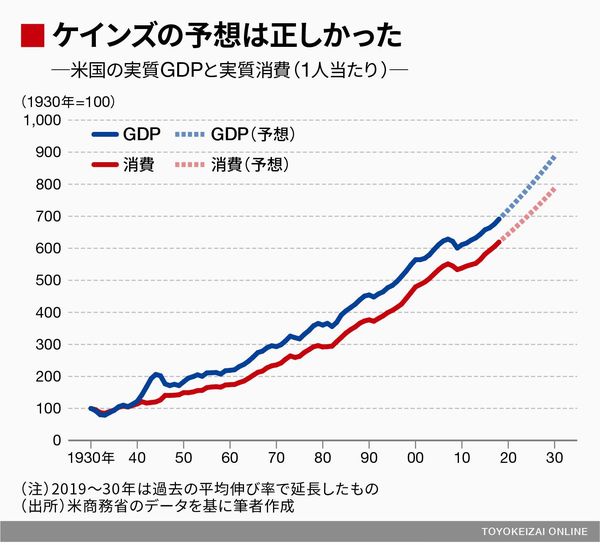
アメリカの1人当たり実質GDP(国内総生産)は2018年には1930年の6.9倍になっている。1人当たりの実質消費は少し伸びが小さいが、6.2倍だ。
2030年までの残り12年間にこれまでの平均と同じ伸び率で増加していくとすれば、GDPは8.9倍になり、消費は7.9倍になる。100年後にあたる2030年の米国の1人当たり実質消費はケインズの予想の上限に近い数字になるだろう。
ケインズは100年の間には経済的問題は解決されるか、少なくとも解決が視野に入るだろうと予想した。消費水準が8倍になっても生活に困るということは考えにくい。いくらぜいたくになっても、2倍も3倍も肉や野菜を食べられるはずはないので、食料などの生活必需品は十分に手に入るようになっていると考えたからだろう。
ケインズは、人類が長年課題としてきた生活に必要なものをどうやって手に入れるかという経済的問題を解決してしまうと、日々の生活の目標がなくなって、かえって困るようになるかもしれない、という心配までしている。
ケインズの予言

1930年、大不況がイギリスを襲っている時期、ジョン・メイナード・ケインズは、「孫たちの経済的可能性」という小論で、100年後(つまり2030年)には、生産性は現在の4倍から8倍に上がり、労働は1日3時間、週に15時間ぐらいで足りるだろうと、次のように述べている。
「その時、人間は何をするのだろうか。今は勤勉が良いこととされているし、経済問題への対応は遺伝子レベルで刷り込まれているから、多くの人は暇と自由に耐えられないだろう。少なくなった仕事を広く薄く共有して、何とか仕事を続けようとするかもしれない(1日3時間労働とか)。一方で、働く必要が無くなれば道徳も変わり、これまで金持ちや高利貸しを肯定してきた価値観が否定される。本当の生き方をわきまえた人が、余暇を十分に使えるようになる。これまでの金持ちや高利貸し翼賛は、資本蓄積を実現するための方便。それが十分に終われば、尊敬されるのは本当に今を充実して生きられる人物だ。ただし、それが実現するのは百年以上先。その上で、今のうちから人生を楽しむ準備をしておいてはいかが?」
ジョン・メイナード・ケインズ「孫たちの経済可能性」山形浩生訳
しかし、現在私たちの世界ではその様にはならず、週に40時間以上の労働が当たり前であるし、「働き方改革」などが叫ばれるほどで、労働はストレスが多いと見なされている。ケインズはなぜ予測を誤ったのか? 生産性はケインズの予測通り当時の10倍以上になっている。生活レベルが上がったとしても、生産性が10倍になると、労働時間はせめて20時間あるいは30時間にはなっても良いのではないか。なぜ、科学技術が飛躍的に発達しても、私たちは相変わらず、精一杯働かなくてはならないのか?それが大きな疑問である。その上、100年前よりも現在の方が数倍幸せだと言えるかどうか疑問がある。

「働く必要が無くなれば道徳も変わり、これまで金持ちや高利貸しを肯定してきた価値観が否定される・・・」とケインズは述べているが、人間の「強欲」は相変わらずである。
1950年代~1980年代までのいわゆるゴールデンエイジは、第二次大戦での経済の破壊から立ち直るように、戦勝国も敗戦国も同じように経済成長がなされ、所得格差が最小となり、安定した経済がもたらされた。
しかし、1970年代からの不況によって、新自由主義思想が流行し、次第に貧富の格差が拡大した。社会民主主義的考え方は衰退していったのだ。格差は広がる一方で、アメリカでは、上位1%の人が所有する資産は、アメリカ全体の資産の40%に達している。現代の貧困層は、かつてのそれとは大きく異なり、飢え死にすることはない、と言われても、貧富の格差はそれ自体が社会を危うくする原因となることは明らかだ。
「これまでの金持ちや高利貸し翼賛は、資本蓄積を実現するための方便。それが十分に終われば、尊敬されるのは本当に今を充実して生きられる人物だ・・・」にも関わらず、方便と見なされた金持ちや高利貸し翼賛、つまりお金を貯めこむことは目的となり、いまだに「今を充実して生きられる人物」が尊敬されているわけではない。便利な生活は、1980年代、つまり、ケインズの予測から50年経つと先進国では既に実現していたが、欲望は形を絶えず変え、もっともっとお金が必要だと考えるようになっている。今や、消費は、生活上の需要を満たすことでなく、供給側から提供される目先が変わった商品を求め続けている。供給は必要な需要を満たすものではなく、供給側の都合によって(大衆の目先を変えた商品で)新しい需要を作り出しているのだ。経済成長は、必要な需要を満たすものでなく、生活に直接必要性が乏しい供給側が作り上げた需要によって決定されるのだ。
「本当に今を充実して生きられる人物」とはどの様な人物なのか? ケインズの予言から100年近く経つ今、充実した人生とはどの様なものかが、改めて社会一般に問われている。それは、短い人生を生きていくことに対して、どの様に考えるか、一人一人に求められているのである。


0 件のコメント:
コメントを投稿