| ||||||||||||||||||||||||




| ||||||||||||||||||||||||

| ||||||||||||||||||||||||

K:The nonpartisan Congressional Budget Office warned that the federal government would be at risk of a payment default as soon as July if lawmakers fail to raise the debt limit.
— Bloomberg TV (@BloombergTV) February 16, 2023
Stony Brook's Stephanie Kelton weighs in https://t.co/tYVlMiwSsa pic.twitter.com/J0Jt9xjPUU
https://stephaniekelton.substack.com/p/quick-thoughts-on-cbos-budget-and?r=pqpdv&utm_medium=ios&utm_campaign=post
Quick Thoughts on CBO's Budget and Economic Outlook
With more to come.
Earlier this week, I joined Romaine Bostick and Scarlet Fu on Bloomberg TV. The Congressional Budget Office (CBO) had just released its annual Budget and Economic Outlook: 2023-2033, forecasting government spending, revenues, inflation, interest rates, unemployment, economic growth, and more over the coming decade. If you just want the summary of the report, click here.
The report is mandated under the Congressional Budget Act of 1974, and the “baseline” that CBO constructs as part of the exercise matters a lot when it comes to determining, e.g., whether future legislation will run up against certain procedural hurdles because of its budgetary impacts. If you want to learn more about where the baseline comes from and how it’s used in the legislative process click here.
The report features this misleading image which invariably sparks a lot of unnecessary alarm and partisan finger-pointing. While Democrats point to Republican tax cuts (George W. Bush and Donald Trump) and the wars in Iraq and Afghanistan, Republicans blame the Biden administration for spending too much on COVID relief and (now somewhat sheepishly) ‘entitlement’ programs like Social Security and Medicare.
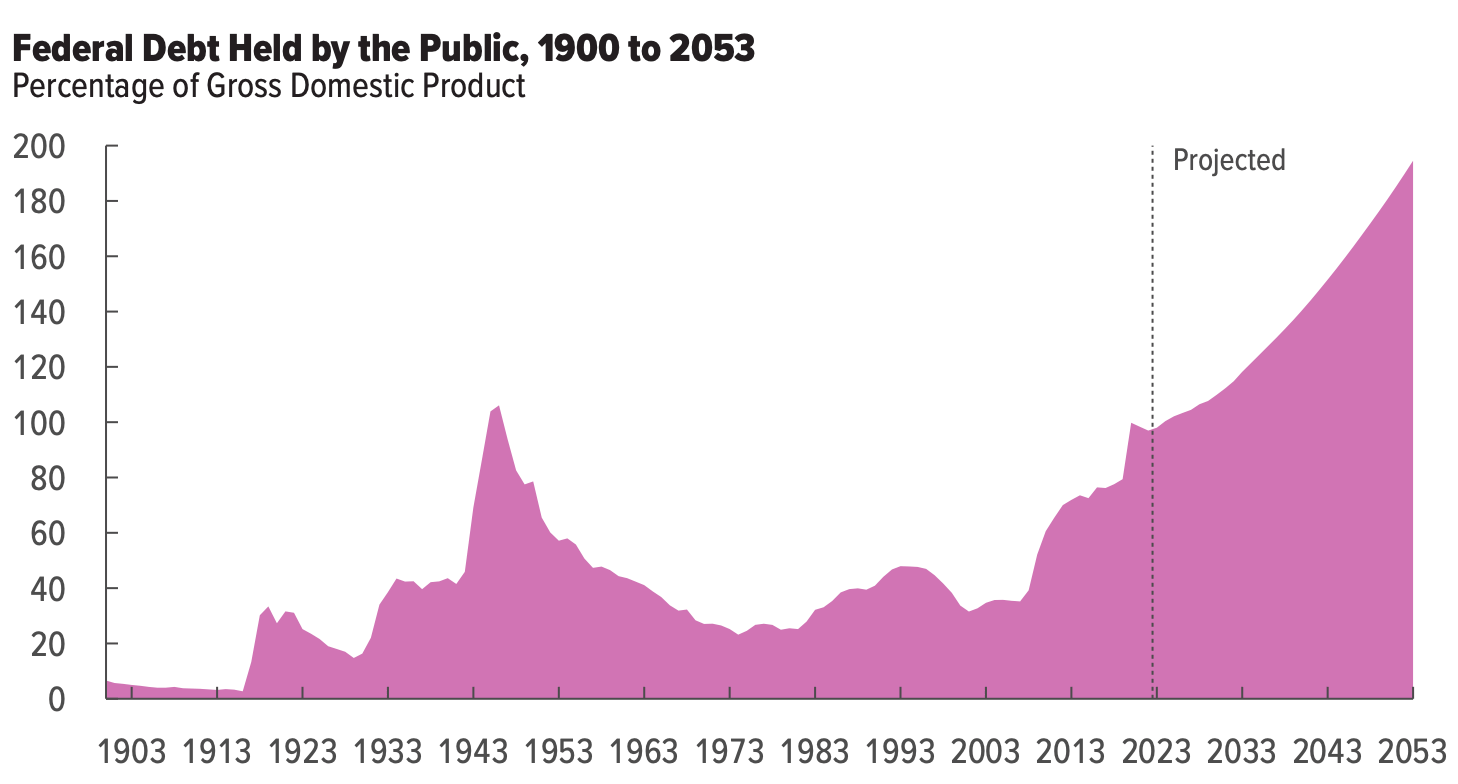
Regular readers of The Lens know that I am neither alarmed by nor particularly interested in projections like the one depicted above. If you aren’t familiar with my views, this chapter from my book The Deficit Mythwill get you up to speed.
I’m going to write more about the CBO report tomorrow, but suffice it to say (for now) that it was a strange report in many ways.
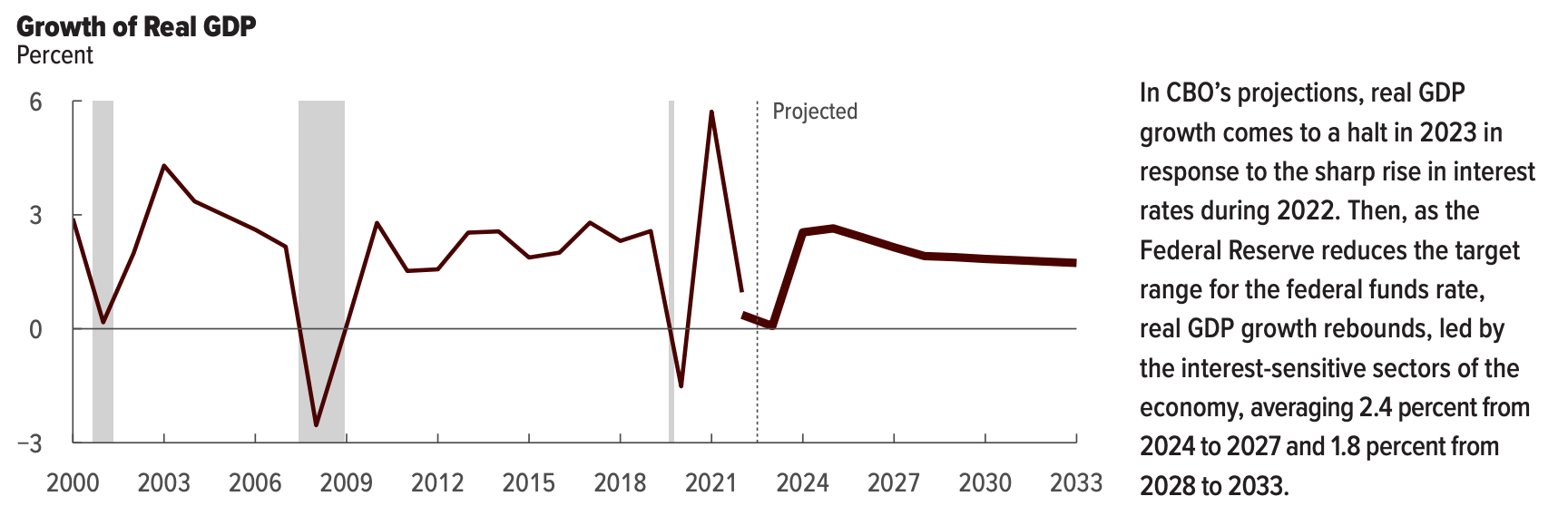
We are told that “real GDP growth comes to a halt in 2023 in response to the sharp rise in interest rates during 2022.”
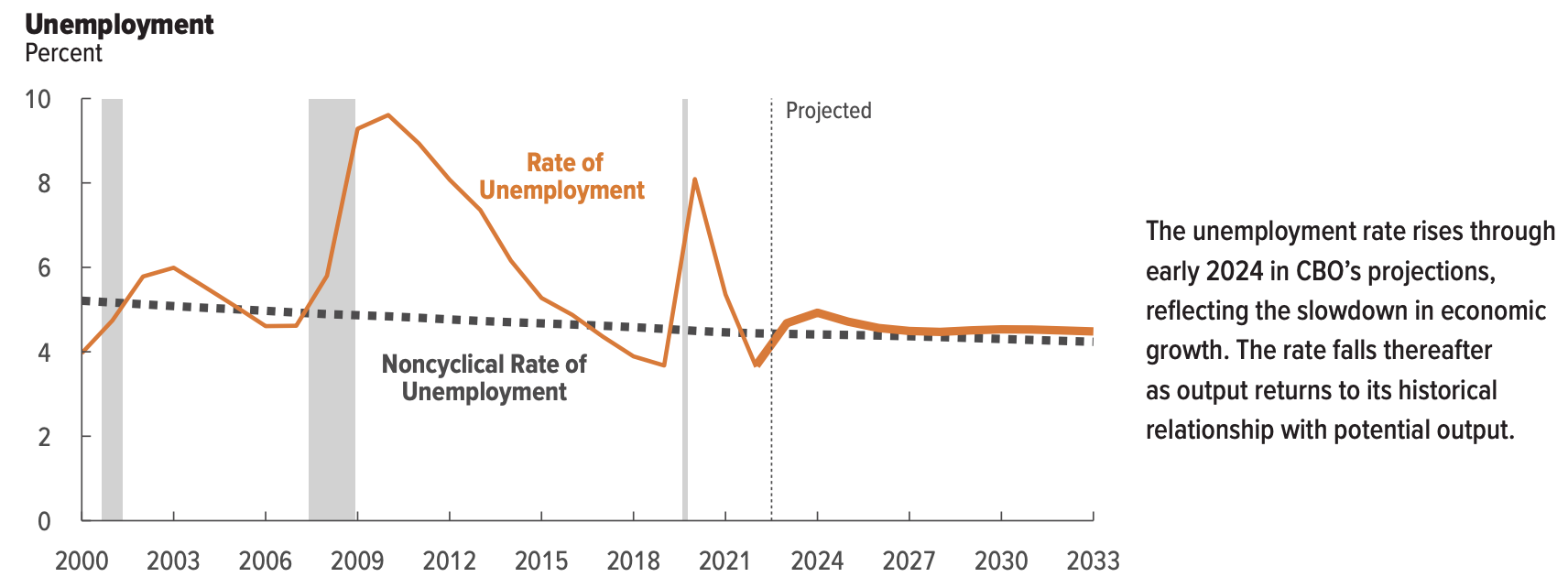
As growth grinds to a halt, CBO predicts that “conditions in the labor market deteriorate” with unemployment rising to 5.1% by the end of this year and continuing to rise into early 2024.
Is CBO predicting a recession? I’ll let you be the judge. While they expect the economy to grow at a barely discernible 0.3 percent this year, they’re not projecting a contraction in real GDP (at least not on average over the year).
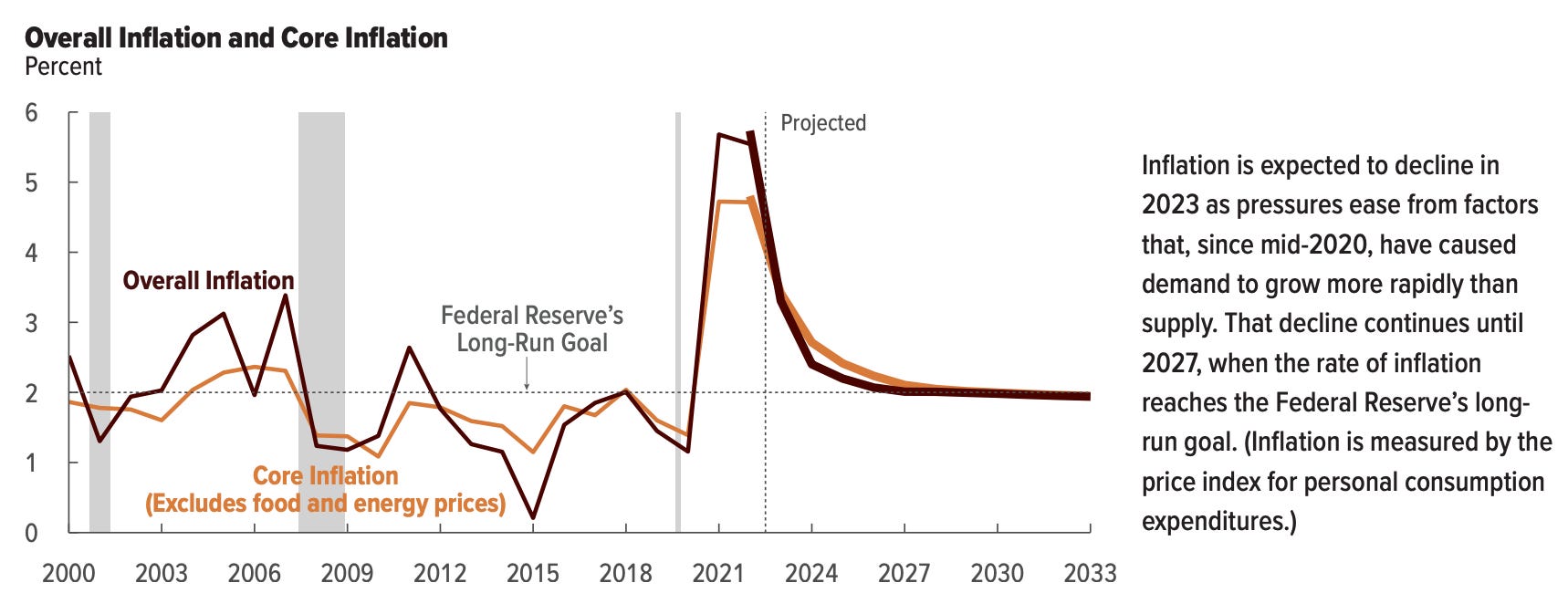
Against this backdrop, CBO predicts that inflation will fall rather precipitously this year and into next year “as pressures ease from factors that, since mid-2020, have caused demand to grow more rapidly than supply.” But they see inflation lingering above 2 percent until 2027.
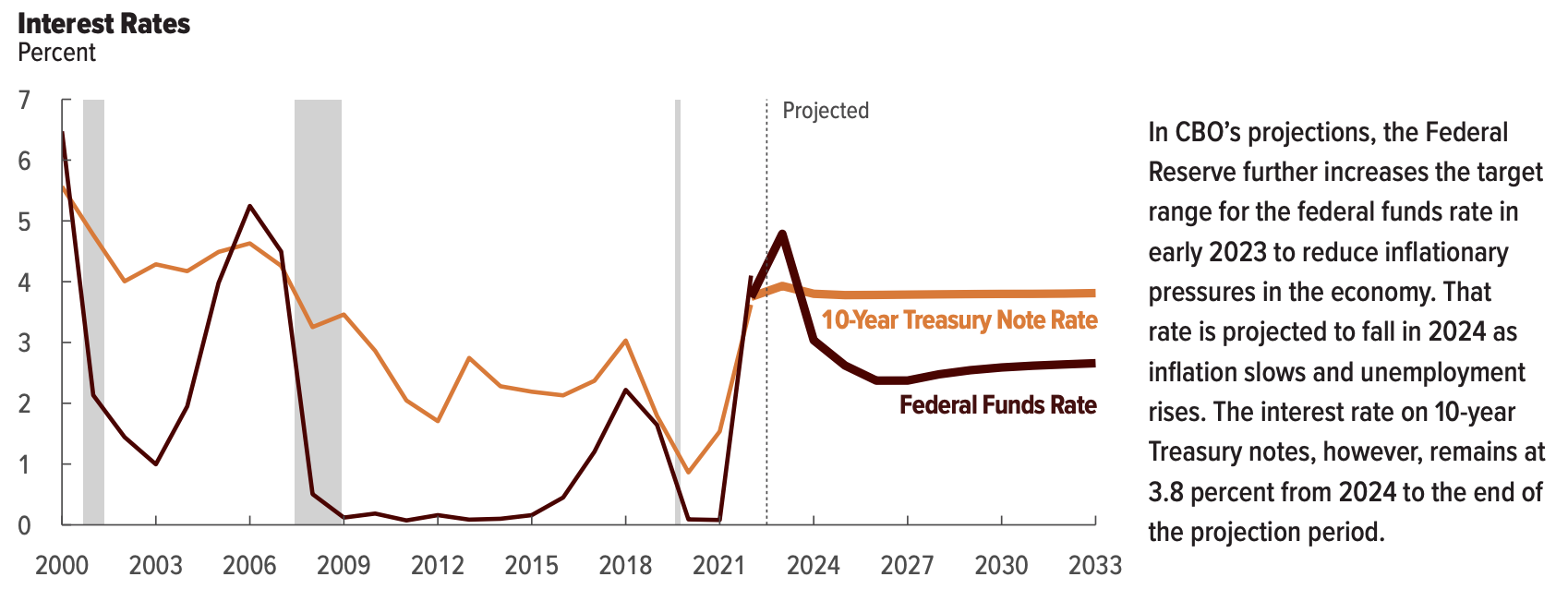
In response to the economic slowdown, CBO predicts that the Fed will begin cutting interest rates sometime in 2024, several years before inflation returns to the Fed’s long run target.
None of us should put too much stock into any long range economic outlook. But CBO’s economic outlook impacts its (baseline) budget projections, which matter for policymaking in all kinds of ways.
By assuming a gloomier economy—no growth, higher unemployment, stickier inflation, and more aggressive rate hikes in the near term (among other things)—CBO is telling lawmakers that projected deficits over the period 2023-2032 will be $900 billion higher than previously forecast (back in May 2022). Part of that jump is due to higher (revised up $295B) projected debt service over that period.
Keep this in mind, because I’m going to write more about rate hikes and their budgetary impacts in my next post.
As always, thank you for reading The Lens.
CBO の予算と経済見通しに関する簡単な考察
まだまだ続きます。
今週初め、私は ブルームバーグ TVでロメイン ボスティックとスカーレット フーに参加しました。議会予算局 (CBO) は、年次 予算および経済見通し: 2023-2033を発表したばかりで、今後 10 年間の政府支出、歳入、インフレ、金利、失業、経済成長などを予測しています。レポートの概要だけを知りたい場合は、 ここをクリックしてください。
報告書は 1974 年の議会予算法に基づいて義務付けられており、CBO が演習の一環として構築する「ベースライン」は、 たとえば将来の立法が その予算のために特定の手続き上のハードルにぶつかるかどうかを判断する際に 非常に重要です 。影響します。ベースラインがどこから来て、立法プロセスでどのように使用されるかについて詳しく知りたい場合は、 ここをクリックしてください。
このレポートは、この 誤解を招くイメージを取り上げており 、常に多くの 不必要な警告 と 党派的な批判を引き起こしています。民主党は共和党の減税(ジョージ・W・ブッシュとドナルド・トランプ)とイラクとアフガニスタンでの戦争を指摘しているが、共和党はバイデン政権がCOVID救済と(今ではややひっそりと)社会保障やメディケア。
The Lensの定期的な読者は、 私が上に示したようなプロジェクションに不安を感じたり、特に興味を持ったりしていないことを知っています。私の見解に慣れていない場合は、 私の著書 「The Deficit Myth」のこの章を読んで理解を深めてください。
CBO のレポートについては明日詳しく書きますが、(今のところ) いろいろな意味で奇妙なレポートだったとだけ言っておきましょう。
「2022年の急激な金利上昇を受けて、2023年には実質GDPの伸びが止まる」と言われています。
成長が鈍化する中、失業率は年末までに 5.1% に上昇し、2024 年初めまで上昇し続けるため、CBO は「労働市場の状況が悪化する」と予測しています。
In CBO's projections, real GDP
growth comes to a halt in 2023 in
response to the sharp rise in interest
rates during 2022. Then, as the
Federal Reserve reduces the target
range for the federal funds rate,
real GDP growth rebounds, led by
the interest-sensitive sectors of the
economy, averaging 2.4 percent from
2024 to 2027 and 1.8 percent from
2028 to 2033.
The unemployment rate rises through
early 2024 in CBO's projections,
reflecting the slowdown in economic
growth. The rate falls thereafter
as output returns to its historical relationship with potential output.
Inflation is expected to decline in
2023 as pressures ease from factors
that, since mid-2020, have caused
demand to grow more rapidly than
supply. That decline continues until
2027, when the rate of inflation
reaches the Federal Reserve's long-
run goal. (Inflation is measured by the
price index for personal consumption
expenditures.)
In CBO's projections, the Federal
Reserve further increases the target
range for the federal funds rate in
early 2023 to reduce inflationary
pressures in the economy. That
rate is projected to fall in 2024 as
inflation slows and unemployment
rises. The interest rate on 10-year
Treasury notes, however, remains at
3.8 percent from 2024 to the end of the projection period.
CBOの予測では、2022年の金利急騰を受けて、2023年に実質GDPの成長は止まる。その後、連邦準備制度理事会がフェデラルファンド金利の目標レンジを引き下げると、金利に敏感な経済部門が主導して実質GDPの成長は回復し、2024年から2027年まで平均2.4%、2028年から2033年まで平均1.8%になる。
CBOの予測では、経済成長の減速を反映して、失業率は2024年初めまで上昇する。その後、生産高が過去の潜在生産高との関係に戻るにつれて失業率は低下する。
インフレ率は、2020年半ば以降、需要が供給を上回る急成長をもたらした要因による圧力が緩和されるため、2023年に低下すると予想される。インフレ率の低下は2027年まで続き、インフレ率は連邦準備制度理事会の長期目標に到達する。(インフレ率は個人消費支出に対する物価指数で測定される)。
CBOの予測では、連邦準備制度理事会は2023年初めに、経済のインフレ圧力を軽減するために、連邦ファンド金利の目標レンジをさらに引き上げた。2024年には、インフレ率の低下と失業率の上昇に伴い、この金利は低下すると予測されている。しかし、10年物国債の金利は、2024年から予測期間終了まで3.8%にとどまる。
CBO は景気後退を予測していますか? あなたに裁判官を任せます。今年の経済成長率はかろうじて認識できる 0.3% であると予想していますが、実質 GDP の縮小は予測していません (少なくとも年間平均ではありません)。
このような背景に対して、CBOは、「2020年半ば以降、需要が供給よりも急速に成長する原因となった要因による圧力が緩和されるため」、今年と来年にかけてインフレ率がかなり急激に低下すると予測しています。しかし、インフレ率は 2027 年まで 2% を超える状態が続くと彼らは見ています。
経済の減速を受けて、CBOは、インフレ率が Fed の長期目標に戻る数年前の 2024 年に Fed が 利下げを開始すると予測しています。
長期的な経済見通しに過度の期待を寄せるべきではありません。しかし、CBO の経済見通しは、あらゆる種類の政策決定にとって重要な (ベースライン) 予算予測に影響を与えます。
CBO は、景気の低迷、失業率の上昇、インフレ率の上昇、近い将来のより積極的な利上げなど、より暗い経済を想定することで、2023 年から 2032 年までの期間の赤字予測は以前よりも 9,000 億ドル高くなると議員に伝えています。予測 (2022 年 5 月にさかのぼる)。その急上昇の一部は、その期間に予想される債務返済額の増加 (2950 億ドルの修正) によるものです。
利上げとその予算への影響については、次の投稿で詳しく説明する予定なので、このことを覚えておいてください。
いつも The Lensをお読みいただきありがとうございます。

0 件のコメント:
コメントを投稿