Nobody Really Knows How the Economy Works. A Fed Paper Is the Latest Sign. - The New York Times
| ||||||||||||||||||||||||



https://www.nytimes.com/2021/10/01/upshot/inflation-economy-analysis.html
The World Wants Greenland’s Minerals, but Greenlanders Are Wary - TechiAI
https://techiai.com/the-world-wants-greenlands-minerals-but-greenlanders-are-wary/
Stephanie Kelton and Paul McCulley in Conversation on Post-Keynesian Solutions
2020/09/22


https://www.bloomberg.com/news/articles/2019-03-07/mmt-moment-pimco-veteran-mcculley-says-it-deserves-a-hearing
Paul McCulley Sees Value in MMT; Larry Fink Calls It ‘Garbage’
Subscriber Only
economics
ByUpdated on
Ex-Pimco economist who coined ‘Minsky Moment’ backs MMT logic
BlackRock’s Fink joins Powell, Summers in slamming theory
BlackRock's Fink: Modern Monetary Theory Is 'Garbage'
BlackRock CEO Laurence Fink calls Modern Monetary Theory "garbage."
Paul McCulley and Modern Monetary Theory go way back.
The former Pimco chief economist says he’s “not a card-carrying MMTer.’’ But he has a lot of sympathy for the doctrine that’s burst into the debate about America’s public finances -- and is drawing a barrage of criticism from mainstream economists and the financial world. BlackRock Chief Executive Officer Larry Fink became one of the latest to weigh in on Thursday, calling the theory “garbage.”
ポール・マッカリーはMMTに価値を見出すが、ラリー・フィンクはそれを「ゴミ」と呼ぶ - Bloomberg
https://www.bloomberg.com/news/articles/2019-03-07/mmt-moment-pimco-veteran-mcculley-says-it-deserves-a-hearing
ポール・マッカリー氏はMMTに価値を見出しているが、ラリー・フィンク氏は「ゴミ」と呼んでいる。
エミリー・バレット2019年3月7日 20:00 JST
購読者専用
経済学
by
更新日:2019年3月7日 23:16 JST
ミンスキー・モーメント」を作った元ピムコのエコノミストがMMTの論理を支持
ブラックロックのフィンク氏がパウエル氏やサマーズ氏と一緒に理論を叩く
ブラックロックのフィンク氏。ブラックロックのフィンク氏:現代金融理論は「ゴミ」だ
ブラックロックのCEO、ローレンス・フィンク氏は、現代通貨理論を "ゴミ "と呼んでいる。
ポール・マッカリーとModern Monetary Theoryの歴史は古い。
元ピムコのチーフエコノミストである彼は、「MMTの信奉者ではない」と言う。しかし、アメリカの財政をめぐる議論に登場し、主流の経済学者や金融界から批判を浴びているこの理論には共感を覚えている。ブラックロック社の最高経営責任者であるラリー・フィンク氏は、木曜日にこの理論を「ゴミ」と称して意見を述べました。
| ||||||||||||||||||||||||

| ||||||||||||||||||||||||

Why Do We Think That Inflation Expectations Matter for Inflation? (And Should We?)
Abstract:
Economists and economic policymakers believe that households' and firms' expectations of future inflation are a key determinant of actual inflation. A review of the relevant theoretical and empirical literature suggests that this belief rests on extremely shaky foundations, and a case is made that adhering to it uncritically could easily lead to serious policy errors.
DOI: https://doi.org/10.17016/FEDS.2021.062
https://www.federalreserve.gov/econres/feds/files/2021062pap.pdf
2021/09/24
Nobody thinks clearly, no matter what they pretend. ...That’s why people hang on so tight to their beliefs and opinions; because, compared to the haphazard way they’re arrived at, even the goofiest opinion seems wonderfully clear, sane, and self-evident. Dashiell Hammett, The Dain Curse (1928) 邦題『デイン家の呪い』
何を隠そう、誰も明確に考えていない。人が自分の信念や意見に固執するのはそのためだ。自分がたどり着いた行き当たりばったりの方法に比べれば、どんなに馬鹿げた意見でも、素晴らしく明確で、まともで、自明なものに思えるからだ。ダシール・ハメット『ダインの呪い』(1928年
Is this state of affairs ever harmful or dangerous? One natural source of concern is if dubious but widely held ideas serve as the basis for consequential policy decisions? (2)
In this note, I examine one such idea, namely, that expected inflation is a key determinant of actual inflation. Many economists view expectations as central to the inflation process; similarly, many central banks consider "anchoring" or "managing" the public's inflation expectations to be an important policy goal or instrument. Here, I argue that using inflation expectations to explain observed inflation dynamics is unnecessary and unsound: unnecessary because an alternative explanation exists…
1
For a useful brief against production functions, see Felipe and Fisher (2003); for the case against capital aggregates, see Brown (1980). The idea that the inherent stability of the economy is a concomitant of general-equilibrium theory is difficult to entertain seriously after giving Fisher (1983) close study; see Grandmont (1982) for some related macroeconomic arguments. Finally, Hildenbrand (1994) provides a sobering corrective to first-year demand theory.
2
I leave aside the deeper concern that the primary role of mainstream economics in our society is to provide an apologetics for a criminally oppressive, unsustainable, and unjust social order.
-1-
このような状態は、決して有害で危険なものではないのでしょうか。一つの当然の懸念材料は、疑わしいけれども 怪しげだが広く支持されている思想が、結果的に政策決定の基礎となっている場合である。(2)
このノートでは、そのような考え方の1つである、期待インフレ率が実際のインフレ率の重要な決定要因であるという考え方を検討します。多くの 多くの経済学者は期待値をインフレプロセスの中心と見なしており、同様に、多くの中央銀行は、「アンカリング」または「インフ また、多くの中央銀行は、国民のインフレ期待を「固定化」または「管理」することを重要な政策目標または手段と考えています。指標としています。ここでは、インフレ期待を用いて観測されたインフレダイナミクスを説明することは、不必要かつ不健全であると主張します。ここでは、観測されたインフレ率のダイナミクスを説明するために、インフレ期待を用いることは不要であり、不健全であると主張します。
1
生産関数に対する有用な報告書としては、Felipe and Fisher (2003)を、資本集約に対する報告書としては、Brown (1980)を参照してください。経済の本質的な安定性は一般均衡理論に付随するものであるという考えは、Fisher (1983)をよく検討した後では真面目に受け止めることは困難ですが、関連するマクロ経済学的な議論についてはGrandmont (1982)を参照してください。最後に、Hildenbrand (1994)は、初年度の需要理論を厳しく批判しています。
2
私たちの社会における主流の経済学の主な役割は、犯罪的に抑圧された、持続不可能で不正な社会秩序に対する弁明を提供することであるという、より深い懸念は置いておきます。
-1-
II Whydowethink that expectations matter—and why should we care if they do?
I’m always a little dubious about an appeal to expectations as a causal factor; expectations are by definition a force that that you intuitively feel must be everpresent and very important but which somehow you are never allowed to observe directly. R. M. Solow (1979)
Solow, Robert M. (1979). “What We Know and Don’t Know About Inflation.” Technology Review, 81(3), 30–46.
II なぜ期待値が重要だと考えるのか、なぜ期待値を気にする必要があるのか?
期待を因果関係の要因として訴えることに、私はいつも少し疑問を持っています。期待とは、定義上、常に存在していて非常に重要であるはずだと直感的に感じられる力ですが、なぜか直接観察することは許されません。R.M.ソロー(1979)
III Howstrong is the theoretical case?
Pure economics has a remarkable way of pulling rabbits out of a hat—apparently a priori propositions which apparently refer to reality. It is fascinating to try to discover how the rabbits got in; for those of us who do not believe in magic must be convinced that they got in somehow. J. R. Hicks (1946)
Hicks, J. R. (1946). Value and Capital: An Inquiry into Some Fundamental Principles of Economic Theory, 2nd ed. Oxford: Oxford University Press.
III 理論的なケースはどれくらい強いのか?
純粋経済学は、帽子の中からウサギを取り出すという驚くべき方法を持っています。魔法を信じない私たちは、どうにかしてウサギが入ってきたことを確信しなければならないのです。J.R.ヒックス(1946年)★
IV Howstrong is the empirical case?
Don’t interfere with fairy tales if you want to live happily ever after. F. M. Fisher (1984)
IV 経験的にはどのくらい強いのか?
幸せに暮らしたいなら、おとぎ話に口出ししないこと。F.M.フィッシャー(1984年
VIII A closing thought
The best lack all conviction, while the worst Are full of passionate intensity. W. B. Yeats, “The Second Coming” (1920)
Consider the following Gedankenversuch.
VIII 締めくくりの言葉
最高のものは信念を持たないが、最悪のものは情熱的な強さに満ちている。W. B. Yeats, "The Second Coming" (1920)
次の Gedankenversuch を考えてみましょう。
参考
2014 アラン・ブラインダー&ジェレミー・ラッド 「オイルショックの経済学」(2009年1月13日) — 経済学101
●Alan S. Blinder and Jeremy Rudd, “Oil shocks redux: Why the recent oil shock wasn’t very shocking”(VOX, January 13, 2009)
つい最近の(2002年~2008年における)原油価格の高騰はどうして1970年代のように惨憺たる結果をもたらさなかったのだろうか? その理由はいくつか考えられる。 i)先進国において省エネ化が進んだため ii)実質賃金の伸縮性が高まったため iii)経済全体に占める自動車産業のシェアが縮小したため iv)金融政策がコアCPIに重きを置いて運営されるようになったため v)原油価格が高騰した原因が世界的に原油の供給が減ったことにではなく世界経済の堅調な成長に支えられて原油の需要が増えたことにあったため
。。。
Nobody Really Knows How the Economy Works. A Fed Paper Is the Latest Sign.
Many experts are rethinking longstanding core ideas, including the importance of inflation expectations.

It has long been a central tenet of mainstream economic theory that public fears of inflation tend to be self-fulfilling.
Now though, a cheeky and even gleeful takedown of this idea has emerged from an unlikely source, a senior adviser at the Federal Reserve named Jeremy B. Rudd. His 27-page paper, published as part of the Fed's Finance and Economics Discussion Series, has become what passes for a viral sensation among economists.
The paper disputes the idea that people's expectations for future inflation matter much for the level of inflation experienced today. That is especially important right now, in trying to figure out whether the current inflation surge is temporary or not.
But the Rudd paper is part of something bigger still. It reflects a broader rethinking of core ideas about how the economy works and how policymakers, especially at central banks, try to manage things. This shift has also included debates about the relationship between unemployment and inflation, how deficit spending affects the economy, and much more.
In effect, many of the key ideas underlying economic policy during the Great Moderation — the period of relatively steady growth and low inflation from the mid-1980s to 2007 that also seems to be a high-water mark for economists' overconfidence — increasingly look to be at best incomplete, and at worst wrong.
It is vivid evidence that macroeconomics, despite the thousands of highly intelligent people over centuries who have tried to figure it out, remains, to an uncomfortable degree, a black box. The ways that millions of people bounce off one another — buying and selling, lending and borrowing, intersecting with governments and central banks and businesses and everything else around us — amount to a system so complex that no human fully comprehends it.
"Macroeconomics behaves like we're doing physics after the quantum revolution, that we really understand at a fundamental level the forces around us," said Adam Posen, president of the Peterson Institute for International Economics, in an interview. "We're really at the level of Galileo and Copernicus," just figuring out the basics of how the universe works.
"It requires more humility and acceptance that not everything fits into one model yet," he said.
Or put less politely, as Mr. Rudd writes in the first sentence of his paper, "Mainstream economics is replete with ideas that 'everyone knows' to be true, but that are actually arrant nonsense."
One reason for this, he posits: "The economy is a complicated system that is inherently difficult to understand, so propositions like these" — the arrant nonsense in question — "are all that saves us from intellectual nihilism."
And from that starting point, a staff economist at the world's most powerful central bank went on to say, in effect, that his own employer has been focused on the wrong things for the last few decades.
Mainstream policymakers, very much including Mr. Rudd's bosses at the Fed, believe that inflation is, in large part, self-fulfilling — that what people expect future inflation to look like has an ability to shape how much prices rise in the near term.
In the common telling, the Great Inflation of the 1970s got going because people came to believe inflation would keep spiraling. The surge in gasoline prices wasn't simply a frustrating development, but a harbinger of things to come, so people needed to demand higher raises, and businesses could feel confident charging higher prices for most everything.
In this story, the great achievement of the Fed in the early 1980s was to break this cycle by re-establishing credibility that it would not allow sustained high inflation (though at the cost of a severe recession).
That is why today's discussions over the inflation outlook often spend a lot of time focusing on things like what bond prices suggest inflation will be five or 10 years from now, or how people answer survey questions about what they expect.
Mr. Rudd argues that there is no solid evidence that the conventional story of the 1970s describes the real mechanism through which inflation takes place. He says there's a simpler explanation consistent with the data: that businesses and workers arrive at prices and wages based on the conditions they've experienced in the recent past, not some abstract future forecast.
For example, when inflation has been low in the recent past, workers might not demand raises as they would in a world where inflation was high; after all, their existing paychecks go pretty much as far as they used to. You don't need some theory involving inflation expectations to get there.
Some economists who are sympathetic to the idea that central bankers have overly fetishized precise measurements of inflation expectations aren't ready to fully dismiss the idea.
For example, Mr. Posen, a former Bank of England policymaker, says there remains a simple and hard-to-dispute idea about inflation expectations supported by lots of history: that if people distrust a country's monetary system, inflation shocks can spiral upward. Economic policy credibility matters. But that isn't the same as assuming that some survey or bond market measure of what will happen to inflation in the distant future is particularly meaningful for forecasting the near future.
"It has been a noble lie that has become a critical part of the catechism of global monetary policy, that long-term inflation expectations are not just interesting but are a decisive determinant of real-time inflation," said Paul McCulley, a former Pimco chief economist, commenting on Mr. Rudd's paper.
This isn't the only way in which basic precepts underlying economic policy are shifting beneath economists' feet.
Particularly prominently, for years central bankers believed there was a tight relationship between the unemployment rate and inflation, known as the Phillips Curve. Over the course of the 2000s, though, that relationship appeared to weaken and become a less reliable guideline for how to set policy.
Similarly, interest rates and inflation fell worldwide, for reasons that scholars are still trying to understand fully. That implied a lower "neutral interest rate," or the rate that neither stimulates nor slows the economy, than was widely believed to be the case as recently as the mid-2010s.
In many ways, the Fed's policies just before the pandemic were aimed at incorporating those lessons and embracing sustained lower interest rates — and the possibility of lower unemployment — than many in the mainstream thought reasonable a few years earlier.
In the realm of fiscal policy, some conventional wisdom has also been upended in the last few years. It was thought that large government debt issuance would risk causing a spike in interest rates and crowd out private sector investment. But in that period, huge budget deficits have been paired with low interest rates and abundant credit for businesses.
All of this makes it a challenging time for central bankers and other shapers of policy. "If you're a policymaker and you don't have robust confidence in the parameters of the game you are managing, it makes your job a whole lot more difficult," Mr. McCulley said.
But if you are in charge of making economic policy that affects the lives of millions, you can't simply shrug your shoulders and say, "We don't know how the world works, so what are we supposed to do?" You look at the evidence available, and make the best judgment you can.
And then, if you think it turns out you were wrong about something, publish a sassy paper to try to get it right.
★
Rudd2021
III Howstrong is the theoretical case?
Pure economics has a remarkable way of pulling rabbits out of a hat—apparently a priori propositions which apparently refer to reality. It is fascinating to try to discover how the rabbits got in; for those of us who do not believe in magic must be convinced that they got in somehow. J. R. Hicks (1946)
Hicks, J. R. (1946). Value and Capital: An Inquiry into Some Fundamental Principles of Economic Theory, 2nd ed. Oxford: Oxford University Press. #1
III 理論的なケースはどれくらい強いのか?
純粋経済学は、帽子の中からウサギを取り出すという驚くべき方法を持っています。魔法を信じない私たちは、どうにかしてウサギが入ってきたことを確信しなければならないのです。J.R.ヒックス(1946年)★
ヒックス
価値と資本 岩波文庫上
62頁
62:
てこのような位置を取ることができなかったはずである。これだけのことは直ちに明らかであ
る。けれどもこのことから進んで、経済理論のうちで必要とされるような限界代替率逓滅の法
則に赴くためには、ひとつの仮定が必要である。われわれは右の条件がすべての中間点におい
ても成立するということ、従って二つの均衡の位置の間では曲線にねじれがないということを
+ へ
仮定しなければならない。(もし曲線にねじれがあるとするならば、価格のある体系では、消一
費者はその所得の二つの異った費し方のうちいずれかを選択することが不可能になるというよ
うな、奇妙な結論が出てくる。)限界代替率逓減の一般原理はたんにこのような奇怪事を排除
するにすぎない。この原理を採ることによってわれわれは、いろいろ採ることのできる可能性
のうち最も単純なものを採択するのである。
第1章 効用と選好
議論が進んで行くにつれて、純粋経済理論の「法則」といわれるものの大部分はこの種の見
方を許すことが判明するであろう。純粋経済学は帽子から兎を~~一見先験的(ア・プリオリ)でありながら、
一見現実に関係のあるような諸命題を~~生み出す不思議な方法を心得ている。その兎がどう
して中に入ったかを発見しようと試みるのは魅力がある。というのは、われわれの間で魔術を
信じない人は、兎が何とかして中に入ったのだと確信しているに相違ないからである。わたく
しは自分ではそれが二つの方法で入ったものと確信するにいたった。一つは、あらゆる経済学
上の議論の冒頭で、その議論のうちで取扱われる事柄だけが何らかの実際問題において重要な
唯一の事柄だと仮定することによってである。(これはつねに危険な仮定であって、ほとんど
つねに多少とも誤っている~~経済理論の適用が非常にむずかしい問題であるのはそのためで
ある。)それが方法の大部分を示してはくれるが、しかしその全部を示すものではない。もう
一つの仮定はいましがたそれだけ切り離して論じたものであって、それはねじれが無視できる
という仮定、すなわちわれわれが取扱っている諸数量の近傍における諸数量のどんな組合せで
も、ある価格体系での可能な均衡の位置となるに充分な程度の規則性が欲望の体系には(そう
してまた、後になって見るように、生産体系にも)存在するということ、これである。ところ
でこの仮定もまた誤っているかもしれない。しかし、およそ可能なかぎりの最も単純な仮定で
あるから、それは出発点とするには適当な仮定である。実際それと経験との合致は確かに申し
分がないように思われる。
われわれの前に横たわる進路はいまや次第にはっきりとしてくる。もし以上が消費財間にお
ける限界代替率逓滅の原理の真の基礎であるとすれば、全く基礎を同じくする他の原理をも発
見することができる。これらの原理を列挙して、それの帰結を究明することができる。それら
のうちいくつかは生産に関係するから、後に第六章で考察されるであろう。残余は本章で引出
された原理の種々な分野への拡張である。このような拡張が非常に多く存在するということは、
8 バレート的な選好階梯表の枠組にはめ込むことのできる人間の選択行為の種別がいかに広いか
し ほん
価値と資本(上)(全2冊)
J.R. ヒックス著
かち
定価はカバーに表示してあります
1995 年2月16日 第1刷発行
やすいたく ま
くまがいひさ お
訳 者 安井琢磨 熊谷尚夫
発行者 安江良介
発行所 株式会社岩波書店
マジックの比喩はレイも使っている。
2021年1月22日
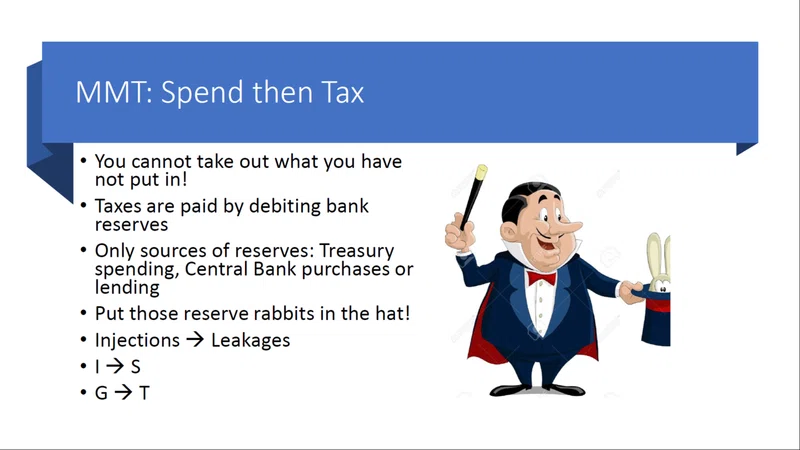
okay let me move to the mmt view on these so it's a completely different perspective we argue that you have to spend first then tax so it's not tax and spend it's spend then tax and we argue that that has always been the case for governments that issue their own currencies and so i give the analogy of the magician and the rabbit in the hat we go to the magician's show and we pretend that we're surprised when the magician could pull a rabbit out of the hat now we know of course the magician put the rabbit in the hat before he started the show you can't pull rabbits out of hats unless you put them in we argue that the same is true for tax payments when central banks finance government spending they credit bank reserves when taxes are paid those reserves are debited so what we're arguing is that since the only source of reserves is treasury spending central bank purchases of assets or central bank lending all the reserves have to come from the government before the taxes can be paid you have to put the reserve rabbits in the hat before you can pull them out and this sounds controversial but many of you who took principles of economics learned the injections and leakages approach those derived from the work of john maynard keynes in which it's argued that injections of income have to be put into the economy before they can leak out of the economy injections create income that can then finance leakages the most famous example in the textbooks is investment i use an i here has to come before saving s investment increases income through the multiplier for those who had principles of economics you know what i'm talking about and the savings rise as income rises generated by the increase of investment until the two are equal the same is true for government spending and taxes the relationship is exactly the same government spending is the injection g that increases income that can be taxed t.
では、ここからMMTの理論をお話していきたいと思います。完全に違う視点なわけです。
まず私たちが言っているのは、まず最初、支出をしてから税金をとるということなんです。税金を取ってから支出をするのではなくて、まず最初に政府が支出をしてから税金を取るのです。
これはこの自分たちのところで自国通貨を発行する政府であればそうなのです。
例えば、手品師みたいなものです。例えば、マジックショーにいきますよね。そして私たちはもちろん、マジシャンがこの帽子からウサギを出すとびっくりするようなふりをするのですけれども、もちろん当然ながら、このショーが始まる前に、ウサギはいたはずです。
要するにウサギを入れてなければ出すことはできません。これが実際に税金でも同じことが言えるわけです。中央銀行が実際、政府の赤字に対して、資金を提供するときには銀行の預金をマイナスして税金を支払っているわけです。と言うことで、これが唯一、準備金、つまり財政支出をして、そして、中央銀行が、資産を買い入れる、あるいは貸し出しをする。
すべてのリザーブというのは必ず政府からとんなきゃいけないと。そうしないと税金をしはらうことはできない。
まず最初に、まずウサギを入れないといけないわけです。そうしないとウサギを取り出すことはできないからです。・・(音飛び)
・・収入とそして漏出というジョン・メイナード・ケインズの理論なんだと思います。つまり所得の注入、これをまず経済に注入しなければ、その所得が経済から流出することはできない。つまり注入が所得を生み、そしてそれがその漏出、流出、の財源となると。
教材のもっとも有名な例というのは、Iつまり投資が、貯蓄の前、Sの前に必ず行われねばならないという例です。
投資は乗数を通じて所得をあげます。皆様、経済理論を学んだ方々はご存知だと思います。
そして貯蓄は、所得が上がると同時に上がり、そしてこれは投資を引き上げたことによる結果であり、その二つは同等である。
それから政府の支出と税金についても同じ関係があるわけです。つまり政府の支出が、Injection、注入、Gであり。これが所得を引き上げ、その所得に対してT、税金が課税される。つまり政府の支出というのは必ず納税より前に行われなければならないということです。

THE SECOND COMING by: W. B. Yeats
返信削除URNING and turning in the widening gyre
The falcon cannot hear the falconer;
Things fall apart; the centre cannot hold;
Mere anarchy is loosed upon the world,
The blood-dimmed tide is loosed, and everywhere
The ceremony of innocence is drowned;
The best lack all conviction, while the worst
Are full of passionate intensity.
Surely some revelation is at hand;
Surely the Second Coming is at hand.
The Second Coming! Hardly are those words out
When a vast image out of Spiritus Mundi
Troubles my sight: somewhere in the sands of the desert
A shape with lion body and the head of a man,
A gaze blank and pitiless as the sun,
Is moving its slow thighs, while all about it
Reel shadows of the indignant desert birds.
The darkness drops again; but now I know
That twenty centuries of stony sleep
Were vexed to nightmare by a rocking cradle,
And what rough beast, its hour come round at last,
Slouches towards Bethlehem to be born?
返信削除https://poetry.hix05.com/Yeats/yeats22.second.html
再生 The Second Coming:イェイツの詩を読む
ウィリアム・B・イェイツの詩「再生」The Second Coming(壺齋散人訳)
らせん状に旋回して飛んでいく鷹に
鷹匠の声が届かないように
世界は秩序を喪失して
混沌たる状態に陥っている
いたるところどす黒い波が押し寄せ
ささやかな生活まで飲み込んでしまう
不安ばかりがつのるばかり
未来への希望は失われた
たしかに啓示は迫ってはいる
たしかに再生の兆しはある
この再生という言葉を聞くやいなや
世界精神の巨大なイメージが
わたしの目をくらます
どこか砂漠の砂の中から
スフィンクスのような怪物が目を怒らせ
ゆったりと立ち上がると
その周りを怒れる鳥たちが旋回する
世界は再び影に覆われ
2000年の安き眠りは破られて
揺籠を悪夢が襲う
だがその中から新たな猛獣が生まれ出て
ベスレヘムをいつくしむだろう
この詩は1919年に書かれたが、イェイツには珍しく政治にコミットする内容が盛られている。
この時期ヨーロッパは第一次大戦の後遺症に苦しんでいた。なかでもイェイツを悩ませたのは共産主義が勝利したソ連の現状だった。イェイツは自分が生きる西欧にもその勢力が押し寄せることを危惧していたふしある。
この詩の題名 The Second Coming は、キリストの復活を指している。キリストは復活することで人々に信仰の根拠を与えた。イェイツは新たな救世主の出現を期待することで、世界の存続に根拠を見出したかった。
kindleデイン家の呪い#3
返信削除「わかりませんね。そんなことは、僕には、何でもない当たりまえのことのように聞こえますがね。人間なんて、たとえ表面はどう装おうとも、実際は明瞭に考えられる者なんて一人もありませんよ。考えるということは、あなたがやられると同じように霧の中の瞥見をいくつもとらえて、それをできるだけうまく接ぎ合わせて行く、めまぐるしい仕事なのですよ。人々が一度得た信念や意見を容易に捨てないのも、そのためです。なぜなら、彼らがそれに到達したときのでたらめな偶然的なやり方にくらべれば、どんなに間の抜けた意見でもおそろしく明瞭、健全、自明に思えるからです。そして、もしそれを捨ててしまえば、彼らはふたたびあの霧に包まれた混沌の中へとびこまなければならないからですよ」