https://nam-students.blogspot.com/2018/12/weberfechner-law.html
ヴェーバー‐フェヒナーの法則 The Weber–Fechner law
☆

Fechner, Gustav Theodor [First published .1860(1966) ]. Howes, D H; Boring, E G, eds.
Elements of psychophysics [Elemente der Psychophysik]. volume 1.
Translated by Adler, H E. United States of America: Holt, Rinehart and Winston.
参考:
NAMs出版プロジェクト: サンクトペテルブルクのパラドックス -ベルヌーイ
http://nam-students.blogspot.jp/2017/04/blog-post_44.html(フェヒナー1860が言及)山下恒男『フェヒナーと心理学』(2018)248頁参照
エッジワース(Francis Ysidro Edgeworth)1881
Weber's investigations were published as "Der Tastsinn und das Gemeingefühl," in Wagner's Handlewörterbuch der Physiologie, iii. (1846).
ワグナーの生理学辞典の「タッチと感覚」
関連サイト
自然科学 社会科学
マルサス
/ (1766~1834)
ダーウィン
(1809~82)
フェーヒナー
(1801~87) \
ジェボンズ
(1835~82)
フロイト
(1856~1939)
マルサス
/ (1766~1834)
ダーウィン
(1809~82)
フェーヒナー
(1801~87) \
ジェボンズ
(1835~82)
フロイト
(1856~1939)
1834年に物理学の教授に任命された。しかし、1839年に、眼の障害に罹り、色と視覚の現象の研究に支障が出たことから辞職した。その後回復し、心と身体の関係の研究に転向した。ベッドに横たわっている時に、彼は精神的感覚と物質的感覚との関係についての洞察を得た。この洞察は、精神世界と物理世界の間に量的関係が存在するということであり、心理学の発展において重要なものであった[6]。
フェヒナーの法則
ヴェーバーの弟子であるグスタフ・フェヒナーは、ヴェーバーの法則の式を積分することにより[1]、以下の対数法則を導き出した。
刺激量の強度R が変化する時、これに対応する感覚量E は

の関係となる。ここでC は定数である。つまり心理的な感覚量は、刺激の強度ではなく、その対数に比例して知覚される。
フェヒナーの法則と呼ばれることも多いが、ヴェーバーの法則から導出したことからヴェーバー・フェヒナーの法則とも呼ばれる。
たとえば、100の刺激が倍に増加して200になるときの感覚量と、200の刺激が倍に増加して400になるときの感覚量の変化は等しい。
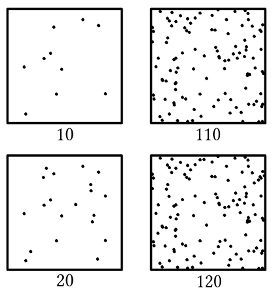
(逆に同じ数だけ増えても110から120増えた人より10から20に増えた人の方が多くなったと感じる。すべては比が決める。行動経済学でお馴染みの考え方だ。投資がフラクタルになるのと似ている。全財産100万の人の1万と100円の人の1円は同じ価値だ。)
10 110
_______________ _______________
| | | ・・・・・・・・・・・|
| | | ・・・・・・・・ ・・ |
| ・・ | |・・・・・ ・・・・・ |
| | |・・・・・・・・・・ |
| ・ | |・・・・・・・・・・ |
| ・ ・ | | ・ ・・・・・・・・ |
| | |・・・・・・・・・・ |
| ・ ・ | |・・・・・・・・・・ |
| ・ ・ | | ・・・・・・・・・・ |
| ・ | | ・・・・・・・・・・|
| | |・・・・・・・ ・・・|
|_______________| |_______________|
↓ ↓
20 120
_______________ _______________
| | | ・・・・・・・・・・・・|
| ・ | | ・・・・・・・・ ・・ |
| ・・ | |・・・・・ ・・・・・ |
| ・ ・ ・ | |・・・・・・・・・・ ・ |
| ・ | |・・・・・・・・・・ ・ |
| ・ ・ ・ | | ・ ・・・・・・・・・ |
| ・ | |・・・・・・・・・・ ・ |
| ・ ・ ・ | |・・・・・・・・・・ ・ |
| ・ ・ | | ・・・・・・・・・・・ |
| ・ ・ ・ | | ・ ・・・・・・・・・・|
| ・ | |・・・・・・・ ・・・・・|
|_______________| |_______________|
左右同じ数だけ増えていても左の方が多くなったと感じる……はず。
白黒反転させて点を豆電球か星と考えてもいい。
(岩渕輝『生命の哲学』2014年参照)
ヴェーバーの発見に積分を取り入れることでフェヒナーはより厳密なものにした。

An illustration of the Weber–Fechner law. On each side, the lower square contains 10 more dots than the upper one. However the perception is different: On the left side, the difference between upper and lower square is clearly visible. On the right side, the two squares look almost the same.
ヴェーバー‐フェヒナーの法則(ヴェーバー‐フェヒナーのほうそく、英: Weber–Fechner law)とは、感覚に関する精神物理学の基本法則で、中等度の刺激について五感のすべてに近似を与えることが知られている。
目次
ヴェーバーの法則
エルンスト・ヴェーバーは、刺激の弁別閾(丁度可知差異:気づくことができる最小の刺激差)は、基準となる基礎刺激の強度に比例することを見いだした。
はじめに加えられる基礎刺激量の強度をR とし、これに対応する識別閾値をΔR とすると、R の値にかかわらず
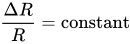
が成り立つ。この一定の値をヴェーバー比という。
たとえば、100の刺激が110になったときはじめて「増加した」と気付くならば、200の刺激が210に増加しても気付かず、気付かせるためには220にする必要がある。
フェヒナーの法則
ヴェーバーの弟子であるグスタフ・フェヒナーは、ヴェーバーの法則の式を積分することにより[1]、以下の対数法則を導き出した。
刺激量の強度R が変化する時、これに対応する感覚量E は
の関係となる。ここでC は定数である。つまり心理的な感覚量は、刺激の強度ではなく、その対数に比例して知覚される。
フェヒナーの法則と呼ばれることも多いが、ヴェーバーの法則から導出したことからヴェーバー・フェヒナーの法則とも呼ばれる。
たとえば、100の刺激が倍に増加して200になるときの感覚量と、200の刺激が倍に増加して400になるときの感覚量の変化は等しい。
脚注
- ^ ここでΔR をdR として積分することは若干の飛躍があり、厳密な計算ではなく近似である。
関連項目
グスタフ・フェヒナー
| グスタフ・フェヒナー Gustav Fechner | |
|---|---|
 | |
| 生誕 | グスタフ・テオドール・フェヒナー Gustav Theodor Fechner 1801年4月19日 .svg) 神聖ローマ帝国 ザクセン選帝侯領 Groß Särchen(ムスカウ付近) 神聖ローマ帝国 ザクセン選帝侯領 Groß Särchen(ムスカウ付近) |
| 死没 | 1887年11月18日(86歳).svg) ザクセン王国 ライプツィヒ ザクセン王国 ライプツィヒ |
| 国籍 |  ドイツ ドイツ |
| 研究分野 | 心理学 |
| 研究機関 | ライプツィヒ大学 |
| 出身校 | カール・グスタフ・カルス医学アカデミー ライプツィヒ大学(PhD、1835年) |
| 論文 | De variis intensitatem vis Galvanicae metiendi methodis (1835) |
| 主な指導学生 | Hermann Rudolf Lotze フリードリッヒ・ポールセン |
| 影響を 与えた人物 | ゲラルドゥス・ハイマンス ヴィルヘルム・ヴント ウィリアム・ジェームズ アルフレッド・ノース・ホワイトヘッド チャールズ・ハートショーン エルンスト・ヴェーバー |
| プロジェクト:人物伝 | |
実験心理学の先駆者、精神生理学の創始者であり、多くの20世紀の科学者・哲学者に影響を与えた。また、心理的感覚と刺激の物理的強度との間に の非線形関係があることを実証し、これは今日ヴェーバー‐フェヒナーの法則として知られている[2][3]。

目次
人物
ニーダーラウジッツのムスカウ付近のGroß Särchen(現 ポーランド領Żarki Wielkie)で牧師の子として生まれた。宗教家の父親に育てられたにもかかわらず、フェフナーは後に無神論者になった[4]。Sorau(現・ポーランド領ジャリ)で最初の教育を受けた。
1817年、ドレスデンのカール・グスタフ・カルス医学アカデミーで医学を学び、1818年からライプツィヒ大学に移り、以降、残りの人生を同学で過ごした[5]。1835年にライプツィヒ大学でPh.Dを取得した。
1834年に物理学の教授に任命された。しかし、1839年に、眼の障害に罹り、色と視覚の現象の研究に支障が出たことから辞職した。その後回復し、心と身体の関係の研究に転向した。ベッドに横たわっている時に、彼は精神的感覚と物質的感覚との関係についての洞察を得た。この洞察は、精神世界と物理世界の間に量的関係が存在するということであり、心理学の発展において重要なものであった[6]。
エルンスト・ヴェーバーの研究を発展させ、刺激に関する感覚の定式をヴェーバー‐フェヒナーの法則として定式化した。精神物理学という学問を創始し、実験心理学の成立に大きな影響を与えた。
著書
- 『フェヒナー博士の死後の世界は実在します』グスタフ・フェヒナー 著、服部 千佳子 翻訳、
- 出版社: 成甲書房、2008年9月2日、ISBN 978-4880862347
死後の世界は存在するのか?もし存在するなら、どのような世界なのか?フェヒナーは170年前にこの大問題を考察し、その答えをこの小さな本にまとめた。彼は驚くべき明快さと確かな根拠をもって、「死は生命の一つの過程であり、死は形を変えた誕生、すなわち、物質界への誕生ではなく、霊界への誕生だ」と説いた。本書は非宗教的かつ経験主義的な立場から死後の世界を考察、古典として現在も読みつがれている超ロングセラーである[7]。
脚注
- ^ [1]
- ^ Fancher, R. E. (1996). Pioneers of Psychology(3rd ed.). New York: W. W. Norton & Company. ISBN 0-393-96994-0.
- ^ Sheynin, Oscar (2004), "Fechner as a statistician.", The British journal of mathematical and statistical psychology 57 (Pt 1): 53–72, May 2004, doi:10.1348/000711004849196, PMID 15171801
- ^ Michael Heidelberger (2004). "1: Life and Work". Nature from within: Gustav Theodor Fechner and his Psychophysical Worldview. University of Pittsburgh Press. p. 21. ISBN 9780822970774. "The study of medicine also contributed to a loss of religious faith and to becoming atheist."
- ^ Fechner, Gustav Theodor at vlp.mpiwg-berlin.mpg.de.
- ^ Schultz, P.D., & Schultz, S.E. (2008). A History of Modern Psychology.(pp. 81-82).Thompson Wadsworth.
- ^ Amazon「BOOK」データベースより
関連項目

An illustration of the Weber–Fechner law. On each side, the lower square contains 10 more dots than the upper one. However the perception is different: On the left side, the difference between upper and lower square is clearly visible. On the right side, the two squares look almost the same.
The Weber–Fechner law refers to two related laws in the field of psychophysics, known as Weber's law and Fechner's law. Both laws relate to human perception, more specifically the relation between the actual change in a physical stimulus and the perceivedchange. This includes stimuli to all senses: vision, hearing, taste, touch, and smell.
CONTENTS
HISTORY AND FORMULATION OF THE LAWS
Both Weber's law and Fechner's law were formulated by Gustav Theodor Fechner (1801–1887). They were first published in 1860 in the work Elemente der Psychophysik (Elements of psychophysics). This publication was the first work ever in this field, and where Fechner coined the term psychophysics to describe the interdisciplinary study of how humans perceive physical magnitudes.[1]
Weber's law
Ernst Heinrich Weber (1795–1878) was one of the first people to approach the study of the human response to a physical stimulus in a quantitative fashion. Fechner was a student of Weber and named his first law in honor of his mentor, since it was Weber who had conducted the experiments needed to formulate the law.[2]
Fechner formulated several versions of the law, all stating the same thing. One formulation states:
"Simple differential sensitivity is inversely proportional to the size of the components of the difference; relative differential sensitivity remains the same regardless of size."[1]
What this means is that the perceived change in stimuli is proportional to the initial stimuli.
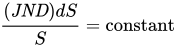
Weber's law also incorporates the Just Noticeable Difference (JND). This is the smallest change in stimuli that can be perceived. As stated above, the JND is proportional to the initial stimuli. Fechner found that the JND is constant for any sense.
Weber contrast
Although Weber's law includes a statement of the proportionality of a perceived change to initial stimuli, Weber only refers to this as a rule of thumb regarding human perception. It was Fechner who formulated this statement as a mathematical expression referred to as Weber contrast. [1][3]

Fechner's law
Fechner noticed in his own studies that different individuals have different sensitivity to certain stimuli. For example, the ability to perceive differences in light intensity could be related to how good that individual's vision is.[1] He also noted that the human sensitivity to stimuli changes depends on which sense is affected. He used this to formulate another version of Weber's law that he named the Massformel, the "measurement formula". Fechner's law states that the subjective sensation is proportional to the logarithm of the stimulus intensity. According to this law, human perceptions of sight and sound work as follows: Perceived loudness/brightness is proportional to logarithm of the actual intensity measured with an accurate nonhuman instrument.[3]

The relationship between stimulus and perception is logarithmic. This logarithmic relationship means that if a stimulus varies as a geometric progression (i.e., multiplied by a fixed factor), the corresponding perception is altered in an arithmetic progression (i.e., in additive constant amounts). For example, if a stimulus is tripled in strength (i.e., 3 x 1), the corresponding perception may be two times as strong as its original value (i.e., 1 + 1). If the stimulus is again tripled in strength (i.e., 3 x 3 x 1), the corresponding perception will be three times as strong as its original value (i.e., 1 + 1 + 1). Hence, for multiplications in stimulus strength, the strength of perception only adds. The mathematical derivations of the torques on a simple beam balance produce a description that is strictly compatible with Weber's law.[6][7]
Deriving Fechner's law
Fechner's law is a mathematical derivation of Weber's law.

Integrating the mathematical expression for Weber's law gives:

where  is the constant of integration and ln is the natural logarithm.
is the constant of integration and ln is the natural logarithm.To solve for , assume that the perceived stimuli becomes zero at some threshold stimuli  . Using this as a constraint, set
  and
and  . This gives:
, assume that the perceived stimuli becomes zero at some threshold stimuli . Using this as a constraint, set and . This gives:
Substituting in the integrated expression for Weber's law, the expression can be written as:
in the integrated expression for Weber's law, the expression can be written as:The constant k is sense-specific and must be determined depending on the sense and type of stimuli.[3]
TYPES OF PERCEPTION
Weber and Fechner conducted research on differences in light intensity and the perceived difference in weight.[1] Other sense modalities provide only mixed support for either Weber's law or Fechner's law.
Weight perception
Weber found that the just noticeable difference (JND) between two weights was approximately proportional to the weights. Thus, if the weight of 105 g can (only just) be distinguished from that of 100 g, the JND (or differential threshold) is 5 g. If the mass is doubled, the differential threshold also doubles to 10 g, so that 210 g can be distinguished from 200 g. In this example, a weight (any weight) seems to have to increase by 5% for someone to be able to reliably detect the increase, and this minimum required fractional increase (of 5/100 of the original weight) is referred to as the "Weber fraction" for detecting changes in weight. Other discrimination tasks, such as detecting changes in brightness, or in tone height (pure tone frequency), or in the length of a line shown on a screen, may have different Weber fractions, but they all obey Weber's law in that observed values need to change by at least some small but constant proportion of the current value to ensure human observers will reliably be able to detect that change.
Fechner did not conduct any experiments on how perceived heaviness increased with the mass of the stimulus. Instead, he assumed that all JNDs are subjectively equal, and argued mathematically that this would produce a logarithmic relation between the stimulus intensity and the sensation. These assumptions have both been questioned.[8][9] Following the work of S. S. Stevens, many researchers came to believe in the 1960s that the power law was a more general psychophysical principle than Fechner's logarithmic law. But in 1963 Donald Mackay showed and in 1978 John Staddon demonstrated with Stevens' own data, that the power law is the result of logarithmic input and output processes.[10][11]
Sound
Weber's law does not quite hold for loudness. It is a fair approximation for higher intensities, but not for lower amplitudes.[12]
Limitation of Weber's law in the auditory system
Weber's law does not hold at perception of higher intensities. Intensity discrimination improves at higher intensities. The first demonstration of the phenomena was presented by Riesz in 1928, in Physical Review. This deviation of the Weber's law is known as the "near miss" of the Weber's law. This term was coined by McGill and Goldberg in their paper of 1968 in Perception & Psychophysics. Their study consisted of intensity discrimination in pure tones. Further studies have shown that the near miss is observed in noise stimuli as well. Jesteadt et al. (1977)[13] demonstrated that the near miss holds across all the frequencies, and that the intensity discrimination is not a function of frequency, and that the change in discrimination with level can be represented by a single function across all frequencies.
Vision
The eye senses brightness approximately logarithmically over a moderate range (but more like a power lawover a wider range),[citation needed] and stellar magnitude is measured on a logarithmic scale.[14] This magnitude scale was invented by the ancient Greek astronomer Hipparchus in about 150 B.C. He ranked the stars he could see in terms of their brightness, with 1 representing the brightest down to 6 representing the faintest, though now the scale has been extended beyond these limits; an increase in 5 magnitudes corresponds to a decrease in brightness by a factor of 100.[14] Modern researchers have attempted to incorporate such perceptual effects into mathematical models of vision.[15][16]
Limitations of Weber's law in visual regularity perception
Perception of Glass patterns[17] and mirror symmetries in the presence of noise follows Weber's law in the middle range of regularity-to-noise ratios (S), but in both outer ranges, sensitivity to variations is disproportionally lower. As Maloney, Mitchison, & Barlow (1987)[18] showed for Glass patterns, and as van der Helm (2010)[19] showed for mirror symmetries, perception of these visual regularities in the whole range of regularity-to-noise ratios follows the law p = g/(2+1/S) with parameter g to be estimated using experimental data.
LOGARITHMIC CODING SCHEMES FOR NEURONS
Lognormal distributions
Activation of neurons by sensory stimuli in many parts of the brain is by a proportional law: neurons change their spike rate by about 10–30%, when a stimulus (e.g. a natural scene for vision) has been applied. However, as Scheler (2017)[20] showed, the population distribution of the intrinsic excitability or gain of a neuron is a heavy tail distribution, more precisely a lognormal shape, which is equivalent to a logarithmic coding scheme. Neurons may therefore spike with 5–10 fold different mean rates. Obviously, this increases the dynamic range of a neuronal population, while stimulus-derived changes remain small and linear proportional.
OTHER APPLICATIONS
The Weber–Fechner law has been applied in other fields of research than just the human senses.
Numerical cognitionEdit
Psychological studies show that it becomes increasingly difficult to discriminate between two numbers as the difference between them decreases. This is called the distance effect.[21][22] This is important in areas of magnitude estimation, such as dealing with large scales and estimating distances. It may also play a role in explaining why consumers neglect to shop around to save a small percentage on a large purchase, but will shop around to save a large percentage on a small purchase which represents a much smaller absolute dollar amount.[23]
Pharmacology
It has been hypothesized that dose–response relationships can follow Weber's Law[24] which suggests this law – which is often applied at the sensory level – originates from underlying chemoreceptor responses to cellular signaling dose relationships within the body. Dose response can be related to the Hill equation, which is closer to a power law.
Public finance
There is a new branch of the literature on public finance hypothesizing that the Weber–Fechner law can explain the increasing levels of public expenditures in mature democracies. Election after election, voters demand more public goods to be effectively impressed; therefore, politicians try to increase the magnitude of this "signal" of competence – the size and composition of public expenditures – in order to collect more votes.[25]
SEE ALSO
REFERENCES
- ^ a b c d e f Fechner, Gustav Theodor (1966) [First published .1860]. Howes, D H; Boring, E G, eds. Elements of psychophysics [Elemente der Psychophysik]. volume 1. Translated by Adler, H E. United States of America: Holt, Rinehart and Winston.
- ^ Ross, H.E. and Murray, D. J.(Ed. and Transl.) (1996)E.H.Weber on the tactile senses. 2nd ed. Hove: Erlbaum (UK) Taylor & Francis;
- ^ a b c d Fechner, Gustav Theodor (1860). Elemente der Psychophysik [Elements of psychophysics]. band 2. Leipzig: Breitkopf und Härtel.
- ^ Li, Wu-bin; Lu, Chang-hou; Zhang, Jian-chuan (February 2013). A lower envelope Weber contrast detection algorithm for steel bar surface pit defects (Thesis). Volume 45. Optics & Laser Technology. pp. Pages 654–659.
- ^ Drew, SA; Chubb, CF; Sperling, G (2010). Precise attention filters for Weber contrast derived from centroid estimations (Article). 10. JOURNAL OF VISION. pp. 16p. ISSN 1534-7362.
- ^ Lanzara, Richard G. "Weber's Law Modeled by the Mathematical Description of a Beam Balance". cogprints.org. CogPrints. Retrieved 5 December 2015.
- ^ "Bio Balance - Reference Library". bio-balance.com. Retrieved 5 December 2015.
- ^ Heidelberger, M. (2004)Nature from within: Gustav Theodor Fechner and his psychophysical worldview. Transl. C. Klohr. Pittsburgh, USA: University of Pittsburgh Press.
- ^ Masin, S.C.; Zudini, V.; Antonelli, M. (2009). "Early alternative derivations of Fechner's law" (PDF). J. History of the Behavioral Sciences. 45: 56–65. doi:10.1002/jhbs.20349.
- ^ Mackay, D. M. (1963). "Psychophysics of perceived intensity:A theoretical basis for Fechner's and Stevens' laws". Science. 139: 1213–1216. doi:10.1126/science.139.3560.1213-a.
- ^ Staddon, J. E. R. "Theory of behavioral power functions". Psychological Review. 85: 305–320. doi:10.1037/0033-295x.85.4.305. Retrieved 23 April 2017.
- ^ Yost, William A. (2000). Fundamentals of hearing : an introduction (4. ed.). San Diego [u.a.]: Academic Press. p. 158. ISBN 0-12-775695-7.
- ^ Jesteadt Walt, Wier Craig C., Green David M. (1977). "Intensity discrimination as a function of frequency and sensation level". The Journal of the Acoustical Society of America. 61: 169. doi:10.1121/1.381278.
- ^ a b V. B. Bhatia (2001). Astronomy and astrophysics with elements of cosmology. CRC Press. p. 20. ISBN 978-0-8493-1013-3.
- ^ Jianhong (Jackie) Shen; Yoon-Mo Jung (2006). "Weberized Mumford–Shah model with Bose–Einstein photon noise". Appl. Math. Optim. 53 (3): 331–358. doi:10.1007/s00245-005-0850-1.
- ^ Jianhong (Jackie) Shen (2003). "On the foundations of vision modeling I. Weber's law and Weberized TV (total variation) restoration". Physica D: Nonlinear Phenomena. 175 (3/4): 241–251. doi:10.1016/S0167-2789(02)00734-0.
- ^ "Glass Patterns". Scholarpedia. doi:10.4249/scholarpedia.9594. Retrieved 2017-03-23.
- ^ Maloney R. K., Mitchison G. J., Barlow H. B. (1987). "Limit to the detection of Glass patterns in the presence of noise". Journal of the Optical Society of America A. 4: 2336–2341. doi:10.1364/josaa.4.002336.
- ^ van der Helm P. A. (2010). "Weber-Fechner behaviour in symmetry perception?". Attention, Perception, & Psychophysics. 72: 1854–1864. doi:10.3758/app.72.7.1854.
- ^ Scheler G. (2017). "Logarithmic distributions prove that intrinsic learning is Hebbian". F1000research. 6: 1222. doi:10.12688/f1000research.12130.2. PMC 5639933. PMID 29071065.
- ^ Moyer R.S., Landauer T.K. (September 1967). "Time required for judgements of numerical inequality". Nature. 215 (5109): 1519–20. doi:10.1038/2151519a0. PMID 6052760.
- ^ Longo M.R., Lourenco S.F. (2007). "Spatial attention and the mental number line: evidence for characteristic biases and compression". Neuropsychologia. 45 (7): 1400–6. doi:10.1016/j.neuropsychologia.2006.11.002. PMID 17157335.
- ^ https://www.npr.org/2015/01/13/376836545/consumer-agency-launches-tool-to-help-you-find-a-cheaper-mortgage
- ^ D. Murray Lyon (1923). "Does the reaction to adrenalin obey Weber's law?". Journal of Pharmacology. 21 (4): 229–235.
- ^ Mourao, P. (2012). "The Weber-Fechner Law and Public Expenditures Impact to the Win-Margins at Parliamentary Elections". Prague Economic Papers. 21 (3): 290–308. doi:10.18267/j.pep.425.
FURTHER READING
- Ries, Clemens (1962). Normung nach Normzahlen [Standardization by preferred numbers] (in German) (1 ed.). Berlin, Germany: Duncker & Humblot Verlag. ISBN 3-42801242-9. (135 pages)
- Paulin, Eugen (2007-09-01). Logarithmen, Normzahlen, Dezibel, Neper, Phon - natürlich verwandt![Logarithms, preferred numbers, decibel, neper, phon - naturally related!] (PDF) (in German). Archived(PDF) from the original on 2016-12-18. Retrieved 2016-12-18.
EXTERNAL LINKS
 Texts on Wikisource:
- "Weber's Law". Encyclopedia Americana. 1920.
- "Weber's Law". Encyclopædia Britannica (11th ed.). 1911.
- https://en.m.wikisource.org/wiki/1911_Encyclop%C3%A6dia_Britannica/Weber%27s_Law
- https://translate.google.co.jp/translate?hl=ja&tab=wT&authuser=0&sl=auto&tl=ja&u=
- https%3A%2F%2Fen.m.wikisource.org%2Fwiki%2F1911_Encyclop%25C3%25A6dia_
- Britannica%2FWeber%2527s_Law
- Fry, Hannah. "Weber's Law" (video). YouTube. Brady Haran. Retrieved 28 May 2018.

https://blog.goo.ne.jp/suzu-nari/e/bdce1eaaafaea2a42d0605019c3493dd
新古典派の経済学は、労働価値説を越えて需要供給の観点から価値をとらえることを可能にする限界革命を経て成立した。メンガーやジェヴォンズが導入した限界効用(Marginal Utility)の考えは、当時の心理学における精神物理学を参照したものだった。限界効用逓減の法則などは、感覚量に関するウェーバー・フェヒナーの法則と同型の内容となっている。エッジワースのように効用の測定に向けて心理学を援用しようとした経済学者もいる。しかし、その後の経済学は、パレートなどの定式化にしたがい、心理量ではなく選択結果を参照してなりたつようにモデル化を行うようになる。サミュエルソンなどが、この流れで新古典派の経済学を数学的にモデル化していく。合理的な選択を前提とした数学的モデルによる専門化した経済学の誕生である。この方向が20世紀の経済学の主流となる。こうした流れに変化のきざしが生じたのは、20世紀の終わりになってからである。行動経済学では、実際の人間の選択を心理学的な理論を参照に実験的に研究を試み、神経経済学など神経科学と経済行動との関連も研究のテーマとなった。19世紀末に試みられた心理学との関連づけが、20世紀の専門化の時代をはさんで、20世紀末から21世紀になって再びより本格的に探求されるようになったのである。(この間の事情については、例えば次の論文が分かりやすい。THE ROAD NOT TAKEN: HOW PSYCHOLOGY WAS REMOVED FROM ECONOMICS, AND HOW IT MIGHT BE BROUGHT BACK, Luigino Bruni and Robert Sugden, The Economic Journal,2007, 117, 146-173.)また、経済学者が効用という扱いやすい概念だけを数学的定式化にのりやすいようにして拝借した功利主義者が問題とした幸福などという問題も経済学の本流に復帰しつつある(例えば、"Economics and Happiness: Framing the Analysis"などを参照。)。
心理学の成立は、ヴントがライプチヒ大学に心理学実験室を設立した1879年とされる。ヴントはヘルムホルツの弟子で、ヘルムホルツは生理学者ヨハネス・ミュラーの弟子だった。ヨハネス・ミュラーの孫弟子には、フロイトやパブロフがいる。ヘルムホルツなどは、物理学と感覚生理学の大家であるとともに、知覚の無意識的推論説を唱えた心理学者でもあった。要するに心理学は19世紀末におけるドイツの生理学における感覚研究などを基盤に学際的背景で成立したのである。ヴントは心理学を直接経験の科学とし、心理学を独立した科学として立ち上げようとした。行動主義や精神分析など、成立は生物学や医学と関係していながら、より専門的な学派を形成していった。心理学も、20世紀の初めから後半までは専門化の時代だったと言える。心理学も20世紀の終わりになって本格的な学際的研究の時期を迎えている。最初は、1960年代から70年代の認知革命、次は1980年代以降の脳科学の参入である(1985年に認知神経科学、1995年に感情神経科学、2005年に社会神経科学と心理学の主要領域ほんとんどすべてとリンクするようになった)。19世紀に生理学を背景として学際的な科学としてスタートした心理学は20世紀の専門化の時代を超えて、ふたたび本格的な学際的研究の時期を迎えつつある。
以上、心理学と経済学についてごく大づかみに述べた。清水幾太の「倫理学ノート」ではヴィーコによる歴史のらせん状発展の説は紹介されていないが、人間科学、社会科学は20世紀の終わりになって、20世紀初めから後半までの専門化の時代を超えて、再び19世紀末と同じような総合的学際化の時代を迎えつつあるようだ。
新古典派の経済学は、労働価値説を越えて需要供給の観点から価値をとらえることを可能にする限界革命を経て成立した。メンガーやジェヴォンズが導入した限界効用(Marginal Utility)の考えは、当時の心理学における精神物理学を参照したものだった。限界効用逓減の法則などは、感覚量に関するウェーバー・フェヒナーの法則と同型の内容となっている。エッジワースのように効用の測定に向けて心理学を援用しようとした経済学者もいる。しかし、その後の経済学は、パレートなどの定式化にしたがい、心理量ではなく選択結果を参照してなりたつようにモデル化を行うようになる。サミュエルソンなどが、この流れで新古典派の経済学を数学的にモデル化していく。合理的な選択を前提とした数学的モデルによる専門化した経済学の誕生である。この方向が20世紀の経済学の主流となる。こうした流れに変化のきざしが生じたのは、20世紀の終わりになってからである。行動経済学では、実際の人間の選択を心理学的な理論を参照に実験的に研究を試み、神経経済学など神経科学と経済行動との関連も研究のテーマとなった。19世紀末に試みられた心理学との関連づけが、20世紀の専門化の時代をはさんで、20世紀末から21世紀になって再びより本格的に探求されるようになったのである。(この間の事情については、例えば次の論文が分かりやすい。THE ROAD NOT TAKEN: HOW PSYCHOLOGY WAS REMOVED FROM ECONOMICS, AND HOW IT MIGHT BE BROUGHT BACK, Luigino Bruni and Robert Sugden, The Economic Journal,2007, 117, 146-173.)また、経済学者が効用という扱いやすい概念だけを数学的定式化にのりやすいようにして拝借した功利主義者が問題とした幸福などという問題も経済学の本流に復帰しつつある(例えば、"Economics and Happiness: Framing the Analysis"などを参照。)。
心理学の成立は、ヴントがライプチヒ大学に心理学実験室を設立した1879年とされる。ヴントはヘルムホルツの弟子で、ヘルムホルツは生理学者ヨハネス・ミュラーの弟子だった。ヨハネス・ミュラーの孫弟子には、フロイトやパブロフがいる。ヘルムホルツなどは、物理学と感覚生理学の大家であるとともに、知覚の無意識的推論説を唱えた心理学者でもあった。要するに心理学は19世紀末におけるドイツの生理学における感覚研究などを基盤に学際的背景で成立したのである。ヴントは心理学を直接経験の科学とし、心理学を独立した科学として立ち上げようとした。行動主義や精神分析など、成立は生物学や医学と関係していながら、より専門的な学派を形成していった。心理学も、20世紀の初めから後半までは専門化の時代だったと言える。心理学も20世紀の終わりになって本格的な学際的研究の時期を迎えている。最初は、1960年代から70年代の認知革命、次は1980年代以降の脳科学の参入である(1985年に認知神経科学、1995年に感情神経科学、2005年に社会神経科学と心理学の主要領域ほんとんどすべてとリンクするようになった)。19世紀に生理学を背景として学際的な科学としてスタートした心理学は20世紀の専門化の時代を超えて、ふたたび本格的な学際的研究の時期を迎えつつある。
以上、心理学と経済学についてごく大づかみに述べた。清水幾太の「倫理学ノート」ではヴィーコによる歴史のらせん状発展の説は紹介されていないが、人間科学、社会科学は20世紀の終わりになって、20世紀初めから後半までの専門化の時代を超えて、再び19世紀末と同じような総合的学際化の時代を迎えつつあるようだ。
1881年
ジェヴォンズはエッジワース経由でフェヒナーに言及
(1881)
"Review of Edgeworth's Mathematical Psychics",
Mind, Vol. 6, p.581-583
[Note on electronic version: Page numbers in bold square brackets, e.g. [p.582] denote the beginning of the respective page in the original (anonymous) 1881 Mind version. Page numbers in normal brackets, e.g. (p.66), were inserted by Jevons and refer to Edgeworth's book. All errors are left intact.
As far as we know, this essay is in the public domain. You are free to make use of this electronic version in any way you wish, except for commercial purposes, without asking permission. All comments and corrections of this text are encouraged and can be addressed to het@cepa.newschool.edu. Click here for a PDF version.]
________________________________________________________
[p.581]Mathematical Psychics: An Essay on the Application of Mathematics to the Moral Sciences. By F.Y. Edgeworth, M.A., Barrister-at-Law. London: Kegan Paul & Co., 1881. Pp. viii., 150.Whatever else readers of this book may think about it, they would probably all agree that it is a very remarkable one. The fearless manner in which Mr. Edgeworth applies the conceptions and methods of mathematical physics to illustrate, if not solve, the problems of hedonic science, is quite surprising. As the invisible energy of electricity is grasped by the marvellous methods of Lagrange, so may the invisible energy of pleasure admit of similar handling. The soul is likened to a steam car moving upon a planed in a direction tending towards the position of minimum potential electro-magnetic energy, but with inconceivably diversified degrees of freedom. The book proceeds upon the conception of Man as a pleasure-machine; but the great difficulty seems to consist in the fact that society is a great aggregate of such machines, the collisions and compacts between which "present an appearance of quantitative regularity in the midst of bewildering complexity resembling in its general characters the field of electricity and magnetism" (p.15). It would be a great mistake, however, to suppose that Mr. Edgeworth's investigations, though stated in so daring and apparently erratic a manner, are devoid of scientific basis and exactitude. The book is one of the most difficult to read which we ever came across, certainly the most difficult of those purporting to treat of economic science. But it may, nevertheless, be recognized in the future as containing new and most important suggestions. Starting from such empirical bases as Fechner's law, Wundt's curve of pleasure and pain, or Delb忖f's formul・ Mr. Edgeworth undertakes to determine the distribution of means and of labour which shall be conducive to the highest aggregate of well-being. Some of the conclusions drawn are very curious, but after a little consideration will probably commend themselves to the common sense of the reader. Thus (p.66) the [p.582]
Jennings's work was denounced by J.E. Cairnes (1857), who saw his attempt to marry economics and phsyico-psychology as being completely off-the-wall. But W. Stanley Jevons was much impressed by Jennings and quoted him extensively in his 1871 treatise.
http://www.hetwebsite.net/het/profiles/jennings.htm
http://www.hetwebsite.net/het/profiles/jennings.htm
ジェヴォンズ経済学の理論1871邦訳42
やすからぎる性質の諸欲望が比較的に顕著となる。しかし私の見るところ,効用の法則の本質と重要性とを鑑識することが最も1)明確であると思われる著者は,1855年に『経済学の自然的諸要素』(NtturalElements of P。litical EcOnOmy)と称する小著を公にしたリチャード・ジユニングス(Richard Jennings)である。この書は経済学の生理学的諸法則への依存を明らかにして:もってこの学問の物的基礎を論じている。それは経済学の真正の基礎に対する偉大な洞察を現わしているが,しかも私は経済学者らのジェニン2)グスに対して一顧を与えたことすら知らない。故に私は彼の効用の本質に対する所言から全文を抜粋する。私が述べるところの法則は新奇のものでなく,また経済学の正しい理論をわれわれに与えるには,ただわれわれの有する諸原理から注意深く演繹すれば足りることがわかるであろう。
1)ロンドン, ロングマンス。2)ヶアンズ(Cairnes)はしかし例外である。彼の著『経済学の性格と論理的方法』(The Character and Logical Methods of Political Economy)ロンドン, 1857年,.81頁,第2版(マクミラン),1875年,56,110,224諸頁,付録2,参照。「感覚をひき起こす上においての諸貨物の相対的結果から転じて,かの絶対的なる諸結果,すなわち独り各貨物の量にの…
ジェニングス経由の影響か?
エッジワース1881はフェヒナーに言及しているが
1863 年刊『純粋論理学』(「普通論理学」)はブールや恩師ドモルガンの記号論理学を発展させており、論理学問題を完全に数理的に解くことを主張した。それを機械的に実現した 1870 年の「論理ピアノ」(写真) は、原始的ながらコンピュータの前身だ (Jevons, 1870: p.517)。その間、経済学に関連した業績としては、1865年「石炭問題」で、何かリソースの利用効率が改善されると、その使用量は減るどころか増えるという、いわゆる「ジェヴォンズのパラドックス」を提唱している。
だが 1870 年にフリーミング・ジェンキンが数理経済学について書いたパンフレットを送ってきた。先を越されるのを恐れたジェヴォンズは論理学の研究を中断し、1871 年に『経済学の理論』を発表して限界革命の火ぶたを切った。
ジェヴォンズはまず、限界効用逓減の原理を説明し、それがどのように個人の選択を左右しているかを説明する。そして、参加者の交渉の結果として、取引が止まる点が市場均衡となることを示した。さらにこの理論を生産経済にあてはめる中で、労働供給の負の効用理論(これは後に 費用理論論争につながる) および 資本の時間依存理論 (これはオーストリア学派を先取りするものだった) を提案する。ただし、いずれも画期的な発想だったが理論にうまく統合されているとは言い難い。
- 1870 [w/ Heywood, et al.] "Memorial to the Home Secretary as to Uniformity in Census of 1871", Dec 1870, JSS of London
- 1871 "The Power of Numerical Discrimination", Feb 1871, Nature [replies by Mullen and J.B., and reply by R.V. (Mar 71)]
- 1871 Report and Minutes in Report of the Commissioners appointed to Inquire into the several matters relating to Coal, 1871, v.1, v.2, v.3
- 1871 The Match Tax: A problem in finance, June 1871 [repr. in Jevons, 1905]
- 1871 The Theory of Political Economy , Oct.1871. [2nd ed., 1879; 3rd ed., 1888; 4th ed., 1910; 5th ed., 1957] - Preface & Chapter 1; Chapter 3 (pdf)
- 1871 "Helmholtz on the Axioms of Geometry", Oct. 1871, Nature [reply by J.L. Tupper, Jan 1872]
- 1871 "Encke's Comet and the Supposed Resisting Medium", Nov 1871, read to Manchester Literary and Philosophical Society [Abstract in Chemical News, Dec 1871, Abstract in Nature, Dec 1871]


(経済学史に詳しいブローグによると)ジェボンズはフロイトとも親交のあったフェーヒナーから(ジェニングズ経由で)限界効用(Marginal Utility)のアイデアを得た(邦訳新版『経済理論の歴史』2:517頁参照)。
フェヒナーは、夢の舞台は覚醒時の表象生活の舞台とは別物だと主張している。例えば覚醒時の思考は概念によって行われるのだが、夢は概して視覚的形象、聴覚的形象によって思考する。勿論、睡眠時には外界に対して背を向けているため、それは思考というより実際の体験として信じられている。こうした夢の表象を互いに結びつける連想作用は覚醒時の連想作用とは違い、特殊なものである。》
Economic Theory in Retrospect - 293 ページ
Natural Images in Economic Thought: Markets Read in Tooth and Claw
ジェヴォンズの経済学の数学化: M. シャバスの見解を中心として