The World Bank and IMF are in crisis. It's time to push a radical new vision | World Bank | The Guardian
https://amp.theguardian.com/commentisfree/2019/jan/31/world-bank-imf-bretton-woods-banking-keynes ☆The World Bank and IMF are in crisis. It's time to push a radical new vision
The exit of Jim Yong Kim offers a chance to put the Bretton Woods institutions in the service of the many, not the few
世界銀行とIMFは危機に瀕しています。根本的な新しいビジョンを推進する時が来ました| 世界銀行| 保護者
https://amp.theguardian.com/commentisfree/2019/jan/31/world-bank-imf-bretton-woods-banking-keynes世界銀行とIMFは危機に瀕しています。根本的な新しいビジョンを推進する時が来ました
ジム・ヨン・キムの出口は、ブレトンウッズの機関を、少数ではなく多くの人々に奉仕させる機会を提供します
2019年1月31日(木)16.20 GMT
世界銀行総裁のジム・ヨン・キム氏 は、任期満了の3年半前の2月1日に、より緑豊かな牧草地を求めて辞任します。最も強力な2つの国際金融機関のいずれかのリーダーシップを辞任する彼の覚悟は憂慮すべき兆候です。しかし、それは重要なモーニングコールでもあります。
世界銀行とIMFは 、1950年代と1960年代に資本主義が黄金期を経験したブレトンウッズの建物の残りの最後の列です 。そのシステムとそれが依存する固定為替レート体制は1971年にほこりをかかえましたが、2つの機関は純粋に大西洋主義の線に沿ってグローバルファイナンスをサポートし続けました。世界銀行。
貧困削減の擁護者として名乗りを上げたキャリア医師であるキム は、銀行のリーダーシップの運命をドナルドトランプの手に委ねています。家。ドラマに不条理を加えたのは、金大統領の後任の捜査委員会を率いる米国大統領の娘イヴァンカトランプ です。
資源置く過激な改革を推進するために-しかし、トランプの時代のあらゆる危機のように、この下劣な事件は、ブレトンウッズ機関のための全く新しいビジョンを周りに動員する絶好の機会である 世界銀行 のサービスでとIMFを非常に少数の人々の利益のために、グローバルファイナンスの車輪を注油するのではなく、多数。
そのような進歩的なビジョンは、ブレトンウッズのシステムをそのフレーマーの高尚な意図に非常に近づけます。「平和のように繁栄は不可分である」と米国財務長官のヘンリー・モーゲンタウは、 世界銀行(当時は国際復興開発銀行)とIMFを誕生させたブレトンウッズ会議への就任演説で述べた。 。「私たちはそれをあちこちに散らばったり、他の人を犠牲にして楽しんだりする余裕はありません。」
当初のブレトンウッズ計画は為替レートを固定することであり、IMFは重債務国が債務の再構築を支援し、安定化基金が資本逃避を抑制しました。一方、世界銀行は開発金融を提供し、国際的な商品安定化企業は「生産者と消費者の両方に公正な価格で主要商品の秩序あるマーケティングをもたらす」でしょう。最後に、システム全体はドル建てで、グリーンバックは固定レートで金と交換できる唯一の通貨です。
ブレトンウッズでイギリスの首席交渉官を務めるジョンメイナードケインズは、アメリカが貿易黒字を抱えている限り、新しいシステムがドルに依存することしかできないと心配していました。アメリカが赤字国になった瞬間、制度は崩壊する。したがって、ケインズは、新しい世界秩序をドルで構築する代わりに、すべての主要経済国が多国間国際清算連合(ICU)に加入することを提案しました。各国は、独自の通貨と中央銀行を維持しながら、ケインズがbancorと名付けた共通の会計単位ですべての国際支払いをデノミネーションし、すべての国際支払いをICUを通じて清算することに同意します。
ICUが設定されると、資本フロー、ボラティリティ、グローバルな総需要および生産性のバランスをとるために、永続的な余剰と赤字に対称的に課税されます。もしそれが制定されていれば、ICUは世界銀行と協力して世界経済の均衡を保ち、世界的な共有繁栄を築いていたでしょう。
しかし、ケインズのICUは拒否されました。米国は、新しい通貨システムのアンカーとしてドルを置き換えることに消極的でした。IMFが救済基金に格下げされたため、世界銀行は独自の準備金からの貸付に限定され(ストレスのある加盟国からの寄付)、IMFが世界銀行の投資を活用する可能性(中央銀行が完了)投棄されました。
アメリカの大規模な貿易赤字に続いて、リチャード・ニクソン大統領は1971年8月15日にブレトンウッズ体制の実効的な終結を発表しました-ケインズが予測したとおりです。
即座に、ブレトンウッズ体制が覆い隠されていた民間銀行が立ち上がり、世界は金融に引き継がれました。
世界銀行とIMFは、政府と繁栄を支援するのではなく、いわゆるワシントンコンセンサスを主導しました。それは、大規模な民営化、緊縮政策、そして金融規制緩和の組織的なキャンペーンです。「民営化できるものには実質的に制限はありません」と、1992年に公共部門管理および民間部門開発部門の責任者であるメアリーシャーリーは書いています。
ジム・ヨン・キムはかつてワシントンのコンセンサスに対する激しい批評家でした。2000年に出版された彼の著書「Dying for Growth」では、金は世界銀行の自由なマーケティング活動に反対し、その費用は「専門家の設計を受け入れた貧しい国々、弱者、弱者によって負担されてきた」。
それでも大統領として、金総書記は公共の利益に対する民間の利益への銀行のコミットメントをターボチャージした。彼が2015年に採用した戦略である「開発のための資金の最大化」(MFD)は、世界銀行を途上国への直接投資家から単なる民間資金のファシリテーターへと変えました。銀行の中心的な活動は政府に貸すことではなく、「リスクを冒すプロジェクト、セクター、国全体」にあり、実質的には民間投資家に代わってリスクを社会化し、利益を民営化することです。
この観点から、キム氏がプライベートエクイティファームのポストに就くために早期に辞任したことは完全に理にかなっています。
しかし、彼の決定は、今日の世界銀行とIMFの役割を振り返り、おそらくケインズの1944年頃の先見の明のある思想を再考するための私たちの手掛かりでなければなりません。
今日の世界では、1944年と同様に、大規模な国際投資プログラムが必要です。当時、人類は致命的な世界大戦後の復興を必要としていました。今日、地球は、年間少なくとも8兆ドルの費用がかかるグリーン移行を求めています。
お金はどこから来るのですか?確かに私たちの州の強調された予算からではありません。
アイデアは次のとおりです。新しいブレトンウッズを建設 し 、刷新された世界銀行と新しいIMF間のリンクアップを介してアイドル貯蓄を動員するだけで、国際グリーンニューディールに資金を提供します。
IMFは、すべての国際支払いが指定されたデジタル通貨単位の発行者になることができ、国は(IMFの単位に対して自由に変動する)通貨を保持でき、それに比例して通貨単位を預金することにより、ウェルスファンドを構築できます。すべての国の貿易赤字 と 黒字に。
一方、IMFが世界の通貨単位を発行する能力に支えられて、世界銀行は世界中のアイドル貯蓄をグリーン投資に集中させ、数十年にわたる環境破壊と人の移動への投資の後にその魂を取り戻すことができます。
キムの辞任は、一つのことを明らかにしている:世界銀行が危機に瀕している。新しい開発銀行は規模と範囲が拡大し、世界銀行が放棄して以来長い間埋められてきました。
今こそ動員する時です。新興のリーダーたちに国際的に考え始め、グリーンニューディールへの熱意をグローバルレベルに押し上げる時です。
私たちが迅速に行動しなければ、根本的な方向転換を要求しますと、世界銀行は無意味になるでしょう。さらに悪いことには、それはトランプ一家とその仲間のための遊び道具となり、世界を彼らの素晴らしいゴルフコースにするでしょう。
デビッドアドラーは作家であり、DiEM25の調整集団のメンバーです。Yanis VaroufakisはDiEM25の共同創設者です。彼はまたギリシャの元財務相でもあります
The World Bank and IMF are in crisis. It's time to push a radical new vision
The exit of Jim Yong Kim offers a chance to put the Bretton Woods institutions in the service of the many, not the few
Thu 31 Jan 2019 16.20 GMT
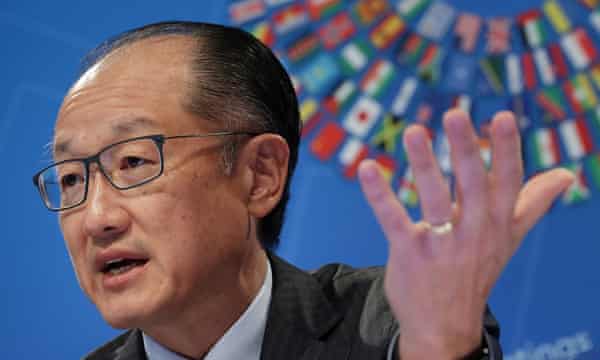
The president of the World Bank, Jim Yong Kim, will step down on 1 February – three and a half years before the end of his term – in search of greener pastures. His readiness to resign from the leadership of one the two most powerful international financial institutions is a worrying omen. But it is also an important wake-up call.
The World Bank and the IMF are the last remaining columns of the Bretton Woods edifice under which capitalism experienced its golden age in the 1950s and 1960s. While that system, and the fixed exchange rate regime it relied upon, bit the dust in 1971, the two institutions continued to support global finance along purely Atlanticist lines: with Europe’s establishment choosing the IMF’s managing director and the United States selecting the head of the World Bank.
Kim, a career physician who presented himself as a champion of poverty alleviation, now leaves the fate of the bank’s leadership in the hands of Donald Trump – the global equivalent of a progressive supreme court justice hanging up his robes in the middle of a Republican White House. Adding a touch of the absurd to the drama, it is the US president’s daughter, Ivanka Trump, who is now leading the searchcommittee for Kim’s replacement.
But like every crisis of the Trump era, this sordid affair is an excellent opportunity to mobilize around an entirely new vision for the Bretton Woods institutions – to push for radical reforms that would put the resources of the World Bank and the IMF in the service of the many, rather than lubricating the wheels of global finance in the interest of the very few.
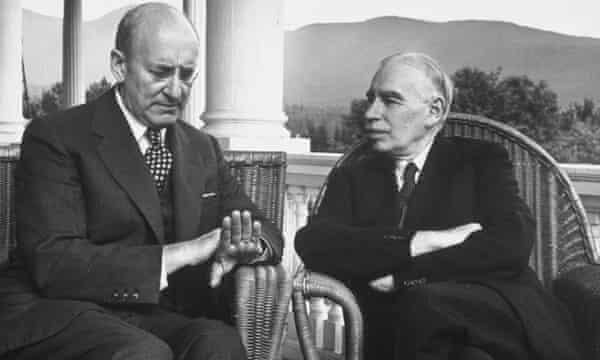
Such a progressive vision would bring the Bretton Woods system much closer to the lofty intentions of its framers. “Prosperity, like peace, is indivisible,” said the US treasury secretary, Henry Morgenthau, in his inaugural speech to the Bretton Woods conference, which gave birth to the World Bank (then the International Bank for Reconstruction and Development) and to the IMF. “We cannot afford to have it scattered here or there among the fortunate or enjoy it at the expense of others.”
The original Bretton Woods plan was for exchange rates to be fixed, with the IMF helping heavily indebted countries restructure their debt and a stabilization fund curbing capital flight. Meanwhile, the World Bank would offer development finance and an international commodity stabilization corporation would “bring about the orderly marketing of staple commodities at prices fair to the producer and consumer alike”. Finally, the whole system would be dollar-denominated, with the greenback being the only currency exchangeable for gold at a fixed rate.
John Maynard Keynes, the chief British negotiator at Bretton Woods, was worried that the new system could only rely on the dollar as long as America had a trade surplus. The moment the United States became a deficit country, the system would collapse. So, Keynes suggested that instead of building the new world order on the dollar, all major economies would subscribe to a multilateral International Clearing Union (ICU). While keeping their own currencies, and central banks, countries would agree to denominate all international payments in a common accounting unit, which Keynes named the bancor, and to clear all international payments through the ICU.
Once set up, the ICU would tax persistent surpluses and deficits symmetrically so as to balance out capital flows, volatility, global aggregate demand and productivity. Had it been instituted, the ICU would have worked alongside the World Bank to keep the global economy in balance and build shared prosperity worldwide.
But Keynes’s ICU was rejected. The United States was unwilling to replace the dollar as the anchor of the new monetary system. And so the IMF was downgraded to a bailout fund, the World Bank was limited to lending from its own reserves (contributed by stressed member states) and, crucially, any possibility of the IMF leveraging the World Bank’s investments (like a central bank might have done) was jettisoned.
Following large US trade deficits, then president Richard Nixon announced on 15 August 1971 the effective end of the Bretton Woods system – just as Keynes had predicted.
Immediately, the private banks, which the Bretton Woods system had been keeping under a lid, sprang up and the world was taken over by financialization.
Rather than supporting governments and prosperity, the World Bank and the IMF led the so-called Washington consensus: an orchestrated campaign of mass privatization, austerity and financial deregulation. “There are virtually no limits on what can be privatized,” wrote Mary Shirley, the chief of the public sector management and private sector development division, in 1992.
Jim Yong Kim was once a fierce critic of the Washington consensus. In his book Dying for Growth, published in 2000, Kim railed against the World Bank’s free marketeering, the costs of which “have been borne by the poor, the infirm and the vulnerable in poor countries that accepted the experts’ designs”.
Yet as president, Kim turbocharged the bank’s commitment to private profits against the public interest. “Maximizing finance for development” (MFD), the strategy he adopted in 2015, transformed the World Bank from a direct investor in developing countries to a mere facilitator of private finance. The bank’s core activity would not be lending to governments, but to “de-risk projects, sectors and entire countries”, in effect socializing the risks on behalf of the private investors and privatizing any gains.
From this perspective, it makes perfect sense that Mr Kim resigned early to take up a post at … a private equity firm.
His decision must, however, be our cue to review the role of the World Bank and the IMF today, and perhaps to revisit Keynes’s prescient idea circa 1944.
The world today needs, as much as it did in 1944, a massive international investment program. Back then, humanity needed reconstruction after a lethal world war. Today, the planet is crying out for a green transition that will cost at least $8tn annually.
Where will the money come from? Surely not from the stressed budgets of our states.
Here’s an idea: build a new Bretton Woods and fund the International Green New Deal by simply mobilizing idle savings via a linkup between the revamped World Bank and the new IMF.
The IMF can become the issuer of a digital currency unit in which all international payments are denominated, countries can retain their currencies (that will float freely against the IMF’s unit), and a wealth fund can be built by depositing in it currency units in proportion to every country’s trade deficits and surpluses.
Meanwhile, backed by the IMF’s capacity to issue the world currency unit, the World Bank can crowd idle savings from across the world into green investments, reclaiming its soul after decades of investing in environmental destruction and human displacement.
Kim’s departure makes one thing clear: the World Bank is on the brink. New development banks are growing in size and in scope, filling the space that the World Bank has long since abandoned.
Now is the time to mobilize – to push a new crop of progressive leaders to start thinking internationally, taking their enthusiasm for the Green New Deal to the global level.
If we do not act quickly – demanding a radical change of direction – the World Bank will likely fade into irrelevance. Or worse: it will become a plaything for the Trump family and its associates, making the world into their great golf course.
David Adler is a writer and a member of DiEM25’s Coordinating Collective. Yanis Varoufakis is the co-founder of DiEM25. He is also the former finance minister of Greece

0 件のコメント:
コメントを投稿