| ||||||||||||||||||||||||



PERI CONFERENCE SCHEDULE
Global Inflation Today: What Is to Be Done?
PANEL III: INFLATION VIA SUPPLY-SIDE AND COMPETITION CHANNELS
— Moderator: Isabella Weber
Kate Bahn and Michael Madowitz, Washington Center for Equitable Growth “Some Deeper Questions about Competition and Monetary Policy
for Addressing Inflation”
Marc Jarsulic, Center for American Progress “Inflation Control and Supply-Side Policy”
Josh Mason, John Jay College and Roosevelt Institute “Rethinking Supply Constraints”
Discussant: Eileen Appelbaum, Center for Economic and Policy Research
Global Inflation Today: What Is to Be Done?
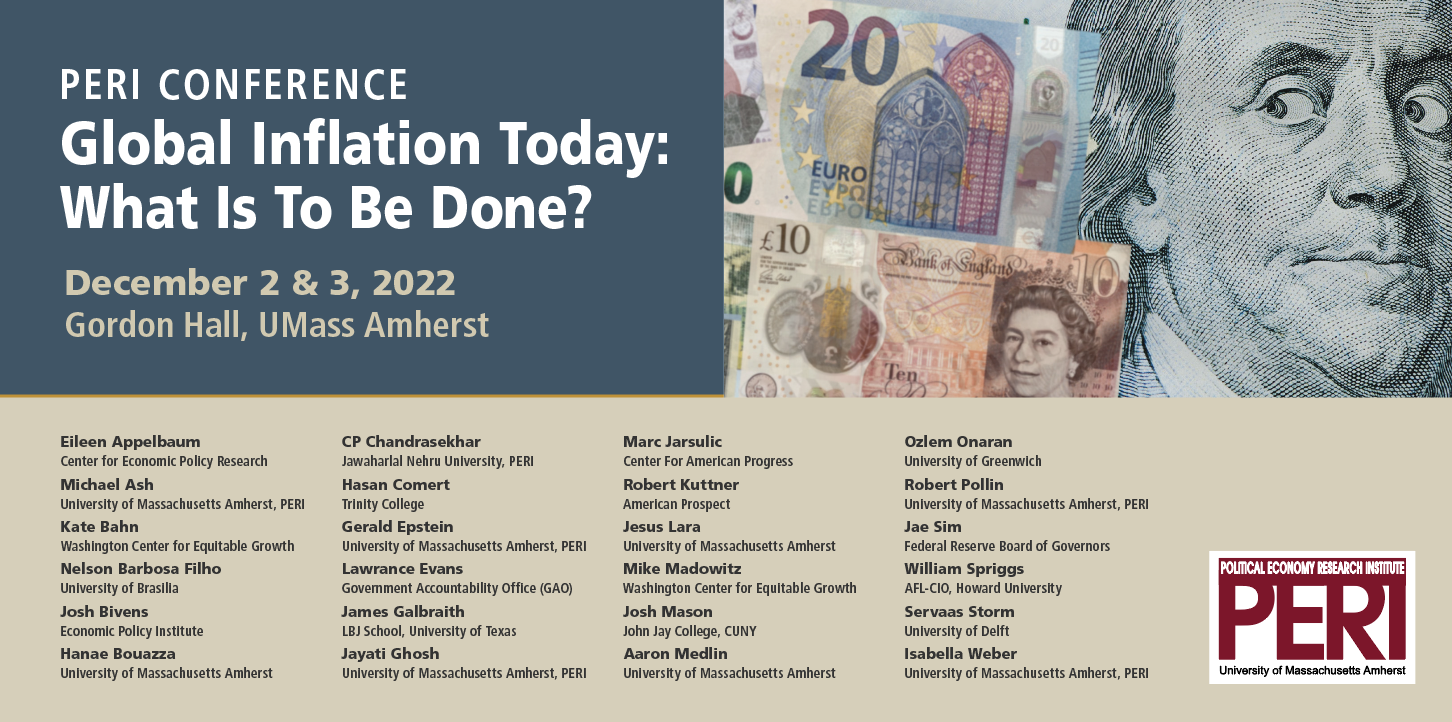
Friday, December 2: 9:30am to 5:30pm
Saturday, December 3: 9:00am to 3:00pm
Gordon Hall, Third Floor Conference Room
Participants:
Eileen Appelbaum, Michael Ash, Kate Bahn, Nelson Barbosa Filho, Josh Bivens, Hanae Bouazza, CP Chandrasekhar, Hasan Comert, Gerald Epstein, Lawrance Evans, Tom Ferguson, James Galbraith, Jayati Ghosh, James Heintz, Marc Jarsulic, Robert Kuttner, Jesus Lara, Mike Madowitz, Josh Mason, Aaron Medlin, Ozlem Onaran, Robert Pollin, Gregor Semieniuk, Jae Sim, William Spriggs, Servaas Storm, Isabella Weber
>> Click here for conference event page
Breakfast and lunch served onsite, breakfast starting at 8:30am on 12/2 and 8:00am on 12/3.
For more information, contact Nicole Dunham at .
~~~
2022/04/19 The Politics of Inflation (Isabella Weber, Tim Barker & Aaron Benanav)
https://youtu.be/gQoTYRiH0Bk
Isabella Weber,
0:04:00~0:29:20


okay hello everyone my name is kevin harris i'm a professor in sociology at the university of california los angeles hello from los angeles welcome to this event on the politics of inflation uh it's a excellent panel and on behalf of my colleagues ck lee and robert brenner i'd like to welcome everyone to the center for social theory and comparative history here at ucla if you are not uh following us on various social media we have social media accounts that are more active these days and um almost all of our panels that are zoom presented end up on our youtube page including the panel we held on april 4th the political economy of russia's war in ukraine which was a why they attended an excellent panel so as was in the financial times yesterday morning the headlines are routinely covering the topic of inflation or even worse the um possibility of stagflation meaning low growth and high inflation prompting all kinds of handwringing from different sectors of the [Music] of the economic elite so um given that uh alongside discussion of inflation in in headline news and discussion by the federal reserve about what to do about it there's been a robust debate about drivers of inflation drawing both on um you know heterodox economics as well as historical comparative accounts of driver's inflation across space and time so you know we're very excited to have a panel today of speakers on the topic given that you know the term itself is thrown around as an excuse uh to engage in all types of policy uh proposals so let me introduce the speakers uh and our discussant and remind everyone that everyone in the room right now is a participant in our panel uh and after the speakers and our discussant uh we'll open it up for q a and you'll be able to share uh your video if you like and ask questions uh via audio to our participants um so we're looking forward to that our panel uh is uh very excited to have uh our speakers today uh first step is going to be professor isabella webber uh she's a political economist um an assistant professor of economics at the university of massachusetts amherst she's the author of 2021's how is china escaped shock therapy the market reform debate which is winner of the joan robinson prize um and is being translated into numerous languages as i can attest next we are going to have uh a presentation by tim barker who's finishing up his phd in history at harvard he's on the editorial board of phenomenal world uh kind of uh blog out of the out of the bagrun institute think tank uh and dissent uh and actually last year he wrote an excellent essay called preferred shares inflation of wages in the 50-year crisis uh on phenomenal world and then our discussion is going to be ucla's alum aaron banana who's an economic historian and social theorist currently aaron is a postdoc at humble university but he's an incoming assistant professor at the department of sociology at the maxwell's and the maxwell school at syracuse university and he is the author of the equally well translated automation and the future of work which came out in 2020 on verso so we're going to have presentations by isabella and then tim and then a discussion by aaron and then we'll open up to the audience and i'll be moderating uh thanks to bob and ck for co-organizing this panel and to roman ivani our graduate student organizer as well who's going to be running behind the scenes so let's get started with isabella welcome.
https://youtu.be/gQoTYRiH0Bk
Isabella Weber,
0:04:00~0:29:20


okay hello everyone my name is kevin harris i'm a professor in sociology at the university of california los angeles hello from los angeles welcome to this event on the politics of inflation uh it's a excellent panel and on behalf of my colleagues ck lee and robert brenner i'd like to welcome everyone to the center for social theory and comparative history here at ucla if you are not uh following us on various social media we have social media accounts that are more active these days and um almost all of our panels that are zoom presented end up on our youtube page including the panel we held on april 4th the political economy of russia's war in ukraine which was a why they attended an excellent panel so as was in the financial times yesterday morning the headlines are routinely covering the topic of inflation or even worse the um possibility of stagflation meaning low growth and high inflation prompting all kinds of handwringing from different sectors of the [Music] of the economic elite so um given that uh alongside discussion of inflation in in headline news and discussion by the federal reserve about what to do about it there's been a robust debate about drivers of inflation drawing both on um you know heterodox economics as well as historical comparative accounts of driver's inflation across space and time so you know we're very excited to have a panel today of speakers on the topic given that you know the term itself is thrown around as an excuse uh to engage in all types of policy uh proposals so let me introduce the speakers uh and our discussant and remind everyone that everyone in the room right now is a participant in our panel uh and after the speakers and our discussant uh we'll open it up for q a and you'll be able to share uh your video if you like and ask questions uh via audio to our participants um so we're looking forward to that our panel uh is uh very excited to have uh our speakers today uh first step is going to be professor isabella webber uh she's a political economist um an assistant professor of economics at the university of massachusetts amherst she's the author of 2021's how is china escaped shock therapy the market reform debate which is winner of the joan robinson prize um and is being translated into numerous languages as i can attest next we are going to have uh a presentation by tim barker who's finishing up his phd in history at harvard he's on the editorial board of phenomenal world uh kind of uh blog out of the out of the bagrun institute think tank uh and dissent uh and actually last year he wrote an excellent essay called preferred shares inflation of wages in the 50-year crisis uh on phenomenal world and then our discussion is going to be ucla's alum aaron banana who's an economic historian and social theorist currently aaron is a postdoc at humble university but he's an incoming assistant professor at the department of sociology at the maxwell's and the maxwell school at syracuse university and he is the author of the equally well translated automation and the future of work which came out in 2020 on verso so we're going to have presentations by isabella and then tim and then a discussion by aaron and then we'll open up to the audience and i'll be moderating uh thanks to bob and ck for co-organizing this panel and to roman ivani our graduate student organizer as well who's going to be running behind the scenes so let's get started with isabella welcome.
thanks so much for having me this is exceedingly exciting thank you so much to the organizing team and to this kind
invitation it's hard to think of a more pressing issue these days and as someone who has
mainly worked historically it's very thrilling to try to make sense of an issue that is really at the edge of our
time my talk is titled politics and economics of the post shutdown inflation and i'm
basically trying to address the three broad questions which is what drives
inflation how can we make sense of this inflationary dynamic secondly what are the social and political implications of
this inflation i'm looking both at the us and internationally and thirdly what
can be done and i'm saying here some thoughts because i think it's really a very very difficult question has to be
acknowledged as such which requires for us to have an open debate about what can be done rather than to
revert to some sort of standard answers of one kind or another
i'm proposing what i'm here preliminarily calling a caldorian baratheon perspective as a framework to
make sense of the inflationary dynamic kaido famously had two pricing regimes
the first for for the raw materials sector where he basically sees the raw material or commodity sector as the
marshallian kind of sector or supply and demand in the world commodity markets
would be determining prices since the adjustment of supply in these
very very capital intensive sectors is very slow this means that you have inherently
volatile prices which resides in a constant destabilizing dynamic
both for the economies of the global north and the global south so both for the economies that are highly commodity
dependent as well as for the economies that are importing these raw materials
for their industrial um production thinking broadly speaking in in in a
north-south kind of view of the world the second pricing regime is that for
the industrial sector where the basic rule is one of cost plus markup pricing
the idea is that you have very highly concentrated sectors large corporations that are basically more or less planning
their production um in in kaidor's time yet not yet in international um uh uh
supply networks but nevertheless in highly concentrated sectors where an increase in cost
induces an increase in prices so in other words in other words cost increases are handed down to consumers
and these cost increases tend to be more than the initial cost increase since
firms are hedging their profit margins against future increases so there's an
assumption if raw material prices are going up then they tend to keep going up for a while so since industrial firms
are only setting their prices relatively infrequently they price in future cost
increases in their price increases that being said in quote unquote normal
or stable times an increase in demand does not increase
and does not induce an increase in prices in cairo's thinking
instead an increase in demand resides in an increase in supply to satisfy this
demand so a quantity response which means that the prices are largely
stable as long as these firms can respond to an increased demand by simply increasing
their capacity utilization and in fact in many ways in our just
entire production network's word that we have inherited and that seems to be crumbling in front of our eyes
um this logic of just in time increase in supply was if anything stronger than
it would have been in kaidor's times so in many ways be while these trust and
time production networks were working as they were designed to work efficiently um and swiftly they were basically even
more sensitive to increases in demand than um the old kind of model however in
the older model that slower responsiveness would have been compensated with inventories whereas now
inventories tend to be lower than in the world that kaido was describing
for the industrial sector i think we can extend the kaidorian view
with call breaths analysis of inflation where goldberg points out that
corporations always have a latent tendency to use their market power in
order to take advantage of opportunities that arise in order to increase prices
and thus increase um profits however without any kind of pretext if a firm
unilaterally increases prices in normal times this would be to their
disadvantage in terms of their market position or in other words they would harm their competitive
position this is why sector riot events serve as some sort of a legitimation and
coordination device for price hikes and the example that goldberg gave was that
wage rises um result in price rises not because
there's some sort of a universal economic law that waged increases always
must reside in increases in prices in fact ricardo of course argued exactly
the opposite but rather because union sectoral bargaining
creates a pre-tax for the whole sector to increase its prices which means that
they are coordinatedly increasing prices which means that one firm increasing prices will not harm its competitive
position towards another firm now in the context that we are living in
i think we can think of the cost push dynamic that we have observed together
with the broken supply chains as such a pretext that functions in a similar kind
of way as what golbrath describes for union
bargaining agreements for whole sector of course we have to add in terms of the
institutional environment shareholder premise primacy and and the role of asset managers as a new kind of
institutional context which to some degree can also function as a sector
sectoral coordinating kind of dynamic the argument that i'm making in a
nutshell is then that there is a cost push dynamic from increased commodity
prices which started long before the war and has accelerated sharply since
secondly that supply chain issues imp impede the supply adjustments that we
would be seeing in normal times where an increase in demand or even a falling
short of supply in relation to demand would be compensated for by an expansion
of demand so therefore the same mechanisms that before the crisis
created pretty stable and often even slightly falling prices now reside in a
dynamic that creates increasing prices commodity price increases in broken
supply chains then present a pretext for synchro synchronized price increases
across sectors where you basically have a switch from competition over increased market shares
to competition over short-term price hikes which intensifies some
pre-pandemic trends of shareholder and asset manager primacy
initially this was i think predominantly a sanctorial story a story of specific
price increases however as these profit and price hikes have become more
widespread it seems that we are entering more and more into a generalized dynamic
of price increases and profit hikes so far price increases have largely been
accommodated by demand in particular prices of many goods for
which demand is relatively inelastic have been going up things like fuel food
and shelter and their consumers or
i mean whatever you want to call people who are demanding these things um naturally don't have a lot of
bigger room to escape so in other words in some sense forced to accommodate
these kind of price increases so in some sense i'm presenting here a
story that is predominantly supply driven highly institutionally dependent and at the
same time one that can reside in a in a
spiraling dynamic that is fairly difficult to control
i'm now going to zoom in a little bit in into some data um i realized that tim also has some of this of some similar
data um in his presentation so i hope that overlap won't be um too much
so first of all i think it's important to acknowledge that even though we have now all started to talk about commodity
prices the commodity price increases predate the war and this is the case not
only for the energy index this is your imf data but also for things like food
but also important industrial inputs such as metals so we can see here that the non-fuel index also had a pretty
sharp increase not quite as sharp as the energy index but nevertheless pretty intense increases
and this has been the case for a whole range of important industrial inputs
then of course as we are all aware in the context of the war this um these commodity price increases have have just
gone through the roof so famously in early march there was this weekly price on
largest weekly rise on record and importantly um food prices have just
are basically skyrocketing now most of the discussion around these
increasing commodity prices um is some has some implicit assumptions on
input output relationships but i have seen very very little work that actually looks at these input output
relationships and this is something that i've started doing um i'm still at the very beginning since the data is just
coming out and so on and this is work um jointly with a number of co-authors
so on the left-hand side here you can see a scatter plot of industries um ranked based on their upstreamness on
the horizontal axis where upstream has very loosely speaking basically measures
um to how for how many industries good is an input and how important of an
input it is so if you compare for example um a a a
chocolate and oh then chocolate would be much much more downstream than than oil
because oil is of course an input to many more things than chocolate so um the further out you get the more you
get into stuff like oil the further um to the left the more you get into stuff
like chocolate and on the um vertical axis here i've plotted um the the yearly um price
changed in in 2020 to 2021 for quarter four
and we can see that some industries stand out so for example for oil and gas extraction um we have very high
upstreamness and very high priced increase above 60 similarly for primary methods but also
for importantly transportation both products fabricated matters and a range
of other upstream goods now what one can do with input output
models is to estimate what the impact of such upstream price increases on the
consumer price index would be and there's basically a direct impact and an indirect impact where the direct
impact is for example if you take if you take fuel is the impact on the
fuel price that you get at the gas station but then there's of course also a very large indirect impact because
pretty much everything that we are consuming has a component of um fuel and we have now started to rank um
industries by their combined cpi impact taking account of the of the indirect
and direct effects and what we can see is that petroleum and coal products are of course the
first and most important industry utilities more generally are incredibly important
chemical products housing because of the very large direct effect
food beverages and tobacco so these are the top five industries which basically
have enormous impacts on the cpi even though we would not be thinking of them immediately if we think about consumer
prices okay um when prices go up in in such a way um
on the commodity markets there are of course always some winners so you can see here on the upper left hand side a
graph where we are plotting the input prices and output prices um for for oil
and gas extraction and you can see that the output price is um shooting up um
towards the end of the graph here um and this is only for 2021 so we we haven't
even included the 2022 ukraine war contacts prices yet um and
this increase is much larger than the increase in input prices which of course means that someone must be reaping that
difference and in fact as the profit numbers are readily coming out we can see that the oil um the fossil fuel
industry has um has uh of course benefited massively from this but this
does not only go for fossil fuel this also goes for grains so for example the um the giant corporation cargill had the
best year in 156 years in 2021 this is from august
2021 so before the price explosions in the context of the ukraine and russian
war and um similarly this family i mean relatedly this family
now has actually ascended to some of the richest people in the world um in this context i think the
groundwork collaborative should really be mentioned here since they have done relentless work to um scan through skim
through earnings calls and have basically shown that around across a whole range of sectors we can find again
and again this story that there's a broad-based passing on of cost increases
which is completely consistent with the kaidorian story that i have presented and also
proud announcements of profit increases that go beyond the increase in costs
which then reside in price hikes and profit hikes in fact also if we look at studies as for example by mckinsey and
company we can find consulting documents that promise
to win the race with inflation the pricing opportunity for industrial companies to increase prices more than
cost so within the business world if we look closely this is pretty explicit
we can also see this in the national income data so this is here plotting profits
with inventory adjustment um after tax on
in the upper part and before tax in the lower part which um you will see that
obviously the tax rates have declined dramatically which makes the before tax distribution
look a little bit less dramatic in terms of the increase in profit margins but if we do care what ends up in in corporate
balance sheets at the end of the day so if we do care about after tax then we can see that basically profit margins
are as high as they haven't been since the immediate um post-war period
there is an interesting curiosity in the data which is that basically the inventory
adjustment became very large in 2021 which i think is pretty consistent with
the theoretical framework that i've presented for you where basically as supply chains started to become unstable
corporations have switched to some sort of auctioning of the inventories which means that in while in normal times we
want to extract the value of inventories from our accounting for profits in the particular 2021 context the very sharp
increase in prices for inventories was actually part of the story of inflation
this erases the question of historical analogies and of course there has been a lot of debate around this i personally
have been arguing in agreement with the white house council of economic advisers that
there's some parallel with the inflationary episode after world war ii when price controls were re
released and um basically there was a relatively strong demand thanks to savings during the war and there were
very widespread supply chain issues which resided in inelastic supply and
relatively high demand which resided in windfall profits in the shooting app of specific prices however as all
historical analogies this is an imperfect historical analogy since overlapping with this we have this
very widespread commodity price explosion which has some resemblance
with the oil shock in the 1970s but it's not just about oil but it's really very very very broad based and then unlike
after the war um in in 1946 47 ambiance
of course at the beginning of a war so um we are not and the pandemic is also not over so in that sense we are in a
much more erratic kind of scenario than this clear end of the war post-war um
inflation boom and then sharp downturn as regards the outlook i'm rather
pessimistic and i think we have to recognize that the increasing cost pressures from these
enormous increases in raw material prices and continuously breaking supply
chains i mean china is only now entering into forward 19 shutdowns
is only about to percolate through the system and then it might well be the case that um cost increases are so sharp
that not the whole cost increase can be passed on which could result in us in a
situation where even though prices are con continue to be increased by firms
they nonetheless end up seeing diminishing margins which could add to its deflationary dynamic
um being mindful of time i just very quickly um skip through this so
basically we see that income inflation specific inflation impacts in the united states have been
to the detriment of lower income groups not only have they seen higher inflation rates
but also lower income groups and middle-income curbs and were less
able to make up for increased inflation with higher earnings
this i think is politically extremely explosive and i think that what happened with the pension could really stand as a
warning for all of us where basically her catch up in the last months has been
driven by her capitalizing on the cost of living crisis
the food price crisis is a global enormous crisis i think has to be taken
absolutely seriously not least because of the enormous
explosive nature of such um of of of of these food price increases but of course
also simply because the u.n has been warning of an imminent famine and starvation
so what is to be done rising interest rates seems to be the default option that economists revert to
however this is of course based on inducing economic hardship by lowering aggregate demand basically by trying to
manufacture unemployment i personally think that it's more likely that this policy will succeed in manufacturing
unemployment but will not necessarily succeed in bringing down inflation since inflation is coming from this massive
cost push dynamic it would also likely be detrimental to investments where
investments would be what we need to fix some of the issues that have come up in those prices
importantly rising interest rates is extraordinarily dangerous for the global
south and might well produce a debt crisis um on on a scale that is simply
terrifying and if we take this together with the looming um uh food security
crisis then i think this this should really make us think twice
income transfers in rich countries are of course nice and welcome however they
do not stop the inflationary dynamic went for profits tax and anti-trust are
important policy tools but they tend to be retroactive and they're really in an emergency situation so in many ways we
would need to act quickly food aid and loans programs to the develop to developing countries
can play an important role in buffering um the impact of the rising um food prices
however the terms of such loans would be absolutely crucial since in particular
if we see rising interest rates it seems the likely outcome then we don't want to
further exacerbate the already looming debt crisis i think that the stabilization of global
commodity markets should have happened before one imposes sanctions on the scale in which they have been imposed
um and of course stocks have been released um in the realm of oil but much more would
need to be done in the rearm of food and also in the realm of of oil and metals and other basic commodities and
um we would need to think about measures that can limit market fluctuations in the context of this enormous volatility
that we have observed the eu commission has recommended gas price a gas price control plan on the european level
which is an interesting proposal price caps for basic needs in essential
rearms could also play a role where as regards co2 intensive goods such as fuel
one could think of a sliding scale where basically some sort of basic consumption need is
covered at a low price but then the more you consume the higher the price gets
so that those who are consuming much um have to pay a very high price that reflects the high environmental costs
from a long run perspective i think we really need to think about uh regimes that can stabilize global commodity
prices um one idea that has been around for a very long time the idea of global
buffer stocks and finally in uh and relatedly as regards supply chains i
personally don't think that trying to rip supply chains apart in the middle of
this enormous crisis would be a good idea but rather that global coordination
is necessary in order to stabilize supply chains in some um i am of the opinion that um
that inflation is an enormously difficult um challenge and that it has
to be taken seriously and that we really need a broad discussion around different
tools and how they can can can can be part of the broader
policy response rather than to search for some sort of one magic bullet or to
revert to knee-jerk reactions based on some sort of one standard model or
another thank you very much thank you
thanks isabella so let's turn it over to tim barker um
who's gonna follow up tim are you are you ready yeah are there slides showing up
you got it yeah okay
okay um well thanks kevin and uh rowan
オーケー、こんにちは皆さん、私の名前はケビン・ハリスです。私はカリフォルニア大学ロサンゼルス校の社会学の教授です。ロサンゼルスからこんにちは。インフレの政治に関するこのイベントへようこそ。ええと、それは素晴らしいパネルであり、同僚の ck lee と robert を代表してブレナー ここ ucla の社会理論と比較歴史センターに皆さんを歓迎したいと思います。さまざまなソーシャル メディアで私たちをフォローしていない場合は、ソーシャル メディア アカウントが最近より活発になっています。 4 月 4 日に開催したロシアの政治経済に関するパネルを含むズーム プレゼンテーションが YouTube ページに表示されます。ウクライナでの戦争が、彼らが優れたパネルに参加した理由であり、昨日の朝のファイナンシャル タイムズと同様に、見出しは日常的にインフレのトピックを取り上げています。さらに悪いことに、スタグフレーションの可能性は、低成長と高インフレを意味し、あらゆる種類の面倒を引き起こしています。経済エリートの [音楽] のさまざまなセクターから、ええと、ヘッドライン ニュースでのインフレに関する議論と、連邦準備制度理事会によるそれについてどうするかについての議論に加えて、ええと、両方に引き寄せられたインフレの要因について活発な議論があったことを考えるとあなたは異端の経済学と、空間と時間にわたるドライバーのインフレの歴史的な比較説明を知っているので、私たちは知っています.今日、このトピックに関するスピーカーのパネルを開催できることに非常に興奮しています。この用語自体が、あらゆる種類の政策提案に関与するための言い訳として投げかけられていることを知っているので、スピーカーと討論者を紹介し、皆さんに次のことを思い出させてください現在この部屋にいる全員が私たちのパネルの参加者です。講演者と討論者の後、QA のために公開します。必要に応じてビデオを共有したり、音声で質問したりできます。参加者の皆さん、私たちのパネリストはとても楽しみです。今日の講演者は非常に興奮しています。最初のステップは、イザベラ ウェバー教授です。彼女は政治経済学者であり、マサチューセッツ大学の経済学の助教授です。 amherst 彼女は 2021 年の著者です」中国はどのようにしてショック療法を免れたのか ジョーン・ロビンソン賞を受賞した市場改革論争は、私が証明できるように、多くの言語に翻訳されています 次に証明できるように、歴史の博士号を取得しているティム・バーカーによるプレゼンテーションがあります.ええと、驚異的な世界について、そして私たちの議論は、経済史家であり社会理論家であるUCLAのミョウバンであるアーロン・バナナになります。現在、アーロンは謙虚な大学のポスドクですが、マクスウェルの社会学科の次期助教授です.S とシラキュース大学のマクスウェル スクールであり、彼は 2020 年に出版された同様によく翻訳された「automation and the future of work」の著者でもあります。そして、私たちは聴衆に門戸を開いて、モデレーターを務めます。このパネルを共同開催してくれた bob と ck と、大学院生のオーガナイザーである roman ivani に感謝します。イザベラとようこそ
and uh everyone at the center uh for bringing
this together and for inviting me it's a real pleasure to be here uh and to be on the panel with isabella who's really been at the forefront of these
conversations for months now so i'm a historian uh by training and my
talk is going to focus on trying to put the contemporary inflation in perspective going back to the 1970s
and thinking a little bit about um the path from the 70s until today and
similarities and differences between the two experiences which are now frequently compared in the media
and i start with this image of 1979 in reverse which was used by the
um french economist cedric duran uh on the new left review blog about a year ago in june 2021
and i've added a question mark because i think you know it's not clear especially now whether we really are in 1979 in
reverse but i think it's a good frame for looking at the current inflation and 1979 here refers to the volcker shock
right the sharp unforeseen increase in interest rates set by the u.s federal
reserve uh under the chairmanship of paul volcker which had the effect of causing a very sharp contraction and
demand uh and a depression really all over the world uh which was felt especially in commodity
exporting countries but also right here um in the more advanced capitalist countries
and what this chart uh tries to represent is it shows you the unemployment rate and the red line shows
a kind of baseline of five percent unemployment and i think if we follow that line through we can see that there
was a decision made in 1979 to basically keep unemployment uh above a certain level and you know in
the 80s and early 90s that was very high uh it fell in the late 1990s but if we
see there really hasn't been a period where it's fallen much below five percent uh until
the last um two and a half years maybe when we've seen a more sustained fall in measured
unemployment than we have at any point since the 70s and so one way of thinking about what 1979 reverse means or would
mean is that there's been a reversal of this policy of intentional slack in the economy as the
main way of fighting inflation uh for people who are more hawkish on inflation they would say we've seen 1979
in reverse in a different way uh which is that consumer price inflation is now at points unseen since the early 1980s
and close to levels uh right before the volcker shock so if you're someone who thinks folker did the right thing then
we've recently seen the undoing of a lot of his good works uh
in the 1970s before the volcker shock uh one thing that i've just been really struck by
in the historical record is that there was not very much sense at all um
from anyone that there was a market solution to inflation people really thought that one way or another the solution would have to be institutional
and that includes uh you know right-wing views that saw reform of the labor market uh elimination of the minimum
wage uh elimination trade unions you know in a way those are free market solutions but they're also really institutional explanations of what was
going on and so i wanted to just revisit uh sort of briefly what the left and center left horizon for reforms
was before the vulgar shock settled the question by deflation through unemployment uh one phrase that was heard widely and
was even included in the party platform of the 1976 democratic party was this idea of national economic planning and
オーケー、こんにちは皆さん、私の名前はケビン・ハリスです。私はカリフォルニア大学ロサンゼルス校の社会学の教授です。ロサンゼルスからこんにちは。インフレの政治に関するこのイベントへようこそ。ええと、それは素晴らしいパネルであり、同僚の ck lee と robert を代表してブレナー ここ ucla の社会理論と比較歴史センターに皆さんを歓迎したいと思います。さまざまなソーシャル メディアで私たちをフォローしていない場合は、ソーシャル メディア アカウントが最近より活発になっています。 4 月 4 日に開催したロシアの政治経済に関するパネルを含むズーム プレゼンテーションが YouTube ページに表示されます。ウクライナでの戦争が、彼らが優れたパネルに参加した理由であり、昨日の朝のファイナンシャル タイムズと同様に、見出しは日常的にインフレのトピックを取り上げています。さらに悪いことに、スタグフレーションの可能性は、低成長と高インフレを意味し、あらゆる種類の面倒を引き起こしています。経済エリートの [音楽] のさまざまなセクターから、ええと、ヘッドライン ニュースでのインフレに関する議論と、連邦準備制度理事会によるそれについてどうするかについての議論に加えて、ええと、両方に引き寄せられたインフレの要因について活発な議論があったことを考えるとあなたは異端の経済学と、空間と時間にわたるドライバーのインフレの歴史的な比較説明を知っているので、私たちは知っています.今日、このトピックに関するスピーカーのパネルを開催できることに非常に興奮しています。この用語自体が、あらゆる種類の政策提案に関与するための言い訳として投げかけられていることを知っているので、スピーカーと討論者を紹介し、皆さんに次のことを思い出させてください現在この部屋にいる全員が私たちのパネルの参加者です。講演者と討論者の後、QA のために公開します。必要に応じてビデオを共有したり、音声で質問したりできます。参加者の皆さん、私たちのパネリストはとても楽しみです。今日の講演者は非常に興奮しています。最初のステップは、イザベラ ウェバー教授です。彼女は政治経済学者であり、マサチューセッツ大学の経済学の助教授です。 amherst 彼女は 2021 年の著者です」中国はどのようにしてショック療法を免れたのか ジョーン・ロビンソン賞を受賞した市場改革論争は、私が証明できるように、多くの言語に翻訳されています 次に証明できるように、歴史の博士号を取得しているティム・バーカーによるプレゼンテーションがあります.ええと、驚異的な世界について、そして私たちの議論は、経済史家であり社会理論家であるUCLAのミョウバンであるアーロン・バナナになります。現在、アーロンは謙虚な大学のポスドクですが、マクスウェルの社会学科の次期助教授です.S とシラキュース大学のマクスウェル スクールであり、彼は 2020 年に出版された同様によく翻訳された「automation and the future of work」の著者でもあります。そして、私たちは聴衆に門戸を開いて、モデレーターを務めます。このパネルを共同開催してくれた bob と ck と、大学院生のオーガナイザーである roman ivani に感謝します。イザベラとようこそ
私を迎えてくれて本当にありがとう これは非常にエキサイティングです 主催チームに感謝します そしてこのような招待に感謝します 最近ではこれ以上差し迫った問題を考えるのは難しいです そして主に歴史的に働いてきた人として私たちの時代の端にある問題を理解しようとするのは非常にスリリングです.私の講演はシャットダウン後のインフレの政治と経済と題されています.私は基本的に3つの大きな問題に対処しようとしています.このインフレのダイナミクスを理解できますか 第二に、このインフレの社会的および政治的影響は何ですか 私は米国と国際の両方を見ており、第三に何ができるかを見ており、ここでいくつかの考えを述べています。非常に難しい問題は、そのようなものとして認識されなければならず、何らかの標準的な答えに戻るのではなく、何ができるかについてオープンな議論をする必要があります。私はここで、インフレのダイナミックなカイドウを理解するための枠組みとして、カルドリアン・バラシオンの視点を予備的に呼んでいるが、有名なのは原材料部門の最初の2つの価格制度を持っていた.これらの非常に資本集約的なセクターの供給の調整は非常に遅いため、世界の商品市場の需要が価格を決定します。グローバルサウスなので、コモディティに大きく依存している経済と、工業生産のためにこれらの原材料を輸入している経済の両方にとって、南北的な見方で広く言えば、世界の 2 番目の価格体系は、基本的なルールがコスト プラス マークアップの価格設定の 1 つである産業部門の場合、アイデアは、非常に高度に集中した部門があるということです。大企業は、基本的に多かれ少なかれ、カイドールの時代に生産を計画しています。まだ国際的な供給ネットワークではありませんが、コストの増加が価格の上昇を誘発する非常に集中したセクターでは、言い換えれば、コストの増加は消費者に引き継がれ、これらのコストの増加は消費者よりも大きくなる傾向があります企業は将来の増加に対して利益率をヘッジしているため、初期コストが増加します。原材料価格が上昇している場合、しばらくの間上昇し続ける傾向があるという仮定です。そのため、工業企業は価格を設定する頻度が比較的低いため、将来のコストの上昇を価格の上昇に織り込みます。カイロの考え方では、需要の増加は増加せず、価格の上昇を誘発しません.企業は、生産能力の利用率を高めるだけで需要の増加に対応でき、実際には生産ネットワーク全体でさまざまな方法で対応できます。」私たちが受け継ぎ、目の前で崩壊しているように見えるという言葉.ええと、このジャスト・イン・タイムの供給増加の論理は、それよりも強力なものでした.多くの点で、これらの信頼と時間の生産ネットワークが機能している間、それらは効率的に機能するように設計されていたため、それらは基本的に、古い種類のモデルよりも需要の増加にさらに敏感でしたが、古いモデルでは遅い.応答性は在庫で補われていたでしょうが、現在、在庫はカイドウが産業部門について説明していた世界よりも低い傾向にあります。ゴールドバーグが指摘するインフレーションのコールブレス分析で、カイドリアンの見解を拡張できると思います。市場支配力を利用して、価格を上げるために発生する機会を利用して利益を増やす傾向があります。彼らの市場での地位の点での彼らの不利な点、言い換えれば、彼らは彼らの競争上の地位を損なうだろう.物価が上がるのは、そこにあるからではない」賃金の上昇は常に物価の上昇に内在しなければならないという、ある種の普遍的な経済法則のようなものです.実際、リカルドはもちろん正反対のことを主張しました.つまり、ある企業が価格を上げても、現在私たちが住んでいる状況では、別の企業に対する競争力が損なわれることはありません。壊れたサプライチェーンとともに観察したコストプッシュのダイナミクスを次のように考えることができると思います。ゴルブラスがセクター全体の組合交渉協定について説明したのと同様の方法で機能するそのような口実はもちろん、制度的環境の株主前提の優位性と、新しい種類としての資産運用会社の役割の観点から追加する必要がありますある程度、部門間の調整力としても機能する制度的文脈の一言で言えば、戦争のずっと前に始まったコモディティ価格の上昇によるコスト プッシュ ダイナミクスがあり、次にサプライ チェーンの問題が通常時に見られる供給調整を妨げて急激に加速しているということです。需要の増加、または需要に比べて供給が不足していても、需要の拡大によって補われるため、危機前に非常に安定した、しばしばわずかに下落した価格を生み出したのと同じメカニズムが、現在、商品価格の上昇を生み出す力学に存在しています。壊れたサプライチェーンでの価格上昇は、基本的に市場シェアの増加をめぐる競争から、激化する短期的な価格上昇をめぐる競争へと切り替わるセクター全体での同期的な価格上昇の口実を提示します。株主と資産運用会社の優位性に関するパンデミック前のトレンド 当初、これは主に聖域的な話、特定の価格上昇の話だったと思いますが、これらの利益と価格の上昇がより広範になるにつれて、私たちはますます一般化されたダイナミクスに入っているようですこれまでの値上げと利益の増加の割合 これまでの値上げは、需要に大きく対応してきました 特に、需要が比較的弾力性のない多くの商品の価格が上昇しています 燃料、食料、住居、およびそれらの消費者、またはあなたが人々を呼びたいものは何でも意味しますこれらのことを要求している人は、当然のことながら、逃げる余地はあまりありません。つまり、ある意味では、この種の値上げに対応することを余儀なくされているので、ある意味では私はここでは、主に供給主導型であり、制度に大きく依存していると同時に、制御がかなり困難なスパイラルダイナミクスの中に存在する可能性のあるストーリーを提示しています。いくつかのデータに少しズームインします。ティムも彼のプレゼンテーションに似たようなデータのいくつかを持っていることに気付いたので、重複があまりないことを願っています。コモディティ価格について話し始めたとしても、コモディティ価格の上昇は戦前からあることを認識することが重要です。これは、エネルギー指数だけでなく、IMF データだけでなく、食品や重要な産業にも当てはまります。ここでは、非燃料指数もかなり急激に増加し、エネルギー指数ほど急激ではありませんが、それでもかなり急激に増加していることがわかります。もちろん、私たち全員が戦争の文脈で知っているように、これらの商品価格の上昇は屋根を通り抜けたばかりなので、有名なことに、3月初旬にこの週の価格が記録上最大の週の上昇であり、重要なことに、食品の価格は基本的に現在、議論のほとんどが急増していますこれらの上昇するコモディティ価格の周りで、ええと、いくつかは投入産出関係についていくつかの暗黙の仮定を持っていますが、実際にこれらの投入産出関係を調べる研究はほとんど見たことがなく、これは私が始めたことです。データはまだ出始めたばかりで、これは多くの共著者との共同作業なので、左側に業界の散布図が表示されています。業界に基づいてランク付けされています。アップストリームは非常に大まかに言えば、横軸のアップストリームネスは、基本的に、いくつの産業にとってどれだけ良いものがインプットであり、どのくらい重要であるかを測定します。たとえば、ええと、チョコレートとチョコレートを比較すると、チョコレートははるかに多くなるでしょう。オイルよりも下流にあるのは、もちろんオイルはチョコレートよりも多くのものへのインプットだからです。つまり、奥に行けば行くほどオイルのようなものに入り込み、左に行くほどチョコレートのようなものに入り込みます。ここで縦軸 i'第 4 四半期の 2020 年から 2021 年にかけての年間価格の変化をプロットすると、一部の業界が際立っていることがわかります。たとえば、石油とガスの採掘では、上流性が非常に高く、一次産業でも同様に 60 を超える非常に高い価格上昇が見られます。方法だけでなく、重要なことに、製造された製品と他の一連の上流の商品の両方の輸送についても、インプット・アウトプット・モデルでできることは、消費者物価指数に対するそのような上流の価格上昇の影響を推定することであり、基本的に直接的な影響があります間接的な影響で、直接的な影響は、たとえば、燃料を使用する場合は、ガソリンスタンドで得られる燃料価格への影響ですが、そこには.もちろん、私たちが消費しているほとんどすべてのものには燃料の成分が含まれているため、間接的な影響も非常に大きく、間接効果と直接効果を考慮して、CPI の影響を組み合わせて業界をランク付けし始めました。ご覧のとおり、石油と石炭製品はもちろん最初で最も重要な産業であり、より一般的には公益事業は非常に重要な化学製品の住宅です。非常に大きな直接効果があるため、食品飲料とタバコです。消費者物価について考えれば、すぐにそれらについて考えることはありませんが、消費者物価がそのように上昇した場合、ええと、コモディティ市場ではもちろん常に何人かの勝者がいますので、左上にあることがわかりますグラフを手渡します石油とガスの採掘の投入価格と産出価格をプロットしています。産出価格がグラフの終わりに向かって急上昇していることがわかります。これは 2021 年のことです。2022 年のウクライナ戦争の連絡先の価格も含まれていますが、この上昇は投入価格の上昇よりもはるかに大きく、もちろん誰かがその差を享受しているに違いありません。石油ええと、化石燃料産業はもちろんこれから大きな恩恵を受けていますが、これは化石燃料だけでなく穀物にも当てはまります。たとえば、巨大企業カーギルは2021年に156年間で最高の年を迎えました。 2021年8月から、ウクライナとロシアの戦争の文脈で価格が爆発する前に、そしてええと、同様にこの家族は関連して、この家族は実際に世界で最も裕福な人々の一部になりました。彼らが行ったので、本当にここで言及されるべきです収支報告の概要をスキャンするための絶え間ない作業の結果、基本的には、さまざまな分野で何度も何度もこの話を見つけることができることが示されました。私が提示したカイドリアンの話と完全に一致する広範なコスト増加の転嫁と、コストの増加を超えた利益増加の誇らしげな発表もあり、実際には価格の上昇と利益の増加にも見られます。マッキンゼーや会社などの研究では、インフレとの競争に勝つことを約束するコンサルティング文書を見つけることができます。産業企業がコスト以上に価格を上げるための価格設定の機会です。国民所得データでこれを参照してください。これは、在庫調整で利益をプロットしたもので、上の部分が課税後、下の部分が税前であり、明らかに税率が劇的に低下し、税前が税前になっていることがわかります。利益率の増加という点では、分布はそれほど劇的ではないように見えますが、最終的に企業のバランスシートがどうなるかを気にする場合、税引き後を気にする場合は、基本的に利益率が戦後すぐの期間以来、これまでにないほど高くなっています。データには興味深い好奇心があり、基本的に2021年に在庫調整が非常に大きくなり、理論的枠組みとかなり一致していると思います。基本的にサプライチェーンが不安定になり始めたとき、企業はある種の在庫のオークションに切り替えました。これは、通常、2021 年の特定の状況での利益の会計処理から在庫の価値を抽出したいということを意味します。在庫の価格の非常に急激な上昇は、実際にはインフレの物語の一部でした.これは歴史的な類推の問題を消し去ります.もちろん、これについては多くの議論がありました.あの'これは、第二次世界大戦後のインフレのエピソードと似ていますが、価格統制が再リリースされたとき、基本的には戦争中の貯蓄のおかげで比較的強い需要があり、非弾力的な供給と比較的高い需要に存在する非常に広範なサプライチェーンの問題がありました。特定の価格のシューティングアプリで棚ぼた利益にありましたが、すべての歴史的なアナロジーとして、これは不完全な歴史的なアナロジーです.オイルだけど」それは本当に非常に非常に幅広い基盤であり、戦後とは異なり、1946年の47もちろん戦争の初めの雰囲気なので、私たちはそうではなく、パンデミックも終わっていないので、その意味で私たちははるかに不安定です.戦争が終結し、戦後のインフレブームと、その後の見通しに関する急激な下落よりも、シナリオのようなものです。私はかなり悲観的であり、これらの原材料価格の大幅な上昇とサプライチェーンの絶え間ない破壊によるコスト圧力の増大は、中国が今まさに前進19のシャットダウンに入ったばかりであることを認識しなければならないと思います。コストの増加が非常に急激であるため、コストの増加全体を転嫁することはできないため、企業によって価格が上昇し続けているにもかかわらず、最終的に利益率が低下するという状況に陥る可能性があります。デフレのダイナミクスがさらに高まる可能性があります。時間に注意してください。すぐにスキップします。したがって、基本的には、米国における所得インフレ固有のインフレの影響が、低所得層に不利益をもたらしていることがわかります。これは政治的に非常に爆発的であり、年金で起こったことは私たち全員への警告として本当に立つことができると思います.基本的に、ここ数か月の彼女の追い上げは、彼女が生活費の危機を利用したことによって促進されました。食料価格の危機は世界的な巨大な危機であり、特にそのような非常に爆発的な性質のために、絶対に真剣に受け止めなければならないと思います.これらの食品の価格は上昇しますが、もちろん単純な理由でもあります。n 差し迫った飢饉と飢餓を警告してきたので、なすべきことは金利の上昇であり、エコノミストはデフォルトのオプションに戻るようですが、これはもちろん、基本的に失業を製造しようとすることによって総需要を低下させることによって経済的困難を誘発することに基づいています.個人的にはそう思う」この政策は失業の製造に成功する可能性が高いですが、インフレはこの大規模なコストプッシュダイナミクスから来ているため、必ずしもインフレを下げることに成功するとは限りません。これらの価格で発生した問題は重要であり、金利の上昇は世界の南部にとって非常に危険であり、単に恐ろしい規模の債務危機を引き起こす可能性があり、これを迫り来る食料安全保障の危機と合わせると、これは、富裕国での所得移転はもちろん素晴らしいことであり、歓迎すべきことであると私たちに考えさせるべきだと思いますが、所得税と独占禁止法は重要な政策手段であるが、それらは遡及的であり、彼らは本当に緊急事態にあるので、多くの点で迅速に行動する必要があります.開発途上国への食糧援助と融資プログラムは、食料価格の上昇の影響を緩和する上で重要な役割を果たすことができます.しかし、そのような条件は.特に金利の上昇が見られる場合、その可能性が高いと思われるため、ローンは絶対に重要です。すでに迫りつつある債務危機をさらに悪化させたいと考えている私は、世界の商品市場の安定化は、課された規模の制裁を課す前に起こるべきだったと思います。食料の分野や、石油、金属、その他の基本的な商品の分野で、さらに多くのことが行われる必要があります。 EU 委員会がガス価格を欧州レベルでのガス価格管理計画を推奨していることを観察しました。これは興味深い提案です。重要な備品の基本的なニーズに対する価格上限は、燃料などの CO2 集約型商品に関してスライドを考えることができる役割も果たします。基本的に何らかの種類のスケール基本的な消費の必要性は低価格でカバーされますが、消費すればするほど価格が高くなるため、消費量が多い人は非常に高い価格を支払わなければならず、長期的な観点からは高い環境コストを反映していると思います.世界の商品価格を安定させることができる制度について本当に考える必要があります.非常に長い間存在していたアイデアの1つは、グローバルな緩衝在庫のアイデアであり、最終的にはサプライチェーンに関してです.この巨大な危機の最中にサプライチェーンを引き裂こうとするのは良い考えだと思いますが、むしろサプライチェーンを安定させるためにはグローバルな調整が必要だと思います。ええと、挑戦であり、真剣に受け止めなければならず、さまざまなツールについて幅広い議論が本当に必要であり、それらがどのようにできるかが、ある種の魔法の弾丸を探したり、元に戻るのではなく、より広範な政策対応の一部になることができる.ある種の標準モデルまたは別の標準モデルに基づいたひざまずく反応 ありがとうございました どうもありがとうございました isabella では、Tim Barker に引き渡しましょう。ええ、ええ、ええと、ケビンとローワンに感謝しますフォローアップします ティム 準備はいいですか はい スライドは表示されますかフォローアップします ティム 準備はいいですか はい スライドは表示されますかフォローアップします ティム 準備はいいですか はい スライドは表示されますかフォローアップします ティム 準備はいいですか はい スライドは表示されますか
ーーー
0:02okay hello everyone my name is kevin harris i'm a professor in sociology at the
0:08university of california los angeles hello from los angeles welcome to this event on the politics of
0:14inflation uh it's a excellent panel and on behalf of my colleagues ck lee and robert
0:22brenner i'd like to welcome everyone to the center for social theory and comparative history here at ucla
0:28if you are not uh following us on various social media we have social media accounts that are
0:34more active these days and um almost all of our panels that are zoom presented end up on
0:41our youtube page including the panel we held on april 4th the political economy of russia's war in ukraine which was a
0:48why they attended an excellent panel so as was in the financial times yesterday
0:54morning the headlines are routinely covering the topic of inflation or even
1:00worse the um possibility of stagflation meaning low growth and high inflation prompting all
1:07kinds of handwringing from different sectors of the [Music] of the economic elite
1:14so um given that uh alongside discussion of inflation in in
1:20headline news and discussion by the federal reserve about what to do about it there's been a robust debate
1:26about drivers of inflation drawing both on um you know heterodox economics as well
1:32as historical comparative accounts of driver's inflation across space and time
1:39so you know we're very excited to have a panel today of speakers on the topic given that you
1:45know the term itself is thrown around as an excuse uh to engage in all types of policy uh
1:52proposals so let me introduce the speakers uh and our discussant and remind everyone that
1:58everyone in the room right now is a participant in our panel uh and after the speakers and our discussant
2:06uh we'll open it up for q a and you'll be able to share uh your video if you
2:11like and ask questions uh via audio to our participants um
2:16so we're looking forward to that our panel uh is uh very excited to have uh our speakers today uh first step is
2:23going to be professor isabella webber uh she's a political economist
2:29um an assistant professor of economics at the university of massachusetts amherst she's the author of 2021's how is china
2:37escaped shock therapy the market reform debate which is winner of the joan robinson
2:43prize um and is being translated into numerous languages as i can attest
2:49next we are going to have uh a presentation by tim barker who's finishing up his phd in history at
2:54harvard he's on the editorial board of phenomenal world uh kind of uh blog out
3:00of the out of the bagrun institute think tank uh and dissent uh and actually last
3:06year he wrote an excellent essay called preferred shares inflation of wages in the 50-year crisis uh on phenomenal world
3:13and then our discussion is going to be ucla's alum aaron banana who's an economic historian
3:20and social theorist currently aaron is a postdoc at humble university but he's an
3:25incoming assistant professor at the department of sociology at the maxwell's and the maxwell school
3:32at syracuse university and he is the author of the equally well translated
3:37automation and the future of work which came out in 2020 on verso
3:42so we're going to have presentations by isabella and then tim and then a discussion by aaron and then
3:49we'll open up to the audience and i'll be moderating uh thanks to bob and ck for co-organizing this panel
3:56and to roman ivani our graduate student organizer as well who's going to be
4:02running behind the scenes so let's get started with isabella welcome
4:10thanks so much for having me this is exceedingly exciting thank you so much to the organizing team and to this kind
4:18invitation it's hard to think of a more pressing issue these days and as someone who has
4:24mainly worked historically it's very thrilling to try to make sense of an issue that is really at the edge of our
4:30time my talk is titled politics and economics of the post shutdown inflation and i'm
4:38basically trying to address the three broad questions which is what drives
4:43inflation how can we make sense of this inflationary dynamic secondly what are the social and political implications of
4:50this inflation i'm looking both at the us and internationally and thirdly what
4:55can be done and i'm saying here some thoughts because i think it's really a very very difficult question has to be
5:01acknowledged as such which requires for us to have an open debate about what can be done rather than to
5:08revert to some sort of standard answers of one kind or another
5:15i'm proposing what i'm here preliminarily calling a caldorian baratheon perspective as a framework to
5:23make sense of the inflationary dynamic kaido famously had two pricing regimes
5:29the first for for the raw materials sector where he basically sees the raw material or commodity sector as the
5:37marshallian kind of sector or supply and demand in the world commodity markets
5:42would be determining prices since the adjustment of supply in these
5:50very very capital intensive sectors is very slow this means that you have inherently
5:57volatile prices which resides in a constant destabilizing dynamic
6:04both for the economies of the global north and the global south so both for the economies that are highly commodity
6:11dependent as well as for the economies that are importing these raw materials
6:17for their industrial um production thinking broadly speaking in in in a
6:24north-south kind of view of the world the second pricing regime is that for
6:30the industrial sector where the basic rule is one of cost plus markup pricing
6:37the idea is that you have very highly concentrated sectors large corporations that are basically more or less planning
6:44their production um in in kaidor's time yet not yet in international um uh uh
6:50supply networks but nevertheless in highly concentrated sectors where an increase in cost
6:57induces an increase in prices so in other words in other words cost increases are handed down to consumers
7:06and these cost increases tend to be more than the initial cost increase since
7:11firms are hedging their profit margins against future increases so there's an
7:16assumption if raw material prices are going up then they tend to keep going up for a while so since industrial firms
7:24are only setting their prices relatively infrequently they price in future cost
7:30increases in their price increases that being said in quote unquote normal
7:37or stable times an increase in demand does not increase
7:42and does not induce an increase in prices in cairo's thinking
7:47instead an increase in demand resides in an increase in supply to satisfy this
7:54demand so a quantity response which means that the prices are largely
7:59stable as long as these firms can respond to an increased demand by simply increasing
8:07their capacity utilization and in fact in many ways in our just
8:12entire production network's word that we have inherited and that seems to be crumbling in front of our eyes
8:19um this logic of just in time increase in supply was if anything stronger than
8:26it would have been in kaidor's times so in many ways be while these trust and
8:32time production networks were working as they were designed to work efficiently um and swiftly they were basically even
8:40more sensitive to increases in demand than um the old kind of model however in
8:46the older model that slower responsiveness would have been compensated with inventories whereas now
8:53inventories tend to be lower than in the world that kaido was describing
8:59for the industrial sector i think we can extend the kaidorian view
9:04with call breaths analysis of inflation where goldberg points out that
9:10corporations always have a latent tendency to use their market power in
9:16order to take advantage of opportunities that arise in order to increase prices
9:21and thus increase um profits however without any kind of pretext if a firm
9:29unilaterally increases prices in normal times this would be to their
9:35disadvantage in terms of their market position or in other words they would harm their competitive
9:41position this is why sector riot events serve as some sort of a legitimation and
9:48coordination device for price hikes and the example that goldberg gave was that
9:54wage rises um result in price rises not because
9:59there's some sort of a universal economic law that waged increases always
10:04must reside in increases in prices in fact ricardo of course argued exactly
10:09the opposite but rather because union sectoral bargaining
10:16creates a pre-tax for the whole sector to increase its prices which means that
10:21they are coordinatedly increasing prices which means that one firm increasing prices will not harm its competitive
10:28position towards another firm now in the context that we are living in
10:35i think we can think of the cost push dynamic that we have observed together
10:40with the broken supply chains as such a pretext that functions in a similar kind
10:45of way as what golbrath describes for union
10:50bargaining agreements for whole sector of course we have to add in terms of the
10:56institutional environment shareholder premise primacy and and the role of asset managers as a new kind of
11:02institutional context which to some degree can also function as a sector
11:08sectoral coordinating kind of dynamic the argument that i'm making in a
11:15nutshell is then that there is a cost push dynamic from increased commodity
11:20prices which started long before the war and has accelerated sharply since
11:27secondly that supply chain issues imp impede the supply adjustments that we
11:33would be seeing in normal times where an increase in demand or even a falling
11:39short of supply in relation to demand would be compensated for by an expansion
11:45of demand so therefore the same mechanisms that before the crisis
11:50created pretty stable and often even slightly falling prices now reside in a
11:57dynamic that creates increasing prices commodity price increases in broken
12:03supply chains then present a pretext for synchro synchronized price increases
12:10across sectors where you basically have a switch from competition over increased market shares
12:17to competition over short-term price hikes which intensifies some
12:23pre-pandemic trends of shareholder and asset manager primacy
12:28initially this was i think predominantly a sanctorial story a story of specific
12:35price increases however as these profit and price hikes have become more
12:40widespread it seems that we are entering more and more into a generalized dynamic
12:45of price increases and profit hikes so far price increases have largely been
12:52accommodated by demand in particular prices of many goods for
12:57which demand is relatively inelastic have been going up things like fuel food
13:02and shelter and their consumers or
13:07i mean whatever you want to call people who are demanding these things um naturally don't have a lot of
13:14bigger room to escape so in other words in some sense forced to accommodate
13:19these kind of price increases so in some sense i'm presenting here a
13:25story that is predominantly supply driven highly institutionally dependent and at the
13:33same time one that can reside in a in a
13:39spiraling dynamic that is fairly difficult to control
13:46i'm now going to zoom in a little bit in into some data um i realized that tim also has some of this of some similar
13:54data um in his presentation so i hope that overlap won't be um too much
13:59so first of all i think it's important to acknowledge that even though we have now all started to talk about commodity
14:05prices the commodity price increases predate the war and this is the case not
14:10only for the energy index this is your imf data but also for things like food
14:16but also important industrial inputs such as metals so we can see here that the non-fuel index also had a pretty
14:23sharp increase not quite as sharp as the energy index but nevertheless pretty intense increases
14:30and this has been the case for a whole range of important industrial inputs
14:36then of course as we are all aware in the context of the war this um these commodity price increases have have just
14:44gone through the roof so famously in early march there was this weekly price on
14:50largest weekly rise on record and importantly um food prices have just
14:55are basically skyrocketing now most of the discussion around these
15:03increasing commodity prices um is some has some implicit assumptions on
15:10input output relationships but i have seen very very little work that actually looks at these input output
15:16relationships and this is something that i've started doing um i'm still at the very beginning since the data is just
15:22coming out and so on and this is work um jointly with a number of co-authors
15:28so on the left-hand side here you can see a scatter plot of industries um ranked based on their upstreamness on
15:35the horizontal axis where upstream has very loosely speaking basically measures
15:41um to how for how many industries good is an input and how important of an
15:47input it is so if you compare for example um a a a
15:53chocolate and oh then chocolate would be much much more downstream than than oil
15:58because oil is of course an input to many more things than chocolate so um the further out you get the more you
16:05get into stuff like oil the further um to the left the more you get into stuff
16:11like chocolate and on the um vertical axis here i've plotted um the the yearly um price
16:17changed in in 2020 to 2021 for quarter four
16:23and we can see that some industries stand out so for example for oil and gas extraction um we have very high
16:30upstreamness and very high priced increase above 60 similarly for primary methods but also
16:36for importantly transportation both products fabricated matters and a range
16:42of other upstream goods now what one can do with input output
16:47models is to estimate what the impact of such upstream price increases on the
16:53consumer price index would be and there's basically a direct impact and an indirect impact where the direct
17:00impact is for example if you take if you take fuel is the impact on the
17:05fuel price that you get at the gas station but then there's of course also a very large indirect impact because
17:12pretty much everything that we are consuming has a component of um fuel and we have now started to rank um
17:19industries by their combined cpi impact taking account of the of the indirect
17:26and direct effects and what we can see is that petroleum and coal products are of course the
17:31first and most important industry utilities more generally are incredibly important
17:37chemical products housing because of the very large direct effect
17:42food beverages and tobacco so these are the top five industries which basically
17:49have enormous impacts on the cpi even though we would not be thinking of them immediately if we think about consumer
17:56prices okay um when prices go up in in such a way um
18:03on the commodity markets there are of course always some winners so you can see here on the upper left hand side a
18:10graph where we are plotting the input prices and output prices um for for oil
18:16and gas extraction and you can see that the output price is um shooting up um
18:22towards the end of the graph here um and this is only for 2021 so we we haven't
18:27even included the 2022 ukraine war contacts prices yet um and
18:33this increase is much larger than the increase in input prices which of course means that someone must be reaping that
18:40difference and in fact as the profit numbers are readily coming out we can see that the oil um the fossil fuel
18:48industry has um has uh of course benefited massively from this but this
18:53does not only go for fossil fuel this also goes for grains so for example the um the giant corporation cargill had the
19:01best year in 156 years in 2021 this is from august
19:062021 so before the price explosions in the context of the ukraine and russian
19:11war and um similarly this family i mean relatedly this family
19:17now has actually ascended to some of the richest people in the world um in this context i think the
19:24groundwork collaborative should really be mentioned here since they have done relentless work to um scan through skim
19:31through earnings calls and have basically shown that around across a whole range of sectors we can find again
19:38and again this story that there's a broad-based passing on of cost increases
19:44which is completely consistent with the kaidorian story that i have presented and also
19:49proud announcements of profit increases that go beyond the increase in costs
19:55which then reside in price hikes and profit hikes in fact also if we look at studies as for example by mckinsey and
20:01company we can find consulting documents that promise
20:07to win the race with inflation the pricing opportunity for industrial companies to increase prices more than
20:13cost so within the business world if we look closely this is pretty explicit
20:19we can also see this in the national income data so this is here plotting profits
20:26with inventory adjustment um after tax on
20:32in the upper part and before tax in the lower part which um you will see that
20:37obviously the tax rates have declined dramatically which makes the before tax distribution
20:45look a little bit less dramatic in terms of the increase in profit margins but if we do care what ends up in in corporate
20:54balance sheets at the end of the day so if we do care about after tax then we can see that basically profit margins
21:00are as high as they haven't been since the immediate um post-war period
21:06there is an interesting curiosity in the data which is that basically the inventory
21:12adjustment became very large in 2021 which i think is pretty consistent with
21:18the theoretical framework that i've presented for you where basically as supply chains started to become unstable
21:26corporations have switched to some sort of auctioning of the inventories which means that in while in normal times we
21:33want to extract the value of inventories from our accounting for profits in the particular 2021 context the very sharp
21:42increase in prices for inventories was actually part of the story of inflation
21:48this erases the question of historical analogies and of course there has been a lot of debate around this i personally
21:55have been arguing in agreement with the white house council of economic advisers that
22:01there's some parallel with the inflationary episode after world war ii when price controls were re
22:07released and um basically there was a relatively strong demand thanks to savings during the war and there were
22:14very widespread supply chain issues which resided in inelastic supply and
22:20relatively high demand which resided in windfall profits in the shooting app of specific prices however as all
22:27historical analogies this is an imperfect historical analogy since overlapping with this we have this
22:34very widespread commodity price explosion which has some resemblance
22:40with the oil shock in the 1970s but it's not just about oil but it's really very very very broad based and then unlike
22:47after the war um in in 1946 47 ambiance
22:52of course at the beginning of a war so um we are not and the pandemic is also not over so in that sense we are in a
23:00much more erratic kind of scenario than this clear end of the war post-war um
23:05inflation boom and then sharp downturn as regards the outlook i'm rather
23:12pessimistic and i think we have to recognize that the increasing cost pressures from these
23:20enormous increases in raw material prices and continuously breaking supply
23:25chains i mean china is only now entering into forward 19 shutdowns
23:30is only about to percolate through the system and then it might well be the case that um cost increases are so sharp
23:38that not the whole cost increase can be passed on which could result in us in a
23:44situation where even though prices are con continue to be increased by firms
23:50they nonetheless end up seeing diminishing margins which could add to its deflationary dynamic
23:59um being mindful of time i just very quickly um skip through this so
24:05basically we see that income inflation specific inflation impacts in the united states have been
24:11to the detriment of lower income groups not only have they seen higher inflation rates
24:17but also lower income groups and middle-income curbs and were less
24:23able to make up for increased inflation with higher earnings
24:28this i think is politically extremely explosive and i think that what happened with the pension could really stand as a
24:35warning for all of us where basically her catch up in the last months has been
24:40driven by her capitalizing on the cost of living crisis
24:46the food price crisis is a global enormous crisis i think has to be taken
24:52absolutely seriously not least because of the enormous
24:57explosive nature of such um of of of of these food price increases but of course
25:03also simply because the u.n has been warning of an imminent famine and starvation
25:09so what is to be done rising interest rates seems to be the default option that economists revert to
25:17however this is of course based on inducing economic hardship by lowering aggregate demand basically by trying to
25:24manufacture unemployment i personally think that it's more likely that this policy will succeed in manufacturing
25:31unemployment but will not necessarily succeed in bringing down inflation since inflation is coming from this massive
25:38cost push dynamic it would also likely be detrimental to investments where
25:44investments would be what we need to fix some of the issues that have come up in those prices
25:50importantly rising interest rates is extraordinarily dangerous for the global
25:55south and might well produce a debt crisis um on on a scale that is simply
26:02terrifying and if we take this together with the looming um uh food security
26:08crisis then i think this this should really make us think twice
26:13income transfers in rich countries are of course nice and welcome however they
26:18do not stop the inflationary dynamic went for profits tax and anti-trust are
26:24important policy tools but they tend to be retroactive and they're really in an emergency situation so in many ways we
26:31would need to act quickly food aid and loans programs to the develop to developing countries
26:37can play an important role in buffering um the impact of the rising um food prices
26:43however the terms of such loans would be absolutely crucial since in particular
26:49if we see rising interest rates it seems the likely outcome then we don't want to
26:56further exacerbate the already looming debt crisis i think that the stabilization of global
27:01commodity markets should have happened before one imposes sanctions on the scale in which they have been imposed
27:08um and of course stocks have been released um in the realm of oil but much more would
27:14need to be done in the rearm of food and also in the realm of of oil and metals and other basic commodities and
27:22um we would need to think about measures that can limit market fluctuations in the context of this enormous volatility
27:29that we have observed the eu commission has recommended gas price a gas price control plan on the european level
27:37which is an interesting proposal price caps for basic needs in essential
27:43rearms could also play a role where as regards co2 intensive goods such as fuel
27:50one could think of a sliding scale where basically some sort of basic consumption need is
27:57covered at a low price but then the more you consume the higher the price gets
28:02so that those who are consuming much um have to pay a very high price that reflects the high environmental costs
28:09from a long run perspective i think we really need to think about uh regimes that can stabilize global commodity
28:16prices um one idea that has been around for a very long time the idea of global
28:22buffer stocks and finally in uh and relatedly as regards supply chains i
28:28personally don't think that trying to rip supply chains apart in the middle of
28:34this enormous crisis would be a good idea but rather that global coordination
28:39is necessary in order to stabilize supply chains in some um i am of the opinion that um
28:46that inflation is an enormously difficult um challenge and that it has
28:51to be taken seriously and that we really need a broad discussion around different
28:57tools and how they can can can can be part of the broader
29:02policy response rather than to search for some sort of one magic bullet or to
29:08revert to knee-jerk reactions based on some sort of one standard model or
29:14another thank you very much thank you
29:21thanks isabella so let's turn it over to tim barker um
29:27who's gonna follow up tim are you are you ready yeah are there slides showing up
29:32you got it yeah okay
29:41okay um well thanks kevin and uh rowan and uh everyone at the center uh for bringing
29:47this
0:02okay hello everyone my name is kevin harris i'm a professor in sociology at the
0:08university of california los angeles hello from los angeles welcome to this event on the politics of
0:14inflation uh it's a excellent panel and on behalf of my colleagues ck lee and robert
0:22brenner i'd like to welcome everyone to the center for social theory and comparative history here at ucla
0:28if you are not uh following us on various social media we have social media accounts that are
0:34more active these days and um almost all of our panels that are zoom presented end up on
0:41our youtube page including the panel we held on april 4th the political economy of russia's war in ukraine which was a
0:48why they attended an excellent panel so as was in the financial times yesterday
0:54morning the headlines are routinely covering the topic of inflation or even
1:00worse the um possibility of stagflation meaning low growth and high inflation prompting all
1:07kinds of handwringing from different sectors of the [Music] of the economic elite
1:14so um given that uh alongside discussion of inflation in in
1:20headline news and discussion by the federal reserve about what to do about it there's been a robust debate
1:26about drivers of inflation drawing both on um you know heterodox economics as well
1:32as historical comparative accounts of driver's inflation across space and time
1:39so you know we're very excited to have a panel today of speakers on the topic given that you
1:45know the term itself is thrown around as an excuse uh to engage in all types of policy uh
1:52proposals so let me introduce the speakers uh and our discussant and remind everyone that
1:58everyone in the room right now is a participant in our panel uh and after the speakers and our discussant
2:06uh we'll open it up for q a and you'll be able to share uh your video if you
2:11like and ask questions uh via audio to our participants um
2:16so we're looking forward to that our panel uh is uh very excited to have uh our speakers today uh first step is
2:23going to be professor isabella webber uh she's a political economist
2:29um an assistant professor of economics at the university of massachusetts amherst she's the author of 2021's how is china
2:37escaped shock therapy the market reform debate which is winner of the joan robinson
2:43prize um and is being translated into numerous languages as i can attest
2:49next we are going to have uh a presentation by tim barker who's finishing up his phd in history at
2:54harvard he's on the editorial board of phenomenal world uh kind of uh blog out
3:00of the out of the bagrun institute think tank uh and dissent uh and actually last
3:06year he wrote an excellent essay called preferred shares inflation of wages in the 50-year crisis uh on phenomenal world
3:13and then our discussion is going to be ucla's alum aaron banana who's an economic historian
3:20and social theorist currently aaron is a postdoc at humble university but he's an
3:25incoming assistant professor at the department of sociology at the maxwell's and the maxwell school
3:32at syracuse university and he is the author of the equally well translated
3:37automation and the future of work which came out in 2020 on verso
3:42so we're going to have presentations by isabella and then tim and then a discussion by aaron and then
3:49we'll open up to the audience and i'll be moderating uh thanks to bob and ck for co-organizing this panel
3:56and to roman ivani our graduate student organizer as well who's going to be
4:02running behind the scenes so let's get started with isabella welcome
4:10thanks so much for having me this is exceedingly exciting thank you so much to the organizing team and to this kind
4:18invitation it's hard to think of a more pressing issue these days and as someone who has
4:24mainly worked historically it's very thrilling to try to make sense of an issue that is really at the edge of our
4:30time my talk is titled politics and economics of the post shutdown inflation and i'm
4:38basically trying to address the three broad questions which is what drives
4:43inflation how can we make sense of this inflationary dynamic secondly what are the social and political implications of
4:50this inflation i'm looking both at the us and internationally and thirdly what
4:55can be done and i'm saying here some thoughts because i think it's really a very very difficult question has to be
5:01acknowledged as such which requires for us to have an open debate about what can be done rather than to
5:08revert to some sort of standard answers of one kind or another
5:15i'm proposing what i'm here preliminarily calling a caldorian baratheon perspective as a framework to
5:23make sense of the inflationary dynamic kaido famously had two pricing regimes
5:29the first for for the raw materials sector where he basically sees the raw material or commodity sector as the
5:37marshallian kind of sector or supply and demand in the world commodity markets
5:42would be determining prices since the adjustment of supply in these
5:50very very capital intensive sectors is very slow this means that you have inherently
5:57volatile prices which resides in a constant destabilizing dynamic
6:04both for the economies of the global north and the global south so both for the economies that are highly commodity
6:11dependent as well as for the economies that are importing these raw materials
6:17for their industrial um production thinking broadly speaking in in in a
6:24north-south kind of view of the world the second pricing regime is that for
6:30the industrial sector where the basic rule is one of cost plus markup pricing
6:37the idea is that you have very highly concentrated sectors large corporations that are basically more or less planning
6:44their production um in in kaidor's time yet not yet in international um uh uh
6:50supply networks but nevertheless in highly concentrated sectors where an increase in cost
6:57induces an increase in prices so in other words in other words cost increases are handed down to consumers
7:06and these cost increases tend to be more than the initial cost increase since
7:11firms are hedging their profit margins against future increases so there's an
7:16assumption if raw material prices are going up then they tend to keep going up for a while so since industrial firms
7:24are only setting their prices relatively infrequently they price in future cost
7:30increases in their price increases that being said in quote unquote normal
7:37or stable times an increase in demand does not increase
7:42and does not induce an increase in prices in cairo's thinking
7:47instead an increase in demand resides in an increase in supply to satisfy this
7:54demand so a quantity response which means that the prices are largely
7:59stable as long as these firms can respond to an increased demand by simply increasing
8:07their capacity utilization and in fact in many ways in our just
8:12entire production network's word that we have inherited and that seems to be crumbling in front of our eyes
8:19um this logic of just in time increase in supply was if anything stronger than
8:26it would have been in kaidor's times so in many ways be while these trust and
8:32time production networks were working as they were designed to work efficiently um and swiftly they were basically even
8:40more sensitive to increases in demand than um the old kind of model however in
8:46the older model that slower responsiveness would have been compensated with inventories whereas now
8:53inventories tend to be lower than in the world that kaido was describing
8:59for the industrial sector i think we can extend the kaidorian view
9:04with call breaths analysis of inflation where goldberg points out that
9:10corporations always have a latent tendency to use their market power in
9:16order to take advantage of opportunities that arise in order to increase prices
9:21and thus increase um profits however without any kind of pretext if a firm
9:29unilaterally increases prices in normal times this would be to their
9:35disadvantage in terms of their market position or in other words they would harm their competitive
9:41position this is why sector riot events serve as some sort of a legitimation and
9:48coordination device for price hikes and the example that goldberg gave was that
9:54wage rises um result in price rises not because
9:59there's some sort of a universal economic law that waged increases always
10:04must reside in increases in prices in fact ricardo of course argued exactly
10:09the opposite but rather because union sectoral bargaining
10:16creates a pre-tax for the whole sector to increase its prices which means that
10:21they are coordinatedly increasing prices which means that one firm increasing prices will not harm its competitive
10:28position towards another firm now in the context that we are living in
10:35i think we can think of the cost push dynamic that we have observed together
10:40with the broken supply chains as such a pretext that functions in a similar kind
10:45of way as what golbrath describes for union
10:50bargaining agreements for whole sector of course we have to add in terms of the
10:56institutional environment shareholder premise primacy and and the role of asset managers as a new kind of
11:02institutional context which to some degree can also function as a sector
11:08sectoral coordinating kind of dynamic the argument that i'm making in a
11:15nutshell is then that there is a cost push dynamic from increased commodity
11:20prices which started long before the war and has accelerated sharply since
11:27secondly that supply chain issues imp impede the supply adjustments that we
11:33would be seeing in normal times where an increase in demand or even a falling
11:39short of supply in relation to demand would be compensated for by an expansion
11:45of demand so therefore the same mechanisms that before the crisis
11:50created pretty stable and often even slightly falling prices now reside in a
11:57dynamic that creates increasing prices commodity price increases in broken
12:03supply chains then present a pretext for synchro synchronized price increases
12:10across sectors where you basically have a switch from competition over increased market shares
12:17to competition over short-term price hikes which intensifies some
12:23pre-pandemic trends of shareholder and asset manager primacy
12:28initially this was i think predominantly a sanctorial story a story of specific
12:35price increases however as these profit and price hikes have become more
12:40widespread it seems that we are entering more and more into a generalized dynamic
12:45of price increases and profit hikes so far price increases have largely been
12:52accommodated by demand in particular prices of many goods for
12:57which demand is relatively inelastic have been going up things like fuel food
13:02and shelter and their consumers or
13:07i mean whatever you want to call people who are demanding these things um naturally don't have a lot of
13:14bigger room to escape so in other words in some sense forced to accommodate
13:19these kind of price increases so in some sense i'm presenting here a
13:25story that is predominantly supply driven highly institutionally dependent and at the
13:33same time one that can reside in a in a
13:39spiraling dynamic that is fairly difficult to control
13:46i'm now going to zoom in a little bit in into some data um i realized that tim also has some of this of some similar
13:54data um in his presentation so i hope that overlap won't be um too much
13:59so first of all i think it's important to acknowledge that even though we have now all started to talk about commodity
14:05prices the commodity price increases predate the war and this is the case not
14:10only for the energy index this is your imf data but also for things like food
14:16but also important industrial inputs such as metals so we can see here that the non-fuel index also had a pretty
14:23sharp increase not quite as sharp as the energy index but nevertheless pretty intense increases
14:30and this has been the case for a whole range of important industrial inputs
14:36then of course as we are all aware in the context of the war this um these commodity price increases have have just
14:44gone through the roof so famously in early march there was this weekly price on
14:50largest weekly rise on record and importantly um food prices have just
14:55are basically skyrocketing now most of the discussion around these
15:03increasing commodity prices um is some has some implicit assumptions on
15:10input output relationships but i have seen very very little work that actually looks at these input output
15:16relationships and this is something that i've started doing um i'm still at the very beginning since the data is just
15:22coming out and so on and this is work um jointly with a number of co-authors
15:28so on the left-hand side here you can see a scatter plot of industries um ranked based on their upstreamness on
15:35the horizontal axis where upstream has very loosely speaking basically measures
15:41um to how for how many industries good is an input and how important of an
15:47input it is so if you compare for example um a a a
15:53chocolate and oh then chocolate would be much much more downstream than than oil
15:58because oil is of course an input to many more things than chocolate so um the further out you get the more you
16:05get into stuff like oil the further um to the left the more you get into stuff
16:11like chocolate and on the um vertical axis here i've plotted um the the yearly um price
16:17changed in in 2020 to 2021 for quarter four
16:23and we can see that some industries stand out so for example for oil and gas extraction um we have very high
16:30upstreamness and very high priced increase above 60 similarly for primary methods but also
16:36for importantly transportation both products fabricated matters and a range
16:42of other upstream goods now what one can do with input output
16:47models is to estimate what the impact of such upstream price increases on the
16:53consumer price index would be and there's basically a direct impact and an indirect impact where the direct
17:00impact is for example if you take if you take fuel is the impact on the
17:05fuel price that you get at the gas station but then there's of course also a very large indirect impact because
17:12pretty much everything that we are consuming has a component of um fuel and we have now started to rank um
17:19industries by their combined cpi impact taking account of the of the indirect
17:26and direct effects and what we can see is that petroleum and coal products are of course the
17:31first and most important industry utilities more generally are incredibly important
17:37chemical products housing because of the very large direct effect
17:42food beverages and tobacco so these are the top five industries which basically
17:49have enormous impacts on the cpi even though we would not be thinking of them immediately if we think about consumer
17:56prices okay um when prices go up in in such a way um
18:03on the commodity markets there are of course always some winners so you can see here on the upper left hand side a
18:10graph where we are plotting the input prices and output prices um for for oil
18:16and gas extraction and you can see that the output price is um shooting up um
18:22towards the end of the graph here um and this is only for 2021 so we we haven't
18:27even included the 2022 ukraine war contacts prices yet um and
18:33this increase is much larger than the increase in input prices which of course means that someone must be reaping that
18:40difference and in fact as the profit numbers are readily coming out we can see that the oil um the fossil fuel
18:48industry has um has uh of course benefited massively from this but this
18:53does not only go for fossil fuel this also goes for grains so for example the um the giant corporation cargill had the
19:01best year in 156 years in 2021 this is from august
19:062021 so before the price explosions in the context of the ukraine and russian
19:11war and um similarly this family i mean relatedly this family
19:17now has actually ascended to some of the richest people in the world um in this context i think the
19:24groundwork collaborative should really be mentioned here since they have done relentless work to um scan through skim
19:31through earnings calls and have basically shown that around across a whole range of sectors we can find again
19:38and again this story that there's a broad-based passing on of cost increases
19:44which is completely consistent with the kaidorian story that i have presented and also
19:49proud announcements of profit increases that go beyond the increase in costs
19:55which then reside in price hikes and profit hikes in fact also if we look at studies as for example by mckinsey and
20:01company we can find consulting documents that promise
20:07to win the race with inflation the pricing opportunity for industrial companies to increase prices more than
20:13cost so within the business world if we look closely this is pretty explicit
20:19we can also see this in the national income data so this is here plotting profits
20:26with inventory adjustment um after tax on
20:32in the upper part and before tax in the lower part which um you will see that
20:37obviously the tax rates have declined dramatically which makes the before tax distribution
20:45look a little bit less dramatic in terms of the increase in profit margins but if we do care what ends up in in corporate
20:54balance sheets at the end of the day so if we do care about after tax then we can see that basically profit margins
21:00are as high as they haven't been since the immediate um post-war period
21:06there is an interesting curiosity in the data which is that basically the inventory
21:12adjustment became very large in 2021 which i think is pretty consistent with
21:18the theoretical framework that i've presented for you where basically as supply chains started to become unstable
21:26corporations have switched to some sort of auctioning of the inventories which means that in while in normal times we
21:33want to extract the value of inventories from our accounting for profits in the particular 2021 context the very sharp
21:42increase in prices for inventories was actually part of the story of inflation
21:48this erases the question of historical analogies and of course there has been a lot of debate around this i personally
21:55have been arguing in agreement with the white house council of economic advisers that
22:01there's some parallel with the inflationary episode after world war ii when price controls were re
22:07released and um basically there was a relatively strong demand thanks to savings during the war and there were
22:14very widespread supply chain issues which resided in inelastic supply and
22:20relatively high demand which resided in windfall profits in the shooting app of specific prices however as all
22:27historical analogies this is an imperfect historical analogy since overlapping with this we have this
22:34very widespread commodity price explosion which has some resemblance
22:40with the oil shock in the 1970s but it's not just about oil but it's really very very very broad based and then unlike
22:47after the war um in in 1946 47 ambiance
22:52of course at the beginning of a war so um we are not and the pandemic is also not over so in that sense we are in a
23:00much more erratic kind of scenario than this clear end of the war post-war um
23:05inflation boom and then sharp downturn as regards the outlook i'm rather
23:12pessimistic and i think we have to recognize that the increasing cost pressures from these
23:20enormous increases in raw material prices and continuously breaking supply
23:25chains i mean china is only now entering into forward 19 shutdowns
23:30is only about to percolate through the system and then it might well be the case that um cost increases are so sharp
23:38that not the whole cost increase can be passed on which could result in us in a
23:44situation where even though prices are con continue to be increased by firms
23:50they nonetheless end up seeing diminishing margins which could add to its deflationary dynamic
23:59um being mindful of time i just very quickly um skip through this so
24:05basically we see that income inflation specific inflation impacts in the united states have been
24:11to the detriment of lower income groups not only have they seen higher inflation rates
24:17but also lower income groups and middle-income curbs and were less
24:23able to make up for increased inflation with higher earnings
24:28this i think is politically extremely explosive and i think that what happened with the pension could really stand as a
24:35warning for all of us where basically her catch up in the last months has been
24:40driven by her capitalizing on the cost of living crisis
24:46the food price crisis is a global enormous crisis i think has to be taken
24:52absolutely seriously not least because of the enormous
24:57explosive nature of such um of of of of these food price increases but of course
25:03also simply because the u.n has been warning of an imminent famine and starvation
25:09so what is to be done rising interest rates seems to be the default option that economists revert to
25:17however this is of course based on inducing economic hardship by lowering aggregate demand basically by trying to
25:24manufacture unemployment i personally think that it's more likely that this policy will succeed in manufacturing
25:31unemployment but will not necessarily succeed in bringing down inflation since inflation is coming from this massive
25:38cost push dynamic it would also likely be detrimental to investments where
25:44investments would be what we need to fix some of the issues that have come up in those prices
25:50importantly rising interest rates is extraordinarily dangerous for the global
25:55south and might well produce a debt crisis um on on a scale that is simply
26:02terrifying and if we take this together with the looming um uh food security
26:08crisis then i think this this should really make us think twice
26:13income transfers in rich countries are of course nice and welcome however they
26:18do not stop the inflationary dynamic went for profits tax and anti-trust are
26:24important policy tools but they tend to be retroactive and they're really in an emergency situation so in many ways we
26:31would need to act quickly food aid and loans programs to the develop to developing countries
26:37can play an important role in buffering um the impact of the rising um food prices
26:43however the terms of such loans would be absolutely crucial since in particular
26:49if we see rising interest rates it seems the likely outcome then we don't want to
26:56further exacerbate the already looming debt crisis i think that the stabilization of global
27:01commodity markets should have happened before one imposes sanctions on the scale in which they have been imposed
27:08um and of course stocks have been released um in the realm of oil but much more would
27:14need to be done in the rearm of food and also in the realm of of oil and metals and other basic commodities and
27:22um we would need to think about measures that can limit market fluctuations in the context of this enormous volatility
27:29that we have observed the eu commission has recommended gas price a gas price control plan on the european level
27:37which is an interesting proposal price caps for basic needs in essential
27:43rearms could also play a role where as regards co2 intensive goods such as fuel
27:50one could think of a sliding scale where basically some sort of basic consumption need is
27:57covered at a low price but then the more you consume the higher the price gets
28:02so that those who are consuming much um have to pay a very high price that reflects the high environmental costs
28:09from a long run perspective i think we really need to think about uh regimes that can stabilize global commodity
28:16prices um one idea that has been around for a very long time the idea of global
28:22buffer stocks and finally in uh and relatedly as regards supply chains i
28:28personally don't think that trying to rip supply chains apart in the middle of
28:34this enormous crisis would be a good idea but rather that global coordination
28:39is necessary in order to stabilize supply chains in some um i am of the opinion that um
28:46that inflation is an enormously difficult um challenge and that it has
28:51to be taken seriously and that we really need a broad discussion around different
28:57tools and how they can can can can be part of the broader
29:02policy response rather than to search for some sort of one magic bullet or to
29:08revert to knee-jerk reactions based on some sort of one standard model or
29:14another thank you very much thank you
29:21thanks isabella so let's turn it over to tim barker um
29:27who's gonna follow up tim are you are you ready yeah are there slides showing up
29:32you got it yeah okay
29:41okay um well thanks kevin and uh rowan and uh everyone at the center uh for bringing
29:47this

0 件のコメント:
コメントを投稿