Are We Living in an MMT World? Not Yet
Sure, Congress wrote some giant checks during the pandemic. But the architects of Modern Monetary Theory say tolerance for deficits and spending is only part of their mission.
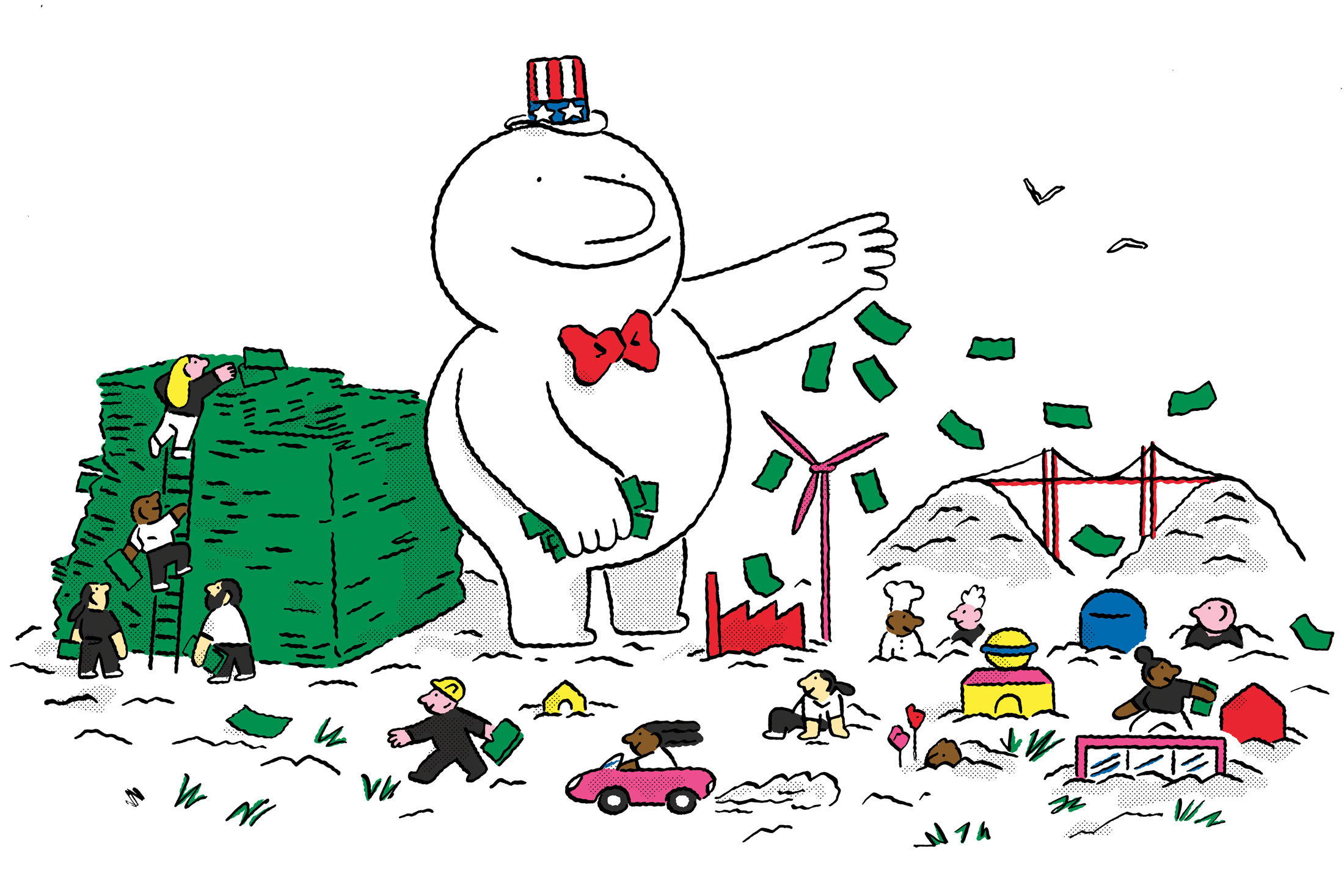
Illustration: Gwendal Le Bec for Bloomberg Businessweek
In the pandemic, the U.S. government has spent money on a scale not seen since World War II—without worrying too much about how it would pay the bills. That looked to some people like the triumph of Modern Monetary Theory.
A newish school of thought that wants to rehabilitate budget deficits—and get policymakers thinking more boldly about what they could achieve with public money—MMT burst out of obscurity a few years ago. It's now regularly name-checked by top officials and big-name academics, though disapprovingly more often than not. Yet when those same people set out their own ideas about the economy, they often sound a bit more MMTish than they used to. Wall Street, meanwhile, has put out plenty of reports arguing that governments are practicing some form of MMT, for better or (usually) worse.
The MMT economists themselves dismiss much of this talk because it's based on a caricature version that reduces their body of work to a simple prescription: Print lots of money and spend it. They say MMT is really a window on how the economy works, rather than a checklist of ways to rev it up. In some areas, they see policy shifting in their direction—and think they deserve credit. In others, they admit to making limited headway.
We asked some leading MMT theorists to review their progress in winning the world over. The examples below are all from the U.S., but similar debates are playing out elsewhere.
● Slaying the Deficit Boogeyman
The U.S. federal budget shortfall came in at around 15% of gross domestic product in the fiscal year ended Sept. 30—the most since 1945, by a wide margin. It's unlikely to be much smaller this year. The headline measure of the national debt has accelerated past 100% of GDP, another postwar record.
U.S. Budget Balance
Share of GDP
Data: White House Office of Management and Budget
Fear of soaring deficits was a key reason the U.S. skimped on stimulus in the wake of the 2008 financial crisis. This time it's proved less of a deterrent, and the economy is bouncing back much faster as a result. MMTers see that as an important win. "It's appropriate for some credit to be given to those of us who have been working so hard to help lawmakers get over some of the anxieties about large deficits and increases in the debt that held them back during the Obama years," says Stephanie Kelton, a professor of economics at Stony Brook University in New York and the author of The Deficit Myth.

Kelton
Photographer: Alex Trebus
Because countries such as the U.S. that issue their own money and have stable currencies don't face the kind of bookkeeping constraints that hold back households or businesses, MMT argues, debt-to-GDP isn't a particularly important metric: The real constraint on government spending is when there are shortages of essential resources, be it labor or lumber, that impede the economy. In such a scenario, there's a risk that fiscal stimulus pushes up prices.
Some say that's happening now. President Joe Biden's spending plans didn't stop with pandemic relief, and his administration is promoting a $4 trillion investment in infrastructure and social programs. But with inflation running higher than anticipated, lawmakers are raising objections, a reminder that the deficit boogeyman is still alive.
Scott Fullwiler, an MMT economist and professor at the University of Missouri at Kansas City, says the Covid-19 crisis has shot down one common argument against deficit spending (used by Democrats to oppose former President Donald Trump's tax cuts): that it risks leaving the government short of funds, so that "in the next crisis you might not be able to respond."
U.S. Federal Debt
Share of GDP
Data: Office of Management and Budget
Nevertheless, he expects mainstream economics will characterize the aggressive use of fiscal policy in the pandemic as a "special case"—indispensable in emergencies but inappropriate in normal times. "It's sort of two steps forward, one step back," Fullwiler says.
There was some evidence for that in Federal Reserve Chair Jerome Powell's July 15 testimony to Congress. Although Powell endorsed deficit spending during the Covid crisis, he told lawmakers it's not sustainable in the long run because "the laws of gravity have not been repealed."
Cost to Service Debt
Share of GDP
Data: Office of Management and Budget
● How to Spend …
The U.S. has steered its economy in recent decades mainly via monetary policy: The Fed tweaks interest rates to cool or stimulate demand. MMT argues that fiscal policy is a better tool.
One objection is that adjusting spending or taxes is unwieldy compared with rapid-response decisions at the Fed. Congress can spend months arguing over spending plans, like it did after the initial virus relief in March 2020, and is usually unwilling to raise taxes.
MMT economists, along with others, say one way around this is to design mechanisms that inject or withdraw money automatically based on the state of the economy—without lawmakers having to take a vote. In academic jargon they're called automatic stabilizers.

Fullwiler
Photographer: UMKC
Fullwiler says Congress passed up an opportunity to permanently beef up programs such as unemployment insurance, relying instead on one-time payments or enhanced benefits that came with an arbitrary cutoff date. "We ended up having to keep going back to Republicans vs. Democrats, and we didn't get anywhere at times, and that hurt a lot of people," he says.
For MMT the ultimate stabilizer is for the government to act as employer of last resort, offering a job to anyone who wants one. Although the idea was in vogue among some leading Democrats a few years ago, it's now largely disappeared from public debate. That's a setback for MMTers, who say the policy could've proved its worth during the Covid recession, which saw unemployment surge to its highest level since the Great Depression.
"The jobs guarantee would make a lot more sense than ramping up jobless benefits and paying airlines $300,000 per job," or mailing checks to households that didn't need the money, says Randall Wray, a senior scholar at the Levy Economics Institute in New York and co-author of the first MMT textbook. "Even if in the beginning you couldn't put the people to work because of safety concerns, you at least would be targeting the spending" to people who were out of work.
● … And How to Pay for It
MMT's take on taxes is one of the most controversial aspects of the theory. It boils down to the notion that governments don't need to raise revenue to pay for their spending, though MMT allows that taxes may be useful for other purposes such as cooling demand (and therefore inflation), redistributing income, or discouraging undesirable behaviors, like smoking and use of fossil fuels.

Wray
Photographer: Levy Economics Institute
In the heat of the Covid crisis, it sometimes looked like U.S. policymakers had bought into this conception. "During the first round of stimulus, no one was talking about pay-fors because the thinking was that there was so much slack in the economy," Wray says.
But that didn't last long. The Biden administration is seeking to raise taxes on high-income households and corporations to pay for some of its policy priorities, including enhanced child benefits. "They're not approaching this next round of spending the way any of us would approach it," Kelton says. "They're just matching dollar for dollar."
Most MMT economists lean left politically and favor measures to make the U.S. less unequal. But they don't think it's good economics to make expanded child care or cleaner energy contingent on Congress approving tax hikes.
● Managing Inflation
With U.S. consumer prices surging at the fastest pace in more than a decade as the economy reopens, fear of inflation is already widespread. More government spending, as advocated by MMT, would just make things worse in the view of critics.
MMTers counter that multiple branches of government should be engaged in managing inflation, not just the Fed with its blunt instrument of interest rates. That includes Congress, which should draw up its plans for spending and taxes with an eye to price pressures rather than balancing the books, in MMT's view. Kelton says there's still a "gaping amount of daylight" between that approach to budgeting and how it's done now.
A holistic anti-inflation strategy could include all kinds of other measures, too, from government interventions to ease supply bottlenecks—such as the lack of semiconductors that's pushing up auto prices right now—to using regulation and other tools to promote competition in sectors where companies are deemed to have too much pricing power. The Biden administration has taken steps in this direction in recent months. "The solution to the supply chain problems is not to raise interest rates," says Fullwiler. "The solution to inflation is going to depend on where the inflation is coming from."
● Not There Yet
Even if much of the pandemic response has been in line with MMT thinking, and there's less alarm about deficits and debt nowadays, Kelton says few have embraced the theory's core claim: that "governments that issue their own currency never have to borrow it from anyone in order to spend. And if they choose to issue bonds, they can always choose the interest rate that they are willing to pay."
She describes that intellectual leap as "the last mile to MMT" and says few economists and policymakers so far have been willing to take it. "They're not there," she says. "They will not go there."
| ||||||||||||||||||||||||



【ケルトン、レイ、フルワイラー:我々はMMTの世界に生きているのか?ーーいや、まだだね】

MMTの経済学者は、彼らが政策立案者に財政赤字の危険性〔という誤った考え〕について再教育したことは評価に値するが、租税やインフレについては〔議論が〕それほど進展していないことを認めている。(ブルームバーグ)
ブルームバーグ紙は、2021年7月23日付けの記事『Are We Living in an MMT World? Not Yet(我々はMMTの世界に生きているのか?ーーいや、まだだね)』で、最近の財政やMMTに関する議論について、複数のMMTの学者の声を紹介している。
(本記事は翻訳記事ではない。著作権の関係上、記事への言及は引用や言い換えに留める。特に括弧書きや引用枠での引用以外は、note筆者の主観的な言い換えや、補足的解説〔本記事で言えばケインズのくだりや機能的財政への言及など〕であるため、あらかじめご承知おきいただきたい。英語の記事本文については上記のハイパーリンクから参照をお願いする。無料での閲覧はブルームバーグにサインインする必要がある。)
矮小化される議論:調子がいいのは危ない時だけ
政府高官や、著名な学者、ウォール街の発言が以前よりもMMT的に聞こえるかもしれないが、MMTの学者はこうした話の多くを否定している。「それは、彼らの研究成果を単純な処方箋に還元した戯画的なバージョンに基づいているからだ。」要するに、MMTの議論を「財政赤字も政府債務も問題ない。どんどん財政拡大しろ」といった「単純な処方箋」に矮小化しているという話だ。
MMTの人々は、現時点で経済学界に大きな変革をもたらすかについては悲観的だ。その内の1人であるスコット・フルワイラーは、「主流派経済学は、パンデミックの際に財政政策を積極的に用いることを『特殊なケース(special case)』とみなすだろうと予想している。」例えば、FRBのパウエル議長は、コロナ禍での赤字支出を支持したが、7月15日の議会証言では財政赤字は「長期的には持続可能ではない」と述べている。
さて、本noteの筆者が「special case」などと言われたら思い出すのがケインズの『一般理論(general theory)』第1章の冒頭である。ケインズがこの本に『一般理論』と名付けたのは、「特殊なケース」にしか適用できない古典派経済学の理論と対比するためだった(『雇用、利子および貨幣の一般理論 上』間宮陽介訳、岩波文庫、2008年、p.5)。ところが今では新古典派の流れを汲む主流派経済学者たちが、自分たちの学説こそ普遍的に正しい「一般理論」と見做しており、MMTはコロナ禍のような「特殊なケース」にしか当てはまらないと考えているという。これは全くの逆なのだが。
ストップ&ゴー(…トゥ・ヘル):地獄への片道切符
米国は数十年にわたって金融政策(金利調整)中心に対応してきた。財政政策については、議会の審議を経る分、FRB(中央銀行)よりも時間がかかってしまうと見られている。MMTは、そうしたタイムラグの問題に対し「自動安定化装置(automatic stablizer)」を提唱している。
「議会は失業保険などのプログラムを恒久的に強化する機会を逸し、代わりに任意で期限付きの一時払いや給付金の強化に頼っていた」とフルワイラーは指摘する。「結局、共和党と民主党の対決に逆戻りしてしまい、埒があかず、多くの人が苦しんでいる」。
つまり、タイムラグを最小限にし、人々への迅速な支援を可能にする、恒久的な自動安定化装置(スタビライザー)の議論よりも、一時的な補償や現金給付といった裁量的な財政政策に固執することで、何ヶ月も与野党の駆け引きに持ち込まれるような事態を招いてしまっているというのだ(もちろん昨今の現金給付のように緊急性に鑑み比較的迅速に対応できたケースもあるが、そうした緊急性に関する合意が保証されない限り議会の綱引きによって支援が遅れることに変わりはない)。
ジョブ・ギャランティー:大事なことはいつも後回し
MMTの究極の自動安定化装置は、政府が「最後の雇い手(ELR)」となり、希望者に仕事を提供することだ。この考え方は、数年前までは民主党の一部の有力者の間で流行っていたが、現在では社会的な議論からほとんど消えている。このことは、MMTer達にとっては大きな障害となっている。彼らは、この政策は、失業率が大恐慌以来の高水準に達したコロナ不況の際に、その価値を証明できたはずだと述べている。
ランダル・レイは、「就業保証(JG)は、失業手当を増やしたり、航空会社に1件あたり30万ドルを支払ったり、お金を必要としない家庭に小切手を郵送〔現金給付〕したりするよりも、はるかに意味がある」と強調する。「最初は安全上の懸念から人々を働かせることができなかったとしても、少なくとも仕事を失った人々に向けて支出を行うことができる」。
貧乏人に回せ!:財布の紐と同時に自分の首も絞める
またMMTの学者達が問題視するのは、現政権を取り巻く「ペイ・フォー(資金調達)」、日本で言えばいわゆる「財源論」である。例えばブルームバーグの記事で指摘されているのは、バイデン政権が、高所得者層や企業への増税によって、子供手当などの政策の「財源」を賄おうとしていることだ。そのような「ロビンフッド式(金持ちに貧困政策の資金を賄わせる)」のやり方は、「我々〔MMT〕と同じアプローチではない」とケルトンは言う。「ドル(支出)にドル(税収)を合わせる(帳尻を合わせる)」やり方だからだ。
以下のことはブルームバーグの記事では詳しく触れられていないが、MMTが重視するのは機能的財政の考え方であり、租税は貨幣への需要や、分配といった「公共目的」の実現のために行われるべきであり、資金調達の手段ではない(より正確には、資金調達の手段たりえない。納税債務の償還自体は通貨の破壊であり、電子上の操作に過ぎず、税金によって支出を賄うことは物理的にありえないからだ)。
処方箋は利上げだけ?:ヤブ医者はいつだって診察を怠る
租税政策のあり方以外に、インフレへの対処についても障害を抱えている。米国では政府支出の拡大に伴い、インフレへの懸念が高まっている。MMTでは、「金利という鈍器を持つFRBだけでなく、複数の政府機関がインフレ管理に関与する」ことを提唱している。当然議会にもその役割があり、いわゆる「帳尻合わせ」よりも、「物価上昇圧力に目を向けて支出や租税の計画を立てる」ことが求められる。ケルトンは、このような予算編成のアプローチと現在のやり方との間には、まだ「大きな隔たりがある」と見ている。
MMTでは、インフレ対策には画一的な方法を取ることはできず、「半導体の供給不足による自動車価格の上昇など、供給のボトルネックを解消するための政府の介入や、企業の価格決定力が強すぎると思われる分野で競争を促進するための規制やその他の手段など」、対処の仕方は多岐にわたるとされる。この点バイデン政権は、従来の金利政策ありきの対応に拘らず、上記の包括的なアプローチを打ち出している点では評価できる。フルワイラーも「サプライチェーンの問題を解決する方法は、金利を上げることではない」と指摘している。「インフレの解決策は、そのインフレがどこから来るか〔原因〕にかかっている」。
さあ旅を続けよう:「MMTへの最後の1マイル」
「財政赤字や政府債務に対する警戒感が薄れている」という点ではMMTに近づいてきていると見えるかもしれない。しかし、ケルトンによれば、「MMTの中核的な主張を受け入れている人は少ない」という。つまり、「自国通貨を発行している政府は、支出のために誰かから通貨を借りる必要はない。また、政府が国債の発行を選択する場合、政府はいつでも任意の金利を選択することができる」という財政観である。
ケルトンは、この「知的飛躍」を「MMTへの最後の1マイル」と表現している。経済学者や政策立案者が、これを受け入れるかについては未だ悲観的だ。逆に言えば、このステップを超えられるかが政策方針における転換の要となるかもしれない(それにしても、ブルームバーグ紙の最近のこうした記事を読むと、日本の有力紙と米国の有力紙では、取材・報道の誠実さにおいてあまりにレベルが違いすぎると改めて感じる)。(了)

0 件のコメント:
コメントを投稿