The Federal Reserve’s Car 🏎️💨 pic.twitter.com/3xzivziIB9
— Kyla Scanlon (@kylascan) November 2, 2022
| ||||||||||||||||||||||||



| ||||||||||||||||||||||||
https://kyla.substack.com/p/economic-outlook-rubber-bands-on

Economic Outlook: Rubber Bands on a Watermelon
with enough pressure, the watermelon *will* explode
wow that's a lot of rubber bands
I was on Compound and Friends this week! Thanks to the team for having me on, and it was incredible to meet Bob Pisani!
Stress Management
I want to first dive into some stress management ideas, and then talk about the markets. One thing I've (candidly) run into over the past few months is trouble with sleep and balancing life.1 I put together a Google Doc here of all the suggestions that people kindly left when I asked for best tips (thank you to everyone who did, it was extremely helpful). I will likely add to this over time.
Now, onwards to stressors.
The Fed Rubber Band on the Watermelon
I have been trying to think of the best way to visualize what all the different stressors are for the world - the dollar, energy prices, geopolitical tensions etc - and I've to come to this:
Rubber bands on a watermelon
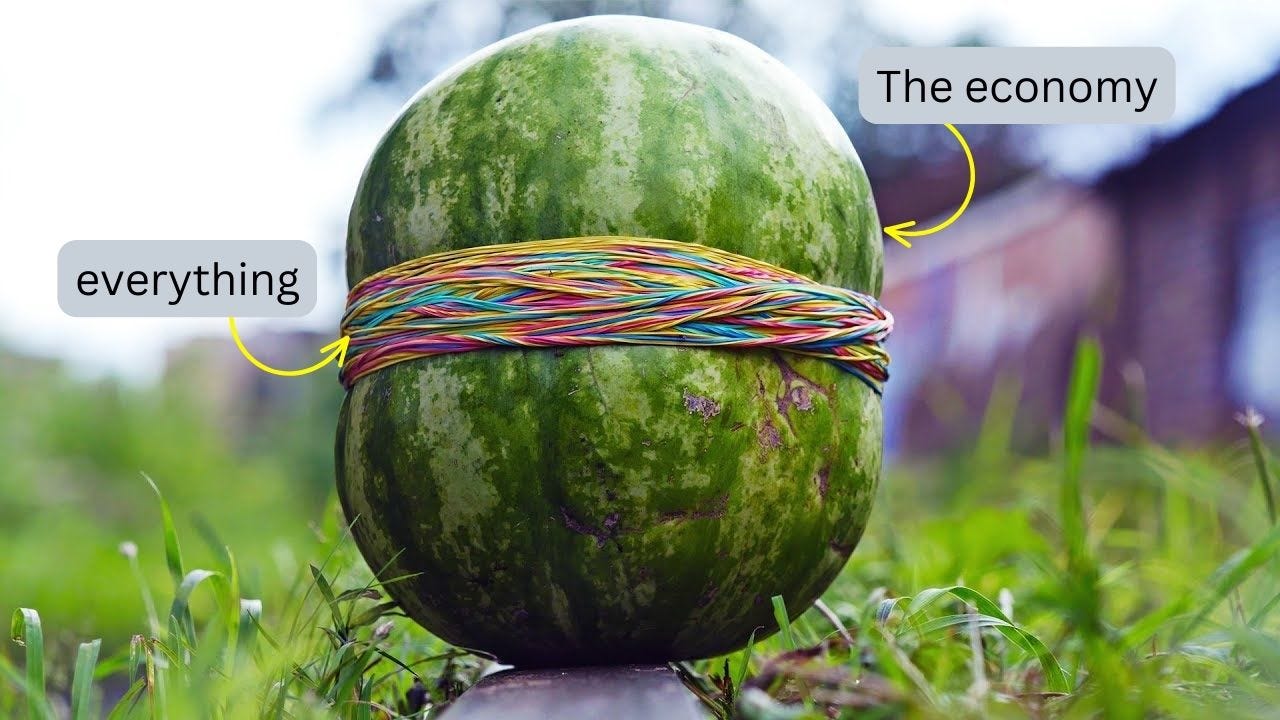
There are plenty of videos of watermelons exploding online, but essentially if you add enough rubber bands to the watermelon, it explodes. 123homeschool says that this is a great way to learn about potential and kinetic energy, but it's also a great way to look at the economy.
The Fed is raising rates to fight inflation - but as I and many others have highlighted, there are a lot of dominoes that tip when they do this. Just for a few examples -
Dollar: Raising rates creates safe haven status for the dollar, which drives inflows, creates a stronger dollar, and then creates a wrecking ball out of the dollar
Energy markets: Javier Blas argues that Fed policy is potentially contributing to energy underinvestment - "The Fed alone can't print energy, but it does help those who can. And the central bank is doing anything but helping right now."
Labor markets: The Fed wants to see softening in labor metrics (which can come from layoffs or higher labor force participation rates) but as Kathryn Anne Edwards highlights in her thread about labor force participation rates - the way we get people back to work is through accommodating the disabled, working around childcare for working parents/caregivers, and addressing systemic issues.
And that's what makes all of this so tough, right? I can write endless newsletters (and I feel like I have, so apologies for that) about the Fed doing the wrong thing and what the "right things" could be (investing in energy production, working on proper labor allocation, etc) but the Fed is a one-trick pony.
They are doing what they can with what they have, which is a blunt instrument that whacks at the economy until it sits down and chills out. Fed policy can nudge things in one direction or the other - as Javier Blas highlighted, easy money does create a certain type of investing environment, but that comes with consequences too. The economy is pretty much eternally trapped between a rock and a hard place.
But there are now all these rubbers bands that are continuously being wrapped around the economic watermelon - and the question now is - how close will it get to exploding?
The Federal Reserve
The Fed is still full steam ahead on raising rates, but there are increasingly dovish (aka we are gonna chill out on rate hikes eventually) threads in their tone.
FOMC Minutes: The Fed seems to be increasingly publicly recognizing that there are two-sided risks to monetary policy, especially the impact that it has on global economic outlook and domestic activity.
However, they also highlighted that the cost of doing too little was likely more than the cost of doing too much (at least right now) and that an global economic slowdown would be good for fighting inflation.
Dovish: Bullard said that the Fed does not need to move faster - but that they should continue moving fast (75 bps in November and December) - and this is very dovish from him!
We also saw Brainard highlight that there were some "two-sided risks" in the market, and that they need to pay attention to what's happening in real time.
Is Monetary Policy Working?
So the underlying question - dovish Fed or not - has become - are Fed actions actually impactful to fighting inflation?
So kind of [bad, but the metric is lagging]: The CPI print did come in hot this week. However, services are driving most of the change in CPI - specifically shelter costs - which are lagged in how they are actually reflected in CPI.
Realtor.com and RedFin have highlighted that rents are slowing as the CPI screams higher. So there will likely be downward pressure on inflation over the next few months as rents, healthcare, and transportation, etc all get accurately reflected (the question is - why aren't they accurately reflected *now*)
PPI came in hot too, so inflation is still permeating the pores of this economy, at least in terms of how monetary policy views it.
Inflation manifestation spiral [bad]: But people are feeling the inflation steam bath too. Inflation expectations ticked up again, which is not great. The reason that the Fed talks so much right now is because the communication part of their toolkit is meant to keep inflation expectations anchored. If people start worrying about higher prices, that creates an inflation manifestation spiral, which is bad.
People are spending less [good]: Consumer spending was flat in September. People are spending more on healthcare and food, but less on things less electronics and furniture. Lots more spending on experiences instead of things. But the important thing for the Fed is that people are spending less.
Corporations are doing pretty good [okay probably]: So far it seems to be a decent earnings season, but there are definitely going to be headwinds ahead.
JPM and other banks benefitting from Fed policy ("charging more for consumer loans and corporate lines of credit without offering customers significantly better rates on deposits" as Adam Tooze highlighted - quite the hurricane for Mr. Dimon)
Pepsi has been able to pass off huge price hikes to consumers, stating that "affordable treats and small moments of pleasure continue to be a key need state… I think we should assume that will continue in spite of all the ups and downs, potentially economically around the world."
Pepsi says "hey… in this economy… you can have a small treat, as a treat"
It seems like the consumer is healthy based off that - credit quality, able to take on price hikes - but for how much longer?
The Housing Market (a quick aside)
The consumer is not healthy in the housing market (at least, first time buyers). There was a great Odd Lots episode on the housing market, which highlighted that Fed policy has at least seeped into mortgage rates.
The biggest thing about the housing market right now is that the there are SO MANY people that have rates under 3.5% - and they simply are not going to move in a 7% mortgage world. Why would they!
We are incredibly lucky here in the United States to be able to lock in a rate for 30 years. In Canada and the U.K., it's a much different situation of variable rate mortagages and 2-5 year fixed horizons.
And to that point, that makes monetary policy probably marginally more impactful in those places because that's another lever that banks can pull on to put pressure on people. In the U.S., it's only first time buyers that are f*cked.
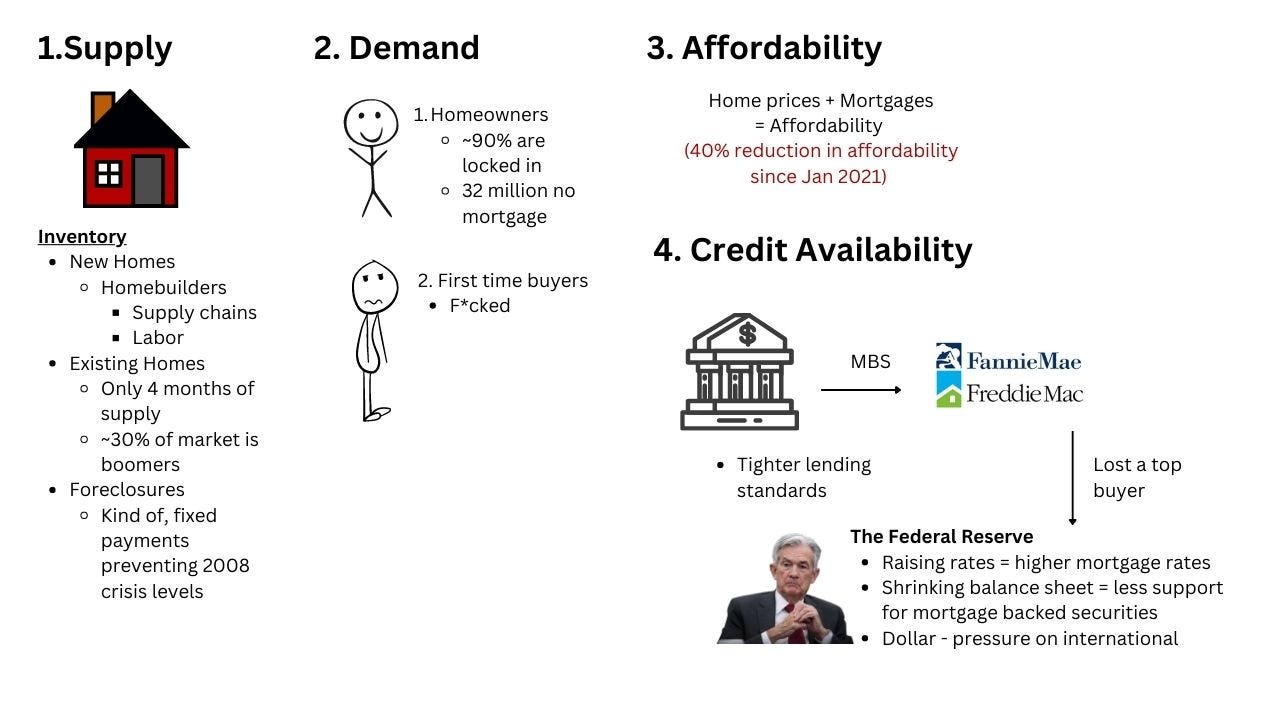
The Odd Lots episode highlighted that there were four main pillars to evaluate the housing market - supply, demand, affordability, and credit availability. Essentially, things are a mess because -
Supply - no one wants to build, no one wants to sell, and (thankfully) no one is foreclosing on their home because we have fixed payments in the U.S.
Demand - Homeowners are solid - they probably won't go after a second house in this environment, but they are doing infinitely better than first time buyers who are just solidly f*cked right now
Affordability - the reason that first timers are f*cked is because affordability has deterioriated considerably since the beginning of the year. A combination of volatile home prices and sky high mortgage results has resulted in a ~40% loss in purchasing power
Credit availability - Mortgages have a big part in what's going on. Banks have tightented their lending standards, and the Fed is raising rates AND shrinking their balance sheet.
When they shrink the sheet, they are no longer buying bonds!! Which means that they are no longer ~25% of the mortgage backed securities market. This has a huge impact on spreads and the overall functioning of the MBS market - and also has a negative impact on the end-state of housing affordability
So is Monetary Policy Really Working?
There are a lot of rubber bands squeezing the watermelon here.
Loss of Liquidity in Treasury Markets: A big worry is lack of structural demand for U.S. Treasuries and mortgage backed securities. JP Morgan released a note highlighting that the Treasury market was losing 3 main buyers - commercial banks (big scary market, don't want to buy), international buyers (U.S. dollar wrecking ball), and the Federal Reserve (tightening their balance sheet)
The question - who will buy if the Fed doesn't buy? Yellen highlighted worries about economic spillover risks, as well as concerns over liquidity in the Treasury market - if she's saying it, it's bad.
International alarm bells: There's a lot of hairline fractures appearing in international bond markets too - the Bank of Japan has no demand for their 10Y bonds (primarily because the Bank of Japan is top bidder, so why would you bid over them) and the Bank of England has waffled between ending their bond market support and continuing it to the end of the month - with the recent volatility wiping out an entire decade of gains.
Market fundamentalism: A lot of this is market fundamentalism, where people are using markets to figure out the effectiveness of policy. So when the bond market starts screaming (as the FT (!) said "who's the daddy") policy makers now have to listen. The question is - are the markets right?
How are People Doing?
Overall, people are doing okay (all things considered). I think a lot of conversations about the economy focus on the stock market because of market fundamentalism.
"People are okay because corporate earnings are okay"
And to a certain extent, sure yes of course. But the flipside of that is that corporations *have* been able to be a bit greedy (and of course, they have people to pay and those people have people to pay, yada yada yada, there is two sides to every coin) but having most of your earnings growth come from price hikes and not increased volume sold is… not great.
I think there is a lot of truth to this sentiment -
What is "good for the market" is not always "good for people".
Final Thoughts
The poem Dogfish by Mary Oliver has stuck with me this week - a reflection on the quickness of life, the pain that threads itself through everyone's stories, on "swimming through fires to stay in this world". I encourage you to read the whole thing but I think of the following excerpt often -
You don't want to hear the story of my life, and anyway I don't want to tell it, I want to listen to the enormous waterfalls of the sun.
And anyway it's the same old story – – – a few people just trying, one way or another, to survive. Mostly, I want to be kind. And nobody, of course, is kind, or mean, for a simple reason. And nobody gets out of it, having to swim through the fires to stay in this world.
And look! look! look! I think those little fish better wake up and dash themselves away from the hopeless future that is bulging toward them.
And probably, if they don't waste time looking for an easier world,
they can do it.
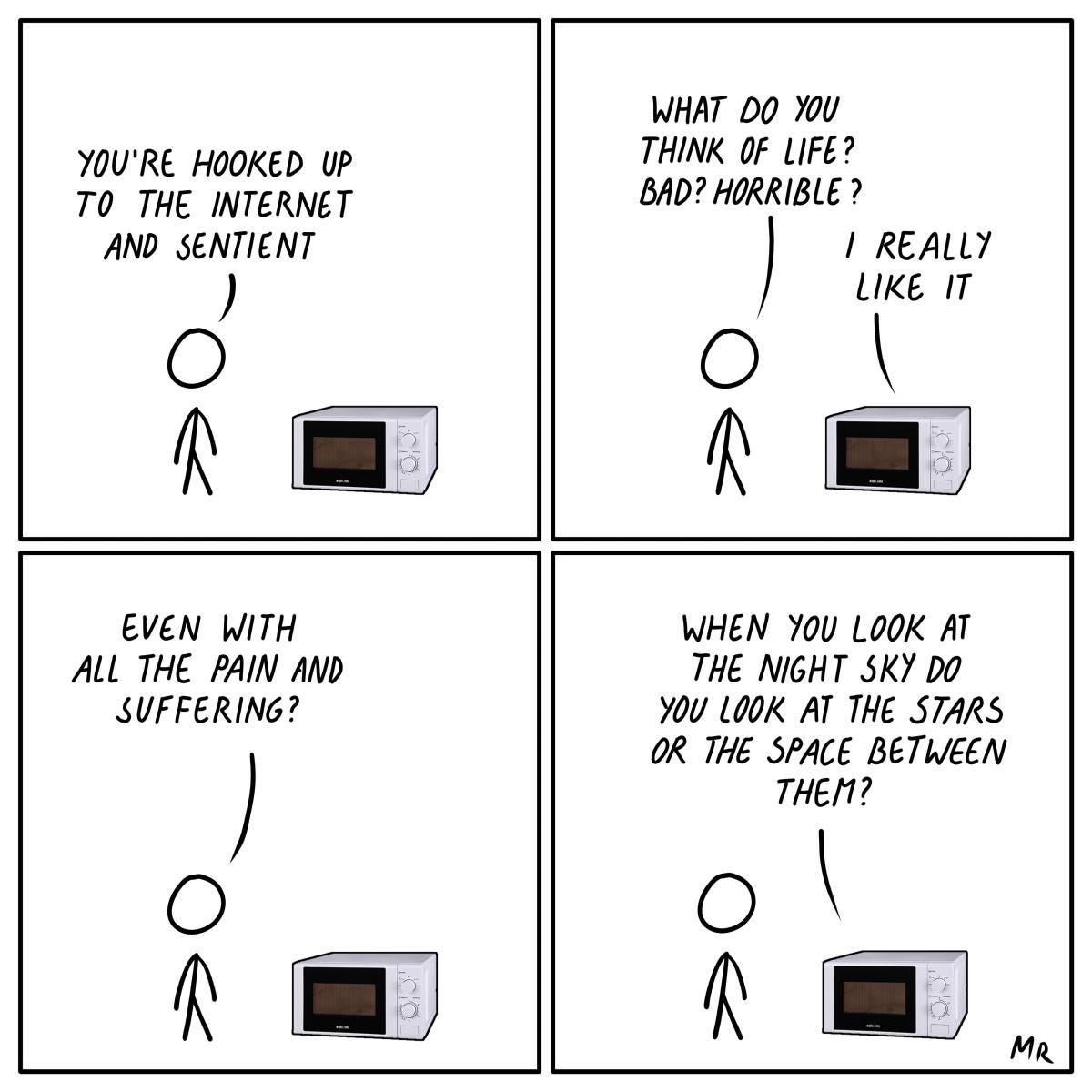
And a nice comic from Martin Rosner
Newsletter Subscriptions
The goal of my newsletter is for it to *always* be free - but there is work that goes into writing, of course! If you think the content is valuable or would like to buy me a coffee once a month :-) I would sincerely appreciate your support.
There are three options:
The annual subscription: $110 annually
The standard monthly subscription: $10 monthly
Founders club: $220 annually or any other amount
What do you get as a paid member?
Q&A drop box + links roundup - This will be sent out in a biweekly email which will include a place to ask questions as well as links of what I've been reading
Disclaimer: This is not financial advice or recommendation for any investment. The Content is for informational purposes only, you should not construe any such information or other material as legal, tax, investment, financial, or other advice.
I also want to note that what causes stress and our stress response are both different for everyone!
経済見通し:スイカの輪ゴム経済見通し:スイカの輪ゴム経済見通し:スイカの輪ゴム経済見通し:スイカの輪ゴム経済見通し:スイカの輪ゴム
十分な圧力で、スイカは*爆発します*十分な圧力で、スイカは*爆発します*十分な圧力で、スイカは*爆発します*十分な圧力で、スイカは*爆発します*十分な圧力で、スイカは*爆発します*

うわー、それはたくさんの輪ゴムです
今週はコンパウンド・アンド・フレンズにいました!私を乗せてくれたチームのおかげで、ボブ・ピサニに会うのは信じられないほどでした!
ストレスマネジメント
まず、ストレス管理のアイデアを掘り下げてから、市場について話したいです。過去数ヶ月間に私が(率直に)遭遇したことの1つは、睡眠とバランスの取れた生活の問題です。1私はここにGoogleドキュメントをまとめました。私が最高のヒントを求めたときに人々が親切に残したすべての提案をまとめました(してくれたすべての人に感謝します、それは非常に役に立ちました)。私はおそらく時間の経過とともにこれに追加するでしょう。
さて、これからストレッサーへ。
スイカの連邦ゴムバンド
私は、ドル、エネルギー価格、地政学的緊張など、世界のすべての異なるストレッサーが何であるかを視覚化するための最良の方法を考えようとしてきました。
スイカの輪ゴム
オンラインで爆発するスイカのビデオはたくさんありますが、本質的にスイカに十分な輪ゴムを追加すると爆発します。 123homeschoolは、これは可能性と運動エネルギーについて学ぶのに最適な方法ですが、経済を見るための素晴らしい方法でもあります。
FRBはインフレと戦うために金利を上げていますが、私と他の多くの人が強調しているように、これを行うときにチップを渡すドミノがたくさんあります。ほんの一例です-
ドル:レートを上げると、ドルの安全な避難所の地位が作成され、流入が促進され、より強いドルが作成され、ドルからレッキングボールが作成されます。
エネルギー市場:ハビエル・ブラスは、FRBの政策がエネルギー過小投資に貢献している可能性があると主張しています - 「FRBだけではエネルギーを印刷することはできませんが、それはできる人を助けます。そして、中央銀行は今、助けること以外は何もしていません。
労働市場:FRBは、労働指標の軟化(解雇や労働力参加率の上昇から得られる)を見たいと考えていますが、キャサリン・アン・エドワーズが労働力参加率に関するスレッドで強調しているように、人々を仕事に戻す方法は、障害者を収容し、働く親/介護者のための育児に取り組み、体系的な問題に対処することです。
そして、それがこのすべてをとても困難にする理由ですよね?私はFRBが間違ったことをし、「正しいこと」が何であるか(エネルギー生産への投資、適切な労働配分に取り組むなど)について、無限のニュースレターを書くことができますが、FRBはワントリックポニーです。
彼らは持っているものでできることをしています。これは、座って冷えるまで経済を強打する鈍な楽器です。FRBの政策は、ある方向または別の方向に物事をナッジすることができます - ハビエル・ブラスが強調したように、簡単なお金は特定のタイプの投資環境を作成しますが、それは結果も伴います。経済は岩と硬い場所の間に閉じ込められている。
しかし、今、経済的なスイカの周りに絶えず包まれているすべてのゴムバンドがあります - そして今、問題は - それが爆発にどれだけ近づくかということです。
連邦準備制度
FRBはまだ金利引き上げに全力を尽くしていますが、彼らの口調にますます卑劣な(つまり、最終的には利上げで冷やすつもりです)スレッドがあります。
FOMC議事録:FRBは、金融政策に両面的なリスク、特に世界経済見通しと国内活動に与える影響をますます公に認識しているようです。
しかし、彼らはまた、やりすぎるコストは(少なくとも今のところ)やりすぎるコストよりも高い可能性が高く、世界経済の減速はインフレと戦うのに良いだろうと強調しました。
ドビッシュ:ブラードは、FRBはより速く動く必要はないと言いました - しかし、彼らは速く動き続けるべきです(11月と12月に75 bps) - そして、これは彼から非常に卑劣です!
また、ブレイナードは、市場にいくつかの「両面リスク」があり、リアルタイムで何が起こっているかに注意を払う必要があることを強調しました。
金融政策は機能していますか?
したがって、根本的な質問 - ドビッシュFRBかどうか - は、FRBの行動が実際にインフレと戦うことに影響を与えていますか?
なので、[悪いですが、メトリックは遅れています]:CPIプリントは今週ホットになりました。しかし、サービスはCPIの変化のほとんど、特に避難所のコストを推進しており、実際にCPIにどのように反映されているかに遅れています。
Realtor.comとRedFinは、CPIが高くなるにつれて家賃が減速していることを強調しました。したがって、家賃、医療、交通機関などがすべて正確に反映されるため、今後数ヶ月でインフレに下方圧力が下がる可能性があります(問題は、なぜ正確に反映されないのか*今*)
PPIも熱くなったので、少なくとも金融政策がそれをどのように見ているかという点では、インフレはまだこの経済の毛穴に浸透しています。
インフレ症状スパイラル[悪い]:しかし、人々はインフレスチームバスも感じています。インフレの期待が再び高まりましたが、それはあまり良くありません。FRBが今そんなに多くを話している理由は、彼らのツールキットのコミュニケーション部分がインフレの期待を固定するためのものであるからです。人々がより高い価格を心配し始めると、それはインフレ症状のスパイラルを生み出し、それは悪いことです。
人々は支出が少ない[良い]:消費者支出は9月に横ばかった。人々は医療や食品に多くを費やしていますが、電子機器や家具には少ないものには少ないです。物事ではなく、経験にもっと多くの支出をする。しかし、FRBにとって重要なことは、人々がより少ない支出をしていることです。
企業はかなりうまくやっています[大丈夫、おそらく]:これまでのところ、まともな収益シーズンのようですが、間違いなく逆風が先にあるでしょう。
アダム・トゥーズが強調したように、FRB政策の恩恵を受けているJPMやその他の銀行(「顧客に預金の大幅なより良い金利を提供することなく、消費者ローンと企業のクレジットラインに対してより多くの料金を請求する」 - 氏にとってかなりのハリケーンダイモン)
ペプシは、消費者に大幅な値上げを渡すことができ、「手頃な価格のおやつと小さな喜びの瞬間は、重要なニーズ状態であり続けています...世界中の潜在的に経済的に、すべての浮き沈みにもかかわらず、それが続くと仮定すべきだと思います。」
ペプシは「ねえ...この経済では...おやつとして小さなおやつをもらえるよ」と言います。
消費者はそれに基づいて健康であるようです - 信用の質、値上げを取ることができます - しかし、どのくらい長く?
住宅市場(素早い脇)
消費者は住宅市場(少なくとも初めての買い手)では健康ではありません。住宅市場には素晴らしい奇数ロットのエピソードがあり、FRBの政策が少なくとも住宅ローン金利に陥っていることを強調しました。
今の住宅市場の最大のことは、3.5%未満の金利を持つ非常に多くの人々がいることであり、彼らは単に7%の住宅ローンの世界で動くつもりはないということです。なぜ彼らはそうするのだろう!
Odd Lotsのエピソードは、住宅市場を評価するための4つの主要な柱があることを強調した - 需要、需要、手頃な価格、信用の可用性。本質的に、物事はめちゃくちゃです。
供給 - 誰も建てたくない、誰も売りたくない、そして(ありがたいことに)米国で固定支払いがあるため、誰も彼らの家を閉鎖していません。
需要 - 住宅所有者はしっかりしています - 彼らはおそらくこの環境でセカンドハウスを追いかけませんが、彼らは今堅実なf * cedである初めてのバイヤーよりも無限にうまくやっています
手頃な価格 - 初めてのタイマーがf * ckedされる理由は、今年の初めから手頃な価格が大幅に悪化しているからです。不安定な住宅価格と非常に高い住宅ローンの結果の組み合わせにより、購買力が約40%低下しました
クレジットの可用性 - 住宅ローンは、何が起こっているかに大きな役割を果たしています。銀行は融資基準を引き締め、FRBは金利を引き上げ、貸借対照表を縮小しています。
彼らがシートを縮小すると、彼らはもはや債券を購入しません!これは、彼らがもはや住宅ローン担保証券市場の約25%ではないことを意味します。これは、スプレッドとMBS市場の全体的な機能に大きな影響を与え、住宅の手頃な価格の最終状態にも悪影響を及ぼします。
では、金融政策は本当に機能していますか?
ここにはスイカを絞っているゴムバンドがたくさんあります。
財務市場における流動性の損失:大きな懸念は、米国の構造的需要の欠如です。財務省と住宅ローン担保証券。JPモルガンは、財務省市場が商業銀行(大きな怖い市場、買いたくない)、国際バイヤー(米ドルレッキングボール)、連邦準備制度理事会(貸借対照表の引き締め)の3つの主要な買い手を失いつつあることを強調するメモを発表した。
質問 - FRBが買わない場合、誰が購入しますか?イェレンは、経済流出リスクに関する懸念と、財務省市場の流動性に対する懸念を強調した - 彼女がそれを言っているなら、それは悪いことだ。
国際警報鐘:国際債券市場にも多くの生え際骨折が現れます - 日本銀行は10Y債券の需要がなく(主に日本銀行がトップ入札者であるため、なぜあなたはそれらを入札するのですか)、イングランド銀行は債券市場のサポートを終了し、月末まで継続する間に困惑しています - 最近のボラティリティは10年間の利益を一掃しました。
市場原理主義:これの多くは市場原理主義であり、人々は市場を使用して政策の有効性を把握しています。だから、債券市場が叫び始めると(FTとして(!)「パパは誰ですか」と言った」政策立案者は今、耳を傾けなければならない。問題は、市場は正しいのかということです。
みなさんはいかがですか?
全体として、人々はうまくやっています(すべてのことを考慮)。市場原理主義のため、経済に関する多くの会話が株式市場に焦点を当てていると思います。
「企業収益は大丈夫なので、人々は大丈夫です」
そしてある程度は、もちろんそうです。しかし、その反対は、企業*少し貪欲になることができたということです(そしてもちろん、彼らは支払うべき人々を持っており、それらの人々は支払うべき人々を持っています、ヤダヤダヤダ、すべてのコインには2つの側面があります)が、あなたの収益成長のほとんどが値上げから来ており、販売量の増加は...素晴らしいことではありません。
この感情には多くの真実があると思います。

「市場に良い」ことは、必ずしも「人々にとって良い」とは限りません。
最終的な考え
メアリー・オリバーの詩ドッグフィッシュは今週私と一緒に立ち往生しました - 人生の速さ、すべての人の物語を通して自分自身を通す痛み、「この世界にとどまるために火を泳ぐこと」についての反射。全部読むことをお勧めしますが、次の抜粋をよく考えます。
あなたは私の人生の物語を聞きたくないし、とにかく私はそれを伝えたくない、私は太陽の巨大な滝に耳を傾けたい。
そして、とにかく、それは同じ古い物語です - 何人かの人々は、何らかの形で、生き残るために努力しています。ほとんどの場合、私は親切になりたいです。そしてもちろん、単純な理由で、誰も親切でも意地悪でもありません。そして、誰もそれから抜け出せず、この世界にとどまるために火の中を泳がなければならない。
そして、見て!見て!見て!私はそれらの小さな魚が目を覚まし、彼らに向かって膨らんでいる絶望的な未来から自分自身を追い払った方がいいと思います。
そしておそらく、彼らがより簡単な世界を探す時間を無駄にしなければ、
彼らはそれができる。
そして、マーティン・ロスナーの素敵な漫画
ニュースレターの購読
私のニュースレターの目標は、それが*常に*無料になることです - しかし、もちろん、書面に入る仕事があります!コンテンツが価値があると思う場合、または月に一度コーヒーをおごりたい場合は、ご支援を心より感謝します。

0 件のコメント:
コメントを投稿