Best New Ideas in Money
Lawmakers in Washington recently struck a bipartisan deal to subsidize the domestic manufacturing of advanced semiconductors, or chips, most of which are now made in Asia. Will it work? Learn more about your ad choices. Visit megaphone.fm/adchoices
Apple Podcastでお聴きください: https://podcasts.apple.com/jp/podcast/best-new-ideas-in-money/id1587222768?i=1000581767996
Making chips at home again
Best New Ideas in Money
Lawmakers in Washington recently struck a bipartisan deal to subsidize the domestic manufacturing of advanced semiconductors, or chips, most of which are now made in Asia. Will it work? Learn more about your ad choices. Visit megaphone.fm/adchoices
Apple Podcastでお聴きください: https://podcasts.apple.com/jp/podcast/best-new-ideas-in-money/id1587222768?i=1000581767996
転送されたメッセージ:
日時: 2022年10月7日 4:34:45 JST
宛先:
件名: The CHIPS and Science Act
返信先: The Lens with Stephanie Kelton <reply+19ry17&pqpdv&&cdedb63797c463d37c3fe74b46dc7f66ad10f4c74cda242b3bb556b961ccee14@mg1.substack.com>★
チップス・アンド・サイエンス法
8月9日、バイデン大統領は2022年の超党派チップス・科学法に署名した。今日、大統領は私の故郷の州にいて、ニューヨーク州ポキプシーにあるIBM施設で法律を宣伝しています。この法案は、アメリカの半導体の研究、開発、製造、労働力開発に527億ドルを提供している。ホワイトハウスは、それを「国内製造業を活性化し、高給のアメリカの雇用を創出し、アメリカのサプライチェーンを強化し、将来の産業を加速するための産業戦略」と表現している。
ニューヨーク州知事キャシー・ホッフルは、この地域にとって数百億ドルと多くの仕事を意味すると述べ、興奮を表明した。ニューヨークのIBM施設での演説の中で、大統領は「世界で製造業をリードできないと書かれている場所はどこですか?それはCHIPS法が変更する1つのことであり、IBMだけでなく国にとっても誇り高く誇り高い遺産を築く法律です。
あらゆる種類の興味深い記事にリンクすることはできますが、今日はすでに多くの読書を勧めたような気がします。代わりに、今日初めにリリースされた、私が共催した短いが非常に有益なポッドキャストエピソードをお知らせします!
それはすべて、チップ科学法と、今後数ヶ月と数年で米国の製造業が直面する機会(および課題)に関するものです。私はこれを録音することを学び、あなたがそれを楽しむことを願っています。
| ||||||||||||||||||||||||



https://twitter.com/whitehouse/status/1578051682289987584?s=21
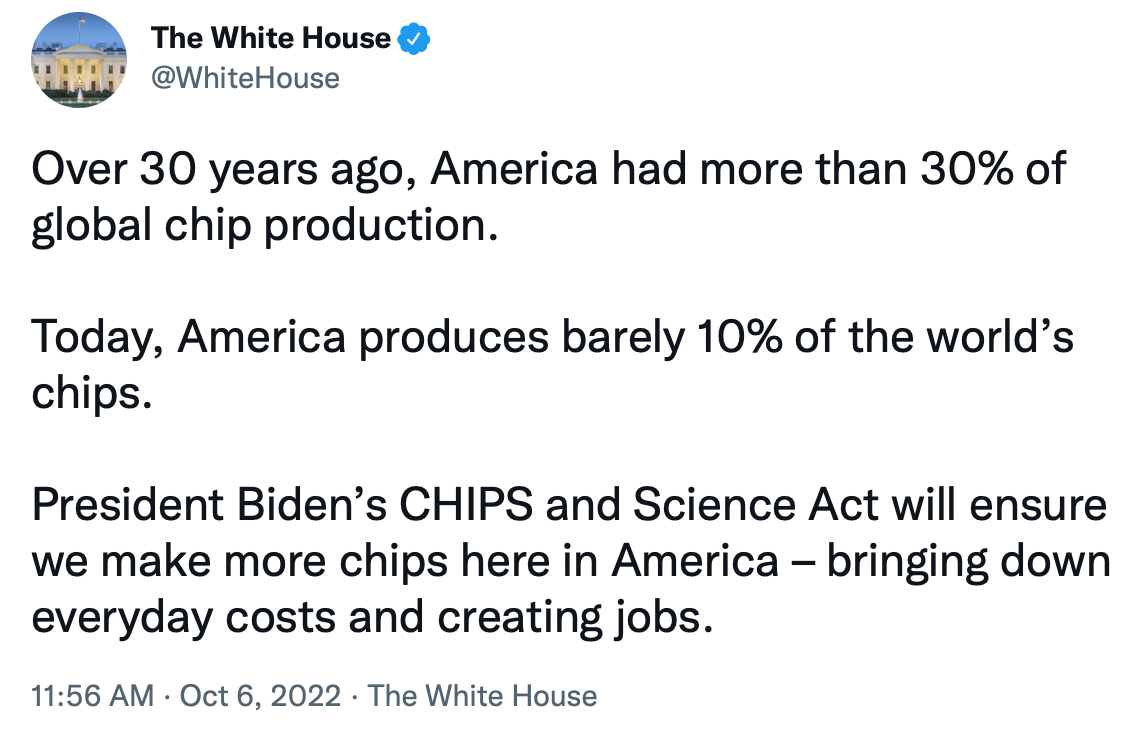
30 年以上前、アメリカは世界のチップ生産の 30% 以上を占めていました。
今日、アメリカは世界のチップのわずか 10% しか生産していません。
バイデン大統領の CHIPS and Science Act により、ここアメリカでより多くのチップを生産できるようになり、日々のコストが削減され、雇用が創出されます。
On August 9, President Biden signed the bipartisan CHIPS and Science Act of 2022 into law. Today, the president is in my home state, touting the legislation at the IBM facility in Poughkeepsie, New York. The bill provides $52.7 billion for American semiconductor research, development, manufacturing, and workforce development. The White House describes it as "an industrial strategy to revitalize domestic manufacturing, create good-paying American jobs, strengthen American supply chains, and accelerate the industries of the future." New York Governor Kathy Hochul expressed excitement, noting that it means tens of billions of dollars—and lots of jobs—for the region. During his speech at the IBM facility in New York, the president asked, "Where it is written that we can't lead manufacturing in the world? That's one thing the CHIPS Act is going to change, a law that's going to build a proud, proud legacy, not only for IBM but the country."
I could link you to all sorts of interesting articles, but I feel like I've already recommended a lot of reading today. So instead, I'll point you to a short but highly informative podcast episode—co-hosted by me—that was released earlier today! It's all about the CHIPS and Science Act and the opportunities (and challenges) facing US manufacturing in the months and years ahead. I learned a lot recording this one and hope you enjoy it.
|



0:00
I'm Charles poussey and this is my
0:03
co-host Stephanie Kelton
0:04
it is going to be a lot of fun today so
0:07
for those of you who Don know about
0:11
each week we explore Innovations in
0:14
economics Finance technology and policy
0:17
that rethink the way we live Fork spend
0:20
save and invest
0:22
great and we are pleased to welcome
0:25
Katie Milkman for this special live
0:28
version of our podcast Katie is a
0:30
Wharton professor and a behavioral
0:32
Economist and we've actually had her on
0:34
the show before around when she
0:37
published her book how to change the
0:39
science of getting from where you are to
0:41
where you want to be she's also a
0:43
seasoned podcaster host of her own
0:45
podcast called choiceology I think I
0:47
have that right uh Katie you've devoted
0:51
your career to studying behavioral
0:52
change and you use a term that we'd like
0:56
you to explain the snudge what the heck
0:59
is a snudge yes thank you for that great
1:01
question
1:02
um a snudge is a self-nudge if you're
1:05
familiar with the book by um Cass
1:08
sunstein and Richard thaler about nudges
1:10
they're small changes that can be made
1:12
to an environment that they don't change
1:14
your incentives but they may reshape
1:17
your decisions through an understanding
1:19
of your Psychology by making things
1:21
easier or more apparent or more
1:22
attractive so a snudge is when you nudge
1:26
yourself towards some better outcome
1:29
okay so today we're talking about how
1:31
you can improve your productivity at
1:34
work using things like snudges and
1:38
Breaking Bad Habits using the idea of a
1:41
snatch nudging your way out of a bad
1:43
habit so I'm curious I would love to
1:46
hear from both of you what work habits
1:49
you would like to break and I'll start
1:51
I'll share mine my bad habit is
1:54
multitasking trying to do too many
1:56
things and not finishing a thing and
1:58
having too much going on at once Charles
2:00
I'm a procrastinator as my bosses know I
2:04
usually wait to the last minute to do
2:06
anything that has a deadline and my bad
2:09
habit would have to be too much time on
2:12
social media when I should be focusing
2:13
on writing projects
2:15
okay so one of the things that we've all
2:19
seen over the last two plus years with
2:21
the pandemic was people going to work
2:25
from home and now millions of people
2:27
going back into the workplace and it
2:29
seems like this is a possibility for
2:32
people to sort of have a new start right
2:35
establish some new behavioral patterns
2:38
and I know that you've written about
2:39
that in your book can you talk about
2:40
that yes I would love to share some of
2:43
my research on this which I hope will be
2:44
helpful to all of you the phenomenon is
2:47
something we call the Fresh Start effect
2:48
and it actually it has a really
2:51
interesting origin in the way we think
2:52
about time as human beings it turns out
2:55
we don't think about time linearly but
2:57
when we reflect on our lives there's
2:59
this whole literature and
3:00
autobiographical memory that shows we
3:02
think about ourselves like we're
3:03
characters in a book and there are
3:06
chapters in that book and the chapters
3:08
of our lives are bounded by major events
3:10
like moving to a new community you might
3:12
you know have the College Years you
3:15
might have the Boston years the New York
3:16
years where you're living where you're
3:19
working who you're surrounded with so
3:21
those are major chapter breaks when you
3:23
pivot from one to another but there are
3:25
also minor chapter breaks and all of
3:27
these chapter breaks whether it's the
3:28
start of a new year which if you think
3:30
about Fresh Starts it's a major one that
3:32
motivates us to set resolutions
3:35
um there are minor ones as well and
3:37
we've studied all these chapter breaks
3:39
that are Salient to people and give us
3:41
the sense of that clean slate New
3:43
Beginning motivate us to step back and
3:45
think big picture about our goals and
3:47
some of the regular occurrences in your
3:49
life that can feel like a fresh start
3:51
include the start of a new week the
3:53
start of a new month the celebration of
3:55
a birthday holidays that feel like Fresh
3:57
Starts so think Labor Day More Than
3:59
Valentine's Day for most of us and we've
4:01
looked at data set after data set and
4:03
seen natural spikes in when people
4:05
invest in goals so for instance we look
4:08
at when people search for the term diet
4:09
and we see spikes at the start of a new
4:12
week month year following holidays that
4:15
feel like Fresh Starts when we look at
4:16
when people visit the gym more
4:18
frequently the very same people visit
4:19
more at the start of a new week month
4:21
year following birthdays following
4:24
holidays that feel like Fresh Starts and
4:26
goal setting on a popular goal setting
4:28
app also spikes at those fresh start
4:31
dates and it's not just about health
4:32
because everything I just mentioned was
4:33
about health we see the same thing when
4:35
we look at financial goals we see the
4:37
same thing when we look at workplace
4:38
goals educational goals when we look at
4:41
goals around your Environmental
4:45
uh goals so all of these categories show
4:48
the same Fresh Start effect and we're
4:50
certainly experiencing a fresh start now
4:52
tomorrow's the first day of fall right
4:54
after Labor day going back to the office
4:56
these are moments when because it feels
4:58
like a chapter break in our lives we're
5:00
more likely to feel we have a clean
5:01
slate a fresh start and want to step
5:03
back and think big picture
5:05
so like people individuals can have this
5:08
fresh start feeling but what about as
5:11
the influx of workers come back you have
5:13
supervisors and managers who are
5:15
welcoming back teams of workers are
5:17
there things that they can do can they
5:19
also take advantage of the Fresh Start
5:20
idea yeah it's a great question one of
5:23
the really neat things we've shown about
5:24
the Fresh Start effect in our work and I
5:26
should say this has worked jointly with
5:28
hang Chen die of UCLA
5:30
we have looked at how we can nudge
5:34
people not as nudge here but how a
5:36
manager can nudge an employee towards
5:38
making better decisions say about their
5:41
finances or pursuing some kind of goal
5:43
and by simply calling attention to Fresh
5:47
Start dates on the calendar that people
5:48
might not otherwise have noticed in the
5:50
context of encouraging goal setting we
5:52
can do this so one example is
5:54
highlighting the first day of spring on
5:57
a calendar when you're asking people you
5:58
know when are you going to start
6:00
pursuing this goal all of a sudden
6:02
there's a whole lot of interest in
6:04
pursuing goals at that new date as
6:07
opposed to just marking it as the third
6:09
Thursday and
6:10
March for instance also we did an
6:13
experiment where we invited people to
6:15
start saving for retirement about 2 000
6:17
people who were not currently saving and
6:19
we either invited them to start saving
6:21
in a few months time on a sort of
6:24
arbitrary date or after an upcoming
6:25
birthday or after the start of spring
6:27
literally it's actually the same but in
6:29
one case we're calling attention to the
6:31
fact that the timeline when we're
6:33
inviting you to start saving is the
6:35
start of spring or your birthday a fresh
6:37
start date and we see about 20 to 30
6:39
percent increase in Saving over the next
6:41
nine months just from changing the
6:43
timeline of when we encourage people to
6:45
begin
6:46
you've given us a lot of different times
6:48
to have a fresh start are they all
6:50
created equal
6:51
yeah it's a great question some are
6:54
absolutely more Salient than others
6:55
right 40 of Americans set New Year's
6:58
resolutions that's the big Fresh Start
7:00
we all Converge on but in terms of
7:02
nudging or trying to encourage someone
7:04
to change Behavior we've actually seen
7:06
better results when
7:08
um it's not a fresh start that's already
7:10
top of mind when you nudge someone for
7:12
instance that say don't you want to
7:13
start saving after the new year
7:15
they've already thought about their New
7:17
Year's resolutions they didn't need a
7:18
little push but when you call attention
7:20
to a date like a birthday or the
7:22
beginning of Spring where there might
7:23
not have been so much Focus you can see
7:25
benefits one other thing I want to just
7:27
say is that you cannot artificially
7:28
create these out of nothing we tried
7:30
some experiments with that to say hey
7:31
it's the 100th day of the year don't you
7:33
want to start pursuing your goals we get
7:35
no absolutely zilch right so you you
7:38
can't manufacture them but every Monday
7:39
is a fresh start we see big increases on
7:42
Monday even relative to Tuesday and
7:44
Wednesday so they come about often
7:45
enough with real meaning where people
7:47
they resonate with people that you can
7:48
use those so so you've decided to make a
7:51
change can I say you've snudged yourself
7:53
I don't know if that's a term
7:55
um how do you make that into an actual
7:57
habit because that's where I think I get
7:58
into trouble yeah habits are hard to
8:00
form first of all but there is a science
8:02
to them and there's some been some
8:04
wonderful popular books that talk about
8:06
this my own of course touches on it but
8:08
if you've read um Power of Habit by
8:10
Charles duhigg Atomic habits those books
8:12
really they mostly get the science right
8:15
that what you want to do is think about
8:16
it like practice if you want to learn a
8:18
new skill like get really good at
8:20
playing a piece on the piano you sit
8:22
down and you practice and you repeat and
8:24
you celebrate small successes and that
8:26
that repetition is how habits are built
8:28
you very deliberately can build a habit
8:29
by trying to repeat this action as
8:32
frequently as possible and and creating
8:34
some stability in the context is
8:36
valuable but I want to tell you about
8:37
one surprising finding around habits
8:40
that my collaborators and I had when we
8:42
ran an experiment with about 2500 Google
8:44
employees who wanted to build exercise
8:47
habits at the start actually of a new
8:49
year so it was a fresh start everybody
8:51
wants to build these habits and we
8:53
experimented with a couple of different
8:54
ways of helping them do that and our end
8:57
goal was to build a little program that
8:59
would last for a month but then carry
9:01
people forward so they'd exercise
9:02
regularly after our program ended and we
9:05
tested two versions of the program in
9:08
one version We encouraged people and
9:09
rewarded them for exercising in a very
9:12
consistent manner meaning everybody
9:15
tells us what's their ideal time to work
9:17
out and they actually got rewarded for
9:19
showing up at that time in that time
9:21
only so people tell us seven to nine
9:23
that's my ideal workout window and by
9:26
encouraging them in this way we got them
9:28
to do about 80 percent of their workouts
9:30
during that sort of Ideal Time
9:32
the other group is encouraged to build
9:34
in more variety as they're trying to
9:36
form the habit for this first month so
9:38
they're inhabit startup mode and instead
9:39
of always doing at the same time we
9:41
encourage them pick your ideal time go
9:42
then some but also mix it up so what
9:45
this leads to is about fifty percent of
9:47
their workouts at the same ideal window
9:49
and the rest more varied both groups
9:52
exercise about the same frequency just
9:54
in these different patterns and then the
9:56
program ends we look who has the more
9:58
robust lasting habit and surprisingly to
10:01
many psychologists who we surveyed and
10:03
frankly to us we actually saw that it
10:05
was better to exercise less regularly so
10:08
same frequency but more variable in the
10:11
timing and when we dug into the data to
10:13
figure out what was going on why did
10:15
this lead to more robust habits and more
10:17
robust Behavior change that lasts beyond
10:19
the end of our program what we see is
10:21
that we were sort of right in thinking
10:23
that some degree of consistency and
10:25
timeline builds builds that habit so if
10:29
you're a 9am workout person you go at
10:30
9am for a month you keep going at 9am a
10:33
little bit more than the person who had
10:35
a more variable routine but if you miss
10:38
9am you don't go at all and that is the
10:41
big important catch the people who had
10:43
been a little less rigid and when they
10:46
visited the gym they built more robust
10:49
habits so they missed their 9 A.M they
10:50
still show up later in the day so big
10:52
takeaway for us from this and and
10:55
resonates with other research that's
10:57
been coming out since is that while it's
10:59
good to repeat and have some degree of
11:01
consistency you actually want to throw
11:04
yourself some curveballs when you're
11:06
trying to build a habit rather whether
11:07
it's around meditation whether it's
11:09
around you know when you're going to
11:11
have your focused work time get your
11:13
writing done today whether it's about
11:15
when you're in practice on Duolingo or
11:17
exercise and that variability is going
11:19
to teach you that when life throws you a
11:22
curveball when you you know hit traffic
11:23
in the morning on the way to drop off
11:25
your kid or something else goes wrong
11:27
you have a backup plan and you'll still
11:30
fall back and find a way to get your
11:31
habit done
11:33
how long does it take to form a habit oh
11:37
I love that you asked me that question
11:38
because one of my favorite myths is that
11:41
there is a magic answer and in fact
11:43
there is one magic number that I've
11:45
heard thrown around a lot you might have
11:46
heard too which is 30 days to form a
11:48
habit that's that's one popular myth
11:51
um Wendy wood is a professor at USC and
11:54
an expert on habits once told me that
11:56
she dug into where that myth came from
11:58
and she thinks that she's pinpointed
12:01
that there was a study done of people
12:02
who'd had plastic surgery and surveys
12:05
were done of how long it took them to
12:06
get used to their new face and that was
12:08
about 30 days and therefore this Legend
12:10
was born that it's 30 days to form a
12:12
habit anyway I don't know how true that
12:15
is but it's sure a great story and the
12:16
research does not support that magic
12:18
number there's some work that's that
12:20
I've been involved in led by Colin
12:22
camera of Caltech using machine learning
12:24
to try to figure out in really large
12:26
populations of both gym goers and
12:28
Hospital caregivers
12:29
um how long does it take gym goers to
12:31
form a habit around exercise how long
12:33
does it take caregivers to form a habit
12:36
around Fan sanitizing their hands when
12:37
they enter and exit patient rooms and
12:40
what's interesting is the answer is
12:42
really different in those different
12:43
contexts you won't be shocked to learn
12:45
takes longer to form a gym habit where
12:47
you're going less frequently than to
12:49
form a habit around hand sanitizing
12:51
where you're doing it several times a
12:52
day hand sanitizing habits seem to take
12:54
on average order magnitude a couple of
12:56
weeks to form whereas gym habits more
12:58
like a couple of months and the the
13:01
speculation is it's going to be
13:03
different depending on the context but
13:04
the more frequently you engage in the
13:06
behavior the less complex it is the
13:08
faster you'll be able to form that habit
13:10
so that's forming the habit but then
13:12
maintaining it you're saying the more
13:15
often you kind of have to do it the
13:17
easier it is to maintain the habit or
13:19
are there tricks that you can adopt as
13:22
well to keep that habit going yeah there
13:25
are tricks you can adopt certainly
13:26
frequency and sort of intensity when you
13:27
have
13:28
a desire to form a habit high frequency
13:31
is beneficial try to use that burst of
13:34
energy you get at New Years to go to the
13:35
gym as frequently as possible so it'll
13:37
start to become routine you won't even
13:38
have to think about it sort of you're
13:39
working it into your day you've got your
13:41
backup plan your first best plan and now
13:43
you know when the motivation wins you've
13:45
got the Habit sort of carrying you
13:47
forward that that idea makes sense
13:48
although I should say only about 30
13:50
percent of the behaviors that we change
13:52
say in a given month in this way end up
13:54
carrying over so it's not as though oh
13:56
once you've done it for a month it's
13:58
magical or once you've done it for any
13:59
period of time it's magical even habits
14:02
tend to wane you have to maintain them
14:03
but in terms of thinking about what it
14:05
takes to
14:07
keep these good behaviors online one
14:10
thing that I think is really important
14:11
is think about social support
14:13
so if you can build a social structure a
14:17
social team that supports you in doing
14:19
the things that you want to do that can
14:20
be really powerful and actually one of
14:21
my favorite studies that I've been
14:23
involved in the last few years that had
14:25
sort of counter-intuitive finding around
14:27
social support suggests one way that we
14:29
can help ourselves maintain habits and
14:32
make good decisions more generally is
14:34
actually by coaching other people who
14:37
have similar goals so we did some
14:39
research and I should say this is led by
14:41
Lauren estrus Winkler at Northwestern
14:44
University's Kellogg School and what she
14:47
realized is that one thing that's a
14:49
barrier to behavior change often into
14:51
habit maintenance is confidence and when
14:53
we mentor and Coach others it helps us
14:55
build our confidence because it shows us
14:58
you know we're if we're capable of
15:00
giving someone else good tips then we
15:02
must kind of have things figured out so
15:04
it builds our confidence it also forces
15:07
us to introspect about what would work
15:09
for us if we're talking to other people
15:10
about oh you're trying to maintain a gym
15:12
habit or trying to build these better
15:14
habits at work trying to avoid
15:15
procrastination say or in my case social
15:18
media overuse then um when you're
15:20
coaching someone else who's facing a
15:22
similar struggle in a similar set of
15:24
goals about how they can achieve it it's
15:26
going to force you to introspect more
15:27
than you might if you were solving the
15:29
problem for yourself because now I have
15:30
to say so say something to Charles right
15:32
I have to say something to Stephanie to
15:34
give them wisdom and I'm going to come
15:36
up with insights that are probably
15:37
self-relevant because those are the
15:39
insights I have access to so I have to
15:41
think about it more deeply it builds my
15:43
confidence and finally when I give you
15:45
advice I'm going to feel like a
15:47
hypocrite if I don't take it myself so
15:49
advice giving and and forming I actually
15:51
have my own advice Club similar people
15:54
with similar set of goals I have a
15:56
professional group of women we all have
15:58
similar goals we reach out to each other
16:00
when we run into a stumbling block and
16:03
it's incredibly valuable to have this
16:04
advice Club because I actually well I
16:07
get you know free consulting which is
16:09
amazing every time that I can't figure
16:10
out what to do
16:12
um social support in general for
16:14
anything I'm trying to achieve but also
16:16
interestingly as I coach these other
16:19
women in this group it has improved my
16:21
own decision making and my own
16:22
confidence and help me maintain better
16:24
habits
16:26
I've got one final question it's one
16:28
I've been dying to ask so we we talk
16:29
about New Year's resolutions plural you
16:33
know and I'll come up with a list each
16:34
year you know go to the gym write the
16:37
Great American novel uh wake up at 6am
16:39
every day and I'm wondering if
16:42
what's going on there maybe we should be
16:44
really talking about New Year's
16:45
resolution singular I mean is it good to
16:47
have a lot of goals or is it better to
16:49
focus on just a few or one or two I'm so
16:52
glad you asked that question too because
16:54
this is a major mistake that many people
16:56
make when they have a fresh start
16:58
whether it's New Year's or any other
16:59
time research by Steven Spiller and
17:02
collaborators at UCLA has looked at what
17:04
happens when we set multiple goals and
17:07
we enumerate plans for reaching multiple
17:10
goals which PS is really important to
17:12
success I talked a little bit about
17:14
social support but another direction we
17:15
could have gone in that conversation
17:16
about habit maintenance is you've got to
17:18
make a really concrete plan break that
17:20
Big Goal I want to volunteer 200 hours a
17:23
year for instance down into bite-sized
17:25
pieces we just ran a massive field
17:27
experiment with 9 000 people were
17:29
showing that encouraging volunteers
17:31
who'd committed to 200 hours a year of
17:33
work asking them to break that down and
17:36
say okay we're going to do four hours a
17:37
week or eight hours every two weeks we
17:39
see eight percent increase in
17:41
volunteering so when we break that Big
17:43
Goal down into bite-sized pieces you see
17:45
better outcomes okay so if you try to
17:48
break things down you break it down into
17:49
those bite-sized pieces you make a plan
17:51
you know when am I going to do it where
17:53
am I going to do it how am I going to
17:54
follow through critical to goal success
17:56
do you do that with more than one goal
17:58
you actually get worse outcomes if you
18:00
do it with one goal you get better
18:01
outcomes so all of the magic tricks that
18:04
we can use all the Behavioral Science
18:06
that supports successful gold Pursuit it
18:09
supports it when we are focusing on a
18:11
single goal a single objective at a time
18:13
but the minute we enter two goals onto
18:15
our to-do list and try to use these best
18:17
practices we overwhelm ourselves it
18:19
feels impossible to get it all done once
18:21
you enumerate the plan you need to make
18:23
and leads to worse results so one goal
18:26
at a time
18:27
we're we're almost out of time speaking
18:29
of of time
18:30
um any last-minute thought
18:33
well one last thing I want to say is
18:35
that both of you were talking about how
18:37
to
18:38
tunes right you want to quit
18:39
procrastinating or quit being distracted
18:41
right I want to quit social media a lot
18:43
of our objectives in the workplace are
18:45
about stopping not starting and there's
18:48
some different magic sauce that you can
18:50
use from science to help with that
18:52
um I'll just leave you with the thought
18:54
that sometimes we want to impose
18:56
constraints on ourselves normally we're
18:58
used to other people doing it right you
18:59
get a speeding ticket if you drive too
19:01
fast somebody else slaps a penalty on
19:04
you but a commitment device is a tool
19:06
you can use to actually impose penalties
19:08
on yourself if you procrastinate and
19:10
there's some websites that can let you
19:11
put money on the line that will you'll
19:14
have to Forfeit if you fail to achieve
19:15
your goals and you can name a referee
19:18
and they're very helpful research shows
19:20
that just having access to this kind of
19:22
a tool can for instance help smokers
19:24
quit at a 30 percent higher rate so
19:26
think about commitment devices if you
19:27
want to quit instead of start building
19:29
new habits and gambling I love it all
19:32
together that's all we have time for
19:33
today Katie it was a pleasure talking
19:36
with you and everyone if you haven't
19:38
already ready check out the best new
19:40
ideas and Money podcasts we have new
19:42
episodes every Thursday thank you so
19:43
much
19:44
episode was a special live taping from
19:47
the best new ideas and money Festival go
19:49
to marketwatch.com to watch highlights
19:51
from the festival and learn more I'm
19:54
Stephanie Kelton and I'm Charles Passey
19:56
the best new ideas and money is a
19:58
podcast for MarketWatch the producers
20:00
are Michael Mcdowell metalutsoft and
20:03
Katie Ferguson who edited and mixed this
20:05
episode Melissa Hagerty is executive
20:07
producer Jeremy Binks is our news editor
20:10
and Tim rosten is the executive editor
20:12
for MarketWatch the best new ideas and
20:14
money theme was composed by Sam retzer
20:16
special thanks this week to Nathan vardy
20:19
Alia aljunaid Mark renfree Rebecca
20:22
bizdale Suzanne Foie and Lindsey Mick
20:24
Stephanie Kelton is an economist and a
20:27
professor of economics and public policy
20:29
at Stony Brook University and not part
20:31
of the market watch Newsroom we'll be
20:33
back next week with another new idea
20:36
[Music]

0 件のコメント:
コメントを投稿