Adam Tooze 2022/09/17 Chartbook #151: Zugzwang - are we on the brink of a central banking paradigm shift?
https://love-and-theft-2014.blogspot.com/2022/09/adam-tooze-20220917-chartbook-151.html @
参考:


Crashed: How a Decade of Financial Crises Changed the World with Adam Tooze
2018/09/25
Adam Tooze: American Power in the Long 20th Century
2019/03/27
Davos 2022: Adam Tooze On New Political And Economic World Order
2022/05/23
From shadow banking to market based finance: old wine in new bottles?
https://youtu.be/IUhF0qft53c 2018/04/26
Conference "Transforming Europe - Keynote Daniela Gabor
https://youtu.be/Quq05nrjbzo 2022/05/19
12 Daniela Gabor Three blindspots in Euroarea Macrofinance
https://youtu.be/Vq6gBbr_hF8 2019/10/31
追記:
邦訳
アダム・トゥーズ「“ツークツワンク”:中央銀行のパラダイムシフトが起きるところまで来たのか?」(2022年9月17日) – 経済学101
https://econ101.jp/translationadamtooze09172022/
https://iitomo2010.blogspot.com/2022/09/2022917-101.html
| ||||||||||||||||||||||||



https://twitter.com/econ101jp/status/1571982509444923392?s=21
| ||||||||||||||||||||||||

https://twitter.com/goethe_chan/status/1572062780639039488?s=21
労働から資本への再分配の問題が存在する。中央銀行は今やその再分配装置となっているわけだが、そもそも政府は政府で現行のエネルギー価格を主とするインフレに対処する責任があるのに、中央銀行をスケープゴートにしている。中央銀行のパラダイムシフトを示唆するガボールに対し、トゥーズはその場凌ぎの保守的対応に留まることを懸念している。
アダム・トゥーズ「“ツークツワンク”:中央銀行のパラダイムシフトが起きるところまで来たのか?」(2022年9月17日)追記。 本人も言っているように危機が起きたら自動的にパラダイムが変わるわけではない。トゥーズは歴史学者だからそのことをよく知っている。金融危機はじめこれまでの危機を振り返れば、そのような変革の期待にはペシミスティックにならざるを得ない。
それにしてもこのダニエラ・ガボールという人も面白い。彼女の言うスーパーサイクルはミンスキーの文脈。ミンスキーで繋がっているのかもね。
~~~
図表のみ
https://nam-students-2021.blogspot.com/2022/09/blog-post_45.html
| ||||||||||||||||||||||||
https://adamtooze.substack.com/p/chartbook-151-zugzwang-are-we-on?s=r&utm_campaign=post&utm_medium=web
Chartbook #151: Zugzwang - are we on the brink of a central banking paradigm shift?
Adam Tooze 10 hr ago 42
Central banks around the world are under pressure. Surging prices stoke fears of inflation. Central bankers, who commonly define themselves as guardians of price stability, feel forced to react. Interest rates are their preferred tool. Higher rates take steam out of the economy. That should lower inflation. The price is pain for borrowers and the risk of a recession and rising unemployment
The choice for central bankers is easier where price increases are taking place across many sectors, meaning that the economy is undergoing a general inflation. This includes wages rising along with prices. The correlation between wages and prices should be regarded neither as anomalous nor as a dangerous "second round effect". It should, in fact, be definitional of a general inflation. Wages are the price of labour. If wages are not rising along with other prices, then you are not dealing with a general inflation at all, but rather a one-sided redistributional push by capital at the expense of labour. A truly general inflation will commonly go hand in hand with a relatively strong economy with low unemployment.
In this respect there is a big difference between the situation on either side of the Atlantic.
In the US, the Fed is facing a general inflation, modest in pace, but broadly based. Price increases are not uniform, they never are. But they now extend from bottleneck sectors, such as energy and food, to rents and house prices. Wages are also rising broadly in line with prices.
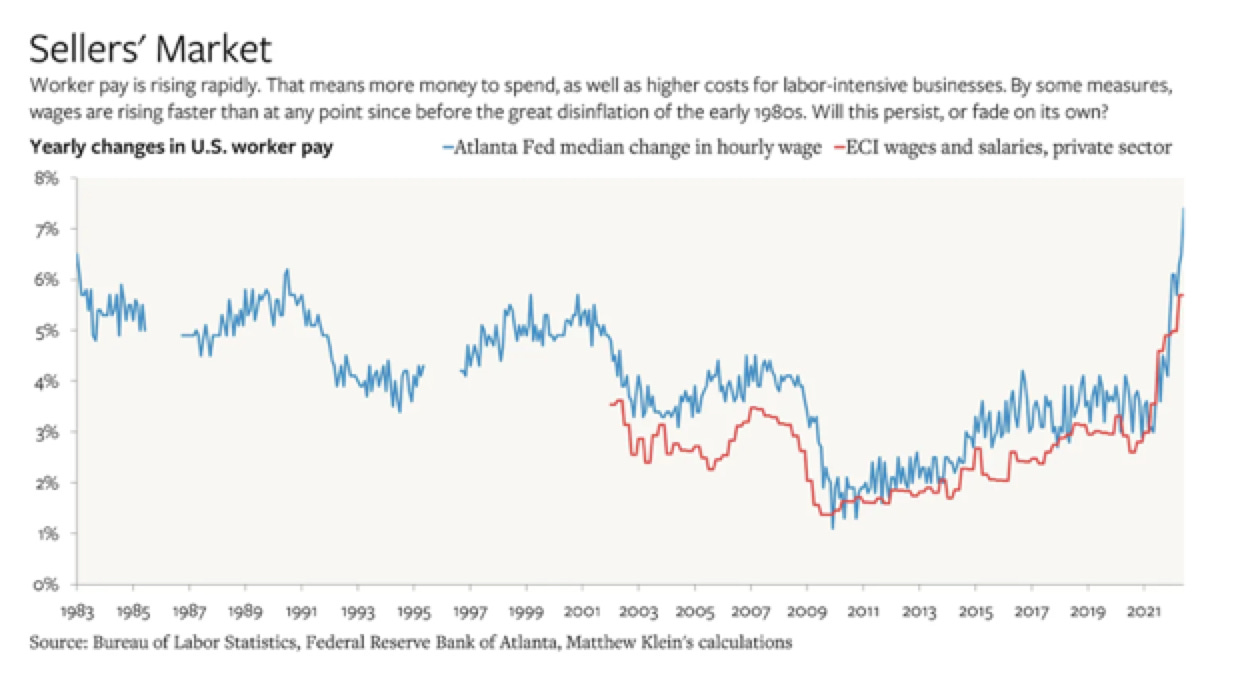
Source: Matt Klein's Overshoot
To respond to this broad-pressure pressure, the Fed's interest rate increases are the conventional answer. This graphic from Skanda Amarnath of Employ America, nicely illustrates the main transmission mechanisms.
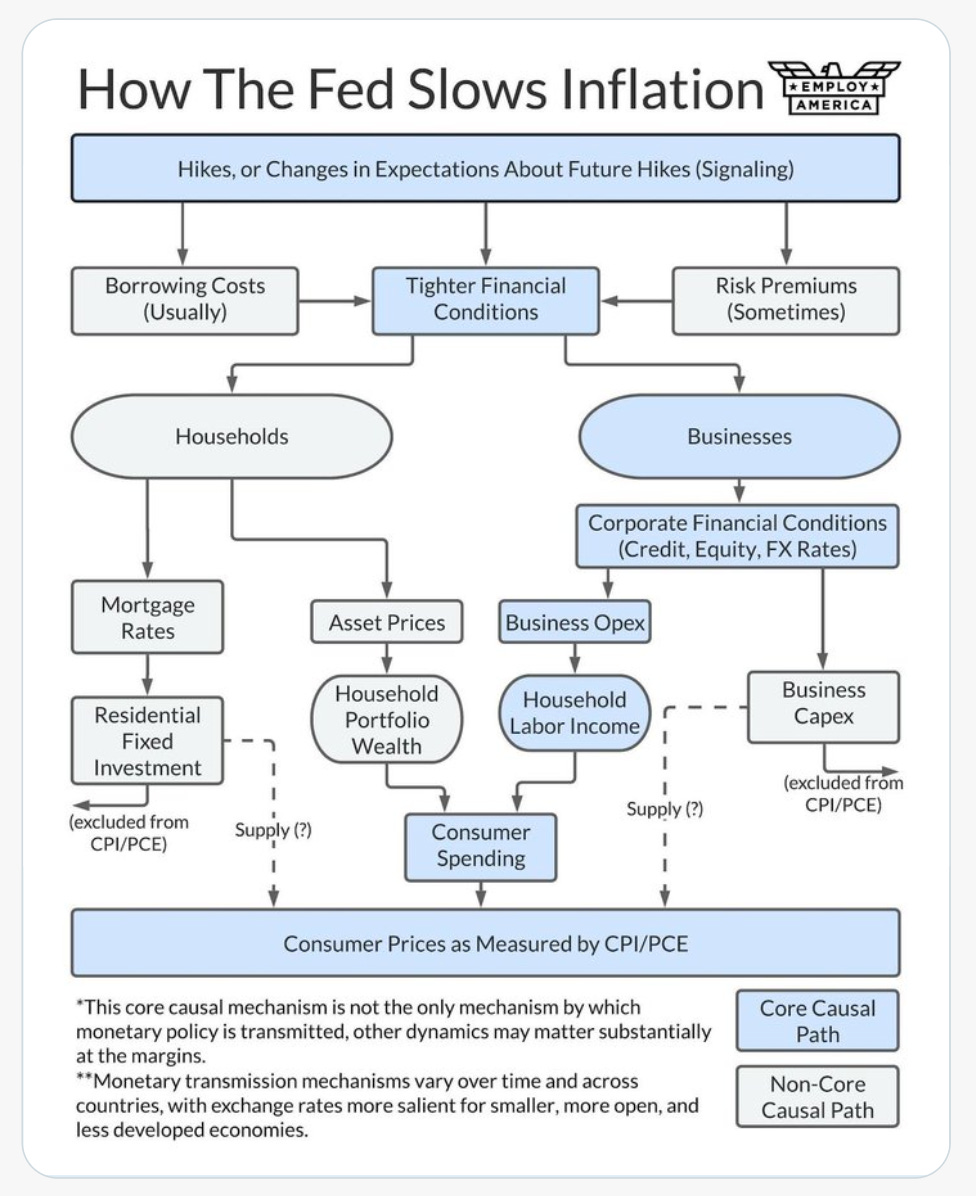
The transmission mechanism, mainly by way of the labour market and unemployment, is blunt force. It prompts one to think about alternative policies that might work more efficiently and with less labour market impact. But given the nature of US inflationary pressure right now, the Fed's hike will likely work. The question is how sharp and sustained the rate hikes should be and what price businesses and employees will pay for the resulting slowdown. The Fed is still hoping for a soft landing.
One thing that the Fed is not worrying about, at least in the near-term, is financial stability. Equity markets have not liked the rise in interest rates. Some debtors have felt the pinch. There are unresolved issues in the architecture of the US Treasury market. As the Fed had ended its asset purchases, liquidity in the Treasury market has dried up. But there is little reason to fear a systemic financial crisis of the type that occurred in 2008.
The situation in Europe is quite different. Price increases are far less broad-based. The proper description for what is happening in Europe is really an energy and food price shock rather than a general inflation.
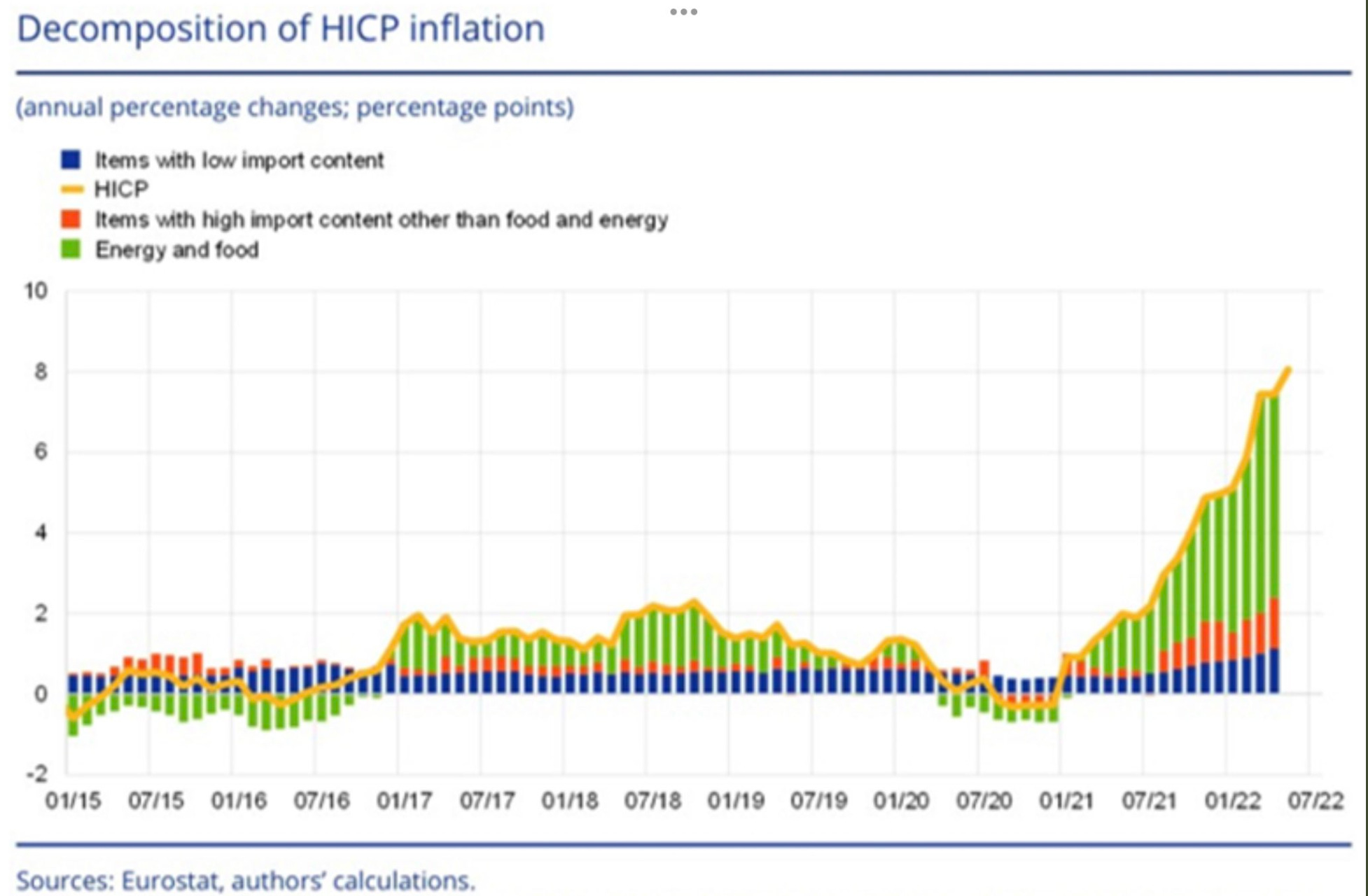
The energy price shock is sufficiently serious, to threaten a socio-political crisis as household expenditures and business budgets are wrenched out of balance by the price of gas and electricity. But to insist that this is an "inflation" problem and thus properly the domain of central bank interest rate policy is, to say the least, question-begging. What good will interest rate increases do in slowing down a surge in gas prices caused by the uneven COVID recovery, Putin's war in Ukraine and the lack of integration in the global gas market?
The ECB's difficulties are compounded by the fact that the European economy is far less robust than that of the US. Many indicators suggest that Europe is already sliding towards a recession, with falling real wages and the energy shock leading to a collapse in confidence. And to make matters worse, any interest rate hike by the ECB risks unleashing the demons of Europe's sovereign debt market. And this pressure is all the more worrying given the fiscal demands generated by the energy crisis.
To respond to the energy crisis Europe's governments are engaging in price stabilization and subsidy packages costing several percentage points of GDP.
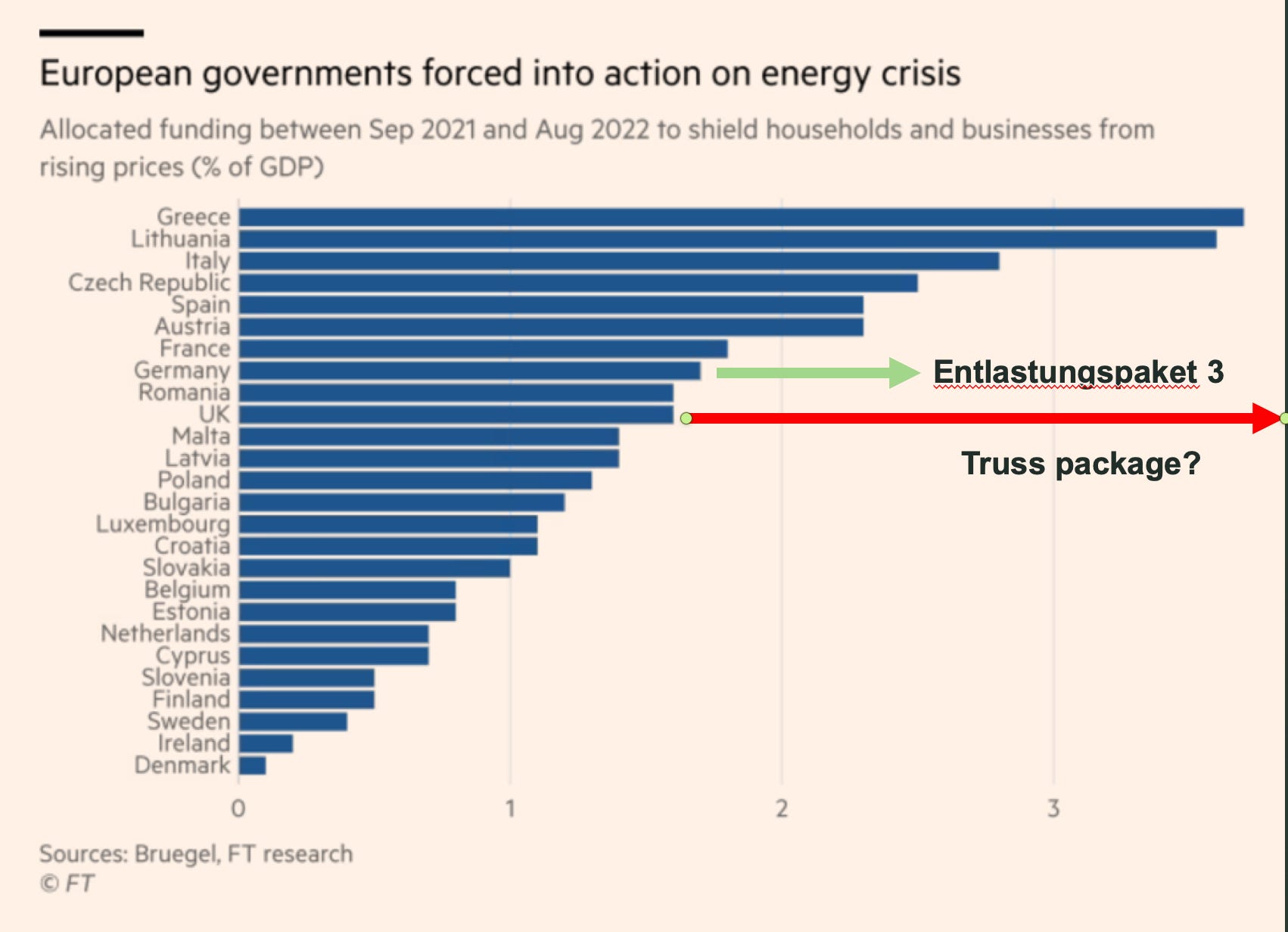
Though they hope to claw much of this back in excess profit taxes and other levies, a surge in government spending will put pressure on budgets and make bond markets nervous. Italy's debt levels were already causing concern before Putin launched his war. It won't help matters if the ECB starts driving up rates. On the other hand, if the ECB does nothing, it will find itself under withering attack from conservatives questioning its commitment to fighting inflation. Their demands for action will be all the more vociferous because over the summer the ECB put in place the so-called Transmission Protection Instrument (TPI), which is notionally supposed to protect the market for Italian debt against unwarranted sell-offs.
So what is the ECB to do? It is damned if it acts and damned if it doesn't. To characterize this uncomfortable situation, Daniela Gabor in a typically brilliant piece in the FT, coins the phrase "Zugzwang central banking".
Zugzwang is the anomalous situation that can arise in a chess game when the requirement to make a move becomes binding. Normally, it is advantage if it is your turn to make a move. It gives you the initiative. But, particularly towards the end of a game, you can find yourself trapped in a situation in which every possible move makes your position worse, so that the requirement to make a move becomes a curse. It can even lose you the game. That, Gabor suggests, is the situation of the ECB.
As she sees it, the ECB has four possible moves. Three of these are conventional central banking policies: raising rates, Quantitative Tightening, holding rates. The fourth, Gabor adds mischievously, is to admit "regime defeat".
On Gabor's reading the ECB in 2022 faces not only a policy dilemma but an impasse that ought to put in question the model of central banking as we have known it since the 1990s.
Under the financial capitalism supercycle of the past decades, inflation-targeting central banks have been outposts of (financial) capital in the state, guardians of a distributional status-quo that destroyed workers' collective power while building safety nets for shadow banking. The limits of this institutional arrangement that concentrates (pricing) power and profit in (a few) corporate hands are now plain to see. …..
What if Zugzwang is that last stage of a central banking paradigm, when it implodes under the contradictions of its class politics?
Let us follow Gabor's train of logic to see how she arrives at this striking conclusion.
Of the three conventional policy options for the ECB, none looks attractive.
On September 8, the ECB followed the Fed in hiking interest rates by 75 basis points. It would be kind to describe this as a symbolic gesture. The interest rate hike will do nothing to stop the price rises that ostensibly justify it. And if it were honest the ECB would admit that it has no model that would suggest otherwise. The ECB does not really believe that an interest rate increase will curb energy price inflation. So the move is best interpreted as political. It is a concession to the conservative claque that is demanding action. How much more action they will extract remains to be seen. If this first increase is the harbinger of a full-blown counterattack by Europe's monetary conservatives, prepare for a serious recession. That may do something to slow down price increases, but given the energy price shock, the economic price would likely be terrible.
Other than interest rate increases, the ECB could also engage in quantitative tightening (QT). It could start rolling off the trillions of euros in Eurozone sovereign debt it acquired in the course of the quantitative easing-programs (QE) of 2015 and 2020-22. QT appeals to hawks because it reverses QE - the talisman of unconventional monetary policy. Reverse QE and you slay the beast, or so the story goes.
It is a high-risk strategy. As Gabor points out, QT would
pile pressure on to sovereign markets that have already delivered some tightening of monetary conditions. Italy's 10-year yield now hovers around 4 per cent, a 2 percentage points spread to the German Bund, at a time when eurozone countries need aggressive fiscal and structural policies to contain the possibility of future persistent supply shocks.
Such pressure would be painful and politically explosive, but it might actually be welcomed by überhawks. For them squeezing the fiscal space of Europe's government is precisely what the ECB should be doing. They welcome a return to the cat and mouse game that Jean-Claude Trichet played, when he was head of the ECB during the Eurozone crisis in 2010 and 2011. Trichet would buy bonds only when he judged that national governments had done enough by way of "reforms". For the hawks this counts as wise central banking, forcing the onus for action onto Europe's national governments.
What this strategy ignores, is not only the attritional impact on European democracy, but the risks to the wider financial system emanating from a nervous sovereign bond markets. As Daniela Gabor has done more than anyone else to show us, the European sovereign debt is not just a means of funding government. Sovereign debt is collateral for repo transactions and thus for private credit. As Gabor remarks in the FT:
In turning European states into a collateral factory for private finance, the founding fathers did not consider the financial stability implications for the ECB.
… the eurozone's macro-financial architecture is wired to amplify volatility in sovereign spreads to the German Bund, via the €9tn repo market. This wholesale money market provides the plumbing for private credit creation, both on bank balance sheets and through securities markets. It was designed — by the ECB and the European Commission — to mainly rely on eurozone sovereign bonds as repo collateral. Yet we know from the eurozone sovereign debt crisis that repo collateral valuation means cyclical market liquidity in eurozone sovereigns except Germany, threatening liquidity spirals that only the ECB can prevent. Liquidity spirals, it is worth remembering, or not just bad for eurozone governments, but also for private institutions that use those bonds as collateral.
The irony is that überhawks imagine that quantitative tightening will allow them to escape from the unconventional policies of the past, whereas it was in fact Trichet's reckless gamesmanship that set in motion the doom-loop in European sovereign debt markets that forced Mario Draghi in 2012 to make his "whatever it takes" speech. Ten years later that logic leads on to the Transmission Protection Instrument, with which the ECB seeks to contain Italian sovereign spreads. The ECB cannot wish aways these financial entanglements and engage in sudden quantitative tightening without risking severe repo market disruption.
Without radical structural reform we are prisoners of decisions taken in the 1990s. In the heyday of neoliberalism, Europe's monetary policy-makers built a market-based model of central banking. They integrated private short-term credit markets, above all the repo market, into the operations of the ECB. This linked the stability of financial markets and institutions umbilically to sovereign debt. Destabilize the latter and you put the former in jeopardy. The necessary measures, such as QE or the TPI, may appall conservatives but, for their own sake, they cannot be trusted with monetary policy. They know not what they do.
The right technocratic choice, Gabor suggests, would be for the ECB to do nothing. For the past year, the ECB deserves credit for doing precisely that. It sat tight
… in the hope that supply shocks that it cannot control would dissipate, and inflation would once again behave as its models predict.
But that sensible policy of inaction has fallen victim to circumstances.
Putin's invasion of Ukraine, coupled with the reluctance of European governments to act decisively with energy price caps, have left the ECB as a convenient scapegoat. Scapegoating invariably turns dovish central bankers into hawks, particularly when their peers elsewhere act as obedient vassals to the dollar hegemon. Indeed, monetary historians will marvel at that brief period when European politicians believed so much in the euro's potential to unseat the US dollar … With that illusion behind us and the euro below parity, the ECB is just another central bank trapped in the global dollar financial cycle, prey to facile comparisons with other central bank interest rates.
How far the Fed was really a significant factor in the ECB's decisions will in due course, be revealed by the historical archive. Personally, I don't find it a particularly persuasive interpretation for the ECB's September decision. But this passage by Gabor contains the germ of another idea that I did hear actively discussed in Europe last week.
Perhaps the game that the ECB is playing is not the Trichet-style game of chicken in which the ECB withholds support from sovereign bond markets until Europe's governments adopt fiscal austerity. Perhaps the game that the ECB is playing in 2022 concerns energy markets. It is clear to the central bankers as well as everyone else that the core of Europe's "inflation" problem is in the markets for gas and electricity. The infrastructure and regulation of those markets is dysfunctional. Fixing those problems is the route to price stability. That is a task for national governments not the ECB. The ECB, however, does need to be seen to be doing something. So it will raise rates, inflicting pain that it knows is largely irrelevant to the issue at hand, until governments commit themselves convincingly to reforming energy markets. That too is a hypothesis, but it makes more sense to me than believing that the ECB is particularly concerned about parity with the dollar.
Whatever the explanation for the ECB's recent interest rate decision, what the ECB leadership has forsaken is the coordination of monetary and fiscal policy that it adopted in reaction to the macroeconomic shock of 2020. At the time Gabor propounded the idea that we were witnessing a revolution in economic policy without revolutionaries. Responding to Gabor, in my book Shutdown I argued that what we were witnessing was not so much a revolution without revolutionaries as a gigantic effort at conservative stabilization, under the slogan that for everything to remain the same, everything must change.
In 2020, it was concern for the stabilization of the all-important US Treasury market that drove the Fed into gigantic bond purchases that then flanked the dramatic fiscal stimulus measures launched by Congress. In the EU we saw an unprecedented combination of open-handed bond buying by the ECB, national fiscal activism and the innovative Next Gen EU recovery program funded by bonds issued by Brussels. All this took place under the sign of low-flation. The main worry was not inflation but the risk of sliding into deflation.
Since the summer of 2021, the surge in prices has flipped the terms of the policy argument.
In the US, monetary and fiscal policy remain coordinated. But now, both fiscal and monetary policy are driving in an anti-inflationary direction. It is emblematic that the core of Biden's climate agenda was stripped out of the $3 trillion Build Back Better program and reborn over the summer of 2022 as the Inflation Reduction Act.
In Europe policy-makers are facing a more conflicted and difficult set of choices. At Jackson Hole, Isabel Schnabel announced that what the ECB was facing was a fundamentally new environment. No longer the Great Moderation welcome by Ben Bernanke in the early 2000s but a new "great volatility". Taking up that idea Gabor goes over to the offensive calling for a new synthesis of fiscal and monetary policy under a progressive sign.
"If the climate and geopolitical (shocks, sic) of 2022 are omens of Isabel Schnabel's Great Volatility that most central banks and pundits expect for the near future, then macro-financial stability requires new framework for co-ordination between central banks and Treasuries that can support a state more willing to, and capable of, disciplining capital."
In other words it is time to tackle the fragility of the European sovereign debt-repo market head on and on that basis to double down on the synthesis of monetary and fiscal policy that first became visible in 2020. That is a tall order and Gabor knows it. Who would initiate such a radical restructuring? One should hardly expect the ECB to do it.
such a (new) framework would threaten the privileged position that central banks have had in the macro-financial architecture and in our macroeconomic models. The history of central banking teaches us that policy paradigms die when they cannot offer a useful framework for stabilising macroeconomic conditions, but never at the hands of central bankers themselves.
No government in the Eurozone or the EU is likely to push such an agenda.
If there is a government that might be willing to put in question the status of an independent central bank, it would seem to be Liz Truss's new administration in the UK. Whilst she was running for the Tory leadership Truss challenged the Bank of England's autonomy in making interest rate decisions. She has since backed away from that heresy. But Kwasi Kwarteng, her choice as Chancellor, has called for "co-ordination across monetary policy and fiscal policy". If both fiscal and monetary policy were set in an expansive direction that would effectively mean the abandonment of the price stability mandate by the Bank of England. A more likely scenario is what might be called a coordination of opposites with fiscal policy responding to the energy crisis with greater spending whilst the Bank of England tightens rates severely. This is not necessarily dysfunctional, but rather an essential division of labour between the fiscal and monetary side. What we would not expect to see from a Truss administration is the kind of thorough-going "discipling of capital", which Gabor calls for.
In the Eurozone too, though as Gabor has brilliantly shown the logic of the existing institutional set up is coming apart at the seams, does it follow that the resulting tension will resolve itself in any logical way?
Gabor promises us that:
The history of central banking teaches us that policy paradigms die when they cannot offer a useful framework for stabilising macroeconomic conditions, but never at the hands of central bankers themselves.
This invocation of history puts me in mind of Gabor's ambitious collaboration with Yannis Dafermos and Jo Michell on "Institutional Supercycles: An Evolutionary Macro-Finance Approach". In this work they trace two postwar supercycles in the structure of macrofinancial regulation.
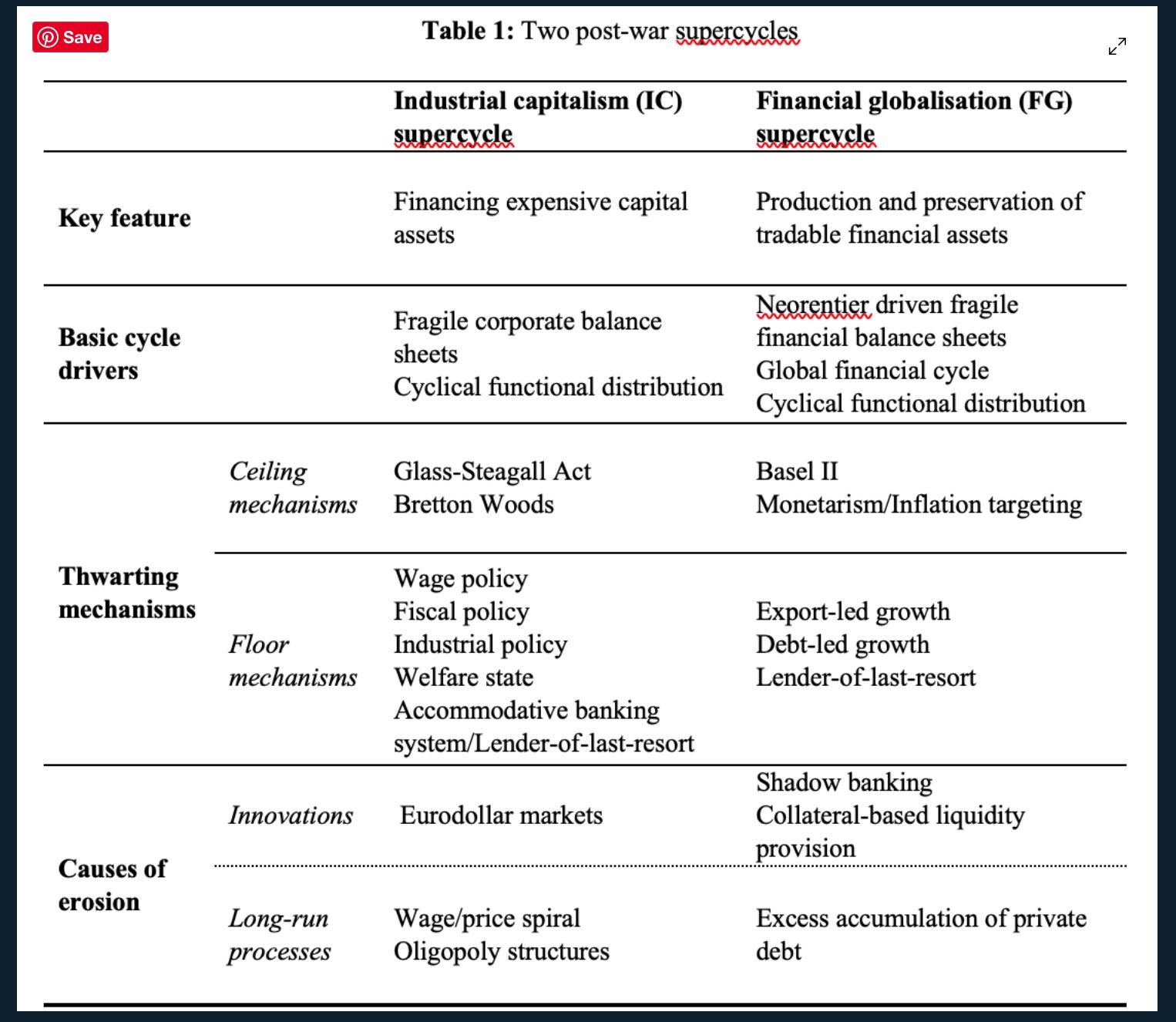
On this basis of this historical narrative they argue that:
Since around 2013 … rich nations have been in the genesis phase of the supercycle: rapid institutional change triggered in the crisis phase of the financial globalisation supercycle
But where will this phase of institutional change lead? Will it lead to a new paradigm? As far as both the dollar system and the eurozone are concerned I am skeptical.
It is comforting perhaps to think of our current moment as an interregnum, a hiatus before a new more coherent structure emerges, whether "at the hands" of central bankers or not. But that implies that beyond the current phase of "transition" lies a new order, a new "regnum". Why should we assume that?
The chess analogy is compelling as a description of the ECB's impasse, but depicting history as a game can also be misleading. Outside the game, there is no fixed sequence of moves, nor is there a denouement in the form of a final checkmate.
The vision of an impending paradigm shift in central banking is, I fear, another example of the tendency of fin-fiction to generate out of the diagnosis of tension and dysfunction the promise of a resolution. But are we really facing the "implosion" of a paradigm? Is our reality not something less clear cut? Rather than a collapse or an implosion, is it not more likely that things will continue as they have done since 2008, in an on-going conservative rearguard action, based on a series of makeshifts and half measures?
****
I love sending Chartbook newsletter for free to thousands of readers around the world. But what sustains the effort are voluntary subscriptions from paying supporters. If you are enjoying the newsletter and would like to join the group of supporters, press this button and pick one of the three options.
There are three subscription models:
The annual subscription: $50 annually
The standard monthly subscription: $5 monthly - which gives you a bit more flexibility.
Founders club:$ 120 annually, or another amount at your discretion - for those who really love Chartbook Newsletter, or read it in a professional setting in which you regularly pay for subscriptions, please consider signing up for the Founders Club.
Several times per week, as a thank you, all paying subscribers to the Newsletter receive the full Top Links email with great links, reading and images.
★
https://www.rebuildingmacroeconomics.ac.uk/post/institutional-supercycles-an-evolutionary-macro-finance-approach
Institutional Supercycles: An Evolutionary Macro-Finance Approach
by Yannis Dafermos, Daniela Gabor, and Jo Michell ★
制度的スーパーサイクル:進化的なマクロファイナンスアプローチ
ヤニス・ダフェルモス、ダニエラ・ガボール、ジョー・ミッシェル著
新しいワーキングペーパーでは、ミンスキーの搾取されていない洞察を活用して、過去70年間のマクロ金融システムの進化の構造化分析を提供します。ミンスキーは、マクロ金融システムを安定させることを目的とした制度構造を「阻止メカニズム」と呼んだ。これらは、ミンスキーが「スーパーサイクル」と呼んだものの上に、抑うつ傾向(弱い経済活動など)、拡張傾向(高インフレなど)、またはその両方に床を置きました:制度構造の有効性がワックスと衰する制度的および政治的変化の長期的なプロセス。
私たちは、標準的なビジネスサイクルと金融サイクルよりも長い視野を持ち、制度的およびアイデアの闘争に固定されているマクロ経済学の「第3」サイクルを探ります。各スーパーサイクル上の阻止メカニズムのアーキテクチャは、社会階級と対立するアイデアセットの間の対立を反映しています。阻止メカニズムは、部分的には、利益を求めるエンティティによって駆動される進化プロセスの成果であり、環境に適応します。しかし、それらはまた、政治的支配をめぐる紛争の結果であり、どのアイデアが国の政治経済を支配しているかでもあります。
私たちは、豊かな国が戦後の2つのスーパーサイクルを通過したと、産業資本主義と金融グローバリゼーションを経たと肯定しています。分析を定量化するために、マクロ金融安定性指数(MSI)を導入します。これは、主要なマクロ金融変数が長期的な上限または下限から逸脱する程度をキャプチャし、それらを制約することを意図したメカニズムを回避します。MSIには、経済成長、雇用、資産価格、経常収支、信用量、インフレの尺度が含まれています。下の図は、主要なマクロ金融イベントのタイムラインとともに、1960年代初頭以降の米国と英国のMSIを示しています。マクロ金融の安定性は、戦後の2つのスーパーサイクルで上昇し、下降します。
図1:マクロ金融安定性指数(MSI)とスーパーサイクル、米国と英国、1952-2018
私たちは、これらのスーパーサイクルに4段階の分類を適用します。それぞれは、安定化メカニズムの有効性が増加する拡張期間から始まります。これに続いて、2008年までのシャドウバンキングの台頭が金融、財政、金融の安定政策の有効性を損なうなど、有効性が低下する満期段階が続きます。制度上の枠組みがもはやマクロ金融の不安定を制約できなくなると、マクロ金融システムは危機に陥る。この時点で、金融と経済活動によって推進される資本主義の通常のブーム・バストサイクルである「基本サイクル」の低迷は深刻な危機になります。
最終的に、危機の後には創世記が続きます:社会グループと政治グループの間の紛争から新しい阻止メカニズムが出現し、マクロ金融の安定性を提供することに効果的であれば、新しいスーパーサイクルを開始する可能性があります。
(下の表を参照)。
2013年頃以来、豊かな国はスーパーサイクルのジェネシス段階にあると主張しています。金融グローバリゼーションスーパーサイクルの危機段階で引き起こされた急速な制度的変化 - 例えば、最後のリゾートの貸し手と最後のリゾート事業と量的緩和における中央銀行の役割の大幅な拡大 - は、2008年の金融メルトダウンによって引き起こされた抑うつ傾向の下に床を置いています。
しかし、マクロ金融システムを安定させる新しい阻止メカニズムはまだ登場していません。コロナウイルス危機とそれが引き起こした急速な制度的変化(雇用維持制度の導入など)は、制度の進化の継続的なプロセスに影響を与えるだろう。
私たちは、新しいスーパーサイクルが出現すると、必然的に「グリーン」スーパーサイクルになると主張します。しかし、これは気候危機が効果的に緩和されるという意味ではありません。代わりに、気候危機によって引き起こされるマクロ金融の不安定を抑制しようとする阻止メカニズムと、潜在的に環境被害自体を制限しようとするメカニズムが出現します。
進行中の研究プロジェクトの次の段階は、「グリーン」スーパーサイクルの2つの可能なシナリオの詳細を分析し、それぞれの潜在的な結果を評価し、これに基づいて政策結論を導き出すことに焦点を当てます。
注:詳細については、こちらのワーキングペーパーを参照してください。
★
In a new working paper, we draw on under-exploited insights from Minsky to provide a structured analysis of the evolution of the macrofinancial system over the last 70 years. Minsky called institutional structures that aim to stabilise the macrofinancial system ‘thwarting mechanisms’. These put a floor on depressive tendencies (such as weak economic activity), a ceiling on expansionary tendencies (such as high inflation) or both, over what Minsky called the ‘supercycle’: a long-run process of institutional and political change over which the effectiveness of institutional structures wax and wane.
We explore a ‘third’ cycle in macroeconomics that has a longer horizon than the standard business and financial cycles, and is anchored in institutional and ideational struggles. The architecture of thwarting mechanisms over each supercycle reflects conflicts between both social classes and opposing sets of ideas: thwarting mechanisms are, in part, the outcome of evolutionary processes driven by profit-seeking entities adapt to their environment. But they are also the result of conflicts over political control and over which ideas dominate in national political economies.
We posit that rich nations have passed through two supercycles in the post-war period: Industrial Capitalism and Financial Globalisation. To quantify our analysis, we introduce the Macrofinancial Stability Index (MSI). This captures the extent to which key macrofinancial variables deviate from their long-run upper or lower bounds, and thus evade the mechanisms that are intended to constrain them. The MSI includes measures of economic growth, employment, asset prices, current account balances, credit volumes and inflation. The figure below shows the MSI for the US and the UK since the early 1960s, alongside a timeline of key macrofinancial events. Macrofinancial stability rises and falls across two post-war supercycles.
Figure 1: Macrofinancial Stability Index (MSI) and supercycles, US and UK, 1952-2018

We apply a four-phase categorisation to these supercycles: each begins with a period of expansion, during which the effectiveness of stabilising mechanisms increases. This is followed by a maturity phase during which effectiveness wanes, as for instance the rise of shadow banking up to 2008 erodes the effectiveness of monetary, fiscal and financial stability policies. The macrofinancial system falls into crisis once the institutional framework is no longer able to constrain macrofinancial instability. At this point, the downturn of the ‘basic cycle’ – the usual boom-bust cycle of capitalism, driven by finance and economic activity – becomes a serious crisis.
Eventually, the crisis is followed by a genesis period: new thwarting mechanisms emerge out of conflict between social and political groups, and may initiate a new supercycle if effective at providing macrofinancial stability.
(see Table below).

Since around 2013, we argue, rich nations have been in the genesis phase of the supercycle: rapid institutional change triggered in the crisis phase of the financial globalisation supercycle– for example the greatly expanded role of central banks in lender-of-last resort and market maker-of-last resort operations and quantitative easing – has placed a floor under the depressive tendencies triggered by the 2008 financial meltdown.
But a new set of thwarting mechanisms that will stabilise the macrofinancial system has not yet emerged. The coronavirus crisis, and the rapid institutional change that it has triggered (such as the introduction of job retention schemes) will influence the ongoing process of institutional evolution.
We argue that a new supercycle, when it emerges, will necessarily be a ‘green’ supercycle. But this does not mean that the climate crisis will be effectively mitigated. Instead, thwarting mechanisms will emerge that try to constrain the macrofinancial instability caused by the climate crisis, as well as, potentially, mechanisms that try to constrain environmental damage itself.
The next stage of our ongoing research project will focus on analysing the details of two possible scenarios for a ‘green’ supercycle, assessing the potential outcomes of each, and drawing policy conclusions on this basis.
Note: for more details see the working paper here
~~~~
「CAPEX」は、英語で「Capital Expenditure」と呼ばれ、事業の生産性や資産価値の向上を図るための投資コスト・設備投資を指しています。一方で「OPEX」は「Operating Expense」または「Operating Expenditure」とよばれ、事業を運営するために必要な諸々の費用のことです。
CAPEXが将来に向けた投資という側面を持つのに対し、OPEXは企業が日々展開しているビジネスに直結しているという側面を持ちます。そのためCAPEXとOPEXの数字と向き合う際には、
- CAPEXをできる限り削減する
- OPEXを適正に管理・削減する
の2つを行うことが重要になってきます。
https://mag.leaner.jp/posts/2217/CAPEX・OPEXとは?意味や違い、経営のためのキャペックスとオペックスを徹底解説
2020.12.17
CAPEX 「キャペックス」とOPEX「オペックス」を正しく理解・計算することで、キャッシュフローを健全化し、収益性を改善することができます。 CAPEXは設備投資等のコストを指し、OPEX は事業のランニングコストを意味します。
今回の記事では、CAPEXとOPEXの意味や計算・管理方法を説明します。また、損益計算書・貸借対照表・キャッシュフロー計算書などに基づいて、これら指標をどのように経営に役立てていけば良いのかを解説します。
TEXT BY Leaner Magazine編集部
CAPEXとOPEXの違いとは?
「CAPEX」は、英語で「Capital Expenditure」と呼ばれ、事業の生産性や資産価値の向上を図るための投資コスト・設備投資を指しています。一方で「OPEX」は「Operating Expense」または「Operating Expenditure」とよばれ、事業を運営するために必要な諸々の費用のことです。
CAPEXが将来に向けた投資という側面を持つのに対し、OPEXは企業が日々展開しているビジネスに直結しているという側面を持ちます。そのためCAPEXとOPEXの数字と向き合う際には、
- CAPEXをできる限り削減する
- OPEXを適正に管理・削減する
の2つを行うことが重要になってきます。
CAPEX「 Capital Expenditure 」の概要
CAPEX「Capital Expenditure)は、企業会計において、不動産や機械設備・IT基盤の価値を高めるための設備投資による支出を指しています。
設備投資の具体例としては、製造業者が生産性を高めるためにプラントや機械設備の購入を行う投資が挙げられます。そのほかにも建物や工場の拡張、サーバーなどのハードウェアの購入、大規模ITシステムの導入も含まれます。また不動産事業においては、建物の資産価値を高めるための投資費用がCAPEXに該当する場合もあります。
CAPEXを削減する方法
CAPEXは「投資コスト」と呼ばれることも多いです。CAPEXに分類される支出(設備投資)は設備や不動産などの価値を維持したり、高めることを目的としています。
しかし、投資はリターンが必ずしも約束されているわけではありません。新規ビジネスや商品から収益を生めなかったり、利益の回収が遅れた場合、CAPEXによる支出は企業の財務状況を圧迫させることになります。
CAPEXを削減することは、投資リスクを解消する上で、重要となります。
CAPEXをOPEX化する
CAPEXが持つリスクを解消する方法として「CAPEXをOPEX化」することが重要になります。その典型例がITシステムの導入です。
これまで企業がIT設備を導入するときには、CAPEXの支出として、ITベンダー・SIerからシステムを一括購入することが一般的でした。しかしこれら投資コストが収益から回収できるようになるには、数年の期間を要することも少なくありません。
そこで懸念されるのが、数年立った際に、導入したIT設備が時代遅れになっていることです。こうなると投資コストを回収しきれていない状態で、新たな設備投資を行う必要が生じ、財務上損失が出てしまいます。
そうしたCAPEXによる財務上のリスクを回避する手法として、従量課金制のクラウド系ITシステムを利用する企業がふえています。
たとえば、近年普及しはじめているクラウドERP(基幹業務システム)は、月額課金制で最新版のシステムを使いつづけることができます。財務面では、プロジェクトチーム単位でスモールスタートし、途中で解約することも簡単にできるため、ムダな支出を抑えられます。そしてこれら費用はCAPEXではなく、日々のランニングコストであるOPEXに該当します。
税務上でもCAPEXをOPEX化することでメリットが生じます。これは、OPEXに含まれる営業費用等は税控除を受けることが可能だからです。一方で、CAPEXは会社の資産価値を上げるための支出になるため、固定資産税の課税対象となります。
CAPEXを管理・計算する際の注意点
CAPEXをOPEX化し、かつコスト削減効果を見込める事業領域は増えています。また費用面を考慮しなかった場合、アウトソーシング・OEMを利用することでCAPEXの比重を落とし、OPEX化することが可能です。
しかし、それでもCAPEXの支出でしか賄えない事業領域は多々あります。くわえて自社のコア事業領域に連なる業務・事業を内製化することは、市場競争力を高める上で重要です。そのためにも自社のCAPEXを注視し、しっかりとコントロールすることはとても重要です。そうした際に、CAPEXを計算・把握するために使われるのが財務諸表です。
財務三表である損益計算書、貸借対照表、キャッシュフロー計算書は、企業の経営状況を診断する重要な指標となります。なかでも、CAPEXの影響が顕著に現れるのが、キャッシュフロー計算書です。
土地や大規模ITシステムを一括購入した場合、会社の賃借対照表上は資産として表記されます。また損益計算書では、購入費用を資産耐久年数で割り算した減価償却費として計上されます。
しかしキャッシュフロー計算書では、CAPEXの支出分だけ、現預金等が流出します。これは、会社の手元にある資金が減少したことを意味します。
黒字倒産してしまう企業はCAPEXのコントロールがうまくできていないことも多いです。黒字倒産とは、損益計算書の上では経常利益が黒字なのにキャッシュフロー計算書がマイナスになり、会社が資金ショートを起こして倒産してしまうケースです。
これはキャッシュフロー上、その年のCAPEXの支出によって手元の資金が底を尽きていても、損益計算書の上では減価償却費の分だけしか引かれず、経常利益が黒字になるためです。黒字倒産しないためにも、キャッシュフロー計算書をきちんと管理することが求められます。
OPEX( Operating Expenditure )の概要
OPEX( Operating Expenditure )は企業の人件費、宣伝広告費、研究開発費、旅費交通費、通信費など日々の営業活動に関わる費用が含まれています。
OPEXの支出は損益計算書の販売費および一般管理費(販管費)に該当するものが多いです。ただし販管費のなかでは、減価償却費や支払金利はOPEXに含まれず、かわりに研究開発費がOPEXに含まれます。
OPEXを適正に管理し、削減する方法
OPEXは、企業が展開しているビジネスを支えている支出だと言えます。そのため、経営面では品質や生産活動の低下を引き起こすことなく、OPEXを削減することが重要になります。
一方で企業の売上が伸びてもなかなか経常利益が増えない場合、OPEXをうまく管理できていないことが多いです。OPEXの中でも、事業規模が大きくなると拡大してしまう支出があり、それらを定期的に見直すことはとても大切です。
今回の記事では、企業が成長するに従って拡大してしまう費目として以下の5つの費用を紹介したいと思います。
*人件費
*消耗品費
*物流費
*外注費
*支払い手数料
人件費
人件費の見直しについては、まずは業務改革(BPR)を優先し、既存業務のフローチャートを見直しながら人員配置を最適化することがおすすめです。これによって残業代等のコストを削減し、社員の業務量適正化にも繋がります。
消耗品費
消耗品費の削減においては、サプライヤーに相見積もりを取ることで大きな削減を見込めます。相見積もりとは、複数のサプライヤーに対して見積もりを取り、その契約内容を同時に比較検討することで、最安価格を獲得する方法です。
物流費
物流費を削減するためには、運送業者と価格交渉を行うことで商品の輸送単価を適正価格まで落とすことができます。とくに垂直統合されたサプライチェーンを持っている企業にとっては、物流費が大きな比重を占めることになるでしょう。これは小売業や自動車産業に多く見受けられます。
支払手数料
銀行振込や海外送金に伴う支払い手数料も、事業拡大に応じてかさんでくる項目の1つです。
支払い手数料削減の基本は、手数料単価の引き下げです。インターネットバンキングや銀行振込み代行業者の選定・利用を開始することで、会社によっては、数十%のコスト削減を見込めることもあります。とりわけ、貿易など商品の売買に伴う取引が多い総合商社ではこれら費用が相対的に多く、支払手数料のコストダウンに取り組むといいでしょう。
外注費
外注費を見直す際には、業務要件を明確化し、サプライヤーと密にコミュニケーションを重ねたうえで、価格交渉を行う必要があります。とくに、外注費が多くの比重を占めているのがIT業界です。これはコア事業に焦点をしぼり、周辺業務をアウトソーシングしていることが多いためです。
OPEXを削減する際の注意点
OPEX内のコスト構造や特徴は業界ごとに変わってきます。そのため、業界や事業戦略に沿って、OPEXの数字を見直していく必要があります。
たとえば、製造業のOPEXは工場のランニングコストが多くの比重を占めているため、これらを注力して管理することが求められます。
特に工場の水道光熱費の削減は、比較的打ち手が豊富にあり、照明のLED化や電力・ガスプランの見直し、自家用水システムの導入や節弁などが有効な削減策として存在します。
またビジネスモデル上、OPEXが増えやすい事業もあります。その一例が通信業におけるMVNO(仮想移動体通信)事業者やラグジュアリー業界です。
MVNO事業者は、他社の通信インフラを借りて携帯・モバイルサービスを提供しています。そのため自社による設備投資は少なく、人件費等のOPEXに比重をかけることで事業拡大を目指すことになります。
またハイエンドなサービスを提供するラグジュアリー業界や高級ホテル業界でも、OPEXが高くなる傾向があります。これら業界では、サービスに掛かるランニングコストを抑えることよりも、顧客の満足度やブランド価値の維持を優先します。
そのため、一等地での店舗賃貸料や宿泊設備の水道光熱費、通信費が他の業界とくらべて、相対的に高まります。その代わりに顧客のリピート率やロイヤリティが向上し、ブランド価値の向上につながります。
終わりに
CAPEXとOPEXは会社運営上、必要不可欠な企業会計の概念です。事業を長期的に成長させるためには、この2つの数字をしっかりと把握し、慎重にコントロールしていくことが求められます。
CAPEXとOPEXのバランスを理解することで、継続的な事業投資と適切な経費削減を取ることができるようになると言えます。ぜひ、この記事を通じて皆様のCAPEXとOPEXに対する理解が深まれば幸いです。
~~~~

0 件のコメント:
コメントを投稿