参考:
Srinivas Thiruvadanthai on the Sectoral Financial Balance Approach to Macroeconomics | Mercatus Center
https://www.mercatus.org/bridge/podcasts/10172019/srinivas-thiruvadanthai-sectoral-financial-balance-approach-macroeconomicsイラスト出典Levy他論考1997
https://www.levyforecast.com/assets/Profits.pdf?__cf_chl_jschl_tk__=50ae1ba163229fed7f018101fa2a39df82661fc1-1595561172-0-AaJzITjcmaaq5GEHoxq0MCJqKE-0nkLK0yUk3XINFEDGKiPFiyPFUDImdha0GLvURqUE-ukHuixidodF0O7f0pmJhwE9eMvEbd9sVaTY7kfjAq5_X6VFvBwUphaGoAu7_2R7InGK4OsmfPQOVOd2acLfMnCB5SZFiRwwnLhUjzd2IMCBxbMcyKjhVaQHmMnmRl0uuvdWER5luKHHvUhl2MiQ2lodkYmbwlvjLxVec_X6_E1KFUj-n24bvc_vNRX2ocrYoxxj_5brNY7VfJOnjh1aMf1gOF_FsT2jJAa2yQdyu0IGDm77o0cY8xXbDBRSymb6Fz9s6bnqcXftojTGfK2TzQfkj6DsNlgBq0GsCvAi

| ||||||||||||||||||||||||



https://nathantankus.substack.com/p/where-do-profits-come-from
Where do profits come from?
A Guide to the Kalecki-Levy Profits Equation
利益はどこから来るのですか?
KALECKI-LEVY利益方程式のガイド
読者の皆さん、こんにちは。引っ越すことは、私が予想したよりもはるかに大きな手間であることが判明し、執筆に通常よりも少ない時間を残しています。しかし、私は利益がどこから来るのかについてのこの詳細な調査に取り組んでいます。今週末に別の投稿を行い、さらにエキサイティングなゲスト投稿がすぐに来るでしょう。マクロ経済調査ジャーナリズムに追加資金を調達することを提案した前回の発表に続いて、私はフリーランスのジャーナリストを雇って、州の失業オフィスの情報技術システムを調査しました。したがって、このスペースを見て、再承認が遅れた場合でも(または、ドアの外に出るメリットのレベルを変更しようとしても)どの程度の損害が発生するかについてのユニークで詳細なレポートを確認してください。ノート・オン・ザ・クライズに携わってくれた有料購読者に感謝 それがマクロ経済のジャーナリズム、理論、分析のためのユニークなアウトレットに発展するにつれて。
政府はくぼみの利益を赤字にしていますか?
定期的に、Twitterでのやり取りは、同僚の間で暗黙の知識を明示することは価値があることを思い出させます。私が定期的に話している経済政策アナリストの間で確立されている重要なポイントがあり、それは今私が持っている、はるかに幅広い、新しい聴衆に明確に伝える必要があります。数週間前、そのリマインダは、とのさえずりの対話の形で来た のGaurav Saroliya、 グローバル・マクロ戦略のディレクター 「オックスフォード経済学」予報大きな経済のために。私による別のツイートへの返信で、ガウラフ氏は政府の財政赤字は企業の利益を低下させる可能性があると主張した。彼らは、家計にもっと貯蓄するように要求することでこの結果を達成し、おそらく家計支出を減らし、それにより利益を下げるでしょう。
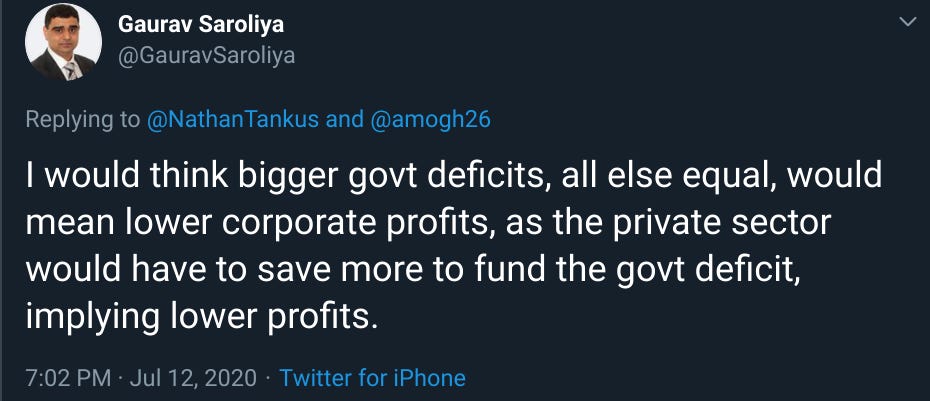
この推論は会計上の誤りに基づいていると私は主張した。非常に短いTwitterインタラクションの後、私はJerome Levy予測センターの出版物を引用しました。」、ガウラフは優雅かつ公に訂正を行いました。そのWebサイトに不慣れなことに不慣れな人にとって、これはTwitterではほとんど聞いたことがありません。
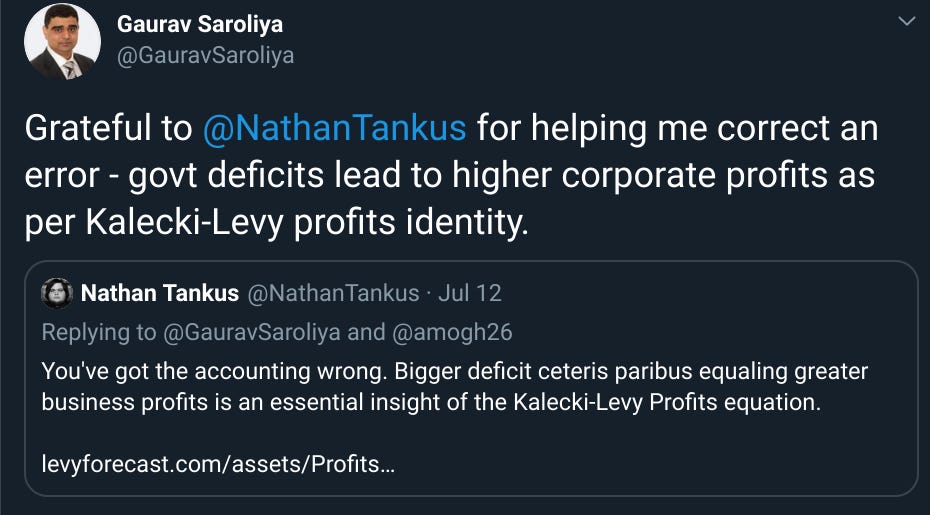
エラーの修正を支援してくれた@NathanTankusに感謝し ます。政府の赤字は、Kalecki-Levyの利益IDに従って企業の利益を増加させます。
それでも、相互作用は私に立ち往生しました。ガウラヴが犯した間違いをどれほど簡単にできるかを思い出させてくれたので、それは私にくっついた。実際、ほとんどの読者は、ガウラフ氏の発言がなぜ間違っていたのか、まだよくわかりません。これらの問題を検討するための適切なフレームワークがなければ、非常に賢い人々は、マクロ経済会計と矛盾する総利益と赤字支出について言います。今日は、マクロ経済学で最も重要な会計ステートメントの1つであるKalecki-Levy利益方程式について説明します。
利益はどこから来るのですか?
今日の記事のトピックに非常に興味があり、詳細を知りたい場合は、Levy Instituteの出版物「Where do Profits Come From?」を読むことを強くお勧めし ます。 これらの優れたイラストのいくつかを再掲載して、これらの会計関係をよりリアルに感じさせます。
背景として、方程式にちなんで名付けられた2人の男性について何か言うことは価値があります。Michal Kaleckiはポーランドの経済学者であり、マルクスの首都の第2巻を読んでここに提示されたマクロ経済会計の分析に来ました 。カレツキは、同じアイデアの多くを独立して生み出したケインズの同時代人として知られています。彼の同時代であるにもかかわらず、今日カレッキーは基礎的な「ポストケインズ派」の経済学者と考えられています。対照的に、 ジェローム・レビーは、自分の 利益がどこから来て いるのかを知るために、利益の方程式を独自に導き出したアメリカのビジネスマンでした 。
多くの人にとって、そのような異なる政治的見解を持つ2人の男性が、同様の分析的フレームワークに参加したことは興味深いことです。Kalecki-Levy利益方程式に組み込まれたKaleckiとLevyの関係は、ハイマンミンスキーが彼の人生の最後の数年間を過ごしたBard CollegeのLevy Economics Instituteの形で今日まで続き ます。(ミンスキーは、資本主義の彼自身の財務分析を開発する際にカレッキー・レヴィの利益方程式に依存していました。
多くの人にとって、そのような異なる政治的見解を持つ2人の男性が、同様の分析的フレームワークに参加したことは興味深いことです。Kalecki-Levy利益方程式に組み込まれたKaleckiとLevyの関係は、ハイマンミンスキーが彼の人生の最後の数年間を過ごしたBard CollegeのLevy Economics Instituteの形で今日まで続き ます。(ミンスキーは、資本主義の彼自身の財務分析を開発する際にカレッキー・レヴィの利益方程式に依存していました。
それでは、実際にはカレッキレビの利益方程式は何でしょうか。厳密には会計上の意味で、名目利益の合計が財政的にどこから来るのかを「説明」するのは、単に会計報告です。
言い換えれば、生産における物理的なインプットが価値を生み出すこと、またはそれらがまったく生み出すことについて話しているのではありません。それは別の議論です。会計のマクロ経済学における最も基本的な教訓の1つは、すべての売り手には買い手がいなければならず、すべての赤字には余剰がなければならないということです。Kalecki-Levyの利益の方程式は、これらのレッスンを有効活用して、企業が受け取る余剰がどこから来るかを理解します。
とはいえ、測定される余剰は純粋に財政余剰ではありません。非財務的価値も総利益にカウントされます。これは、まあ、それは個々の会社の利益にカウントされるので、成り立つ。投資支出は、企業が利益を削減することと同等ではありません。マシンの購入に100ドルを費やす企業は、現在100ドル相当のマシンを所有しています。費やした資金は損失ではありません。時間の経過とともに、そのマシンでの支出はコストとして認識されますが、その時点で関連する支出はありません 。
これは、減価償却と呼ばれる企業会計の概念 です。
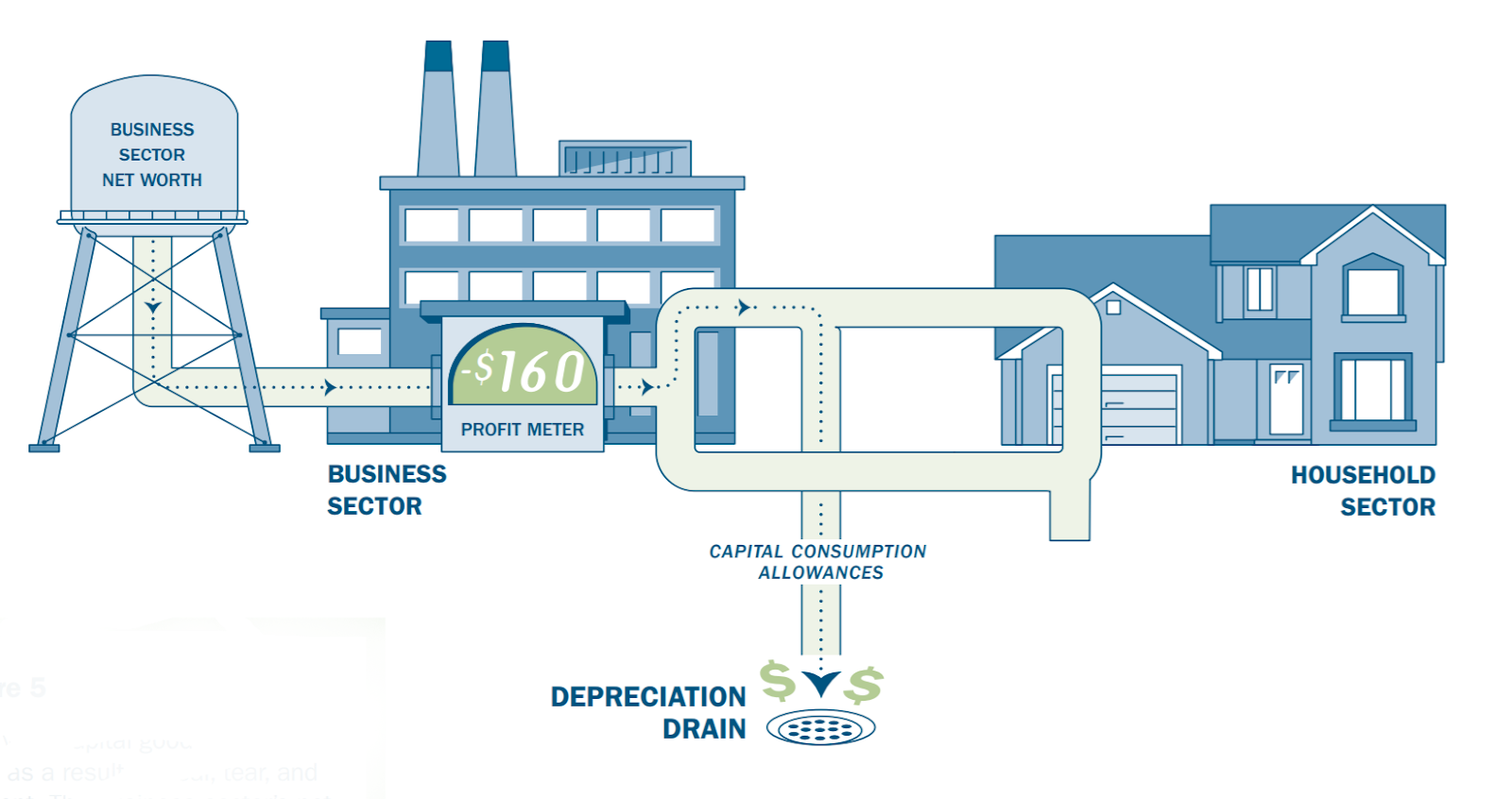
これらすべての結果は、政府、外国セクター、家計貯蓄を追加する前に、ビジネスセクターの測定された利益の基本的なソースは、ビジネス 自身の 投資支出であるということです。
投資支出はコストの要素ではないため、これらの資金が最終的にビジネスセクターに戻った場合、利益が増加します(それがどれほど可能性 があるかについては、後で検討します )。多くの人にとって、民間投資への焦点はこの基本的な会計関係から来ています。その後、民間投資自体 が経済を牽引するとの信念があり ます。より一般的には、ある種類の支出は、総事業費を生成せずに総事業収益を生成する場合、総利益を増加させると言えます。民間投資は、企業が直接管理する支出であり、この独特の特徴があるため、ユニークです。
投資支出はコストの要素ではないため、これらの資金が最終的にビジネスセクターに戻った場合、利益が増加します(それがどれほど可能性 があるかについては、後で検討します )。多くの人にとって、民間投資への焦点はこの基本的な会計関係から来ています。その後、民間投資自体 が経済を牽引するとの信念があり ます。より一般的には、ある種類の支出は、総事業費を生成せずに総事業収益を生成する場合、総利益を増加させると言えます。民間投資は、企業が直接管理する支出であり、この独特の特徴があるため、ユニークです。
投資=利益
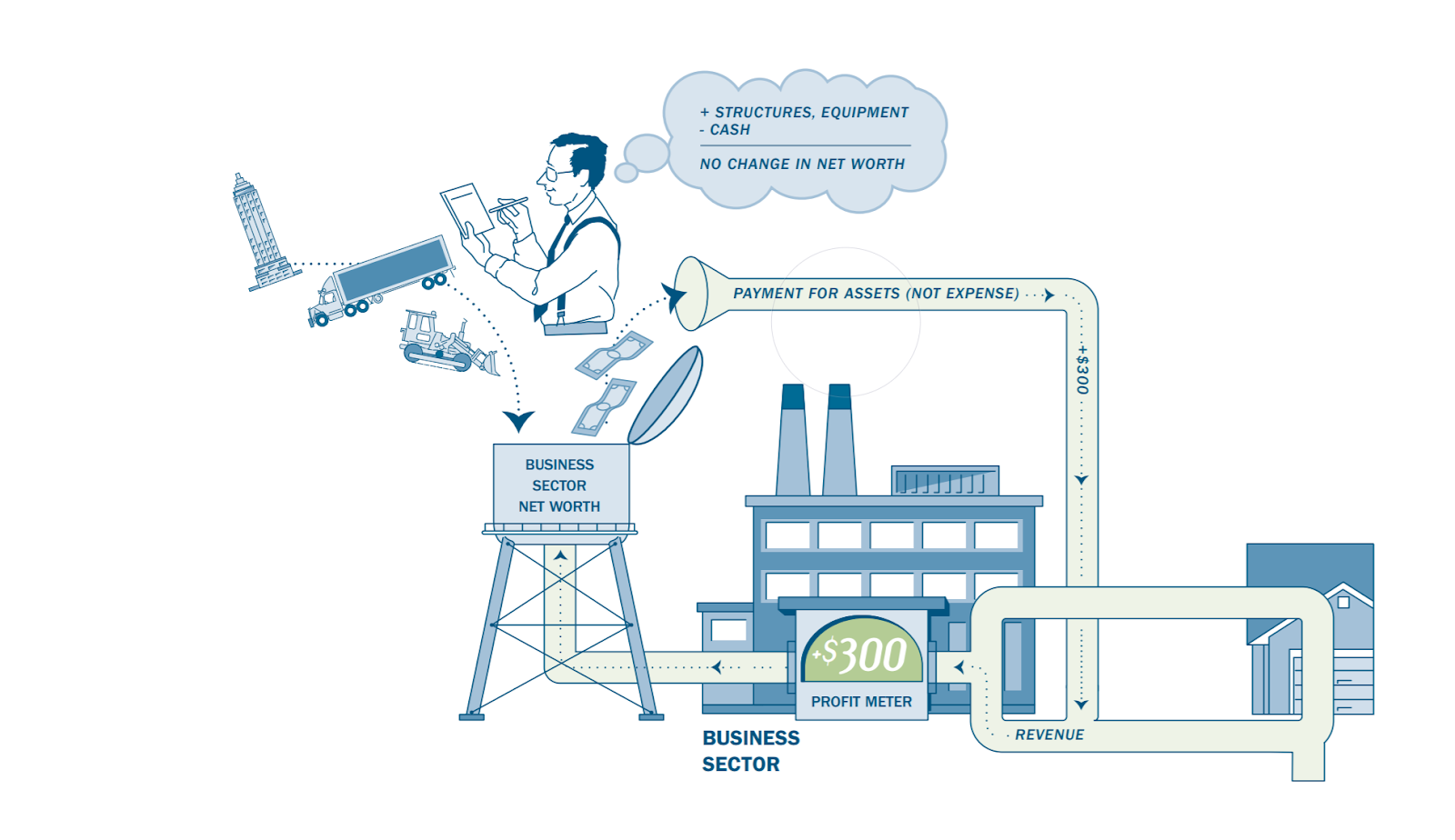
それでも、 マクロ経済会計の他の要素を学ぶ前に、人々がこれ(またはジョンメイナードケインズの同様の会計関係の投資=節約)について学ぶことを後悔することが あります。作成または購入される投資財には金銭的価値があるため、投資支出は民間部門の純資産を増加させるだけです。簡単に言えば 、民間投資のおかげで、民間部門の金融価値は変化しません 。総合的な財務利益を説明することが、より重要な出発点になると私には思われます。言い換えると、ビジネスのセクターの財務的純益を増加させる可能性のあるフローを特定します。これにより、個々の企業会計を学ぶことから、マクロ経済学を学ぶことができます。
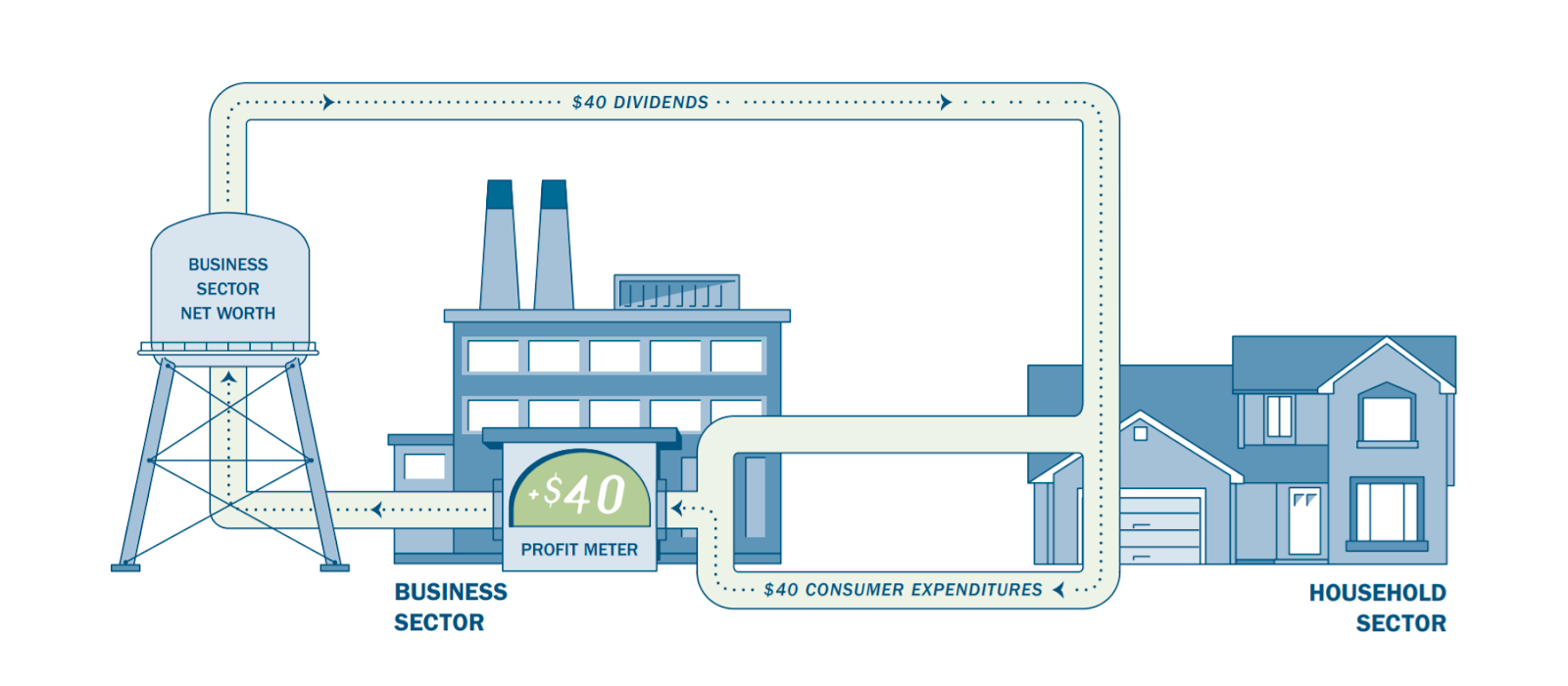
もちろん、収益としてビジネスセクターに流れ込むことはできますが、ビジネス費用として流れ出ない別のフロー、つまり配当があります。
配当は測定された利益に基づいており、利益の「分配」と見なされます。そのため、配当は費用として扱われることなく流出します。しかし、彼らはビジネスからの購入に資金を提供し、ビジネス収益を生み出す可能性があります。もちろん、多くの配当金は、現在の測定された収入が増加したため、実際には配当金のほんの一部のみが次の形式で企業に流れ込むため、支出(または世帯への支払い)を増加させない機関投資家のアカウントに流れ込みます販売の。世帯については、この問題にさらに取り組みます。これらのフローのどちらも、ビジネスセクターの財務的価値を高めることはできないことを強調することが重要です。したがって、この時点では、金融利益 はまだゼロです。
投資+配当=利益
0 =金融利益
政府はどのように利益を後押しできるか?
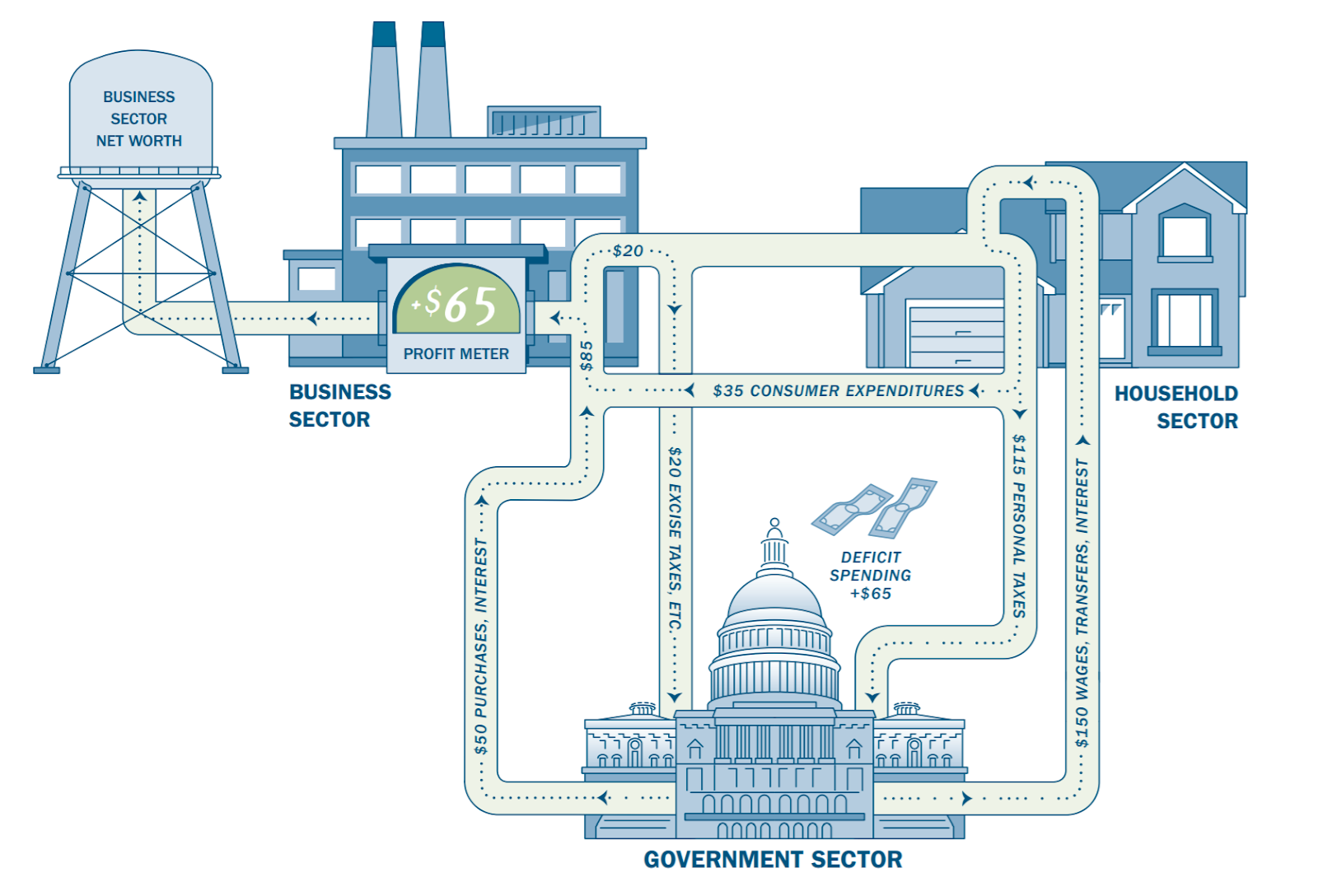
次に、現代の通貨理論家が注目していることで有名なものがあります。政府の財政赤字が民間部門に財政余剰を生み出す方法です。
これは、政府が現代の経済において独特の役割を果たすために可能です。政府の財政赤字のユニークな点は、誰もがより財政的に安全になる能力です。米国政府の財政赤字は、輸入の増加を通じて(国内民間部門に加えて)安全な資産を世界の他の地域に提供することさえできます。反対に、政府予算の黒字は総利益を押し下げるものであり、経済の純資産を枯渇させます。
これは、政府が現代の経済において独特の役割を果たすために可能です。政府の財政赤字のユニークな点は、誰もがより財政的に安全になる能力です。米国政府の財政赤字は、輸入の増加を通じて(国内民間部門に加えて)安全な資産を世界の他の地域に提供することさえできます。反対に、政府予算の黒字は総利益を押し下げるものであり、経済の純資産を枯渇させます。
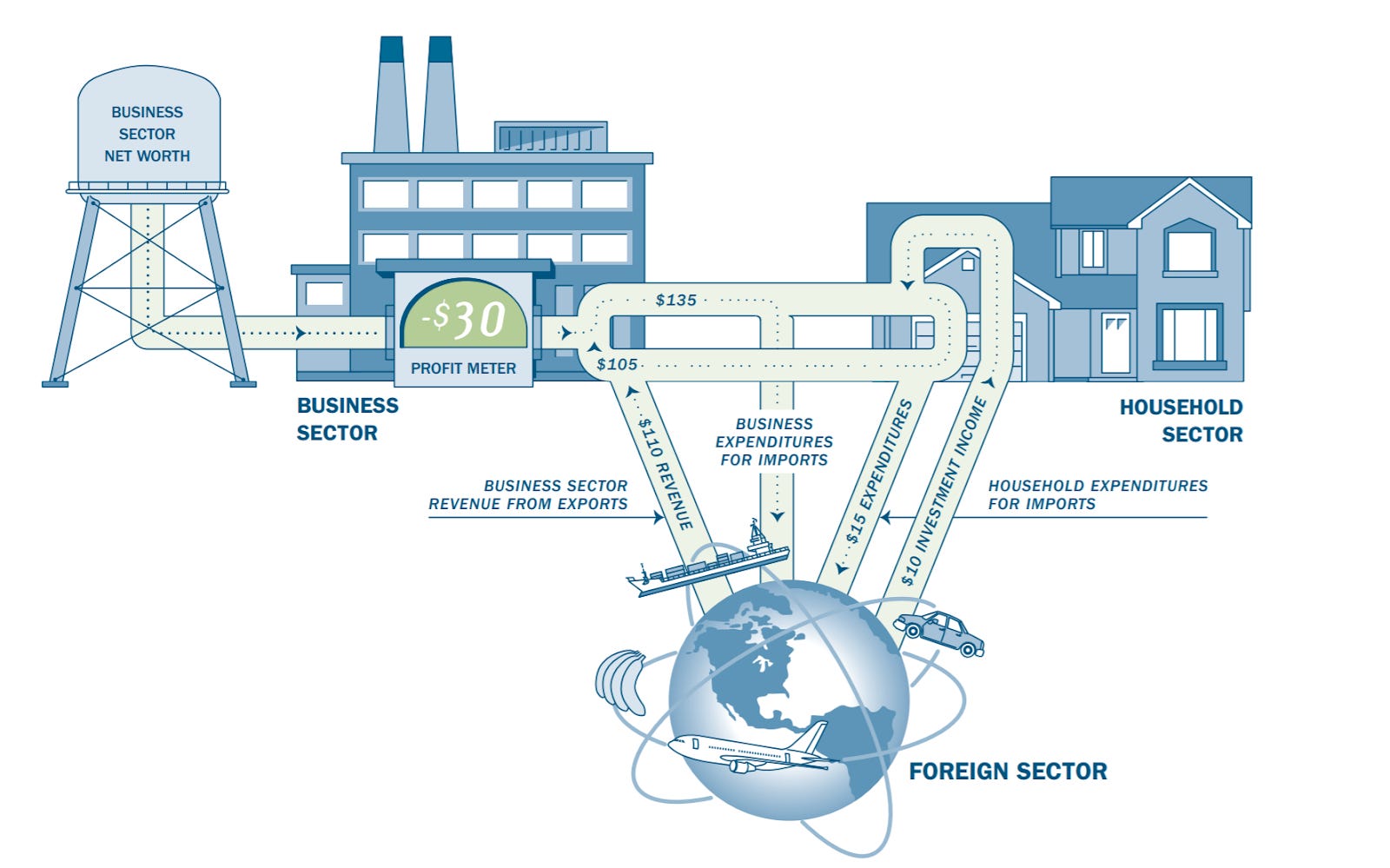
下の図をよく見ると、私が何度も繰り返してきたポイントの図が表示されます。家計への現金支払いは 、企業への間接的な財政支援です。あなたは彼らにお金を与えます、彼らは彼らの家賃を払います 。あなたは世帯にお金を与えます、彼らは購入をします。あなたは家計にお金を与えます、彼らは事業利益になる利子を支払います(元本を支払うことは家計貯蓄の形であり、これについては後で説明します)。しかし、読者はこれから教訓を得るべきではありません。政府のすべての財政赤字はガチョウの利益であるということです。彼らはまた、世帯自身により多くの財政的安全を提供することができます。そして、私の観点から、明らかにすべきです。
投資+配当+政府予算残高=利益
政府予算バランス=金融利益
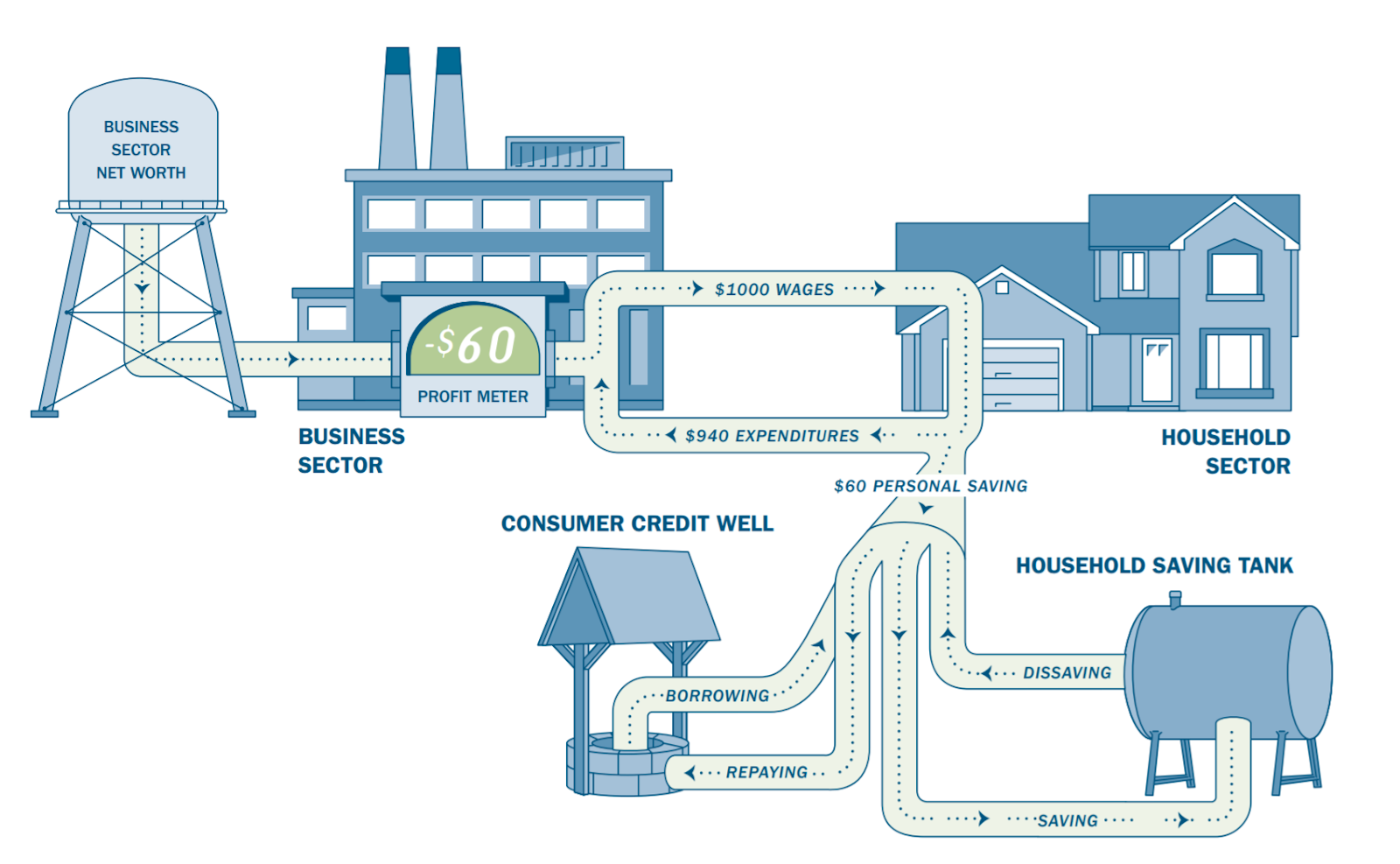
これは私たちに家計の問題をもたらします。ほとんどの場合、家計は貯蓄が資金を吸い上げているため、家計は利益を金銭的に「引きずる」ものです。これは、賃金をビジネスセクターに完全に還元していない企業の従業員であろうと、給与の一部を節約している連邦政府の従業員であろうと、同様に当てはまります。そうでなければ利益を増加(または維持)するこれらの他のフローは、 ビジネスに到達する前に縮小さ れています。
この最後のポイントを強調することが重要です。他のすべてのものが等しい場合、予算赤字は単に利益を増加させ、家計貯蓄はそれらを減少させます。しかし、すべてが等しいわけではなく、マクロ経済会計では、1つのセクターの財政状態を一定に保つことはできません。非ビジネスセクター間でシフトが発生し、利益をすべてそのままにする場合があります。補足的な失業手当と一緒に刺激チェックはこれの良い例を提供します。これらの現金の支払いは 、受け取った月に家計がすぐに使うことはなかっ たため、個人の貯蓄率が大幅に上昇しました。政府予算の赤字が増えると、家計の貯蓄が直接的に増え 、事業の利益には影響がありません。
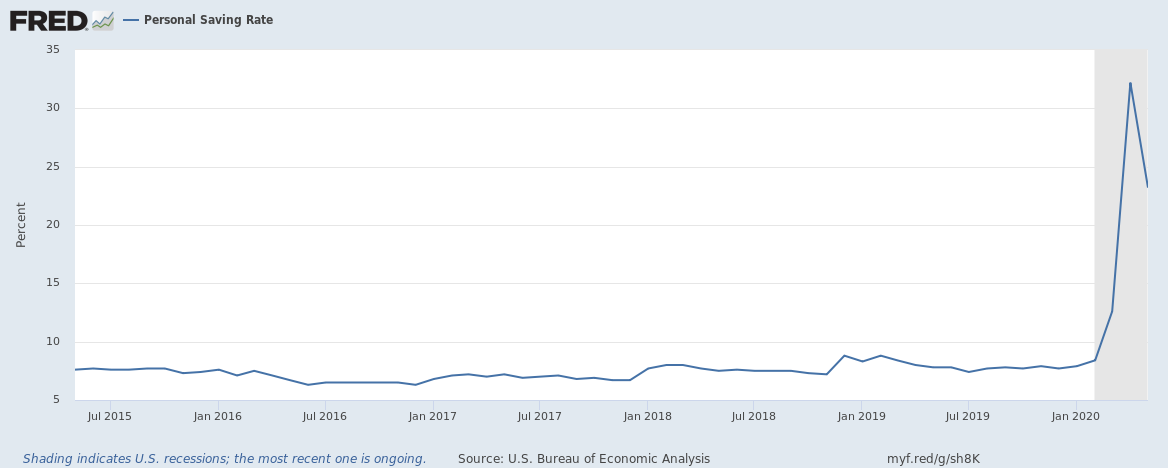
もちろん、それは長続きしませんでした。
世帯は、売上高(したがって利益)を増加させる緊急現金支払いを使い始めました。そして今、州が「刺激」チェックを更新せずに拡大した失業保険を解約した場合、世帯は一時的な財政保護層を失うことになります。差し迫った避けられない結果として、企業の売上高(および利益)は引き続き急降下します。事業売上高はどこから利益を引き出しますか?
繰り返しますが、私たちが今見ているのは会計関係です。これらに厳密に焦点を合わせるには、いくつかの明らかな制限があります。彼らは何が何を引き起こしているのか教えてくれません。しかし、それらは私たちの考えを構造化し、因果関係をより明確に識別できるようにします。これを演習と考えてください。マクロ経済の観点から考えるのに役立ちます。
投資+配当+政府予算残高+家計部門残高=利益
政府予算残高+家計部門残高=金融利益
最後に、確かに重要なことですが、外国のセクターがあります。「国内」という観点から見ると、外国部門の余剰は常に赤字に見える。具体的には、経常収支の赤字。政府の財政赤字の増加などで相殺されない場合、経常収支の赤字は企業部門の利益を浪費します。一方、ノルウェーや中国などの国では、経常収支の大きな黒字が事業利益の源となっています。彼らは、民間部門と公共部門の両方が黒字を実行するのを容易にします。これらの国々は、世界の他の地域の赤字支出なしではそれを行うことができませんでした。
これで、完全なKalecki-Levy利益方程式と、それに相当する財務利益が得られました。
投資+配当+政府予算残高+家計部門残高+経常収支残高=利益
政府予算残高+家計部門残高+経常収支=金融利益
いくつかの基本的な代数的操作を使用すると、利益方程式(セクター別バランス方程式と呼ばれるもの)から導出できます 。これは、すべての剰余について 、対応する赤字が存在する必要があることを明確に示してい ます。
政府予算残高+国内民間部門+当座預金残高= 0
これら2つの会計方程式を使用して、個々の経済、実際には世界経済がどのように機能するかについて多くを学ぶことができます。また、これら2つの方程式(およびその下の関係)が頭の最前線にない場合に、非常に簡単に発生するエラーを回避するのにも役立ちます。彼らは私たちにすべてを教えてくれるわけではありません—政府、企業、家計が実際にどのように振る舞うかを知る必要があります—しかし、これは良い出発点です。
金融政治経済への私の情熱を共有する人々は、これが役立つ復習だと思うかもしれません。しかし、私はこの短い要約を読んだだけで多くのことを学んだと思います。「利益はどこから来るの?」という長いパンフレットでより多くの時間を過ごすことをお勧めし ます。、ここからこの投稿のイラストを取りました。(彼らはそこにもっと素晴らしいイラストを持っています)。演習として、読者は、学んだことすべてを振り返り、ガウラフの過ちが何であったかに対する自分の答えを提供するために、少し時間をかける必要があります。
★
Hello Readers. Moving has turned out to be a much bigger hassle than I expected, leaving me with less time than usual for writing. I have however been working on this deep dive into where profits come from.. I’ll have another post up this weekend, and more exciting guest posts coming soon. Following my previous announcement where I proposed sourcing additional funding for macroeconomic investigative journalism, I’ve hired a freelance journalist to investigate the Information Technology systems of state unemployment offices. So watch this space for some unique and in-depth reporting on how much damage will be done by even a late reauthorization (or any attempt to change the level of benefits going out the door). Thank you to my paid subscribers for bearing with Notes on the Crises as it develops into a unique outlet for macroeconomic journalism, theory, and analysis.
Do Government Deficits Dent Profits?
Periodically, an interaction on Twitter reminds me that it is worthwhile to make implicit knowledge among my colleagues explicit. There are important points which are well established among the economic policy analysts I regularly speak to which still need articulating to the new, much wider, audience that I now have. A couple weeks ago, that reminder came in the form of a twitter interaction with Gaurav Saroliya, the Director of Global Macro Strategy for the large economics forecaster “Oxford Economics”. In reply to another tweet by me, Gaurav argued that government budget deficits had the potential to lower corporate profits. They would achieve this outcome by requiring households to save more, thus presumably lowering household spending, and thus profits.
I argued that this reasoning was based on an accounting error. After a very brief twitter interaction, in which I cited the Jerome Levy forecasting center publication “Where do Profits Come From?”, Gaurav gracefully and publicly issued a correction. For those mercifully unfamiliar with that website, this is almost unheard of on Twitter.
Still, the interaction stuck with me. It stuck with me because it reminded me just how easy it is to make the mistake Gaurav made. In fact, most readers are probably still unsure why what Gaurav said was wrong. Without having the right framework to think through these problems, very smart people say things about aggregate profits and deficit spending which are inconsistent with macroeconomic accounting. So today, I’m going to be explaining one of the most important accounting statements in macroeconomics- the Kalecki-Levy profits equation.
Where Do Profits Come From?
If you’re very interested in the topic of today’s article and want to know more, I highly recommend reading The Levy Institute’s publication “Where do Profits Come From?” I’ll be reposting a few of their great illustrations to make these accounting relations feel more real.
By way of background, it is worth saying something about the two men the equation is named after. Michal Kalecki was a Polish economist, who came to the analysis of macroeconomic accounting presented here by reading volume 2 of Marx’s Capital. Kalecki is known as a contemporary of Keynes, who came to many of the same ideas independently. Despite being his contemporary, today Kalecki is considered a foundational “Post-Keynesian” economist. By contrast, Jerome Levy was an American businessman who derived the profits equation independently, in pursuit of the knowledge of where his own profits were coming from.
For many, it is of interest that two men of such differing political views came to such a similar analytical framework. The relationship between Kalecki and Levy embedded in the Kalecki-Levy profits equation continues to this day in the form of the Levy Economics Institute at Bard College, where Hyman Minsky spent the last years of his life. (Minsky relied on the Kalecki-Levy profits equation in developing his own financial analysis of capitalism, work which I will return to another time).
For many, it is of interest that two men of such differing political views came to such a similar analytical framework. The relationship between Kalecki and Levy embedded in the Kalecki-Levy profits equation continues to this day in the form of the Levy Economics Institute at Bard College, where Hyman Minsky spent the last years of his life. (Minsky relied on the Kalecki-Levy profits equation in developing his own financial analysis of capitalism, work which I will return to another time).
So what actually is the Kalecki-Levy profits equation? It’s simply an accounting statement that, in strictly an accounting sense, “explains” where total nominal profits come from, financially.
In other words, we’re not talking about what physical inputs in production create value, or whether they do at all. That is a different discussion. One of the most basic lessons in the macroeconomics of accounting is that for every seller there must be a buyer, and for every deficit there must be a surplus. The Kalecki-Levy profits equation puts these lessons to good use to figure out where the surplus businesses receive come from.
That said, the surplus being measured is not a purely financial surplus. Non-financial value also counts towards aggregate profits. This holds because, well, it counts towards individual company profits. Investment Expenditures are not equivalent to firms shedding profits. A company that spends 100 dollars purchasing a machine now has a machine worth 100 dollars — those funds spent are not a loss. Over time the expenditure on that machine will be recognized as a cost, but there won’t be any associated expenditure at that time.
This is the business accounting concept known as depreciation.
The upshot of all this is that before you add governments, foreign sectors and household saving, the basic source of measured profits for the business sector is the business’s own investment expenditures.
Since investment expenditures aren’t an element of costs, if those funds end up back in the business sector , they will increase profits (we’ll examine how likely that is in a moment). For many, the focus on private investment comes from this fundamental accounting relation. Following from that is a belief that private investment itself drives the economy. More generally, we can say a type of expenditure increases aggregate profits when it generates aggregate business revenue without generating aggregate business expenses. Private investment is unique because it's an expenditure businesses directly control, which has this distinctive feature.
Since investment expenditures aren’t an element of costs, if those funds end up back in the business sector , they will increase profits (we’ll examine how likely that is in a moment). For many, the focus on private investment comes from this fundamental accounting relation. Following from that is a belief that private investment itself drives the economy. More generally, we can say a type of expenditure increases aggregate profits when it generates aggregate business revenue without generating aggregate business expenses. Private investment is unique because it's an expenditure businesses directly control, which has this distinctive feature.
Investment=Profits
Still, sometimes I regret that people learn about this (or John Maynard Keynes’s similar accounting relation investment=saving) before learning other elements of macroeconomic accounting. Investment expenditures only increase the net-worth of the private sector because the investment goods being created or purchased have monetary value. Put simply: the financial net-worth of the private sector doesn’t change because of private investment. It seems to me that explaining aggregate financial profits would be a more important starting point. In other words, identifying flows that can increase the business’s sector’s financial net-worth. This would allow us to disentangle learning macroeconomics, from learning individual business accounting.
There is, of course, another flow which can flow back into the business sector as revenue, but doesn’t flow out as a business expense — dividends.
Dividends are based on measured profits and considered a “distribution” of profits. As such, dividends flow out without being treated as expense. But they could possibly finance a purchase from a business, thus creating business revenue. Of course, many dividends flow into the accounts of institutional investors who aren’t going to increase their expenditures (or payouts to households) because their current measured income has increased so in practice only a small portion of dividends flow back to businesses in the form of sales. We’ll tackle this question more when we get to households. It’s important to emphasize that neither of these flows can increase the financial net-worth of the business sector. So at this point, financial profits are still zero.
Investment+Dividends=Profits
0=Financial Profits
How Can Governments Boost Profits?
Next up, we have something that Modern Monetary Theorists are famous for focusing on —how government budget deficits can generate financial surpluses for the private sector.
This is possible because governments play a distinctive role in contemporary economies. What’s unique about government budget deficits is their ability to make everyone more financially secure. U.S. government budget deficits can even provide safe assets to the rest of the world (in addition to the domestic private sector) through increasing imports. On the flipside, government budget surpluses are a drag on aggregate profits, and drain financial net-worth from the economy.
This is possible because governments play a distinctive role in contemporary economies. What’s unique about government budget deficits is their ability to make everyone more financially secure. U.S. government budget deficits can even provide safe assets to the rest of the world (in addition to the domestic private sector) through increasing imports. On the flipside, government budget surpluses are a drag on aggregate profits, and drain financial net-worth from the economy.
If you look at the graphic below closely, you’ll see an illustration of a point I’ve been making over and over: cash payments to households is indirect financial support to businesses. You give them money, they’ll pay their rent. You give households money, they’ll make purchases. You give households money, they’ll pay interest which becomes business profits (paying down principal is a form of household saving, a point we’ll discuss below). However, readers shouldn’t take the lesson from this that all government budget deficits do is goose profits. They can also provide more financial security to households themselves. And from my perspective, clearly should.
Investment+Dividends+Government Budget Balance=Profits
Government Budget Balance=Financial Profits
This brings us to the question of households. Most of the time, households are a financial “drag” on profits, because their saving siphons off funds. This holds equally true whether we’re talking about an employee of a business who doesn’t fully return their wages to the business sector, or an employee of the federal government who saves part of their salary. These other flows that would otherwise increase (or sustain) profits are being shrunk before they get to businesses.
It’s important to emphasize this last point: if all other things were equal, a budget deficit would simply increase profits and household saving would reduce them. But not everything is equal and with macroeconomic accounting, you can’t hold one sector’s financial position constant.. Sometimes shifts happen between non-business sectors that leave profits untouched all together. The stimulus checks along with the supplementary unemployment benefits provide a good example of this. These cash payments weren’t immediately spent by households in the month they were received, which led to a big jump in the personal saving rate. Increasing government budget deficits straightforwardly increased household saving, without any effect on business profits.
Of course, that wasn’t going to last.
Households started spending the emergency cash payments which increased sales (and thus profits). And if the state now cuts off expanded unemployment insurance while not renewing the “stimulus” checks, households will lose their temporary financial layer of protection. As an immediate and unavoidable consequence, business sales (and profits) will continue their nosedive. Where else would business sales pull their profits from?
Again, what we’re looking at right now are accounting relations. A strict focus on these has some obvious limits. They don’t tell us what is causing what. But they structure our thinking, so that we can identify causal relationships more clearly. Think of this as an exercise, to help us to think in macroeconomic terms.
Investment+Dividends+Government Budget Balance +Household Sector Balance=Profits
Government Budget Balance +Household Sector Balance=Financial Profits
Last, but certainly not least, there is the foreign sector. From the point of view of the “domestic country” the surplus of the foreign sector always appears as a deficit. Specifically, the current account deficit. If not offset by, say, an increase in the government budget deficit, then current account deficits drain profits from the business sector. Meanwhile, for countries like Norway or China, large current account surpluses are a source of business profits. They facilitate both the private sector and the public sector running surpluses. These countries couldn’t do it without the deficit spending of the rest of the world.
We now have the full Kalecki-Levy profits equation, and its financial profits equivalent:
Investment+Dividends+Government Budget Balance +Household Sector Balance +Current Account Balance=Profits
Government Budget Balance+Household Sector Balance+Current Account Balance=Financial Profits
With some basic algebraic manipulation you can derive from the profits equation — what’s known as the sectoral balances equation. This shows us clearly that for every surplus, there must be a corresponding deficit.
Government Budget Balance+Domestic Private Sector+Current Account Balance=0
With these two accounting equations we can learn a lot about how an individual economy — indeed the world economy — functions. They also help us to avoid errors which are very easy to make when we don’t have these two equations (and the relations underneath them) at the forefront of our minds. They don’t tell us everything — we still need to know how governments, businesses and households actually behave — but this is a good start.
Those who share my passion for monetary political economy may have found this a helpful refresher. But I suspect a lot of you have learned a lot just by reading this short summary. I really recommend spending more time with the longer pamphlet “Where Do Profits Come From?”, which is where I took the illustrations for this post from. (They have more great illustrations in there). As an exercise, readers should take some time to reflect on all that they’ve learned, and provide their own answers to what Gaurav’s mistake was.
iPhoneから送信

317 金持ち名無しさん、貧乏名無しさん (ワッチョイ 8dc9-A8vS)[sage] 2022/03/13(日) 00:04:35.30 ID:hdQOn2yg0
返信削除Where do profits come from? 利益はどこから来るのですか?
A Guide to the Kalecki-Levy Profits EquationKalecki-Levy利益方程式のガイド
Notes on the Crises
Published by Nathan Tankus. He is Research director of the Modern Money Network.Bylines in the Financial Times,
Business Insider, The Guardian &American Prospect
https://nathantankus.substack.com/p/where-do-profits-come-from?s=r
私は、この推論は会計上の誤りに基づいていると主張しました。非常に短いTwitterインタラクションの後、
私はJeromeLevy予測センターの出版物「利益はどこから来るのか? 」を引用しました。」、Gauravは
優雅にそして公に訂正を出しました
利益はどこから来るのですか?
今日の記事のトピックに非常に興味があり、もっと知りたい場合は、LevyInstituteの出版物「利益はどこから
来るのか」を読むことを強くお勧めします。これらの会計関係をよりリアルに感じさせるために、彼らの素晴らしい
イラストのいくつかを再投稿します。
背景として、方程式の名前にちなんで名付けられた2人の男性について何か言う価値があります。ミハウ・カレ
ツキはポーランドの経済学者であり、マルクスの資本論の第2巻を読んで、ここに提示されたマクロ経済会計の
分析に来ました。カレツキはケインズの同時代人として知られており、ケインズは独立して同じアイデアの多く
に到達しました。彼の同時代人であるにもかかわらず、今日、カレツキは基本的な「ポストケインズ派」経済
学者と見なされています。対照的に、ジェローム・レヴィは、彼自身の利益がどこから来ているのかという知識
を追求して、利益方程式を独立して導き出したアメリカのビジネスマンでした。
多くの人にとって、そのような異なる政治的見解を持つ2人の男性がそのような同様の分析的枠組みに到達
したことは興味深いことです。カレツキとレビーの利益方程式に組み込まれたカレツキとレビーの関係は、ハイマン・
ミンスキーが人生の最後の年を過ごしたバード大学のレビー・エコノミックス・インスティテュートの形で今日まで
続いています。(ミンスキーは、資本主義の彼自身の財務分析を開発する際にカレツキ-レヴィの利益方程式
に依存していました。これについてはまた別の機会に説明します)。
では、実際にはカレツキ-レビーの利益方程式は何ですか?これは、厳密に会計上の意味で、名目利益の
合計がどこから来るのかを財務的に「説明」する単なる財務諸表です。
言い換えれば、私たちは、生産における物理的な入力がどのような価値を生み出すのか、あるいはそれらが
まったく価値を生み出すのかどうかについて話しているのではありません。それは別の議論です。会計のマクロ
経済学における最も基本的な教訓の1つは、すべての売り手には買い手が必要であり、すべての赤字には
余剰がなければならないということです。Kalecki-Levyの利益方程式は、これらの教訓を有効に活用して、
余剰企業がどこから来るのかを把握します。
https://www.levyforecast.com/assets/Profits.pdf
返信削除Where do profits come from?
Published by The Jerome Levy Forecasting Center, LLC Answering theCritical Question ThatFewEverAsk David A. Levy Martin P. Farnham Samira Rajan
2008
返信削除地域通貨花子1
@TiikituukaHana
@StephanieKelton cf.
Where do profits come from?
A Guide to the Kalecki-Levy Profits Equation
Nathan Tankus
nathantankus.substack.com/p/where-do-pro… pic.twitter.com/Axvw4RSP5O
2022/09/21 23:59
https://twitter.com/tiikituukahana/status/1572601314642890752?s=21