NAMs出版プロジェクト: ピグーの不遇:メモ
http://nam-students.blogspot.jp/2015/04/blog-post_78.html


第9章 ポスト·ケインズ派貨幣理論とカレツキ
207
「定常状態」としての長期的な完全雇用均衡が達成されるであろうと言う。こ
れが今日,「ピグー効果」と呼ばれているものにほかならない。
これに対して,カレツキは次のように論じて,ピグーの見解を否定する。
《もしすべての貨幣(現金と預金)が個人と企業に対する債権によって「裏づけられている」とすれば,すなわち,もし銀行組織のすべての資産がそのような債権から構成されているとするならば,貨幣ストックの実質価値の増加は諸資産の総実質価値の増加を意味しない。というのは,この場合,貨幣保有者の利得には,銀行の債務者のそれに等しい損失が対応しているからである(*1)。資産の総実質価値は,貨幣が金によって裏づけられている程度に応じてしか増大しないのである》(ibid., p. 343, ( ) 内は原著者のもの)。
たとえば,すべての貨幣が金準備によって裏づけられているような商品貨幣
経済においては,賃金切り下げによって引き起こされるデフレーションは,経
についての純資産総額の増加をもたらす。これに対して,貨幣が債権·
債務から成る信用貨幣経済においては, デフレーションは債権者の購買力を増
加させる一方で,債務者の実質的な負担を増大させる。こうして債務者から債
権者への購買力の移転が発生し,債務者の支出が減少することによって、ピ
グー効果の働きは相殺されてしまうことになる。したがって,金ストックが国
民資産の額に比べて著しく小さいならば,完全雇用所得からの貯蓄がゼロであ
るような点に到達するためには,大幅な賃金切り下げと物価水準の下落が必要
とされるであろう。しかし,とカレツキは言う。
《必要とされる調整は,負債の実質価値を破滅的に増大させ,その結果,全般的な破産と「確信の危機」をもたらすであろう。おそらく,そのような「調整」が最後まで成し遂げられることは決してないだろう。 もし労働者が無制限な賃金切り下げ競争のゲームをあくまで続けるならば, 雇用主からの圧力のもとに,政府は賃金ストップを導入するであろう》(ibid., p. 343) 12)。
ピグー効果
ピグー効果(ピグーこうか、英: Pigou effect)とは、特にデフレーションにおいて、資産(wealth)の実質価値の増加が生産高や雇用に刺激を与える効果のことである[1]。「資産効果」と呼ばれることもある[2][3]。
解説
物価と貨幣賃金が十分に下落すれば、消費者が保有している資産の実質的な価値が上がることにより、消費が増大(IS-LMモデルで言えば、IS曲線が右にシフト)し、雇用と生産が増え、完全雇用が達成される[4]とアーサー・セシル・ピグーは考えた。すなわち、ピグー効果を前提に考えると、仮に経済が不景気に陥り、失業(貨幣賃金の低下)が発生すると、デフレ状態になり、ピグー効果によって消費の増大(需要の増大)が起こり、そして雇用の増大がなされ、経済は自動的に(自己修正的に)景気回復へ向かうだろうということが言える。このピグー効果という用語は新古典派経済学者であるアーサー・セシル・ピグーの名前をとってドン・パティンキンが1948年に使いはじめた[5][6][7]。
しかしながら、G.バーバラーやT.シトフスキーはピグー以前にも同じ所得効果を指摘しており、現在では実質残高効果や資産効果と呼ぶことも多い[8]。ピグー効果が示された論文として有名なのは1943年のピグーの論文「The Classical Stationary State」である。なお、ピグーは新古典派の経済学者であることに留意する必要がある。
ここで、資産(wealth)とは、ピグーによって、マネーサプライと国債の和を物価で割ったものと定義されている[1]。ピグーは、賃金引下げによって物価(生産物の貨幣価格)が下がることによって、資産の実質価値が大きくなり、その実質購買力の増加が生ずるので、これが支出(特に消費支出)を刺激し、雇用が拡大すると論じた[9]。これがピグ―効果である。
彼は次の点が明記されていないジョン・メイナード・ケインズの『一般理論』は不十分であると論じた。すなわち、実質残高と現在の消費のつながりと、このような富効果が総需要の落ち込みに対して、ケインズが予測したよりも経済をより「自己修正的」にするだろうという点である[1]。
この「貨幣賃金を引き下げることによって雇用が増大する」というピグーのアイデアに対しては、「不況や失業を克服するためには政府が積極的に介入するべき」という立場を取るケインジアン達から批判がなされた。
ケインジアンとの論争

古典派の経済学者であったピグーは、彼ら古典派経済学者の基本的な信念である「技術等の諸条件が一定のもとで、もし労働者が競争的賃金政策に従うならば、経済体系は最終的には必ず完全雇用-定常状態に向かう」[10]という命題を論証する論文「The Classical Stationary State」を1943年に発表した。その中で述べられたのがピグー効果である。すなわち、貨幣賃金の引き下げが起こったとしても、ピグー効果によって(貨幣賃金および貨幣価値が完全に伸縮的であれば)自動的に完全雇用が達成されるというものである。
しかしながら、この「貨幣賃金の引き下げが結果的に雇用を拡大する」というアイデアに対しては、「不況や失業を克服するためには政府が積極的に介入するべき」という立場を取るケインジアン達から批判が起こった。本郷亮 (2013)によれば、ピグーとケインジアンの論争は第一期と第二期に分けられるが[11]、第一期はピグーとケインジアンであるニコラス・カルドア(およびジョン・メイナード・ケインズ)の論争である。ピグーとケインジアンの学者達は1937-38年の間に失業論争と呼ばれる論争を繰り広げた[12]。ピグーは1937年に「貨幣賃金の引き下げが完全雇用を達成させる」という趣旨の「Real and Money Wage Rates in Relation to Unemployment」という論文を発表し、これが失業論争の発端となった。この1937年の論文では、ピグーは暗黙のうちに彼自身が1933年に発表した論文「The Theory of Unemployment(失業の理論)」から踏襲していた「貨幣賃金の下落は利子率を上昇させる」という立場を取っていた(一方でケインズは一般理論において貨幣賃金の下落は利子率を下落させるという主張をしていた)。ピグーは1933年の「The Theory of Unemployment(失業の理論)」のときから、次のような議論に反対していた。すなわち、貨幣賃金が下がったとしても、同様に物価が下がってしまうので、実質賃金は下落せず、雇用の拡大は起こらないという議論である[13]。ピグーはこの議論に反対し、所得が産業活動に直接の影響を受けない「固定所得階級」を想定すれば、貨幣賃金の切り下げは雇用を拡大するとした[12]。すなわち、もしそのような固定所得階級が存在するなら、貨幣賃金が切り下げされても、物価の下落の程度は常に貨幣賃金の下落の程度よりも小さくなる。すると、貨幣賃金の切下げによって実質賃金が下落することになり、労働力が割安となるため、雇用が拡大する、というのがピグーの主張である。この前提によって、ピグーは平均貨幣賃金の下落が常に総雇用を上昇させるモデルを設定した[12]。この考えの下、ピグーは、貨幣賃金の切り下げは、固定所得階級が存在することで経済を直接的に活性化させるため、総貨幣需要を増加させ、結果として、貨幣賃金の切り下げは利子率を上昇させると彼は考えた。ピグーは1937年の論文「Real and Money Wage Rates in Relation to Unemployment」でも暗黙のうちに「貨幣賃金の切り下げは利子率を上昇させる」という立場を取っていた[12]。

しかし、このピグーの論文に対してカルドアとケインズは同じく1937年に「Prof. Pigou on money wages in relation to unemployment」というピグーに反論する論文を発表している(2人は同じ題で論文を載せたが、ケインズの論文とカルドアの論文は別々のものであり、ケインズの論文にカルドアの論文が添付されるというような形式で提出されたため、共同研究というわけではない)。ケインズは、「ピグーは貨幣賃金と利子率の間に直接の関連があることを見逃しており、ピグーの理論が正しくあるためには、貨幣賃金率が平均貨幣供給量の変動に応じて変化していなければいけない」[14]と述べた。 しかしながら、ピグーが認めたのはケインズの反論ではなく、カルドアの反論だった。カルドアは数学的な手法を使い、ピグーのモデルは貨幣賃金の下落が利子率の下落を伴わない限り雇用を増大させないことを数学的に証明した[14]。また、カルドアの反論は、J.R.ヒックスが1937年に創始したIS-LMモデル[15]によって説明することができる。すなわち、貨幣賃金が下落し、物価が下落したとすると、IS-LMモデル上ではLM曲線が右にシフトすることになる。しかし、もし流動性の罠が発生しているならばLM曲線が右にシフトしても利子率は下落せず、投資も増えることはなく、雇用も増えない。ピグーは1938年のカルドアへの返答論文で自身の誤りを認めた。このカルドアの論文はケインズとの連名で提出され、経済誌であるEconomic Journal47巻の743ページから753ページに掲載された[16]。なお、743-745ページがケインズによるもので[17]、745-753ページがカルドアによって書かれたものである[18]。


本郷亮 (2013)によれば、第二期は1941年に発表されたピグーによる論文「Employment and Equilibrium」以後のものである[11]。この第二期の議論は1941-50年の間に展開されたが、これらの議論はマーシャル体系とケインズ体系の一般化をめざす試みとして理解されている[19]。1943年にはピグーによって冒頭の「The Classical Stationary State」が発表された。この論文ではピグーは次のようにピグー効果を説明している。つまり、たとえ経済が流動性の罠に陥っていても、十分に貨幣賃金が下がり、物価が下がることで、資産の実質価値が上昇する。すると、この実質価値の上昇が、資産の実質購買力の上昇をもたらすため、支出(特に消費支出)が刺激され、その結果、雇用が拡大するというものであった[20]。この新しいルートであれば、たとえ利子率が下がらずとも支出が刺激され増加し、雇用が増大する[20]。IS-LMモデルで言えば、IS曲線が右にシフトし、完全雇用が達成される。ドン・パティンキンはこのような物価下落のもたらす消費の増大を「ピグー効果」と名付けた。これは実質残高効果とも呼ばれる。実質残高効果に対する反論としてはケインジアンであるミハウ・カレツキの1944年の論文 「Professor Pigou on "The Classical Stationary State": A Comment」などがある。
モデルによる説明
高見典和 (2010)によれば、ピグーの1937年の論文「Real and Money Wage Rates in Relation to Unemployment」では次のようなモデルが使われた[21]。
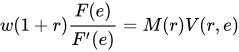

このとき、
w:貨幣賃金
r:利子率
F(e):総雇用eに依存する生産関数
M:利子率に依存する貨幣量
V:貨幣の所得速度
ρ:時間選好率
ニコラス・カルドアは2番目の等式をつぎの式に変更した。

これは、貯蓄(S)が利子率(r)と雇用(e)に依存しており、さらに貯蓄がゼロであることを示している。 カルドアは貨幣賃金の切り下げが雇用を増大させる条件を導き出した。以下は貨幣賃金の変化に対する雇用の増分の比率である[22]。

上の式の右辺が負であるならば、「貨幣賃金の切り下げが雇用を増大させる」というピグーの考えが正しいと言える。上の式の右辺が負になるためにはが正の有限の値である必要がある。しかし、流動性の罠の状況を考えるとどうだろう。が無限の値を取ると、はゼロになるので、貨幣賃金の切り下げは雇用に影響を与えない。


ピグーはこのカルドアの証明を認め、流動性の罠の状態では貨幣賃金の切り下げが雇用を増大させないことを認めた。そして、彼は物価と貯蓄の正の関連を取り入れた新たなモデルを考案した。この式(高見典和 (2010)が単純化したもの[23])を以下に示す。

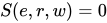
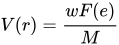
ここで、は投資関数。このモデルを用いて新たに貨幣賃金の変化に対する雇用の増分の比率を求めると以下のようになる。

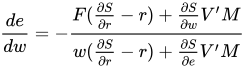
この比率は、たとえが無限であっても(流動性の罠の状態であっても)、ゼロにはならず、負の値である。よって、このモデルは仮に利子率が最低限の水準にあっても貨幣賃金の引き下げが雇用を拡大させると言うことができる。

日本のデフレとピグー効果
消費者物価指数で見ると、日本は90年代後半から10年以上デフレに陥っていた[24][25]。ピグー効果を考慮するなら、(たとえ流動性の罠に陥っていたとしても)日本経済は物価下落によって消費の増大がもたらされていたはずであろう。しかしながら、デフレによって日本の家計の消費が刺激されることはほとんどなく、内閣府は以下のようにまとめている[26][27]。
家計全体では、借金よりも預金等の金融資産の方が多いため、物価下落による実質資産残高効果(保有資産の実質価値が増加する効果)により、消費を増加させることが考えられる。しかし、これまでの研究によれば、我が国の場合、家計の実質資産残高効果はあまり大きくない。また、(…中略…)消費者物価が下落している99年以降、ローン返済家計の消費の減少度合いが大きいことからも、家計全体での実質資産残高効果はさほど大きくないと考えられる。 — 内閣府、平成13年度 年次計画財政報告[26]none
こうした資産・債務を通じた効果とは別に、デフレは、人々に物価下落が継続するという見通しを生み、経済の先行きに対する不透明感を高めることによって、消費等への買い控えを引き起こすといった可能性も考えられる。 — 内閣府、平成13年度 年次計画財政報告[26]none
わが国の貯蓄水準は高く、デフレ不況が続く中でも高い水準を維持している。物価の下落は貯蓄の実質的な価値を高める効果があり(実質資産残高の増加)、また、消費者物価の下落を考慮した実質金利も90年代後半以降名目金利を上回っている。デフレはこのような経路を通じて、貯蓄を持つ人々の支出を増加させると考えられるが、現実にはどうであろうか。日本銀行「生活意識に関するアンケート調査(第16回)」(2003年3月)によれば、1年前と比べて支出を減らしている理由として、「低金利で金利収入が少ないから」と答える人が18.3%となっており、実質的な貯蓄の増減よりも手取り収入を意識している人が多い。このような錯覚が生じることの影響などから、実質資産残高の増加による消費の刺激効果は小さいと考えられる。 — 内閣府、国民生活白書[27]none
脚注
- ^ a b c Pigou effect(英語)(July. 10, 2014, 19:53 UTC)参照
- "資産効果とは". 金融・経済用語辞典. 2014年8月25日閲覧。none
- "資産効果". 金融用語辞典. Infobank マネー百科 by ARTIS. 2014年8月25日閲覧。none
- 本郷亮 2013, p. 185.
- Patinkin, Don (September 1948). "Price Flexibility and Full Employment". The American Economic Review 38 (4): 543-564.none
- ^ Hough, Louis (June 1955). "An Asset Influence in the Labor Market". Journal of Political Economy 63 (3): 202-215.
- ^ Takami, Norikazu (April 2011). "Managing the Loss: How Pigou Arrived at the Pigou Effect". HOPE Center Working Papers.
- ^ 本郷亮 2013, p. 192.
- ^ 漆崎健治 1982, p. 153.
- ^ 本郷亮 2013, p. 189.
- ^ a b 本郷亮 2013, p. 190.
- ^ a b c d 高見典和 2010, p. 96.
- ^ 高見典和 2010, p. 95.
- ^ a b 高見典和 2010, p. 97.
- ^ J. R. Hicks (April, 1937)"Mr. Keynes and the Classics – A Suggested Interpretation". Econometrica 5: 147–159
- ^ J.M.Keynes & N.Kaldor 1937.
- ^ J.M.Keynes & N.Kaldor 1937, p. 743-745.
- ^ J.M.Keynes & N.Kaldor 1937, p. 745-753.
- ^ 本郷亮 2013, p. 191.
- ^ a b 漆崎健治 1982, p. 152.
- ^ 高見典和 2010, p. 99-100.
- ^ 高見典和 2010, p. 99.
- ^ 高見典和 2010, p. 100.
- ^ 中沢正彦 (2010-02). "(シリーズ「日本経済を考える」(1))デフレと日本経済" (PDF). ファイナンス: 71.図表1参照
- ^ IMF World Economic outlook 2014 April edition
- ^ a b c 内閣府 (2001年12月). "平成13年度 年次経済財政報告(経済財政政策担当大臣報告)". 2014年8月25日閲覧。
- ^ a b 内閣府 (2003年). "(第1章 デフレ下の国民生活 第6節 デフレと金融資産の選択行動の変化)「実質資産残高効果による消費刺激は小さい」". 平成15年版 国民生活白書~デフレと生活-若年フリーターの現在(いま)~. 2014年8月25日閲覧。
参考文献[編集]
- 高見典和「ピグー効果の形成過程―ケインズ一般理論前後におけるピグー失業率の連続性 (PDF) 」 『経済学史学会大会報告集 第74回 全国大会』、経済学史学会、2010年、 95-100頁。
- 本郷亮「<翻訳>A.C.ピグー「古典派の定常状態」(1943年)-邦訳と解題- (PDF) 」 『経済学論研究』第62巻第2号、2013年、 177-197頁。
- A. C. Pigou (1943). "The Classical Stationary State". Economic Journal 53 (212): 343-351.
- J.M.Keynes; N.Kaldor (1937). "Prof. Pigou on Money Wage in Relation to Unemployment". Economic Journal 47: 743-753.
- 漆崎健治 (1982). "貨幣供給と資産効果" (PDF). 商學論集 (福島大学経済学会): 151-185.
関連項目[編集]
plan for the beginning or the end of the period in trading assets. It pre- judges the issue by hiding in the words “if the periods presupposed by the analyses are the same" the idea that the analyses also identify the same part of the period as the moment for which the agent is making plans. Finally, Patinkin sums up his views (1958, p. 307): "It should also be clear from the above that the distinction that is sometimes attempted between flow equilibrium and stock equilibrium is an inadvisable one. Once again, if the periods are the same, the existence of one type of equilibrium implies the existence of the other." This way of talking ignores the distinction I have been trying to establish above. A final passage from Johnson may be in oruer, since it seems to represent a widely accepted "compromise" view (Johnson 1961, pp. 6–7):"
* The last sentence is quoted (approvingly, given the context in which it appears) by Leijonhufvud (1968, p. 65, n. 13).
21 of 22 pages
ASSET EQUILIBRIUM
323
It may be worthwhile to point out in detail which arguments in this passage seem to be correct, and which do not, in light of the analysis of this paper. The stock flow distinction is relevant, even though in either stock or flow equilibrium either the money or securities market can be eliminated. (The remaining expressions will not be identical in the two versions, however.) Even if markets for goods and factors are not in equilibrium, equality between the stock demand for and stock supply of money implies equality between the stock demand for and supply of securities, and vice versa. Only if the goods and factor markets are in equilibrium does flow equilibrium in the money market imply flow equilibrium in the securities market. The two theories (stock and flow equilibrium) are different even in static analysis of equilibrium situations, as long as perfect foresight is not assumed.
In the last part of this passage, Johnson implicitly assumes the flow or end-of-period equilibrium model, and his remarks are correct in that context. If the economists he mentions in the last quoted sentence had beginning-of-period equilibrium in mind, perhaps they did not deserve so harsh a judgment on their scientific integrity.
Perhaps the only constructive way out of this confusion, short of developing more exact models of aggregate transactions, is for theorists to become familiar with both specifications, bring the choice between them up to the conscious level, and make explicit which vision underlies their result.
8. Conclusions
We can draw the following main conclusions from these arguments: 1. There exist two different ways of specifying asset equilibrium con- ditions in a macro model, each internally consistent both in period models and in continuous time.
2. The two specifications are consistent with each other only when there is perfect foresight on the part of agents concerning near future prices and rates of return.
3. There is no easy choice between the two versions of asset equilibrium, because they are both highly abstract approximations to a reality in which transactions are discrete and unsynchronized.
4. Certain theoretical propositions hold in one model but not in the other. For instance, "Walras's law" holds in end-of-period or flow equilibrium between goods and asset markets. It does not apply in beginning-of-period or stock equilibrium, although in stock equilibrium it is possible to eliminate any asset market. For another instance, it is possible to have asset market equilibrium in the stock version without goods market equilibrium, so that an IS-LM-type division of the equilib- rium conditions is natural. No such division is possible in flow equilibrium models.
These results lead me to think that the most fruitful line of future inquiry may be into models where the explicit structure of the transactions process is studied more precisely, rather than into “disequilibrium" variants of either of these models.
References
Foley, D., and Sidrauski, M. Monetary and Fiscal Policy in a Growing Economy. New York: Macmillan, 1971.
Hahn, F. “The Rate of Interest and General Equilibrium Analysis." Econ. J. 65 (March 1955): 52-66.
Johnson, H. G. “The General Theory after Twenty-five Years." A.E.R. 50 (May 1961): 1 ff.
Keynes, J. M. “Alternative Theories of the Rate of Interest." Econ. J. 47 (June 1937): 241–52.
Leijonhufvud, A. On Keynesian Economics and the Economics of Keynes. London: Oxford Univ. Press, 1968.
May, J. “Period Analysis and Continuous Analysis in Patinkin's Macroeconomic Model." J. Econ. Theory 2, no. 1 (March 1970) : 1–9.
Ohlin, B. “Some Notes on the Stockholm Theory of Savings and Investment. II." Econ. J. 47 (June 1937): 221–40.
Patinkin, D. “Liquidity Preference and Loanable Funds: Stock and Flow Analysis." Economica, n.s. 25 (November 1958): 300–318.
Rybczynski, T. M. “Factor Endowments and Relative Commodity Prices." Economica 22 (November 1955): 336-41.
Tobin, J. “A General Equilibrium Approach to Monetary Theory." J. Money, Credit and Banking 1, no. 1 (February 1969): 15–29.

0 件のコメント:
コメントを投稿