don't do it this way anymore modern governments do not spend by printing up money in spite of what greenspan said they don't spend that way okay they spend through their central bank and their central bank spends through the private banks so there are two degrees of separation between the sovereign and the subject two degrees of separation that makes it so complicated economists can't understand it okay and so one of the things that mmt did was to investigate to see is this diagram still true it's just behind this veil of two degrees of separation and the answer is yes it's just hidden behind a veil so we peel back the veil okay and so for 25 years we've been explaining how governments really spend how they really spend they do not spend tax revenue and they do not spend paper notes into existence they use banks and central banks so this is the way it actually works today and i we've gone deeply into the details okay i even though i'm peeling back the veil i'm only peeling back a little ways just enough to explain uh in general terms how it's done so when the treasury is authorized to spend they can issue a check that is received by let's say a contractor okay who's building a bridge for the government the contractor takes it to the bank the bank credits the contractor's deposit account the bank sends the check on to the central bank the central bank credits the bank's reserves so how does the government spend now the central bank credits reserves of private banks and private banks credit the deposit accounts of the contractors now today most of this is just electronic we don't even need the paper checks anymore it's all electronic entries okay the key point is for every dollar or every pound the treasury spends bank reserves go up by one dollar or one pound okay by identity that's how they spend what about paying taxes paying taxes just reverses the steps the taxpayer writes a check to the treasury the treasury sends it on to the central bank the central bank debits the bank's reserves and the bank debits the deposit account of the taxpayer and also this is mostly electronic now so most people pay their taxes electronically so we don't even need the paper checks it's just an electronic debit of bank reserves an electronic debit of the taxpayers demand deposits so let me summarize spending always leads to a credit to bank reserves and a credit to a deposit account taxing always reduces bank reserves and reduces the taxpayers グリーンスパンが言ったにもかかわらず、現代の政府はお金を印刷して使うことはありません。彼らは中央銀行を通して使い、中央銀行は民間銀行を通して使うのです。私たちは25年間、政府が実際にどのように支出するのかを説明してきました 政府は税収を使うのではなく、紙幣を使うのでもなく、銀行や中央銀行を使うのです これが今日の実際の仕組みであり、私たちは詳細に踏み込んできました 私はベールを剥いでいるとはいえ、その方法を一般的な言葉で説明するのに十分な程度にしか剥いでいません国庫が支出を許可された場合、小切手を発行することができますその小切手を、例えば政府のために橋を建設している業者が受け取ります。銀行は請負業者の預金口座に入金します 銀行は小切手を中央銀行に送ります 中央銀行は銀行の準備金に入金します 中央銀行は民間銀行の準備金に入金します 民間銀行は請負業者の預金口座に入金します 今日ではほとんどが電子化されています 紙の小切手はもう必要ありません すべて電子入力です 重要なのは、国庫が1ドルまたは1ポンド支出するごとに 銀行の準備金が1ドルまたは1ポンド増えるということです これがIDによる支出方法です 納税はどうでしょうか?納税者は国庫に小切手を書き、国庫はそれを中央銀行に送ります 中央銀行は銀行の準備金を引き落とし、銀行は納税者の預金口座を引き落とします 今はほとんどが電子化されているので、ほとんどの人が電子的に納税しているので、紙の小切手は必要ありません 銀行の準備金が電子的に引き落とされ、納税者の要求払い預金が電子的に引き落とされるだけです 要約すると、支出は常に銀行の準備金と預金口座への信用につながります 課税は常に銀行の準備金を減らし、納税者を減らします
www.DeepL.com/Translator(無料版)で翻訳しました。
30:00
now so most people pay their taxes electronically so we don't even need the paper checks it's just an electronic debit of bank reserves an electronic debit of the taxpayers demand deposits so let me summarize spending always leads to a credit to bank reserves and a credit to a deposit account taxing always reduces bank reserves and reduces the taxpayers demand deposit if spending is greater than taxing that means reserves are net credited because more reserves are added then taken away so that is how that is the accounting consequence of a budget deficit it's a reduction of bank reserves uh sorry an increase of bank reserve a government surplus is a reduction of bank reserves okay so what does the central bank do the sender mike facilitates payments buy into the state payments by the state e-flux money that is gets it into the economy taxes reflux money they don't finance government spending they're used for redemption okay so they reduce uh the accounts of the taxpayers and the reserves of the banks bonds don't really finance the deficit if a deficit has occurred if government spending has been greater than taxes the uh it has already been paid for by the credits to bank reserves and to the accounts of the recipients of the government spending the deficit has already been paid for before the bonds are ever sold the deficit is exposed it's after the reflux of taxes and you you over the course of the year when you're spending a taxing you don't even know if at the end of the year you're going to record a budget surplus budget deficit or a balanced budget you won't know till the end of the year and usually it takes several revisions of the data before you really know whether there was a deficit at all what that means is that as you're spending over the course of the year you don't know if you're gonna end up with a deficit which also means there's no such thing as deficit spending all spending is the same at the time that it occurs you don't even know whether you can have a budget deficit or a budget surplus or a balanced budget you cannot know until the end of the accounting period usually a year bond issues then are not to finance deficits they're actually functionally a part of monetary policy they're not a borrowing operation sovereign governments actually don't borrow their own currency which would be a nonsensical operation anyway a sovereign government never needs to borrow its own currency it issues bonds for a different purpose it issues bonds as part of monetary policy to help the central bank hit its interest rate targets and we see how nonsensical it is to issue bonds uh for the all the way since the global financial crisis because central banks have been engaged in qe what is qe it just means so you put some bonds into the economy and then you took them right back out and the central bank is holding them so the government is owing itself there was never a need to issue those bonds in the first place okay and so this is starting to be recognized that selling bonds is not necessary at all whether you have a deficit or not because sovereign governments don't borrow the danger is excess spending not excess money government spending takes one form only there's no such thing as a choice let's see should i use tax revenue or should i borrow or should i print money there is no such choice there's only one way you spend i already described it so congress or parliament authorizes the spending treasury cuts the checks the syndromic clears them by crediting reserves the budgetary outcome is known only exposed okay as stephanie kelton my former student and colleague always says cash registers do not discriminate cash register doesn't care if you came from the government or you came from the private sector too much spending government or private can cause inflation keynes said true inflation only occurs beyond full employment okay if you're beyond full employment you get what you what he called true inflation before full employment you can have prices rising but he called that semi-inflation not true inflation it occurs because of bottlenecks or perhaps pricing power could be labor unions could be monopolists that have pricing power
hello everyone
thank you for joining us today my name
is alexandra
and i am a community member of oxford
economics affairs
all of our events for this term are
online
and all of them will be streamed on our
facebook page
and then pop posted in on our youtube
channel
afterwards last week
we had doctor van graven who was talking
about decolonizing economics
and you can find the recording of her
lecture on our youtube
our next event will be tomorrow and we
will have
news for hobbit talking about economic
pluralism
so check out check out our event on
facebook if you are interested
in this this week we are very happy to
host professor randall wright
who who is a professor of economics at
the university of missouri-kansas city
and c and senior scholar at the level
economics institute of bad college in
new york
he is a prominent proponent of modern
monetary theory in macroeconomics
which challenges the conventional views
on monetary and system policies
random right has published widely in
edited books and academic journals
including journal of economic issues the
cambridge journal of economics
and the journal of post-ancient
economics
the talk will be dedicated to the modern
monetary policy responses to the ongoing
pandemics from the perspective
of the modern monetary theory
the format of our meeting today will be
45 minute talk
and then the 15 minutes of question from
the audience
we have posted a link on uh in the
description of our facebook event
uh on on like our facebook so uh
if if you if you want a question if you
have a question that you would like to
be asked
professor you can you should go to this
link and then give us
our question i will i and i will i i
will wait
after the um talk um
okay and thank you for uh for for
joining us uh professor wright we are
very happy to have you here today
and if you're ready we can start with
the communication
okay thanks for the invitation
let me share the screen oops i'm not
abled
and while we're doing that let me just
make one correction
i retired from umkc
so i no longer teach there i teach at
bard
uh and at the leave
so you think you could fall now
let me try yep now i can okay
and this
okay so
um let me begin
we um face a
multitude of pandemics so now we have
coven 19. um there's a pretty good
possibility that we're going to have
different versions of this disease
hitting us maybe every couple of years
we also have the pandemic of a climate
catastrophe
in the united states at least we have
pandemics of
racism of the forever wars
the forever fires right now i'm
in uh in the west in oregon and the fire
season now in california prince a whole
year
we have pandemics of inequality of
access to health care education housing
wealth and jobs
we have pandemics of poverty
unemployment homelessness
financialization
secular stagnation refugees rising
sea levels and we could go on and on so
multiple pandemics when
um the covet crisis hit
many people started talking about mmt
and it was in the headlines all over the
world
every important central banker
financial markets
person heads of the finance ministry or
treasury all
had to weigh in and say
that uh we found this new way to finance
the covet response
we're going to use central banks to drop
helicopter money into the economy
this is mmt and uh
japan has been doing mmt for a while and
now we're all going to adopt it
but we have to be very careful mmt
is only for a crisis we would only use
it in a crisis
okay it's very dangerous because it's
it is potentially inflationary and
could drive us to zimbabwe land with
hyperinflation
okay but our response is first we're in
the age of
multiple permanent pandemics the crises
are not going to
end there is no end in sight
second mmt says there's only one
one way that modern governments spend
uh there this is not something you apply
only in a crisis
mmt accurately describes the way
governments actually spend which is that
central banks credit bank reserves and
banks credit the deposits of the
recipients
that is a description it's not a policy
to
recommendation it's not a policy you use
in crisis
this is the way modern governments spend
okay so mmt is largely a description or
better
we could say it is a framework for
analyzing sovereign
currency nations nations where
governments issue their own currency
how that works
now it's very different from the
orthodox view
the orthodox view is that in normal
times
you tax and then you spend the revenue
limited borrowing could be okay
especially in a recession
so a deficit is okay and you
uh finance that by borrowing
you have to worry about the
sustainability condition and the
the main one is that
you need the growth rate above the
interest rate
or the problem is that debt service
will grow relative to the size of the
economy
and so government spending on interest
will grow and
potentially grow without limit because
the government will need to finance its
spending on interest
by more borrowing
increasing government spending though
tends to slow the growth rate
because government is not as efficient
as the private sector
and it pushes up the interest rate this
is the crowding out theory
so all the government borrowing will
push up the interest rate and we're
going to have slower growth
so we're going to end up with
growth below the interest rate
furthermore the debt burdens our
grandkids
i guess a lot of you are grandkids
you're all gonna have to pay this back
and uh you know all the old generation
is leaving you with all of this debt
that you're going to have to pay back
and the result will be
slow growth heavy indebtedness
taxing you a lot we're going to end up
with secular stagnation
on the other hand government might prim
money to pay for its spending
but that causes inflation and then we're
off to
zimbabwe so you have to avoid that
well paul samuelson who wrote the
textbook
your grandparents all used he was
i was going to say the main queue of his
day but he was much greater than thank
you
um in any case he gave an interview in
1974
with blog mark blough you can find it
online
i urge you to google it
the sami sun interview by mark blaug
because it's very interesting
i have a long quote in the blue i'm not
going to read that you can read that
later
but basically what he's saying is can
you keep a secret
the necessity of balancing the budget
whether we're talking about
annually or over the business cycle is
that old-time religion we use
to scare politicians and the population
to behave themselves
it's like the grim fairy tales that we
tell our children
uh you know the wolves in the forest
kind of a story
so that they won't wander around in the
forest we have to scare the politicians
all sorts of bad things will happen if
they run budget deficits
okay it's not true but keep the secret
don't let it out don't let the cat out
of the bag
um more recently ben bernanke who was
the chair of the fed
during the global financial crisis uh
the fed
spent and lent a total of 29
trillion dollars to bail out the global
financial system
uh in the aftermath of the gfc and so
congress called him in because they were
very worried he said
look what the fed is doing with taxpayer
money
and so they asked him uh are you
spending taxpayer money to bail out the
financial system he said
no no no it's not tax money we simply
use the computer to mark up the size of
the account
it's just keystrokes we're not spending
tax money
we keystroke credits to the accounts of
the banks
now he was talking about you know this
specific
uh fed intervention but what he said
is true this is the way the government
really spends
and i'll explain why when the treasury
spans
it is still a central bank keystroke
because central bank makes all payments
for the treasury
or alan greenspan the previous chair
before bernanke was asked
about the u.s social security system
lots of people are afraid that we have
an aging society and social security
will go
bankrupt and greenspan said no that
can't happen
the united states can pay any debt it
has because we can always print money to
do that so there's
zero probability of default we cannot be
forced to default
on any debts that are in dollars
including
the promised social security payments
okay now he said print
money okay that's not true that's not
accurate
bernanke was accurate it's keystrokes
we will keystroke those credits into the
retirement accounts
of the elderly we can't run out of money
okay so the mmt view
is precisely the opposite of the
orthodox
view it's not tax then spend it's spend
then tax you spend first
then you tax you can't take out of the
economy which you haven't already put in
and taxes are paid by debiting bank
reserves banks have to have the reserves
before taxes can be paid where do
reserves come from
they can only come from treasury
spending central bank purchases
or central bank lending there is no
other source
of bank reserves so taxes can't be paid
until the reserves are put in
when you go to the uh a magician's show
and the magician pulls the rabbit out of
the hat you pretend like you're
surprised
wow magic okay now you know
that the magician put the rabbit in the
hat
before he pulled it out you can't pull
rabbits out
that you have not put in okay the same
is true of the reserves
you have to put the reserve rabbits into
the hat before you can pull
the reserve rabbits out of the hat now
this is so surprising to most people
however i assume all of you
have studied your principles of
macroeconomics
and you learned the injections leakages
approach
you have to have the injections before
you can get the leakages
the injections create income that can
then be leaked out of the circular flow
injections first then leakages what are
the injections well you always study
investment is an injection saving is a
leakage
the investment has to come first before
the saving
can leak out you have to create income
through investment
then you can save the same is true
of government spending that's an
injection
taxes are the leakage you have to have
the spending first
before you can have the leakage into
taxes
now the second one is not emphasized
probably in your class it's emphasized
in my class
uh but if the principle is the same
and so when we say you spend then tax
that is perfectly consistent with
the keynesian approach to macroeconomics
uh
that is uh that still remain or lingers
in the textbooks including mancus
okay um so what mmt
does i said is it provides a framework
for analyzing
national sovereign currencies
so we begin with the money entries
money entries are denominated in the
national
currency or money of account financial
stocks and flows
in are also measured in terms of the
money of account
when you think of the financial system
as a huge electronic scoreboard
keeping track of the credits and debits
in money terms charles goodheart
in 1996 wrote about three different
versions of the paper
uh why is it that we
when we look around the world the
general rule
both today and historically as far back
as we go
all the way back to babylonian times
we observe each nation has its own
currency
why is it one nation one currency
it's so ubiquitous
it can't be a coincidence i'll come to
his reason in a minute
okay uh in the united states
our constitution actually says
that only congress can create money and
sometimes people bring this up and they
say hold it
it's unconstitutional for banks to be
creating money
because the constitution very clearly
says only congress can do this
however my own professor was hyman
minsky
and he used to always say anyone can
create
money there seems to be some kind of a
conflict between these two things
but really there isn't only the national
government
can create the money that is the money
of account
dollar in the u.s pound in britain
and then we all can create money
things or money records
records of nominal values
that is what we are recording in that
financial
system scoreboard we're recording
money records denominated in
the state's money of account
so our alternative approach to money is
that it's a state monopoly in the sense
that the state
chooses the money of account we then
denominate
transactions and financial assets and
financial liabilities
in that money of account there's a
hierarchy
of ious they're all liabilities
but as minsky said anyone can create
money the problem is to get it accepted
the government's i o use what we call
currency or bonds are the most
acceptable ious in the economy
and then lower in the pyramid
there are banks and lower still there
are non-financial corporations and lower
still
there are small firms and also
households they can
all issue debt denominated in the money
of account
it's a money record uh however
they have differing degrees of
acceptability
when i first started teaching in the
early 80s i would ask
my students what backs up the us dollar
and the majority of students would say
gold well that wasn't true
we had gone off the gold standard in the
early 70s
when president nixon left the bretton
woods system
so it wasn't true even then but what i
would do is
i would take my take out my wallet and i
would take out a one dollar bill
and i would read to them what it says it
says
this note is legal tender for all debts
public and private
then i would take out a canadian dollar
this note is legal tender
australian dollar this australian node
is legal tender
okay and so we see a pattern say oh
okay so what backs up the currency is
that it's legal tender
then i take out the uk pound there's a
picture of the queen
and the queen says i promise to pay the
bearer on demand the sum of five pounds
this is written on a five pound note
what she says is if you bring her a five
pound note
she will give you a five pound note or
some
sum of coins to total five pounds
okay so it's not gold
it's not legal tender i mean maybe
maybe not so what people
generally uh describe this
as is a fiat money
that its value is determined by fiat
the government just tells you what it's
worth
okay well that would be a fairly
flimsy thing to base
your financial system on
is just the government's fiat
we mmt argues that there's more than
that behind it
but it's not gold okay but there is
something
standing behind it we argue that
it is the uh the value of money
and the reason why currency is used
is because the power of the issuing
authority
okay so money records
are promises to redeem they are promises
to redeem
debts and when good heart
posed this question the way he answered
it is that
you know it's not a coincidence that we
see one nation one currency rule
the currency is tied up with sovereign
power
political independence and fiscal
authority
so there's no wonder that when the
soviet union broke apart
each new nation chose their own currency
they are expressing their political
independence
and their government is creating
a fiscal authority so what we focus on
what drives the currency is obligations
that a sovereign authority can put on
the population
for shorthand we say taxes drive money
today the main obligation that the
government puts on
people is tax but
if we go back a couple hundred years ago
the main obligations were
fees and fines in some cases tribute
in some cases tithes but it's an
obligation
to pay that the government is able to
put on
the population the government then
issues a currency denominated
in its money of account and accepts it
back in payment taxes
that is what we mean by the term
redemption
the currency is redeemed
when it is paid back to the issuer
to meet an obligation such as taxes
when taxes are paid both the government
and the taxpayer are redeemed
it's a simultaneous redemption
the taxpayer is redeemed because they
don't owe a tax anymore
the government is redeemed because the
currency
has been returned to the government uh
by the way
the our english word revenue
that we use for tax revenue means return
to what returns
the government's currency returns to
the government and i know you always
hear
about this fabulous innovation which was
double entry bookkeeping
but monetary
accounting is always quadruple entry
bookkeeping there are four entries that
are wiped clean
when you pay your tax okay you have an
asset and a liability
that are wiped clean and the government
has an asset and liability
wiped clean i want to give
one historical example i could go on and
on with ex with historical examples but
this one is particularly
clear so farley grubb is
one of the authorities on american
colonial currency the american colonies
were not allowed to issue coins so the
crown
of england would not allow them to
because the crown
wanted the colonies to use the crown's
old
own coins okay but there was a loophole
nothing said that they couldn't issue
paper money now paper money had been
issued in china
for a long time but this was i think the
first
big example of paper money being used in
the west
so the colonial legislatures would pass
a law that said
that permitted the government
to issue let's say 10 000 virginia
pounds
worth of notes at the same time
they would enact a new tax that imposed
what they called
a redemption tax a redemption tax
that was expected to raise about 10 000
pounds people could use
the paper money to pay their new tax
that created a demand for the paper
money and adam smith
the wealth of nations mentions this
in his book he said this strange thing
is going on in the colonies
they're issuing paper money and it's
accepted
and they don't get inflation as long as
they don't issue too much
okay so he noticed this
and it's very clear that these colonial
governments knew
what they were doing they called it a
redemption
tax the purpose of the tax
was not to obtain tax revenue in order
to spend
they knew they had to spend first then
tax
nobody could pay the tax if they had not
spent the notes
you spend first then you tax what do you
do with your tax revenue
you burn it you burn every note
that is used to pay taxes tax revenue is
not for spending tax revenue
is for burning okay
uh now there's nothing unusual about
this
this was also true all over europe most
of the
uh sovereign governments in europe
spent by issuing tally sticks wooden
sticks
and when they receive those back there
was a stock and a stub
when they received them back and matched
them they burned
the tally sticks okay what do you do
with tax revenue
you don't spend it you burn it what do
you do with coins
you melt them down any and
issue a new coinage okay so
taxes come after spending and you use
the revenue
for a fire
the way that it used to work was very
simple and it was very obvious
and i'm telling you the colonial
government's understood it
perfectly well you spend first
spend your currency collect it back in
taxes
and then you burn it now we don't do it
this way anymore
modern governments do not spend by
printing up money in spite of what
greenspan
said they don't spend that way okay
they spend through their central bank
and their central bank spends through
the private banks
so there are two degrees of separation
between the sovereign and the subject
two degrees of separation that makes it
so complicated economists can't
understand it
okay and so one of the things that mmt
did was
to investigate to see
is this diagram still true
it's just behind this veil of two
degrees of separation and the answer is
yes
it's just hidden behind a veil so we
peel back the veil
okay and so for 25 years
we've been explaining how governments
really spend
how they really spend they do not spend
tax revenue
and they do not spend paper notes into
existence
they use banks and central banks so this
is the way it actually works today
and i we've gone deeply into the details
okay i even though i'm peeling back the
veil i'm only peeling back a
little ways just enough to
explain uh in general terms how it's
done so
when the treasury is authorized to spend
they can issue a check that is received
by
let's say a contractor okay who's
building a bridge for the government
the contractor takes it to the bank
the bank credits the contractor's
deposit account
the bank sends the check on to the
central bank the central bank
credits the bank's reserves
so how does the government spend now the
central bank credits reserves
of private banks and private banks
credit the deposit accounts
of the contractors now today most of
this is just
electronic we don't even need the paper
checks anymore
it's all electronic entries okay
the key point is for every dollar or
every
pound the treasury spends bank reserves
go up by one dollar or one pound
okay by identity that's how they spend
what about paying taxes paying taxes
just reverses the steps
the taxpayer writes a check to the
treasury
the treasury sends it on to the central
bank
the central bank debits the bank's
reserves
and the bank debits the deposit account
of the taxpayer
and also this is mostly electronic
now so most people pay their taxes
electronically
so we don't even need the paper checks
it's just
an electronic debit of bank reserves
an electronic debit of the taxpayers
demand deposits
so let me summarize spending always
leads to
a credit to bank reserves and a credit
to a deposit account
taxing always reduces bank reserves
and reduces the taxpayers demand deposit
if spending is greater than taxing
that means reserves are net credited
because more reserves are added then
taken away
so that is how
that is the accounting
consequence of a budget deficit
it's a reduction of bank reserves uh
sorry an increase of bank reserve
a government surplus is a reduction of
bank reserves
okay so what does the central bank do
the sender mike facilitates payments buy
into the state
payments by the state e-flux money that
is gets it into the economy
taxes reflux money they don't finance
government spending they're used for
redemption
okay so they reduce uh the accounts
of the taxpayers and the reserves of the
banks bonds don't really finance the
deficit
if a deficit has occurred if government
spending has been greater than taxes
the uh it has already been paid for
by the credits to bank reserves and to
the accounts
of the recipients of the government
spending
the deficit has already been paid for
before the bonds are ever sold
the deficit is exposed it's after the
reflux of taxes
and you you over the course of the year
when you're spending a taxing you don't
even know
if at the end of the year you're going
to record a
budget surplus budget deficit or a
balanced budget
you won't know till the end of the year
and usually it takes several revisions
of the data
before you really know whether there was
a deficit at all
what that means is that as you're
spending over the course of the year
you don't know if you're gonna end up
with a deficit
which also means there's no such thing
as deficit spending
all spending is the same
at the time that it occurs you don't
even know whether you can have a budget
deficit or a budget surplus or a
balanced budget
you cannot know until the end of the
accounting period usually a year
bond issues then are not to finance
deficits they're actually functionally a
part of monetary policy
they're not a borrowing operation
sovereign governments actually don't
borrow their own currency
which would be a nonsensical operation
anyway
a sovereign government never needs to
borrow its own currency
it issues bonds for a different purpose
it issues bonds as part of monetary
policy
to help the central bank hit its
interest rate targets
and we see how nonsensical it is
to issue bonds uh
for the all the way since the global
financial crisis
because central banks have been engaged
in qe
what is qe it just means so you put some
bonds into the economy and then you took
them right back
out and the central bank is holding them
so the government is owing itself there
was never a need to issue those bonds in
the first place
okay and so this
is starting to be recognized
that selling bonds is not necessary
at all whether you have a deficit or not
because
sovereign governments don't borrow
the danger is excess spending not excess
money government spending takes one form
only
there's no such thing as a choice let's
see should i use tax revenue
or should i borrow or should i print
money there is no such choice
there's only one way you spend i already
described it
so congress or parliament authorizes the
spending treasury cuts the checks
the syndromic clears them by crediting
reserves the budgetary outcome is known
only exposed
okay as stephanie kelton my
former student and colleague always says
cash registers do not discriminate
cash register doesn't care if you came
from the government or you came from the
private sector
too much spending government or private
can cause inflation
keynes said true inflation only occurs
beyond full employment
okay if you're beyond full employment
you get what you what he called true
inflation
before full employment you can have
prices rising
but he called that semi-inflation not
true inflation
it occurs because of bottlenecks or
perhaps
pricing power could be labor unions
could be monopolists
that have pricing power and he he argued
against
using austerity uh it's doubtful
whether austerity ought to be used if
the inflation is coming from bottlenecks
or pricing power
and just as one example uh back in the
early 70s 1974
opec quadrupled the price of oil okay
it's pricing power
the united states chose to implement
austerity to fight
the rising prices induced by rising oil
prices
and we suffered ever since we never
really recovered from that
japan chose instead
to become energy efficient
to reduce their oil use per unit of
output
now which one of those two strategies
makes the most sense
obviously austerity made no sense
becoming energy efficient was the right
response
to an increase of oil prices
okay mmt is not a proposal to ramp up
deficit spending
uh people say see look at japan japan is
a good example of mmt because they have
huge deficits
well that's not an mmt proposal
we follow abba lerner's functional
finance approach
budgeting should be functional to pursue
full employment
moderate inflation sustainable growth
greater equality
environmental sustainability all of
those are in the public interest
and the budget ought to be pursuing that
the budgetary outcome
outcome in any case is exposed not
discretionary
japan has run high deficits and debt not
because it's following mmt
it's doing the opposite of mmt policy
recommendations
as i'll explain in a second but still
japan does validate
the core mmt arguments about sovereign
death
deficits and debt deficits do not lead
to inflation
japan's problem has been deflation
for a whole generation bond markets
cannot force default
in fact the bond markets want more
japanese debt
not less bond yields depend on central
bank policy
so japan has had near zero interest
rates for a whole generation
because that's the central bank policy
so it doesn't depend on the amount of
debt
what japan has been doing is following a
stop go stop policy so this is why we
say it's not mmt
since the collapse of the real estate
bubble japan has been
in and out of recession with sluggish
average growth
in recession they usually have some kind
of a fiscal stimulus
but as soon as the recovery begins they
take out the stimulus and they usually
enact some kind of a tax increase
especially on consumption
because they want to reduce the deficit
and retire some of the debt
so that is not mmt this pushes the
economy back into recession
and the deficit climbs so this is the
usual way that you get big deficits
and i call it the ugly way you get
deficits
you get deficits because growth
falls and so i came up with um
a simple graph uh to show that there are
always at least two ways to get a big
deficit
the first is the ugly way if you're at
point a you're
you've got some moderate growth
but the economy slows down then you will
produce a deficit
as you go into recession and you can
move to point b that's the ugly way
the pretty way to get a deficit is
you've got some moderate growth and you
would like to grow faster maybe you want
to implement a green new deal
so you start spending more you can move
up to point c
but point c is a higher deficit
with a higher growth rate that growth
rate
is going to reduce the deficit
because tax revenue will grow fast and
so you'll move to a point
something like point d so the point is
that
just because you have a high deficit
does not mean
that you're using fiscal stimulus you
can get a high deficit because tax
revenue collapses
deficits are exposed not discretionary
another way
you can get at the same thing that i've
been describing
is by using wynn godly's sectoral
balance approach
so as wind shows by identity
at the aggregate level the sum of
surpluses equals the sum of deficits
since income equals expenditure at the
aggregate level national income equals
national spending
for one sector to run a surplus at least
one other sector must run a deficit
so we can break up the sectors any way
we want we could have households
government corporations and rest of
world
uh that would be four sectors the one we
usually use is three sectors the
government sector
domestic private sector which is
households and firms together
and the foreign sector a country like
the us
and or the uk that runs
current account deficits most of the
time
typically we'll have a government
deficit
a domestic private sector surplus
and foreigners are also running
surpluses
against the country the only way to
reduce the government's deficit
is if one or both of the other sectors
adjust their balances
so either the domestic sector has to
reduce its private surplus
which is not a good idea that leads to
minsky type financial instability
or you have to get the rest of the world
to adjust
their balance against you which is
difficult you don't have
control over the economies of the rest
of the world
so the point is anyone who tells you
that the government ought to reduce its
deficit they have to explain to you
how they're going to get the domestic
private sector or the foreign sectors
to adjust their balances to allow that
to occur
it is not a simple result of
discretionary policy
okay let me finish by talking a bit
about the
crises we face the world faces
unprecedented and immediate challenges
human survival is threatened this is
probably
the greatest uh threat that humans have
ever faced
it will take coordinated and concerted
effort by the richest nations
why because they're the source of most
production
and they will they have been and will
remain
the source of most pollution so it's up
to
the rich developed countries to take
this on
the age of austerity has to end
we can learn from the experience of war
how do you
tackle a crisis well we learned a lot
from world war
ii in world war ii the government
absorbed 50 percent of gdp in the case
of the us
probably more in the case of the uk so
we moved
half of all the production to the war
effort
we're going to have to move more
resources to our effort to fight these
pandemics
how do we do it keynes explained how in
a little book
1940 how to pay for the war he set out
the plan
how are you going to move the resources
to the government without causing
massive inflation
because in every other big war both the
us and the uk had high
inflation we both had well
world war one was not a big war for us
it was a big war for you
you had high inflation in world war one
we had high inflation in the civil war
how can we prevent that kane said the
problem is
when you go into a big war of course
you're going to be beyond full
employment of resources
beyond full employment and
the government's spending is going to
create income for everybody everybody's
going to be working
even more hours than they want to work
you're going to be paying
them wages but there's hardly anything
for them to buy
because you move the production to the
war effort
how can you prevent inflation so he said
finding the money is not the problem
preventing inflation is the problem so
he recommended three principles
use deferred compensation to reward
workers don't pay them now
promise to pay them later second tax
higher income people
not because you need tax revenue
government doesn't spend tax revenue
you need to reduce their consumption
okay they don't need to consume
a lot they're already rich and third
maintain
adequate minimum standards for those
with lower income
uh jpeg foster
said similar thing he's an american
institutionalist
i just want to focus on the first thing
whatever
is technically feasible is financially
possible if we know how to do it and we
can find the resources
we can always afford it okay tackling
multiple pandemics comes down to
mobilizing the unemployed resources
shifting those that are already employed
and creating new ones
how do we shift them through taxes
postponed consumption
maybe patriotic saving rationing
regulations we did all of that in world
war ii
spending then allocates the resources as
desired to achieve the public purpose
and the good news is
taking on these pandemics including a
broad-ranging green new deal
is not going to take anything like 50 of
our nation's resources
our estimate of the green new deal is
the net increase in demand for resources
for a broad-based green new deal is only
five percent of gdp
so it's a small demand on resources
okay conclusion no change of procedures
is required to implement
our pandemic response the central bank
and treasury already know how to finance
it
the ultimate constraint is resources not
finance
the budgetary outcome is neither
discretionary
you can't control it nor is it something
to worry about
interest rates are determined by central
bank policy not by markets
inflation can be avoided by policy
focused on mobilizing resources
and releasing them as necessary as
keynes
explained so let me stop
sharing and
take questions uh thank you thank you
very much
for uh for this professor it was really
interesting
uh just to remind our viewers how to ask
questions you have the link
under which you can submit your question
on our um
on our facebook even and also in the
comments under this stream
that's going on now um and my first
question is about
what is different about mnt idea
response to the pandemic
compared to what mainstream like
economic
idea would be about what we should do so
many people would say that even before
pandemics in the reality of low interest
rates
and low inflation there there was a new
emerging consensus in the mainstream
economic that monetary policy is not
enough and we also need fiscal policy
to step into control inflation and now
uh
during pandemics it seems like not only
kenya but even like mental economics our
economics are advocating for huge fiscal
spending
so my question is why do we need mmt to
have the best
response to the pandemic what is there
uniquely about and
policy recommendation about how to
respond
to the pandemic that's different to what
other economists
say yeah well so
the the big difference is
that they believe you need very special
circumstances
in which you can expand
a fiscal policy without worrying about
inflation
and without worrying about interest rate
effects so
the special circumstances were that
inflation
has been low for quite a while and
interest rates
have been near zero so it's pretty easy
to have the growth rate above the
interest rate okay
we say you don't need any of those
conditions
okay the government cannot run out of
money
even if the interest rate were high or
above the growth
rate we can still afford to do this
but let me tell you already
larry summers and blanchard have started
worrying about inflation i i in fall of
2019
you're right fall of 2019 i sat side by
side with blanchard we gave testimony to
the us congress
we we had identical
views on uh our ability to expand
spending to do the green new deal he
agreed completely
don't worry is that because the interest
rate
is uh very low and probably going to be
below the growth rate
okay but he came out
uh last week along with larry summers
they're both warning about inflation oh
no
don't go too big they're saying that
biden's plan is too big and it's going
to be inflationary
okay so they are already backing off
that's the problem okay
uh so if you you come at it from
an orthodox uh basically view
um even though both of them are you know
keynesian orthodox they're
they're not monitors to orthodox uh
you're you're going to take your foot
off the pedal too
early which is what we did in the global
financial crisis too
and larry summers was behind that larry
summers was one of the people that kept
obama's
stimulus down to 800 billion we should
have had
four times more stimulus but all this
worry about the debt and inflation
forced them to keep the stimulus so
small that we did not fully recover
until 2018
more than 10 years okay
from the time that crisis first hit so
that's the problem
and during that whole period larry
summers saying oh we have secular
stagnation
well yes we do because we have austerity
thank you very much my second question
is about inflection so a lot of
criticism to mmt
relates to this prediction that a
monetary financing of deficit
would result in the inflation i believe
that he turned this position in
inflation warriors
uh so the solution that mit has to
prevent inflation
is that government can cut back on
deficit spending
or by raising taxes and the potential
worry about this solution
is that in practice politicians who make
decisions about fiscal policy
act act more in the response to what the
general public wants
but not necessarily what what is uh like
best for the economy
at the moment so the argument can be for
instance that government
is unlikely to raise taxes during a
period of high inflation where
when public is already upset about
rising price
so what would you say to unlike
inflation warrior
that that would argue that independent
central bank does a better job of
controlling inflation than products
let me uh save the independent central
bank
because this is a myth anyway so that
that's a whole
topic by itself a very good topic to
discuss
okay first there is no alternative
to money financing of spending whether
it's by the government
or by households it's always money
financed
that's how you spend okay the government
spending
is always money financed there is no
choice
okay there is no special kind of
spending
uh as i was saying so it's always money
financed
all government spending always requires
a credit
by the central bank to bank reserves
that's how the spending occurs this
isn't a joint
i hope that mmt would like to have more
of um
like more monetary finances of
government spending
than mainstream economy no
all we're doing is describing this is
not a policy proposal
we say that is how government spends it
has no other option
it spends you mentioned that you
disagree with people who who would like
to see a smaller
response to um to
like ongoing pandemics because these
people are more afraid about inflation
than
you are right uh well i'm sure there are
people who are more afraid of inflation
than i am yes
um uh i just said so uh
blanchard and summers are starting to
warn about it now i'll tell you
their view even for uh mainstream
economists
including say the people at the fed
right now uh
they uh they're they're outliers
our fed is not worried about inflation
okay
powell has come out and and uh
said they don't see any danger of
inflation
now we're going to get some price
increases
uh through the economy because we are
hitting a lot of bottlenecks
okay there are bottlenecks in shipping
there are bottlenecks in
the global supply chains because of
covet
and so we're going to see some prices
increasing
but as the factories reopen
as shipping resumes
these are going to be temporary so i
won't be surprised to see
some uh little glitches in the cpi
going up because some items will go up
in price
but when we're not going to get a
sustained inflation this is the view
of our fed right now too so
i don't think that uh mmt is an outlier
on this i think the
the um
the dominant view right now even among
fairly mainstream people
in america at least is that we're not
likely to get much inflation
from these packages let me also say
although we're calling it a biden
stimulus package it's not
a stimulus it's relief if you look at
the items
in the 1.9 trillion
this is mostly just relief it is not
providing income
that it's going to boost consumption
you're
you're relieving state and local
governments and school districts
that have lost a tremendous amount of
revenue
tax revenue has fallen through the floor
and so a lot of is just relief
so anyway i don't believe that story um
the idea that uh
democracy does not work
uh and so we need committees of experts
because we can't trust elected uh
representatives because uh
they are catering to the interests of
the people
who of the voters who elected them
is just anti-democratic
i mean that you know
we we need what is best for the economy
not what is best for people
i think that is crazy that's uh
elitist anti-democratic um
i don't share that view at all um i
think that we should be focused on what
is best for people
not what is best for this abstraction
which is the economy
something you cannot uh feel
touch here it's an abstract it's a
complete abstraction
um i don't i don't want what's best for
the economy i want what's best for
people
i want jobs i want health care
i want vaccinations
i want food energy
and a clean environment that's what we
should be focused on
and that's what politicians should be
focused on not
some uh abstract
thing that we call the economy okay
independent central bank sorry
i'm sure you have other questions but
central banks are not independent
they are creatures of the government
they're created by the government
um the the fed
it's always that it is a creature of
congress and the
the heads of the fed when they go to
congress uh bernanke
told congress several times that look if
you don't know what
if you don't like what we're doing tell
us to do something different
okay we're a creature of congress we
will do what you say
now when when people say that there are
two senses in which they
they say that the central bank is
independent
one of them uh is is true
although it's not a necessity and that
is usually
we let the central bank set the
overnight interest rate target
okay that is true in the u.s our fed
is independent to do that most of the
time
in in major wars sometimes we take that
away from them world war ii we took it
away
we said no uh the uh
executive branch is going to set the
interest rate not the central bank
then we gave them back their
independence at the end of the war
now people say then that's a good thing
because they can use the interest rate
to fight inflation so they can be the
warriors
the inflation worriers and the inflation
fighters
well unfortunately control over the
interest rate
is not a tool that gives you control
over the inflation rate
okay it just does not do it and uh
i've been saying that from basically the
day i started economics
and i the past 20 years has demonstrated
that central banks cannot increase the
inflation rate
they've done everything they could think
of to try to increase the inflation rate
they've all failed now before that
they'll say
well that's true but back we fought the
inflation in the 80s and 90s and we got
rid of it
i think that's also false they didn't
get rid of inflation
basically india and china got rid of
inflation for us
by bringing so many new low paid workers
into the global economy
they depressed wages in the west
and they reduced inflation it wasn't
central banks
the final way in which cinder banks are
supposed to be independent is
they're supposed to be the counter to
the congress or parliament
so supposedly congress and parliament
you know they're they're always catering
to the people who elected
them and so they're spending on all
sorts of goodies for the population
and they don't worry about inflation and
that's what causes inflation
and the good thing is that an
independent central bank can stop them
from doing it
how do they stop them well then you
wonder how do they stop them
central banks cannot say no
okay congress gives the treasury
the authorization to spend can
the fed take that away from the treasury
the answer is no
will the fed ever bounce a treasury
check
no will the bank of england
bounce treasury checks no
they're not going to bounce a check if
you start bouncing the treasury's check
you're going to lose faith in the
payment system
if treasury checks can bounce why would
you trust any other kind of check
so it's simply false central banks
cannot say no
now they might raise the interest rate
if the
if the uh budgetary outcome is a deficit
okay the only thing they do is raise the
interest rate they can't stop the
treasury from spending
and by raising the interest rate they're
going to increase treasury spending
because spending on interest will go up
so by trying to stop trying to stop the
treasury
from spending their increased treasury
spending there's nothing they can do
okay okay thank you so my last question
it's about developing countries
so this is like people's very often
criticized mmt talking about that that
is easy for
countries like the u.s not to care about
their debts when it's like
so easy to roll their them because their
their currency is dollar
but they said it would be more difficult
for for developing countries
so i wanted to ask you would you say
that there are any differences
in recommendations uh about how to
respond to the pandemics for the u.s and
for the developing countries
or do you think that basically as long
as developing countries
issue their own money it doesn't matter
um and it's like no difference
whatsoever and and they can follow
exactly the
policies that u.s can follow okay
now look developing countries vary a lot
because
some of them peg to the dollar
or to another international reserve
currency
that means they are severely constrained
in their ability to spend
because they are liable
to exchange their currency for u.s
dollars
they can be forced into bankruptcy okay
i mean there's no bankruptcy procedure
but they can default on their debts that
happens
my question is about countries that have
their own mind
okay so i want to make that clear
so the ones that uh
peg or that issue debt in foreign
currency
so there are countries that have their
own currency but they issue government
debt in u.s dollars
they're also very constrained so as long
as they
don't peg and
don't issue debt in foreign currency
they are able to use their currency
to mobilize their domestic resources
just as you are and we are okay
now their problem is that they probably
don't have the resources they need
to deal with the pandemic domestically
uh they're not necessarily able
to mobilize foreign resources with their
own currency
they face a constraint can the u.s
mobilize foreign resources with u.s
dollars
yes it can can britain yes
it can okay so we're not claiming
developing countries can do exactly the
same thing as u.s
domestically they can if they have
unemployed resources
they're able to create a
vax vaccine and produce the vaccine
then they they could
deal with the pandemic but of course i'm
not describing
reality for most developing countries
they cannot do it
they have to rely on imports and
their ability to import will depend on
their the demand for their currency
abroad
which could be very limited
okay i think that's uh thank you very
much for everything i think that's all
we have time for
today um and so thanks again for
thanks again for joining us for the
survive and have a loving
thank you bye
英語 (自動生成)
文字起こし
00:03
hello everyone
00:04
thank you for joining us today my name
00:06
is alexandra
00:08
and i am a community member of oxford
00:10
economics affairs
00:12
all of our events for this term are
00:14
online
00:15
and all of them will be streamed on our
00:17
facebook page
00:18
and then pop posted in on our youtube
00:21
channel
00:22
afterwards last week
00:25
we had doctor van graven who was talking
00:27
about decolonizing economics
00:29
and you can find the recording of her
00:31
lecture on our youtube
00:33
our next event will be tomorrow and we
00:36
will have
00:36
news for hobbit talking about economic
00:39
pluralism
00:40
so check out check out our event on
00:42
facebook if you are interested
00:44
in this this week we are very happy to
00:47
host professor randall wright
00:49
who who is a professor of economics at
00:51
the university of missouri-kansas city
00:54
and c and senior scholar at the level
00:57
economics institute of bad college in
00:59
new york
01:00
he is a prominent proponent of modern
01:02
monetary theory in macroeconomics
01:04
which challenges the conventional views
01:06
on monetary and system policies
01:09
random right has published widely in
01:11
edited books and academic journals
01:13
including journal of economic issues the
01:16
cambridge journal of economics
01:18
and the journal of post-ancient
01:19
economics
01:21
the talk will be dedicated to the modern
01:23
monetary policy responses to the ongoing
01:25
pandemics from the perspective
01:27
of the modern monetary theory
01:31
the format of our meeting today will be
01:33
45 minute talk
01:35
and then the 15 minutes of question from
01:37
the audience
01:39
we have posted a link on uh in the
01:41
description of our facebook event
01:43
uh on on like our facebook so uh
01:46
if if you if you want a question if you
01:49
have a question that you would like to
01:50
be asked
01:52
professor you can you should go to this
01:54
link and then give us
01:55
our question i will i and i will i i
01:58
will wait
01:59
after the um talk um
02:02
okay and thank you for uh for for
02:04
joining us uh professor wright we are
02:06
very happy to have you here today
02:08
and if you're ready we can start with
02:09
the communication
02:11
okay thanks for the invitation
02:14
let me share the screen oops i'm not
02:18
abled
02:21
and while we're doing that let me just
02:24
make one correction
02:26
i retired from umkc
02:30
so i no longer teach there i teach at
02:32
bard
02:33
uh and at the leave
02:37
so you think you could fall now
02:41
let me try yep now i can okay
02:48
and this
02:54
okay so
02:59
um let me begin
03:03
we um face a
03:07
multitude of pandemics so now we have
03:11
coven 19. um there's a pretty good
03:14
possibility that we're going to have
03:16
different versions of this disease
03:19
hitting us maybe every couple of years
03:22
we also have the pandemic of a climate
03:26
catastrophe
03:27
in the united states at least we have
03:30
pandemics of
03:31
racism of the forever wars
03:35
the forever fires right now i'm
03:39
in uh in the west in oregon and the fire
03:42
season now in california prince a whole
03:44
year
03:46
we have pandemics of inequality of
03:48
access to health care education housing
03:51
wealth and jobs
03:52
we have pandemics of poverty
03:54
unemployment homelessness
03:55
financialization
03:57
secular stagnation refugees rising
04:00
sea levels and we could go on and on so
04:03
multiple pandemics when
04:07
um the covet crisis hit
04:11
many people started talking about mmt
04:15
and it was in the headlines all over the
04:17
world
04:18
every important central banker
04:22
financial markets
04:26
person heads of the finance ministry or
04:29
treasury all
04:30
had to weigh in and say
04:33
that uh we found this new way to finance
04:36
the covet response
04:38
we're going to use central banks to drop
04:40
helicopter money into the economy
04:43
this is mmt and uh
04:46
japan has been doing mmt for a while and
04:48
now we're all going to adopt it
04:51
but we have to be very careful mmt
04:54
is only for a crisis we would only use
04:57
it in a crisis
04:59
okay it's very dangerous because it's
05:03
it is potentially inflationary and
05:06
could drive us to zimbabwe land with
05:09
hyperinflation
05:11
okay but our response is first we're in
05:14
the age of
05:15
multiple permanent pandemics the crises
05:18
are not going to
05:19
end there is no end in sight
05:23
second mmt says there's only one
05:27
one way that modern governments spend
05:30
uh there this is not something you apply
05:34
only in a crisis
05:36
mmt accurately describes the way
05:39
governments actually spend which is that
05:41
central banks credit bank reserves and
05:44
banks credit the deposits of the
05:46
recipients
05:48
that is a description it's not a policy
05:50
to
05:51
recommendation it's not a policy you use
05:54
in crisis
05:55
this is the way modern governments spend
05:59
okay so mmt is largely a description or
06:02
better
06:02
we could say it is a framework for
06:06
analyzing sovereign
06:09
currency nations nations where
06:12
governments issue their own currency
06:14
how that works
06:18
now it's very different from the
06:19
orthodox view
06:21
the orthodox view is that in normal
06:23
times
06:25
you tax and then you spend the revenue
06:29
limited borrowing could be okay
06:32
especially in a recession
06:34
so a deficit is okay and you
06:37
uh finance that by borrowing
06:41
you have to worry about the
06:42
sustainability condition and the
06:45
the main one is that
06:49
you need the growth rate above the
06:51
interest rate
06:52
or the problem is that debt service
06:56
will grow relative to the size of the
06:58
economy
06:59
and so government spending on interest
07:01
will grow and
07:03
potentially grow without limit because
07:07
the government will need to finance its
07:10
spending on interest
07:11
by more borrowing
07:15
increasing government spending though
07:17
tends to slow the growth rate
07:19
because government is not as efficient
07:21
as the private sector
07:23
and it pushes up the interest rate this
07:25
is the crowding out theory
07:27
so all the government borrowing will
07:28
push up the interest rate and we're
07:30
going to have slower growth
07:31
so we're going to end up with
07:34
growth below the interest rate
07:37
furthermore the debt burdens our
07:39
grandkids
07:40
i guess a lot of you are grandkids
07:43
you're all gonna have to pay this back
07:45
and uh you know all the old generation
07:48
is leaving you with all of this debt
07:50
that you're going to have to pay back
07:53
and the result will be
07:55
slow growth heavy indebtedness
07:58
taxing you a lot we're going to end up
08:01
with secular stagnation
08:04
on the other hand government might prim
08:06
money to pay for its spending
08:09
but that causes inflation and then we're
08:11
off to
08:12
zimbabwe so you have to avoid that
08:16
well paul samuelson who wrote the
08:18
textbook
08:20
your grandparents all used he was
08:25
i was going to say the main queue of his
08:26
day but he was much greater than thank
08:28
you
08:29
um in any case he gave an interview in
08:33
1974
08:34
with blog mark blough you can find it
08:37
online
08:37
i urge you to google it
08:41
the sami sun interview by mark blaug
08:44
because it's very interesting
08:45
i have a long quote in the blue i'm not
08:47
going to read that you can read that
08:48
later
08:50
but basically what he's saying is can
08:53
you keep a secret
08:55
the necessity of balancing the budget
08:58
whether we're talking about
09:00
annually or over the business cycle is
09:03
that old-time religion we use
09:06
to scare politicians and the population
09:10
to behave themselves
09:11
it's like the grim fairy tales that we
09:14
tell our children
09:16
uh you know the wolves in the forest
09:18
kind of a story
09:19
so that they won't wander around in the
09:21
forest we have to scare the politicians
09:23
all sorts of bad things will happen if
09:26
they run budget deficits
09:28
okay it's not true but keep the secret
09:32
don't let it out don't let the cat out
09:34
of the bag
09:36
um more recently ben bernanke who was
09:39
the chair of the fed
09:41
during the global financial crisis uh
09:44
the fed
09:46
spent and lent a total of 29
09:50
trillion dollars to bail out the global
09:52
financial system
09:54
uh in the aftermath of the gfc and so
09:58
congress called him in because they were
09:59
very worried he said
10:00
look what the fed is doing with taxpayer
10:02
money
10:04
and so they asked him uh are you
10:07
spending taxpayer money to bail out the
10:10
financial system he said
10:11
no no no it's not tax money we simply
10:15
use the computer to mark up the size of
10:17
the account
10:19
it's just keystrokes we're not spending
10:21
tax money
10:22
we keystroke credits to the accounts of
10:25
the banks
10:26
now he was talking about you know this
10:29
specific
10:30
uh fed intervention but what he said
10:33
is true this is the way the government
10:36
really spends
10:38
and i'll explain why when the treasury
10:41
spans
10:42
it is still a central bank keystroke
10:46
because central bank makes all payments
10:48
for the treasury
10:50
or alan greenspan the previous chair
10:54
before bernanke was asked
10:59
about the u.s social security system
11:01
lots of people are afraid that we have
11:03
an aging society and social security
11:05
will go
11:05
bankrupt and greenspan said no that
11:09
can't happen
11:10
the united states can pay any debt it
11:12
has because we can always print money to
11:14
do that so there's
11:15
zero probability of default we cannot be
11:19
forced to default
11:21
on any debts that are in dollars
11:24
including
11:25
the promised social security payments
11:27
okay now he said print
11:29
money okay that's not true that's not
11:32
accurate
11:33
bernanke was accurate it's keystrokes
11:36
we will keystroke those credits into the
11:39
retirement accounts
11:41
of the elderly we can't run out of money
11:45
okay so the mmt view
11:49
is precisely the opposite of the
11:52
orthodox
11:53
view it's not tax then spend it's spend
11:56
then tax you spend first
12:00
then you tax you can't take out of the
12:02
economy which you haven't already put in
12:06
and taxes are paid by debiting bank
12:08
reserves banks have to have the reserves
12:10
before taxes can be paid where do
12:13
reserves come from
12:14
they can only come from treasury
12:15
spending central bank purchases
12:18
or central bank lending there is no
12:20
other source
12:21
of bank reserves so taxes can't be paid
12:25
until the reserves are put in
12:27
when you go to the uh a magician's show
12:31
and the magician pulls the rabbit out of
12:33
the hat you pretend like you're
12:35
surprised
12:36
wow magic okay now you know
12:40
that the magician put the rabbit in the
12:42
hat
12:44
before he pulled it out you can't pull
12:46
rabbits out
12:47
that you have not put in okay the same
12:50
is true of the reserves
12:52
you have to put the reserve rabbits into
12:54
the hat before you can pull
12:56
the reserve rabbits out of the hat now
13:00
this is so surprising to most people
13:03
however i assume all of you
13:06
have studied your principles of
13:08
macroeconomics
13:10
and you learned the injections leakages
13:13
approach
13:15
you have to have the injections before
13:16
you can get the leakages
13:18
the injections create income that can
13:21
then be leaked out of the circular flow
13:25
injections first then leakages what are
13:28
the injections well you always study
13:30
investment is an injection saving is a
13:33
leakage
13:34
the investment has to come first before
13:37
the saving
13:38
can leak out you have to create income
13:41
through investment
13:42
then you can save the same is true
13:46
of government spending that's an
13:47
injection
13:49
taxes are the leakage you have to have
13:52
the spending first
13:54
before you can have the leakage into
13:56
taxes
13:57
now the second one is not emphasized
14:00
probably in your class it's emphasized
14:02
in my class
14:03
uh but if the principle is the same
14:07
and so when we say you spend then tax
14:11
that is perfectly consistent with
14:14
the keynesian approach to macroeconomics
14:17
uh
14:18
that is uh that still remain or lingers
14:22
in the textbooks including mancus
14:25
okay um so what mmt
14:28
does i said is it provides a framework
14:31
for analyzing
14:32
national sovereign currencies
14:36
so we begin with the money entries
14:40
money entries are denominated in the
14:43
national
14:44
currency or money of account financial
14:47
stocks and flows
14:48
in are also measured in terms of the
14:52
money of account
14:53
when you think of the financial system
14:56
as a huge electronic scoreboard
14:59
keeping track of the credits and debits
15:03
in money terms charles goodheart
15:07
in 1996 wrote about three different
15:09
versions of the paper
15:11
uh why is it that we
15:14
when we look around the world the
15:17
general rule
15:19
both today and historically as far back
15:22
as we go
15:22
all the way back to babylonian times
15:26
we observe each nation has its own
15:28
currency
15:29
why is it one nation one currency
15:33
it's so ubiquitous
15:36
it can't be a coincidence i'll come to
15:39
his reason in a minute
15:40
okay uh in the united states
15:45
our constitution actually says
15:48
that only congress can create money and
15:52
sometimes people bring this up and they
15:54
say hold it
15:55
it's unconstitutional for banks to be
15:57
creating money
15:58
because the constitution very clearly
16:00
says only congress can do this
16:03
however my own professor was hyman
16:05
minsky
16:06
and he used to always say anyone can
16:09
create
16:10
money there seems to be some kind of a
16:13
conflict between these two things
16:16
but really there isn't only the national
16:20
government
16:21
can create the money that is the money
16:24
of account
16:25
dollar in the u.s pound in britain
16:29
and then we all can create money
16:33
things or money records
16:36
records of nominal values
16:40
that is what we are recording in that
16:43
financial
16:44
system scoreboard we're recording
16:49
money records denominated in
16:52
the state's money of account
16:55
so our alternative approach to money is
16:59
that it's a state monopoly in the sense
17:02
that the state
17:02
chooses the money of account we then
17:06
denominate
17:07
transactions and financial assets and
17:10
financial liabilities
17:12
in that money of account there's a
17:14
hierarchy
17:15
of ious they're all liabilities
17:19
but as minsky said anyone can create
17:21
money the problem is to get it accepted
17:25
the government's i o use what we call
17:28
currency or bonds are the most
17:31
acceptable ious in the economy
17:35
and then lower in the pyramid
17:38
there are banks and lower still there
17:40
are non-financial corporations and lower
17:43
still
17:44
there are small firms and also
17:45
households they can
17:47
all issue debt denominated in the money
17:50
of account
17:51
it's a money record uh however
17:54
they have differing degrees of
17:58
acceptability
18:00
when i first started teaching in the
18:02
early 80s i would ask
18:04
my students what backs up the us dollar
18:08
and the majority of students would say
18:10
gold well that wasn't true
18:13
we had gone off the gold standard in the
18:15
early 70s
18:17
when president nixon left the bretton
18:19
woods system
18:20
so it wasn't true even then but what i
18:23
would do is
18:24
i would take my take out my wallet and i
18:27
would take out a one dollar bill
18:29
and i would read to them what it says it
18:32
says
18:32
this note is legal tender for all debts
18:35
public and private
18:36
then i would take out a canadian dollar
18:38
this note is legal tender
18:40
australian dollar this australian node
18:42
is legal tender
18:44
okay and so we see a pattern say oh
18:48
okay so what backs up the currency is
18:51
that it's legal tender
18:53
then i take out the uk pound there's a
18:56
picture of the queen
18:57
and the queen says i promise to pay the
18:59
bearer on demand the sum of five pounds
19:01
this is written on a five pound note
19:04
what she says is if you bring her a five
19:06
pound note
19:07
she will give you a five pound note or
19:11
some
19:11
sum of coins to total five pounds
19:15
okay so it's not gold
19:18
it's not legal tender i mean maybe
19:22
maybe not so what people
19:25
generally uh describe this
19:29
as is a fiat money
19:33
that its value is determined by fiat
19:37
the government just tells you what it's
19:38
worth
19:40
okay well that would be a fairly
19:43
flimsy thing to base
19:46
your financial system on
19:50
is just the government's fiat
19:53
we mmt argues that there's more than
19:57
that behind it
19:58
but it's not gold okay but there is
20:00
something
20:01
standing behind it we argue that
20:05
it is the uh the value of money
20:09
and the reason why currency is used
20:12
is because the power of the issuing
20:14
authority
20:16
okay so money records
20:19
are promises to redeem they are promises
20:23
to redeem
20:24
debts and when good heart
20:27
posed this question the way he answered
20:30
it is that
20:30
you know it's not a coincidence that we
20:32
see one nation one currency rule
20:35
the currency is tied up with sovereign
20:37
power
20:38
political independence and fiscal
20:41
authority
20:42
so there's no wonder that when the
20:44
soviet union broke apart
20:47
each new nation chose their own currency
20:51
they are expressing their political
20:54
independence
20:55
and their government is creating
20:58
a fiscal authority so what we focus on
21:02
what drives the currency is obligations
21:06
that a sovereign authority can put on
21:09
the population
21:11
for shorthand we say taxes drive money
21:14
today the main obligation that the
21:16
government puts on
21:17
people is tax but
21:20
if we go back a couple hundred years ago
21:23
the main obligations were
21:25
fees and fines in some cases tribute
21:29
in some cases tithes but it's an
21:32
obligation
21:33
to pay that the government is able to
21:36
put on
21:37
the population the government then
21:40
issues a currency denominated
21:44
in its money of account and accepts it
21:47
back in payment taxes
21:50
that is what we mean by the term
21:52
redemption
21:53
the currency is redeemed
21:56
when it is paid back to the issuer
22:02
to meet an obligation such as taxes
22:06
when taxes are paid both the government
22:08
and the taxpayer are redeemed
22:10
it's a simultaneous redemption
22:13
the taxpayer is redeemed because they
22:15
don't owe a tax anymore
22:17
the government is redeemed because the
22:19
currency
22:21
has been returned to the government uh
22:24
by the way
22:25
the our english word revenue
22:28
that we use for tax revenue means return
22:31
to what returns
22:34
the government's currency returns to
22:37
the government and i know you always
22:41
hear
22:42
about this fabulous innovation which was
22:44
double entry bookkeeping
22:46
but monetary
22:49
accounting is always quadruple entry
22:53
bookkeeping there are four entries that
22:56
are wiped clean
22:57
when you pay your tax okay you have an
23:00
asset and a liability
23:02
that are wiped clean and the government
23:04
has an asset and liability
23:06
wiped clean i want to give
23:09
one historical example i could go on and
23:12
on with ex with historical examples but
23:14
this one is particularly
23:15
clear so farley grubb is
23:19
one of the authorities on american
23:23
colonial currency the american colonies
23:28
were not allowed to issue coins so the
23:31
crown
23:32
of england would not allow them to
23:34
because the crown
23:35
wanted the colonies to use the crown's
23:38
old
23:38
own coins okay but there was a loophole
23:43
nothing said that they couldn't issue
23:46
paper money now paper money had been
23:49
issued in china
23:50
for a long time but this was i think the
23:52
first
23:53
big example of paper money being used in
23:56
the west
23:57
so the colonial legislatures would pass
24:00
a law that said
24:02
that permitted the government
24:05
to issue let's say 10 000 virginia
24:08
pounds
24:09
worth of notes at the same time
24:13
they would enact a new tax that imposed
24:16
what they called
24:18
a redemption tax a redemption tax
24:22
that was expected to raise about 10 000
24:25
pounds people could use
24:28
the paper money to pay their new tax
24:32
that created a demand for the paper
24:34
money and adam smith
24:36
the wealth of nations mentions this
24:39
in his book he said this strange thing
24:42
is going on in the colonies
24:44
they're issuing paper money and it's
24:47
accepted
24:48
and they don't get inflation as long as
24:51
they don't issue too much
24:53
okay so he noticed this
24:56
and it's very clear that these colonial
24:59
governments knew
25:00
what they were doing they called it a
25:02
redemption
25:03
tax the purpose of the tax
25:07
was not to obtain tax revenue in order
25:10
to spend
25:11
they knew they had to spend first then
25:14
tax
25:16
nobody could pay the tax if they had not
25:18
spent the notes
25:19
you spend first then you tax what do you
25:23
do with your tax revenue
25:25
you burn it you burn every note
25:29
that is used to pay taxes tax revenue is
25:32
not for spending tax revenue
25:36
is for burning okay
25:40
uh now there's nothing unusual about
25:43
this
25:44
this was also true all over europe most
25:47
of the
25:49
uh sovereign governments in europe
25:52
spent by issuing tally sticks wooden
25:55
sticks
25:57
and when they receive those back there
25:59
was a stock and a stub
26:01
when they received them back and matched
26:03
them they burned
26:04
the tally sticks okay what do you do
26:07
with tax revenue
26:09
you don't spend it you burn it what do
26:11
you do with coins
26:13
you melt them down any and
26:16
issue a new coinage okay so
26:20
taxes come after spending and you use
26:23
the revenue
26:25
for a fire
26:28
the way that it used to work was very
26:30
simple and it was very obvious
26:32
and i'm telling you the colonial
26:35
government's understood it
26:36
perfectly well you spend first
26:40
spend your currency collect it back in
26:43
taxes
26:44
and then you burn it now we don't do it
26:46
this way anymore
26:48
modern governments do not spend by
26:50
printing up money in spite of what
26:51
greenspan
26:52
said they don't spend that way okay
26:56
they spend through their central bank
27:00
and their central bank spends through
27:02
the private banks
27:04
so there are two degrees of separation
27:07
between the sovereign and the subject
27:10
two degrees of separation that makes it
27:13
so complicated economists can't
27:15
understand it
27:17
okay and so one of the things that mmt
27:20
did was
27:21
to investigate to see
27:26
is this diagram still true
27:30
it's just behind this veil of two
27:32
degrees of separation and the answer is
27:34
yes
27:35
it's just hidden behind a veil so we
27:38
peel back the veil
27:40
okay and so for 25 years
27:44
we've been explaining how governments
27:46
really spend
27:48
how they really spend they do not spend
27:50
tax revenue
27:52
and they do not spend paper notes into
27:54
existence
27:56
they use banks and central banks so this
27:59
is the way it actually works today
28:01
and i we've gone deeply into the details
28:05
okay i even though i'm peeling back the
28:08
veil i'm only peeling back a
28:10
little ways just enough to
28:13
explain uh in general terms how it's
28:15
done so
28:16
when the treasury is authorized to spend
28:21
they can issue a check that is received
28:25
by
28:25
let's say a contractor okay who's
28:28
building a bridge for the government
28:31
the contractor takes it to the bank
28:34
the bank credits the contractor's
28:37
deposit account
28:39
the bank sends the check on to the
28:41
central bank the central bank
28:43
credits the bank's reserves
28:47
so how does the government spend now the
28:50
central bank credits reserves
28:52
of private banks and private banks
28:55
credit the deposit accounts
28:57
of the contractors now today most of
29:00
this is just
29:00
electronic we don't even need the paper
29:03
checks anymore
29:04
it's all electronic entries okay
29:08
the key point is for every dollar or
29:11
every
29:12
pound the treasury spends bank reserves
29:14
go up by one dollar or one pound
29:18
okay by identity that's how they spend
29:22
what about paying taxes paying taxes
29:25
just reverses the steps
29:28
the taxpayer writes a check to the
29:30
treasury
29:32
the treasury sends it on to the central
29:35
bank
29:35
the central bank debits the bank's
29:38
reserves
29:39
and the bank debits the deposit account
29:41
of the taxpayer
29:42
and also this is mostly electronic
29:46
now so most people pay their taxes
29:48
electronically
29:50
so we don't even need the paper checks
29:52
it's just
29:53
an electronic debit of bank reserves
29:56
an electronic debit of the taxpayers
29:59
demand deposits
30:01
so let me summarize spending always
30:04
leads to
30:05
a credit to bank reserves and a credit
30:08
to a deposit account
30:10
taxing always reduces bank reserves
30:15
and reduces the taxpayers demand deposit
30:20
if spending is greater than taxing
30:24
that means reserves are net credited
30:28
because more reserves are added then
30:30
taken away
30:32
so that is how
30:35
that is the accounting
30:38
consequence of a budget deficit
30:41
it's a reduction of bank reserves uh
30:44
sorry an increase of bank reserve
30:46
a government surplus is a reduction of
30:48
bank reserves
30:50
okay so what does the central bank do
30:54
the sender mike facilitates payments buy
30:56
into the state
30:59
payments by the state e-flux money that
31:01
is gets it into the economy
31:04
taxes reflux money they don't finance
31:07
government spending they're used for
31:09
redemption
31:10
okay so they reduce uh the accounts
31:15
of the taxpayers and the reserves of the
31:20
banks bonds don't really finance the
31:23
deficit
31:25
if a deficit has occurred if government
31:28
spending has been greater than taxes
31:33
the uh it has already been paid for
31:37
by the credits to bank reserves and to
31:40
the accounts
31:41
of the recipients of the government
31:43
spending
31:45
the deficit has already been paid for
31:47
before the bonds are ever sold
31:49
the deficit is exposed it's after the
31:52
reflux of taxes
31:56
and you you over the course of the year
32:00
when you're spending a taxing you don't
32:02
even know
32:04
if at the end of the year you're going
32:07
to record a
32:08
budget surplus budget deficit or a
32:10
balanced budget
32:12
you won't know till the end of the year
32:14
and usually it takes several revisions
32:16
of the data
32:18
before you really know whether there was
32:20
a deficit at all
32:22
what that means is that as you're
32:25
spending over the course of the year
32:28
you don't know if you're gonna end up
32:30
with a deficit
32:31
which also means there's no such thing
32:34
as deficit spending
32:37
all spending is the same
32:40
at the time that it occurs you don't
32:43
even know whether you can have a budget
32:44
deficit or a budget surplus or a
32:46
balanced budget
32:47
you cannot know until the end of the
32:50
accounting period usually a year
32:54
bond issues then are not to finance
32:57
deficits they're actually functionally a
33:00
part of monetary policy
33:03
they're not a borrowing operation
33:06
sovereign governments actually don't
33:08
borrow their own currency
33:11
which would be a nonsensical operation
33:13
anyway
33:15
a sovereign government never needs to
33:17
borrow its own currency
33:19
it issues bonds for a different purpose
33:22
it issues bonds as part of monetary
33:24
policy
33:25
to help the central bank hit its
33:27
interest rate targets
33:29
and we see how nonsensical it is
33:34
to issue bonds uh
33:37
for the all the way since the global
33:40
financial crisis
33:41
because central banks have been engaged
33:42
in qe
33:44
what is qe it just means so you put some
33:46
bonds into the economy and then you took
33:48
them right back
33:49
out and the central bank is holding them
33:52
so the government is owing itself there
33:55
was never a need to issue those bonds in
33:57
the first place
33:59
okay and so this
34:03
is starting to be recognized
34:06
that selling bonds is not necessary
34:09
at all whether you have a deficit or not
34:12
because
34:12
sovereign governments don't borrow
34:17
the danger is excess spending not excess
34:19
money government spending takes one form
34:21
only
34:22
there's no such thing as a choice let's
34:24
see should i use tax revenue
34:26
or should i borrow or should i print
34:29
money there is no such choice
34:31
there's only one way you spend i already
34:33
described it
34:34
so congress or parliament authorizes the
34:37
spending treasury cuts the checks
34:39
the syndromic clears them by crediting
34:41
reserves the budgetary outcome is known
34:43
only exposed
34:45
okay as stephanie kelton my
34:49
former student and colleague always says
34:53
cash registers do not discriminate
34:56
cash register doesn't care if you came
34:58
from the government or you came from the
35:00
private sector
35:01
too much spending government or private
35:03
can cause inflation
35:06
keynes said true inflation only occurs
35:10
beyond full employment
35:12
okay if you're beyond full employment
35:14
you get what you what he called true
35:16
inflation
35:17
before full employment you can have
35:19
prices rising
35:20
but he called that semi-inflation not
35:23
true inflation
35:25
it occurs because of bottlenecks or
35:27
perhaps
35:28
pricing power could be labor unions
35:30
could be monopolists
35:32
that have pricing power and he he argued
35:35
against
35:35
using austerity uh it's doubtful
35:39
whether austerity ought to be used if
35:42
the inflation is coming from bottlenecks
35:45
or pricing power
35:46
and just as one example uh back in the
35:49
early 70s 1974
35:52
opec quadrupled the price of oil okay
35:54
it's pricing power
35:56
the united states chose to implement
35:59
austerity to fight
36:01
the rising prices induced by rising oil
36:05
prices
36:07
and we suffered ever since we never
36:09
really recovered from that
36:12
japan chose instead
36:15
to become energy efficient
36:18
to reduce their oil use per unit of
36:20
output
36:22
now which one of those two strategies
36:24
makes the most sense
36:26
obviously austerity made no sense
36:29
becoming energy efficient was the right
36:32
response
36:33
to an increase of oil prices
36:37
okay mmt is not a proposal to ramp up
36:40
deficit spending
36:42
uh people say see look at japan japan is
36:44
a good example of mmt because they have
36:46
huge deficits
36:48
well that's not an mmt proposal
36:52
we follow abba lerner's functional
36:54
finance approach
36:57
budgeting should be functional to pursue
36:59
full employment
37:00
moderate inflation sustainable growth
37:03
greater equality
37:05
environmental sustainability all of
37:08
those are in the public interest
37:12
and the budget ought to be pursuing that
37:14
the budgetary outcome
37:16
outcome in any case is exposed not
37:18
discretionary
37:19
japan has run high deficits and debt not
37:22
because it's following mmt
37:25
it's doing the opposite of mmt policy
37:28
recommendations
37:29
as i'll explain in a second but still
37:32
japan does validate
37:36
the core mmt arguments about sovereign
37:40
death
37:40
deficits and debt deficits do not lead
37:42
to inflation
37:43
japan's problem has been deflation
37:47
for a whole generation bond markets
37:50
cannot force default
37:52
in fact the bond markets want more
37:53
japanese debt
37:55
not less bond yields depend on central
37:58
bank policy
37:59
so japan has had near zero interest
38:01
rates for a whole generation
38:03
because that's the central bank policy
38:05
so it doesn't depend on the amount of
38:07
debt
38:09
what japan has been doing is following a
38:11
stop go stop policy so this is why we
38:14
say it's not mmt
38:15
since the collapse of the real estate
38:17
bubble japan has been
38:19
in and out of recession with sluggish
38:21
average growth
38:22
in recession they usually have some kind
38:25
of a fiscal stimulus
38:26
but as soon as the recovery begins they
38:28
take out the stimulus and they usually
38:30
enact some kind of a tax increase
38:32
especially on consumption
38:34
because they want to reduce the deficit
38:36
and retire some of the debt
38:38
so that is not mmt this pushes the
38:41
economy back into recession
38:43
and the deficit climbs so this is the
38:46
usual way that you get big deficits
38:50
and i call it the ugly way you get
38:52
deficits
38:53
you get deficits because growth
38:56
falls and so i came up with um
39:00
a simple graph uh to show that there are
39:04
always at least two ways to get a big
39:07
deficit
39:08
the first is the ugly way if you're at
39:10
point a you're
39:11
you've got some moderate growth
39:14
but the economy slows down then you will
39:18
produce a deficit
39:20
as you go into recession and you can
39:21
move to point b that's the ugly way
39:24
the pretty way to get a deficit is
39:27
you've got some moderate growth and you
39:29
would like to grow faster maybe you want
39:31
to implement a green new deal
39:33
so you start spending more you can move
39:35
up to point c
39:36
but point c is a higher deficit
39:40
with a higher growth rate that growth
39:43
rate
39:43
is going to reduce the deficit
39:47
because tax revenue will grow fast and
39:49
so you'll move to a point
39:51
something like point d so the point is
39:53
that
39:55
just because you have a high deficit
39:57
does not mean
39:59
that you're using fiscal stimulus you
40:01
can get a high deficit because tax
40:03
revenue collapses
40:06
deficits are exposed not discretionary
40:09
another way
40:10
you can get at the same thing that i've
40:12
been describing
40:13
is by using wynn godly's sectoral
40:16
balance approach
40:17
so as wind shows by identity
40:21
at the aggregate level the sum of
40:22
surpluses equals the sum of deficits
40:26
since income equals expenditure at the
40:29
aggregate level national income equals
40:30
national spending
40:32
for one sector to run a surplus at least
40:35
one other sector must run a deficit
40:38
so we can break up the sectors any way
40:41
we want we could have households
40:44
government corporations and rest of
40:46
world
40:47
uh that would be four sectors the one we
40:50
usually use is three sectors the
40:53
government sector
40:54
domestic private sector which is
40:56
households and firms together
40:58
and the foreign sector a country like
41:01
the us
41:02
and or the uk that runs
41:06
current account deficits most of the
41:08
time
41:10
typically we'll have a government
41:13
deficit
41:14
a domestic private sector surplus
41:18
and foreigners are also running
41:21
surpluses
41:22
against the country the only way to
41:25
reduce the government's deficit
41:27
is if one or both of the other sectors
41:30
adjust their balances
41:32
so either the domestic sector has to
41:35
reduce its private surplus
41:37
which is not a good idea that leads to
41:40
minsky type financial instability
41:43
or you have to get the rest of the world
41:46
to adjust
41:46
their balance against you which is
41:49
difficult you don't have
41:51
control over the economies of the rest
41:55
of the world
41:57
so the point is anyone who tells you
42:00
that the government ought to reduce its
42:02
deficit they have to explain to you
42:04
how they're going to get the domestic
42:06
private sector or the foreign sectors
42:09
to adjust their balances to allow that
42:12
to occur
42:13
it is not a simple result of
42:16
discretionary policy
42:18
okay let me finish by talking a bit
42:21
about the
42:23
crises we face the world faces
42:25
unprecedented and immediate challenges
42:29
human survival is threatened this is
42:31
probably
42:32
the greatest uh threat that humans have
42:35
ever faced
42:37
it will take coordinated and concerted
42:39
effort by the richest nations
42:41
why because they're the source of most
42:43
production
42:45
and they will they have been and will
42:47
remain
42:48
the source of most pollution so it's up
42:51
to
42:52
the rich developed countries to take
42:54
this on
42:55
the age of austerity has to end
42:58
we can learn from the experience of war
43:01
how do you
43:02
tackle a crisis well we learned a lot
43:05
from world war
43:06
ii in world war ii the government
43:08
absorbed 50 percent of gdp in the case
43:11
of the us
43:12
probably more in the case of the uk so
43:15
we moved
43:15
half of all the production to the war
43:18
effort
43:20
we're going to have to move more
43:21
resources to our effort to fight these
43:24
pandemics
43:26
how do we do it keynes explained how in
43:29
a little book
43:30
1940 how to pay for the war he set out
43:33
the plan
43:35
how are you going to move the resources
43:37
to the government without causing
43:38
massive inflation
43:40
because in every other big war both the
43:43
us and the uk had high
43:44
inflation we both had well
43:48
world war one was not a big war for us
43:50
it was a big war for you
43:51
you had high inflation in world war one
43:53
we had high inflation in the civil war
43:56
how can we prevent that kane said the
43:58
problem is
43:59
when you go into a big war of course
44:02
you're going to be beyond full
44:03
employment of resources
44:05
beyond full employment and
44:08
the government's spending is going to
44:10
create income for everybody everybody's
44:12
going to be working
44:13
even more hours than they want to work
44:15
you're going to be paying
44:16
them wages but there's hardly anything
44:18
for them to buy
44:20
because you move the production to the
44:22
war effort
44:23
how can you prevent inflation so he said
44:26
finding the money is not the problem
44:29
preventing inflation is the problem so
44:32
he recommended three principles
44:34
use deferred compensation to reward
44:37
workers don't pay them now
44:39
promise to pay them later second tax
44:41
higher income people
44:43
not because you need tax revenue
44:45
government doesn't spend tax revenue
44:47
you need to reduce their consumption
44:49
okay they don't need to consume
44:51
a lot they're already rich and third
44:54
maintain
44:55
adequate minimum standards for those
44:56
with lower income
44:58
uh jpeg foster
45:01
said similar thing he's an american
45:03
institutionalist
45:04
i just want to focus on the first thing
45:07
whatever
45:08
is technically feasible is financially
45:11
possible if we know how to do it and we
45:14
can find the resources
45:17
we can always afford it okay tackling
45:20
multiple pandemics comes down to
45:22
mobilizing the unemployed resources
45:25
shifting those that are already employed
45:27
and creating new ones
45:29
how do we shift them through taxes
45:32
postponed consumption
45:34
maybe patriotic saving rationing
45:37
regulations we did all of that in world
45:40
war ii
45:42
spending then allocates the resources as
45:44
desired to achieve the public purpose
45:46
and the good news is
45:49
taking on these pandemics including a
45:52
broad-ranging green new deal
45:55
is not going to take anything like 50 of
45:58
our nation's resources
46:00
our estimate of the green new deal is
46:03
the net increase in demand for resources
46:07
for a broad-based green new deal is only
46:09
five percent of gdp
46:11
so it's a small demand on resources
46:15
okay conclusion no change of procedures
46:18
is required to implement
46:20
our pandemic response the central bank
46:23
and treasury already know how to finance
46:25
it
46:26
the ultimate constraint is resources not
46:28
finance
46:29
the budgetary outcome is neither
46:31
discretionary
46:32
you can't control it nor is it something
46:35
to worry about
46:36
interest rates are determined by central
46:38
bank policy not by markets
46:40
inflation can be avoided by policy
46:42
focused on mobilizing resources
46:45
and releasing them as necessary as
46:47
keynes
46:48
explained so let me stop
46:52
sharing and
46:56
take questions uh thank you thank you
46:59
very much
47:00
for uh for this professor it was really
47:02
interesting
47:03
uh just to remind our viewers how to ask
47:05
questions you have the link
47:07
under which you can submit your question
47:09
on our um
47:11
on our facebook even and also in the
47:13
comments under this stream
47:15
that's going on now um and my first
47:18
question is about
47:19
what is different about mnt idea
47:22
response to the pandemic
47:24
compared to what mainstream like
47:26
economic
47:27
idea would be about what we should do so
47:30
many people would say that even before
47:32
pandemics in the reality of low interest
47:34
rates
47:35
and low inflation there there was a new
47:38
emerging consensus in the mainstream
47:40
economic that monetary policy is not
47:42
enough and we also need fiscal policy
47:45
to step into control inflation and now
47:48
uh
47:48
during pandemics it seems like not only
47:50
kenya but even like mental economics our
47:53
economics are advocating for huge fiscal
47:56
spending
47:57
so my question is why do we need mmt to
48:00
have the best
48:01
response to the pandemic what is there
48:03
uniquely about and
48:06
policy recommendation about how to
48:08
respond
48:09
to the pandemic that's different to what
48:12
other economists
48:13
say yeah well so
48:16
the the big difference is
48:19
that they believe you need very special
48:23
circumstances
48:25
in which you can expand
48:29
a fiscal policy without worrying about
48:32
inflation
48:33
and without worrying about interest rate
48:34
effects so
48:36
the special circumstances were that
48:39
inflation
48:40
has been low for quite a while and
48:42
interest rates
48:43
have been near zero so it's pretty easy
48:47
to have the growth rate above the
48:49
interest rate okay
48:51
we say you don't need any of those
48:52
conditions
48:54
okay the government cannot run out of
48:56
money
48:58
even if the interest rate were high or
49:01
above the growth
49:02
rate we can still afford to do this
49:06
but let me tell you already
49:09
larry summers and blanchard have started
49:13
worrying about inflation i i in fall of
49:16
2019
49:17
you're right fall of 2019 i sat side by
49:21
side with blanchard we gave testimony to
49:23
the us congress
49:25
we we had identical
49:29
views on uh our ability to expand
49:33
spending to do the green new deal he
49:35
agreed completely
49:37
don't worry is that because the interest
49:39
rate
49:40
is uh very low and probably going to be
49:44
below the growth rate
49:46
okay but he came out
49:49
uh last week along with larry summers
49:52
they're both warning about inflation oh
49:54
no
49:54
don't go too big they're saying that
49:57
biden's plan is too big and it's going
49:59
to be inflationary
50:01
okay so they are already backing off
50:04
that's the problem okay
50:07
uh so if you you come at it from
50:11
an orthodox uh basically view
50:15
um even though both of them are you know
50:17
keynesian orthodox they're
50:18
they're not monitors to orthodox uh
50:22
you're you're going to take your foot
50:24
off the pedal too
50:26
early which is what we did in the global
50:29
financial crisis too
50:30
and larry summers was behind that larry
50:33
summers was one of the people that kept
50:35
obama's
50:36
stimulus down to 800 billion we should
50:39
have had
50:40
four times more stimulus but all this
50:44
worry about the debt and inflation
50:48
forced them to keep the stimulus so
50:51
small that we did not fully recover
50:53
until 2018
50:56
more than 10 years okay
50:59
from the time that crisis first hit so
51:02
that's the problem
51:03
and during that whole period larry
51:05
summers saying oh we have secular
51:07
stagnation
51:08
well yes we do because we have austerity
51:14
thank you very much my second question
51:17
is about inflection so a lot of
51:18
criticism to mmt
51:20
relates to this prediction that a
51:22
monetary financing of deficit
51:24
would result in the inflation i believe
51:26
that he turned this position in
51:28
inflation warriors
51:29
uh so the solution that mit has to
51:33
prevent inflation
51:35
is that government can cut back on
51:37
deficit spending
51:38
or by raising taxes and the potential
51:42
worry about this solution
51:43
is that in practice politicians who make
51:45
decisions about fiscal policy
51:47
act act more in the response to what the
51:50
general public wants
51:52
but not necessarily what what is uh like
51:54
best for the economy
51:56
at the moment so the argument can be for
51:58
instance that government
51:59
is unlikely to raise taxes during a
52:02
period of high inflation where
52:04
when public is already upset about
52:06
rising price
52:08
so what would you say to unlike
52:09
inflation warrior
52:11
that that would argue that independent
52:13
central bank does a better job of
52:14
controlling inflation than products
52:20
let me uh save the independent central
52:23
bank
52:24
because this is a myth anyway so that
52:27
that's a whole
52:28
topic by itself a very good topic to
52:30
discuss
52:31
okay first there is no alternative
52:34
to money financing of spending whether
52:37
it's by the government
52:38
or by households it's always money
52:40
financed
52:42
that's how you spend okay the government
52:46
spending
52:46
is always money financed there is no
52:49
choice
52:50
okay there is no special kind of
52:53
spending
52:54
uh as i was saying so it's always money
52:57
financed
52:58
all government spending always requires
53:01
a credit
53:02
by the central bank to bank reserves
53:05
that's how the spending occurs this
53:08
isn't a joint
53:10
i hope that mmt would like to have more
53:13
of um
53:14
like more monetary finances of
53:16
government spending
53:17
than mainstream economy no
53:21
all we're doing is describing this is
53:23
not a policy proposal
53:25
we say that is how government spends it
53:28
has no other option
53:30
it spends you mentioned that you
53:33
disagree with people who who would like
53:36
to see a smaller
53:37
response to um to
53:40
like ongoing pandemics because these
53:43
people are more afraid about inflation
53:46
than
53:46
you are right uh well i'm sure there are
53:49
people who are more afraid of inflation
53:51
than i am yes
53:52
um uh i just said so uh
53:56
blanchard and summers are starting to
53:58
warn about it now i'll tell you
54:00
their view even for uh mainstream
54:03
economists
54:04
including say the people at the fed
54:06
right now uh
54:07
they uh they're they're outliers
54:12
our fed is not worried about inflation
54:15
okay
54:16
powell has come out and and uh
54:19
said they don't see any danger of
54:21
inflation
54:22
now we're going to get some price
54:24
increases
54:26
uh through the economy because we are
54:28
hitting a lot of bottlenecks
54:31
okay there are bottlenecks in shipping
54:33
there are bottlenecks in
54:35
the global supply chains because of
54:37
covet
54:38
and so we're going to see some prices
54:41
increasing
54:42
but as the factories reopen
54:46
as shipping resumes
54:49
these are going to be temporary so i
54:51
won't be surprised to see
54:53
some uh little glitches in the cpi
54:57
going up because some items will go up
55:00
in price
55:02
but when we're not going to get a
55:04
sustained inflation this is the view
55:06
of our fed right now too so
55:09
i don't think that uh mmt is an outlier
55:12
on this i think the
55:14
the um
55:17
the dominant view right now even among
55:19
fairly mainstream people
55:22
in america at least is that we're not
55:25
likely to get much inflation
55:27
from these packages let me also say
55:30
although we're calling it a biden
55:32
stimulus package it's not
55:34
a stimulus it's relief if you look at
55:37
the items
55:38
in the 1.9 trillion
55:42
this is mostly just relief it is not
55:44
providing income
55:45
that it's going to boost consumption
55:48
you're
55:49
you're relieving state and local
55:51
governments and school districts
55:53
that have lost a tremendous amount of
55:55
revenue
55:57
tax revenue has fallen through the floor
55:59
and so a lot of is just relief
56:02
so anyway i don't believe that story um
56:06
the idea that uh
56:09
democracy does not work
56:13
uh and so we need committees of experts
56:16
because we can't trust elected uh
56:20
representatives because uh
56:23
they are catering to the interests of
56:26
the people
56:26
who of the voters who elected them
56:31
is just anti-democratic
56:34
i mean that you know
56:37
we we need what is best for the economy
56:40
not what is best for people
56:42
i think that is crazy that's uh
56:46
elitist anti-democratic um
56:49
i don't share that view at all um i
56:52
think that we should be focused on what
56:54
is best for people
56:56
not what is best for this abstraction
56:59
which is the economy
57:00
something you cannot uh feel
57:04
touch here it's an abstract it's a
57:06
complete abstraction
57:08
um i don't i don't want what's best for
57:11
the economy i want what's best for
57:12
people
57:13
i want jobs i want health care
57:17
i want vaccinations
57:21
i want food energy
57:24
and a clean environment that's what we
57:26
should be focused on
57:28
and that's what politicians should be
57:29
focused on not
57:31
some uh abstract
57:34
thing that we call the economy okay
57:37
independent central bank sorry
57:39
i'm sure you have other questions but
57:41
central banks are not independent
57:43
they are creatures of the government
57:46
they're created by the government
57:48
um the the fed
57:51
it's always that it is a creature of
57:53
congress and the
57:54
the heads of the fed when they go to
57:56
congress uh bernanke
57:58
told congress several times that look if
58:00
you don't know what
58:02
if you don't like what we're doing tell
58:03
us to do something different
58:05
okay we're a creature of congress we
58:07
will do what you say
58:10
now when when people say that there are
58:12
two senses in which they
58:14
they say that the central bank is
58:16
independent
58:17
one of them uh is is true
58:20
although it's not a necessity and that
58:23
is usually
58:24
we let the central bank set the
58:26
overnight interest rate target
58:28
okay that is true in the u.s our fed
58:32
is independent to do that most of the
58:34
time
58:35
in in major wars sometimes we take that
58:37
away from them world war ii we took it
58:39
away
58:40
we said no uh the uh
58:43
executive branch is going to set the
58:45
interest rate not the central bank
58:47
then we gave them back their
58:49
independence at the end of the war
58:52
now people say then that's a good thing
58:55
because they can use the interest rate
58:57
to fight inflation so they can be the
59:00
warriors
59:00
the inflation worriers and the inflation
59:03
fighters
59:04
well unfortunately control over the
59:06
interest rate
59:08
is not a tool that gives you control
59:09
over the inflation rate
59:11
okay it just does not do it and uh
59:14
i've been saying that from basically the
59:17
day i started economics
59:20
and i the past 20 years has demonstrated
59:24
that central banks cannot increase the
59:27
inflation rate
59:28
they've done everything they could think
59:30
of to try to increase the inflation rate
59:33
they've all failed now before that
59:36
they'll say
59:37
well that's true but back we fought the
59:40
inflation in the 80s and 90s and we got
59:41
rid of it
59:42
i think that's also false they didn't
59:44
get rid of inflation
59:47
basically india and china got rid of
59:50
inflation for us
59:52
by bringing so many new low paid workers
59:54
into the global economy
59:57
they depressed wages in the west
60:01
and they reduced inflation it wasn't
60:03
central banks
60:06
the final way in which cinder banks are
60:09
supposed to be independent is
60:11
they're supposed to be the counter to
60:13
the congress or parliament
60:14
so supposedly congress and parliament
60:16
you know they're they're always catering
60:18
to the people who elected
60:20
them and so they're spending on all
60:23
sorts of goodies for the population
60:26
and they don't worry about inflation and
60:28
that's what causes inflation
60:29
and the good thing is that an
60:31
independent central bank can stop them
60:33
from doing it
60:34
how do they stop them well then you
60:36
wonder how do they stop them
60:39
central banks cannot say no
60:42
okay congress gives the treasury
60:46
the authorization to spend can
60:49
the fed take that away from the treasury
60:51
the answer is no
60:53
will the fed ever bounce a treasury
60:55
check
60:57
no will the bank of england
61:00
bounce treasury checks no
61:03
they're not going to bounce a check if
61:05
you start bouncing the treasury's check
61:08
you're going to lose faith in the
61:10
payment system
61:11
if treasury checks can bounce why would
61:13
you trust any other kind of check
61:15
so it's simply false central banks
61:18
cannot say no
61:19
now they might raise the interest rate
61:22
if the
61:23
if the uh budgetary outcome is a deficit
61:28
okay the only thing they do is raise the
61:29
interest rate they can't stop the
61:31
treasury from spending
61:32
and by raising the interest rate they're
61:34
going to increase treasury spending
61:37
because spending on interest will go up
61:41
so by trying to stop trying to stop the
61:43
treasury
61:44
from spending their increased treasury
61:46
spending there's nothing they can do
61:49
okay okay thank you so my last question
61:53
it's about developing countries
61:55
so this is like people's very often
61:57
criticized mmt talking about that that
61:59
is easy for
62:00
countries like the u.s not to care about
62:02
their debts when it's like
62:04
so easy to roll their them because their
62:06
their currency is dollar
62:08
but they said it would be more difficult
62:11
for for developing countries
62:12
so i wanted to ask you would you say
62:15
that there are any differences
62:16
in recommendations uh about how to
62:18
respond to the pandemics for the u.s and
62:21
for the developing countries
62:23
or do you think that basically as long
62:25
as developing countries
62:26
issue their own money it doesn't matter
62:29
um and it's like no difference
62:30
whatsoever and and they can follow
62:32
exactly the
62:33
policies that u.s can follow okay
62:36
now look developing countries vary a lot
62:39
because
62:40
some of them peg to the dollar
62:44
or to another international reserve
62:46
currency
62:47
that means they are severely constrained
62:50
in their ability to spend
62:51
because they are liable
62:55
to exchange their currency for u.s
62:57
dollars
62:58
they can be forced into bankruptcy okay
63:01
i mean there's no bankruptcy procedure
63:03
but they can default on their debts that
63:06
happens
63:07
my question is about countries that have
63:09
their own mind
63:10
okay so i want to make that clear
63:14
so the ones that uh
63:17
peg or that issue debt in foreign
63:19
currency
63:20
so there are countries that have their
63:22
own currency but they issue government
63:24
debt in u.s dollars
63:25
they're also very constrained so as long
63:28
as they
63:29
don't peg and
63:32
don't issue debt in foreign currency
63:35
they are able to use their currency
63:37
to mobilize their domestic resources
63:41
just as you are and we are okay
63:45
now their problem is that they probably
63:49
don't have the resources they need
63:53
to deal with the pandemic domestically
63:57
uh they're not necessarily able
64:00
to mobilize foreign resources with their
64:04
own currency
64:05
they face a constraint can the u.s
64:08
mobilize foreign resources with u.s
64:11
dollars
64:12
yes it can can britain yes
64:16
it can okay so we're not claiming
64:19
developing countries can do exactly the
64:21
same thing as u.s
64:23
domestically they can if they have
64:25
unemployed resources
64:27
they're able to create a
64:31
vax vaccine and produce the vaccine
64:35
then they they could
64:38
deal with the pandemic but of course i'm
64:40
not describing
64:42
reality for most developing countries
64:44
they cannot do it
64:45
they have to rely on imports and
64:49
their ability to import will depend on
64:51
their the demand for their currency
64:53
abroad
64:54
which could be very limited
64:59
okay i think that's uh thank you very
65:01
much for everything i think that's all
65:02
we have time for
65:04
today um and so thanks again for
65:07
thanks again for joining us for the
65:08
survive and have a loving
65:12
thank you bye
英語 (自動生成)
okay let me move to the mmt view on these so it's a completely different perspective we argue that you have to spend first then tax so it's not tax and spend it's spend then tax and we argue that that has always been the case for governments that issue their own currencies and so i give the analogy of the magician and the rabbit in the hat we go to the magician's show and we pretend that we're surprised when the magician could pull a rabbit out of the hat now we know of course the magician put the rabbit in the hat before he started the show you can't pull rabbits out of hats unless you put them in we argue that the same is true for tax payments when central banks finance government spending they credit bank reserves when taxes are paid those reserves are debited so what we're arguing is that since the only source of reserves is treasury spending central bank purchases of assets or central bank lending all the reserves have to come from the government before the taxes can be paid you have to put the reserve rabbits in the hat before you can pull them out and this sounds controversial but many of you who took principles of economics learned the injections and leakages approach those derived from the work of john maynard keynes in which it's argued that injections of income have to be put into the economy before they can leak out of the economy injections create income that can then finance leakages the most famous example in the textbooks is investment i use an i here has to come before saving s investment increases income through the multiplier for those who had principles of economics you know what i'm talking about and the savings rise as income rises generated by the increase of investment until the two are equal the same is true for government spending and taxes the relationship is exactly the same government spending is the injection g that increases income that can be taxed t.
pay their taxes 29:48 electronically 29:50 so we don't even need the paper checks 29:52 it's just 29:53 an electronic debit of bank reserves 29:56 an electronic debit of the taxpayers 29:59 demand deposits 30:01 so let me summarize spending always 30:04 leads to 30:05 a credit to bank reserves and a credit 30:08 to a deposit account 30:10 taxing always reduces bank reserves 30:15 and reduces the taxpayers demand deposit 30:20 if spending is greater than taxing 30:24 that means reserves are net credited 30:28 because more reserves are added then 30:30 taken away 30:32 so that is how 30:35 that is the accounting 30:38 consequence of a budget deficit 30:41 it's a reduction of bank reserves uh 30:44 sorry an increase of bank reserve 30:46 a government surplus is a reduction of 30:48 bank reserves 30:50 okay so what does the central bank do 30:54 the sender mike facilitates payments buy 30:56 into the state 30:59 payments by the state e-flux money that 31:01 is gets it into the economy 31:04 taxes reflux money they don't finance 31:07 government spending they're used for 31:09 redemption 31:10 okay so they reduce uh the accounts 31:15 of the taxpayers and the reserves of the 31:20 banks bonds don't really finance the 31:23 deficit 31:25 if a deficit has occurred if government 31:28 spending has been greater than taxes 31:33 the uh it has already been paid for 31:37 by the credits to bank reserves and to 31:40 the accounts 31:41 of the recipients of the government 31:43 spending 31:45 the deficit has already been paid for 31:47 before the bonds are ever sold 31:49 the deficit is exposed it's after the 31:52 reflux of taxes 31:56 and you you over the course of the year 32:00 when you're spending a taxing you don't 3


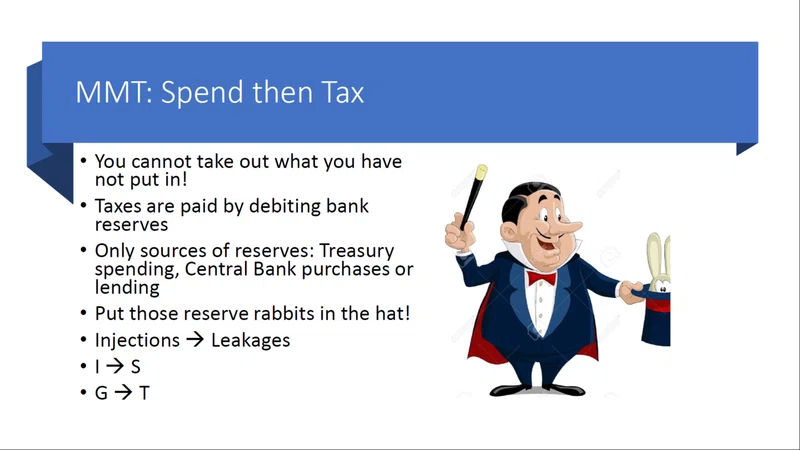

pay their taxes 29:48 electronically 29:50 so we don't even need the paper checks 29:52 it's just 29:53 an electronic debit of bank reserves 29:56 an electronic debit of the taxpayers 29:59 demand deposits 30:01 so let me summarize spending always 30:04 leads to 30:05 a credit to bank reserves and a credit 30:08 to a deposit account 30:10 taxing always reduces bank reserves 30:15 and reduces the taxpayers demand deposit 30:20 if spending is greater than taxing 30:24 that means reserves are net credited 30:28 because more reserves are added then 30:30 taken away 30:32 so that is how 30:35 that is the accounting 30:38 consequence of a budget deficit 30:41 it's a reduction of bank reserves uh 30:44 sorry an increase of bank reserve 30:46 a government surplus is a reduction of 30:48 bank reserves 30:50 okay so what does the central bank do 30:54 the sender mike facilitates payments buy 30:56 into the state 30:59 payments by the state e-flux money that 31:01 is gets it into the economy 31:04 taxes reflux money they don't finance 31:07 government spending they're used for 31:09 redemption 31:10 okay so they reduce uh the accounts 31:15 of the taxpayers and the reserves of the 31:20 banks bonds don't really finance the 31:23 deficit 31:25 if a deficit has occurred if government 31:28 spending has been greater than taxes 31:33 the uh it has already been paid for 31:37 by the credits to bank reserves and to 31:40 the accounts 31:41 of the recipients of the government 31:43 spending 31:45 the deficit has already been paid for 31:47 before the bonds are ever sold 31:49 the deficit is exposed it's after the 31:52 reflux of taxes 31:56 and you you over the course of the year 32:00 when you're spending a taxing you don't 3
返信削除リッキーさんがリツイートしていたレイの動画を見ている。この前の日経のとほぼ同じ。そのときは気づかなかったがInjections First then Leakage という言い方をしている。スペンディングファーストと同じぐらい重要なフレーズだと思う。
返信削除先に注入してからリークする
返信削除