| ||||||||||||||||||||||||



| ||||||||||||||||||||||||

| ||||||||||||||||||||||||

https://www.newyorker.com/news/persons-of-interest/what-if-were-thinking-about-inflation-all-wrong?utm_medium=social&utm_brand=tny&mbid=social_twitter&utm_social-type=owned&utm_source=twitter
What if We're Thinking About Inflation All Wrong?
Isabella Weber's heterodox ideas about government price controls are transforming policy in the United States and across Europe.

Photograph by Marzena Skubatz / Redux
Cancelling Christmas was, of course, a disaster. Raised in West Germany during the reunification era, Isabella Weber had been working as an economist in either Britain or the United States for the better part of a decade. An annual winter flight back to Europe was the most important remaining link to her German friends and family. But in December, 2021, the Omicron variant was surging, and transcontinental travel felt too risky. Weber and her husband drove from the academic enclave of Amherst, Massachusetts, to a pandemic-vacated bed-and-breakfast in the Adirondacks, hoping to make the best of a sad situation. Maybe Weber could finally learn how to ski.
Instead, without warning, her career began to implode. Just before New Year's Eve, while Weber was on the bunny slopes, a short article on inflation that she'd written for the Guardian inexplicably went viral. A business-school professor called it "the worst" take of the year. Random Bitcoin guys called her "stupid." The Nobel laureate Paul Krugman called her "truly stupid." Conservatives at Fox News, Commentary, and National Review piled on, declaring Weber's idea "perverse," "fundamentally unsound," and "certainly wrong."
"It was straight-out awful," she told me. "It's difficult to describe as anything other than that."
She gave up on skiing. The proprietor of the hotel made extra soup to cheer her up. But every time Weber checked her phone she was being mocked by a new round of critics. "The ugliness of the reaction to Weber's op-ed is depressing," Adam Tooze wrote, in his popular "Chartbook" newsletter. "Depressing and telling."
In a matter of hours, Weber, who was thirty-three years old, had transformed from an obscure but respected academic at the University of Massachusetts, Amherst, into the most hated woman in economics—simply for proposing a "serious conversation about strategic price controls." The uproar was clearly about something much deeper than a policy suggestion. Weber was challenging an article of faith, one that had been emotionally charged during the waning years of the Cold War and rarely disputed in its aftermath. For decades, the notion of a government capping prices had evoked Nixonian cynicism or Communist incompetence. And Weber was making her case in a climate of economic fear. Although the most acute disruptions of the pandemic seemed to be over—businesses were reopening and jobs were coming back—supply chains remained snarled and prices were rising faster than they had in forty years. Fringe fantasies of hyperinflation and economic doom were starting to go mainstream.
But Weber's argument was carefully grounded in history. Price controls, she argued, had been an essential element of the U.S. mobilization strategy during the Second World War. And there were several striking similarities between the economy of the nineteen-forties and that of the present day, including very high consumer demand for goods, record corporate profits, and production bottlenecks in important areas. Back then, the Office of Price Administration simply prohibited companies from raising prices above certain levels. Violators could be sued, or worse. In 1944, Montgomery Ward, the department-store chain, refused to accept the terms of a collective-bargaining agreement—a cap on the price of labor—brokered by the government. President Roosevelt ordered the National Guard to seize the business and remove Sewell Avery, its chairman, from its headquarters.
The O.P.A. program was born of necessity. The traditional inflation-control tactic—jacking up interest rates—would have reduced employment and industrial activity, making it harder for the military to obtain the supplies that it needed to fight. Industry-specific price controls contained consumer costs while encouraging companies to boost profits through higher sales volume. The initiative worked. During the First World War, inflation had run rampant. During much of the Second, it was close to two per cent. And yet factories were operating at peak levels. If contemporary policymakers could do the same thing, Weber argued, they could limit inflation without inducing layoffs and wage cuts.
Today, in a host of key sectors, that's more or less happening. The European Union is regulating the price of natural gas, the Biden Administration is regulating the price of oil, and the G-7 is enforcing a global cap on the price of petroleum products produced in Russia. Inflation appears to be cooling, and by nearly every measure we are living in the best labor market in a quarter century.
Weber, meanwhile, has recovered from her moment of notoriety. She's now living something like the public-intellectual dream: shaping German energy policy one day, testifying before Congress the next. Her portrait is on the cover of a recent issue of the German-language magazine Institutional Money, the Financial Times writes about her academic work, the Washington Post wants her op-eds, and Bloomberg can't stop hosting her on its flagship podcast. Analysts at the French investment bank Société Général and the European Central Bank now take much of Weber's analysis for granted. In January, Krugman—who apologized to Weber as the fracas peaked—even argued that price controls might be a useful piece of inflation management after all.
This astounding turnabout reveals a transformation in how we conceptualize the global economy. If you can understand Weber's once forbidden theories, you can understand just how dramatically Washington's economic assumptions have changed during the past two years—and what this new thinking might mean for the country's future.
At Joe Biden's first press conference as President, he pitched his $1.9-trillion American Rescue Plan by announcing that he wanted to "change the paradigm" in economic thought. He told reporters that he intended to "reward work, not just wealth." But the technical side of this new paradigm—what set of tools he'd use to bring about this change, and how those tools would function—remained unclear. His agenda broke with recent precedent in the Democratic Party primarily through its sheer size. Biden wanted more of everything: roads, bridges, housing, child care, and direct cash support to millions of households. Congress obliged. In addition to the A.R.P., lawmakers approved, in August of 2021, a half trillion dollars of new spending on infrastructure—a wave of public investment that followed nearly four trillion dollars in rescue funding deployed by Trump the year before.
Both Biden and Trump spent on this scale to avoid the elevated unemployment and stagnant wages that had hobbled President Barack Obama, whose eight-hundred-billion-dollar stimulus in the wake of the 2008 financial crisis had been enough to hold off another Great Depression, but not enough to prevent the unemployment rate from breaching double digits. Relative to the over-all size of the U.S. economy, Biden's program was nearly double the scope of Obama's, and structured to deliver more of its relief directly to working people.
But by the end of Biden's first year, the sense of possibility that had accompanied his early initiatives gave way to profound pessimism. Inflation was at seven per cent, its highest level since 1982. Those who had opposed his aggressive fiscal policy—most prominently, Larry Summers, the architect of Obama's more modest stimulus—offered an explanation. The President's quest to "reward work" had put so much money into consumers' hands that they were now outbidding one another for ordinary household products, pushing up prices. The basic problem, according to this diagnosis, was that the American public essentially had it too good, and would have to become poorer—spend less—for inflation to abate.
The solution pressed by Summers and like-minded thinkers was to induce millions of layoffs. By raising interest rates, the Fed could make borrowing more difficult for businesses, forcing many to cut costs by firing workers. By the spring of 2022, Summers proposed fixing inflation with a year of ten-per-cent unemployment—meaning sixteen million people without a job. "It's quite a painful way to bring inflation down," Weber told me. This story didn't sit well with her, and she began to find data points that contradicted it. The U.S. spent a lot on economic relief during the pandemic, but so did other countries, including Japan, where inflation peaked at just 4.3 per cent. If too much government spending were the problem, why weren't all of the big spenders getting hit similarly hard? And if excessive household wealth were the key driver of inflation, you would expect the prices of consumer goods to rise more or less in tandem, as people bought more of everything. Instead, most inflationary pressure came from large spikes in the prices of specific products and commodities, such as natural gas. Were households devoting every cent of their stimulus checks to higher thermostat settings?
To Weber, people like Summers were looking at the situation from the wrong side. The focus ought to be on sellers, not buyers. The pandemic had upended global supply chains, making it harder for corporations to acquire the stuff they needed to make their products. This should have squeezed their profit margins. Instead, as the economy began opening up, corporate profits were wildly outpacing growth in consumer spending power.
Here's an example. Semiconductor chips are the basic building blocks for electronic equipment. When COVID lockdowns and a string of temporary factory closures led to global shortages, the price of each chip began to rise, as did the price of everything else that used them. This proved especially troubling for the automobile market—a new vehicle can require as many as three thousand chips. As you'd expect, new cars got more expensive. So did the consumer alternative, used cars, which, in the first six months of 2021, jumped in price by nearly thirty per cent. But Weber argued that carmakers were raising prices far beyond what was necessary to cover the more costly chips. By 2022, the ongoing chip shortage had resulted in the fewest annual sales of new cars in more than a decade. Still, profits were up—car companies posted their best earnings in six years.
In a recent paper, Weber writes that the chip shortage established a "temporary monopoly" that allowed automakers to "raise prices without having to fear a loss in market share." And it wasn't just chips. Analyzing transcripts of company earnings calls, Weber concludes that firms in a variety of industries knew they could get away with gouging customers, who were already primed by the chaos of the pandemic to expect price hikes. Crucially, firms weren't worried about losing customers to competitors; because of the supply bottlenecks, competitors would also be raising prices. Weber calls this dynamic "sellers' inflation," in contrast with the traditional model of inflation, in which an excess of consumer purchasing power is to blame.
The higher upstream the supply disruption, Weber has noted, the greater the ultimate impact on consumers. Raise the price of electricity or oil, for instance, and suddenly everything becomes harder to make or move. The same is true for chemicals, metals, lumber, or any of the basic commodities required to produce more complex products. If a government could somehow prevent the price of these magnifiers from getting out of hand, it could stave off inflation.
In February, 2022, Weber tried her price-control pitch again. She presented a detailed scheme for regulating the price of natural gas in Germany: households and businesses would be guaranteed a limited supply at an affordable, government-controlled price. Anything they burned in excess of that quota would be subject to the soaring market price. (Producers of natural gas would receive government subsidies to make up for lost profits.) She was again pilloried online. If producers have the ability to raise prices irrespective of consumer demand, why didn't they do so all the time? Weber argues that they sometimes do—but that the pandemic had spurred just about everyone to do it at once.
"We got a huge reaction from economists in Germany, overwhelmingly negative, even from people who were vocally on the left and later became supporters," Weber recalled. "But we were invited to present the plan in Parliament, and there was a very large attendance, including from the Social Democratic Party—these people said they were getting a lot of feedback from constituents and this is a serious proposal that we should consider." German labor unions, in particular, began to come around. A functional price-control program, labor leaders recognized, would be better for workers than a round of interest-rate hikes, which amounted to a direct attack on wages.
And then Vladimir Putin invaded Ukraine. Almost overnight, the world's energy infrastructure had to be rewired. The U.S. imposed economic sanctions, Western investors fled Russia, and Putin cut off the flow of Russian natural gas to Europe. The price of energy futures exploded. The price of natural gas had already been elevated, but in 2022 the cost for a typical German family to heat their home almost tripled.
The onset of war in Europe marked the beginning of a new phase for the global economy. Weber had been arguing for months that the supply shocks of the pandemic were akin to those typically seen in war. Now an actual war had arrived, and the resulting economic dislocation was difficult to interpret as a case of flush consumers spending the economy into oblivion. It was hard to see how the orthodox approach—increasing unemployment through higher interest rates—would help solve the problem. In mid-September, Weber received an urgent note from the German Ministry of Economic Affairs. Would she be interested in serving on an official government commission to contain gas and heating prices? She took the job, and, within a few weeks, the commission had settled on her price-control plan as the solution. "In a strange way, the initial backlash to our proposals had been so tremendous that everyone knew we had come up with the idea, which meant that we didn't lose credit for it," she told me.
The German "price brake" is currently scheduled to run through April, 2024. After almost four months in operation, inflation in Germany fell to 7.4 per cent, the first time that it had dipped below eight per cent in half a year. And Germany's example seems to have encouraged broader initiatives. In February, the European Union began implementing a separate price cap on natural gas that applies to the entire Eurozone. Weber's fundamental point that corporate profits are a key driver of today's inflation is now openly embraced by the establishment on multiple continents. Researchers at the Kansas City Federal Reserve recently concluded that corporate price markups may have accounted for more than half of the inflation experienced by the U.S. in 2021. Weber's ideas have shifted from "truly stupid" to sound economic practice, supported by an ideologically broad coalition.
On paper, the German price brake is a modest initiative. (According to current estimates, it will cost less than fifty billion euros.) Still, a relatively small outlay that changes the way commodities are produced can have tremendous downstream effects; if you lower the price of energy, you can lower the price of everything produced using energy, and transform household finances without ever cutting a stimulus check. Similar programs could be developed for any durable material essential to manufacturing processes, such as steel, copper, or lithium for batteries.
Policymakers don't need to wait until things go wrong to try to stabilize them—they could instead take proactive steps to insulate important sectors from shocks. The Biden Administration is now trying to do just that. Last summer, it began selling oil from the U.S. Strategic Petroleum Reserve and issuing price guarantees to drillers in return for expanded production. Meanwhile, Congress passed the Inflation Reduction Act and the CHIPS and Science Act, which, combined, provided six hundred and thirty billion dollars for domestic microchip factories, wind and solar power, scientific research, and an electric-vehicle program that subsidizes the entire E.V. production chain.
There's a coherent, unified energy strategy at work here. Biden has been helping households manage short-term fossil-fuel costs while attempting to lower long-term fossil-fuel demand by expanding the supply of electric vehicles and green energy. Consumers aren't being punished with high prices today, and they will be offered lower prices on cleaner vehicles in the future. You can call this climate policy, foreign policy, or industrial policy—regardless, as a deliberate demotion of the market in favor of public economic management, it has a Weberian aura. Biden and Congress have decided not to let individual self-interest, consumer choice, or market competition determine the course of energy and manufacturing policy. They are quite straightforwardly attempting to reshape an industrial sector for the sake of other democratic goals.
Parts of the economy have always worked this way, to different degrees. The U.S. government has been subsidizing agriculture since the nineteen-thirties, and energy development since the First World War. The government helped build railroads and develop the early Internet. It owns Amtrak and built the highways that carry our cars, and it guarantees the money that ordinary people store in banks. But, starting in the late nineteen-seventies, mainstream economists and policymakers began to view these efforts as outliers and embarrassments. "The vision of public investment that had energized the American project in the postwar years—and indeed for much of our history—had faded," Jake Sullivan, Biden's national-security adviser, said recently. "It had given way to a set of ideas that championed tax cutting and deregulation, privatization over public action, and trade liberalization as an end in itself. There was one assumption at the heart of all of this policy: that markets always allocate capital productively and efficiently."
For nearly half a century, the Federal Reserve has embodied these ideas. If the central bank could manage the economy through interest-rate movements, then policymakers could let the market take care of everything else. There would be no need to decide which energy resources to develop, or which industries to strengthen. The process of supply matching demand according to the currents of consumer choice would insure that the economy automatically adjusted to the public's preferences.
This happy denouement hasn't arrived, which is what makes Weber's work so critical. She shows policymakers how they might move beyond the Fed and, by doing so, open up new ways to address different kinds of problems. Late last year, the G-7 implemented a global price cap on Russian oil—an effort to keep Russian energy flowing to developing nations that rely on it while limiting the Russian government's ability to profit. In the first few months of 2023, Russian oil revenues were down forty per cent. Weber particularly admires the enforcement mechanism: any ships that purchase Russian oil above the G-7-mandated price will not be eligible for insurance. "That's exactly the right principle," she told me. "You don't create some global board of price regulation, which will be guaranteed to fail. You work with the existing market infrastructure."
She's also enthusiastic about a proposal from the New York attorney general's office to strengthen the state's price-gouging regulations. The new rules would draw particular scrutiny to price increases of ten per cent or more during a period of "abnormal market disruption." Critically, this threshold would apply not only to consumer prices but also to price increases further up the supply chain. If such a disruption caused a baby-formula shortage, for instance, retailers could be fined for raising the price of baby formula on the shelves, and baby-formula producers could also be sued for raising the wholesale price charged to retailers. Zephyr Teachout, the antitrust lawyer who spearheaded the proposal, invited Weber to submit formal comments to improve it, and Weber has been promoting it on her speaking tours across Europe as a promising experiment in taming supply-shock inflation.
All of these efforts might be derailed. A concerted push from China could undercut the price cap on Russian oil; a backward-looking Supreme Court could prohibit just about anything; sheer political exhaustion could take hold. The increased willingness to accept economic heresies during a crisis often fades as the immediate threat dissipates. But Putin's invasion of Ukraine is unlikely to be the last major economic shakeup of this generation. If every shock is greeted with high interest rates and high unemployment, the result will be greater political instability and even greater economic dislocation. "There will be more shocks," Weber told me. "And the research has become impossible to ignore. We are finally trying to develop a stabilization policy that grapples with what is really happening in the economy—instead of what the old textbooks say should be happening." ♦
First she scandalized Washington. Then she became a princess.
~~~
Chartbook #65: Inflation & Price Controls

Chartbook #65: Inflation & Price Controls

チャートブック #65: インフレと価格管理

「危機はインフレに対抗するための強力な武器、当面の価格制限を持っている。それを検討する時期が来た」と語った。
このセンセーショナルな思考の下、ガーディアン紙はイザベラ・ウェーバーによる衝撃的な論説を掲載した。「お願いですか?」それは今考えました。
議論の本質は変わらなかった。ウェーバーは、1946年にアメリカの著名な経済学者がとった見解に基づいて、「戦略的価格制限」が、ここ緊張月アメリカでそのような不安を抱えている利益と価格の急騰を考えるための可能性があると示唆した。
私はケンタッキー州の田舎に住む義理の両親を訪問するためにソーシャルメディアを休みながら、試合に遅れました。
ツイッターに戻って今度は、ウェーバーの論説に対する反応の醜さに憂鬱だ。
私は問題の本質について議論したいので、以下でそれを行います。
知的生活の政治に関しては、私は語らずに示すことに専念しています。 チャートブックはその努力の要点です。が引用されたことを考慮して、この場合は例外とすることをお許しください。
この種の議論では、軽蔑が許されるほうはありません。いるのを見たのは先生だった。しかし、被害が出ました。
これはシルエットエチケットやマナー、性格の問題ではありません。議論の調子では、職業上の問題が問題になっています。 。
残念ながら、ウェーバーの理論説によって一旦守られた攻撃性も、知識から見ても非常に非生産的である。これは偶然ではありません。歓迎されない議論を覚悟する方法の 1 つは、ガッツポーズをすることです。一つは癇癪です。どちらの場合でも、その後の会話が非生産的なことはバグではありません。それが特徴です。
***
ウェーバーの論説は内容が不足している。彼女は、どのような種類の価格規制をサポートしているのか、どのセクターなどについては妥協していない。より具体的な研究内容にリンクしています。
あなたが真剣に討論に参加したいのであれば、ウェーバーの800語の短文に焦点を当てるのではなく、1945年以降の西側諸国と中国の価格統制政治に関する彼女の重要な歴史的著作権を尊重して、それ自体が疑問を投げかけているものを読んでください。そして、彼女の提案には諦めがないわけではないという事実を認めてください。これは、インフレ抑制への「型破りな」アプローチを奨励する最近の投稿・ケインジアンの著作物の豊富な鉱脈を反映しています。
私は意図的にポストケインジアンと言っています。 MMT への傾きは、ツイッター上での価格競争の気を紛らわせてもう一つの目標となった。
瓦礫の中から何を回収できるでしょうか?この議論をより生産的な方向に導くにはどうすればよいでしょうか?
エリック・レヴィッツがこの論争に関する優れた記事の中で討論しているように、ウェーバーの論説に説得力があると思うかどうかに見方、議論すべき重大な立場がある。主張を主張する取り組みは、私たちの取り組みをキャンセルします。
アメリカの医療制度全体を超え、より危機管理を強く主張することができます。そして、価格統制自体は、インフレ管理に対する多くの型破りなアプローチの1をあまり考えません。価格つり上げ企業の独占力を減らすこと、必要が供給を今後の部門に信用を振り向けること、労働者に給与の一部を貯蓄することを強制すること(または強く奨励すること)、生産拡大への直接公共投資などにも挙げられる。
これらの対策は、マイナスの副作用や予期せぬ結果を考える可能性があります。 ただし、警戒上昇についてもすべて同じことができます。正統的なツールの可能性を無視すれば、私たちはずっとその代償を忘れることになります。
1945 年以来の米国の価格制限の歴史について、博士号が大きな影響を考えている優秀なアンドリュー エルロッドを眺めてみましょう。このスレッドから始めてください。
「当時、情報に基づいた議論は暫定価格を管理すべきかどうかではなく、誰が価格を管理すべきかについてのものだった。」
価格制限が現在まで米国で実際にどのように機能してきたかについての議論な議論については、トッド・タッカーによるこの記事を参照してください。
さまざまなタイプの規制価格と制限がアメリカの最新インフレ問題の管理にどのように対処するかについてのポストケインジアンの提案については、ルーズベルト研究所のジョシュ・メイソンとローレン・メロディアの立場をチェックしてください。
そうは言っても、現在の状況に関しては価格制限が重要な解決策になるかどうかは、私にはまだ納得できません。
***
インフレ圧力は広く行われているため、金融政策対応に値すると考えているため、懐疑的な見方もある。
私としては、私は一時チームの有料メンバーですが、ウェーバーはこの診断について中断していますが、真剣に考えません。 実際、私は一時的なチームの考えではありません。のメンバーです。念のため言っておきますが、私は最近の物価上昇を一般的なインフレとみなすべきかどうか全く自信がありません。 最近の価格変動の重要性が低下している共通懸念そして、それが2019年までのデータに不安があり、新型コロナウイルスショック以降の期間ではさらにです。ウイルス要素と非新型コロナウイルス要素に分類したことは、このスコアに関しては非常に説得力があります。
この考え方が必要な場合、どの商品がどの価格上昇のどの問題に有効に対処できるかが問題になります。
ウェーバー氏はまず、一般的なインフレの重要な推進として利益率の上昇を強調した。 この点に関しては、BLSの金融アナリストでサブスタッカーのジョセフ・ポリターノによる見方が完全に自信があると一般的な利益率の急上昇がここでダメージを与えているとは考えられません。
同様に、ポリターノ氏のインフレのセクター別論理の分析や、同様にエネルギー価格のインフレに対処する手段としての価格に対する懐疑論も非常に説得力があると思います。
アメリカで医薬品の価格を見直す根拠があるのは間違いありません。 一部の都市では、家賃規制が住宅政策のトレードオフの前提となる場合があります。しかし、「価格制限」という(意図的に)慎重な下のルールで、その手段を使って継続の個別の検討を入れるためにはほとんど必要があると思います。
「価格制限」という用語の使用が慎重であるであると表現するのは軽蔑的ではないと思います。 私は、この言語の目的は、相対を考慮し、従来の言説の限界を打ち破ることであると考えています。
しかし、この種の異端的な挑戦は一般論として立ち向かうことはできないかもしれないが、そのような決断が2022年の価格上昇に対抗するための「強力な武器」であると想像するのは冗談になるだろう。
これは、さまざまな悪い選択肢に決断した場合、金融政策、政策政策、外交政策のいずれであっても、反インフレ政策の導入には自制すべきであることを暗示しているだけです。
***
最近登場したより印象的なデータの 1 つは、ブルッキングスが作成した暫定への影響に関する天気予報の数字です。 4四半期平均移動ベースでも現在はマイナス領域の境界がある。

出典:ブルッキングス
今後の政策政策と特に救済計画の影響について詳しくは、EPIによるこの優れた記事をご覧ください。
私はウェーバーがチームの一時的な立場を特徴付けるために使用する言葉、「家が燃えている」などに優先的に考えているが、最新価格に政治的なリスクが含まれていることを否定する人はいないだ。
しかし、これを「価格制限」政策と考え、1940年代を思い起こさせることに何の目的があるのでしょうか?
純粋に知られた根拠に基づいて、より広範な議論が歓迎されるのは間違いありません。しかし、私たちはディベートクラブに所属しているわけではありません。これは一か八かの政治の舞台です。「政権政権にとって重要なのは、2022年の中間選挙だ。「価格制限」の話が、変化を起こす重要な選挙区や報道機関にどう影響するかについて、世論調査をした人はいるだろうか?
薬価に関しては、大多数のアメリカ人がしっかりとした薬価交渉をサポートしているようだ熱意を示しません (もちろん、これが公開されている Web サイトは知っています)。
この点について訂正してもらったのは嬉しいが、一応、活動家でタフな政府の交渉人は、「価格制限」の話で呼び出されるなんとか的なビジョンよりも魅力的だろう。統制の経験は、今後数十年間、価格制限の問題に関するアメリカの公的憲法に長い影を落とした。
ここでついに歴史の利用法になりました。
***
進歩陣営の一部の人々は、ニューディール政策の全体的な雰囲気や特定の政策だけでなく、1946年に議論されたが実施されなかった平時価格制限などの政策からも、歴史からインスピレーションを得ることは明らかだと確信している。 知識生産性が高く、政治的にも有益です。 グリーン・ニューディール政策が登場して以来、私はこの「過去からの戦略の爆発」には懐疑的で進歩ような政治がこの種の歴史主義からどのような利益を得ているの理解するのは難しいと思いますグリーン・ニューディールに関する限り、私はここまで来ました。現在の状況の間に強い類似点が引き出されていることを心配し続けています。
ダイアン、私は彼女の歴史に対する関心を共有しています、ケインズ、カレツキ、ラーナーラのような世紀半ばのマクロ経済学者の著作に対する熱意を共有しています。教訓を20世紀半ばから現在にテレポートすることについては、私は非常に懐疑的です。
歴史と政策の別の領域では、これを「永遠の勝利」症候群と呼ぶかもしれない。
挑戦現代の歴史の力関係が非常に劇的で暴力的なため、複雑さが増大するペースが驚くべきものであるため、国家と政治経済の万華鏡が非常に根本的に変化しているため、歴史の役割は私たちを招待することではないと私は思います。過去の戦いをやり直すために。
また、開発はすべて一方向に進むわけではありません。今日の米国の政府機構が、大規模な価格の監督に必要な能力と資源を集中できるかどうかは、当面は白ではない。新型コロナウイルス検査などの基本的なサービスの提供に関する最近の経験では、多くのことは示唆されない。 行政能力の再構築は、実際には市場監督と価格管理という基礎的なプロジェクトの一部である可能性がある性がある。しかし、その場合は長期戦の戦略となります。
これまで、歴史は非直線的に機能し、「過去からの爆発」、「永遠大義」、「もし…さえあれば」戦略が政治的命題として機能する可能性自体は考えられないわけではないドナルド・トランプは他に何を取引しましたか? しかし、これは一か八かの考えであり、進歩政治の従来の理解からすれば、当面はなかったかもしれない黄金時代への飛躍は明白な動きのように思えます。
現代史の劇的なエスカレーションという大いなる加速のドラマに負けて、歴史より明白な役割は、私たちがどのようにしてここに定着したのかを理解することを助けることであるように思われる。
なお、ウェーバーの過去への飛躍に動機がないわけではない。 実際、それはホワイトハウス経済討論委員会と同等の保証によって保証されているテデスキ_の強力なチームは、第二次世界大戦後の戦後を現在に至っては歴史的類似物として準公式に支持する論文を発表した。ただし、これは確かに歴史の道具化の注目に値する例です。
目的は明確でした。1970年代型のスタグフレーションとの憂鬱 類似を断ち切るために。 著者らは次のように結論付けています。
現在の出来事の完璧なテンプレートとなる歴史上のエピソードは 1 つもありません。第二次世界大戦後のインフレ期は、1970年代よりも現在の経済状況をより正確に比較できる可能性が高く、サプライチェーンが完全にオンラインになり、滞留需要が横ばいになると、インフレは急速に低下する可能性があることを示唆しています。
「第二次世界大戦の影響について話したいなら、価格制限と当時推奨された政策について話しましょう」多くの著名な経済学者によって…」。
そこで、アナロジーによって時間を遡ることは、「1946年に戻ってさえいれば、彼らはサミュエルソンラの言うことを聞いていれば…彼らの間違いを読まないようにしましょう。しましょう」という線に沿って、反事実への「横向き」の飛躍を許可します。 1946 年に最も優れた人々によって言われたものに基づいています。」より、過去の省略やチャンスの逃しなどを恐れることとして想定されているようです。
しかし、第二次世界大戦以来のアメリカにおける価格制限の歴史的経験についての話であれば、実際に最後に実際に大規模に試行されたときの、それらの手段の苦難の歴史に決心せずに、本当に真剣に語ることができるだろうか? ホワイトハウスのチームが避けようとしていた歴史的領域、そのうち1970年代に関わる必要はないのか?
それは、クルーグマンのような人々が、価格制限に関する全域にわたって一方通行とアレルギーを感じた原因となった時代である。
私は1970年代の歴史を創造的に再考することに大賛成です。 あの時代の悪夢のような記憶から私たちを解放することは、政治の想像力に大きな貢献となるだろう。現在も最も重要であったインフレ価格の分野、将来エネルギーを考えると、価格管理は特に重視のない領域のように思われる。
2020年以降、米国だけでなく世界中でエネルギー価格が価格上昇の最大の検討となっている、1970年代の米国のエネルギー価格制限の経験を再現したいと思う人はいるだろうか? OPECへのいじめには魅力がありますが、薬価を巡る骨の折れる交渉に似ていると考えてください。逆の石油増産を促進するだけでなく、低エネルギー価格は米国の生得の権利であり、必要な手段を一時的にそれを実現するのが政府の仕事であるという国民の感覚を定着させます。
***
「一時的なチーム」が金融政策に関して忍耐を覚悟であれば、それは「戦略的価格管理」の慎重政策としても倍増する。
状況をドラマ化することで大統領政権が得るものはほとんどなく、ものは大きい。ぜひ、楽勝を目指してください。脱炭素化などの戦略目標から逸脱しない限り。暴利を貪る者たちを摘み取る。しかし、今日の私の状況を、第二次世界大戦後に米国が敗北している状況と混同しないようにしましょう。これからも、その時代から遠く離れています。私たちはやるべき問題を考えています。20世紀中間のロッカーを漁るのではなく、自分の言葉で問題に対処しましょう。
***
私は、世界中の多種多様な購読者にチャートブックを無料で提供するのが大好きです。 書くのは楽しいし、アイデアを考えるのに最適な場所です。サポートしたいと思われる場合は、次の 3 つの購読オプションがあります。
年間サブスクリプション : 年間50ドル
標準 の月額サブスクリプション: 月額 5 ドル - もう少し柔軟に利用できます。
ファウンダーズ クラブ: 年額 120 ドル、または任意の金額 - Chartbook ニュースレターが大好きな方、または定期購読料をかけてニュースに向かってプロフェッショナルな環境でレターを読んでいる方は、ファウンダーズ クラブへのサインアップをごご検討 ください。
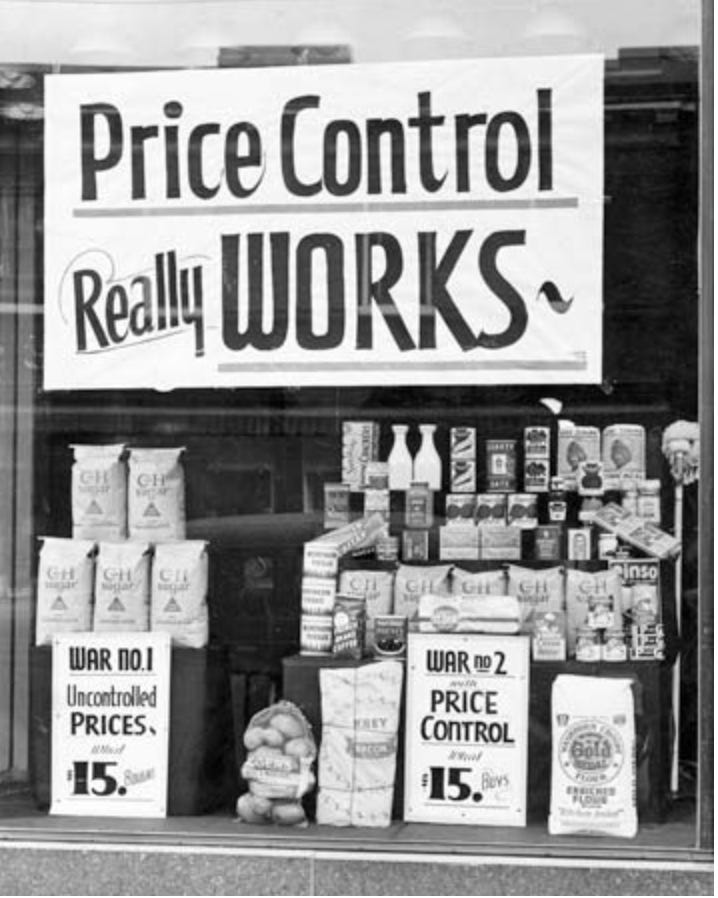
"We have a powerful weapon to fight inflation: price controls. It's time we consider it."
Under this sensationalist headline, the Guardian, published an explosive op-ed by Isabella Weber. After a week of furious controversy, the headline was revised. "Could strategic price controls help fight inflation?" it now asked.
The substance of the argument remained unchanged. On the basis of positions taken by prominent American economists in 1946, Weber suggested that "strategic price controls" might be a means to contain the surge in profits and prices that is causing such anxiety in the United States in recent months.
I'm late to the game having been on a break from social media visiting in-laws in rural Kentucky.
Coming back to twitter this week, the ugliness of the reaction to Weber's op-ed is depressing. Perhaps one should not be surprised. But it is depressing and telling, nevertheless.
I would much prefer to discuss the substance of the issues and I will do so below. But one should not pass over the tone of this debate without comment.
When it comes to the politics of intellectual life, I'm committed to showing not telling. Chartbook is part of that effort. But given the importance of the subject matter and since my name was invoked in one widely quoted thread, forgive me for making an exception in this case.
In this kind of debate there should be no room for disrespect. Full stop. However wrong and ill-judged you may feel Weber's op-ed to be, there should be no room for disrespect. It was good to see Paul Krugman apologizing. But the harm was done.
This is not merely a matter of etiquette, manners, or personalities. In the tone of a debate, issues of professional authority are at stake. If the personal is political, so too is the tone of a debate.
Regrettably, the aggression triggered by Weber's op-ed is also profoundly unproductive in intellectual terms. It turned what should be a serious argument about an important issue - the means of inflation-control - into an ugly slanging match. This is not by accident. One way to shut down an unwelcome discussion is by means of fist-pounding. Another is the tantrum. In either case, the unproductiveness of the ensuing conversation is not a bug. It's a feature.
***
Weber's op-ed is short on substance. She does not tell us what kind of price controls she advocates, on what sectors etc. But, in fairness, the op-ed links to work that is more specific.
If you are serious about engaging in the argument, don't focus on Weber's 800 word squib, read it in light of her important historical work on price control politics in the West and China after 1945, which poses its own questions. And acknowledge the fact that her suggestion is not without context. It reflects a rich vein of recent post-Keynesian writing that has urged "unconventional" approaches to inflation control.
I say post-Keynesian deliberately. Tilting at MMT was another of the distractions of the price control debate on twitter.
What can we salvage from the wreckage? How can we take this debate in a more productive direction?
As Eric Levitz makes clear in his excellent write-up of the debate, whether you find Weber's op-ed convincing or not, there is a serious position to be argued with. The effort to assert the monopoly of conventional inflation-fighting disarms us.
One could make a strong case for more stringent controls throughout the American health-care system. And price controls are themselves just one of many unorthodox approaches to inflation management. Reducing the monopoly power of price-gouging firms, channeling credit to sectors where demand outstrips supply, forcing (or strongly encouraging) workers to save a fraction of their paychecks, and direct public investment in expanded production are others.
All of these measures have the potential for negative side effects and unintended consequences. But the same can be said of raising interest rates. If policymakers reflexively presume the wisdom of conventional tools, and dismiss the potential of unorthodox ones, we will all pay the price.
On the history of price controls in the US since 1945, follow the excellent Andrew Elrod, whose PhD is going to make a major impact. Start with this thread.
It includes this great line: "Informed debate then was never about whether prices should be controlled but who should control them."
For a serious discussion of how price controls have actually operated in the US up to the present, check out this piece by Todd Tucker.
For post-Keynesian proposals on how regulations and price controls of various types might assist in managing America's current inflation problems, check out the position of Josh Mason and Lauren Melodia at the Roosevelt Institute.
Having said all that, I remain unpersuaded that price controls can be an important remedy in our current situation.
***
Some are skeptical because they believe that inflationary pressure is broad-based and merits a monetary policy response.
For my part, I'm a paid-up member of team transitory, a diagnosis Weber mentions but does not seriously address. In fact, I am not just part of team transitory. I am a member of team sectoral, as well. To put a point on it, I am not convinced that the current round of price increases should really be thought of as a general inflation at all. I am impressed by recent BIS work which shows the common factor in recent price movements declining in significance. And if that is true for data up to 2019, it is all the more the case for the period since the COVID shock. Matt Klein's breakdown of the data into COVID and non-COVID elements is highly persuasive on this score.
If one takes this approach, the question becomes which instruments might usefully address which drivers of which price increases. It is not obvious to me that either interest rate hikes or price controls in general can be of much help.
Weber starts by stressing rising profit margins as an important driver of general inflation. On that score I find the critique by BLS-financial analyst and Substacker Joseph Politano wholly persuasive. It just isn't likely that a general surge in profit margins is doing the damage here.
Likewise, I find Politano's breakdown of the sectoral logic of inflation highly persuasive as well as his skepticism towards price controls as a means of addressing inflation in energy prices, for instance.
There is no doubt a case for driving down the price of pharmaceuticals in the US. Rent controls may be part of housing-policy trade-off in some cities. The meat lobby has an anti-trust case to answer. But I see little advantage in packing an array of discrete measures using existing instruments under the (deliberately) provocative rubric of "price controls".
I don't think it is pejorative to describe the use of the term "price controls" as provocative. I take it to be the purpose of this language to provoke debate and break open the confines of conventional discourse.
But as desirable as that kind of heterodox challenge may be in general terms, we will be kidding ourselves if we imagine that such measures are a "powerful weapon" to fight the spike in prices in 2022.
Cleaving to team transitory does not imply complacency. It just implies that faced with a range of bad options we should practice restraint in adopting any anti-inflationary policy, whether that involves monetary policy, regulatory policy or fiscal policy.
***
One of more striking set of data to appear of late are the quarterly numbers for fiscal impact produced by Brookings. For all the talk of Biden stimulus, the fiscal impulse went into negative territory in Q2 2021. Even on a four-quarter moving average basis it is now on the border of negative territory.
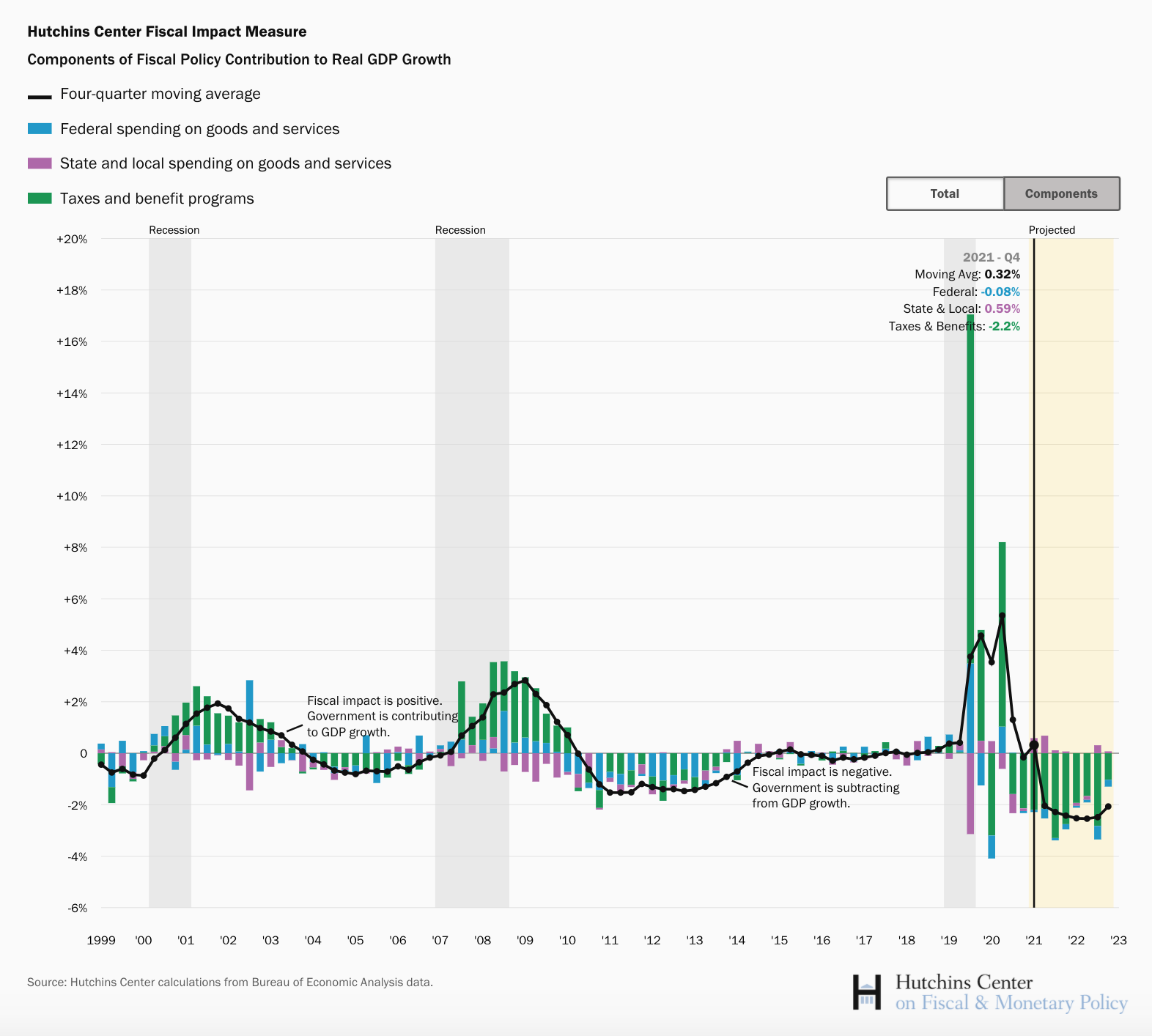
Source: Brookings
For more on the impact of Biden's fiscal policy and the Rescue Plan in particular, check out this excellent piece by the EPI.
Though I would take issue with the language Weber uses to characterize the team transitory position - "houses on fire" etc - no one would deny that there are political risks involved in the current price surge. The Biden team clearly think it is important to be seen to be doing something about the price of petrol, meat etc.
But what purpose is served by labeling this as a policy of "price controls" and harking back to the 1940s?
On purely intellectual grounds a more wide-ranging debate is no doubt to be welcomed. But we are not in a debating club. This is the arena of high-stakes politics. What matters for the Biden administration are the midterms in 2022. Has anyone done any polling on how talk of "price controls" might play with important swing constituencies and media outlets that make a difference?
On drug prices, a large majority of Americans seem to favor robust drug price negotiations. But when the issue of price control is raised, at least one yougov poll (take it or leave it) shows little enthusiasm (and yes I am aware of the website this is published on).
Happy to be corrected on this, but perhaps an activist, tough government negotiator is more attractive than the bureaucratic visions summoned up by talk of "price control". Certainly, the experience of 1940s control cast a long shadow over American public debate of the issue of price controls for decades to come.
Which brings us finally to the uses of history.
***
Some folks in the progressive camp are clearly convinced that taking inspiration from history, not just from the general aura of the New Deal, or from specific policies, but even from policies, like peacetime price controls, that were debated in 1946 but not implemented, is intellectually productive and politically helpful. I've been a skeptic on this "blast from the past"-strategy since the Green New Deal came on the scene. I find it hard to see how progressive politics benefits from this kind of historicism. As far as the Green New Deal is concerned I have come around. I've ended up embracing its grand vision of our historic predicament, whilst continuing to worry about strong analogies being drawn between the mid-century moment and our current situation. On those grounds I find Weber's effort to segue from 1946 to 2022 unpersuasive.
Obviously, I share her interest in history and I share the enthusiasm for the writings of mid-century macroeconomists like Keynes, Kalecki, Lerner et al. But I am deeply skeptical when it comes to teleporting structural analyses and particular policy lessons from the mid 20th century into the present. And we should particularly guard against the kind of nostalgia that is evoked by the evocation of "If only, …..".
In another domain of history and policy one might refer to this as the "Lost Victories" syndrome.
Precisely because the dynamic of modern history is so dramatic and so violent, because the pace at which complexity increases is so staggering, because the kaleidoscope of power and political economy shifts so radically, I don't think that history's role should be to invite us to refight past battles.
Nor is development all in one direction. It is far from obvious that the US government machine today would be able to mobilize the competence and resources necessary to supervise prices on a large scale. Recent experience with the provision of basic services like COVID testing hardly suggests as much. Rebuilding administrative competence may in fact be part of the underlying project of market supervision and price control. But in that case it is a long-haul strategy.
Of course, history functions in non-linear ways and it is not per se inconceivable that a "blast from the past ", "lost cause", "if only…"-strategy may work as a political proposition. What else did Donald Trump trade on? But it is a gamble at long odds and on any conventional understanding of progressive politics a leap back to a golden age that might have been hardly seems like an obvious move.
Faced with the drama of the great acceleration - the dramatic escalation of modern history - the more obvious role for history would seem to be to help us to understand how we got here.
Of course, Weber's leap into the past is not unmotivated. In fact, it is warranted by no lesser authority than the White House Council of Economic Advisors. In July 2021 the formidable team of Cecilia Rouse, Jeffery Zhang, and Ernie Tedeschi issued a paper giving quasi official endorsement to the aftermath of World War II as the proper historical analogue for the present. I don't know whether this is a historic first - for. the White House to announce its preferred historical analogue. But it is certainly a remarkable example of the instrumentalization of history.
The aim was clear. To cut off the alarming analogy to 1970s-style stagflation. As the authors conclude:
No single historical episode is a perfect template for current events. But when looking for historical parallels, it is useful to concentrate on inflationary episodes that contained supply chain disruptions and a spike in consumer demand after a period of temporary suppression. The inflationary period after World War II is likely a better comparison for the current economic situation than the 1970s and suggests that inflation could quickly decline once supply chains are fully online and pent-up demand levels off.
It is this prise de position by the Biden administration's advisors that licenses Weber to make her move: "Well, if you want to talk about the aftermath of World War II, let us talk about price controls and the policy that was advocated at the time by many distinguished economists …".
Thus a leap back in time by way of analogy licenses a "sideways" leap into counterfactual, along the lines of: "If only back in 1946 they had listened to Samuelson et al … Let us not repeat their mistake. Let us not shy away from what was advocated by the best and the brightest in 1946". The dialectic of progress seems to be envisioned not so much as avoiding mistakes, but avoiding omissions of the past, missed opportunities etc.
But if you want to talk about the historical experience with price controls in America since World War II can we really do so seriously without engaging with the embattled history of those instruments when they were actually last tried in practice on a large scale? Don't you have to engage with the historical terrain that the White House team were trying to avoid, i.e. the 1970s?
Like it or not, that is how we got here. That is the epoch that left folks like Krugman as conflicted and allergic as they clearly feel about any mention of price controls.
I am all for a creative historical reimagining of the 1970s. Releasing us from the nightmare memories of that period would do a great service to the political imagination. But price controls seem a particularly unpromising territory, particularly given the area of price inflation that mattered most, then and now i.e. energy.
If energy prices have been the largest single driver of the price spike since 2020 not just in the US but around the world, would anyone wish to repeat America's experience with energy price controls in the 1970s? Surely not. Bullying OPEC has its attractions - think of it as the analogue to muscular negotiations over drug prices - but it also harbors risks. Not only does it promote greater oil production, which is the opposite of what we need, but it entrenches the popular sense that low energy prices are an American birth-right that is the job of government to deliver, by all means necessary.
***
By a process of elimination, the best judgement is surely what it was last autumn. If "team transitory" favored patience with regard to monetary policy that goes double for any policy of "strategic price control".
The Biden administration has little to gain and much to lose by dramatizing the situation. By all means, go for the easy wins. So long as they do not deflect from strategic objectives like decarbonization. Pick off the profiteers. Use the tools that are available. But let us not confuse our situation today with that facing the United States after World War II. We are far removed from that epoch, both from its dangers and its possibilities. We have our own problems to face, let us address them on their own terms rather than rummaging in the locker of the mid twentieth century.
***
I love putting out Chartbook for free to a wide and diverse range of subscribers from all over the world. It is a pleasure to write and a great place to pull ideas together. It is also, however, a lot of work. If you feel moved to support the project, there are three subscription options:
The annual subscription: $50 annually
The standard monthly subscription: $5 monthly - which gives you a bit more flexibility.
Founders club:$ 120 annually, or another amount at your discretion - for those who really love Chartbook Newsletter, or read it in a professional setting in which you regularly pay for subscriptions, please consider signing up for the Founders Club.

0 件のコメント:
コメントを投稿