| ||||||||||||||||||||||||



| ||||||||||||||||||||||||
| ||||||||||||||||||||||||
What is true of government as a whole is also true of particular programs.
Social Security and Medicare are government programs; they cannot go bankrupt, and they cannot fail to meet their obligations unless Congress decides-say on the recommendation of the Simpson-Bowles Commission- to cut the benefits they provide. The exercise of linking future benefits and projected payroll tax revenues is an accounting farce, done for politicareasons. That farce was started by FDR as a way of protecting Social Security from cuts. But it has become a way of creating needless anxiety about these programs and of precluding sensible reforms, like expanding Medicare to those 55 and older, or even to the whole population.
| ||||||||||||||||||||||||
https://stephaniekelton.substack.com/p/save-social-security-from-its-saviors
Save Social Security From its 'Saviors'
Stephanie Kelton Jul 3 43 26
Lately, I've been writing about Social Security (here and here). With everything else that's' commanding our attention at the moment, it's not a topic that feels particularly urgent. It soon will.
The debates have already started, and I expect them to heat up after the midterms. Just think back to what happened after the midterm shellacking in 2010, when a newly-emboldened group of republicans lawmakers joined forces with a group of so-called "moderate democrats" to push for cuts to Social Security as part of a "Grand Bargain."
Of course, no one ever comes right out and says they want to CUT Social Security. That would be political suicide. Instead, lawmakers—democrats and republicans—describe their positions as well-intentioned and grounded in the harsh reality of budgetary math. They want to SAVE Social Security.
Robert Eisner, who spent most of his career as a professor of economics at Northwestern University, was onto this charade.
In 1998, Eisner published an article called "Save Social Security from its 'Saviors'." I strongly encourage you to read the entire thing.
In addition to that article, Eisner wrote a number of books and op-edsabout Social Security. He was frustrated by the policy debates, which he saw as entirely misguided. Here's the closing sentence from an op-ed he published in The Wall Street Journal in 1997.
Politicians and pundits should stop playing games with a confused public, and focus on total spending and total taxes, how they affect the economy, who gains and who loses.
If you go on to read the article I recommended, you'll see that Eisner echos this little-known fact made by MMTers like Warren Mosler.
| ||||||||||||||||||||||||

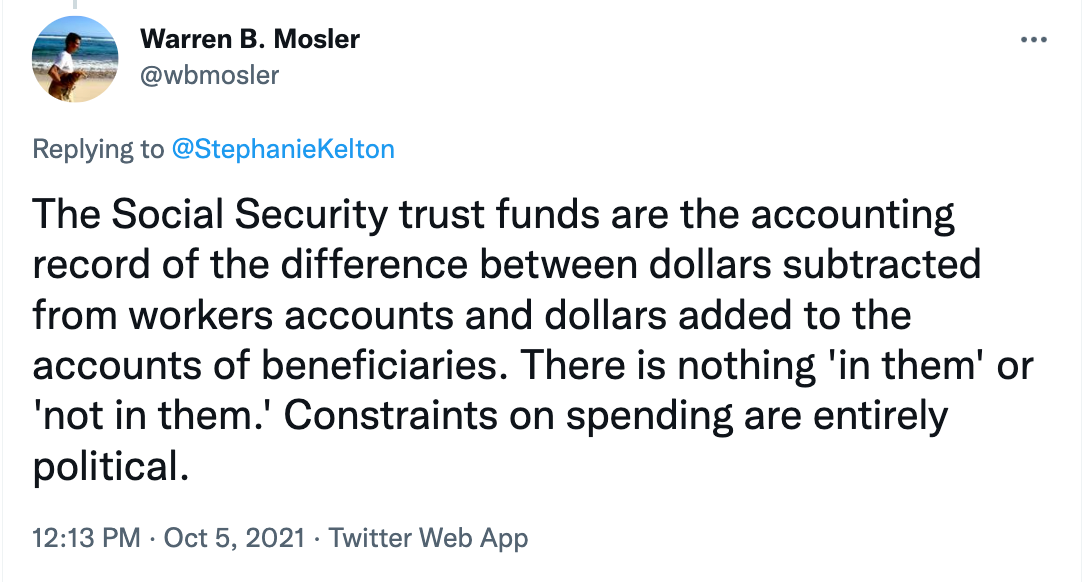
Eisner's main message was that the obsession with Social Security's Trust Funds (OASI and DI) is a distraction. To borrow a phrase from Gertrude Stein, "There is no there there." The trust funds exist merely as accounting entities. We don't need them to carry a positive balance—or any balance whatsoever—in order to preserve Social Security for future generations. Here's Eisner:
Expenditures alleged to be related to trust funds are often less than their income—witness the highway and airport funds as well [as] Social Security. There is no particular reason they cannot be more. The accountants can just as well declare the bottom line of the funds' accounts negative as positive—and the Treasury can go on making whatever outlays are prescribed by law. The Treasury can pay out all that Social Security provides while the accountants declare the funds more and more in the red.
The only conceivable problem, as I explained last week, is with the way the enacting legislation was written.1 Congress could "fix" Social Security simply by amending that legislation to grant the Old-Age and Survivor's Insurance (OASI) and Disability Insurance (DI) programs the same federal backstopping that already guarantees program solvency for the Supplemental Medical Insurance (SMI) Trust Fund.
If for some reason we choose to perpetuate the myth that the trust fund balances are vital to the program's "solvency," Eisner had this to say:
For those concerned, nevertheless, about the 'solvency' of the trust funds, there are simple, painless remedies for this accounting problem.
What he strongly opposed were the kinds of "remedies" that are often proposed in the name of "saving" Social Security—means-testing, raising the retirement age, reducing cost-of-living adjustments, diverting payroll contributions into privatized accounts, etc.
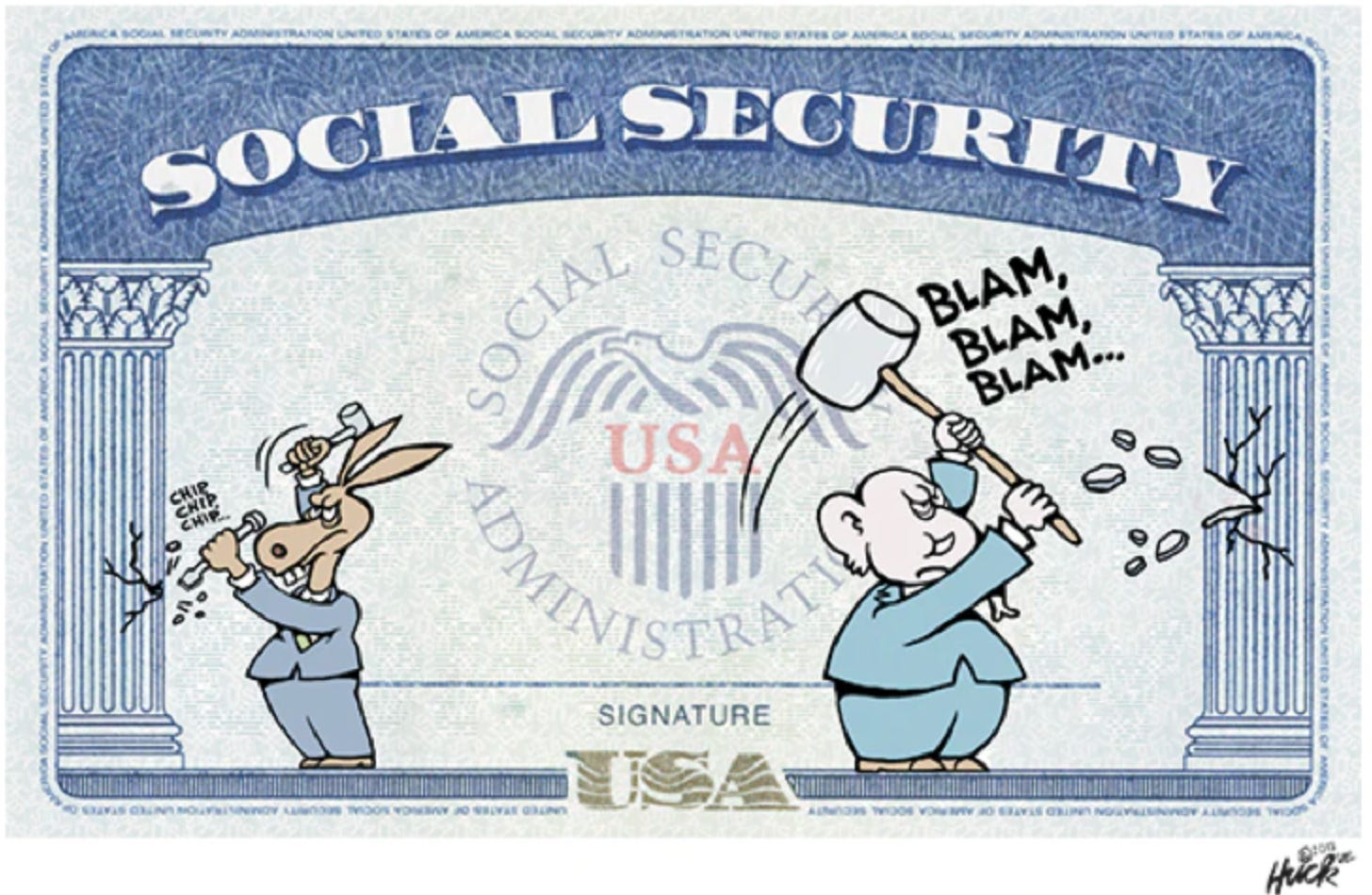
The proposed nibbling away of Social Security, including that by some of its presumed friends, is disingenuous and misleading. Even some of its defenders seem all too ready to accept 'minor' cuts in benefits to achieve prospective fund balance.
Eisner might have tweaked an old adage, "With saviors like these, who needs executioners?"
Under current law, OASI, DI, and HI are authorized to pay statutory benefits—i.e. what beneficiaries are entitled to under the law—only if there are adequate financial resources to cover those obligations.
Save Social Security from Its Saviors

2014 Greenspan: 「政府が作成することを妨げるものは何もありません...
| ||||||||||||||||||||||||
| ||||||||||||||||||||||||
| ||||||||||||||||||||||||
政府全体に当てはまることは、特定のプログラムにも当てはまります。
社会保障とメディケアは政府のプログラムです。議会が、たとえばシンプソン・ボウルズ委員会の勧告に基づいて、彼らが提供する利益を削減することを決定しない限り、彼らは破産することはできず、義務を果たせなくなることはありません。将来の給付と予測される給与税収を結び付けることは、政治的な理由で行われる会計茶番です。その茶番劇は、社会保障を削減から保護する方法として FDR によって開始されました。しかし、それは、これらのプログラムについて不必要な不安を生み出し、メディケアを 55 歳以上の人、さらには全人口に拡大するなどの賢明な改革を妨げる方法になっています。
| ||||||||||||||||||||||||
その「救世主」から社会保障を救う
ステファニー・ケルトン 7月3日 43 26
最近、私は社会保障について書いています (ここ と ここ)。 現時点で 私たちの 注意を喚起している他のすべてのこと を考えると、それは特に緊急に感じられるトピックではありません. もうすぐです。
議論はすでに始まっており、 中間選挙以降は熱くなるだろう。2010 年の中間弾圧の後に起こったことを思い出してください。新たに勇気づけられた共和党議員 のグループが、いわゆる「穏健な民主主義者」のグループと力 を合わせ、「大交渉」の一環として社会保障の削減を推進しました。 "
もちろん、すぐに出てきて、 社会保障を削減したいと言う人はいません。それは政治的自殺だろう。代わりに、民主党と共和党の議員は、彼らの立場を善意であり、予算計算の厳しい現実に基づいていると説明しています。 彼らは社会保障 を救いたいのです 。
キャリアのほとんどをノースウェスタン大学の経済学教授として過ごした ロバート・アイズナーは、このシャレードに乗っていました。
1998年、アイズナーは「救世主から社会保障を救え」という記事を発表した。 全体を読むこと を 強くお勧めします。
その記事に加えて、アイズナーは 社会保障に関する多くの本 と 論説を書きました。彼は、政策論争が完全に見当違いであると見なしたことに不満を感じていました。 これは、1997 年にウォール ストリート ジャーナルに掲載され た論説の結びの 文 です。
政治家や専門家は、混乱した大衆とのゲームをやめ、総支出と総税金、それらが経済にどのように影響するか、誰が得をし、誰が損をするかに注目すべきです。
私が推奨する記事を読み進めると、Eisner が、Warren Mosler のような MMTer によって作成されたこのあまり知られていない事実を反映していることがわかります。
社会保障信託基金は、労働者の口座から差し引かれたドルと受益者の口座に追加されたドルとの差額の会計記録です。 「それらの中に」または「それらの中にない」ものは何もありません。支出の制約は完全に政治的なものです。
Warren B. Mosler
@wbmosler
:
Replying to @StephanieKelton
The Social Security trust funds are the accounting
record of the difference between dollars subtracted
from workers accounts and dollars added to the
accounts of beneficiaries. There is nothing 'in them' or
'not in them.' Constraints on spending are entirely
political.
12:13 PM Oct 5, 2021 Twitter Web App
アイズナーの主なメッセージは、社会保障の信託基金 (OASI と DI) への執着は気を散らすものであるというものでした。ガートルード・スタインの言葉を借りれば 、「そこには何もない」。信託基金は、単に会計主体として存在します。将来の世代のために社会保障を維持するために、彼らがプラスのバランスをとる必要はありません。アイズナーは次のとおりです。
信託基金に関連していると主張される支出は、多くの場合、彼らの収入よりも少なくなります。高速道路や空港の基金、社会保障などを目撃してください。それ以上にならない特別な理由はありません。会計士は、ファンドの決算のマイナスをプラスと宣言することもできます。財務省は、法律で規定されている支出を実行し続けることができます。財務省は、会計士が資金をますます赤字で宣言している間、社会保障が提供するすべてを支払うことができます。
先週説明したように、考えられる唯一の問題は 、制定法がどのように書かれたかということです。1 議会は、老齢および生存者保険 (OASI) および障害保険 (DI) プログラムに、補足医療保険 (SMI) トラストのプログラムの支払い能力をすでに保証しているのと同じ連邦バックストップを付与するようにその法律を修正するだけで、社会保障を「修正」することができます。基金。
何らかの理由 で、信託基金の残高がプログラムの「ソルベンシー」に不可欠であるという神話を永続させることを選択した場合、アイズナーは次のように述べています。
それでもなお、信託基金の「ソルベンシー」について心配している人々のために、この会計上の問題に対する簡単で苦痛のない解決策があります。
彼が強く反対したのは、社会保障を「貯蓄する」という名目で提案されることが多い種類の「救済策」でした。資力調査、退職年齢の引き上げ、生活費の調整の削減、給与拠出金の民営化口座への転用などです。 .
提案されている社会保障をかじることは、その推定上の友人の何人かによるものも含めて、不誠実で誤解を招くものです。その擁護者の一部でさえ、将来の資金収支を達成するために、利益の「わずかな」削減を受け入れる準備ができているようです.
アイズナーは、「このような救世主がいれば、誰が死刑執行人を必要とするでしょうか?」という古い格言を微調整したかもしれません。
現行法の下では、 OASI、DI、および HIは、法定給付 (つまり、受益者が法の下で受け取る権利があるもの) を支払う権限を与えられていますが、 これらの義務をカバーする十分な財源 がある場合に限ら れます。

0 件のコメント:
コメントを投稿