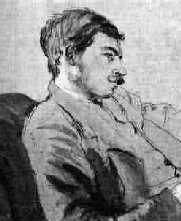
Interview with James Tobin
From his 1951 appearance in Herman Wouk's The Caine Mutiny, through his service in President Kennedy's administration, his receipt of the Nobel Prize in Economics and in his continuing work at Yale University, James Tobin has often been in the public eye. He is an economist who has worked on issues ranging from public policy questions of the day to more complicated, academic arcana—and always with the ability to discuss those issues with a lay audience.
Tobin studied at a time when Keynes' The General Theory of Employment, Interest and Money was making its impression, and Tobin was immediately attracted to the book's ideas—although he did not always agree with Keynes. Tobin's honors thesis was critical of Keynes, but not so critical as to dismiss The General Theory entirely. Indeed, Tobin's affiliation with Keynesian theory has remained steadfast throughout his career. "I think it still looks pretty good," Tobin says in the following interview, "but I'm prejudiced."
Tobin also comments on other economic theories, as well as on monetary policy, the consumer price index, Social Security, his days with the Kennedy administration and how he came to be mentioned in Wouk's novel.
REGION: In an essay on monetary policy in Fortune's Encyclopedia of Economics you ask the question, "Should policymakers give priority to price stability or to full employment?" What is your response to that question?
TOBIN: My response is that they should pay attention to both of those objectives. They certainly should, in my opinion, take a pragmatic view of the combination of those goals. I think the current Federal Reserve has done that, under both Volcker and Greenspan. Their main objectives for monetary policy have been overall macroeconomic performance, and that includes the reduction of unemployment as much as that can be done, and also controlling inflation. I think they've done a good job.
I think they look at unemployment numbers as one guide to policy, and inflation numbers as another guide to policy. They don't say, "We're just going to look at one." Likewise, they don't make monetary policy in terms of some intermediate monetary aggregates; that was very popular in the '70s, until Paul Volcker abandoned the monetary aggregates in 1983.
We have the best record since the 1980s of any G-7 country in terms of macroeconomic policy, and I think that comes from not saying we are for price stability only; rather, it comes from saying we care about what happens to the real economy. As I said, I think the Fed has done very well recently, and I've not been a routine fan of the Fed during my career. Maybe they can continue to get lower rates of unemployment without getting any worse inflation than we're having now. It's quite possible that the inflation-safe unemployment rate is even lower than what we have now. People who had estimated it at 6 percent have since changed their minds; maybe they will again.
REGION: Speaking of unemployment rates and inflation—as you suggested, we have been at or under the so-called full employment rate for some time. Why haven't we seen any wage inflation? Or, perhaps, are we simply wrong about what that level is?
TOBIN: Well, it may be even lower than where we are now. Robert Gordon, the Northwestern [University] economist who was Mr. Phillips Curve for a long time, used to say it is 6 percent, it has been 6 percent and it will always be 6 percent. Now he's down to 5.2. So, if there's no acceleration of prices now, or wages, then possibly it's lower than 5.2.
If you look at some of the other dimensions of labor market tightness, it may be that the labor market is softer than the unemployment rate seems to say, judging by experience in the last 15 years. I refer to the proxy that we have in the United States for job vacancies, unfilled vacancies—we don't have a good series for that, but we have a help-wanted index which is a proxy for vacancies. There's just not a lot of vacancies compared to what you would have expected for the present unemployment rate. In that respect things look more like the 1960s than the 1970s and '80s. If you think of a graph on which you put vacancies or help-wanted indexes on the vertical axis, and unemployment on the horizontal line, you'll have a downward sloping curve. With low unemployment you have more vacancies and with high unemployment you don't have very many vacancies—usually called a Beveridge curve. That shifted out against us in the '70s and '80s and it seemed to accompany the rise in the apparent NAIRU [nonaccelerating inflation rate of unemployment] from 4 percent in the '50s and 60's to 6 or even more in the late '70s and early '80s. Now it has shifted back again, and the Beveridge curve we see in the later '80s and the '90s looks like the one we saw in the '50s and '60s.
REGION: So unemployment rates could go even lower?
TOBIN: At least it's worth a try. And there are other statistics which give the same answer. For example, in the monthly labor survey they ask people if they lost their job or left their job. You'd think in a period of tight labor markets where there are a lot of jobs around, and there's not much competition for them among the unemployed, that people will feel confident and secure about leaving their jobs; whereas in bad times they are afraid to leave their jobs and they can be fired more often because the employers don't have to worry about finding someone else. So this ratio tells a similar story, this ratio of losers to leavers. It too looks like a softer labor market than you would think we have now if you just looked at the unemployment rate; that is, there are not many people who are leaving their jobs, relatively speaking. So it can well be that there has been a favorable shift in the structure of the labor market.
And we have other evidence. There's international competition, which makes it harder for employers to mark up wages into higher prices and therefore stiffens their resistance to wage increases. Also, unions are weak, much weaker than they were, say, 20 years ago.
So that is what I like about today's Fed—that they're willing to be pragmatic about it and willing to see whether it's possible to have lower rates of unemployment or not. At least they are not arresting the expansion.
REGION: So, in terms of wage inflation, until we see it we shouldn't necessarily worry about it?
TOBIN: Well, I wouldn't necessarily say that you shouldn't worry about it until you see it, but on the other hand you're making a gratuitous assumption if you think you can detect its imminence by looking at the unemployment rate alone. And it isn't as if there's a cliff, such that if you step an inch over it you fall into a canyon. We're not talking about a barrier, a line you can't cross without disaster. It's not that if the Fed goes an inch beyond some NAIRU line that something irretrievably bad will happen. The Fed can change its policy. I mean, it's the expected value of a probability distribution, not a definite number. If we're really close to that number then, yes, I think it would be unusual to see no sign of price and wage pressure.
REGION: In the previous issue of The Region, in response to a question about whether we should worry about smoothing business cycles, Edward Prescott responded that the paramount question for economists is, "Why isn't the whole world rich?" He said that fluctuations in the business cycle are not costly to society: "What we should be worrying about is increasing the average rate of increase in economywide productivity and not smoothing business cycle fluctuations." What is your reaction to that idea?
TOBIN: Well, surely, "Why isn't everybody rich?" or "Why is most of the world poor?" is a big, important question, no doubt about that. But I can't understand why we don't have time and space to worry about more than one puzzle. It certainly is a problem to figure out how we can increase the rate of economic growth here and throughout the world. So, I agree on that, and it's a problem I've worked on myself.
I don't see why that excuses us as a profession, though, from worrying about business cycles, or makes business cycles uninteresting. And I certainly don't agree with the statement that Prescott made, that there's no loss of welfare involved in having business cycles. I think that comes from thinking of business cycles as symmetrical fluctuations around the trend—the trend representing full employment, or equilibrium. My view is different, my view is that most of the time in business cycles we are below the equilibrium trend. So we lose, permanently, output that we could have if we operated all the time at equilibrium, that is at full employment.
See, it all comes to a difference between me and Prescott about what's going on in the real economy during business cycles: He thinks fluctuations are moving equilibrium in which supply and demand are equal to each other all the time, and he attributes most of the cycle to productivity fluctuations; whereas, I believe that in business cycles we don't have market clearing. Instead we do have, for example, involuntary unemployment and other situations of excess supply, predominantly. We're losing output that would be valuable to the economy, to society. It's not a moving equilibrium. When we have 11 percent unemployment in 1982 or 25 percent in 1932, I don't regard that as being a labor market equilibrium with supply and demand equal. And I don't believe that productivity, technology, go up and down in anything like waves which would be consistent with the business cycles we observe. We don't forget things we already know how to do; people don't abruptly lose skills they already have.
The other main component of real business cycle theory is intertemporal choices that people are supposedly making about consumption now and consumption later, and between leisure now and leisure later, and working now and working later. I don't believe you can explain, by any reasonable elasticities of intertemporal substitution, the actual variations in consumption we observe. So, I don't think that the so-called real business cycle theory fits the facts, and I think that their theory that business cycles don't matter is based on an erroneous view of where the equilibrium point is relative to economic fluctuations. I think of the equilibrium point as being close to the peaks of the business cycles and not in the mid range.
I could go into a lot of rather simple stylized facts of economic fluctuations that are inconsistent with real business cycles. For example, just the fact that in the depths of a recession there are a very few vacancies and lots of unemployed; whereas, in the peak of a business cycle there are lots of vacancies and relatively few unemployed. If both of those were equilibria, you'd think that the balance between vacancies and unemployment would be the same, or close to the same. I remember seeing a blackboard in the graduate students lounge in Stanford in 1982, and it said, "Yesterday the Bureau of Labor Statistics announced that the natural rate of unemployment is now 10 percent." That was meant to be satirical, and it makes a good point. It wasn't the natural rate that was 10 percent, of course, it was the actual rate.
REGION: Prescott also suggested that the Fed should retain its independent status. Recently, there have been calls for more congressional control over monetary policy and central bank operations. What is your view on the question of central bank independence?
TOBIN: I think some aspects of the Federal Reserve are inconsistent with democratic political theory, and I will tell you what they are. These are views that I've published and voiced in hearings in Congress. I don't think that there should be votes on the Federal Open Market Committee for people who are not appointed as public servants by the president and who are not subject to confirmation by the Senate. I think either the bank presidents should have no votes, or, to achieve voting status, they should be appointed and confirmed in the same manner as the governors. That doesn't make me popular with the presidents of Reserve banks, but that's what I think. Personally, I have nothing against the presidents of Reserve banks, I think most of them would be perfectly good people to have the president appoint and the Senate confirm. I just think it's contrary to democratic politics to have private citizens voting on the most important questions of macroeconomic policy.
I also think that the four-year term of the chairman of the Fed and the four-year term of the president should be better synchronized. I think the fact that it's not is completely accidental, it just got that way because of bad drafting of the law. Now, though, we have this anomaly that when a new chairman is appointed he's appointed for four years from that date. He's not appointed to fill out a term which has fixed dates of starting, as are the governors. Maybe six months after the president's term begins the chairman's term should begin, or maybe a year, but not three-and-a-half years the way it is now. I wrote an op-ed piece in the Wall Street Journal last March when Greenspan was being reappointed, where I suggested we make this kind of change by appointing Greenspan only for what would be logical for starting a new four-year term, and get on to a better rhythm.
I also suggested that we go back to the practice, as before 1933, of having the Secretary of the Treasury on the Board, and I would add the Chairman of the Council of Economic Advisers.
REGION: You would put the Treasury Secretary back on?
TOBIN: Put him back on and the Chairman of the Council, too. Put them on, at least, for being present, even if they don't have votes. I'm not trying to do anything drastic, I just think the present system is too anti-democratic.
REGION: Some might argue that such moves would too closely link the Fed and the White House, that it would politicize monetary policy.
TOBIN: Well, you see, it's not just a technical question. It's not as if monetary policy is nonpolitical. Monetary policy is politics. The judgments, the trade-offs involved during the 1979-1980 policies, for example, or during any deep recession, are not just technical matters. The president is blamed and credited for what happens to the economy, but what happens is not done by him. Clinton is the beneficiary of Greenspan's success, but he might have been the victim of Greenspan's failures in policy. But either way he, perhaps, should have a little more to say about what goes on—as the president used to have. It used to be that the chairman of the Fed resigned when a new president came in. No longer.
REGION: The 1962 Economic Report of the President, which you helped write, was considered by some to be a Keynesian manifesto; 34 years have passed since that report was written and other economic ideas have since then made their mark, such as monetarism, rational expectations and supply-side economics. What is the current state of Keynesian economics?
TOBIN: The Keynesian economics that I was talking about, circa 1962, was not just what was written in the General Theory in 1936, but was a result of an evolution of the subject between those two dates. For example, there's one whole chapter of that document on growth, long-run growth, not on Keynesian macro. And I think it looks pretty good still, but I'm prejudiced.
I think Keynesian ideas are still what's going on in practical economics. What guides the Federal Reserve mostly is mainstream Keynesian macroeconomics. I don't see monetarism being of any practical use these days and I don't see real business cycle theory being of any practical use any days, even though it occupies an inordinate amount of time of some very gifted people and their students. And supply-side economics, aside from the supply-side economics that is just ordinary microeconomics and growth economics, the supply-side economics that you might call "pop" supply-side economics which, unfortunately, was able to get a certain amount of authenticity in this most recent political campaign for an outrageous proposal by Sen. Dole, I don't see any of that getting anywhere at all. So, Reaganomics, supply-side economics in that sense, Laffer curves, Jack Kemp stuff, alas the stuff that some very good economists were selling during the recent campaign, that's nonsense and that's certainly not getting us anywhere. So after you look at the other entries in the beauty contest, you come back to the natural evolution from 1936 to 1962. And isn't it interesting that these guys who were so big on pushing all these fantasies, Lucas, Barro, Prescott, they're not interested in business cycles anymore—not because they solved the problem, but because they didn't.
REGION: Research produced at the Federal Reserve Bank of Minneapolis was instrumental during the early years of rational expectations theory. What is your assessment of rational expectations, and has it aided in the formulation of policy?
TOBIN: I think I just answered that—I don't think it has helped in the formulation of policy. I do think there is a good idea involved, an idea that's unexceptional in that it's a canon for model building, that is, you should have expectation-consistent models, or model-consistent expectations—in the sense that you should not build a model that says people are behaving incorrigibly with expectations that are not justified by the model itself. I think that canon is met by almost all long-run models—that was always the characteristic of those models. Now, where problems come is finding the model-consistent expectations in a business cycle, where things are changing a lot. And there I think that the ambitious program of saying, "Let's see if we can generate moving equilibrium systems in which we have model-consistent expectations and uncertainty," and so on, that has proved to be an over-ambitious program that hasn't paid off yet. Maybe it will; meanwhile, I see Lucas and Prescott not working on that anymore.
REGION: You have been critical of minimum wage laws, arguing that the intended beneficiaries are not likely employed because they lack the capacity to earn a decent living. You are also among the 101 economists who recently supported an increase in the minimum wage from $4.25 an hour to $5.15. Some may view these as contradictory positions. Can you explain these views?
TOBIN: The minimum wage has fallen a lot in real terms—way below what it was about 10 years ago. I thought this time that not much is being done for poor, low-wage working people in the present political climate. Public assistance, food stamps, welfare, Medicaid and other social programs are all under attack. The minimum wage always had to be recognized as having good income consequences—a number of people get higher wages. So, I thought in this instance those advantages outweighed the small loss of jobs.
And then there were these studies by Krueger and Card which I think showed that the elasticity of employment relative to the minimum wage is pretty small—they couldn't find it at all. I know that's controversial and there are opposing studies, but the difference didn't seem like a big deal in terms of employment.
REGION: Even at a rate of $5.15 the minimum wage is below what it probably should be in real terms. Should it have been raised even higher? In other words, if you could wave a magic wand ...
TOBIN: Oh, I don't know what the right number is, if any. I think I would prefer a much more generous permanent earned income tax credit—suitably more generous, and I would pursue my recommendations of years ago for a negative income tax. We're not doing any of those things and we're not likely to do any of those things. I can't believe that the minimum wage is such a big deal and that it is such an important matter to conservative economists. There are a lot more important issues upon us in this country than that one.
REGION: Questions have been raised about the reliability of the consumer price index, and also about whether we can accurately measure the economy's productivity given the advances in technology and, hence, about whether we can know how much growth the economy can absorb without causing inflation. Are these serious issues and, if so, how should monetary policy react?
TOBIN: Well, we surely are not able—it's intrinsic in the situation—we're not going to be able to give an accurate measure of inflation and cost of living and other price indexes, given that the bundle of goods that people buy is changing all the time. So, I think that it surely is true that the prices of a fixed market basket overstate the rate of inflation. It's not a question for which there is a true answer. Maybe the Boskin Commission's judgment that the CPI overstates inflation by about 1.1 percent per year is a good estimate, and if that is true then productivity has been understated and the growth of GDP has been understated. That means that if we thought that the sustainable rate of growth of the economy was, say, 2.2 or 2.5, then you could add maybe most of a full point to that and say our sustainable growth is higher than we thought it was.
That doesn't change the reality out there in the world—it changes the partition of nominal GDP growth that we make between real growth and price increases. Now, in terms of the ambitions of some people to get to zero inflation, maybe that means that they shouldn't be so keen about it because we're closer to that than we thought we were. And more important than that: If it is intrinsically impossible to say exactly what the rate of inflation is, then the objective of zero doesn't have a lot of operational meaning, and it is probably nothing people should be breaking their necks about or causing more unemployment to achieve.
REGION: On one hand the question of the actual rate of inflation is sort of an inside baseball question and a political question, that is, how we are going to set the rate of increase on Social Security, and so on. But what about monetary policy? You just mentioned that perhaps the zero inflation hawks—so to speak—shouldn't worry so much because maybe we're on the way down, or we're pretty close. But, indeed, if we don't know the real inflation rate, does the Fed then wink at the CPI and play its own hunches?
TOBIN: I don't think it would cause any change in monetary policy. I mean, except that it tames some of the inflation hawks in the Federal Open Market Committee who want to copy some other countries that have installed zero inflation as the prime, maybe the sole, aim of monetary policy. Our Federal Reserve has not done that and it's not mandated to do that yet, and I hope it won't be, so I don't see that there would be anything in this change in statistics to cause the Federal Reserve to do anything differently.
But more interesting, perhaps, and more difficult is the question of what can be done, other than changing these numbers, to the indexation of Social Security benefits and other things. Even if the Bureau of Labor Statistics comes some distance toward the Boskin Commission, that doesn't mean that Congress has to use a corrected number for indexation of benefits. There will probably be some reluctance to do that. At least to do it very quickly. So, that's another question. I suppose that maybe a reasonable solution to that would be to develop a new index for these purposes where they really are going to make a difference to the people getting benefits and paying taxes.
REGION: Have you given much thought to the Social Security issue—any proposals?
TOBIN: Oh yes, I have given it some thought, and there's no way of getting around the fact that to have an actuarially sound old-age retirement system—Social Security—we need to have some combination of reducing benefits or raising the payroll taxes. I do think that moving gradually in the direction of converting some part of the Social Security system—for workers who are now young—into a defined contribution plan would be a good idea. And then possibly investing some of the trust fund that is produced in a defined contribution plan in equities, that would be a good idea, too. I'm not in favor, however, of giving people back their payroll taxes and letting them invest in whatever they want to. I'm not in favor of that-privatization in that sense. I think that would be a madhouse and I hesitate to imagine the competition of bond and stock salesmen for every old geezer's Social Security fund.
It's not out of the question to fix up the system for the next, say, 75 years, which is the usual horizon in which the Social Security plans are made. Now the question is how to do that by some changes in the structure of benefits and taxes; for example, raising the age of retirement-one might want to raise that by indexing it, formally or informally, to longevity. There's no reason that 65 should be the normal age of retirement. In the past, that meant 10 more years of life and now it means 20.
REGION: In its plans to offer inflation-indexed bonds, the Clinton administration has reportedly cited your support for the idea. Please explain the need for inflation-indexed bonds.
TOBIN: It may be that they're doing this is at a time when it seems less necessary, especially if we have this question of what the rate of inflation really is.
I suggested this some time ago when I wrote a long paper—it was really a small book on debt management policies—and among other things I recommended indexed bonds. And not just for savings bonds, although certainly for them. I think it is important to offer less sophisticated, small investors safe assets—safe against inflation, as well as against default.
REGION: And that's the general purpose for inflation-indexed bonds?
TOBIN: Yes, that's one purpose, but that's not the only one. I also wrote that these could be bought by insurance companies, banks or pension funds. And they, in turn, could offer indexed liabilities to their customers. So you could have indexed retirement annuities and so on. The private sector doesn't seem to be willing to take that risk on themselves.
And then there is another idea: What the central bank is really trying to do is to change the real cost of capital, not the nominal interest rate and not just the interest rate on nominal federal Treasury assets. This frontier between the real economy and the financial economy is really the saving-investment nexus, and that presumably depends on—well I have my 'q' ratio and things like that—but it essentially is the cost of capital, investments. The Federal Reserve is or should be trying to control this in the widest sense, houses as well as plants and equipment and durable goods.
But the Federal Reserve doesn't have a way of gauging the real cost of capital, if that involves buying and selling corporate bonds or corporate stock. Some obvious disadvantages in doing that are that you have to buy particular issues. So, I thought that open market operations in indexed bonds would be closer to doing what the Federal Reserve really is or should be trying to do—a closer substitute for real assets at the margin for investments. So, that was another one of my rationales.
Now, of course, the Federal Reserve does not buy long-term stuff, or sell it, and that's another pet peeve of mine—I don't see why they shouldn't do that. They are trying to operate monetary policy by dealing in the assets that are as far as possible away from the margin that is really the important thing for the real economy. So, I'm trying to get them closer to it. They never wanted my help on that.
REGION: You mentioned your 'q' ratio, so, let's talk about that. Please explain Tobin's 'q' and how you developed the idea and, also, what does Tobin's 'q' tell us about the current market?
TOBIN: Well, I think it's a fairly obvious idea and it's certainly not original. Think about Wicksell and other Swedish economists, they had this idea. And Keynes, both in the Treatise, and less so in the General Theory. The idea is to think about the productive, physical assets of a company—maybe people think of it as book value of a company—but convert that into the replacement cost of the assets, not the original cost. How much would it cost to buy the assets again, new, off the production line? So, that's one valuation of the firm.
Looking at it that way, then, there's the market valuation, and one way of having a market valuation would be to have used capital goods markets—used car markets or used house markets. But for many things that's not a practical matter, so we have a used business market implicit in securities markets, stock and bond markets. And that's the ratio. The replacement costs are the denominator, the securities market valuations are the numerator.
Now, you might think that the value of this should be 1, that arbitrage would keep the two valuations the same. If people have a choice, they either buy new, build a new plant or buy another firm that already has a plant, in the securities market. That's one arbitrage. Now, of course, there are going to be deviations from 1, obviously, even if the measurements were precise, which they're not—there would be deviations from 1 because of goodwill or monopoly value or things like that. But at any rate, it is possible to estimate this number on an aggregated basis as well as on a disaggregated basis.
And that comes to the second part of your question, which is, what about it right now? It's very high. It's the highest it's ever been since the Second World War. There may have been higher numbers in the pre-war period in the '20s, but I'm not even sure that's true. But at any rate, it's certainly the highest in the post-World War II period by considerable margins. For example, the previous high was probably in 1968 when the number was 1.15. For a long period of time it was below 1, even as low as 0.3 in the '70s—0.35. And now it's 1.4, 1.5, at least until yesterday. [This interview was conducted in early December.]
REGION: Is that inordinately high?
TOBIN: Well, I don't know if it's inordinately high, it might be. Greenspan said maybe it's irrational exuberance—speculation. Maybe there has been a change in the rate of discount which investors, asset holders put on the riskier earnings that come out of companies—nonfinancial companies. In that case, what will happen is that aggregate replacement value will rise towards the levels of the market value by the new investments for which present values of 'q' are a strong incentive. It will take a while to happen, but you'd think that what we have now may be a stimulus to investment, not necessarily a speculative bubble that will collapse.
Now, it is true that there may be a change in the ratio between goodwill, human capital, things that are not in the commodity market, that are the basis for the valuation of firms—like Microsoft. Microsoft is not being valued at what it is now because of bricks and mortar and even chips—microprocessors. It is being valued as it is now because it has a kind of monopoly lead based on its ability to keep innovating and to have its hands on human capital of a superior kind—an organization of a superior kind. So, if that's the case, then the 'q' ratio, which requires a replacement cost calculation in the denominator, is not going to be very informative for telling you about Microsoft. If more of the economy is like that, it's going to be different from what it used to be.
REGION: I suppose the trick now would be to come up with a ratio that would incorporate what you described about Microsoft.
TOBIN: The problem, you see, is that Microsoft doesn't have the smart nerds as slaves. They can be bought away from Microsoft any day—or start a new firm of their own.
REGION: Back to the early 1960s. The economics team under Kennedy included yourself, Walter Heller, Kermit Gordon, Arthur Okun, Robert Solow and Kenneth Arrow, among others. Can you describe for us how economic policy was developed in that administration? Did you agree all the time? And what was the president's relationship with the Council of Economic Advisers?
TOBIN: The group of people you spoke about pretty much did agree all the time among themselves. Not in every respect. I guess I was less enthusiastic for tax cutting and more interested in having an easier monetary policy as an alternative to a fiscal stimulus. But since we couldn't do that, and we also couldn't raise government spending in directions that I thought would be worth more than the tax cuts, then I went along with the tax cuts, because I certainly wanted to get the unemployment rate down. But, on the whole, we all agreed on basic issues.
Getting that to be the policy of the president, that's another matter. The president had, of course, other advisers, and then we had the political people who were concerned about getting out ahead of the Congress, and the Congress was quite conservative. They were not interested in fiscal policy and they were not terribly fond of Kennedy, anyway, because he was a senator who was younger than they were. But the president was interested in what we had to say. He listened to it and he learned about it. He liked the subject, and he liked it because it was a fun subject as well as because he had to make policy.
Once the president found out that he wasn't going to get any credit from the conservative press and Republicans and certain Democrats, for that matter, for trying to balance the budget, he decided it was better to have prosperity and not to break his head against a stone wall by trying to balance the budget. The government wasn't doing much in the way of deficit spending compared to what the Republicans did in the 1980s. It was nothing. But at any rate, he eventually did understand and agree with Heller's proposals, and then the Treasury went along with it and sort of adopted it. Before that big change occurred we had succeeded in getting agreement among the president, the Treasury, the Council and the Budget Bureau to propose an additional tax credit, which had the advantage of not losing much revenue as well as being an incentive for capital investment. It was a good thing for the supply side as well as the demand side. We didn't use those words—supply side and demand side-in those days, but that was the idea.
REGION: We are told that U.S. citizens looked to government with less cynicism and more trust in the early '60s than they do now. On the assumption that politicians are affected by the mood of the electorate, to what degree does this mood—whether trustful or cynical—impact the economic policy that we get?
TOBIN: Well, I think it's true that before Vietnam, before Watergate, the country thought better of government and politicians than it does now, and was not so concerned about reducing the government's size and reducing tax burdens and so on. I think the idea that the government can't do anything right and that the government is an external foreign body that is exploiting the country and the people for its own benefit, this idea that the government is not something the people created but is rather an invader from overseas—King George III or something strange like that—and the idea that our taxes are completely wasted and serve no purpose whatsoever, that has been put over so well by the ideology of the right, along with the distrust of the government that came out of the episodes I referred to—that sure does affect economic policy. It makes it difficult to judge government policy on its merits, on a discriminating basis. And it certainly has resulted in making monetary policy the only short-run macroeconomic policy. It's impossible to use fiscal policy as a tool for economic stabilization anymore. We're at risk if we're going to have to have a balanced budget constitutional amendment and, even without a constitutional amendment, we head toward an annual balancing of the budget in 2002, independent of what the macroeconomic situation would be between now and then. If we have a recession we still have to balance the budget in 2002. I happen to believe that it's within the capacity of the Federal Reserve to offset the fiscal stringency of the results from that policy. I'm not sure they will do it, even with all the praise I have given Alan Greenspan earlier in the interview.
REGION: You received the Nobel for, in part, your work in portfolio theory. Please describe your insights into portfolio management and, if you care to, relate the anecdote regarding the press conference following the Nobel announcement.
TOBIN: I was concerned about the fact that in the real world there's not just one financial asset—money; rather, there is a whole spectrum of them or several of them and they are imperfect substitutes for each other. So, that started me on trying to think about deriving the demand for money and demand for other assets out of a general framework, rather than the way it was being done, which led me into thinking about portfolio decisions. My interest in doing that was that of a macroeconomist, not as somebody in the finance department of a business school. I am a macroeconomist, and so I was going to apply that idea to the demand for money.
I worked out a lot of the mathematics of mean variance theory, something which Harry Markowitz was doing, too. He published a general microeconomic mean variance article before I did. He didn't have a safe asset in there. I put the safe asset in, not because I was trying to differentiate myself from Markowitz, not at all, but because money seemed to be the safe asset—that was the way I was approaching it. That turned out to be very fruitful because it led to the separation theorem. You would choose the same portfolio of nonsafe assets regardless of how risk-averse you were. Even if you wanted to change the amount of risk in the portfolio, you'd do it by changing the amount of the safe assets, relative to the nonsafe assets but not by changing the different proportions in which you held the nonsafe assets relative to each other.
When I was asked about this in the press conference, the reporters asked me what all this was, this portfolio theory. I hadn't seen the press release from Stockholm, so I didn't know what they had said. I tried to explain, not in as abstract a way as I just did for you, the idea of trying to understand why it is that people hold different proportions of different assets in their portfolios. After I tried to explain this as best I could for a lay audience of reporters, they said, "Oh no, we want you to explain it for a lay audience." So that's when I said, "Well, you know, diversification—don't put all your eggs in one basket." And that's what led to headlines around the world: "Yale Economist Receives Nobel Award for Don't Put All Your Eggs in One Basket."
REGION: "A mandarin-like midshipman named Tobit, with a domed forehead, measured quiet speech, and a mind like a sponge, was ahead of the field by a spacious percentage." That's how Herman Wouk described a character-based on you-in The Caine Mutiny. How did you come to be enshrined in a Wouk novel?
TOBIN: That was said in The Caine Mutiny, in the first chapter, and, as you just read, referred to a midshipman, named Tobit, at the school. T-o-b-i-t. It wasn't a very deep disguise. This school was the midshipman's school for what used to be called those "90 Day Wonders." They would take us for 90 days and make us naval officers. We're talking about 1942, the early days of war after Pearl Harbor. We were assembled in this "ship" in Columbia University in a dormitory. We were taught to be naval officers, supposedly in three months. We were arranged alphabetically in the dormitory. At the top were the people with my first initial T, and also U, V, W. We knew the people adjacent to us and up and down better then the rest of the group, and one of those fellows was Herman Wouk. We were acquainted and were good friends. He was famous in the school because he had been a gag writer for Fred Allen and Allen's famous radio program of the day.
Wouk wrote The Caine Mutiny later and he wanted the protagonist in the book to go to the school that both Wouk and I attended. So that's how this matter came up. That's my only appearance in the book. Wouk and I never had any contact after those 90 days-I was not in the same theater of war that he was or on the same ship or anything. That's how all that came about. The first days after the war when I was beginning my teaching career, in the late '40s and early '50s, The Caine Mutiny became a very popular book which all the students seemed to be reading. So, when the word got around that, well, your teacher was in the book, that added to my reputation among undergraduate students, and graduate students, too. Incidentally, for having the best academic record in this school, I, like Tobit, was given a gold watch by J. P. Morgan.
REGION: Thank you, Mr. Tobin.
| In 1939, Tobin graduated summa cum laude in economics from Harvard University, studying with economists such as Wassily Leontief and Joseph Schumpeter. Following service in the U.S. Navy during World War II, he received his Ph.D. in 1947 from Harvard, where he remained for three years as a junior fellow in the Society of Fellows. In 1950 he joined Yale University, where he taught until 1988 and where he occupied a variety of posts, including director of the Cowles Foundation for Economic Research, as well as his current position as Sterling Professor of Economics Emeritus. He served as a member of President Kennedy's Council of Economic Advisers in 1961-62. He was awarded the Nobel Prize in Economics in 1981 for his work, especially for his development of a model of the way in which monetary, financial and real variables are jointly determined, and for his theory of portfolio selection. Tobin has been president of the Econometric Society, the American Economic Association and the Eastern Economics Association, and has been a member of the National Academy of Sciences since 1972. He has written or edited 16 books and more than 400 articles for both professional readers and the general public. |
Top