2020年9月3日木曜日

藤井二冠

33:

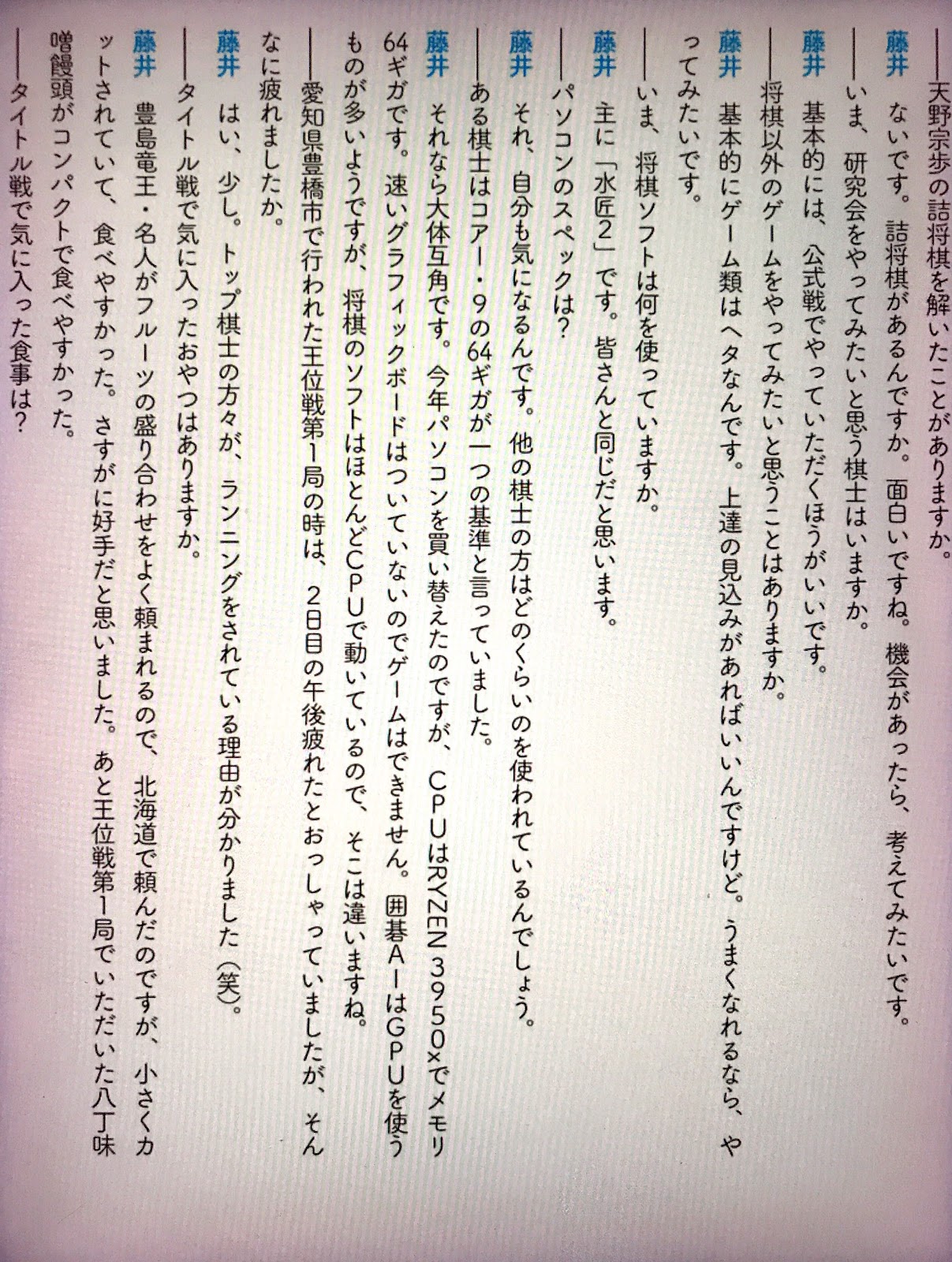
ー天野宗歩の詰将棋を解いたことがありますか。

藤井 ないです。詰将棋があるんですか。面白いですね。機会があったら、考えてみたいです

いま、 研究会をやってみたいと思う棋士はいますか

藤井基本的には、公式戦でやっていただくほうがいいです

一将棋以外のゲームをやってみたいと思うことはありますか

藤井 基本的にゲー ム類はヘタなんです。上達の見込みがあればいいんですけど。うまくなれるなら、や

ってみたいです

-いま、将棋ソフトは何を使っていますか。

藤井 主に「水匠2」です。皆さんと同じだと思います。

ーーパソコンのスペックは?

藤井 それ、自分も気になるんです。他の棋士の方はどのくらいのを使われているんでしょう。

ーーある棋士はコア1.9の64ギガが一つの基準と言っていました。

藤井 それなら大体互角です。今年パソコンを買い替えたのですが、CPUはRYZEN 3950×でメモリ

64ギガです。速いグラフィックボードはついていないのでゲームはできません。囲基碁AIはGPUを使う

ものが多いようですが、将棋のソフトはほとんどCPUで動いているので、そこは違いますね。

一愛知県豊橋市で行われた王位戦第1局の時は、2日目の午後疲れたとおっしゃっていましたが、そん

なに疲れましたか。

藤井 はい、少し。トップ棋士の方々が、ランニングをされている理由が分かりました(笑)。

ーータイト ル戦で気に入ったおやつはありますか。

藤井 豊島竜王名人がフルーツの盛り合わせをよく頼まれるので、北海道で頼んだのですが、小さくカ

ットされていて、食べやすかった。さすがに好手だと思いました。あと王位戦第1局でいただいた八工丁味

噌優頭がコンパクトで食べやすかった。

-タイト ル戦で気に入った食事は?


ーー…初めての和服はいかがでしたか。

藤井  トイレが難敵かと思ったけど、意外に気になりませんでした。

ーー第2局では、△ 5四金がすごい手と評判になりました。

あれは研究ですか。

藤井  部分的に、永瀬二冠に指されたことのある手です。ある

手(有力)といった認識でした。

ーー自陣に打った△3一銀も渡辺棋聖の意表を突きました。

ソフトもあの手を発見するのに苦労したといわれますが。

藤井  (攻める手も考えましたが) △3一銀がいちばん安定

していそうだと。いったん受け止めて、息長く指す方針でい

きました。

.…

ーー和服の着付けや封じ手の書き方など、タイトル戦の前

に練習しましたか。

藤井 着付けはまだ自分ではやっていないんですが、今年中

には覚えなくてはいけないと思っています。封じ手はサイン

を書くのに脇息を使ったのと、自分で封じた時にサインを書

きそびれたことがまずかったですが、次からは大丈夫だと思

っています。

ーー和服での対局はやりやすかったですか

藤井 多分、ゆるめに着付けていただいたと思うんですが

どの対局も大丈夫でした。


写真で追う…25,32頁より


藤井聡太二冠インタビュー 初戴冠となった棋聖戦を語る

この夏、将棋界の歴史をまたしても塗り替えた藤井聡太二冠。第91期ヒューリック杯棋聖戦では、最年少挑戦と最年少タイトル獲得の記録を更新し、第61期王位戦では最年少複数冠保持の記録を作りました。
初タイトルとなった棋聖獲得を藤井二冠はどう振り返るのか。王位戦真っただ中の8月1日に行われたインタビューをお届けします。
(本原稿は、9月2日発売のムック『写真で追う藤井聡太 最年少二冠までの軌跡』『高校生二冠 藤井聡太 ―完全収録! 第61期王位戦、第91期ヒューリック杯棋聖戦―』、9月3日発売『将棋世界10月号』(いずれも日本将棋連盟発行)より一部を抜粋し再編集したものです)

対局中断期間の準備と挑決

――棋聖戦も王位戦も挑戦まであと2勝というところで、藤井さんの対局も約2カ月止まりました。どんな気持ちでしたか
藤井「状況が状況でしたし、心の準備はできていたので驚きはありませんでした。与えられた条件の中で頑張るつもりでした」

――最年少挑戦の記録については
藤井「もともと意識していませんでしたし、詳しい条件も知りませんでした」

――自粛期間中はどう過ごしましたか
藤井「じっくり自分の将棋を見直しました。クセを見直し、序盤を調べました。次の対局までこれだけ時間を取れることはなかなかありませんから、じっくり課題に取り組めました」

――ネット将棋も指しましたか
藤井「対面では指しませんでしたが、ネットでは永瀬さん(拓矢二冠)と25局指しました。成績はカウントしていません(笑)」

――棋聖戦の日程発表を受けての心境は
藤井「準決勝と挑決の間が中1日で、そこはハードな日程だなと」

――挑戦者になれば、最年少挑戦の記録が誕生することになりました
藤井「挑決を迎えるときには記録のことは知っていました。それより相手が永瀬さんなので、内容的にしっかりついていくことが大事かなと思っていました。研究会で永瀬さんにはいつも教わっていますが、公式戦では初めてなので、楽しみでした」

――挑戦者になった瞬間は
藤井「際どい将棋だったので、感慨にひたる余裕はありませんでした。もちろんうれしかったですが、第1局が目前に迫っていますから、しっかり準備をすることのほうが大事だと思いました」

渡辺棋聖との番勝負

――第1局はスーツで対局されました
藤井「日程を見て、なんとなく第2局から和服を着るイメージを持ちました」

――渡辺明棋聖の印象は
藤井「渡辺先生は戦略家で、相居飛車でもいろいろ指されるので、後手になったときの作戦は考えました」

――自粛期間中に渡辺将棋を研究しましたか
藤井「それはありません(笑)」

――初めてのタイトル戦はいつもと違いましたか
藤井「前夜祭や検分などのイベントもなかったですし、違ったのは立ち合いの先生や関係者の方たちがいらしたことくらいでしょうか。ただ、この第1局で流れが決まると思いましたし、最初が大事だとは思っていました」

――結果は見事に勝利。第1局の勝利にはどんな意味がありましたか
藤井「ストレートで負けてしまうと、見ていただいている方や関係者の方に申し訳ないと思っていたので、ほっとしました」

――第3局で決めたいという気持ちはありましたか
藤井「第3局は先手番ですし、第4局は王位戦から連戦になるので、ここで決めるのが理想的だとは思いました」

――第3局に敗れて迎えた第4局。どう思っていましたか
藤井「第3局に負けた時点で五分だなと」

――渡辺棋聖が投了した瞬間、何を思いましたか
藤井「最後、自玉が詰まないかどうか不安だったので、タイトルを取ったという実感はあまりありませんでした。結果としては非常に大きな勝利で、徐々にうれしさが出てきました」

――大勢の報道陣が押し寄せて大ニュースになりました
藤井「自分としてはそんなにすごいことをしたという実感はないのですが、報道をきっかけにして将棋に関心を持っていただく方が増えたらうれしいです」

――渡辺先生と4局戦って、どんな印象を受けましたか
藤井「シリーズを通じて何度か気づかない好手を指されて、非常に勉強になりました。あと、タイトル戦は多くの方に支えられているんだということを強く感じました」

タイトル獲得後とこれから

――棋聖戦と王位戦を一緒に戦ったわけですが、作戦はいくつ用意しましたか
藤井「ストックを用意するのではなく、その対局ごとに考えています。一局終わったら、次を考えます」

――タイトル獲得後に師匠とは何か話しましたか
藤井「師匠も現地に来ていたので、終わってからすぐに、おめでとうと声をかけられました。それから、竜王戦も頑張れ、と言われたんですが、あっさり負けてしまったので、そちらは残念でした」

――それまで最年少記録を持っていた屋敷伸之九段は「注目されて、タイトルを取ってからが大変だった」とおっしゃっていました。そこはどう考えていますか
藤井「自分が対局することは変わらないので、いつも通りにやっていければいいと思います」

――次の目標は
藤井「引き続き強くなることを目指したいです」

――これから先、どのくらい強くなれると思っていますか
藤井「強くなれる余地はたくさんあると思っていますので、すべては自分次第です」
将棋界の歴史を塗り替え続ける藤井聡太二冠

将棋情報局では、お得なキャンペーンや新着コンテンツの情報をお届けしています。

iPhoneから送信


藤井聡太二冠がピアノを弾く姿、見たことある? Numberカメラマンが撮った“秘蔵写真10枚”。(3/3) - 将棋 - Number Web - ナンバー

藤井聡太二冠がピアノを弾く姿、見たことある? Numberカメラマンが撮った“秘蔵写真10枚”。
img_c060234d9ec600d149685e758f946448158449.jpg
touch-icon-ipad-retina.png
photograph by
Takuya Sugiyama
幼少期はピアノを弾いていた!
(7)気鋭の14歳の姿
 2017年9月に発売された『天才 藤井聡太』(文藝春秋)の表紙別カット。カジュアルなTシャツ姿で、純粋な視線で盤面を見つめる。
(8)かわいい幼少時の対局姿
 幼少時に通った瀬戸市内の将棋教室で将棋に親しむ“藤井くん”。師匠の杉本八段は小学校1年生時からその才能に目を見張っていたという。
(9)祖父とも対局
 祖父と楽しそうに将棋に打ち込む貴重な幼少期のショット。この姿が10数年前、というのが驚きでもある。
(10)なんとピアノも!
 50メートル6秒台の俊足は広く知られた“藤井くん豆知識”だが、子供の頃にはピアノを習っていたことも。ちなみに卓球でも張本智和との逸話があるが……詳しくはNumber1010号で。
 9月3日発売のNumber1010号「藤井聡太と将棋の天才」は、小誌史上初となる「将棋」特集。将棋ファンだけでなくスポーツを愛する人々にも盤上での“頭脳の闘い”の世界観を知ってもらいたいと各棋士、愛棋家アスリートに登場してもらい、将棋の魅力について多角的に追っている。 
Number1010号『藤井聡太と将棋の天才』ではタイトル獲得への軌跡を追った「天翔ける18歳」に「記録で辿る異次元の歩み」、そして中京棋界の悲願を成就した「板谷一門の偶然と必然」など、藤井聡太二冠を様々な角度で追い、渡辺明新名人をはじめ、谷川浩司九段、木村一基九段ら数多くの名棋士の特集も組んでいます。ぜひお手に取ってください!
Sports Graphic Number 1010
本誌初の将棋特集! 

【最年少の輝き】 藤井聡太「天翔ける18歳」 

【新名人の決意】 渡辺明「敗北の夜を越えて」 

【トップ棋士対談】 佐藤天彦×中村太地 

【勝負師インタビュー】 
谷川浩司/佐藤康光 
木村一基/久保利明 

【七冠ロードを振り返る】 羽生に挑んだ男たち
定価:本体582円+税目次ページへ
MAGAZINE
最新号
RECOMMEND
img_6af5c2aaa4c313e0690656629ac7ac6b9519.png
INFORMATION
会員メニュー


iPhoneから送信

John T. Harvey, “What Actually Causes Inflation (and Who Gains from It),” Forbes, May 30, 2011,


kelton2020#5 f2

John T. Harvey, “What Actually Causes Inflation (and Who Gains from It),” Forbes, May 30, 2011,
https://www.forbes.com/sites/johntharvey/2011/05/30/what-actually-causes-inflation/#76db9b02f9a9

What Actually Causes Inflation (and who gains from it)


I made a post two weeks ago in which I explained that the popular view of inflation (wherein it is caused by money growth) depends critically on assumptions that do not hold in the real world. Money comes into existence when someone adds it to her portfolio of assets. This occurs either when she borrows money (which creates new cash from reserves) or sells securities to the Federal Reserve (which injects new cash into the system). Neither of these scenarios allows the central bank to increase the supply of money beyond demand, the story told by those in the money growth ==> inflation camp. Instead, inflation happens first. This then means that agents need more cash for transactions, leading them to borrow more or sell government securities to the Fed. Thus, the money growth accompanies inflation, but it does not cause it. The original post can be found here:
What I did not answer there (except for a brief example) was what economic processes were actually responsible for the initial rise in the price level. I’ll fill that void here.
Inflation Defined
Inflation is simply a rise in the average price of goods and services in the macroeconomy. Which particular goods and services depends on the measure we are examining. Consumer price inflation is the one usually in the news, and it takes a weighted average of various items purchased by the typical household (the list being determined by survey and then updated periodically). The average can rise while some prices have actually fallen, and how much it reflects your personal situation is a function of how closely the basket of goods and services in the index matches your buying patterns. But, the bottom line is that we say that inflation has occurred when the average price of those goods and services has increased.
This does not happen by magic. It takes someone, somewhere making a conscious choice to charge more for the good or service they sell. The initial increase does not have to be in something that is being directly measured by the consumer price index. No household in my neighborhood, for example, buys barrels of oil; and yet when they become more expensive that sends a ripple throughout all related products. In the end, consumer prices jump as well.
Of course, that someone, somewhere who raises their price must also be in a position to make it stick. I could march into the Chancellor’s office here at TCU and demand that my salary be doubled, but that probably won’t accomplish a whole lot (other than to give me a chance to update my vita while I am cleaning out my office). Other factors must come into play. Many circumstances can cause inflation. I will focus on four.
Causes of Inflation: Market Power
First, the economic agent could have market power. This means they have the ability to avoid (at least to some extent) competitive pressures. It is the latter that forces firms to please consumers. Adam Smith wrote in 1776 that we cannot trust the undertakers of business to look out for anyone but themselves, and so we must handcuff them. But not with markets, per se, with competition, and the two do not always go hand in hand. The OPEC oil cartel in the 1970s and 1980s is a classic example of marker power. Had there been other viable sources of what they sold, they could not have restricted supply and driven up prices as they did because the competition would not have allowed them to do so. We would have just bought oil (or a close substitute) from someone else. Up to late 1973, they lacked the political will to set strict quotas among the various exporters. But, once the motivation was provided by US involvement in the Yom Kippur War, they made a conscious decision to raise prices by cutting supply. And because they were able to avoid competition, it worked! Even though households do not buy barrels of oil, it caused terrible inflation. It drove up the prices of anything that used petroleum or petroleum-based products, it raised the price of gas and, therefore, anything that needed to be transported, and it caused inflation in other energy sources as users shifted to those products. Market power–not money growth–caused this inflation. The money supply only rose as a result of the fact that firms and consumers took out larger loans and sold assets for cash. The Federal Reserve acted as it should have done in these circumstances, accommodating this increased demand.
(Note that having market power does not give carte blanche to raising prices. Even monopolists can only charge so much before consumers stop buying their products. However, they have the incentive and ability to engage in periodic attempts to capture more income for themselves. I won’t go into the specifics of when and how they do so here, but this phenomenon is discussed in detail in Alfred Eichner’s classic study of the microeconomy, Megacorp and Oligopoly: Micro Foundations of Macro Dynamics, Cambridge U Press, 1976. Thought it’s a little dated, the basic lessons still apply.)
The impact of the inflation of the 1970s and 1980s was hardly even, and this is always the case. Remember that when you pay more for something, the person on the other side of the register is also getting more. It depends on individual buying patterns and particularly where you earn your salary. With the OPEC inflation, those in the oil industry, while facing the same rising prices at the gas pump, grocery store, etc., as everyone else, were actually better off than they had been before because their salaries and profits rose at a higher rate. This was especially true of those in the OPEC countries who controlled the oil supplies. The inflation process redistributed income towards them–that was the whole point, wasn’t it? This fact is exceedingly important to understand. Inflation never affects everyone equally. It shifts buying power from one group to another (even though the winners may still complain because they see themselves as hurt by the overall price increases–what they don’t understand is their role in causing the latter!). In fact, it is the very attempt to capture more income that is at the heart of the inflationary process under these circumstances. Money supply growth did not cause prices to rise, OPEC’s attempt to grab a larger income share did. No amount of controlling the money supply was going to eliminate the ultimate impact of rising oil prices: the redistribution of income towards those countries and the oil industry.
As a very quick aside, it’s worth pointing out that just because the market created a particular price, wage, profit rate, or income does not mean that it is somehow objectively “fair.” These numbers only quantify our existing social values. There are, of course, more purely economic forces at work, too. Gold is more valuable than silver because there is less of it. But can we truly justify the wages and incomes earned by African Americans in the 1950s as economically reasonable, simply a function of their productivity? The fact of the matter is that a free-market system in a racist society reflects and reinforces racist values. Markets are people, and the preferences of those people, for good or bad, end up in the prices we see. My point here is that there may be times when we would, as a nation, actually prefer to alter the outcomes created by competitive pressures. Desegregation interfered with the market mechanism and the forces of competition, as did movements aimed at creating safer workplaces. Furthermore, paying African Americans more and reducing the chances of on-the-job injuries caused inflation (because they raised costs) and redistributed income. Was this justifiable or not? Unfortunately, these are not simple questions.
Causes of Inflation: Demand Pull
Another means by which inflation can take place is a rise in demand relative to supply. Say there is an increase in the demand for housing during an economic expansion. Bottlenecks may arise in certain building supplies like lumber. Contractors bid up these prices in an attempt to secure the materials they need; these price increases then ripple through the economy. Firms and consumers again desire a larger money supply to be able to operate, which the Fed presumably accommodates. The producers of lumber and bricks may also experience a rise in their incomes as part of this process–and why shouldn’t they? This is how a market system is supposed to work. Those selling goods and services in highest demand should see their profits and wages rise, even though by definition this will almost certainly cause inflation. This attracts others to sell these same goods and services, while some consumers go in search of substitutes. This is the greatest strength of a market system, it’s flexibility in the face of unanticipated changes.
Causes of Inflation: Asset Market Boom
Third and very relevant today, inflation can be injected from the asset market. The connection between the prices of goods and services and those of financial assets is tenuous. Sometimes there is practically none at all. Witness the 1990s, with a massive increase in stock prices but very little movement in the consumer price index. However, lines of causation can exist, particularly though commodities futures. I have already written about this at length in the context of gas prices:
The gist of the above is this. When speculative money bids up the price of a commodity future, this creates an incentive for those actually selling the commodity to withhold supply today in favor of the future (when prices will presumably be higher). The rising spot price then convinces the speculator that her bet had been correct, and she increases her position. This may drive futures prices even higher, and so on. Thus, a goods price is driven up by the price of a financial asset. The winners here are 1) those whose portfolios include those assets (of course, they can only realize their gain by selling) and 2)the producers of the commodities in question. Those producers often bear the brunt of the blame for these inflations, but they are not actually the source. As usual with inflation, it leads to a rise in the money supply as agents take out loans and sell government securities. The way to stop this inflation is not via blocking monetary growth, however, but to control the link between the asset market and the commodity price.
Causes of Inflation: Supply Shock
Last is a supply shock. If a storm rages through the Gulf of Mexico, taking out oil derricks and refineries along the way, this may well raise the price of oil and gas. As it should, for this creates incentives to build more derricks and refineries and for consumers to find alternate energy sources. Again, this is what capitalism is supposed to do. In terms of who wins with this sort of inflation, it’s obviously more complex since it depends on whose derricks were destroyed and who gets to build new ones. In any event, this, too, can lead to a rise in the money supply and there is no logical reason for the Fed to block this.
Conclusions
This is not an all inclusive list, but I would think that it covers the vast majority of what we have experienced since the end of WWII (today, we are most threatened by the link between financial markets and commodities). The bottom line is that there are a number of processes that can create inflation, none of which starts with, “the money supply increases.” Someone make a conscious decision to raise a price or wage, and they must be able to make this stick. Because every higher price you pay means someone is getting more income, inflation causes a redistribution of income. Sometimes it does so in a manner that we would endorse and sometimes not. But in any event, it causes a rise in the demand for money that the Fed will almost certainly accommodate--and rightfully so, for refusing to do so almost always serves to punish those already in the weakest position.
I’m afraid this more realistic perspective does not offer a nice, simple rule as in the money growth ==> inflation camp. That said, neither do they since that’s not how the world really works! In reality, monetary policy does not cause inflation, and it is not well placed to stop it. What it does do is very strongly and directly affect interest rates. But prices are determined elsewhere in the system.
John T. Harvey
I am a professor of Economics at Texas Christian University, where I have worked since 1987. My areas of specialty are international economics (particularly exchange
…

Election 2020|1,383 views|12:48pm EDT

Betting Markets Swing Toward Trump, Forecasting Tightening Race

Rethinking America's 'Deficit Myth' With Economist Stephanie Kelton | On Point


Rethinking America's 'Deficit Myth' With Economist Stephanie Kelton | On Point
https://www.wbur.org/onpoint/2020/09/02/rethinking-americas-deficit-myth-with-economist-stephanie-kelton

Rethinking America's 'Deficit Myth' With Economist Stephanie Kelton


A pedestrian walks by a Jos A. Bank clothing store that is closing on August 03, 2020 in San Francisco, California. (Justin Sullivan/Getty Images)

Fiscal policy in a pandemic. We discuss why COVID-19 is giving a bigger voice to economists with very different ways of looking at the deficit.

Guests


Stephanie Kelton, professor of economics and public policy at Stony Brook University. Senior economic adviser to Bernie Sanders’ 2016 and 2020 presidential campaigns. Author of "The Deficit Myth." (@StephanieKelton)
Joseph Stiglitz, professor of economics at Columbia University. Chief economist at the Roosevelt Institute. Co-founder and co-president of the Initiative for Policy Dialogue. (@JosephEStiglitz)

From The Reading List


Excerpt from "The Deficit Myth" by Stephanie Kelton
Copyright © 2020 Stephanie Kelton. Reprinted with permission from the publisher.

Excerpt from People, Power, and Profits: Progressive Capitalism for an Age of Discontent by Joseph E. Stiglitz
Reprinted from People, Power, and Profits: Progressive Capitalism for an Age of Discontent. Copyright (c) 2019 by Joseph E. Stiglitz. Used with permission of the publisher, W. W. Norton & Company, Inc. All rights reserved.
Story continues below

Most Viewed Stories

The New Yorker: "The Economist Who Believes the Government Should Just Print More Money" — "Stephanie Kelton, a senior economic adviser to Bernie Sanders and a professor of economics and public policy at Stony Brook University, is popular in a way that economists, almost definitionally, are not."
CBC: "Modern monetary theory is not the future — it's already here: Don Pittis" — "When modern monetary theory began to emerge into popular consciousness almost two years ago it carried with it an odour of coming from the distant economic fringe."
Get up to speed on the local coronavirus outbreak, Election 2020 and other news Boston is talking about. Add our daily newsletter to your morning routine. Sign up now.
The Balance: "US Budget Deficit by Year Compared to GDP, Debt Increase, and Events" — "The U.S. budget deficit by year is how much more the federal government spends than it receives in revenue annually. The Fiscal Year 2021 U.S. budget deficit was budgeted at $1.1 trillion."
The Prospect: "Fiscal Follies in the Biden Campaign" — "Joe Biden has heartened progressives with his calls for levels of public spending, well into the trillions, equal to the urgent needs at hand."
Dissent Magazine: "Monetary Myth-Busting: An Interview With Stephanie Kelton" — "Stephanie Kelton’s The Deficit Myth: Modern Monetary Theory and the Birth of the Peoples’ Economy is a foundational book on economic policy."
New York Times: "Ben Bernanke: I Was Chairman of the Federal Reserve. Save the States." — "The coronavirus pandemic has set loose a recession of shocking speed and severity. In the coming months, the actions taken by both the public and the private sectors will have economic and public health repercussions that will reverberate for years."
Forbes: "Biden's Mask Of Moderation Has Finally Slipped" — "Presumptive Democratic presidential nominee Joe Biden pitches himself to American voters as a reasonable and pragmatic centrist. But he's stocked his campaign team with some of the Democratic party's most prominent—and extreme—left-wingers."


2020年9月2日水曜日

Modern Monetary Theory Explained - Is MMT Right or Wrong?

Modern Monetary Theory Explained - Is MMT Right or Wrong?


Mariana Mazzucato – IMF F&D 2020/09/02


Read my latest interview in September's @IMFNews where I outline how governments can & should be leaders in innovation for the benefit of everyone. #ValueofEverything  https://t.co/sR42yVmK32

http://twitter.com/MazzucatoM/status/1301101193641504768

2020/09/03


Economics Agitator: Mariana Mazzucato – IMF F&D

https://www.imf.org/external/pubs/ft/fandd/2020/09/economics-agitator-mariana-mazzucato.htm

ECONOMICS AGITATOR

11 min Read

Download PDF 

Mariana Mazzucato, tireless proponent of government-led innovation

Even around the dinner table, economist Mariana Mazzucato deployed her extraordinary skills as a communicator to keep her family engaged during the pandemic lockdown in London.

She and her husband, Italian filmmaker Carlo Cresto-Dina, insist on a sit-down family meal each evening in their London home, and everyone speaks a mix of Italian and English. They discuss school, work, movies, and economics.

“We talk about a theme, so every night is a massive debate between the teenagers and us,” Cresto-Dina says. The four kids are ages 20, 17, and 14 (twins). “During lockdown she also assigned the twins a research project on the digital divide.” There was, he says, “lots of yelling.”

Outside the home, Mazzucato has been stirring the pot in economics and public policy for nearly a decade. Her main message is that governments around the world need to seize their power to lead innovation for the betterment of humanity. Just now she’s immersed in applying her ideas to the COVID-19 crisis as a member of various task forces as well as in her customary role of economics agitator.

“We can’t get out of the COVID problem,” she says, “unless we actually rethink the role of the state. Literally, what is it for?”

Her controversial answer: Government is for setting big goals, defining the missions necessary for achieving them, encouraging and investing in innovation, and governing the process so that the public benefits. This contradicts the modern conventional wisdom that government is there to clean up after disasters and fix egregious market imbalances, but it should otherwise get out of the way so that private enterprise can lead innovation.

That kind of thinking led to the 2007–08 financial crisis and the damaging wave of government austerity that followed, especially in Europe, Mazzucato says.

'Hollowed-out' government capacity

“All I saw were cuts to social services and public investments—in the name of innovation,” she says. As an expert in innovation, she was horrified. She made the case for rethinking the role of government in her 2013 book, The Entrepreneurial State: Debunking Public vs. Private Sector Myths . In it, she argues that much of private innovation in health care, technology, and elsewhere relies on government-funded research that private enterprise can’t or won’t invest in. “I’m not sure I would have embarked on this had I not seen the suffering on the ground,” she says in an interview.

The different levels of suffering wrought by the pandemic in different parts of the world reinforce the argument, Mazzucato says. The 52-year-old Italian-American is a professor of economics focusing on innovation and public value at University College London (UCL), where she is also the founding director of UCL’s Institute for Innovation and Public Purpose.

“State capacity has really been hollowed out because of the narrow way that we think about the state,” she says. “If the state is only there to fix market failures and then get out of the way, then there is not much incentive to invest in the knowledge-creation mechanisms to cocreate value.” That’s particularly evident in the United Kingdom and the United States, where political leaders defunded public health and devalued government itself,   eroding public trust and government’s capacity to respond to crises, she says.

If the state is only there to fix market failures and then get out of the way, then there is not much incentive to invest in the knowledge creation mechanisms to co-create value.

By contrast, governments of several much smaller, much less rich nations responded more effectively to the pandemic than America and Britain, Mazzucato says. She cites Vietnam, southwest India’s Kerala state, New Zealand, and Denmark, which made substantial investments over time in state capacity and were better able to manage the crisis in terms of lockdown   measures, providing protective equipment and inspiring citizens’ trust. 

Woman on a mission

Mazzucato may be one of the world’s highest-profile economists since the publication ofThe Entrepreneurial State. She expanded the discussion in 2018’s  The Value of Everything: Making and Taking in the Global Economy.

She’s become a fixture on British TV news. She has appeared on CNN, PBS,   and the BBC’s popular “Desert Island Discs” radio broadcast. She gave TED talks this year and last. She regularly writes opinion pieces for the likes of the Financial Times and the Guardian. She has been profiled by Wired, the Times of London, theNew York Times, the Financial Times, Quartz, and  Fast Company, among others.

Along the way, Mazzucato has picked up a fistful of economics awards and become a sought-after advisor to policymakers. South Africa, Italy, and the Vatican drafted her for COVID-19 task forces. She’s an advisor to the Scottish government on economics, the Organisation for Economic Co-operation and Development on growth, Norway on research policy, and the European Union on research and innovation.

Born in Rome, Mazzucato came to the United States at the age of five, when her nuclear physicist father accepted a position at Princeton University’s Plasma Physics Laboratory. She learned Italian cooking and baking from a mother who taught culinary arts. After completing public high school in Princeton, New Jersey, she did her undergraduate work at Tufts University in Massachusetts and her doctorate in economics at New York’s New School for Social Research. She has worked in the United Kingdom most of the past 20 years, assuming her present position in 2017.

“She has changed the debate on the role of government,” says Gregor Semieniuk, an economics professor at the University of Massachusetts, Amherst, who did postdoctoral work with Mazzucato at Sussex University in   Brighton, England. “She is very eloquent in bringing across the point that government can be part of the solution rather than blocking progress.”

In The Entrepreneurial State, Mazzucato points to the role of the US government in funding pharmaceutical research that helps drugmakers invent new treatments and in creating the technologies behind Apple’s iPhone and related products. She argues that government can thus foster innovation, leading to job creation, economic growth, and broad gains in social welfare. The professor often cites the American government’s 1960s mission to land humans on the moon, which uncorked a wave of innovation across dozens of fields.

Taking on the critics

Of course, not everyone buys it. To economist Arthur Diamond of the University of Nebraska, Omaha, Mazzucato’s thesis sounds too much like centrally planned industrial policy, which he argues won’t work because government is inherently unable to foster innovation. In his 2019 book, Openness to Creative Destruction: Sustaining Innovative Dynamism, he argues that what drives innovation is entrepreneurs who are deeply immersed in their subject and able to benefit from serendipity, pursuing hunches, and plain old trial and error.

“Government decision-makers won’t be as immersed in the problems, won’t have the detailed information, and won’t be in a position to follow hunches toward breakthrough solutions,” Diamond says.

Mazzucato’s sharpest critic may be Alberto Mingardi, a historian of political thought who teaches at IULM University in Milan and is director-general of Italy’s free-market think tank Istituto Bruno Leoni in Milan. In 2015 he published a 23-page critique of  The Entrepreneurial State with a 32-entry reference list. Mazzucato’s “evidence is shaky,” and she “fails to prove that the specific government interventions that she hails as beneficial were purposefully directed to achieve the particular outcome in question,” he writes.

“My contention is that the way she develops The Entrepreneurial State at its core is that military investment in technology had positive spillovers into the civilian economy,” he says in an interview. “But she pretends that these are not positive spillovers but rather the result of directional policies, and she doesn’t prove her thesis.”

Such critiques, Mazzucato replies, ignore governments’ record of supporting new technologies at the risky early stages. Apple’s Steve Jobs and Microsoft’s Bill Gates recognized that they were building on advances by government-funded organizations, she says. The American government’s 62-year-old Defense Advanced Research Projects Agency was set up to take risks, and its research laid the foundations for much of today’s information technology and the internet, Mazzucato adds.

“If the state is so unsuited to pursuing hunches and serendipity, how do you explain that the US was spending billions of dollars to establish the GPS system, long before it came to support billion-dollar taxi companies?” Mazzucato says. “If Uber is the poster child for creative disruption, how can it be that it depends so totally on an innovation entirely supported and developed by the government?”

Mazzucato also rejects the idea that she advocates central planning.

“Rather, the state should give direction to the economy—making the necessary investments early on but also governing the process to make sure that citizens benefit,” she says. “This means making sure that patents are not abused and that prices of medicines reflect the underlying public   funding so the taxpayer does not pay twice.” She argues that this requires a market-shaping, not a market-fixing, policy approach.

If Uber is the poster child for creative disruption, how can it be that it depends so totally on an innovation entirely supported and developed by the government?

Mazzucato wrote The Value of Everything, she says, “because even though my ideas in The Entrepreneurial State really caught on and eventually led to real policy change in so many countries, the underlying principles of who was a wealth creator needed tackling head-on, especially the ramifications for basic economic theory about ‘what is value.’”

Undervalued essential workers

The pandemic puts a harsh spotlight on the issue as many of the workers deemed the most essential—from grocery store clerks to delivery drivers to nurses and hospital orderlies—are also some of the lowest-paid. This partly reflects accounting-related distortions in the economy: GDP calculations count financial services because they generate fees even though they don’t create anything new, but it’s hard to put a value on a sound public health or public education system, Mazzucato says.

“We need to value and resource the essential parts of the economy,” Mazzucato says. “Value has not been shared with the workers, meaning that real wages have stalled behind productivity growth.” In her second book, Mazzucato observes that while the American economy has tripled in size, wages adjusted for inflation haven’t budged in four decades.

As they shore up economies and bail out businesses amid the pandemic, governments should use their leverage to tilt the playing field in significant ways, Mazzucato says. There should be strong conditions for grants and loans, she argues. In return for bailouts, for example, airlines should be required to lower carbon emissions.

In a July 1 New York Times opinion piece, Mazzucato urged “citizens’ dividends” and government equity stakes in businesses linked to government funding. “It is simply admitting that the government, an investor of first resort, can benefit from thinking more like a venture capitalist around societal goals like a green transition,” she wrote.

“The race for a coronavirus vaccine offers a good opportunity,” Mazzucato said in the article. “The price that citizens pay for pharmaceuticals does not reflect the enormous public contribution—in 2019, over $40 billion—to medical research. The pricing of COVID-19 vaccines must account for the public-private partnerships that build off public-funded research and make sure the patents around COVID-19 vaccines are shared in a common pool and the vaccine is universally available and free.”

Training civil servants

In the six-story building on London’s Russell Square that houses the two-and-a-half-year-old Institute for Innovation and Public Purpose, Mazzucato’s team of 30 is developing a Master of Public Administration program focusing on innovation, public policy, and public value. She aims to train civil servants to apply her ideas in government. With a budget generated from teaching income, research grants, and policy consulting, the institute has already helped Scotland set up a national investment bank, the European Union adopt a mission-based research and innovation policy, and the United Kingdom develop an innovation and industrial strategy.

Mazzucato’s principal contributions have been to challenge thinking about the role of government, highlight the disconnect between value and price, and reconnect theory and policy practice through her work with governments, says Carlota Perez, a British-Venezuelan scholar specializing in technology and socioeconomic development. An honorary professor at Mazzucato’s institute, she wrote the 2002 bookTechnological Revolutions and Financial Capital: The Dynamics of Bubbles and Golden Ages .

“She is a very brave woman to confront the powerful economics establishment   that has continued to espouse market fundamentalism despite its repeated failure to identify bubbles, predict crashes, and to give advice for truly successful policies,” Perez says. And Mazzucato stands out in a profession where women have long been underrepresented. “She is a star, an excellent role model of what a woman can achieve,” Perez says.

For her own part, Mazzucato sees her work as far from finished. This time around, there’s been little discussion so far of government budget cutting as a cure for the world’s pandemic-stricken economies. But she sounds a warning.

“Be careful,” she says. Even as governments open the fiscal spigots to   counter the pandemic’s downward pressures, “don’t assume that means that we won’t have austerity.” Already there’s talk in Britain of “burden sharing,” meaning that local governments may be expected to repay funds advanced by the central government, she says.

“That would mean cuts in the very services and systems and structures which we seem to have woken up to during the pandemic, calling them ‘essential,’” Mazzucato says. “There’s a huge battle ahead.”

author

BOB SIMISON is a freelance writer and editor who previously worked at the Wall Street Journal, the Detroit News, and Bloomberg News.

Opinions expressed in articles and other materials are those of the authors; they do not necessarily reflect IMF policy.


iPhoneから送信

伊藤 新 RIETI - 政府債務の歴史に教えられること 2013

RIETI - 政府債務の歴史に教えられること 2013

https://www.rieti.go.jp/jp/columns/a01_0379.html

政府債務の歴史に教えられること

先々週、国の財政に関する2つのニュースが新聞紙上などを賑わせた。1つは8日に政府より公表された財政健全化に向けた中期の財政政策運営計画、いわゆる中期財政計画についてのニュースである。いまひとつは9日に財務省より公表された債務統計についてのニュースであり、国債をはじめとする国の債務残高(6月末時点)が初めて1000兆円を突破した。

政府債務に関連する最近のニュースを見聞きするうちにその将来を気にしだした読者は少なくないかもしれない。そのような読者が政府の財政再建計画を読むとき、政府債務の過去の動向に見られた特徴について理解を深めておくことは有益かもしれない。

内閣府や財務省など政策現場では実務家が長期の債務データを丹念に収集してきて緻密な分析をおこない、過去の債務動向に見られた特徴をよく理解している。しかしその分析資料は公表されておらず、残念ながら読者はそれを見ることができない(注1)。また読者が自身でデータを収集しようとしても実際にはそれほど容易ではない。

そこでこのコラムでは過去の債務動向の特徴に関心を持つ読者の強いニーズに応えるという動機から、筆者がかつて研究で使用するためにさまざまな資料から収集してきて作製したデータをもとにいくつか興味深い特徴を紹介する。 

1世紀以上の長期にわたる政府債務の推移

図1は1885年から2011年までの期間におけるわが国の政府債務残高の対国内総生産(GDP)比の推移を描いている(注2)。政府債務には国が負う債務のみならず地方自治体(都道府県や市区町村)が負う債務も含まれている(注3)。

図1:政府債務GDP比率

粗債務比率の動きを眺めると、それは上昇とそれに続く低下を繰り返しながら推移してきた。その比率が顕著に上昇している局面はおもに3つあり、1900年代半ば、1930年代後半から1940年代前半そして1990年代から現在までである。最初の2つの局面における比率の上昇は日露戦争と第2次大戦での膨大な戦費調達による一時的な財政赤字の増加から生じた。

一方、最後の3番目の局面では債務比率はそれら2つの局面ほどではないにしろ急速にかつ持続的に上昇している。これは比率の上昇が一時的な要因というよりむしろ構造的な要因、すなわち慢性化した財政赤字から生じていることを示しており、著しく対照的な特徴である。直近の2011年度における粗債務比率は2.2近くまで達しており、終戦前に最も高かったときの水準(1944年度の1.7)をゆうに超えている。

しかし粗債務を用いて債務規模を評価することについては研究者のあいだで批判的な意見もある。すなわち、一般的に経済主体は負債を抱える一方で現金や預金など金融資産を保有しており、したがって債務規模の評価は粗債務よりむしろそれから金融資産を控除した純債務によりおこなわれるのが望ましい。両者のあいだでどれほど違いがあるかをチェックするため、図では粗債務比率と一緒に純債務比率を描いている。それらの水準は明らかに異なるものの動向は総じて似通っている。

図2は米英両国の粗債務比率を日本のそれと一緒に描いている。どちらの国も2度の大戦期に債務比率は一時的に急上昇し、そのあと時間がかかりながらも(とりわけ第2次大戦後)着実に減少し続け、最終的にほぼ戦前の水準まで戻っている。日本でもそれとよく似た現象は日露戦争後の1900年代後半から1910年代前半までの時期に見られた。しかし第2次大戦のあと日本の債務比率は急落しており、米英両国の数百年以上の歴史でも観察されたことのない特徴である。

図2:米英の債務GDP比率

債務比率の低下局面で見られる特徴

表1は債務比率の上昇局面と低下局面ごとにその変動を要因分解した結果を示している(注4)。債務比率の顕著な上昇局面(2列目の値が大きなプラス)では明らかに大規模な財政赤字が発生しており、前のところで述べた特徴を裏付けている。さらに表が示す興味深い点は、債務比率が低下するときはいつも財政黒字が生み出されているわけではないことである。むしろそのようなケースはごく稀である。

表:債務GDP比率の変動の要因分解

言うまでもないが、債務比率の引き下げは今後の大きな政策課題である。比率が低下する局面で何が起こっていたかを詳しく知ることにより課題解決のためのヒントが何か得られるかもしれない。図3は表1の数値を利用していくつかの局面で見られる特徴を視覚的に描いている。

図3:低下局面における比率の変動の要因分解

日露戦後の局面では利子支払いを上回る規模のプライマリー黒字(政府収入と利子支払を除く政府支出との差)が生み出されたことと名目ベースでの持続的な高成長が債務比率を押し下げた。当時の政権は強い財政規律を保持しながら財政政策を運営していた。これは財政改善と経済成長との組み合わせでいくつかあるうちのベストミックスにより債務比率の低下が実現した事例であり、健全な比率低下の1つの例である。

これに対して第2次大戦後の局面では円の通貨価値の下落に伴う激しい物価上昇により名目GDPが大きく伸び、その結果として債務比率が低下した。実質経済成長率の要因は債務比率の上昇に寄与したことが示すとおり、実体経済活動の不活発さは甚大であった。これは比率低下の最悪な事例である。

日露戦後の局面と同様に1980年代後半の局面でも経済成長とプライマリー黒字がともに債務比率を押し下げた。もっとも日露戦後の局面と比べると、プライマリー黒字の規模が小さかったため比率の低下幅は小さい。視線を表に再び向けると、2006年における債務比率の低下はわずかである。プライマリー黒字の規模が小さかったこともさることながら1990年代後半から発生したデフレもその結果をもたらす一因であった。

このように債務GDP比率を変動させる要因は実質経済成長率、物価上昇率そしてプライマリー黒字である。現在の高水準にある債務比率をオーソドックスな方法で引き下げようとするとき、ある程度の規模のプライマリー黒字を地道に継続して生み出していくことから逃げることはどうしてもできない。これは政府債務の歴史に教えられる重要なポイントである。第2次大戦後の米英では政府が長い時間をかけながらも着実にプライマリー黒字を生み出すことで高水準にあった債務比率の引き下げに成功した。

安倍政権は債務比率の変動の要因のうち最初の要因にかかる課題、すなわち実体経済の潜在成長力の増進に対しては第3の矢である成長戦略のもと経済構造改革を強力に推し進めようとしている。2番目の要因にかかる課題、すなわちデフレの脱却に対しては第1の矢である大胆な金融政策による対処が試みられている。最後の3番目の要因にかかる課題については、6月に決められた「経済財政運営と改革の基本方針」、いわゆる骨太の方針のなかでプライマリー赤字を2015年度に2010年度の半分の規模にまで縮小させ、そのあと2020年度にその赤字を解消することが当面の財政政策運営の目標として掲げられた。

債務GDP比率の将来見通し

図4はプライマリー赤字または黒字の動向についていくつか異なる想定を置き、そのもとで算出された債務GDP比率(ここでは純債務に着目)の見通しを示している(注5)。2020年に政府目標が達成されたとしても債務比率は依然として高水準に留まる。しかし上昇ペースはこれまでと比べて大幅に鈍化する。もし財政改善が思うように進まなければ債務比率は2.5を越すかもしれない。

図4:債務GDP比率の将来見通し

最終的に政府は債務比率の引き下げを目指して財政政策を運営しようとしている。いま政府が2020年に政策運営目標をクリアし、そのあと継続してプライマリー黒字を生み出していくと仮想する。将来の債務比率の水準が債務にかかる利払いの利子率と経済成長率の相対的な大きさの想定により異なることを考慮すると、少なくとも年3.5%のプライマリー黒字(対GDP比)が生み出されたとき債務比率は2060年に2011年の水準を下回ると試算される。さらに債務比率が1まで低下するのは慎重な想定のもとではそれから30年以上も先となる。

しかし市場関係者のあいだでは債務比率引き下げの一里塚である2015年の目標達成すらおぼつかないとの見方もある。プライマリー赤字は経済成長に伴う税の自然増収と増税や支出削減による裁量的な調整によって縮小される。前のところで述べたように、債務の膨張が慢性的な赤字体質による以上、プライマリー赤字の解消には後者のほうが重要な鍵を握る。

先般発表された中期財政計画は、安倍首相が消費税率を来年4月に引き上げるか否かを最終判断した後に改訂が行われ、最終的に仕上げられる見込みである。安倍政権が借金体質を抜本的に改めるための実効性のある具体的な取り組みを書き表した説得力ある財政計画の最終版を作りあげることができるか注目される。

2013年8月20日

  • ^ いくつかの国際機関でも同様の観点から分析がおこなわれている(たとえば、IMF World Economic Outlook October 2012)。しかしその大半は英語版でしか提供されていない。


  • iPhoneから送信