JGP:Sadie Tanner Mossell Alexander – America’s first black woman economist
https://love-and-theft-2014.blogspot.com/2021/05/jgpsadie-tanner-mossell-alexander.html @
The Life of Sadie T. M. Alexander https://t.co/4zt2mqba4k @YouTubeより pic.twitter.com/TuPFsRaK8k
— luminous woman (@_luminous_woman) July 9, 2021
The Life of Sadie T. M. Alexander
5:00
"Now, in June of 1921, I received the degree of Doctor of Philosophy in economics. It was a great
occasion because I was the first black woman in the United States to qualify and to receive the
degree. And I can well remember marching down Broad Street from Mercantile Hall to the
Academy of Music when there were photographers from all over the world taking my picture. All
of the glory of that occasion faded, however, quickly, when I tried to get a position.'
- Sadie Tanner Mossell Alexander
"さて、1921年の6月、私は経済学の哲学博士の学位を受けました。これは大変な出来事でした。
なぜなら、私はアメリカで資格を得て学位を取得した最初の黒人女性だったからです。
それは素晴らしい出来事でした。ブロードストリートをマーカンタイルホールから音楽院まで行進しているときのことをよく覚えています。
世界中のカメラマンが私の写真を撮っていました。その時の栄光は
しかし、その時の栄光は、職に就こうとするとすぐに消えてしまったのです」。
- セディ・タナー・モッセル・アレキサンダー
サディ・タナー・モッセル・アレキサンダー

Sadie Tanner Mossell Alexander – America’s first black woman economist.
(1898~1989)


情報源
スコットランドMMTer
https://twitter.com/indyanatomist?s=21
https://twitter.com/mammothwhale?s=21
https://www.modernmoney.scot/policy-papers
| ||||||||||||||||||||||||



https://twitter.com/modernmoneyscot/status/1397521433929162754?s=21
Modern Money Scotland
@ModernMoneyScot
podcasts.apple.com/gb/podcast/the… with @IndyAnatomist and @MammothWhale
https://twitter.com/modernmoneyscot/status/1397521433929162754?s=21
https://podcasts.apple.com/jp/podcast/the-mmt-podcast-with-patricia-pino-christian-reilly/id1375093518?i=1000523117840
Modern Money Scotland | Policy Papers
https://www.modernmoney.scot/policy-papers
https://aa0f34f8-ea4c-4aac-8d8a-10a62dc59aeb.filesusr.com/ugd/682c4d_ad66b038013649e48556a3838c277128.pdf
(6) Banks, N. (2008). The Black Worker, Economic Justice and the Speeches of Sadie
However, the most criminally overshadowed economist to propose a federal JGP was Sadie Tanner Mossell Alexander – America’s first black woman economist. Almost twenty years before Minsky and the Civil Rights Movement, Alexander proposed a federal JGP that would build interracial working-class alliances across the United States and specifically made sure to include women’s working conditions in her analysis. By fully utilising the state’s industrial plants and labour, direct job creation would ultimately be able to combat extreme poverty within American ghettos. Not only by making employment a fundamental human right, this would mean every citizen would be liberated from fear and want. In her speech at the Florida Agricultural and Mechanical College, she stated: “Freedom from want and freedom from fear cannot be attained at home, when hoards of unemployed men and women are pounding the city streets and bargaining on street corners against each other for a chance to do a day's work. I hold it the obligation of every American to remove those iniquities which have crept into our national life and caused men to fear want and to fear each other. Just as Congress and the courts have recognized the need to
protect child labour, the … [right of] workers to organize for the purposes of collective bargaining and to picket to enforce their contracts with management, as well as the unfair economic treatment of women workers, so too by act of the courts or by congressional act must the right to work in the Postwar World be guaranteed every able bodied man and woman in America, regardless of his race or religious beliefs. Discrimination in employment because of race, colour or religion is an abuse of a right as fundamental as denial [of] freedom of religion or freedom of speech.” (6) Due to gender and racial discrimination, Alexander was prevented from becoming a practicing economist. Her personal proposals have been largely forgotten about, despite the originality and relevance of her policy. Whilst she did not live to see a federal JGP, the same policy is championed by progressives in the US today, such as Alexandria Ocasio-Cortez and Bernie Sanders.
☆
“The Role of the Negro Women in the Economic Life of the Post-War South,” 1945
Sadie Tanner Mossell receiving her PhD in economics at the University of Pennsylvania
モダン・マネー・スコットランド|ポリシーペーパー
https://www.modernmoney.scot/policy-papers
https://aa0f34f8-ea4c-4aac-8d8a-10a62dc59aeb.filesusr.com/ugd/682c4d_ad66b038013649e48556a3838c277128.pdf
(6) Banks, N. (2008). The Black Worker, Economic Justice and the Speech of Sadie
しかし、連邦政府のJGPを提案した経済学者の中で最も影が薄いのは、アメリカ初の黒人女性経済学者であるサディ・タナー・モッセル・アレキサンダーです。アレグザンダーは、ミンスキーや公民権運動の約20年前に、全米で人種を超えた労働者階級の連合体を構築する連邦政府のJGPを提案し、特に女性の労働条件を分析に含めるようにしていた。州内の工場や労働力を十分に活用し、直接雇用を創出することで、最終的にはアメリカのゲットーにおける極度の貧困を解消することができる。雇用を基本的人権とするだけでなく、すべての市民が恐怖と欠乏から解放されることを意味しています。彼女は、フロリダ農工大学での講演で次のように述べている。
「欠乏からの自由、恐怖からの自由は、大量の失業者が一日の仕事のチャンスを求めて街の通りを歩き、街角で互いに交渉しているような状況では、家庭では達成できません。私は、国民生活に忍び込み、人々に欠乏を恐れさせ、互いを恐れさせるようにしたこれらの不正を取り除くことが、すべてのアメリカ人の義務であると考えます。議会や裁判所が児童労働を保護する必要性を認めたように
児童労働の保護、団体交渉を目的とした労働者の組織化、経営者との契約を履行するためのピケッティング、女性労働者の不公平な経済的扱いなどの必要性を議会や裁判所が認めたように、戦後の世界では、人種や宗教的信条にかかわらず、健常な男女すべてに働く権利を裁判所や議会が保証しなければならない。人種、肌の色、宗教による雇用の差別は、信教の自由や言論の自由を否定するのと同じくらい基本的な権利の乱用である」。(6)
性別や人種による差別のために、アレクサンダーは経済学者として活躍することを阻まれた。彼女の個人的な提案は、その政策の独創性と妥当性にもかかわらず、ほとんど忘れ去られてしまいました。彼女は連邦政府のJGPを目にすることはできませんでしたが、同じ政策は、アレクサンドリア・オカシオ・コルテスやバーニー・サンダースなど、現在の米国の進歩的な人々によって支持されています。ペンシルバニア大学で経済学の博士号を取得したSadie Tanner Mossell氏
Sadie Alexander、最初の女性のアフリカ系アメリカ人弁護士
…If full employment by determination of the people and the government could be obtained for the destructive purposes of war, why can we not unite to achieve it for the constructive purposes of maintaining the peace? A vocal, informed, concerned home guard of Negro women must combine with every agency and force working for full employment, if the Negro and the great mass of white labor are to be permanently relieved of the fear of those destructive forces which play one against the other and result in economic poverty and want of the masses of the white as well as the black workers of America.*
…国民と政府の決意による完全雇用が、戦争という破壊的な目的のために得られるのであれば、平和を維持するという建設的な目的のために、なぜ私たちは団結してそれを達成できないのでしょうか?もし、黒人と大規模な白人労働者が、アメリカの白人労働者と黒人労働者の両方に経済的な貧困と欠乏をもたらし、一方が他方に対抗するような破壊的な力の恐怖から永久に解放されるのであれば、黒人女性の声と情報と関心のあるホームガードが、完全雇用のために働くあらゆる機関や力と結合しなければならないだろう。
| ||||||||||||||||||||||||

Democracy, Race, and Justice: The Speeches and Writings of Sadie T. M. Alexander
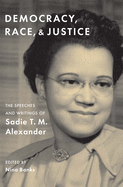
Buy new or used from an indie through our partner Biblio:
| Price | Condition | Seller |
|---|---|---|
| $15.00 | fine | Montclair Book Center |
Product Details
Price
$30.00 $27.60
Publisher
Yale University Press
Publish Date
June 15, 2021
Pages
320
Dimensions
6.2 X 9.3 X 1.3 inches | 1.25 pounds
Language
English
Type
Hardcover
EAN/UPC
9780300246704
Earn by promoting books
Earn money by sharing your favorite books through our Affiliate program.
 Become an affiliate
About the Author
Sadie Tanner Mossell Alexander (1898-1989) was an attorney, economist, and civil rights activist. She was the first Black American to gain a Ph.D. degree in economics, doing so in 1921. Nina Banks is associate professor of economics and an affiliated faculty member in Women's and Gender Studies and in Africana Studies at Bucknell University.
https://www.greelane.com/ja/文系/歴史と文化/sadie-tanner-mossell-alexander-biography-45232
Sadie Alexander、最初の女性のアフリカ系アメリカ人弁護士

アフリカ系アメリカ人と女性のための主要な公民権、政治的、および法的擁護者として、Sadie Tanner MossellAlexanderは社会正義のための戦闘機であると考えられています。アレクサンダーが1947年にペンシルベニア大学から名誉学位を授与されたとき、彼女は次のように説明されました。
「[...] [A]公民権のための積極的な労働者である彼女は、国、州、地方自治体のシーンで着実かつ強力な支持者であり、自由は理想主義だけでなく粘り強さと意志によっても勝ち取られることを世界中の人々に思い出させています。長い間[…]」
彼女の最大の成果のいくつか:
- 1921年:アフリカ系アメリカ人の女性として初めて博士号を取得。米国では。
- 1921年:アフリカ系アメリカ人として初めて博士号を取得。ペンシルベニア大学で経済学を専攻。
- 1927年:ペンシルベニア大学に入学して法学位を取得した最初のアフリカ系アメリカ人女性。
- 1943年:全国弁護士会で全国事務所を開く最初の女性。
アレクサンダーの家族の遺産
アレクサンダーは、豊かな遺産を持つ家族から来ました。彼女の母方の祖父であるベンジャミンタッカータナーは、アフリカ法聖公会の司教に任命されました。彼女の叔母であるハレ・タナー・ディロン・ジョンソンは、アラバマで医師免許を取得した最初のアフリカ系アメリカ人女性でした。そして彼女の叔父は国際的に高く評価されている芸術家ヘンリー・オッサワ・タナーでした。
彼女の父、アーロンアルバートモッセルは、1888年にペンシルベニア大学ロースクールを卒業した最初のアフリカ系アメリカ人でした。彼女の叔父、ネイサンフランシスモッセルは、ペンシルベニア大学医学部と共同を卒業した最初のアフリカ系アメリカ人医師でした。 -1895年にフレデリックダグラス病院を設立。
初期の人生と教育
1898年にフィラデルフィアでサラタナーモッセルとして生まれた彼女は、生涯を通じてセイディと呼ばれていました。アレクサンダーは子供の頃、母親と年上の兄弟と一緒にフィラデルフィアとワシントンDCの間に住んでいました。
1915年、彼女はMストリートスクールを卒業し、ペンシルベニア大学教育学大学院に通いました。アレクサンダーは1918年に学士号を取得して卒業し、翌年には経済学の修士号を取得しました。
フランシスサージェントペッパーフェローシップを受賞したアレクサンダーは、アフリカ系アメリカ人の女性として初めて博士号を取得しました。米国では。この経験について、アレクサンダーは言った
「マーカンタイルホールから音楽アカデミーまでブロードストリートを行進したことをよく覚えています。そこでは世界中から写真家が私の写真を撮っていました。」
彼女の博士号を取得した後 ペンシルベニア大学ウォートンスクールオブビジネスで経済学を専攻したアレクサンダーは、ノースカロライナ相互生命保険会社に2年間勤務した後、フィラデルフィアに戻って1923年にレイモンドアレクサンダーと結婚しました。
最初の女性のアフリカ系アメリカ人弁護士
レイモンド・アレクサンダーと結婚した直後、彼女はペンシルベニア大学ロースクールに入学し、ペンシルベニア大学ローレビューの寄稿者および副編集長として非常に活発な学生になりました。1927年、アレクサンダーはペンシルベニア大学ロースクールを卒業し、後にペンシルベニア州弁護士会に合格して入院した最初のアフリカ系アメリカ人女性になりました。
アレクサンダーは32年間、夫と一緒に家族法と不動産法を専門として働いていました。
法務に加えて、アレクサンダーは1928年から1930年まで、また1934年から1938年まで、フィラデルフィア市の事務弁護士補佐を務めました。
トルーマン人権委員会
アレクサンダーは公民権運動に積極的に参加し、公民権法も実践しました。夫が市議会に出席している間、アレクサンダーは1947年にハリー・トルーマン大統領の人権委員会に任命されました。この役職で、アレクサンダーは報告書「これらの権利。」報告書の中で、アレクサンダーは、性別や人種に関係なく、アメリカ人は自分自身を改善する機会を与えられるべきであり、そうすることで米国を強化するべきであると主張しています。
その後、アレクサンダーは1952年から1958年までフィラデルフィア市の人間関係委員会の委員を務めました。
1959年、夫がフィラデルフィアのコモンプレア裁判所の裁判官に任命されたとき、アレクサンダーは1982年に引退するまで法務を続けました。その後、1989年にフィラデルフィアで亡くなりました。
絵が信仰告白だと明言していたヘンリー・オサワ・タナー(はじめて有名になったアフロ・アメリカンの画家で、20世紀になってから人種差別を嫌ってフランスに住み、フランスで埋葬されている)の『イエスに会いに来たニコデーモス(ニコデモ、ヨハネ3章)』のいくつかの絵(同じ年に描かれた)を見ていてそう思う。
https://en.wikipedia.org/wiki/Sadie_Tanner_Mossell_Alexander
Sadie Tanner Mossell Alexander
Sadie Tanner Mossell Alexander | |
|---|---|
 Sadie Tanner Mossell receiving PhD at the University of Pennsylvania | |
| Born | Sadie Tanner Mossell January 2, 1898 |
| Died | November 1, 1989 (aged 91) |
| Alma mater | University of Pennsylvania |
| Occupation | Lawyer; first national president of Delta Sigma Theta Sorority, Incorporated; Civil Rightsactivist |
| Spouse(s) | Raymond Pace Alexander |
| Children | Mary Elizabeth Alexander Rae Pace Alexander |
| Parent(s) | Aaron Albert Mossell II Mary Louisa Tanner |
Sadie Tanner Mossell Alexander (January 2, 1898 – November 1, 1989), was the first African-American to receive a Ph.D. in economics in the United States (1921), and the first woman to receive a law degree from the University of Pennsylvania Law School. She was the first African-American woman to practice law in Pennsylvania, following in her father's footsteps.[1] She was the first national president of Delta Sigma Theta Sorority, serving from 1919 to 1923.[2][3]
In 1946 she was appointed to the President's Committee on Civil Rightsestablished by Harry Truman. She was the first African-American woman appointed as Assistant City Solicitor for the City of Philadelphia. She and her husband were both active in civil rights. In 1952 she was appointed to the city's Commission on Human Relations, serving through 1968. She was President of John F. Kennedy Lawyers' Committee for Civil Rights Under Law (1963). In 1979, Jimmy Carter appointed her as chair of the White House Conference on Aging (WHCoA). She served on the board of the National Urban League for 25 years.[4]
Biography

Sadie Tanner Mossell was born on January 2, 1898 in Philadelphia to Aaron Albert Mossell II and Mary Louisa Tanner (born 1867).
Mossell attended high school in Washington, D.C., at the M Street School, now known as Dunbar High School, graduating in 1915.[5][6]
Mossell returned to Philadelphia to study at the School of Education at the University of Pennsylvania, graduating in 1918. There, she faced numerous hardships, due to her race and gender, such as poor advising, false accusations of plagiarism, and other students stealing her intellectual property.[7] She pursued graduate work in economics, also at Penn, earning her master's in 1919. Awarded the Francis Sergeant Pepper fellowship, she was able to continue her studies and in 1921 became the first African-American woman in the United States to earn a Ph.D from an American university.[8][9][10]
Finding it difficult to get professorship work in Philadelphia as an African-American even with her doctorate,[4] Mossell decided to take an actuarial job with the black-owned North Carolina Mutual Life Insurance Company in Durham, North Carolina and worked there for two years.
In 1919, Sadie Tanner Mossell was elected the first national President of Delta Sigma Theta Sorority. Mossell Alexander also served as the legal advisor to Delta Sigma Theta sorority for 35 years.[11] She was in contact with the Alpha Chapter of Delta Sigma Theta since 1915 when she arrived at the University of Pennsylvania. However, she needed five students to charter a chapter of the sorority, which was not possible until 1918. In March 1918, the Gamma Chapter of Delta Sigma Theta was established with Mossell as its first President. At the request of the Alpha Chapter, the four existing chapters of Delta Sigma Theta were called to convene at Howard University in December 1919. The sorority planned to host their meetings in the women's dormitory on campus until Mossell's uncle Lewis Baxter Moore offered his office as a meeting place. At this convention, the Grand Chapter of the sorority was established, taking the sorority from a loose federation of chapters to a national body. Under, Mossell's leadership the Sorority expanded to new locales in the West, the South, and further into the Midwest and Northeast. She also initiated Delta's first national program, May Week.[12]
In 1923, Mossell married Raymond Pace Alexander shortly after he was admitted to the bar, then returned with him to Philadelphia. Mossell received job offers from several Black colleges and universities, but none of them were located in Philadelphia, and she had no desire to leave her new family. So she stayed home for a year, did volunteer work, and eventually entered law school.[4] She was the first African-American woman admitted to the University of Pennsylvania Law School.[9] In 1927, she was its first African-American woman graduate, and the first to be admitted to the Pennsylvania Bar.[5]
Mossell Alexander practiced law from 1927 until her retirement in 1982. Upon admission to the Bar, she joined her husband's law practice as partner, specializing in estate and family law. They both were active in civil rights law as well. In 1928 she was the first African-American woman appointed as Assistant City Solicitor for the City of Philadelphia, serving to 1930. She was reappointed from 1934–1938. From 1943–1947, she was the first woman to serve as secretary of the National Bar Association.[9]She was appointed to the Commission on Human Relations of the City of Philadelphia, serving from 1952–1968. In 1959, when her husband was appointed to the Court of Common Pleas in Philadelphia, she opened her own law office. She continued to practice law independently until her husband's death in 1974.[4] In 1976, she joined the firm of Atkinson, Myers, and Archie as a general counsel, where she remained until her retirement.
Mossell Alexander died on November 1, 1989 at Cathedral Village in Andorra, Philadelphia, from pneumonia as a complication from Alzheimer's disease.[2][3][1] She was buried in West Laurel Hill Cemetery.
Family
.jpg)
Her maternal grandfather was Benjamin Tucker Tanner (1835–1923), a bishop in the African Methodist Episcopal Church (AME) and editor of the Christian Recorder.[13] Bishop Tanner and his wife had seven children, including Henry Ossawa Tanner (1859–1937), who became a noted painter, and Hallie Tanner Johnson, the first female physician to practice medicine in Alabama[4] and who established the Nurses' School and Hospital at the Tuskegee Institute in Alabama.[5]
Her father, Aaron Albert Mossell II (1863-1951), was the first African-American graduate of the University of Pennsylvania School of Law and practiced as a lawyer in Philadelphia. In 1899, when his daughter Sadie was 1 year old, he abandoned his family and moved to Wales.[14] Her uncle, Nathan Francis Mossell (1856–1946) was the first African-American graduate of the University of Pennsylvania School of Medicine.[5]
Mossell Alexander's siblings include Aaron Albert Mossell III (1893–1975), who became a pharmacist; and Elizabeth Mossell (1894–1975), who became a Dean of Women at Virginia State College, a historically black college.[5]
During her high school years, Mossell lived in Washington, DC with her uncle, Lewis Baxter Moore, who was dean at Howard University.
On November 29, 1923, Sadie Tanner Mossell married Raymond Pace Alexander (1897–1974) in her parents' home on Diamond Street in North Philadelphia, with the ceremony performed by her father. Alexander, the son of slaves, grew up in Philadelphia. He attended and graduated from Central High School (1917, valedictorian), Wharton School of the University of Pennsylvania (1920), and Harvard Law School (1923). At the time of this marriage, he had established a law practice in Philadelphia.
Sadie and Raymond had four premature children, with only the last two surviving. They were able to raise two daughters:[4] Mary Elizabeth Alexander (born 1934), who married Melvin Brown; and Rae Pace Alexander (born 1937), who earned a PhD. and married Archie C. Epps III. After her divorce with Epps, in 1971 Rae Pace Alexander married Thomas Minter, and they had two sons together.[15]
Views

According to Nina Banks,[17] Alexander's opposition to racial oppression was within a tradition of 19th century scholars Frederick Douglass and T. Thomas Fortune, and with later scholars W.E.B. DuBois and A. Philip Randolph. Alexander's focus was frequently on racial and economic justice for the working class, especially for working men and women. However, unlike Dubois or Randolph, Alexander never embraced socialism. Alexander also can be contrasted with Howard University radicals Ralph Bunche, E. Franklin Frazier, and fellow black economist Abram Harris. For example, Harris wrote that the fundamental problems facing blacks could be overcome through multi-racial labor organizing and did not support direct action for civil rights until blacks had achieved economic power. Alexander, on the other hand, was outspoken against white dominance in political, social, and economic spheres.[17]
Alexander's work and views are recorded in speeches kept in the University of Pennsylvania archives. Among her earliest works are from the 1920s and discuss black workers in the US economy. In 1930, Alexander published an article, "Negro Women in Our Economic Life", which was published in Urban League's Opportunity magazine advocating black women's employment, particularly in industrial jobs. Alexander generally supported the Republican Party, suspicious of the control of conservative southern whites over the Democratic Party, although she also criticized Republican political appointments, as well as what she saw as uneven benefits of the New Deal which did not do enough to help blacks who were most hurt by the great depression. During World War II, Alexander saw similarities in a rise in racial violence and discrimination in the US as paralleling the treatment of Jews in Germany. Near the end of the war, she supported integrating labor unions to increase their bargaining power once the war economy slowed and industrial employment moved toward pre-war levels. Her interest in labor economic issues extended to advocating for government regulation to smooth fluctuations in the business cycle, modification of tariffs, regulation of public utilities, and regulation of securities and securities markets.[17]
After the war she was appointed to Truman's Presidential Committee on Human Rights and shifted her focus to civil and human rights. Evidence in the archives suggests that her focus was in this direction for over a decade. In 1963 she gave a speech to the Annual Conference of Commission on Human Rights and she returned to the topic of economic justice, advocating for universal employment.[17]
In a 1981 interview she did with the Geriatric Nursing journal about her position as chair of the WHCoA, Alexander expressed her disapproval of anti-abortion legislation. She advocated for better benefits for nurses and stressed their vitality to the healthcare system. She also expressed that everyone, no matter their age or educational level, can add value to the economy with the proper support.[4]
Legacy and honors
- In 1948, the National Urban League featured Alexander as "Woman of the Year" in its comic book of Negro Heroes.[5]
- In 1970, Alexander was finally granted membership into Phi Beta Kappa, and honor she had been denied as an undergraduate at University of Pennsylvania.[18]
- In 1974, Alexander was awarded an honorary doctorate by the University of Pennsylvania, her first of seven such honors[9]
- In 1980, Alexander received the Distinguished Service Award from the University of Pennsylvania's Law School.[4]
- An elementary school in West Philadelphia, the Sadie Tanner Mossell Alexander University of Pennsylvania Partnership School ("Penn Alexander"), is named after her. The public school was developed in partnership with the University, which supports the school financially and academically.[19]
- The Raymond Pace and Sadie Tanner Mossell Alexander Professorship at the University of Pennsylvania is named in her honor.[20]
- In 2018, The Sadie Collective, an organization for Black Women in quantitative fields was created in her honor.[7] It hosted the first U.S. conference for Black Women in Economics in 2019, drawing attention from press outlets such as NPR, Forbes, Bloomberg, and Quartz as well as notable economists like Janet Yellen, former Chair of the Federal Reserve System, and James Poterba, current president and CEO of the NBER. The conference was attended by her daughter, Dr. Rae Pace Alexander-Minter, and took place at Mathematica Policy Research's Washington D.C. office.[21]
- In 2018, Philadelphia City Councilwoman Cherelle Parker proposed a measure to erect a statute of Alexander.[22]
- On February 24, 2021, Sadie's life and accomplishments were the subject of an episode of the podcast Broads You Should Know[23]
See also
References
- ^ a b "Lawyer Sadie Alexander, a Black pioneer dies at 91". Associated Press. November 3, 1989. Retrieved 2015-09-10.
Sadie Tanner Mosell Alexander, a lawyer and civil rights advocate who achieved many firsts as a black woman, has died of pneumonia at age 91. ...
- ^ a b "Sadie T. M. Alexander, 91, dies; lawyer and civil rights advocate". The New York Times. November 3, 1989. Retrieved 2014-08-17.
On June 15, 1921, she became the second black woman in the United States to receive a Ph.D.; the first, Georgiana Simpson, got the degree a day earlier at the University of Chicago. ...
- ^ a b "Sadie T.M. Alexander". The Washington Post. November 5, 1989.
Sadie Tanner Mossell Alexander, 91, who was appointed by President Truman to the Committee on Civil Rights in 1948, and by President Carter as chairman of his White House Conference on Aging in 1981, died Nov. 1 at her home in Philadelphia. She had Alzheimer's disease. Mrs. Alexander, who is believed to be the first black woman to hold a doctorate in economics and to become a lawyer in Pennsylvania, founded a chapter of the Howard University-based black sorority Delta Sigma Theta, and became its first national president. She was active nationally in the ...
- ^ a b c d e f g h "A lively leader for the WHCoA". Geriatric Nursing. 2(3): 233–234. 1981-05-01. doi:10.1016/S0197-4572(81)80093-6. ISSN 0197-4572.
- ^ a b c d e f "Alexander Family Collection". University of Pennsylvania University Archives and Records Center. Retrieved 2010-10-26.
- Sowell, Thomas (2002). Lazear, Edward P. (ed.). The Education of Minority Children. pp. 79–92. ISBN 978-0-8179-2892-6. Retrieved 2010-10-26.
- ^ a b "The Alexander Technique." The Economist, vol. 437, no. 9225, December 19, 2020, pp. 46-47.
- Malveaux, Julianne (1997). "Missed opportunity: Sadie Teller Mossell Alexander and the economics profession". In Thomas D. Boston (ed.). A Different Vision: Africa American economic thought. 1. Routledge, Chapman, & Hall. pp. 123ff. ISBN 978-0-415-12715-8. Retrieved 4 June 2013 – via Google Books.
- ^ a b c d "Sadie Tanner Mossell Alexander", University of Pennsylvania Almanac, accessed 31 March 2011
- "Negress Gets Ph.D at Pennsylvania". The Evening World (21, 767). June 15, 1921. Retrieved May 26, 2021.
- Malveaux, Julianne (1996-12-13), "Missed Opportunity", A Different Vision, Routledge, ISBN 978-0-415-09590-7, retrieved 2021-05-06
- Giddings 1998, op. cit., p. 83.
- Walker, Clarence E.; Seraile, William (June 2000). "Fire in His Heart: Bishop Benjamin Tucker Tanner and the A.M.E. Church". The Journal of American History. 87 (1): 214. doi:10.2307/2567957. ISSN 0021-8723.
- "Sadie Alexander Biography at Black History Now". Retrieved Jun 8,2020.
- Martin, Douglas (May 26, 2009). "Thomas Minter, 84, New York and Federal Education Official, Dies". The New York Times. Retrieved May 27, 2009.
- DeNavas-Walt, Carmen; Proctor, Bernadette D.; Smith, Jessica C. (September 2012). "Real Median Household Income by Race and Hispanic Origin: 1967 to 2010" (PDF). Income, Poverty, and Health Insurance Coverage in the United States: 2011. U.S. Census Bureau. p. 8.
- ^ a b c d Nina Banks, The Black Worker, Economic Justice and the Speeches of Sadie T.M. Alexander. Review of Social Economy, Vol. LXVI, No. 2, June 2008 p 139-161 available as of November 1, 2018 at https://www.jstor.org/stable/29770460
- Garner, Carla (Oct 29, 2010). "Sadie Tanner Mossell Alexander (1898-1989) •". Retrieved Jun 8, 2020.
- "With All Due Respect". Sadie Tanner Mossell Alexander: University of Pennsylvania, PH.D, 1921, LLD 1927. 15 (1).
- "Archived copy". Archived from the original on 2012-07-18. Retrieved 2012-05-01.
- "The Sadie T.M. Alexander Conference for Economics and Related Fields". Retrieved Jun 8, 2020.
- D’Onofrio, Michael. "Statue for lawyer, civil rights advocate long overdue, officials say". The Philadelphia Tribune. Retrieved Jun 8,2020.
- Broads You Should Know (2021). "Sadie Tanner Mossell Alexander".
Further reading
- Mack, Kenneth W., (2012). Representing the Race: The Creation of the Civil Rights Lawyer (2012). ISBN 978-0-674-04687-0.
- Mack, Kenneth W., (2002) "A Social History of Everyday Practice: Sadie T.M. Alexander and the Incorporation of Black Women into the American Legal Profession, 1925-60," Cornell Law Review, Vol. 87, p. 1405 A Social History of Everyday Practice: Sadie T.M. Alexander and the Incorporation of Black Women into the American Legal Profession, 1925-60
- Nier, Charles Lewis. (1998) "Sweet are the Uses of Adversity: The Civil rights Activism of Sadie Tanner Mossell Alexander," Temple Political and Civil Rights Law Review 8. no.59
- Obituaries: New York Times and Philadelphia Inquirer, 3 Nov. 1989.
External links
- Sadie Tanner Mossell Alexander at Find a Grave
- Sadie Tanner Mossell Alexander Papers 1817-1985 (bulk 1920-1983)at the University of Pennsylvania University Archives and Records Center
- Sadie Tanner Mossell Alexander material in the Alexander family papers, 1817-2005 (bulk 1925-1983) at the University of Pennsylvania University Archives and Records Center
| ||||||||||||||||||||||||


Democracy, Race, and Justice: The Speeches and Writings of Sadie T. M. Alexander
Buy new or used from an indie through our partner Biblio:
| Price | Condition | Seller |
|---|---|---|
| $15.00 | fine | Montclair Book Center |
Product Details
Price
$30.00 $27.60
Publisher
Yale University Press
Publish Date
June 15, 2021
Pages
320
Dimensions
6.2 X 9.3 X 1.3 inches | 1.25 pounds
Language
English
Type
Hardcover
EAN/UPC
9780300246704
Earn by promoting books
Earn money by sharing your favorite books through our Affiliate program.
Become an affiliateAbout the Author
Sadie Tanner Mossell Alexander (1898-1989) was an attorney, economist, and civil rights activist. She was the first Black American to gain a Ph.D. degree in economics, doing so in 1921. Nina Banks is associate professor of economics and an affiliated faculty member in Women's and Gender Studies and in Africana Studies at Bucknell University.

https://twitter.com/sandydarity?s=21
返信削除
返信削除Stephanie Kelton
@StephanieKelton
Awesome! Congratulations, @SandyDarity !!!
2021/05/28 6:48
https://twitter.com/stephaniekelton/status/1398033500444504068?s=21
返信削除Modern Money Scotland | Policy Papers
https://www.modernmoney.scot/policy-papers
参考:
Democracy, Race, and Justice: The Speeches and Writings of Sadie T. M. Alexander (English Edition)Kindle版
英語版 Sadie T. M. Alexander (著), Nina Banks (編集) 形式: Kindle版
https://www.amazon.co.jp/dp/B096KNLWPQ/
https://twitter.com/tiikituukahana/status/1436906664184070146?s=21
返信削除