2022年12月6日火曜日

Della Moneta - Ferdinando Galiani, 貨幣論 ガリアーニ 1751

Della Moneta - Ferdinando Galiani, 貨幣論 ガリアーニ 1751
https://www.blogger.com/blog/post/edit/2133355681582705445/961216840775572077


貨幣論 (近代社会思想コレクション) 単行本 – 2017/8/10 


特異な啓蒙主義者で重農主義者でもあったガリアーニ(1728~87)の主著『貨幣論』の全訳。イタリア語圏外の研究者にあまり読まれなかった本書は「金属」「貨幣の本質」「貨幣の価値」「貨幣の構造」の四部に分かれ、貨幣の存在意義に関するあらゆる問題を扱っている。経済学の黎明期にあって先駆的な古典経済学書がようやくその全貌を現す。

マルクス資本論で言及

1:1:4
 だから、人々がじぶんの労働諸生産物を価値として相互に連関させるのは、これらの物象が、彼らにとって同等な種類の・人間的な・労働の単なる物象的外被として意義をもつからではない。その逆である。彼らは、彼らの相異なる種類の諸生産物を交換において価値として相互に等置することによって、彼らの相異なる諸労働を人間的労働として相互に等置する。彼らは、それを意識してはいないが、そうするのである。だから、価値なるものの額には、それが何であるかということは書かれていない。価値は、むしろ、どの労働生産物をも一つの社会的象形文字に転化する。〔80〕のちにいたって人々は、この象形文字の意味をとこうとし、彼らじしんの社会的産物──けだし、価値としての使用対象の規定は、言語と同じように彼らの社会的産物である──の秘密をさぐろうとする。労働諸生産物は、それらが価値であるかぎりでは、それらの生産に支出された人間的労働のたんに物象的な表現である、という後代の科学的発見は、人類の発達史において時代を劃するものではあるが、しかし決して、労働の社会的性格の対象的仮象をおいはらいはしない。商品生産というこの特殊的生産形態にのみ妥当することが、すなわち、相互に独立する私的諸労働の独自的・社会的性格なるものは、人間的労働としてのそれらの同等性であり、労働諸生産物の価値性格という形態をとるということが、商品生産の諸関係のとりことなった人々にとっては、右の発見の前後をとわず──あたかも、空気が科学的にその諸元素に分解されても物理的な物体形態としての空気形態はなお存続するということと同じく──最終決定的に見える。

二七 第二版への注。だから、ガリアニが「価値は、二人の人物のあいだの一関係である」──La Ricchezza è una ragione tra due persone ──といったとき、彼は、物的外被のもとに隠された関係、と附言すべきであったろう。(ガリアニ『貨幣について』、クストディ編『イタリー経済学古典集』近世の部、第三巻、ミラノ、一八〇三年、二二〇頁。)


。。。
1:2

四二 カール・マルクス『経済学批判』、一三五頁〔ディーツ版、一九五一年、一六七頁〕。「金属は……生れながらに貨幣である。」(ガリアニ『貨幣について』、クストディ編集本、近世の部、第三巻、七二頁。)

四六 「金銀は、それらが貨幣である前から、金属として価値をもつ。」(ガリアニ『貨幣について』、七二頁。)

。。。
1:4:1

一〇a 「物は、前進する際にもたない無限的なものを、循環する際にもつ。」(ガリアニ『貨幣について』、一五六頁。)

。。。
1:4:2

…使用価値にかんしては交換者の双方が得をすることができるとしても、交換価値について彼らの双方が得をすることはできない。この場合にはむしろ、「平等の存するところに利得なし」といえる。

一八 ガリアニ『貨幣について』、クストディ編、近世の部、第四巻、二四四頁。

。。。

1:10
二 「産業が完成されるということは、それによれば一商品が従来よりも少数の労働者をもって──あるいは、(同じことだが)より短い時間で──仕上げられうるような、新たな方法が発見されるということ以外には何も意味しない。」(ガリアニ『貨幣について』、一五九頁。)「生産費の節約とは、生産に用いられる労働量の節約いがいの何ものでもありえない。」(シスモンディ『研究』、第一巻、二二頁。)

。。。

1:23:4

八七 「貧困は、生殖のために好都合なように見える。」(A・スミス〔『諸国民の富』、岩波文庫新版、Ⅰ、二五〇頁〕。)ハイカラで才気に富んだガリアニ師によれば、このことはむしろ神の特に賢明な摂理である、──「最も有用な職分をおこなう人間がたくさん生れるということは、神の摂理である」と。(ガリアニ『貨幣について』、七八頁。)


~~~


Risultati della ricerca di "ragione tra" - Wikisource
https://it.wikisource.org/wiki/Speciale:Ricerca?fulltext=Cerca+in+questo+libro&fulltext=Search&ns0=1&ns102=1&ns110=1&prefix=Della+moneta&search=ragione%E3%80%80tra

邦訳156頁

2:4

Da questa definizione si comprende che la ricchezza è una ragione tra due persone, e, riguardo ad ogni uomo, uno è [p. 125 modifica] disegualmente ricco. Inoltre non la sola quantitá delle cose desiderate, ma la varia qualitá loro con ragione composta è misura delle ricchezze, e chi ha le cose piú utili, è piú ricco di chi possiede le meno utili. Or nella serie delle cose utili le prime sono gli elementi; indi è l’uomo, che di tutte le cose è la piú utile all’altro uomo; poi sono i generi atti al vitto, indi al vestito, appresso all’abitazione, e in ultimo alle comoditá meno grandi ed all’appagamento de’ piaceri secondari dell’uomo. In questa classe sono i metalli, non discosti dalle gemme: sono dunque utili anche essi, ma meno dell’uomo. Dunque, se Ciro, se Roma, se Alessandro aveano piú uomini, o, per meglio dire, migliori che Creso e Perseo e Dario, erano piú ricchi assai; e non fu fortuna il vincere, o cosa strana se il piú forte restò superiore. È errore chiamar piú forte chi ha piú denaro. Non ebbero adunque costante fortuna i romani, ma costante superioritá di potere. «Caso» e «fortuna» sono voci nate dall’ignoranza nostra, e nella natura non sono. Diciamo noi meschini «caso» quell’ordine di leggi, che non sappiamo sviluppare, ed ella è voce relativa al diverso intendimento nostro; onde il savio è sempre dallo sciocco chiamato «fortunato». Né credo io perciò che vi sia voce di questa piú vergognosa per noi e piú ingiuriosa alla provvidenza, che ci governa.


この定義から、富は二人の人間の間の理であり、それぞれの人間に関して、一人は [p.125 edit] 不等に富んでいることが理解できる。また、望ましいものの単なる量ではなく、複合的な理由による質の変化が豊かさの尺度であり、最も有用なものを持つ者は、最も有用でないものを持つ者よりも豊かなのである。さて、有用なもののシリーズでは、まず元素があり、次に人間であり、あらゆるものの中で他の人間にとって最も有用である。次に、食物に適したもの、衣服に適したもの、居住に適したもの、最後に、より少ない快適さと人間の第二の喜びを満足させるものがある。このクラスには、宝石に似ていない金属があります。したがって、彼らもまた有用ですが、人間ほどではありません。したがって、キュロス、ローマ、アレキサンダーがクロイソスやペルセウス、ダリウスよりも多くの兵、いやむしろ優れた兵を持っていれば、彼らはより豊かであり、彼らが勝ったのは運ではないし、強い者が優位を保ったとしても不思議なことではないのです。お金を多く持っている人を強いと言うのは間違いです。したがって、ローマ人は常に運を持っていたのではなく、常に力の優位性を持っていたのである。"偶然 "や "幸運 "は、私たちの無知から生まれた声であり、自然界には存在しない。私たち小市民は、どのように発展させるかわからない法則の秩序を「偶然」と言い、それは私たちの異なる理解に相対する声であり、それゆえ賢者は常に愚者から「幸運」と呼ばれる。ですから、私たちにとってこれほど恥ずべき声、私たちを支配する摂理にとってこれほど侮辱的な声があるとも思えません。
:deepl


第4章 | 156

と同様に、逆に、多くの物が無用か有害だとしても、間違って多くの要望があれば、それを持つ人は富裕だ

ろう。

 〈富は常に人間の間と事物の間で相対的である〉 この定義から、富とは二人の人間の間の比率であり、 あ

らゆる人に対して一人が不平等に富裕であることが理解される。さらに、望まれる物の量だけではなくて、

それらのさまざまな質も構成根拠として富の尺度になるので、最も有用な物をもつ人が最も無用な物をもつ

人よりも富裕である。さて、有用物の系列には第一の構成要素がある。 そこで、すべてのもののうちで他の

人に対して最も有用なものは人間である。 次に、食べ物に、それから衣装に、引き続いて住居に、最後に過

大でない快適と人間の二次的快楽の満足をかなえる諸商品がある。 この等級には、 宝石からかけ離れていな

諸金属があるので、それらも有用だが人間ほどではない。だから、もしキュロス Ciro (ペルシャの王)、

ローマ、 アレクサンドロス大王 Alessanndro (前三五六年~三三三三年)が、多くの人々を、もっと分り易く言え

ば、クレゾ、ペルセウス、ダリウス一世より優れた人々を抱えていたとすれば、もっとずっと豊かだろう。

勝利は財産では得られなかったし、言い換えれば、最も強い者が最も優位に立ったとしてもおかしくない。

お金を沢山もつ人を強い人と呼ぶのは誤りである。だから、ローマ人は恒常的な財産を持たなかったが、 権

力の絶えざる優越性をもった。偶然〉 caso (初版、他c.) と 運命〉 fortuna (同f.) は、我々の無知から生ま

れた言葉で、自然には存在しない。我々が発展させられない法律の命令を惨めな偶然〉(同)と言おう。

運命は、我々と違った意図に対応する言葉である。そのため、賢人は常にばか者から 〈運のいい人〉 fortu-

nato (同)と呼ばれた。 だから、私は、運命という言葉は我々にとりひどく恥ずかしいとも、 我々を統べる

神意にひどく無礼だとも思わない。

 〈金属がまったく無益だという間違った結論〉 だから、金・銀がまったく無益だとまでは言えないにして

も、まして万物の君主で幸福の主人だと公言するには値しない。 オリーブ油やワインが、 無駄でなければ決

してこうは言われなかったように。 金属は奢侈の商品である。すなわち、奢侈は、第一の必要が容易に充足


第三編でガリアニは金属主義の立場から貨幣価値の切り下げを批判的に論じている。


ーーー
Della Moneta - Wikipedia

貨幣論

ウィキペディアから、無料の百科事典。
ナビゲーションにジャンプ検索にジャンプ
コインの
著者フェルディナンド・ガリアーニ
第1版オリジナル1751
サブジャンル経済、哲学
元の言語イタリア語

デラ・モネタはフェルディナンド・ガリアーニによって書かれたエッセイであり、アダム・スミスによる25年間に先立つ経済学、特に金融理論の最初の特定の条約の1つと考えられています。

[編集 | ソースの編集]

デラ・モネタは5つのセクションに分かれており、今日でも金融理論の標準的な側面と考えられているものをカバーしています。これには、お金の起源、その価値(インフレとデフレを含む)、利益、金融政策が含まれます。

お金の起源[編集 | ソースの編集]

著者は、わずか23歳の時、ギリシャ人とローマ人にまでさかのぼるイタリアの貨幣の歴史から始まりました。集中契約を通じてお金の起源の現代的なビジョンを捨てて、ガリアーニは、貿易の必要性を通じて、お金が自発的に発生する傾向があり、オーストリアの経済学校を1世紀以上予想することを提案しています。これは、略奪があまりにも多様で複雑で処理できないことが判明するまで、政府が王国のすべての資産の一部を税金を通じて取引または没収しようとする一種の精神的な実験を説明し、したがって、コンパクトさ、容易さなど、当時お金に有用であると考えられていた特性を持ついくつかの単純な商品で同等の貿易を求めることに頼るだけです。1]

お金の価値[編集 | ソースの編集]

本の他のテーマと絡み合って、お金と一般的に物質的な商品は、人々への有用性に基づいて価値があるという2番目の前提があります。これは、120年後に限界効用の調査によってのみ再発見された前提です。[2] 20世紀半ばまで再び徹底的に検討されなかったであろう現代のアイデアにも触れています。お金と商品の価値は、需要と供給に基づいて価格バランスに達することができます。これはまた、経済エンジンとしての需要と供給の最初の近代的な検討になる可能性があります。

方法論[編集 | ソースの編集]

デラ・モネタでは、ガリアーニは彼の本のプレゼンテーションと組織に哲学的方法論を使用しようとしています。彼はまた、他の初期の経済テキストがそうしなかったと批判している。例えば、彼はモンテスキューを引用しています。モンテスキューは、彼の本はフランスに有害でした。なぜなら、それは間違いを義務付け、敬虔な欲望を含み、科学的厳しさを欠いているからです。[3]

影響[編集 | ソースの編集]

ガリアーニは、16世紀のスペインでの価格革命などの事件によって引き起こされ、過去2世紀にお金がヨーロッパにどのような影響を与えたのか、なぜお金がヨーロッパにどのような影響を与えたのかについての複雑な議論の専門家だったようです。新世界からの金の流入が最初にスペインで劇的なインフレを引き起こし、その後、ヨーロッパ全土で危機はおよそその時まで程度変化し続けました。

彼は、この本の中で、ジョン・ロックやルドヴィコ・アントニオ・ムラトリなど、他の人々による政治経済学に関する以前の考察について言及している。

影響影響[編集 | ソースの編集]

この本は、アダム・スミスの時代からカール・マルクスからジョセフ・シュンペーターまで、さまざまな経済思想の経済学者によって広く引用されています。

エディション[編集 | ソースを編集]

翻訳[編集 | ソースの編集]

メモ[編集 | ソースの編集]


https://it.wikipedia.org/wiki/Della_Moneta

Della Moneta

Della Moneta
AutoreFerdinando Galiani
1ª ed. originale1751
SottogenereEconomia, Filosofia
Lingua originaleitaliano
Modifica dati su Wikidata · Manuale

Della Moneta è un saggio scritto da Ferdinando Galiani, ed è considerato uno dei primi trattati specifici di economia, in particolare di teoria monetaria, precedendo di venticinque anni La ricchezza delle nazioni di Adam Smith.

Indice

  • 1 Riepilogo
  • 2 L'origine del denaro
  • 3 Il valore del denaro
  • 4 Metodologia
  • 5 Influssi
  • 6 Impatto
  • 7 Edizioni
    • 7.1 Traduzioni
  • 8 Note

Riepilogo

Della Moneta è diviso in cinque sezioni, che coprono quelli che ancora oggi sono considerati gli aspetti standard della teoria monetaria. Questi includono l'origine del denaro, il suo valore (comprese inflazione e deflazione ), gli interessi e la politica monetaria.

L'origine del denaro

L'autore, all'epoca di soli 23 anni, iniziò con la storia della monetazione italiana, risalendo ai Greci e ai Romani. Scartando la visione contemporanea dell'origine del denaro attraverso contratti centralizzati, Galiani propone che il denaro tenda a sorgere spontaneamente, attraverso la necessità del commercio, anticipando di oltre un secolo la scuola economica austriaca. Descrive una sorta di esperimento mentale, in cui un governo tenterebbe di commerciare o confiscare attraverso le tasse una parte di tutti i beni del regno, finché non scopre che il saccheggio è troppo vario e complesso da gestire, e quindi si rivolgerebbe solo a chiedere l'equivalente commerciale in alcune semplici merci che hanno le caratteristiche considerate utili per il denaro all'epoca, come compattezza, facilità di distribuzione e facilità di immagazzinamento.[1]

Il valore del denaro

Intrecciata negli altri temi del libro c'è una seconda premessa, che il denaro, e i beni materiali in generale, hanno valore in base alla loro utilità per le persone: una premessa che è stata riscoperta solo con l'esame dell'utilità marginale 120 anni dopo.[2] Tocca persino un'idea moderna che non sarebbe stata nuovamente esaminata a fondo fino alla metà del XX secolo: che il valore del denaro e delle merci possa raggiungere un equilibrio di prezzo, basato su domanda e offerta. Questo potrebbe anche essere il primo esame moderno della domanda e dell'offerta come motore economico.

Metodologia

In Della Moneta, Galiani tenta di utilizzare la metodologia filosofica nella presentazione e nell'organizzazione del suo libro. Critica anche altri primi testi economici per non averlo fatto. Ad esempio, cita Montesquieu, il cui libro, secondo lui, è stato dannoso per la Francia, perché commette l'errore è-dovere, contiene un pio desiderio e manca di rigore scientifico.[3]

Influssi

Galiani sembra essere stato esperto nei complessi dibattiti su come e perché il denaro ha avuto un tale impatto sull'Europa nei due secoli precedenti, causato da incidenti come la rivoluzione dei prezzi in Spagna nel XVI secolo, dove un afflusso di oro saccheggiava dal Nuovo Mondo provocò una drammatica inflazione prima in Spagna, poi in tutta l'Europa, una crisi che continuò in varia misura fino all'incirca all'epoca del libro di Galiani.

Fa menzione, nel libro, di precedenti riflessioni su temi di economia politica di altri, tra cui John Locke e Ludovico Antonio Muratori.

Impatto

Questo libro è stato ampiamente citato da economisti di diverse scuole di pensiero economico dai tempi di Adam Smith in poi, da Karl Marx a Joseph Schumpeter.

Edizioni

Traduzioni

Note

ーー


Sie wissen das nicht, aber sie tun es. 

柄谷
中心

1:1:4


内省と遡行
「彼らはそれを意識していないが、そう行うのだ。」

河出
彼らは、それを意識してはいないが、そうするのである。


ルカ23:34

34〔そのとき、イエスは言われた。「父よ、彼らをお赦しください。自分が何をしているのか知らないのです。」〕人々はくじを引いて、イエスの服を分け合った。

⑸〔  〕   新約聖書において、後代の加筆と見られているが年代的に古く重要である個所を示す。


資本論1:4
注27の直前
Sie wissen das nicht, aber sie tun es. 
新日本出版社2019版によればルカによる福音書の言い換え。
「彼はそれを知ってはいないけれども、それを行なう。」133

「彼らはそれを知ってはいないが、しかし、それを行なうのである。」国民文庫①138

https://newchristianbiblestudy.org/multi/bible_japanese-bible-kougo_luke_23_34/bible_german-luther-1912_luke_23_34/explanation_jesus-love-of-the-neighbor

Lukas 23:34

34 Jesus aber sprach: Vater, vergib ihnen sie wissen nicht, was sie tun! Und sie teilten seine Kleider und warfen das Los darum. 

https://www.uibk.ac.at/theol/leseraum/bibel/lk23.html

Lk 23,34 Jesus aber betete: Vater, vergib ihnen, denn sie wissen nicht, was sie tun. Dann warfen sie das Los und verteilten seine Kleider unter sich


ルカによる福音書 23:34 新共同訳

34 そのとき、イエスは言われた、「父よ、彼らをおゆるしください。彼らは何をしているのか、わからずにいるのです」。人々はイエスの着物をくじ引きで分け合った。 

The Deficit Myth - Milken Institute Review


The Deficit Myth - Milken Institute Review

The Deficit Myth

Modern Monetary Theory and the Birth of the People's Economy

If you think Modern Monetary Theory is a rationale for ignoring federal budget deficits and spending whatever's necessary to fund an ambitious progressive agenda — everything from tuition-free college to Medicare-for-All — you're correct, in part. It's certainly been used that way by the political left, much as supply-side economics has been used by the right to justify tax cuts for the one percent. But as Stephanie Kelton, an economics professor at the State University of New York at Stony Brook and the most visible (and persuasive) advocate of MMT, makes strikingly clear in The Deficit Myth: Modern Monetary Theory and the Birth of the People's Economy, much of what underpins the theory is widely accepted by mainstream economists — if not mainstream politicians and the public. Indeed, while the terminology is different, one can make the case that MMT builds on fundamental precepts of Keynesian economics seasoned with a dash of Milton Friedman's provocations. Read this excerpt with an open mind, and you may just begin to doubt the "common sense" of fiscal prudence.

— Peter Passell

illustrations by michal dziekan

Published January 24, 2021

*Published by PublicAffairs of the Hachette Book Group ( 2020). All rights reserved.

When I arrived in Washington in 2015, I was the only staffer on the U.S. Senate Budget Committee who looked at the world through the lens of a currency issuer. I knew the federal government wasn't like a household or a private business. I knew Uncle Sam could never run out of money. I knew that inflation, rather than insolvency, was the relevant punishment for overspending. I also knew I was alone in this thinking.

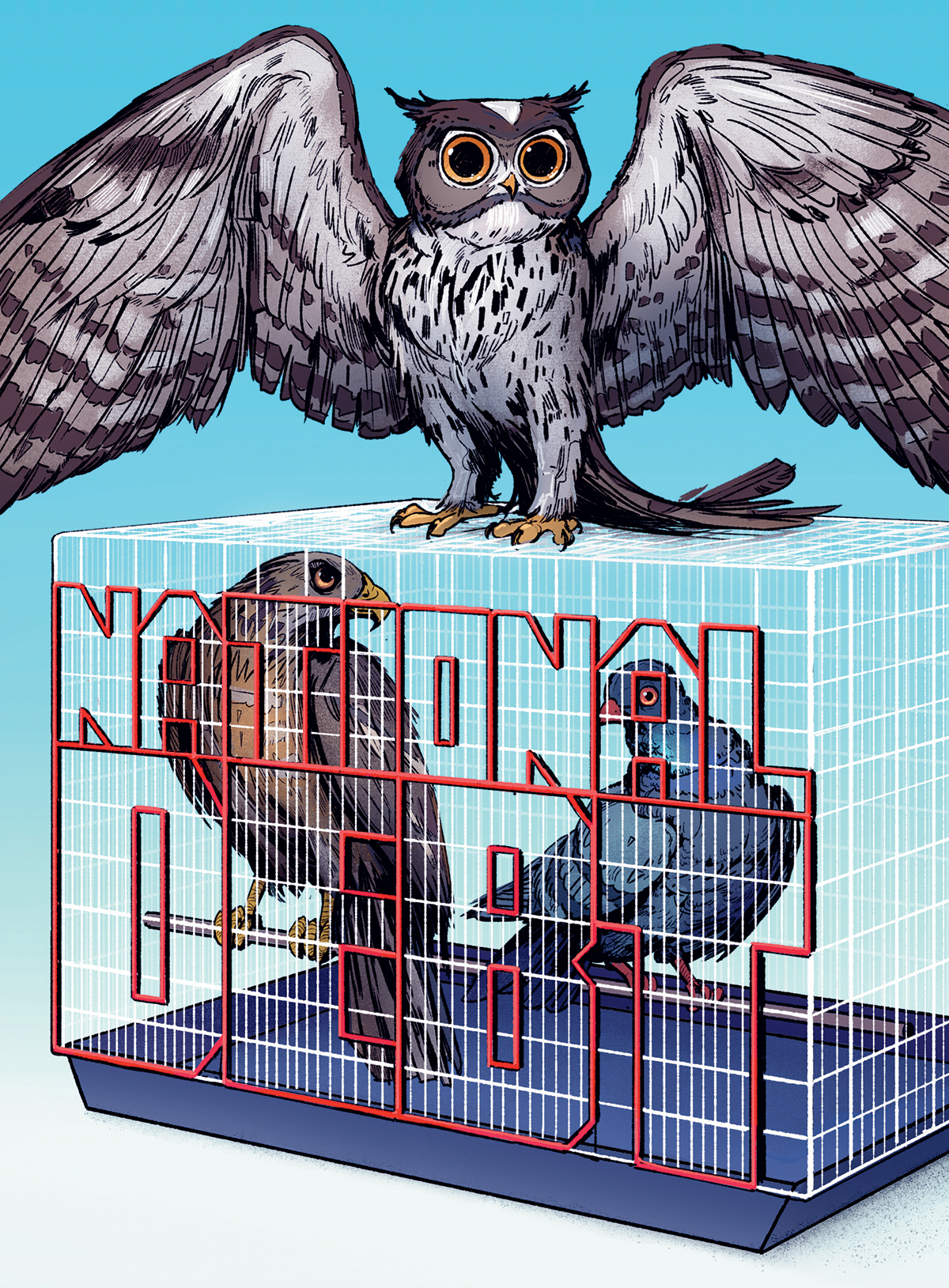
Everyone else fell into one of two camps: deficit hawks or deficit doves. While Washington insiders depicted them as polar opposites, I saw them as birds of a feather. Both considered the long-term fiscal outlook a problem that needed to be fixed. Most Republicans wanted to slash entitlements, while most Democrats wanted to raise taxes. Different paths to the same destination.

As word spread that I would be heading to the nation's capital to advise the Democrats, journalists fired off articles with headlines like "Sanders Hires Deficit Owl." I had coined that term in 2010, as a way to distinguish the views held by modern monetary theory (MMT) economists like me from those of the more deficit-anxious birds. Most of the senators on the committee had never heard of MMT. When I met with the members of the committee for the first time, no one was rude, but I could sense that there was reticence about expanding the deficit aviary.

I looked for ways to help the committee without reinforcing myths and misunderstandings about our nation's finances. One of the most eye-opening things I learned came from a game I would play with members of the committee (or their staffers). I'd start by asking them to imagine that they had discovered a magic wand with the power to eliminate the entire national debt with one flick of the wrist. Then I'd ask, "Would you wave the wand?" Without hesitation, they all wanted the debt gone. Then, I'd ask a seemingly different question: "Suppose that wand had the power to rid the world of U.S. Treasuries. Would you wave it?" The question drew puzzled looks. Eventually, everyone would decide against waving the wand.

They loved U.S. Treasuries, as long as they thought of them as financial assets held by the private sector. But they hated the very same securities when they considered them obligations of the federal government.

Eventually, I'd point out that I had asked two versions of the same question. Some of them told me they understood that waving the wand entailed eliminating the entire U.S. Treasury market, but they wanted the debt wiped out anyway, because it scares voters.

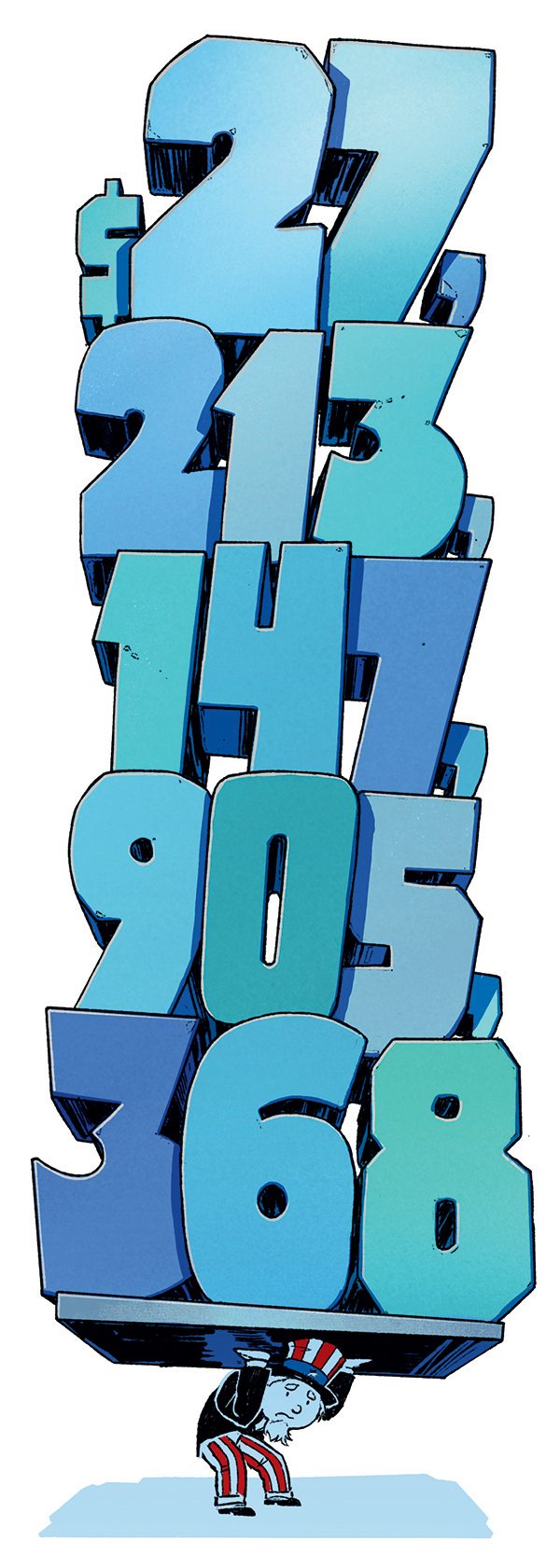
It's So,Ooo,Ooo,Ooo,OOO Big

Of course voters are terrified! It's virtually impossible to get through the workweek without encountering some form of hysteria over fiscal deficits and the national debt. A debt clock towers over pedestrians on West 43rd Street in New York City, delivering the daunting numbers in real time. Social media circulates breaking news alerts to report the latest dire projections from the Congressional Budget Office.

MYTH: One way or another, we're all on the hook. REALITY: The national debt poses no financial burden whatsoever.

The truth is, we're fine. The debt clock simply displays a historical record of how many dollars the federal government has added to people's pockets without subtracting (taxing) them away. Those dollars are being saved in the form of U.S. Treasuries. If you're lucky enough to own some, congratulations! They're part of your wealth. While others may refer to it as a debt clock, it's really a U.S. dollar savings clock. But you won't hear that from anyone in Congress. Think about what would happen if a member of Congress returned to his or her district and tried to convince a roomful of panicked constituents that everything they deeply fear about our ballooning national debt is really a big nothing- burger.

Even if their own thinking wasn't so broken, there are reasons members of Congress might not want the rest of us to see the so called debt for what it really is.

I remember being struck by this during a meeting with members of the Budget Committee. The Congressional Budget Office had projected that the fiscal deficit would stand at $1.1 trillion and the gross federal debt would reach $27.3 trillion in 2025. Mike Enzi, the committee's chairman, suggested that the CBO be required to write the numbers out in long form: $1,100,000,000,000 and $27,300,000,000,000.

Once politicians like Senator Enzi succeed in making us anxious about the sheer size of this thing we label debt, they can weaponize that fear in a number of ways. By persuading voters that something must be done about these big scary numbers, politicians can push for cuts to popular programs like Social Security and Medicare. People will fight tooth and nail to protect them. Unless, of course, they can be convinced that there is no alternative. MMT shows that we don't need to fix the debt. We need to fix our thinking.

China, Greece and Bernie Madoff

I can read the latest CBO report and not panic over the projected increase in the national debt. I don't agonize over "my share" of the national debt, and I never worry about the U.S. ending up like Greece. I don't fret over the possibility that China might one day shut off the spigot and starve the U.S. of the dollars we need to pay our bills. Heck, I don't even think we should be referring to the sale of U.S. Treasuries as borrowing, or labeling the securities themselves as the national debt. So, let's try to fix our thinking.

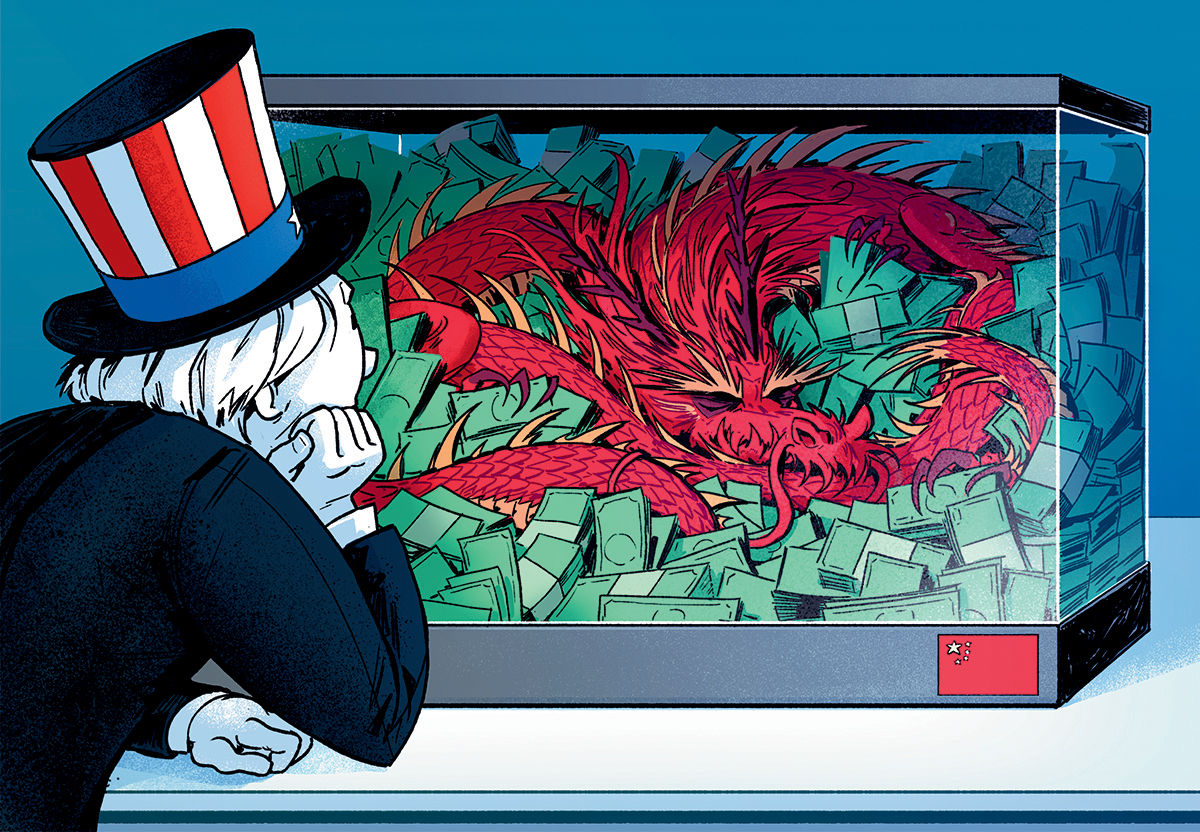
It was at a campaign stop in Fargo, North Dakota where Obama told a small crowd that America was relying on "a credit card from the Bank of China." His choice of words was important because it taps into two of our basic anxieties. For one thing, there's the fear of relying on borrowed money to pay the bills. Hearing that our country is running up trillions of dollars in credit card debt is enough to make anyone worry. Learning that we owe that money to a foreign nation — an adversary even – only heightens the anxiety.

In 2018, the U.S. exported $120 billion in U.S. manu factured goods to China, while China shipped $540 billion of its products to the U.S. The difference gave China a $420 billion mer chandise trade surplus.

It's not that we don't have anything to worry about when it comes to our international trading partners. But relying on China to pay our bills isn't one of them. To see why, let's take a step back and think about how China (and other foreign countries) end up holding U.S. government bonds.

What happens first is that China decides it wants to sell some of what it produces to buyers outside China. The U.S. does that, too, but America exports less than it imports. In 2018, the U.S. exported $120 billion in U.S. manufactured goods to China, while China shipped $540 billion of its products to the U.S. The difference gave China a $420 billion merchandise trade surplus. Americans paid for those goods with U.S. dollars, and those payments were credited to China's account at the Federal Reserve.

Like any other holder of U.S. dollars, China has the option to sit on those dollars or use them to buy something else. Uncle Sam doesn't pay interest on the dollars that China keeps in its checking account at the Fed, so China usually prefers to move them into what is effectively a savings account at the Fed. It does this by purchasing U.S. Treasuries. It's still just sitting on its U.S. dollars, but now China is holding what I call "yellow" dollars instead of green ones.

The dollars don't originate from China. They're coming from the United States. We're not really borrowing from China so much as we're supplying China with dollars and then allowing those dollars to be transformed into U.S. Treasury securities. Terms like borrowing are misleading. So is labeling those securities the national debt. There is no real debt obligation.

Although China is the largest foreign holder of U.S. Treasuries, it owned less than 7 percent of the publicly held total at the time of this writing. Still, some people worry that this gives China enormous leverage over the U.S. because China could decide to sell off its holdings. The worry is that Uncle Sam could lose access to affordable financing if China refuses to keep buying Treasuries.

There are a number of problems with this thinking. For one thing, China can't avoid holding dollar assets without wiping out its trade surplus with the United States. That's not something China wants to do, since shrinking its exports to the U.S. would slow its economic growth. And even if it does decide to hold fewer U.S. Treasuries, this won't leave Uncle Sam strapped for cash.

Remember, the U.S. is a currency issuer, which means it can never run out of dollars.

Even though it can't happen to the United States, it is possible for a country to lose access to affordable financing. That's what happened to Greece in 2010. But that's because Greece undermined its monetary sovereignty by abandoning the drachma in favor of the euro in 2001. All of the Greek government's existing debt was redenominated into euros, a currency that the Greek government could not issue. Lending to Greece was now a lot like lending to an individual U.S. state — say Georgia or Illinois.

As the 2008 financial crisis spread through Europe, tax revenues fell off a cliff. At the same time, the Greek government was making larger payments to support the ailing economy. That pushed Greece's budget deficit to more than 15 percent of its GDP in 2009.

To cover those deficits, Greece had to borrow. The problem was that lenders weren't willing to buy Greek government bonds unless they got a substantial premium for the obvious risk they were taking in lending billions of euros to a borrower who might have trouble paying it back. From 2009 to 2012, the interest rate on ten-year Greek government bonds rose from less than 6 percent to more than 35 percent!

Compare that with what happened in currency-issuing countries like the U.S. and the UK. Their fiscal deficits more than tripled from 2007 to 2009. And yet the average interest rate paid on ten-year government bonds fell from 3.3 percent to 1.8 percent in the U.S. and from 5 percent to 3.6 percent in the UK. That's because both countries have a central bank that acts on behalf of the government as a monopoly supplier of the currency.

The government can strip markets of any influence over the interest rate on government bonds. That's exactly what the Fed did during and immediately after World War II, and it's what the BOJ is doing today.

Still, isn't there some limit? Surely the U.S. debt can't go on rising forever. To some people, finding new investors to purchase a never-ending mountain of government debt can start to look like a fraudulent pyramid scheme. The kind run by the notorious huckster Bernie Madoff. It isn't.

Madoff was defrauding investors. The U.S. Treasury is not.

The U.S. could not end up like Greece, desiring to make scheduled payments to bondholders but lacking the authority to instruct its central bank to clear the payments. That's because the federal government can always meet its obligation to turn those yellow dollars back into green dollars. All it has to do is change the relevant numbers on the Federal Reserve's balance sheet.

Since our lawmakers have not yet had the benefit of MMT's insights, they view debt service as a growing financial burden on the federal government. In truth, paying interest on government bonds is no more difficult than processing any other payment. To pay the interest, the Federal Reserve simply credits the appropriate bank account.

Right now, lawmakers look at rising interest expenditure the way we might look at a rising cable bill — it means less money to spend on everything else. So, when the CBO says that the federal government is on track to "spend more on interest payments than the entire discretionary budget … by 2046," many lawmakers begin to panic. They think it shrinks the amount of money that's left over, forcing them to spend less on other priorities. That's just not true. There is, however, only so much room in the economy to safely absorb higher spending. That's the constraint Congress needs to worry about.

The limit is our economy's capacity to absorb that additional spending without pushing inflation higher. Every dollar that is paid in the form of interest becomes income to bondholders. If a high percentage of interest income was spent back into the economy, it could potentially push aggregate spending above potential, fueling some inflationary pressure. Even if bondholders aren't spending enough of their interest income to fuel ordinary price inflation, they might still fuel asset price inflation by using their interest income to bid up the prices of commodities, real estate, stocks and so on.

The idea that the rest of us are personally liable for some portion of the national debt is preposterous. The truth is, the entire national debt could be paid off tomorrow, and none of us would have to chip in a dime.
We Could Pay It off Tomorrow

In April 2016, Time magazine devoted its cover to the U.S. national debt. It began, "Dear Reader, You Owe $42,998.12. That's what every American man, woman and child would need to pay to erase the $13.9 trillion U.S. debt."

The idea that the rest of us are personally liable for some portion of the national debt is preposterous. The truth is, the entire national debt could be paid off tomorrow, and none of us would have to chip in a dime.

That's not how most economists see it.

Some do, however, argue that faster growth would help us deal with our "debt problem" because the problem is really the ratio of debt to the size or our economy. The trick, then, is to keep the debt ratio from heading north in perpetuity. For decades, conventional thinking held that the U.S. debt was on an unsustainable path because the formal models used to evaluate the debt trajectory all showed the ratio rising steadily higher into the indefinite future.

Today, some of the most influential economists in the world are telling us the debt might be sustainable after all, at least for now. For example, in January 2019, Olivier Blanchard, the former chief economist of the International Monetary Fund, made this the focus of his presidential address at the annual meeting of the American Economic Association. Blanchard explained that the debt trajectories for many countries, including the United States, appear to be on a sustainable path, at least in the near term. That's because Blanchard expects interest on the debt to remain below the economy's growth rate, which ensures that the debt ratio will not head off to infinity.

Blanchard argues we're safe until financial markets push the interest rate above our economy's growth rate, putting us right back on an unsustainable debt trajectory unless the budget has moved into surplus in the interim. Until then, we can relax and perhaps even safely increase the size of the fiscal deficit.

Blanchard's more cautious take on sustain ability rests on the possibility that interest rates could eventually jump higher, leading to the kind of debt crisis that unfolded in Greece or Argentina.

These were important findings, but it should be pointed out that economist Scott Fullwiler (University of Missouri—Kansas City) made a similar observation 13 years earlier. The difference is that Fullwiler looks at debt sustainability through the MMT lens. Blanchard's more cautious take on sustainability rests on the possibility that interest rates could eventually jump higher, leading to the kind of debt crisis that unfolded in Greece or Argentina. But the U.S. is not like Greece (which borrows in euros) or Argentina (which defaulted on U.S. dollar-denominated debt). It can't lose control of its interest rate.

This is a critically important insight that distinguishes the MMT perspective on debt sustainability from more conventional thinking. Under MMT, it is inflation — not the relationship between interest rates and growth rates — that matters. Still, it's easy enough for the U.S. (and other monetary sovereigns) to satisfy the conventional criteria for sustainability.

Just look at Japan. At 240 percent, Japan's debt-to-GDP ratio is the highest in the developed world. Imagine the horror Senator Enzi would experience at the thought of more than a quadrillion (yen) in debt. That's a lot of zeroes! But Japan, like the U.S., is fine, at least when it comes to debt sustainability, because it's a currency-issuing government with a central bank that can clear every payment obligation that comes due. Financial markets can't push Japan into crisis because the Bank of Japan (BOJ) can override any unwanted move in interest rates. It could also, essentially, retire the entire debt using nothing more than a computer keyboard at the BOJ.

Most of the world's leading central banks focus on setting just one interest rate — a very short-term interest rate known as the overnight rate. They rigidly fix this rate and then allow longer-term rates to reflect market sentiment about the expected future path of the short-term policy-determined rate. That leaves investors with some influence over the interest rate that the U.S. government pays on Treasuries. But — and this is really important — the government can always strip markets of any influence over the interest rate on government bonds. Indeed, that's exactly what the Fed did during and immediately after World War II, and it's what the BOJ is doing today.

To keep a lid on interest rates, the Fed formally committed to maintaining a low-interest- rate peg of 0.375 percent on short-term Treasury bills and implicitly capped the rate First Quarter 2021 93 on long-term Treasury bonds at 2.5 percent. Even as deficits exploded and the national debt climbed from $79 billion in 1942 to $260 billion by the time the war ended in 1945, the federal government paid just 2.5 percent interest on long-term bonds. To hold rates at 2.5 percent, the Fed simply had to buy large quantities of U.S. Treasuries.

This required an open-ended commitment by the Fed, but it was an easy commitment to fulfill since the Fed purchases bonds simply by crediting the seller's account with reserves. Coordination with fiscal policy officially ended in 1951, with an agreement known as the Treasury-Federal Reserve Accord, which freed the Fed to pursue independent monetary policy.

For more than three years, the Bank of Japan has been engaged in a policy known as yield curve control. In addition to anchoring the short-term interest rate, the BOJ committed to pinning rates on ten-year government bonds near zero. In carrying out that policy, the BOJ has purchased massive amounts of government debt, buying up ¥6.9 trillion in June 2019 alone.

As a result, the BOJ now holds roughly 50 percent of all Japanese government bonds. So half of its debt has already been essentially retired. And the BOJ could easily go all the way to 100 percent. Overnight.

To some, this might seem preposterous. How can the BOJ manufacture ¥500 trillion out of thin air to buy back the rest of the debt without devastating inflationary consequences? Most economists are trained to accept some version of the quantity theory of money. Strict adherents, such as followers of Milton Friedman, will likely scream, "Zimbabwe!" "Weimar!" or "Venezuela!"

Economist Eric Lonergan, a hedge fund manager in London, knows better. He correctly observes that swapping government bonds for cash has no effect on the private sector's net wealth.

While net wealth is unaffected, buying the bonds does have an effect on income. When the BOJ replaces bonds with cash, the private sector loses out on any interest that would have been paid. So, retiring the debt siphons interest income out of the private sector. With this in mind, Lonergan asks, "Why on earth would the Japanese household sector rush out and buy things when their interest income has fallen, their wealth is unchanged, and they are used to falling prices?"

The short answer is, they wouldn't. If anything, transferring all of the outstanding government debt to the central bank's balance sheet would tend to push prices lower, not higher. I would think twice about stripping the private sector of all of its interest-bearing government bonds at once, but the Japanese government could certainly pull it off. The U.S. could do it, too.

Fiscal surpluses suck money out of the economy. Fiscal deficits do the opposite. As long as they're not excessive, deficits can help to maintain a good economy by supporting in comes, sales and profits.
A Life Without Debt?

Just think of it. No one comparing Uncle Sam to a spendthrift who's running up the credit card and borrowing from China. No fear of losing access to the bond market and being forced into default like Greece. No economists arguing about whether interest rates will be low enough to keep the debt on a sustainable path. And best of all, no more stress about how to cover "your share" of the national debt.

We actually did it once. It was 1835, and it was the only time in U.S. history when the public debt was paid all the way down. That was long before the Fed was created, so the debt wasn't gobbled out of existence by the central bank. It happened because the government ran fiscal surpluses from 1823 to 1836. As bonds matured, the government simply paid them off.

By 1835, the U.S. was debt-free. It was also headed for one of the worst economic downturns the country has ever experienced. Fiscal surpluses suck money out of the economy. Fiscal deficits do the opposite. As long as they're not excessive, deficits can help to maintain a good economy by supporting incomes, sales and profits. They're not imperative, but if they disappear for too long, eventually the economy hits a wall.

Each and every time the government substantially reduced the national debt, the economy fell into depression. Could it have been a remarkable coincidence? As we see from MMT, government surpluses shift deficits onto the non-government sector. Eventually, the private sector reaches the point where it can't handle the debt. When that happens, spending grinds sharply lower and the economy falls into depression.

The U.S. experienced one brief period of sustained fiscal surpluses relatively recently. It happened during Bill Clinton's presidency, and many Democrats still look back on it as a crowning achievement. The surpluses began in 1998, and by 1999 the White House was ready to party like it was, well, 1999.

The White House was preparing to feature the news in its annual Economic Report of the President. But instead of shouting it from the rooftops, White House officials quietly tucked it away. They were worried about the broader implications of wiping out the entire U.S. Treasury market. It was a return to the love-hate relationship many public officials have with the national debt. On the one hand, the White House would have loved to eliminate the national debt. On the other, it couldn't risk getting rid of all Treasuries.

Taxes aren't important because they help the government pay the bills. They're important because they help to prevent government spending from creat ing an inflation problem.

What worried policymakers the most was the prospect of depriving the Federal Reserve of the key instrument it relied on to conduct monetary policy — government debt. When the Fed wanted to raise interest rates, it sold some of its Treasuries. Buyers paid for those bonds using a portion of their bank reserves. By removing enough reserves, the Fed could move the interest rate up. To cut rates, the Fed would do the opposite.

But the Great Recession changed the way the Fed conducts monetary policy, proving Treasuries were not a crucial tool. In November 2008, the Fed launched the first of three rounds of a massive bond-buying program called quantitative easing. By the time it was over, the Fed had gobbled up some $4.5 trillion in bonds. In addition to using quantitative easing to push longer-term interest rates lower, the Fed also changed the way it managed its short-term interest rate. Instead of buying and selling Treasuries to add and subtract reserves, the Fed simply started paying interest on reserve balances. Today, the Fed can adjust the short-term interest rate simply by announcing that it will pay a new rate.

• • •

Times have changed. Taxes aren't important because they help the government pay the bills. They're important because they help to prevent government spending from creating an inflation problem. Similarly, bond sales aren't important because they allow the government to finance fiscal deficits.

If we really want to make the national debt disappear, the most straightforward option is to simply let the central bank buy up government bonds in exchange for bank reserves. The thing we call the national debt is nothing more than a footprint from the past. What matters is not the size of the debt (or who holds it) but whether we can look back with pride, knowing that our stockpile of Treasuries exists because of the many (mostly) positive interventions that were taken on behalf of our democracy.