ready to use its fiscal capacity to maintain full employment at home, there is no reason to resort to a trade war. Instead, we can envision a new world trade order that works better, not for corporations seeking to exploit cheap labor and escape regulations, but for millions of workers who’ve received such a raw deal under previous “free trade” policies in the post-NAFTA era. Reenvisioning trade also can lead to better policies for developing countries and for the global environment.
Three Buckets
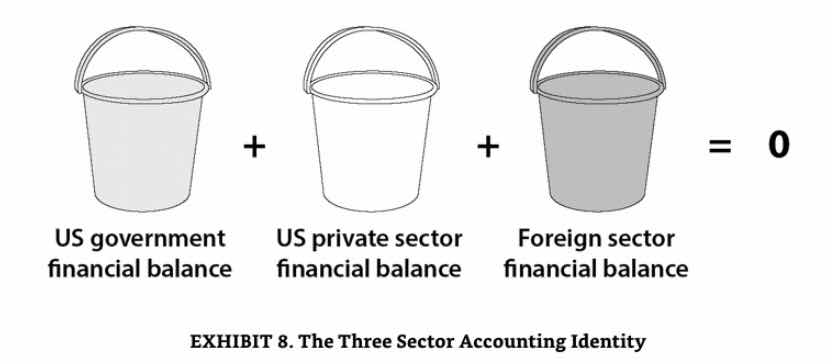
One way to think about trade imbalances is to add a third bucket to the model we used in the last chapter. Previously, we put Uncle Sam in one bucket and everyone else in the other. Whenever Uncle Sam spent dollars, there was only one place for them to go—into a collective bucket we called the nongovernment sector. That was a perfectly reasonable way to illustrate the fact that Uncle Sam’s deficits poured dollars into “our” bucket. Now it’s time to look more closely at the nongovernment bucket. Since this chapter is about international trade, we want to see how dollars flow between the US economy and the rest of the world. To do that, we need to split the nongovernment bucket into two separate buckets. When we do this, we end up with a three-bucket model. We still have the US-government bucket, but now we have a bucket that belongs to all US households and businesses (i.e., the domestic private sector bucket), along with one that belongs to the rest of the world (i.e., the foreign sector bucket). As before, it’s impossible for all of the buckets to be in surplus (or deficit) at the same time. If there’s red ink in one bucket, there must be black ink in at least one other bucket. As Godley told me, “Everything must come from somewhere, and then go somewhere.” For every payment that flows out of one bucket, a payment of equal size must be received into at least one other bucket. As a matter of accounting, that means that the balance across all three buckets must always sum to zero. Exhibit 8 captures these relations.
EXHIBIT 8. The Three Sector Accounting Identity
In the real world, dollars flow among the three buckets every day. If the US government buys some bulldozers from Caterpillar Inc. and hires some American workers to build a bridge, dollars will flow into the US private sector bucket as the government makes those payments. American workers and (most) US businesses also pay federal taxes, so Uncle Sam subtracts some of those dollars away from the private sector bucket. To keep it simple, suppose, as before, that Uncle Sam spends $ 100 and taxes $ 90 away, leaving behind a surplus of $ 10 in the private sector bucket. Those dollars can spin around in the US private sector, changing hands as Americans pay for haircuts, theater tickets, and college tuition. They can also switch buckets, as Americans import products from abroad. Let’s say Americans spend $ 5 buying goods and services from the rest of the world, while foreigners spend just $ 3 buying products from the United States. By importing more than it exports, the US is running a trade deficit. When all is said and done, the US trade deficit transfers $ 2 into the foreign sector bucket. Exhibit 9 nets all these payments out, showing that the US government’s fiscal deficit (minus $ 10) is exactly balanced by the sum of the surpluses in the other two buckets ($ 8 plus $ 2). As long as the US economy remains at full employment, there is no inherent problem with this outcome.
EXHIBIT 9. US Fiscal Deficit Plus US Trade Deficit (Twin Deficits) Since Uncle Sam is the issuer of the dollar, he never has to worry about running low. His bucket can manufacture dollars at will. But everyone else has to get the currency from somewhere. And the US
private sector normally wants to accumulate more dollars than it spends—that is, to be in surplus. That’s not to say that the private sector can’t fall into deficit. It can, as it did during the late 1990s and early 2000s. But as Godley warned, that’s usually an unsustainable situation because it often involves the private sector taking on too much debt. 8 (Remember, the private sector isn’t a currency issuer, so it can’t sustain deficits the way Uncle Sam can.) To keep the US private sector from falling into deficit, someone needs to supply that bucket with enough dollars to keep it in surplus. Right now, that “someone” is Uncle Sam. That’s because the US runs persistent trade deficits (aka “stuff ” surpluses), which cause dollars to flow out of the private sector’s bucket and into the foreign bucket. As long as that remains the case, only Uncle Sam can supply enough dollars to keep the private sector in surplus. To do that, the government must run budget deficits that exceed the US trade deficit. 9 Exhibit 10 shows what happens if the government deficit becomes smaller than the trade deficit.
EXHIBIT 10. US Fiscal Deficit Smaller Than US Trade Deficit
In this example, the government has almost balanced its budget. But not quite. Uncle Sam is running a small deficit, spending $ 100 into the US economy and taxing $ 99 back out. 10 As a result, his deficit adds just $ 1 to the US private sector bucket. But the US is sending that dollar—and four more—on to the rest of the world. And foreigners are only sending $ 3 back. So the US is running a trade deficit, spending $ 5 on goods and services produced by the rest of the world but only collecting $ 3 for the things it sells abroad. Looking at all of these payments, the foreign sector accumulates a $ 2 surplus, while the government and the private sector each end up with a $ 1 deficit. A private sector deficit is the inevitable consequence of allowing the government deficit to fall below the trade deficit. What would it take to return the private sector to its usual state of surplus? One option is for Uncle Sam to add more dollars to the private sector’s bucket, either by spending more dollars into the US economy or taxing fewer dollars away. As soon as the government deficit gets bigger than the trade deficit, the private sector’s financial balance will move back into surplus. Another way to
eliminate the private sector’s deficit is to try to shrink (or reverse) the trade deficit. There are a number of ways to try to do this. Sometimes, countries try to hold down the value of their currencies to make their goods more competitive on world markets. President Trump has routinely lashed out at China, accusing the Chinese government of manipulating its currency, the yuan, to gain an advantage over US producers. In December 2019, he accused Brazil and Argentina of “presiding over a massive devaluation of their currencies,
which is not good for our farmers.” 11 Some countries don’t have the option to weaken their
currencies. Nineteen countries in Europe, for example, have formed a currency union (the Economic and Monetary Union or EMU), making it impossible to alter the value of their currencies vis-à-vis one another (one euro equals one euro throughout the eurozone). When an external (i.e., currency) devaluation isn’t an option, countries often pursue internal devaluation as a way to try to “win” at trade. The neoliberal term of art for this particular strategy is structural reform. It’s the polite way of describing an agenda aimed at driving down labor costs (wages and pensions) to increase competitiveness by reducing the costs of production. Essentially, it means that a country uses weaker labor as a substitute for a
weaker currency. When it comes to this strategy, Germany is Europe’s poster child. After the German government committed to this strategy in the early 2000s, it was able to replace its long-standing trade deficits with massive trade surpluses. 12 The thinking behind Trump’s policy was to use tariffs (i.e., taxes on imports) to reduce the US trade deficit. By making certain foreign goods more expensive, Trump believes he is pursuing an America First strategy that will result in American consumers buying fewer imports and spending more money buying domestically produced goods. That would mean fewer dollars leaving the US private sector bucket and flowing into the foreign bucket. Trump sees that as “winning” because his entire worldview is shaped by cash flows. The one with the biggest bucket of money wins. MMT recognizes the importance of maintaining healthy financial balances but views the tariffs as largely counterproductive. That’s because MMT recognizes that imports are real benefits. Viewed this way, Trump’s tariffs are really a tax on US benefits. There are better ways to maintain a healthy balance in the private sector and, as we’ll see, better ways to protect American jobs. ーーーー No Full Employment, No Fair Trade Now that we understand the simple financial flows, we can return to thinking about the human and economic impacts of trade. Too often, the US doesn’t just lose dollars to the rest of the world, it loses jobs, too. As we discussed above, most of the angst people feel when they think about US trade deficits appears to stem from pain—especially the pain that comes from unemployment as American businesses close up shop and ship jobs overseas. As MMT economist Pavlina Tcherneva has documented, unemployment resembles an epidemic: like a virus, it affects other people nearby, resulting not only in lost income but higher mortality and suicide rates and a permanent decline in well-being. 13 But it’s easier to blame immigrant workers, foreign currency manipulators, or even global technology than to come to terms with the fact that joblessness is an official policy in the United States. I have argued that one of the best answers to, “They took our jobs!” is, “Everyone gets a job!” The MMT solution to involuntary unemployment is to introduce a federal job guarantee that establishes a legal right to a good job at good wages with good benefits. This would address one of the most pernicious effects stemming from trade—the unemployment that is too often visited upon whole communities as jobs are lost to foreign competition. It’s not enough just to provide training and other temporary forms of assistance to workers whose jobs are lost to foreign competition. Federal programs like Trade Adjustment Assistance (TAA) 14 are important, but something more is needed. That something is a federal job guarantee. By no means is it a panacea, but at a minimum, it begins to tackle the problem of unemployment directly (as opposed to subsidizing the effects of unemployment). Through the thick and thin of the
business cycle, we leave tens of millions of Americans idle in the belief that this makes political, economic, and social sense. Consider the closure of the Harley-Davidson manufacturing facility in Kansas City, Missouri, the city in which I taught for seventeen years. The company’s eight hundred workers were left stunned by the announcement that ultimately resulted in a net loss of 350 jobs. 15 The timing was particularly pernicious,
coming as it did against the backdrop of a dividend increase for shareholders and an announcement that the company would spend millions buying back up to fifteen million shares of its own stock. Had a federal job guarantee program been in place, it would have mitigated the impact of the closure. At a minimum, it would have provided the workers whose jobs were lost with a way to remain employed right in their communities. But it would have done more than that.
The benefits of a federal job guarantee not only include the production of goods, services, and income. The guarantee also features on-the-job training and skill development; poverty alleviation; community building and social networking; social, political, and economic stability; and social multipliers (positive feedback loops and reinforcing dynamics that create a virtuous cycle of socioeconomic benefits). With a program like this in place, the government would have mitigated the localized devastation of communities that directly experienced the loss of well-paying US industrial jobs. It may be hard to imagine an economy that doesn’t allow millions to fall by the wayside. But that’s because America has almost never achieved anything like true full employment. It’s something we’ve rarely experienced, outside of wartime. One of the most important features of a job guarantee program is that it maintains a form of full employment by immediately rehiring the unemployed into public service work, providing them with income and the retraining required when they are displaced by trade shocks. In this way, the job guarantee can serve as the core of a response to both “free trade” and the “trade war.” With a job guarantee, free trade is no longer a threat to full employment, and trade wars are no longer necessary to prevent unemployment. Trade negotiations can then focus on labor standards and environmental sustainability, with the US using its market power to promote acceptable working conditions and environment standards worldwide. 16 Today, Chinese firms sell American households many environmentally unfriendly products. In addition, people all over the world currently endure unsafe and unsanitary working conditions in order to provide America its stuff surplus. If we want to prioritize the well-being of workers worldwide, communities, and the planet as a whole, then we need a new approach to global trade. Especially in an era of global climate crisis, we should not be suckered by the simplistic rhetoric of countries “winning” and “losing” at trade. The quality of trade is at least as important as the quantity of trade. What ends and whose interests are our trade relationships serving? Just like with fiscal policy, the big scary number that is the trade deficit is not worthy of so much attention. As MMT reminds us, real resources, real social needs, and real environmental benefits are what matters most when it comes to trade policy. At this point, it’s important to understand a bit more about our trading partners around the world—and the United States’ special privileges compared to other countries. So far, we’ve discussed how global trade affects the United States and how MMT can make the trade flows into and out of our own country more productive and humane. But what about Britain, France, Saudi Arabia, Turkey, Venezuela, and all the other nations out there?
The Special Position of the US Dollar
Since the 1970s, there has been a fundamental shift in the way our monetary system operates. This shift redefines how we should think about macroeconomics and the role of a national
government that issues its own currency. Unfortunately, on the question of trade, as in so many other matters, policy makers remain locked in an anachronistic framework that belongs to the bygone gold standard era. From the middle of the nineteenth century until the Nixon “gold shock” that ended US dollar convertibility in the early 1970s, the gold standard (in one form or another) served as the common monetary framework regulating domestic economies and trade between them. Although the framework’s restrictions were gradually loosened, the overriding principle remained the same: in all countries, the monetary authority effectively tethered the value of its currency to gold by standing ready to buy or sell gold (or US dollars) to meet any supply or demand imbalance arising from international trade. To carry out these interventions, the central bank (or equivalent in those days) had to maintain enough gold (or US dollars) to back the circulating currency at a fixed exchange rate. A gold standard is only credible if the government can make good on its promise to convert the currency into gold at a fixed price. Having enough gold was critical. And running a trade surplus was the surest way to build up a country’s gold reserves. Conversely, trade deficits led to an outflow of gold, since countries used gold to pay for their imports. To try to prevent the loss of gold reserves, interest rates were frequently raised to draw the flow of gold bullion back into the country. The idea is that
for everyone who wants to work? Do people have the health care and education they need? Can our seniors enjoy a dignified retirement? Does every child have enough food, clean drinking water, and a safe place to live? Are we doing everything we can to keep our planet habitable? In short, are we tending to the deficits that matter? MMT teaches us that if we have the real resources we need—that is, if we have the building materials to fix our infrastructure, if we have people who want to become doctors, nurses, and teachers, if we can grow all the food we need—then the money can always be made available to accomplish our goals. That is the beauty of a sovereign currency. Contrary to Margaret Thatcher’s dictum, there is public money, and we should not be wary of embracing it. As former Fed chair Alan Greenspan testified, “There’s nothing to prevent the federal government from creating as much money as it wants and paying it to someone.” His successor, Ben Bernanke, went further, describing how the government actually pays its bills: “It’s not taxpayer money. We simply use the computer to mark up the size of the account.” These are paradigm-shifting observations that should liberate us from the age-old question, How will we pay for it? The truth is, the federal government is already paying all of its bills using nothing more than a keyboard at the New York Federal Reserve. Taxes subtract spending power from the rest of us, but they don’t pay the bills. It’s high time we come to grips with what it means to live in a country where the government is the currency monopolist. No US president should ever again claim that the government has “run out of money,” and no reporter should ever let such a claim go unchallenged. We all deserve to know the truth: a currency-issuing government can afford to buy whatever is for sale in its own unit of account. Uncle Sam’s pockets are never empty. The government’s spending capacity is infinite, but our economy’s productive capacity isn’t. There are limits to what we can and should do. MMT urges us to respect our material and ecological constraints and to ask, How will we resource it? Budgeting through an MMT lens would have us replace the artificial budget constraint that tells us to live within our financial means with inflation constraint that tells us to live within our biological and material means. As we’ve learned, every economy has its own internal speed limit. There is only so much demand that can be placed on our material resources—our workers, factories, machinery, and raw materials—before we push things too far. Once an economy reaches its full employment potential, any additional spending—whether it comes from the government, the domestic private sector (US households and businesses), or the rest of the world (foreign demand for our exports)—carries inflation risk. The good news is that because we chronically run our economy below its maximum speed limit, there’s almost always room to rev up spending without risking an acceleration in inflation. And that’s what matters. There was a time when our political leaders had this figured out. For example, President John F. Kennedy sought the expertise of Nobel Prize–winning economist James Tobin, who served as an adviser to Kennedy’s 1960 presidential campaign and then as a member of the president’s Council of Economic Advisers. Tobin recalls JFK asking, “Is there any limit to the deficit? I know of course about the political limits.… But is there any economic limit?” When Tobin confessed that “the only limit is really inflation,” the president replied, “That’s right, isn’t it? The deficit can be any size, the debt can be any size, provided they don’t cause inflation. Everything else is just talk.” 45
45. Council of Economic Advisers: Walter Heller, Kermit Gordon, James Tobin, Gardner Ackley, and Paul Samuelson, recorded interview by Joseph Pechman, August 1, 1964, John F. Kennedy Library Oral History Program, www.jfklibrary.org/ sites/ default/ files/ archives/ JFKOH/ Council% 20of% 20Economic% 20Advisers/ JFKOH-CEA-01/ JFKOH-CEA-01-TR.pdf.
Kennedy’s intuition was right. It’s not the size of the debt or deficit that matters. It’s the strain we place on our planet and our productive resources that matters. On May 25, 1961, President Kennedy delivered his moon-shot speech before a joint session of Congress. Before requesting a single dime to fund his ambitious space exploration program, Kennedy assured Congress:
I believe we possess all the resources and talents necessary. But the facts of the matter are that we have never made the national decisions or marshaled the national resources required for such leadership. We have never specified long-range goals on an urgent time schedule, or managed our resources and our time so as to insure their fulfillment. 46
Kennedy got it exactly right. Our material resources are scarce and must be managed. Time is
the ultimate scarce resource. No one can squeeze more than twenty-four hours from a day. Human ingenuity is constrained by our existing technological knowledge and capabilities. Our technical capabilities and our material resources are the only things that can limit our possibilities. JFK understood that America would need to develop new technologies to carry out his ambitious space exploration program. Landing a man on the moon and bringing him safely back to earth would require substantial funding to facilitate scientific research and the development of new technologies. Kennedy told Congress that no part of his space exploration program “will be so difficult or so expensive.” And then he asked Congress—and the American people—to support the mission. Let it be clear—and this is a judgment which the Members of the Congress must finally make—let it be clear that I am asking the Congress and the country to accept a firm commitment to a new course of action, a course which will last for many years and carry very heavy costs: 531 million dollars in fiscal ’62—an estimated 7 to 9 billion dollars additional over the next five years. Kennedy made no reference to taxes or taxpayers in his moon-shot speech. To fund the program, he simply asked “the Space Committees of the Congress, and the Appropriating Committees, that you will consider the matter carefully.” He knew that Congress had the power to increase the discretionary budget to provide the billions of dollars he was requesting. Consistent with the teachings of MMT, Kennedy showed that finding the money was the easy part. The real challenge would come later, as Kennedy explained: This decision demands a major national commitment of scientific and technical manpower, material and facilities, and the possibility of their diversion from other important activities where they are already thinly spread. It means a degree of dedication, organization and discipline which have not always characterized our research and development efforts. It means we cannot afford undue work stoppages, inflated costs of material or talent, wasteful interagency rivalries, or a high turnover of key personnel. To pull off his ambitious agenda, the government would need to command more of the economy’s real resources—more scientists and engineers, more contractors and civil servants, more satellites and spacecraft and fuel boosters, and so on. Even though the official unemployment rate stood at 7.1 percent when JFK delivered his famous speech, Kennedy understood that the moon shot might require the government to compete for high-skilled labor and other real resources. To manage the inflation risk, his administration pressured unions and private industry, urging them to keep wage and price increases to a minimum to avoid driving inflation higher. It worked. The economy grew, unemployment fell sharply, and inflation remained below 1.5 percent for the first half of the decade. 47 Eight years after that famous speech, NASA’s Apollo 11 mission safely landed the first human beings on the moon. Today, almost all of us benefit in one way or another from that historic endeavor. As the economist Mariana Mazzucato put it, “the launching of Sputnik in 1957 by the Soviets led to an eruption of panic among US policy makers.” 48 That panic gave rise to a space race that paved the way for the development of many of the things we now take for granted. The personal computer as well as “much of the technology in our smart phones today can be traced back to the Apollo program and related missions.” 49 Can You Imagine a People’s Economy? The challenges we face today are very different from those faced by Kennedy nearly sixty years ago, but no less daunting and surely far more important. To avoid global catastrophe, we need to limit the impacts of climate change and adapt to the degree of warming that is already inevitable. To do this, governments must make investments, in the US and elsewhere, that will dwarf in scale and duration the massive commitment of real resources required for the space program.
It is not melodramatic to regard our immediate future as a fight for survival, and in that sense the right analogy is World War II. In his important book, How to Pay for the War, John Maynard Keynes explained what Kennedy later understood: Coming up with the money is the easy part. The real challenge lies in managing your available resources—labor, equipment, technology, natural resources, and so on—so that inflation does not accelerate. If Kennedy had used the wrong lens, America might never have gone to the moon. If Keynes had used the wrong lens, the British war effort may very well have been too little too late. If our generation continues to use the wrong lens, we will not make the right investments at the scale and pace needed to avert ever-greater social and ecological crises. The good news is that we now have the right lens, and that lens is MMT. A just and more prosperous world—one that combines ecological sustainability with full employment, human well-being, a lower degree of inequality, and excellent public services that meet the needs of all—is within reach. As we collectively expand our understanding of public money and shift our nation’s focus away from an obsession with budget deficits, we can begin to build a better economy, one that works for all of our people. Human imagination is incredibly powerful. Transformational moments in human history have come about when someone or some group of people were able to imagine a world that the rest of us couldn’t see. In many cases, such as with our previous example of Copernicus, the shift was simply one of perspective, but once the shift came, it spawned an explosion of new discoveries and advances. MMT is in one sense a very simple way of seeing the big picture of modern economies from a different perspective, but we should not underestimate the profound change a simple shift in perspective can have. We have let our imaginations become far too limited, and it is holding us back. We have been too restrictive in public policy out of unwarranted fears about numbers recorded in government agency spreadsheets. We have held back progress in science, fought unnecessary wars, kept living standards too low, and lived with less beauty than we could have enjoyed. Austerity is a failure of imagination—a failure to imagine how we can simultaneously improve living standards, invest in our nation’s future, maintain a healthy economy, and manage inflation. Trade wars are a failure of imagination—a failure to imagine how we can simultaneously maintain domestic full employment, help poorer nations sustainably develop, lower our global carbon impact, and continue to enjoy the benefits from trade. Ecological exploitation is a failure of imagination—a failure to imagine how we can simultaneously improve living standards, maintain a prosperous economy, and transition human activity so that we are protecting people and the planet. MMT provides a profound tool kit for all countries to begin to reimagine how they can care for their local populations, preserve treasured cultural identities, rejuvenate unique ecosystems, redevelop sustainable and local agriculture, increase productive capacity, and encourage innovation. Let’s look at one example of how MMT can help us find alternative approaches to improving real outcomes. One of the main challenges facing policy makers in the US and around the world is the transition to sustainable and zero carbon energy production. The transition of our nation’s electric infrastructure has begun, but there is a long way to go to scale up renewable energy, energy storage, and other technologies to replace fossil fuels as the primary means of electricity production. Under the old paradigm, the policy debate is often based on either government mandates or market incentives. A government mandate requiring power companies to generate cleaner forms of electricity could leave ratepayers (households and businesses) saddled with the extra costs. Though market incentives, such as giving tax credits to companies who develop more sustainable energy generation, can potentially stimulate a build-out of alternative energy sources, they can also slow adoption as developers wait for optimal economic conditions. As a result, utilities might wait longer before retiring existing coal plants. How might an MMT-led approach introduce new options into the mix? One possibility might be that the federal government could allow electric utilities to sell to the government at book value any high-emission generator, no matter its age, in order to remove those costs from rates—a bit like the “cash for clunkers” program (Car Allowance Rebate System), which encouraged US residents to trade in their old, less-fuel-efficient vehicles for more-fuel-efficient ones, but aimed at grid decarbonization.
This would free up private capital for a rapid transition to renewable energy and avoid burdening households and businesses with higher costs for electricity due to a change in public policy. The federal government could go further and increase funding for research and development and scaled-up deployment of energy storage technologies. The US could have the lowest electricity costs in the world while rapidly transitioning to 100 percent renewable energy. That’s good for businesses, the environment, and households. And it’s financially affordable for the government. Note that in this example, the government is not taking over but rather is facilitating a public policy outcome via private sector energy markets. There are, of course, many other options. What’s important here is not whether this example is a good idea or not, but that we begin to imagine how the government’s fiscal capacity can help deploy real resources effectively to achieve a clear public policy objective. As we rethink the kind of health care, education, urban planning, scientific research, agriculture, and housing we need for our future, how might our knowledge of MMT shift our focus to the real resources we need and suggest ways where a change in fiscal policy can help? Can you imagine an economy where private enterprise and public investment all combine to raise living standards for everyone? Can you imagine an economy where every rural and urban community has sufficient health, education, and transportation services to meet the needs of the local population? Can you imagine an economy that can measure and continually improve human well-being, not just gross domestic product? Can you imagine an economy where human activity rejuvenates and enriches all ecosystems? Can you imagine an economy where nations trade in ways that enhance living standards and environmental conditions for all parties? Can you imagine an economy comprising of a strong middle class with service-and labor-based occupations that have good wages and benefits? Can you imagine an economy where all are ensured a carefree retirement, with all their food, housing, and health-care needs met? Can you imagine an economy where all manner of research is fully funded, with a steady stream of successful ideas commercialized or rolled out to serve the public? In the United States, where we have an abundance of resources and labor, there is no reason we cannot embark on a policy agenda that results in provisioning our entire population with quality health services, providing each worker with adequate and appropriate advanced education and job training, upgrading our infrastructure to meet the demands of a low-carbon world, and ensuring adequate housing for everyone while redesigning our cities to be clean, beautiful, and nurturing of community spirit. We can be a global force for good, leading the way in decarbonization, providing assistance to countries with real needs, while ensuring our domestic economy thrives and no communities, from small towns to urban neighborhoods, are left behind. With the knowledge of how we can pay for it, it’s now in your hands to imagine and to help build the people’s economy.
REALITY: For evidence of overspending, look to inflation.
In 2015, I took a leave of absence from my job teaching economics at the University of Missouri–Kansas City and moved to Washington, DC, to serve as the chief economist for the Democrats on the US Senate Budget Committee. I thought it would be interesting to step outside the academic world, where anything is theoretically possible, and into the sausage factory, where budgets are formulated and spending decisions impact the lives of real people. I’m not sure exactly what I expected to find, but what I discovered was incredibly disheartening. None of the senators who sit on the powerful Budget Committee seemed to realize that the federal budget didn’t work like a household budget. The top Republican on the committee was its chairman, Senator Mike Enzi from Wyoming. Enzi had a background in accounting and had run a shoe-sale business before getting involved in politics. He spent a decade as a state legislator, serving in Wyoming’s house of representatives as well as its state senate. In all of these jobs, he operated under a constrained budget. As a businessman, he had to control costs, meet payroll, and turn a profit to remain viable. As a member of the Wyoming legislature, he operated in an environment where the governor is constitutionally required to submit a balanced budget each year. Before coming to Washington, he had only seen the world through the lens of a currency user. The committee held regular hearings on budget-related matters, and I typically sat close behind Senator Enzi and the ranking Democratic member of the committee, Senator Bernie Sanders, who had hired me for the job. At the start of each hearing, the chairman would read aloud several minutes of prepared remarks. Senator Enzi’s comments never changed much. He looked at the federal budget as if it was an income statement for his shoe-sale business. To him, the problem was obvious. Uncle Sam was operating at a loss. Deficits and debt had become a way of life, and the whole thing was just plain irresponsible. You didn’t need an accounting degree (like Senator Enzi) to see the problem. Time and again he would simplify the situation by declaring, “Deficits are evidence of overspending!” The economist in me wanted to leap from my chair. The chief economist in me was forced to sit quietly and hope that one of the other twenty-one senators on the committee had a background in economics. As we teach our first-year students, excessive spending manifests as inflation. A deficit is only evidence of overspending if it sparks inflation. Since prices weren’t accelerating, the deficit couldn’t possibly be too big. To my great disappointment, none of the other senators challenged Enzi’s claim. They were all using the same flawed lens and commenting on the need to match spending with receipts. Republicans saw too much on the expenditure side of the ledger—a spending problem. Democrats saw too little on the income side—a revenue problem. Everyone was convinced the deficit was too big. The argument was about whether to cut spending to match revenue or increase revenue to match spending. Kitchen-table budgeting. What were they missing? Three big things.
across the country are tightening their belts and making tough decisions. The federal government should do the same. —PRESIDENT OBAMA, STATE OF THE UNION ADDRESS, 2010
MYTH #1: The federal government should budget like a household.
REALITY: Unlike a household, the federal government issues the currency it spends.
Like many of you, I grew up watching the television show Sesame Street. One of the skills it helped young kids develop was the ability to sort objects according to their similarities and differences. “One of these things is not like the other one,” the song began as this segment of the show started. Four images appeared in a matrix on the screen: a banana, an orange, a pineapple, and a sandwich. “The sandwich! The sandwich!” my sister and I would holler back at the TV set. I’m no longer a kid, but I still find myself hollering back at the TV whenever I hear someone talk about the federal government’s budget as if it were no different from a household budget. If you’ve heard someone complain that Washington needs to get its fiscal house in order, you’ve heard a version of the household myth. It derives from the flawed idea that we should look at Uncle Sam’s budget through the same lens we use to manage our own family budgets. Of all the myths we’re going to explore in the pages ahead, this is undoubtedly the most pernicious. It’s a favorite among politicians, who tend to look for the simplest possible rhetoric to connect with their constituents. And what could be easier than describing the government’s finances in terms the rest of us already understand—our own. We all know it’s important to keep our personal spending in line with our overall income. So, when we hear someone come along and talk about government finances in ways that remind us of our own, it hits home. It’s got a folksy, kitchen-table feel to it. We’ve all seen it done. In campaign ads and town halls across America, politicians point to the small businessman or the hardworking waitress, holding them up as shining examples of what responsible budgeting looks like. They empathize with the struggles of everyday Americans, reminding us that we all know what it’s like to sit around the kitchen table and balance the family checkbook. Then, in the hope of drawing outrage from the crowd, they shift the conversation to the federal government, telling us that Uncle Sam’s books almost never balance because irresponsible spending has become a way of life in Washington, DC. Stories like these resonate with us because the language is so familiar. We know that we’re supposed to live within our means and arrange our finances so that we aren’t spending more than we bring in. We know we need to set aside some savings for the future and that we should be extra careful when it comes to borrowing money. Taking on too much debt can lead to bankruptcy, foreclosure, and even incarceration. We know people can go broke, and we’ve seen iconic companies like RadioShack and Toys “R” Us get driven into bankruptcy when they could no longer afford to pay the bills. Even cities (Detroit) and states (Kansas) can run into big trouble when they’re not bringing in enough money to cover their
expenses. Every family sitting around the kitchen table understands these realities. What they don’t understand is why the federal government (Uncle Sam) is different. To understand why, we go right to the heart of MMT. Issuers Versus Users of Currency MMT takes as its starting point a simple and incontrovertible fact: our national currency, the US dollar, comes from the US government, and it can’t come from anywhere else—at least not legally. Both the US Treasury and its fiscal agent, the Federal Reserve, have the authority to issue the US dollar. This might involve minting the coins in your pocket, printing up the bills in your wallet, or creating digital dollars known as reserves that exist only as electronic entries on bank balance sheets. The Treasury manufactures the coins, and the Federal Reserve creates the rest. Once you appreciate the significance of this reality, you will be able to unravel many of the deficit myths on your own. Even though you may not have given it much thought before, something inside you probably already understands this basic truth. I mean, think about it. Can you create US dollars? Sure, you can earn them, but can you manufacture them? Maybe with high-tech engraving equipment you could set up shop in your basement and produce something that looks very much like the US dollar. Or maybe you could hack into the computer at the Federal Reserve and type up some digital dollars. But we both know you’ll end up in an orange jumpsuit if you get caught trying to counterfeit the currency. That’s because the US Constitution grants the federal government the exclusive right to issue the currency. 1 As the Federal Reserve Bank of St. Louis put it, the US government is “the sole manufacturer of dollars.” 2 The term monopoly refers, of course, to a market in which there is only one supplier of some product. Since the federal government is the sole manufacturer of US dollars, we can think of it as having a monopoly over the dollar itself. It’s kind of like a being given a super copyright (one that never expires) over the ability to make additional copies of the dollar. It’s an exclusive power, articulated by our founders. It’s not something households, businesses, or state and local governments can do. Only the federal government can issue our currency. Everyone else is merely a currency user. It’s a special power that must be exercised with great care. Going back to Sesame Street, we can easily identify which of the things in Exhibit 1 is not like the others.
EXHIBIT 1. Currency Users Versus Issuers
The distinction between currency users and the currency issuer lies at the heart of MMT. And as we will see in the pages ahead, it has profound implications for some of the most important policy debates
of our time, such as health care, climate change, Social Security, international trade, and inequality. To take full advantage of the special powers that accrue to the currency issuer, countries need to do more than just grant themselves the exclusive right to issue the currency. It’s also important that they don’t promise to convert their currency into something they could run out of (e.g., gold or some other country’s currency). And they need to refrain from borrowing (i.e., taking on debt) in a currency that isn’t their own. 3 When a country issues its own nonconvertible (fiat) currency and only borrows in its own currency, that country has attained monetary sovereignty. 4 Countries with monetary sovereignty, then, don’t have to manage their budgets as a household would. They can use their currency-issuing capacity to pursue policies aimed at maintaining a full employment economy. Sometimes, people ask me whether MMT applies to countries outside the United States. It does! Even though the US dollar is considered special because of its status as the global reserve currency, lots of other countries have the power to make their monetary systems work for their people. So, if you’re reading this book outside the USA, don’t assume there are no important lessons here for you and your country. On the contrary, MMT can be used to describe and improve the policy choices available to any country with a high degree of monetary sovereignty—the US, Japan, the UK, Australia, Canada, and many more. And, as we’ll see in Chapter 5, MMT also offers insights for countries with little or no monetary sovereignty—nations like Panama, Tunisia, Greece, Venezuela, and many more. MMT helps us to see why countries that fix their exchange rates, like Argentina did until 2001, or that take on debt denominated in a foreign currency, like Venezuela has done, undermine their monetary sovereignty and subject themselves to the kinds of constraints faced by other currency users, such as Italy, Greece, and other eurozone countries. When countries with little or no monetary sovereignty fail to prioritize budget discipline, they can face unsustainable debts just like a household. In contrast, the United States never has to worry about running out of money. It can always pay the bills, even the big ones. The US can’t end up like Greece, which gave up its monetary sovereignty when it stopped issuing the drachma in order to use the euro. America is not dependent on China (or anyone else) for financing. Most importantly, having monetary sovereignty means that a country can prioritize the security and well-being of its people without needing to worry about how to pay for it.
Thatcher’s Backward Dictum: (TAB) S
In a now-famous speech from 1983, British prime minister Margaret Thatcher declared that “the state has no source of money, other than the money people earn themselves. If the state wishes to spend more it can only do so by borrowing your savings or by taxing you more.” 5 This was Thatcher’s way of saying that the government’s finances were constrained in the same way our personal finances are constrained. In order to spend more, the government would need to raise the money. “We know that there is no such thing as public money,” she added. “There is only taxpayer money.” If the British people wanted more from their government, they would have to foot the bill. Was it an innocent mistake or a carefully crafted statement designed to discourage the British people from demanding more from their government? I’m not sure. Regardless of her motives, Thatcher’s remarks concealed the currency-issuing power of the state. More than three decades later, political leaders in currency-issuing nations like the UK and the US still talk as though we, the taxpayers, are the ultimate source of the government’s money. As former British prime minister Theresa May put it more recently, the government doesn’t have a “magic money tree.” 6 Unless they take more of our money, we’re told, the government can’t afford to top up spending on existing programs much less fund ambitious new projects. To most of us, the idea that the government must tax more to spend more probably sounds reasonable. And our politicians know it. They also know that most of us don’t want to see our taxes go up, so they twist themselves into knots, trying to figure out how to win votes by vowing to do big things without asking the majority of us to pay more. For example, Donald Trump promised the American people that Mexico would pay for his border wall, while Democrats have insisted that billionaires and Wall Street banks can foot the bill for many of their ambitious programs. The money has to come from
somewhere, right? Actually, we’ve got it backward. But before we get to that, let’s walk through the conventional understanding so it will be easier to contrast this backward thinking with the way things actually work. Recall that the finances we understand best are our own, and we know that we need to come up with money before we can spend. So, the idea that the federal government must collect funds in order to spend seems intuitively correct. Extrapolating from our own experiences, we know that we can’t walk out of the department store with a new pair of shoes or drive away from the car dealership in a sporty new vehicle unless we come up with the financing first. According to conventional thinking, the government relies on two sources of funding: it can raise your taxes, or it can borrow your savings. Taxes allow the government to collect money from people who have it, which means taxes are looked upon as a way to transfer money to the federal government. If the government wants to spend more than it collects by taxing, it can raise additional funds by borrowing from savers. In either case, the idea is that the government must come up with the money before it can spend. That’s how most of us have been taught to understand the government’s fiscal operations. Taxing and borrowing come first. Spending comes last. A handy mnemonic for the conventional way of thinking is (TAB) S: taxing and borrowing precede spending. Because we’ve been trained to believe that, like each of us, the government must “find the money” before it can spend, everyone becomes obsessed with the question: How are you going to pay for it? We’ve been conditioned to expect our elected officials to offer a blueprint that maps out the source of every new dollar they wish to spend. Even the most progressive candidates fear that they’ll be eaten alive if their proposals add to the deficit, so borrowing is almost never an option. To show that their policies won’t add to the deficit, they hunt for ways to squeeze more tax revenue out of the economy, usually targeting those who can most easily afford to pay more. For example, Senator Bernie Sanders insists that a financial transactions tax will cover the cost of making public colleges and universities tuition-free, and Senator Elizabeth Warren claims that a 2 percent tax on fortunes above $ 50 million would raise enough revenue to wipe out student debt for 95 percent of students and also pay for universal childcare and free college. In both cases, the goal is to demonstrate that everything can be paid for by taxing the richest people in America. As we’ll see in the pages ahead, there’s often room to fund new programs without the need for higher taxes. Adding to the deficit shouldn’t be looked upon as a taboo. Taxes are critically important, but there’s no reason to assume the government must raise taxes whenever it wants to invest in our economy. In practice, the federal government almost never collects enough taxes to offset all of its spending. Deficit spending is the norm, and everyone in Washington, DC, knows it. And so do voters. That’s why so many politicians complain that Congress needs to get its fiscal house in order before it’s too late. To demonstrate their commitment to good, old-fashioned household budgeting, the Democrats, led by Speaker Nancy Pelosi (D-CA) reinstated a budget rule known as pay as you go (PAYGO) in 2018. With PAYGO in place, borrowing to finance new expenditures is technically off limits. That reduces (TAB) S to just tax and spend (T) S, so lawmakers face intense pressure to cover any proposed new spending with revenue from new taxes. 7 Is this a good political strategy? Is it good economics? It certainly sounds like a wholesome approach to budgeting. But it’s rooted in a flawed understanding of how the federal government actually spends. In fact, it gets everything backward.
How the Currency Issuer Spends: S( TAB)
Because it’s the dominant way of thinking, most of us probably carry a version of the (TAB) S model in our minds. Even if we have never spent a moment of our time thinking about the inner workings of the federal budget, we probably believe that the government needs our money to help pay the bills. We might even feel a bit patriotic about the check we send off to the Internal Revenue Service (IRS) every April, proud to have done our small part in building low-income housing, paying our men and women in uniform, and supporting our farmers with generous subsidies. I hate to be the bearer of uncomfortable
news, but that’s not what’s actually happening. If you’re not already doing so, you should probably sit down. Are you ready? Your taxes don’t actually pay for anything, at least not at the federal level. The government doesn’t need our money. We need their money. We’ve got the whole thing backward! When I first encountered this way of understanding how taxing and spending work in actual practice, I recoiled. It was 1997, and I was midway through a PhD program in economics when someone shared a little book called Soft Currency Economics with me. 8 The book’s author, Warren Mosler, was a successful Wall Street investor, not an economist, and his book was about how the economics profession was getting almost everything wrong. I read it, and I wasn’t convinced. According to Mosler, the government spends first and then taxes or borrows. That sequencing turns Thatcher’s dictum completely around, reordering the mnemonic to give us S( TAB): spending before taxing and borrowing. By Mosler’s reasoning, the government doesn’t go around looking for someone else to pick up the TAB, it just spends its currency into existence. Warren saw things that most economists were missing. To many of us, his ideas initially sounded completely original, but most weren’t. They were only new to us. It turns out they could be found (and we found them) in canonical texts, like Adam Smith’s Wealth of Nations or in John Maynard Keynes’s two-volume classic, A Treatise on Money. Anthropologists, sociologists, philosophers, and others had long ago arrived at similar conclusions about the nature of money and the role of taxes, but the economics profession had largely lagged behind. Mosler is considered the father of MMT because he brought these ideas to a handful of us in the 1990s. He says he doesn’t know how he came up with this way of understanding taxing and government spending but that it just struck him after his years of experience working in financial markets. He was used to thinking in terms of debits and credits because he had been trading financial instruments and watching funds transfer between bank accounts. One day, he started to think about where all those dollars must have originally come from. It occurred to him that before the government could subtract (debit) any dollars away from us, it must first add (credit) them. He reasoned that spending must have come first, otherwise where would anyone have gotten the dollars they needed to pay the tax? Although the logic seemed infallible, I felt certain his story couldn’t be right. How could it? It turned everything I thought I understood about money, taxes, and government spending on its head. I had studied economics with world-renowned economists at Cambridge University, and none of my professors had ever said anything like this. In fact, all of the models they taught me were compatible with Thatcher’s dictum that governments must tax or borrow before they can spend. 9 Was it really possible that nearly everyone had it wrong? I had to find out. In 1998, I visited Mosler at his home in West Palm Beach, Florida, where I spent hours listening to him explain his thinking. He began by referring to the US dollar as “a simple public monopoly.” Since the US government is the sole source of dollars, it was silly to think of Uncle Sam as needing to get dollars from the rest of us. Obviously, the issuer of the dollar can have all the dollars it could possibly want. “The government doesn’t want dollars,” Mosler explained. “It wants something else.” “What does it want?” I asked. “It wants to provision itself,” he replied. “The tax isn’t there to raise money. It’s there to get people working and producing things for the government.” “What kinds of things?” I asked. “A military, a court system, public parks, hospitals, roads, bridges. That kind of stuff.” To get the population to do all that work, the government imposes taxes, fees, fines, or other obligations. The tax is there to create a demand for the government’s currency. Before anyone can pay the tax, someone has to do the work to earn the currency. My head spun. Then he told me a story. Mosler had a beautiful beachfront property with a swimming pool and all the luxuries of life anyone could hope to enjoy. He also had a family that included two young kids. To illustrate his point, he told me a story about the time he sat his kids down and told them he wanted them to do their part to help keep the place clean and habitable. He wanted the yard mowed, beds made, dishes done, cars washed, and so on. To compensate them for their time, he offered to pay them for their labor. Three of
his business cards if they made their beds. Five for doing the dishes. Ten for washing a car and twenty-five for tending to the yard work. Days turned into weeks, and the house became increasingly uninhabitable. The grass grew knee high. Dishes piled up in the sink, and the cars were covered in sand and salt from the ocean breeze. “Why aren’t you doing any work?” Mosler asked the kids. “I told you I would pay you some of my business cards to pitch in around here.” “D-a-a-a-a-ad,” the kids intoned. “Why would we work for your business cards? They’re not worth anything!” That’s when Mosler had his epiphany. The kids hadn’t done any chores because they didn’t need his cards. So, he told the kids he wasn’t requiring them to do any work at all. All he wanted was a payment of thirty of his business cards, each month. Failure to pay would result in a loss of privileges. No more TV, use of the swimming pool, or trips to the mall. It was a stroke of genius. Mosler had imposed a “tax” that could only be paid using his own monogrammed paper. Now the cards were worth something. Within hours, the kids were scurrying around, tidying up their bedrooms, the kitchen, and the yard. What was once considered a worthless rectangular calling card was suddenly perceived as a valuable token. But why? How did Mosler get the kids to do all that work without forcing them to do any chores? Simple. He put them in a situation where they needed to earn his “currency” to stay out of trouble. Each time the kids did some work, they got a receipt (some business cards) for the task they had performed. At the end of the month, the kids returned the cards to their father. As Mosler explained, he didn’t actually need to collect his own cards back from the kids. “What would I want with my own tokens?” he asked. He had already gotten what he really wanted out of the deal—a tidy house! So why did he bother taxing the cards away from the kids? Why didn’t he let them hold on to them as souvenirs? The reason was simple: Mosler collected the cards so the kids would need to earn them again next month. He had invented a virtuous provisioning system! Virtuous in this case means that it keeps repeating. Mosler used this story to illustrate some basic principles about the way sovereign currency issuers actually fund themselves. Taxes are there to create a demand for government currency. The government can define the currency in terms of its own unique unit of account—a dollar, a yen, a pound, a peso—and then give value to its own otherwise worthless paper by requiring it in payment of taxes or other obligations. As Mosler jokes, “Taxes turn litter into currency.” At the end of the day, a currency-issuing government wants something real, not something monetary. It’s not our tax money the government wants. It’s our time. To get us to produce things for the state, the government invents taxes or other kinds of payment obligations. This isn’t the explanation you’ll find in most economics textbooks, where a superficial story about money being invented to overcome the inefficiencies associated with bartering—trading goods without the use of money—is preferred. In that story, money is just a convenient device that sprang up organically as a way to make trade more efficient. Although students are taught that barter was once omnipresent, a sort of natural state of being, scholars of the ancient world have found little evidence that societies were ever organized around barter exchange. 10 MMT rejects the ahistorical barter narrative, drawing instead on an extensive body of scholarship known as chartalism, which shows that taxes were the vehicle that allowed ancient rulers and early nation-states to introduce their own currencies, which only later circulated as a medium of exchange among private individuals. From inception, the tax liability creates people looking for paid work (aka unemployment) in the government’s currency. The government (or other authority) then spends its currency into existence, giving people access to the tokens they need to settle their obligations to the state. Obviously, no one can pay the tax until the government first supplies its tokens. As a simple point of logic, Mosler explained that most of us had the sequencing wrong. Taxpayers weren’t funding the government; the government was funding the taxpayers. 11 It started to make sense to me, at least in theory. I began to think of the government as the currency monopolist. Mosler’s argument brought back childhood memories, in this case playing the board game Monopoly with my family when I was just a kid. As I thought about the rules of the game, I began to see the parallels even more clearly. For one thing, the game can’t begin until someone is put in control of the currency. The players don’t pony up the money to get the game underway. They can’t, because they don’t have it yet. The currency has to be issued before anyone can get it. After the initial dispensation,
the players move around the board, buying property, paying rent, landing in jail, or drawing a card that instructs them to pay $ 50 to the IRS. Each time a player rounds the board, they receive a $ 200 payment from the person who controls the currency. Because the players are merely users of the currency, they can and do go broke. The issuer, however, can never run out of money. In fact, the official rules12 of the game literally read: “The Bank never ‘goes broke.’ If the Bank runs out of money, the Banker may issue as much more money as may be needed by writing on any ordinary paper” (emphasis mine). I thought about this idea of writing on paper to make money when I took my own kids on a tour of the US Bureau of Engraving and Printing in Washington, DC. If you haven’t done it, I highly recommend it. It’s eye opening. You can schedule a tour on the government’s own website: www.moneyfactory.gov. It’s a far more sophisticated operation than making Monopoly money by “writing on any ordinary paper,” but it amounts to much the same thing. It’s one of the places where the issuer of our currency manufactures it. 13 One of the first things I noticed was an enormous neon sign, suspended high above the engraving equipment. The sign read: “We Make Money the Old-Fashioned Way. We Print It.” Everyone wanted to take a picture of it, but photos aren’t permitted on the tour. The crowd marveled at the sight as reams of uncut $ 10s, $ 20s and $ 100s spun from the machines. Then someone said what we were all thinking. “I wish I could do that!” Alas, to avoid the orange jumpsuits we need to leave the manufacturing to the US Bureau of Engraving and Printing. Those notes make up part of the supply of US currency. As those old mason jars full of pennies, nickels, and dimes on your grandmother’s shelf attest, the government also issues US currency in the form of coins. Just as the Federal Reserve describes itself as “the issuing authority for all Federal Reserve notes,” the US Mint describes itself as “the nation’s sole manufacturer of legal tender coinage.” Finally, the Federal Reserve issues digital dollars, known as bank reserves. 14 These are created exclusively via keystrokes on a computer controlled by the government’s fiscal agent, the Federal Reserve. When the Wall Street banks needed trillions of dollars to survive the 2008 financial crisis, the Fed effortlessly conjured them into existence using nothing more than a keyboard at the New York Federal Reserve Bank. To the average person, it might seem as though the government literally takes the bills rolling off its printing press or coins tumbling from its minting machines to pay its bills. Cable news shows certainly love the imagery of the mass production of money. They’ll often air a story about government spending while running a video of newly manufactured dollars spewing from the printing press. But Federal Reserve notes and coins are mostly there for our convenience. It would be way too clunky for the federal government to pay Boeing for a fleet of new fighter jets with an enormous stockpile of physical currency. That’s just not how it works. Instead of handing over fistfuls of cash, as in Monopoly, the federal government makes most of its payments the way a scorekeeper assigns points in a game of bridge. Except, instead of writing the points on a scorecard, payments simply get typed into a keyboard by someone at the Federal Reserve. Let me explain. Take military spending. In 2019, the House and Senate passed legislation that increased the military budget, approving $ 716 billion, nearly $ 80 billion more than Congress had authorized in fiscal year 2018.15 There was no debate about how to pay for the spending. No one asked, Where will we get the extra $ 80 billion? Lawmakers didn’t raise taxes or go out and borrow an extra $ 80 billion from savers so that the government could afford to make the additional payments. Instead, Congress committed to spending money it did not have. It can do that because of its special power over the US dollar. Once Congress authorizes the spending, agencies like the Department of Defense are given permission to enter into contracts with companies like Boeing, Lockheed Martin, and so on. To provision itself with F-35 fighters, the US Treasury instructs its bank, the Federal Reserve, to carry out the payment on its behalf. The Fed does this by marking up the numbers in Lockheed’s bank account. Congress doesn’t need to “find the money” to spend it. It needs to find the votes! Once it has the votes, it can authorize the spending. The rest is just accounting. As the checks go out, the Federal Reserve clears the payments by crediting the sellers’ account with the appropriate number of digital dollars, known as bank reserves. 16 That’s why MMT sometimes describes the Fed as the scorekeeper for the dollar. The scorekeeper can’t
run out of points. Think about where the points come from when you play a card game or go to a basketball game. They don’t come from anywhere! They’re just conjured into existence by the person doing the recordkeeping. When a basketball player drains a shot from behind the three-point line, three points are added to the team’s total. Does the scorekeeper reach into a bucket to get those three points? Of course not! The scorekeeper doesn’t actually have any points. To record the three-point shot, the scorekeeper simply changes the number up, and the bigger number lights up on the scoreboard. Now, suppose the play gets reviewed and the referees determine that the shot clock had run out. The points are taken away. But note that the arena doesn’t actually collect anything back. It’s just adding and subtracting points, the same way the federal government adds and subtracts dollars from the economy when it spends and taxes. Uncle Sam doesn’t lose any dollars when he spends, and he doesn’t get any dollars when he taxes. That’s why former Fed chairman Ben Bernanke refuted the claim that taxpayer dollars were being used to rescue banks after the financial crisis. “The banks have accounts with the Fed,” he explained. “We just use the computer to mark up the size of the accounts.” Taxpayers didn’t bail out Wall Street. The scorekeeper did. Bernanke’s comments might remind some of you of the popular television show Whose Line Is It Anyway? The host, Drew Carey, introduced every episode by saying, “A show where everything’s made up and the points don’t matter.” It was improv comedy, so everything really was made up. Throughout the show, Carey awarded imaginary points, based on how thoroughly he and the audience were amused by the other comedians. No one could do anything with the points, so they really didn’t matter. The government’s points, however, do matter. For one thing, you and I need dollars to pay our taxes. And because taxes (and death) are an inescapable fact of life, the government’s currency occupies a central place in our economic lives. Once a tax-backed currency like the US dollar is introduced, it usually becomes the standard unit in which everything else is priced. Walk into any restaurant or shopping mall in the United States, and you’ll find a seller who is trying to earn dollars. Enter a courthouse and you’ll find a judge awarding damages in US dollars. Log on to your computer to order a pizza, and you’ll be expected to pay in dollars. We need the dollars, and we get them from the only place they can come from, the currency issuer. The pizza parlor and the department store need them, too, because, ultimately, they’ll have to pay taxes as well. Even state and local governments rely on them because they have to pay the teachers, judges, firefighters, and police officers, all of whom expect to be paid in dollars. Only the scorekeeper is different. Uncle Sam doesn’t need dollars. When he collects taxes from us, he’s just subtracting away some of our dollars. He doesn’t actually get any dollars. It’s jarring, I know. This is our first Copernican moment. It’s why one journalist at the Financial Times described MMT as an autostereogram. 17 You know, one of those two-dimensional images that doesn’t look like much until you focus your gaze a certain way and then the image behind the image comes into view, revealing an intricate 3-D visual of a painted desert or a great white shark. Once you’re able to see that the government’s ability to spend doesn’t revolve around the taxpayer dollar, the whole fiscal paradigm shifts. Or as that journalist put it, “Once you get it, you never see things quite the same way again.”
Why Bother Taxing and Borrowing?
If the federal government really can just manufacture all of the dollars it could possibly desire, then why bother taxing or borrowing at all? Why not eliminate taxes altogether? The people would rejoice! And why borrow a dollar if you don’t need to? We could eliminate the national debt if we stopped borrowing. So why not skip the (TAB) altogether and just spend the money to solve our problems? These are important questions that often come up when someone realizes that currency-issuing governments don’t need to rely on taxes or borrowing to spend. In 2018, a thirteen-year-old named Amy from Bristol, England, called the hosts of a popular podcast known as Planet Money with this suggestion:
AMY: I had this idea that because they print money, instead of giving it to the bank and making inflation go up, they could use it just for the public services. And it would be much easier. And it would be, in general, really good because there’s lots of problems with, like, there’s not enough tax to go around all of the schools and hospitals. So I thought maybe this might help. So thank you for listening. Yeah, thanks. Bye.
Out of the mouths of babes, as they say. Amy sees problems that need solving. Underfunded schools and a National Health Service that desperately needs more public investment. She also witnessed the Bank of England cranking up its digital printing press to manufacture £ 435 billion out of thin air, as part of its quantitative easing program following the financial crisis. To Amy, the solution seems obvious—forget about taxes and just run the printing press for the people! The hosts of the podcast were intrigued, and they reached out to me with the following question: The government can create money. So, what’s the point of taxes? Why does the government need to take my money in taxes? 18 I told the folks at Planet Money that MMT recognizes at least four important reasons for taxation. 19 We’ve already touched on the first. Taxes enable governments to provision themselves without the use of explicit force. If the British government stopped requiring its people to settle their tax obligations using British pounds, it would rather quickly undermine its provisioning powers. Fewer people would need to earn pounds, and the government would have a harder time finding teachers, nurses, and so on who were willing to work and produce things in exchange for its currency. Amy touches on the second important reason for taxation—inflation. If the government did as Amy suggested, merely spending loads of new money without taxing any of it away from people, it would cause an inflation problem. As we’ll see in the next chapter, it’s not the printing of money, per se, but the spending of money that matters. If the government wants to boost spending on health care and education, it may need to remove some spending power from the rest of us to prevent its own more generous outlays from pushing up prices. One way to do this is by coordinating higher government spending with higher taxes so that the rest of us are forced to cut back a little to create room for additional government spending. 20 That can help manage inflationary pressures, by balancing the strain on our economy’s real productive capacity. More than any other economic school of thought, MMT emphasizes the importance of deciding when tax increases should accompany new spending and which taxes will be most effective at restraining inflationary pressures. Raising taxes when it’s not necessary can undermine fiscal stimulus, and raising the wrong kind of taxes can leave a nation vulnerable to accelerating inflation. We’ll see why in the next chapter. Third, taxes are a powerful way for governments to alter the distribution of wealth and income. Tax cuts, like those passed by the Republicans in December 2017, can be structured to widen the gap between the rich and the poor, delivering windfall gains to large corporations and the wealthiest people in our societies. Today, there is more income and wealth inequality than at almost any time in US history. About half of all new income goes to the top 1 percent, and just three families own more wealth than the bottom half of America. Such extreme concentrations of wealth and income create both social and economic problems. For one thing, it’s hard to keep the economy strong when most of the income goes to the thinnest slice of people at the top, who save (rather than spend) much of their income. Capitalism runs on sales. You need a reasonable distribution of income so that businesses have enough customers to stay profitable enough to provide enough employment to keep the economy running well. Extreme concentrations of wealth also have a corrosive effect on our political process and our democracy. Just as tax cuts can be used to exacerbate inequities, governments can exercise their taxing authority to reverse these dangerous trends. Stepping up enforcement, closing loopholes, raising rates, and establishing new forms of taxation are all important levers to enable the government to achieve a more sustainable distribution of income and wealth. So, MMT sees taxes as an important means to help redress decades of stagnation and rising inequality. Finally, governments can use taxes to encourage or discourage certain behaviors. To improve public
health, battle climate change, or deter risky speculation in financial markets, governments might levy a cigarette tax, a carbon tax, or a financial transactions tax. Economists often refer to these as sin taxes because they’re used to deter people from engaging in harmful activities. MMT recognizes that in each case, the purpose of a sin tax is to discourage undesirable behaviors—smoking, polluting, or excessive speculation—not to raise money for the sovereign currency issuer. Indeed, the more effective the tax at discouraging these behaviors, the less the government will end up collecting, since the tax is only paid if the behavior continues. If a carbon tax succeeds in stamping out all CO2 emissions, it will yield no revenue, but the tax will have served its true purpose. Conversely, taxes can be used to incentivize behaviors. For example, the government might offer tax rebates to encourage people to buy energy-efficient appliances or electric vehicles. For all of these reasons, taxes are an indispensable policy tool that cannot be abandoned simply because the government can manufacture its own currency. Amy was definitely on to something, though. Most governments, including hers, routinely spend more than they tax. And they do it, year after year, without creating an inflation problem. In fact, many of the world’s largest economies have been actively trying to get their inflation rates to move higher. So, why not just spend more without worrying about raising taxes? And what’s the point of borrowing your own currency if you can manufacture it yourself? We turn to these questions below.
The Role of Borrowing in MMT
Until I switched my own thinking from the household model (TAB) S to the currency-issuer model S( TAB), I wasn’t able to see clearly what taxes and borrowing were really about. Flipping that mental switch wasn’t easy, and I initially resisted Mosler’s sequencing. It didn’t feel right. But something about it gnawed at my brain. I was training to become a professional economist, and it seemed more important for me to try to get it right than to cling to the conventional way of thinking simply because the textbooks had decided that the taxpayer was at the center of the monetary universe. So, I went in search of answers. I spent months researching the intricacies of government finance. I poured over official documents from the Federal Reserve and the US Treasury, read countless books and articles about monetary operations, and talked with numerous government insiders. Then I began writing. I organized my thoughts around a single question: Do taxes and bonds finance government spending? Everything I had been taught suggested this was a pointless exercise. Everyone “knew” the purpose of taxing and borrowing was to finance government spending. I thought of that Mark Twain quote—“ It ain’t what you know that gets you into trouble. It’s what you know for sure that just ain’t so”—and decided to keep an open mind. As I began to write, I honestly had no idea where I would arrive. I was committed to letting the research be my guide. In 1998, I published an early draft of the paper, and two years later a more polished version became my first peer-reviewed, academic publication. 21 The answer to the question I had posed was no. It’s not easy to see how it all works. In fact, it’s impossible to disentangle the government’s monetary operations in discrete time. On any given day, there are, literally, millions of moving parts. Throughout the year, the Federal Reserve handles trillions of dollars in US Treasury payments. Each month, millions of households and businesses write checks to Uncle Sam, and those payments clear between commercial banks and the Federal Reserve. 22 The Treasury, the Federal Reserve, and the primary dealers coordinate about when to auction Treasuries, what mix of maturities to offer, and how many total securities to offer at each auction. The whole thing is like a perfectly choreographed water ballet. A perpetual motion machine, clearing tax payments, federal spending, and borrowing in perfect unison. To the naked eye, it can appear that the government is collecting dollars from taxpayers and bond buyers because it needs those dollars to pay its bills. Viewed this way, the purpose of taxes and bonds is to finance government spending. That’s how Thatcher wanted us to see it, through the lens of a household. MMT looks at what’s happening through the lens of the currency issuer. The government doesn’t
need our money. Just as the reason for taxation is not to provide the government with its own currency, the purpose of auctioning US Treasuries—that is, borrowing—isn’t to raise dollars for Uncle Sam. Then why does the government need to borrow? The answer is, it doesn’t. It chooses to offer people a different kind of government money, one that pays a bit of interest. In other words, US Treasuries are just interest-bearing dollars. To buy some of those interest-bearing dollars from the government, you first need the government’s currency. We might call the former “yellow dollars” and the latter “green dollars.” When the government spends more than it taxes away from us, we say that the government has run a fiscal deficit. That deficit increases the supply of green dollars. For more than a hundred years, the government has chosen to sell US Treasuries in an amount equal to its deficit spending. So, if the government spends $ 5 trillion but only taxes $ 4 trillion away, it will sell $ 1 trillion worth of US Treasuries. What we call government borrowing is nothing more than Uncle Sam allowing people to transform green dollars into interest-bearing yellow dollars. MMT shows why it is a mistake to look at government borrowing through the household lens. If you and I borrow to purchase a home or an automobile, we don’t walk into a bank, hand over a stack of cash to the loan officer, and then ask to borrow that money to buy a house or a car. The reason we borrow the money is because we don’t have it. Unlike a household, the government spends first, supplying the dollars that can then be used to buy government bonds. As we will see in Chapter 3, it does this to support interest rates, not to fund expenditures.
Staying Within the Limits
Once you internalize the difference between the currency issuer and a currency user, you can begin to see, through a new lens, why so much of our political discourse is broken. Free of the constraints that bound us in a gold-standard world, the US now enjoys the flexibility to operate its budget, not like a household, but in the true service of its people. To get there, we must break free of Thatcher’s dictum. That means shedding the myth that the government has no money of its own, that it must ultimately get the money it needs from us, the taxpayer. MMT shows that this is exactly backward. In purely financial terms, our government can afford to purchase whatever is for sale in its own currency. It can never “run out of money,” as President Obama once claimed. Does that mean there are no limits? Can we just print our way to prosperity? Absolutely not! MMT is not a free lunch. There are very real limits, and failing to identify—and respect—those limits could bring great harm. MMT is about distinguishing the real limits from the self-imposed constraints that we have the power to change. It may seem like Congress is already spending without limit. The US is projected to run trillion-dollar deficits, and the publicly held debt is on track to rise from $ 16 trillion in 2019 to $ 28 trillion by 2029. In many ways, it looks like there’s nothing holding Congress back. Technically, there is. Congress has adopted a number of technical procedures and budgetary conventions that are meant to slow or impede new federal spending. Let’s look at just a handful of them. First, as noted earlier, is PAYGO, a rule that currently operates in the House of Representatives. PAYGO is a self-imposed rule that makes it harder for lawmakers to approve new spending. If you want to put more federal dollars into, say, education, you don’t just have to win enough votes to fund that priority, you also have to win support for the tax increase or spending cut you’re attaching to the legislation to “pay for” it. Adding to the deficit is not an option under PAYGO. The rule is there to force Congress to budget like a household. Another self-imposed constraint, known as the Byrd rule, exists on the Senate side. Under the Byrd rule, deficits can increase, but they can’t continue to rise beyond the ten-year budget window. Third, both the House and Senate are required to seek a budget score from agencies like the Congressional Budget Office or the Joint Committee on Taxation before lawmakers can even vote on major legislation. A poor score from one of these agencies can literally stop a bill in its tracks. Finally, Congress faces a debt ceiling limit, which places a legal limit on the total amount of federal debt the government can accrue.
Because all of these constraints were imposed by Congress, they can all be waived or suspended by Congress. 23 In other words, they are binding only if Congress wants them to bind. Congress can, and frequently does, rewrite the playbook. For example, House Republicans quickly suspended the PAYGO rule to pass their Tax Cuts and Jobs Act in 2017. To pass their version of the bill, Senate Republicans had to deal with the Byrd rule. They did this by assuming wildly optimistic economic growth24 and scheduling personal income tax cuts to expire after 2025. Together, these maneuvers allowed Republicans to gimmick their way around the Byrd rule, producing “evidence” that the tax cuts wouldn’t increase the deficit outside the ten-year budget window. And, of course, we have all borne witness to the recurring dramas over the debt ceiling limit. In theory, this limit, first enacted in 1917, is there to do just that—limit the size of the national debt. In practice, lawmakers have increasingly viewed any approaching debt ceiling limit as a political opportunity to grandstand or extract legislative concessions. But, at the end of the day, Congress always musters the will to avert default by raising the limit. It has done so some one hundred times since the limit was enacted. If Congress frequently unshackles itself, then what’s the point of all these nonbinding constraints? Why not eliminate PAYGO, the Byrd rule, the debt limit statute, and other self-imposed checks on government spending? Why not stop pretending that Congress needs to budget like a household? The truth is, many lawmakers find the self-imposed constraints politically useful. For one thing, members of Congress routinely face pressure from voters seeking more generous funding for health care, education, and so on. The budget rules give them political cover. Instead of explaining that they’re philosophically opposed to boosting Pell Grant funding to help low-income students attend college, lawmakers can feign empathy with their constituents while claiming their hands are tied because of the deficit. If they couldn’t hide behind the deficit myth, what excuse would they use to justify withholding support? It helps to have a bad cop. Others in Congress look for ways to turn self-imposed constraints into political opportunities. Lemons into lemonade, so to speak. Instead of fighting to overturn the constraints, they find ways to pair their spending objectives with other policy goals. For example, a progressive Democrat might embrace PAYGO by calling for an array of new taxes on the rich to “pay for” new programs aimed at helping poor and middle-income families. Robin Hood was beloved by the people, after all.
Our Real Limits
Viewed through the lens of MMT, we see that the US government is nothing like a household or a private business. The key difference is simple and inescapable. The government issues the currency (the US dollar), and everyone else—households, private business, state and local governments, and foreigners—merely uses it. This gives Uncle Sam an incredible advantage over the rest of us. Uncle Sam doesn’t need to come up with dollars before he can spend. The rest of us do. Uncle Sam can’t face mounting bills that he can’t afford to pay. The rest of us can. Uncle Sam will never go broke. The rest of us could. So why not tell Congress to just keep spending until all our problems are solved? Ah, if only it were that easy. Inflation, the subject of our next chapter, is a real danger. To be clear, MMT is not about removing all limits. It’s not a free lunch. It’s about replacing our current approach, one obsessed with budget outcomes, with one that prioritizes human outcomes while at the same time recognizing and respecting our economy’s real resource constraints. In other words, MMT redefines what it means to engage in fiscally responsible budgeting. To paraphrase Democratic political strategist James Carville (who during Bill Clinton’s 1992 presidential campaign famously coined the phrase “It’s the economy, stupid”), MMT points out, “It’s the economy’s real resources, stupid!” We are a nation rich with real resources—advanced technologies, an educated workforce, factories, machines, fertile soil, and an abundance of natural resources. We are blessed to have enough of what matters. We can build an economy that provides a good life for all. We just need to budget our real resources.